Govern Anonymization and Reidentification Risk
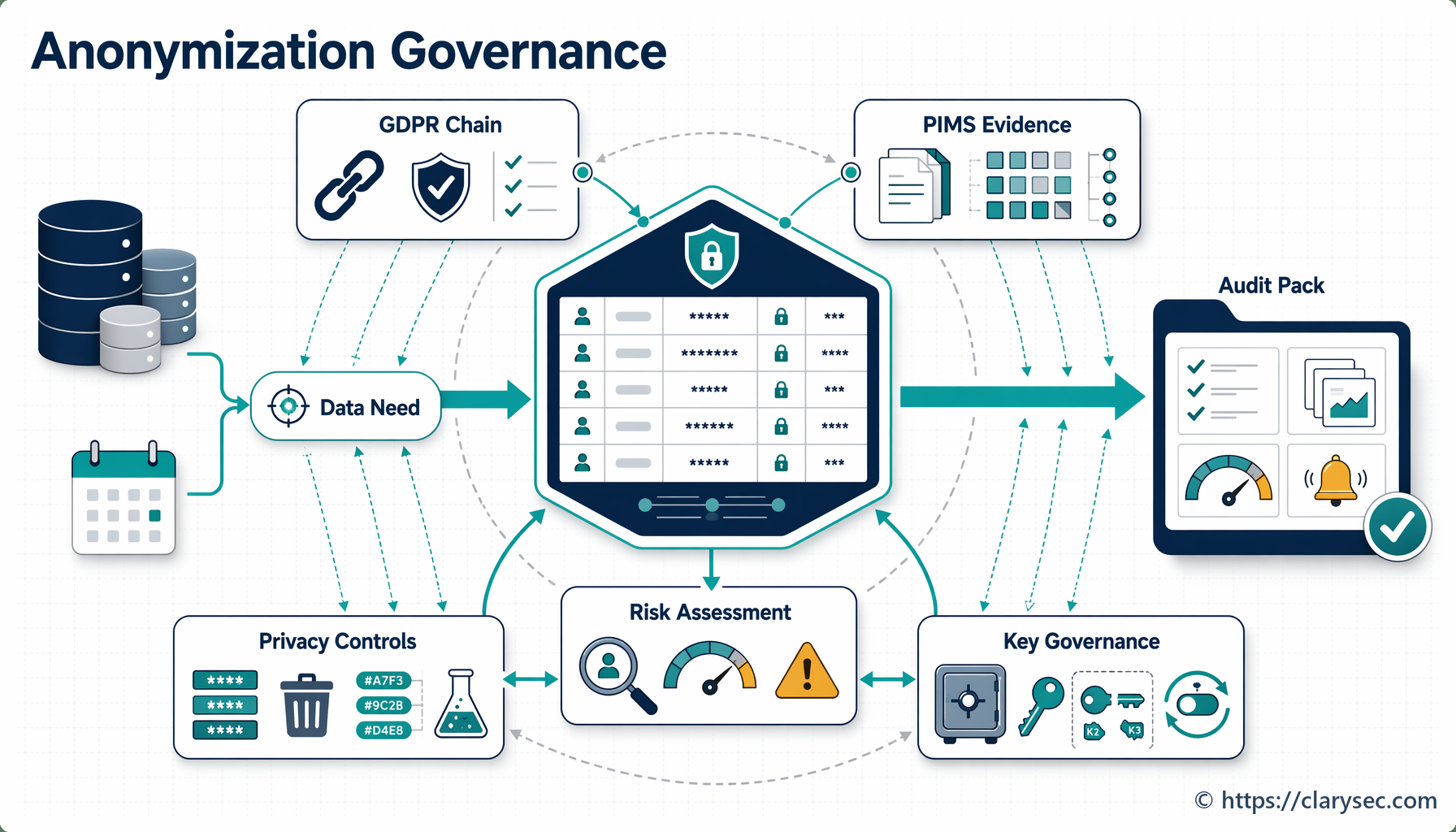
The AI project needed five years of data. The auditor needed proof.
The proposal landed on CISO Maria Kuznetsov’s desk with the certainty of a business priority already sold internally. The data science team wanted five years of customer transaction and behavioural history to train a new AI-driven personalization engine. Product wanted richer churn prediction. Sales wanted aggregated customer benchmarks. Finance wanted to reduce storage exposure by deleting source tables but preserving trend data.
The assurance was short and confident: “Don’t worry, we’ll anonymize the data.”
Maria knew that sentence was not a control. Under GDPR, “anonymous” is not a database flag, a masking script, or a product team promise. Data is only outside GDPR when individuals are no longer identifiable by reasonably likely means, considering the actual context in which the data exists. That context includes internal users, support systems, supplier platforms, analytics tools, cloud services, public records, customer exports, and future enrichment.
Then the privacy auditor asked the question that stopped the room:
“Show me how you assessed reidentification risk, who approved the anonymization decision, and how you know the dataset is still non-identifiable after new data sources are added.”
That is the real governance challenge behind anonymization under ISO 27701:2025 and GDPR. It is not enough to remove names, emails, and account IDs. The organization must prove, over time, that transformed data is not reasonably linkable to a person in its business, technical, legal, and supplier environment.
For CISOs, DPOs, compliance managers, auditors, and business owners, anonymization is attractive because it supports analytics, data minimization, safer testing, reduced retention risk, and external data sharing. It is also dangerous when treated as a magic label. Weak pseudonymization can be reversed. Aggregates can still single out people. Test datasets can be joined with production logs. AI and BI teams can combine “safe” datasets into something unsafe.
Clarysec’s position is simple: anonymization and reidentification risk must be governed as privacy risk treatment inside the same integrated ISMS and PIMS evidence model that supports ISO/IEC 27001:2022, ISO 27701:2025, GDPR, NIS2, DORA, NIST CSF 2.0, COBIT 2019, and customer audits.
Anonymization is a governance decision, not a pipeline step
Many organizations use privacy terms interchangeably, which creates legal and audit exposure. The first step is to define what each data state means and what governance question it raises.
| Term | Practical meaning | Governance question |
|---|---|---|
| Masking | Hiding or replacing values for a specific use case | Is the masked dataset still linkable to a person through other fields or systems? |
| Pseudonymization | Replacing identifiers while keeping a way to relink under controlled conditions | Who can reverse it, where is the key, and what audit trail proves access was justified? |
| De-identification | Reducing identifiability through removal, transformation, aggregation, or controls | What residual reidentification risk remains, and is it acceptable? |
| Anonymization | Transforming data so it is no longer reasonably identifiable in context | What evidence proves this now, and what monitoring proves it remains true? |
GDPR makes this distinction critical. Article 4 defines personal data broadly as information relating to an identified or identifiable person. Article 4(5) defines pseudonymization as processing personal data so it can no longer be attributed to a specific person without additional information, provided that additional information is kept separately and protected. Pseudonymized data remains personal data.
Recital 26 clarifies the high bar for anonymization. GDPR principles do not apply to information rendered anonymous in such a way that the data subject is not, or is no longer, identifiable. The test is not whether direct identifiers were removed. The test is whether identification remains reasonably possible.
Article 5 then raises the accountability bar. Personal data must be processed lawfully, fairly, transparently, for specified purposes, limited to what is necessary, retained in identifiable form only as long as necessary, and secured appropriately. Article 5(2) requires the controller to demonstrate compliance.
That means a claim of anonymization needs evidence. If internal keys, rare attributes, timestamps, geolocation, transaction sequences, device fingerprints, customer support tickets, public datasets, or supplier enrichment can reconnect the data to a person, the dataset may still be personal data.
Clarysec’s Enterprise PII Retention, Deletion and Disposal Policy treats anonymization as a controlled retention and disposition decision, not a shortcut around deletion:
[Both] The Process Owner / Business Owner MUST document anonymization, de-identification or pseudonymization as a retention risk-reduction measure or final disposition outcome in REG02 before identifiable PII is transformed.
From section “Anonymization, de-identification and retention minimization”, policy clause 4.5.1.
The same policy requires approval before anonymization is used as an alternative to deletion:
[Both] The Privacy Lead / PIMS Manager MUST approve use of anonymization or de-identification as an alternative to deletion in REG02 before the original identifiable PII is retained beyond its purpose or retention period.
From section “Anonymization, de-identification and retention minimization”, policy clause 4.5.2.
This is the audit point many organizations miss. A business owner cannot say, “We anonymized it, so retention no longer applies.” The evidence must show why anonymization was appropriate, what was transformed, what happened to the original identifiable PII, who approved the decision, and when the residual risk will be reviewed.
The GDPR accountability chain behind reidentification risk
A defensible anonymization governance program starts with GDPR’s operational logic.
First, determine whether GDPR applies. Article 3 extends GDPR to processing in the context of an EU establishment, and to non-EU organizations that offer goods or services to individuals in the EU or monitor their behaviour in the EU. SaaS, fintech, analytics, adtech, HR platforms, cloud providers, and AI vendors can be in scope even when headquarters or infrastructure are outside the EU.
Second, define the organization’s role. A controller determines purposes and means. A processor acts on documented controller instructions. Joint controllers share decision-making and accountability. Subprocessors inherit contractual restrictions and technical obligations. This matters because anonymization decisions differ by role:
- A controller must justify purpose, lawful basis, retention, transparency, and further processing.
- A processor must follow customer instructions and avoid independent reuse unless it has a lawful role.
- A subprocessor must respect flow-down restrictions, deletion obligations, and onward sharing limits.
- Joint controllers must document shared responsibilities and provide clear transparency.
Third, connect anonymization to Article 6. If data is reused for analytics, benchmarking, model training, or secondary operational use, the organization must assess lawful basis and compatibility. Anonymization may reduce risk, but the question remains whether the output is actually anonymous or merely transformed personal data.
Fourth, identify special category or sensitive inference risk. Article 9 adds stricter conditions for health data, biometric data for unique identification, genetic data, political opinions, religion, trade union membership, racial or ethnic origin, sex life, and sexual orientation. Even when obvious identifiers are removed, rare combinations and inferred attributes can harm people.
Clarysec’s Data Protection and Privacy Policy - SME sets this as a practical risk treatment expectation:
Controls must be implemented to reduce identified risks, including encryption, anonymization, secure disposal, and access restrictions
From section “Risk Treatment and Exceptions”, policy clause 7.2.1.
For SMEs, the message is deliberately direct. Anonymization is one safeguard among many. It must work with encryption, access restrictions, secure disposal, supplier controls, logging, and review.
Why ISO/IEC 27001:2022 still matters for ISO 27701:2025 PIMS evidence
ISO 27701:2025 privacy governance depends on a management system backbone. It extends privacy obligations through a PIMS, but strong evidence still relies on the ISMS discipline of ISO/IEC 27001:2022.
The most important ISO/IEC 27001:2022 requirements for anonymization are not only technical. They are governance requirements:
- Clauses 4.1 to 4.4 establish organizational context, interested parties, scope, interfaces, dependencies, and management system processes.
- Clauses 5.1 to 5.3 require leadership, policy, roles, responsibilities, accountability, and reporting.
- Clauses 6.1.1 to 6.1.3 require risk and opportunity planning, information security risk assessment, risk treatment, control selection, the Statement of Applicability, treatment plans, and residual risk acceptance.
This means anonymization risk belongs in the risk register, treatment plan, and Statement of Applicability, not only in a data engineering ticket.
The Zenith Blueprint makes this traceability explicit in the Risk Management phase, Step 13, Risk Treatment Planning and Statement of Applicability:
The SoA is effectively a bridging document : it links your risk assessment/treatment to the actual controls you have.
From the Risk Management phase, Step 13: Risk Treatment Planning and Statement of Applicability.
For anonymization and reidentification risk, that bridge should connect:
- GDPR processing activity and purpose
- Controller, processor, joint controller, or subprocessor role
- ISO 27701:2025 PIMS obligation and privacy owner
- Reidentification risk scenario and attacker model
- Data categories, systems, recipients, and suppliers
- Applied safeguards, such as aggregation, suppression, masking, pseudonymization, deletion, access control, contractual limits, and monitoring
- ISO/IEC 27002:2022 controls such as 5.9 Inventory of information and other associated assets, 5.12 Classification of information, 5.15 Access control, 5.18 Access rights, 5.21 Managing information security in the ICT supply chain, 5.23 Information security for use of cloud services, 5.34 Privacy and protection of PII, 8.10 Information deletion, 8.11 Data masking, 8.12 Data leakage prevention, 8.15 Logging, 8.24 Use of cryptography, and 8.33 Test information
- Residual risk acceptance and review frequency
If a customer asks why anonymized telemetry is retained after account closure, the answer should not be “because product needs it.” The answer should be a processing register entry, privacy risk assessment, anonymization feasibility record, retention disposition approval, technical evidence, access logs, supplier restrictions, and management acceptance.
The Clarysec control map for privacy, deletion, masking, and test data
Anonymization governance becomes credible when policy, risk, and technical controls are mapped together.
Zenith Controls treats ISO/IEC 27002:2022 control 5.34, Privacy and protection of PII, as a preventive control supporting confidentiality, integrity, and availability. It aligns with Identify and Protect concepts and operates across Information Protection plus Legal and Compliance.
Zenith Controls explains that 5.34 depends on knowing where PII exists. It links 5.34 to 5.9, Inventory of information and other associated assets, because customer databases, HR files, logs, telemetry, backups, exports, and support records must be included in asset inventories. Without inventory, privacy measures such as consent management, encryption, masking, deletion, anonymization, and supplier restrictions will miss data stores.
Zenith Controls also links 5.34 to 8.11, Data masking, because masking reduces exposure of real personal data in reports, non-production environments, analytics platforms, and sharing workflows. For 8.11, Zenith Controls identifies it as a preventive confidentiality control in the Protect concept, with operational capability in Information Protection. It links 8.11 to:
- 5.12, Classification of information, because masking depends on sensitivity classification.
- 5.34, Privacy and protection of PII, because masking operationalizes privacy by design.
- 8.33, Test information, because safe test datasets should be synthetic, anonymized, or masked.
For 8.10, Information deletion, Zenith Controls ties deletion to 8.11 Data masking and 8.12 Data leakage prevention, forming a lifecycle strategy: protect data in use, prevent leakage, and ensure data is not recoverable after it is no longer required.
| Control area | Why it matters for anonymization governance |
|---|---|
| Asset inventory | You cannot anonymize, classify, or delete data you have not identified. |
| Classification | Sensitivity and identifiability labels drive masking, aggregation, and access decisions. |
| Privacy and PII protection | The PIMS defines privacy obligations, roles, approvals, and evidence. |
| Information deletion | Anonymization may be a final disposition outcome, but only with approval and proof. |
| Data masking | Masking, pseudonymization, and transformation reduce exposure but require validation. |
| Access control and access rights | Reidentification attempts, linkage keys, and exports must be restricted. |
| Logging | Reversal, access, enrichment, administrative changes, and exports need audit trails. |
| Supplier and cloud security | Vendors must not relink, enrich, repurpose, or onward share transformed datasets. |
| Test information | Non-production environments must not become reidentification laboratories. |
The Zenith Blueprint reinforces this in the Controls in Action phase, Step 21, Controls 8.27 to 8.34:
Ultimately, Control 8.33 reminds us that information doesn’t lose its value just because it’s in a sandbox.
From the Controls in Action phase, Step 21: Controls 8.27-8.34.
That sentence belongs in every test data, QA, analytics, BI, and ML workflow.
A practical Clarysec workflow for approving an anonymized analytics dataset
Maria’s AI project does not need a blanket “no.” It needs a governed “yes, if.” A Clarysec-led implementation would follow a repeatable workflow.
1. Register the processing activity
The Privacy Coordinator or PIMS Manager updates the processing register with data categories, purpose, lawful basis, retention, recipients, systems, suppliers, and PIMS role.
Clarysec’s Data Protection and Privacy Policy - SME requires this baseline:
The Privacy Coordinator must maintain a register of all personal data processing activities, including data categories, purpose, lawful basis, and retention periods
From section “Governance Requirements”, policy clause 5.2.1.
For enterprise PIMS evidence, the record should also identify whether the organization acts as controller, processor, joint controller, or subprocessor. If the SaaS provider is a processor for customer telemetry, it may need customer instruction before creating anonymized derivative datasets. If it is controller for product analytics, it needs lawful basis and purpose documentation.
2. Prove identifiable processing is necessary
Before identifiable PII is approved for analytics, reporting, testing, or secondary use, the business owner must evaluate whether non-identifiable processing is feasible.
The Enterprise Privacy by Design and Default Policy states:
[Both] The Process Owner / Business Owner MUST document de-identification, pseudonymization, aggregation or non-identifiable processing feasibility in REG04 before approving identifiable PII for testing, analytics, reporting or secondary operational use.
From section “Data minimization and privacy-default design”, policy clause 4.2.5.
This is where governance prevents overcollection. The data science team may not need raw timestamps, exact locations, full event sequences, unmasked domains, or rare segment attributes. Date bucketing, aggregation, suppression of small cohorts, synthetic feature generation, and removal of unique device identifiers may preserve utility with lower risk.
3. Assess reidentification risk
The privacy risk assessment should evaluate singling out, linkability, inference, uniqueness, internal access, external datasets, supplier access, and future enrichment. It should define the realistic attacker model, including a curious employee, a supplier analyst, a customer with partial knowledge, or a determined external party.
The Enterprise PII Retention, Deletion and Disposal Policy requires review of assumptions for high-risk or externally shared data:
[Both] The Data Protection Officer / Privacy Advisor MUST review re-identification risk assumptions in REG12 before approval of anonymization or de-identification for high-risk or externally shared data sets.
From section “Anonymization, de-identification and retention minimization”, policy clause 4.5.4.
REG12 should answer practical audit questions: what direct identifiers were removed, what quasi-identifiers remain, what aggregation thresholds apply, whether small groups are suppressed, whether event sequences can identify individuals, whether employees can link the output to production systems, whether vendors can enrich it, whether special category inferences exist, what residual risk remains, who accepted it, and when it will be reviewed.
4. Apply controls and keep technical evidence
Technical evidence may include transformation logic, masking scripts, anonymization tool settings, sampling results, uniqueness testing, aggregation checks, deletion logs for source data, access control lists, export approvals, key vault logs, and monitoring alerts.
The Zenith Blueprint, Controls in Action phase, Step 19, Technological Controls I, says data masking is about “preventing unnecessary exposure within your organization” and recommends defining use cases where masking or anonymization is mandatory, including test environments, ML or BI platforms, and data shared with external vendors. It also states that evidence may include stored masking scripts or configurations, tool settings or logs, and written procedures governing the creation of safe datasets.
That evidence belongs in the PIMS evidence register and should be linked to the processing activity, REG04 assessment, REG12 assumptions, risk register, treatment plan, and SoA.
5. Govern reversibility and keys
If the dataset is pseudonymized rather than anonymized, reversibility must be exceptional, approved, logged, and segregated.
Clarysec’s Enterprise Data Masking and Pseudonymization Policy states:
Reversibility of pseudonymized data must never be enabled by default and must be governed strictly, including through audit trails and enforcement of role-based access control.
From section “Risk Treatment and Exceptions”, policy clause 7.5.
The SME version highlights prohibited or high-risk behaviour. The Data Masking and Pseudonymization Policy - SME identifies a risk treatment and exception scenario as:
Re-identification of pseudonymized data without documented approval.
From section “Risk Treatment and Exceptions”, policy clause 7.3.4.
It also flags weak reversible design:
Weak or reversible pseudonymization resulting from inadequate key management.
From section “Risk Treatment and Exceptions”, policy clause 7.1.1.3.
For auditors, this is where privacy becomes security control evidence: key management, segregation of duties, access approvals, logging, alerting, and exception review.
6. Close with residual risk and review triggers
The Enterprise Privacy Risk Assessment and DPIA Policy requires disciplined closure:
[Both] The Privacy Lead / PIMS Manager MUST ensure that each REG04 assessment records risk rating, treatment decision, owner, due date, residual risk, approval status, and review date before closure.
From section “Privacy risk assessment and DPIA execution”, policy clause 4.3.7.
If the dataset is later enriched, shared externally, used for model training, linked to support data, moved to another cloud service, or combined with new customer attributes, the review trigger should reopen the assessment.
Test data is where anonymization programs often fail
Production systems usually have stronger controls than test environments. Staging, QA, development, and analytics sandboxes often have broader access, weaker monitoring, shared credentials, relaxed network rules, offshore testing, old database copies, and unclear ownership.
That makes test data a common reidentification risk zone.
Clarysec’s SME Test Data and Test Environment Policy requires:
The data must be anonymized or pseudonymized using appropriate tools
From section “Policy Implementation Requirements”, policy clause 6.1.2.2.
The Enterprise Test Data and Test Environment Policy goes further by requiring anonymized or masked datasets to be:
Verified to prevent re-identification through cross-referencing
From section “Policy Implementation Requirements”, policy clause 6.2.1.2.
That means QA data should be tested against realistic linkage attacks. Can a developer identify a VIP customer from transaction time and city? Can support tickets be joined to test records? Can rare product usage patterns identify one enterprise tenant? Can masked emails reveal usernames or domains? Can logs, screenshots, or debug traces expose original identifiers? Can test and production databases be joined through retained account numbers?
ISO 27701:2025 PIMS evidence should show the rule, the exception, the approval, the safeguard, and the cleanup.
Cross-compliance expectations for anonymization governance
Anonymization governance is privacy-led, but it is not privacy-only.
NIS2 Article 21 requires essential and important entities to implement appropriate and proportionate technical, operational, and organizational measures to manage risks to network and information systems and minimize incident impact. Its measures include risk analysis, incident handling, business continuity, supply chain security, secure development, control effectiveness assessment, training, cryptography, access control, asset management, and authentication. NIS2 Article 23 also matters because a reidentification incident may become reportable if it causes significant operational disruption, financial loss, or material or non-material damage to persons.
DORA applies to many financial entities from 17 January 2025. Articles 5 and 6 make ICT risk governance board-owned and audited. Articles 17 to 19 require ICT incident detection, classification, escalation, reporting, root-cause analysis, and client notification where financial interests are affected. Articles 28 to 30 require ICT third-party registers, due diligence, contractual controls, data confidentiality, integrity, availability, access and recovery rights, audit rights, and exit planning. If a fintech shares de-identified transaction datasets with a cloud analytics provider, anonymization governance is also third-party resilience governance.
NIST CSF 2.0 helps executives translate privacy risk into enterprise risk. Its GOVERN function includes GV.OC-03 for legal, regulatory, contractual, privacy, and civil-liberties obligations, GV.RM-03 for integrating cybersecurity risk into enterprise risk management, GV.RM-06 for standardized risk calculation and prioritization, and GV.PO-01 and GV.PO-02 for policy establishment, enforcement, review, and update.
COBIT 2019 and ISACA assurance perspectives focus on decision rights, control ownership, data lifecycle governance, control operating effectiveness, risk acceptance, and evidence reliability. A COBIT-oriented reviewer will ask whether management has defined roles, performance goals, monitoring responsibilities, and exception handling.
Supporting ISO standards can strengthen implementation. The Zenith Blueprint Step 19 references ISO/IEC 27555 for deletion and pseudonymization or anonymization of PII, ISO/IEC 20889 for privacy-enhancing de-identification techniques, ISO/IEC 27018 for protection of PII in public cloud environments, and ISO/IEC 29134 for privacy impact assessment guidance.
How auditors will test anonymization and reidentification governance
Different auditors may inspect the same dataset through different lenses, but the evidence pattern is consistent.
| Audit lens | What the auditor will ask | Evidence Clarysec prepares |
|---|---|---|
| ISO 27701:2025 PIMS | Was the anonymization decision governed by privacy roles, obligations, risk assessment, and approval? | REG02 retention disposition, REG04 privacy by design assessment, REG12 reidentification assumptions, PIMS role mapping, approval records |
| ISO/IEC 27001:2022 | Is anonymization linked to risks, controls, SoA, access, logging, deletion, supplier controls, and improvement? | Risk register, treatment plan, SoA mappings, asset inventory, access reviews, logs, internal audit findings |
| GDPR accountability | Can the controller demonstrate purpose limitation, minimization, retention limitation, security, lawful basis, and residual risk? | Processing register, lawful basis record, compatibility assessment, retention schedule, DPIA or privacy risk assessment |
| NIST CSF 2.0 | Are privacy and cybersecurity obligations integrated into enterprise risk management and governed through policies and profiles? | Current and target profiles, gap plan, governance policy set, risk metrics, executive reporting |
| COBIT 2019 or ISACA | Are decision rights, control ownership, monitoring, assurance, and exception processes operating effectively? | RACI, control testing results, exception approvals, management review minutes, KPI and KRI reporting |
| DORA or NIS2 | Does the dataset create ICT, supplier, incident, or resilience risk for regulated services? | Supplier register, incident playbook, third-party clauses, monitoring evidence, board reporting |
The following table maps common data states to GDPR status, risk, governance action, and relevant ISO/IEC 27002:2022 controls.
| De-identification state | GDPR status | Reidentification risk | Required governance action | Key ISO/IEC 27002:2022 controls |
|---|---|---|---|---|
| Raw production data | Personal data | High | Strict access control, use only for approved purpose, monitor and log access. | 5.15 Access control, 5.18 Access rights, 8.15 Logging, 8.24 Use of cryptography |
| Pseudonymized data | Personal data | Medium to high | Formal risk assessment, secure key management, approval for reversal, contractual controls. | 8.11 Data masking, 5.34 Privacy and protection of PII, 5.21 Managing information security in the ICT supply chain, 8.24 Use of cryptography |
| Aggregated data | Potentially personal data or anonymous depending on context | Low to medium | Suppress small cohorts, test uniqueness, assess linkage risk, document assumptions. | 8.11 Data masking, 5.12 Classification of information, 5.34 Privacy and protection of PII |
| Truly anonymized data | Outside GDPR if individuals are no longer identifiable | Negligible when validated | Document expert assessment, retain evidence, define review triggers for enrichment or sharing. | 8.10 Information deletion, 8.11 Data masking, 5.34 Privacy and protection of PII |
An auditor will not accept “we removed names” as sufficient. Expect sampling, interviews, inspection of transformation logic, review of access paths, testing of small-cohort suppression, examination of supplier contracts, and verification that anonymization is not being used to bypass deletion without approval.
Common failure patterns to remove before the audit
The most frequent anonymization failures are governance failures disguised as engineering shortcuts:
- Direct identifiers removed, quasi-identifiers ignored. Names and emails are gone, but location, age, transaction time, employer, device ID, and event sequence remain unique.
- Pseudonymization sold as anonymization. A lookup table, token vault, or reversible key exists, but stakeholders call the output anonymous.
- Retention logic bypassed. Teams anonymize data to keep it forever without documenting why continued retention is justified.
- Production data copied into test. Developers use real data because “it is only staging,” while staging has weaker controls.
- Supplier enrichment not assessed. A vendor receives de-identified data but can combine it with its own datasets.
- No review after new data sources. A once-low-risk dataset becomes linkable after CRM, telemetry, support, or marketing data is added.
- No incident playbook for reidentification. Breach procedures exist, but no criteria cover unauthorized relinking, failed anonymization, or privacy-impacting inference.
- No audit trail for reversal. Pseudonymization keys exist, but access is not approved, logged, or reviewed.
The correction pattern is consistent: register, classify, assess, treat, approve, evidence, monitor, and review.
Practical anonymization governance checklist
Use this checklist before approving analytics, AI training, customer benchmarking, external sharing, retention transformation, or test data use:
- Confirm whether the organization acts as controller, processor, joint controller, or subprocessor.
- Identify the processing purpose, lawful basis, compatibility assessment, or customer instruction.
- Update the processing activity register with data categories, systems, recipients, suppliers, and retention.
- Classify the dataset for PII, special categories, confidentiality, and business sensitivity.
- Decide whether identifiable processing is truly necessary.
- Assess de-identification, aggregation, masking, pseudonymization, or synthetic data feasibility.
- Document reidentification risk assumptions, including internal and external attacker models.
- Validate the output against singling out, linkability, inference, uniqueness, and cross-referencing risk.
- Define minimum aggregation thresholds and small-cohort suppression rules.
- Remove, generalize, or bucket rare attributes, exact timestamps, locations, device identifiers, and high-risk event sequences.
- Restrict transformed dataset access using role-based access control and least privilege.
- Log access, exports, reversals, enrichment, administrative changes, and key use.
- Approve any reversible pseudonymization through documented workflow.
- Link the decision to retention schedules, source data deletion, and final disposition evidence.
- Bind suppliers through contractual restrictions on relinking, enrichment, reuse, onward sharing, and subcontracting.
- Store evidence in the PIMS evidence register and link it to the SoA.
- Schedule review after enrichment, external sharing, new data sources, incidents, model retraining, or major product changes.
This checklist is intentionally cross-functional. The business owner defines purpose. The Privacy Lead or PIMS Manager governs risk. The DPO or Privacy Advisor reviews high-risk assumptions. The CISO ensures security controls. Legal validates obligations. Engineering implements transformations. Internal audit tests evidence.
Turn anonymization from a claim into an auditable control system
The pressure to use data for analytics, AI, product improvement, customer benchmarking, and operational efficiency will only increase. The answer is not to block innovation. The answer is to govern it.
Clarysec helps organizations build anonymization and reidentification risk governance using:
- The Zenith Blueprint for phased implementation, including Step 13 for risk treatment and SoA traceability, Step 19 for data masking, Step 21 for test information, and Step 23 for privacy and PII protection.
- Zenith Controls for cross-compliance mapping across privacy protection, information deletion, data masking, test information, classification, asset inventory, supplier risk, cloud security, logging, cryptography, and audit perspectives.
- Clarysec enterprise policy templates such as PII Retention, Deletion and Disposal Policy, Privacy by Design and Default Policy, Privacy Risk Assessment and DPIA Policy, Data Masking and Pseudonymization Policy, and Test Data and Test Environment Policy.
- SME-ready variants including Data Protection and Privacy Policy - SME, Data Masking and Pseudonymization Policy - SME, and Test Data and Test Environment Policy - SME.
Your next action is simple: choose one high-value analytics, AI, benchmark, or test dataset and run it through the Clarysec anonymization governance workflow. If you cannot show the processing register, minimization assessment, reidentification risk review, approval record, technical transformation evidence, access controls, retention decision, supplier restrictions, and review trigger, the dataset is not audit-ready.
Clarysec can help you make it audit-ready.
About the Author

Igor Petreski
Compliance Systems Architect, Clarysec LLC
Igor Petreski is a cybersecurity leader with over 30 years of experience in information technology and a dedicated decade specializing in global Governance, Risk, and Compliance (GRC).Core Credentials & Qualifications:• MSc in Cyber Security from Royal Holloway, University of London• PECB-Certified ISO/IEC 27001 Lead Auditor & Trainer• Certified Information Systems Auditor (CISA) from ISACA• Certified Information Security Manager (CISM) from ISACA • Certified Ethical Hacker from EC-Council