Audit-Ready Consent Management for GDPR and ISO 27701
The Friday afternoon consent failure nobody budgeted for
It usually starts with a small release note.
A SaaS company pushes a new marketing preference center on Friday afternoon. Product is pleased because unsubscribe complaints should go down. Marketing is pleased because the cookie banner has a cleaner layout. Legal is pleased because the privacy notice was refreshed two weeks earlier. Engineering is pleased because the consent management platform finally syncs with the CRM.
Then Monday arrives.
The Data Protection Officer receives a complaint from a customer in Germany: “I withdrew consent for analytics and marketing, but I was still tracked and emailed.”
Within two hours, the team finds the real issue. The banner captured a “reject all” event, but the event did not update the CRM suppression flag. The preference center displayed the correct status to the user, but the marketing automation platform continued processing an old segment. The privacy notice version shown at capture was not logged. The mobile SDK activated a non-essential tracking tool before the preference state loaded.
The organization could show a consent banner. It could not prove consent governance.
That distinction matters.
Under GDPR, consent must connect to lawfulness, transparency, purpose limitation, individual rights, processor management, security, and accountability. Under ISO/IEC 27701:2025, consent and preference management should be treated as part of an operational Privacy Information Management System, not as a cosmetic website feature. Under ISO/IEC 27001:2022 and ISO/IEC 27002:2022, the same privacy operation depends on legal requirement tracking, access control, supplier agreements, records protection, logging, incident response, and continual improvement.
A second scenario makes the risk even clearer. Sarah, the CISO of a fast-scaling health SaaS provider, receives an auditor agenda before a new analytics module launch: “Demonstrable consent records, lawful basis documentation for processing special category data, and evidence of withdrawal mechanisms as per GDPR and ISO 27701.”
Her company handles health data and behavioral analytics. The board has also been briefed on NIS2 and management accountability. A consent failure is no longer a minor website issue. It is a governance failure, a trust failure, and potentially a leadership risk.
Consent is not a banner. It is a promise, a workflow, and an evidence trail.
From consent-as-a-checkbox to demonstrable compliance
Many organizations confuse a visible consent interface with a consent management system. A banner that disappears after a click is not enough. A preference center that shows the right status is not enough. A contract with a cookie tool vendor is not enough.
GDPR Article 5(1)(a) requires personal data to be processed lawfully, fairly, and transparently. Article 5 also includes purpose limitation, data minimization, accuracy, storage limitation, integrity and confidentiality. Article 5(2) adds the accountability principle: the controller must be responsible for, and able to demonstrate, compliance.
That evidence burden changes the design question.
The question is not, “Do we ask for consent?” The question is, “Can we prove what purpose was presented, what notice was shown, what the individual chose, which systems acted on that choice, which processors were instructed, and whether withdrawal stopped further processing?”
Clarysec’s Consent and Preference Management Policy Consent and Preference Management Policy makes this operational from the start:
“[Controller] The Process Owner / Business Owner MUST ensure each consent request is purpose-specific and linked to the applicable REG07 privacy notice version before the consent request is presented to a PII principal.”
From section ‘Consent Request and Capture’, policy clause 4.2.1.
That clause would have prevented the Monday failure. It ties consent to a purpose, an owner, and a privacy notice version before capture. It makes evidence design part of the control design.
The same policy defines what must be recorded when consent is captured:
“[Controller] The Process Owner / Business Owner MUST record the PII principal reference, purpose, PII category, consent wording or version, privacy notice version, capture channel, timestamp, method, status, and applicable validity period in REG05 when consent is captured.”
From section ‘Consent Request and Capture’, policy clause 4.2.3.
This is the difference between having consent and proving consent.
Consent is not the lawful basis register, but it must connect to it
Consent management and lawful basis management are related, but they are not the same thing.
GDPR Article 6 provides several lawful bases for processing, including consent, contract necessity, legal obligation, vital interests, public task, and legitimate interests. GDPR Article 9 adds stricter conditions for special category data, including health data. A mature privacy program does not ask for consent when contract necessity is the correct basis, and it does not hide advertising tracking under legitimate interests when consent is required.
For Sarah’s health SaaS launch, the distinction is critical. Standard service processing may rely on contract necessity. Product analytics may require consent depending on the purpose and operating model. Health data processing may require explicit consent or another Article 9 condition. Marketing communications may require a separate preference and legal basis analysis.
Clarysec’s enterprise Data Protection and Privacy Policy Data Protection and Privacy Policy includes consent management within a broader privacy operating model:
“Data subject rights management, lawful basis documentation, and consent management.”
From section ‘Scope’, policy clause 2.2.2.
It also sets the baseline for consent quality:
“Consent shall be freely given, informed, specific, and revocable.”
From section ‘Policy Implementation Requirements’, policy clause 6.1.2.
The same policy makes ownership explicit:
“The Legal Department shall maintain and update the Lawful Basis Register.”
From section ‘Policy Implementation Requirements’, policy clause 6.1.3.
For smaller organizations, Clarysec’s Data Protection and Privacy Policy - SME Data Protection and Privacy Policy - SME translates this into practical recordkeeping:
“The Privacy Coordinator must maintain a register of all personal data processing activities, including data categories, purpose, lawful basis, and retention periods”
From section ‘Privacy Records and Documentation’, policy clause 5.2.1.
At the point of collection, the SME policy also requires:
“The lawful basis (e.g., consent, contract, legal obligation) must be documented in the processing register”
From section ‘Data Collection Rules’, policy clause 6.1.2.
This matters because consent failures often begin outside Legal. Product adds telemetry. Marketing adds pixels. Sales imports webinar lists. Customer success exports contacts. Data science uses production data for testing or model development. The lawful basis decision may be documented once, but processing changes constantly.
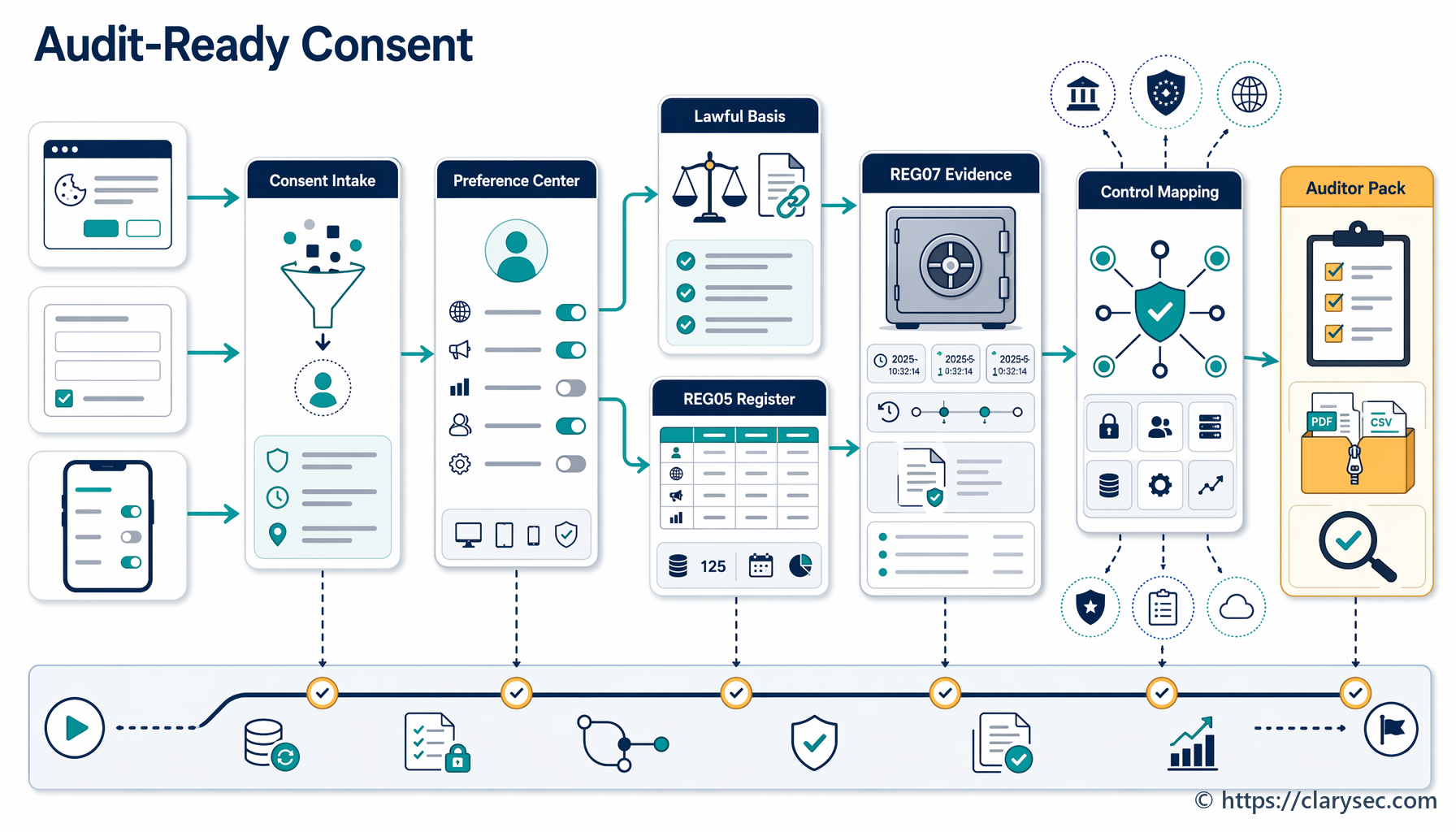
An audit-ready PIMS should therefore connect:
- REG05, the consent and preference register.
- REG07, the privacy notice register and version history.
- The Lawful Basis Register maintained by Legal or the Privacy Coordinator.
- The processing activity register.
- Supplier and processor records, including DPAs and subprocessor obligations.
- Evidence repositories for screenshots, logs, workflow tests, approvals, and exception handling.
Auditors are not only asking whether you have a banner. They are asking whether the banner, notice, lawful basis, processing register, downstream systems, withdrawal workflow, and processor instructions all agree.
The evidence model auditors actually test
A consent screenshot is useful, but it is not a complete evidence pack. A reliable consent and preference management system should answer practical audit questions across legal, technical, and operational boundaries.
| Audit question | Evidence that should exist | Clarysec artifact or control area |
|---|---|---|
| What purpose was consent requested for? | Purpose-specific consent wording linked to a processing activity | REG05 consent register and Lawful Basis Register |
| What privacy notice did the person see? | Notice version, timestamp, channel, and language | REG07 privacy notice register |
| What did the person choose? | Consent status, preference flags, withdrawal status, and validity period | REG05 consent and preference record |
| What systems acted on the choice? | CRM, marketing, CMP, app, SDK, analytics, and data warehouse update logs | System owner evidence and logging |
| What processors received or acted on the preference? | DPA terms, processor instructions, suppression propagation, and subprocessor records | Supplier and processor evidence |
| Can the organization stop processing before further use? | Suppression state update, workflow SLA, exception handling, and monitoring | Consent withdrawal workflow |
This evidence model also supports data subject rights. A preference change may become relevant to an access, erasure, objection, or restriction request. Clarysec’s enterprise Data Protection and Privacy Policy states:
“The Data Protection Officer (DPO) shall maintain documented processes for Data Subject Request (DSR) intake, validation, tracking, and response.”
From section ‘Policy Implementation Requirements’, policy clause 6.4.1.
The SME policy makes the logging requirement concrete:
“All responses to data subject requests must be logged in a secure register, with access restricted to the Privacy Coordinator and GM”
From section ‘Handling of Individual Rights’, policy clause 6.5.4.
A privacy program that treats consent and DSRs as separate silos will eventually fail in production. If an individual withdraws marketing consent and later requests access, the organization must show the withdrawal, the systems affected, the suppression evidence, and the response record.
Cookie consent is only the visible control surface
Cookie banners, consent management platforms, and preference centers receive attention because users see them. Regulators also scrutinize them because they can reveal dark patterns, vague purposes, pre-ticked choices, tracking before consent, or withdrawal friction.
But a compliant cookie banner is only one capture channel. The operational control must cover web, mobile, in-product modals, account settings, webinar forms, call centers, sales imports, customer support workflows, and offline records.
A practical cookie and tracker control environment requires:
- Clear purpose categories, such as analytics, personalization, advertising, functional services, and direct marketing.
- No activation of non-essential cookies, tags, pixels, SDKs, or tracking technologies before the valid preference state is available.
- Equal operational respect for rejection, acceptance, withdrawal, and restriction.
- Versioned consent wording and privacy notice evidence.
- Propagation of choices to websites, mobile apps, CRM, marketing systems, data warehouses, analytics tools, and processors.
- Monitoring to detect tags or SDKs firing before consent.
- Exception handling when integrations fail.
Clarysec’s Marketing Privacy and Cookies Policy Marketing Privacy and Cookies Policy sets a clear deployment gate:
“[Controller] The System Owner / Application Owner MUST configure non-essential cookies, tags, pixels, SDKs and similar tracking technologies to remain inactive until the required consent or preference state is available in REG05 before deployment.”
From section ‘Consent, Preference and Cookie Controls’, policy clause 4.2.2.
The withdrawal mechanism must also exist when consent is requested, not after complaints arrive. The Consent and Preference Management Policy requires:
“[Controller] The System Owner / Application Owner MUST provide a withdrawal or preference-change mechanism linked to REG05 and REG07 no later than the point at which consent is requested.”
From section ‘Preference and Withdrawal Management’, policy clause 4.3.1.
It also requires systems to stop acting on the withdrawn purpose:
“[Controller] The System Owner / Application Owner MUST update affected systems, suppression states, or preference flags in REG05 before further processing continues for a withdrawn or restricted purpose.”
From section ‘Preference and Withdrawal Management’, policy clause 4.3.3.
That phrase, “before further processing continues,” is where many teams discover the real control gap. Batch jobs, legacy exports, delayed webhooks, stale CRM segments, and mobile SDKs can keep processing after withdrawal unless suppression is designed as a priority control.
Building REG05 and REG07 into the release workflow
An audit-ready consent system is built into change management, not bolted on after launch.
Assume a product team wants to add onboarding analytics. It will track user clicks during the first seven days after account creation and send events to an analytics provider. The privacy team determines that non-essential analytics requires consent in the organization’s operating model.
A Clarysec-aligned workflow should look like this:
- The Process Owner creates or updates the processing activity, including purpose, PII categories, data subjects, retention, recipients, and lawful basis.
- Legal validates the lawful basis and updates the Lawful Basis Register.
- The privacy notice owner updates REG07 with a new notice version describing the analytics purpose and provider category.
- The System Owner configures purpose-specific consent wording linked to the REG07 version.
- The application records each consent event into REG05 using the required capture fields.
- Engineering blocks the analytics SDK until REG05 confirms an allowed preference state.
- The withdrawal mechanism is tested before release.
- CRM, marketing, data warehouse, and analytics integrations are tested for suppression propagation.
- Evidence is attached to the release ticket, including screenshots, test results, data-flow updates, DPIA decision if applicable, vendor DPA reference, and logging configuration.
- Monitoring confirms the analytics tag does not fire before consent and stops after withdrawal.
A practical REG05 record does not need to be complex, but it must be complete enough to prove the control.
| REG05 field | Example value | Why it matters |
|---|---|---|
| PII principal reference | user_284739 | Links the choice to the individual without exposing unnecessary identity data |
| Purpose | Onboarding analytics | Shows the specific processing purpose |
| PII category | Online identifiers and usage events | Connects consent to data categories |
| Consent wording version | analytics_consent_v3 | Proves what was presented |
| Privacy notice version | REG07_notice_v12_en | Proves transparency at time of capture |
| Capture channel | Web app onboarding modal | Shows where the choice was made |
| Timestamp and method | 2026-06-23 09:14 UTC, checkbox | Supports audit and dispute resolution |
| Status | Granted, later withdrawn | Shows lifecycle, not only initial capture |
| Validity period | Until withdrawal or notice change requiring refresh | Supports refresh logic |
| Downstream state | Analytics SDK active, CRM flag synced | Proves implementation beyond the UI |
This example shows why consent management belongs in release governance. If the analytics provider changes, the notice may need updating. If the purpose changes from onboarding analytics to advertising personalization, a new consent purpose may be required. If the SDK starts collecting location data, the PII category and risk analysis change.
Under ISO/IEC 27001:2022, those changes should flow through risk assessment, risk treatment, Statement of Applicability logic, supplier review, and documented evidence. Under ISO/IEC 27701:2025, they should also flow through PIMS role accountability, controller or processor obligations, privacy notices, rights workflows, and privacy risk treatment.
Roles matter: controller, processor, joint controller, and subprocessor
Consent and preference obligations depend on the organization’s role.
A SaaS platform may be a controller for its own website analytics and direct marketing, but a processor for customer-uploaded end-user data. It may be a subprocessor when it provides services to another processor. It may become a joint controller in a co-branded campaign where two parties jointly determine purposes and means.
| Scenario | Likely PIMS role | Consent and preference implication |
|---|---|---|
| Your company sends its own product newsletter | Controller | You own lawful basis, notice, consent records, withdrawal, and suppression |
| Your SaaS customer uses your platform to email its users | Processor | You act on customer instructions and support their preference handling as contracted |
| You and a partner run a shared webinar campaign | Joint Controller | Responsibilities for notice, consent capture, records, and rights handling must be allocated |
| Your analytics vendor processes app events for you | Processor or subprocessor chain | Contract terms, instructions, retention, deletion, and transfer safeguards must support your consent model |
Supplier agreements are therefore part of consent operations. Clarysec’s Legal and Regulatory Compliance Policy - SME Legal and Regulatory Compliance Policy - SME states:
“Data Processing Agreement (DPA) clauses or equivalent contractual terms must be agreed before any personal or sensitive data is shared.”
From section ‘Third-Party Risk and Compliance’, policy clause 6.3.2.
For enterprise teams, Clarysec’s Legal and Regulatory Compliance Policy Legal and Regulatory Compliance Policy highlights the evidence expectation:
“Required artifacts or records to demonstrate compliance (e.g., audit logs, encryption settings, consent documentation)”
From section ‘Policy Implementation Requirements’, policy clause 6.2.2.3.
The processor contract is not enough. The organization must show the consent documentation and the technical or operational evidence that processors respected the relevant preference state.
How Clarysec maps consent to ISO/IEC 27002:2022 controls
Consent and preference management is a privacy operation, but it depends on security and governance controls.
In Clarysec’s Zenith Controls: The Cross-Compliance Guide Zenith Controls, this topic is anchored to three ISO/IEC 27002:2022 controls that matter for audit-ready privacy operations.
| ISO/IEC 27002:2022 control | Why it matters for consent and preference management | Evidence examples |
|---|---|---|
| 5.34 Privacy and Protection of PII | Ensures PII processing is governed by privacy obligations, safeguards, and operational procedures | PIMS policies, consent register, privacy notices, DSR workflows, training records |
| 5.31 Legal, Statutory, Regulatory and Contractual Requirements | Ensures GDPR, ePrivacy, customer contracts, sector obligations, and internal commitments are identified and maintained | Legal requirements register, lawful basis register, regulatory change review |
| 5.20 Addressing Information Security Within Supplier Agreements | Ensures processors, cookie vendors, CRM platforms, analytics providers, and marketing tools are contractually bound to security and privacy requirements | DPAs, processor instructions, audit rights, subprocessor notices, deletion and return clauses |
Zenith Controls also helps teams explain how ISO/IEC 27002:2022 control 5.34 relates to supporting controls such as 5.12 Classification of Information, 5.15 Access Control, and 8.10 Information Deletion. Consent records lose value if PII is not classified, if too many administrators can alter preference history, or if data is not deleted when a valid basis no longer exists.
Clarysec’s Zenith Blueprint: An Auditor’s 30-Step Roadmap Zenith Blueprint makes this practical in Step 23, Organizational controls 5.19-5.37:
“PII protection also requires purpose limitation. It’s not just about stopping breaches, it’s about ensuring data is only used for what it was collected for. This means enforcing consent, limiting access to business-justified roles, and ensuring downstream processors (e.g., suppliers, cloud platforms) uphold the same obligations (linked directly to 5.19–5.22).”
The same step emphasizes operational validation:
“Assess Your Privacy Practices and PII Safeguards
Confirm that your organization has implemented privacy measures (5.34) aligned with applicable legal requirements. Verify classification of PII, proper access controls, secure handling practices, and awareness training. Validate whether subject access requests, data deletion, or processing logs are supported operationally, not just by policy.”
That is the audit-ready standard: operationally, not just by policy.
Cross-compliance: GDPR, ISO 27701, NIS2, DORA, NIST CSF, and COBIT 2019
Consent and preference management is primarily a privacy topic, but the evidence ecosystem supports broader compliance needs.
GDPR provides the legal foundation. Article 3 can apply to organizations outside the EU when they offer goods or services to people in the EU or monitor their behavior. Article 4 defines personal data broadly, including online identifiers. Article 6 requires a lawful basis. Article 7 sets consent conditions. Article 9 raises the standard for special category data. Article 25 requires data protection by design and by default. Article 28 governs processors. Article 32 addresses security of processing.
ISO/IEC 27701:2025 provides the PIMS operating model for privacy governance, roles, records, notices, rights handling, processor obligations, and continual improvement. ISO/IEC 27001:2022 provides the management system backbone, including context, interested parties, scope, leadership, risk assessment, risk treatment, support, operation, performance evaluation, and improvement.
NIS2 is relevant where the organization is an essential or important entity. Article 20 strengthens management accountability. Article 21 focuses on cybersecurity risk-management measures, including risk analysis, incident handling, business continuity, supply-chain security, access control, asset management, training, cryptography, and effectiveness assessment. Consent systems rely on those capabilities. If the preference register is unavailable, altered, or mis-synced because of a security incident, the privacy control fails.
DORA is relevant for financial entities and many fintech operating models. A consent or preference platform may be part of ICT risk where it affects digital channels, customer communications, regulatory evidence, outsourced processing, or operational resilience. DORA’s emphasis on ICT risk management, incident reporting, resilience testing, third-party contracts, audit rights, continuity, and exit strategies fits naturally with consent vendors, CRM platforms, cloud services, analytics providers, and marketing automation tools.
NIST CSF 2.0 adds a useful governance lens. The GOVERN function includes GV.OC-03, where legal, regulatory, and contractual cybersecurity requirements, including privacy and civil liberties obligations, are understood and managed. For consent management, a target NIST-style outcome might be: all non-essential tracking technologies remain inactive until a valid preference state exists, and withdrawals propagate to downstream systems before further processing.
COBIT 2019 auditors often focus on governance objectives, process ownership, information quality, control monitoring, and assurance. They will ask whether decision rights are assigned, process goals are defined, performance is measured, evidence is retained, and outsourced services are monitored.
| Framework or lens | Consent management relevance | Practical evidence |
|---|---|---|
| GDPR | Lawfulness, transparency, consent conditions, special category data, processor obligations, accountability | REG05, REG07, lawful basis register, DSR logs, DPAs |
| ISO/IEC 27701:2025 | PIMS roles, privacy records, notices, rights, processor obligations, continual improvement | PIMS scope, role matrix, privacy procedures, control testing |
| ISO/IEC 27001:2022 and ISO/IEC 27002:2022 | ISMS risk treatment, supplier agreements, legal obligations, PII protection | Risk register, Statement of Applicability, 5.31, 5.34, 5.20 evidence |
| NIS2 | Management accountability, risk management, incident handling, supply-chain security | Governance minutes, incident linkage, supplier review, effectiveness testing |
| DORA | ICT risk, resilience testing, incident reporting, ICT third-party management | ICT asset inventory, third-party register, continuity tests, contract clauses |
| NIST CSF 2.0 | Governance of legal, regulatory, contractual, privacy, and civil liberties obligations | CSF profile, gap plan, monitoring outputs, management reporting |
| COBIT 2019 | Process ownership, governance, control assurance, outsourced service oversight | RACI, KPIs, control tests, issue logs, assurance reports |
The value of Zenith Controls is that it turns these into one cross-compliance story. Control 5.34 anchors privacy and PII protection. Control 5.31 keeps legal and contractual obligations current. Control 5.20 brings suppliers under enforceable requirements. Together, they help CISOs, DPOs, compliance managers, and auditors speak the same language.
What auditors will actually ask for
Consent audits are uncomfortable because they cross organizational boundaries. Legal owns lawful basis. Product owns user experience. Engineering owns implementation. Marketing owns campaign execution. Security owns access, logging, and monitoring. Procurement owns vendor terms. The DPO or Privacy Coordinator owns governance evidence.
A prepared organization can answer from multiple audit lenses.
| Auditor lens | What they will test | Evidence they expect |
|---|---|---|
| ISO/IEC 27701:2025 PIMS auditor | Whether consent, preferences, notices, rights, roles, and processor obligations are operationalized | PIMS scope, role matrix, REG05, REG07, lawful basis register, DSR workflow, processor records |
| ISO/IEC 27001:2022 auditor | Whether privacy obligations are included in ISMS scope, risk treatment, controls, records, and supplier management | ISMS scope, risk register, Statement of Applicability, 5.31 and 5.34 evidence, supplier agreements |
| GDPR accountability reviewer | Whether the controller can demonstrate lawfulness, transparency, withdrawal, and purpose limitation | Consent records, notice versions, preference logs, suppression evidence, DPA records, DSR logs |
| NIST CSF 2.0 assessor | Whether privacy-related cyber requirements are governed, monitored, and improved | CSF profile, gap plan, governance records, monitoring outputs, incident response linkage |
| COBIT 2019 or ISACA-style auditor | Whether process ownership, control design, information integrity, and monitoring are reliable | RACI, process KPIs, control testing, issue logs, management reporting, supplier oversight |
| DORA or NIS2-informed reviewer | Whether ICT and supplier dependencies supporting consent operations are resilient and governed | ICT asset inventory, third-party register, continuity tests, incident classification, contract clauses |
The Zenith Blueprint, Step 23, provides a simple foundation for this evidence discipline:
“Build and Maintain a Legal and Regulatory Requirements Register
Work with Legal, Compliance, or external counsel to build a register of applicable laws, regulations, and contractual obligations related to information security (5.31). This should include data protection laws (e.g., GDPR), sector-specific requirements, and certification mandates. Ensure the ISMS team knows where to reference this and that changes are reviewed at least quarterly.”
For consent and preference management, that register should explicitly include GDPR, applicable ePrivacy or cookie rules, customer privacy commitments, sector-specific obligations, processor contract requirements, retention rules, and evidence obligations.
Auditors will also test records protection. Consent history can be the target or casualty of incidents. If ransomware destroys consent records, the organization may lose the ability to prove lawfulness. If administrators can edit preference records without traceability, the evidence may not be reliable. Consent records need access control, classification, logging, backup, restoration, deletion, and incident response linkage.
Common failure patterns in consent and preference management
Across SaaS, fintech, health technology, and service-provider environments, consent failures usually follow predictable patterns.
First, the privacy notice changes but consent wording does not. Users consented to one description while the organization later relies on another. The fix is to link consent capture to REG07 notice versions and require purpose-specific wording before presentation.
Second, the cookie banner records a preference but downstream systems do not honor it. The CMP may be correct, but pixels, SDKs, CRM segments, and data warehouse jobs continue processing. The fix is suppression propagation, system owner accountability, and testing before release.
Third, consent is used as a universal lawful basis. Teams ask for consent because it feels safe, even when contract, legal obligation, or legitimate interests is the better basis. The fix is a maintained Lawful Basis Register that matches the processing activity register and consent purposes.
Fourth, processors are not included in the workflow. A vendor may receive preference data but have no contractual duty to act within defined timelines, support deletion, return evidence, or notify subprocessor changes. The fix is supplier agreement controls, DPAs, processor instructions, and evidence requirements mapped to ISO/IEC 27002:2022 control 5.20.
Fifth, evidence is fragmented. Screenshots sit with Legal, logs sit with Engineering, contracts sit with Procurement, and campaign suppression reports sit with Marketing. The fix is a defined evidence model, registers, responsibilities, and audit-ready release records.
A practical checklist for your next consent control review
Use this checklist before an ISO/IEC 27701:2025 readiness review, GDPR accountability assessment, ISO/IEC 27001:2022 audit, or internal privacy control test.
- Identify all consent capture channels, including web, mobile, in-product modals, call centers, sales forms, webinars, and offline imports.
- Confirm every consent request is purpose-specific and linked to a privacy notice version in REG07.
- Confirm every consent event records the fields required in REG05.
- Verify that refusal and withdrawal are as operationally effective as acceptance.
- Test that non-essential cookies, pixels, tags, SDKs, and analytics tools remain inactive until the correct preference state is available.
- Trace one withdrawal through every downstream system, including CRM, marketing automation, data warehouse, analytics, customer support, and processors.
- Confirm the Lawful Basis Register matches the processing activity register and consent purposes.
- Review DPAs and processor instructions for preference propagation, deletion, retention, breach support, audit rights, and subprocessor controls.
- Restrict access to consent and DSR records, and ensure changes are logged.
- Include consent systems in incident response, backup, continuity, and restoration testing.
- Report control exceptions to management with accountable owners and remediation dates.
This is not bureaucracy. It is how the organization proves that privacy choices are real.
Where Clarysec helps next
Clarysec’s approach is built for teams that need to turn privacy requirements into operational controls and audit-ready evidence.
The combination of the Consent and Preference Management Policy, Marketing Privacy and Cookies Policy, Data Protection and Privacy Policy, Data Protection and Privacy Policy - SME, Legal and Regulatory Compliance Policy, Legal and Regulatory Compliance Policy - SME, Zenith Blueprint, and Zenith Controls gives CISOs, DPOs, compliance managers, auditors, and business owners a connected operating model.
If you are preparing for ISO/IEC 27701:2025 PIMS coverage, strengthening GDPR consent evidence, fixing cookie consent and preference-center gaps, or mapping privacy controls into ISO/IEC 27001:2022, NIS2, DORA, NIST CSF 2.0, and COBIT 2019 assurance, start with a focused consent control review.
Your next step:
- Build or validate REG05 and REG07.
- Map consent purposes to the Lawful Basis Register.
- Test withdrawal propagation across systems and processors.
- Review supplier agreements against privacy and security evidence needs.
- Use Zenith Controls Zenith Controls to connect 5.34, 5.31, and 5.20 into one cross-compliance view.
- Use Zenith Blueprint Zenith Blueprint Step 23 to prepare the audit evidence pack.
Do not wait for an auditor’s pointed question or a customer complaint to expose your gaps. Download the Clarysec PIMS policy suite, book a consent control assessment, or request a demo of how Zenith Blueprint and Zenith Controls help turn consent from a fragile banner into a defensible privacy operation.
Get PECB ISO/IEC 27701 certified and stand up your PIMS
- ✓ Official PECB courseware and two exam attempts
- ✓ Certification fee and first-year AMF included, where applicable
- ✓ Self-study or live online · course assigned within 1 business day
About the Author

Igor Petreski
Compliance Systems Architect, Clarysec LLC
Igor Petreski is a cybersecurity leader with over 30 years of experience in information technology and a dedicated decade specializing in global Governance, Risk, and Compliance (GRC).Core Credentials & Qualifications:• MSc in Cyber Security from Royal Holloway, University of London• PECB-Certified ISO/IEC 27001 Lead Auditor & Trainer• Certified Information Systems Auditor (CISA) from ISACA• Certified Information Security Manager (CISM) from ISACA • Certified Ethical Hacker from EC-Council