Browser Extension Governance for NIS2, DORA, GDPR
Maria, the CISO of a fast-growing fintech firm, thought the DORA pre-assessment was going well. Her team had prepared the ICT third-party register, critical SaaS contracts, supplier due diligence records, risk acceptance decisions, and management body reporting pack.
Then the auditor asked a question no one had planned for.
“Can you show us your governance process for browser extensions?”
The question came from an endpoint review with a finance analyst. During a screen-share, the auditor noticed a third-party productivity extension in the analyst’s browser. It looked harmless, but a quick search showed the developer had suffered a supply-chain compromise three months earlier. The compromised extension had been used to siphon session tokens for major SaaS platforms.
The fintech had strong policies against unauthorized software. It had EDR, MFA, CASB, SaaS logs, and an ISO/IEC 27001-aligned ISMS. But nobody had treated the browser as a managed software platform. Nobody had inventoried extensions. Nobody had approved their permissions. Nobody had checked whether extension developers were suppliers. Nobody had mapped extension activity to DORA, NIS2, or GDPR evidence.
A single browser add-on had turned a compliant-looking endpoint into a possible backdoor to financial systems, customer data, and regulated workflows.
That is the browser extension governance problem in 2026. The browser is no longer just a window to the internet. It is where employees authenticate, approve payments, access CRM records, process personal data, manage cloud infrastructure, and interact with critical SaaS platforms. Extensions are no longer cosmetic add-ons. They are third-party code running inside the most sensitive layer of modern work.
For CISOs, compliance managers, DPOs, and ICT risk owners, unmanaged extensions sit at the intersection of endpoint security, shadow IT, supplier risk, change management, vulnerability management, and privacy accountability. ISO/IEC 27001:2022 gives organizations the structure to govern this risk. NIS2, DORA, and GDPR provide the regulatory pressure to prove it.
Browser extensions are software, suppliers, and data processors
Most organizations have already learned to manage laptops, mobile devices, servers, SaaS applications, cloud infrastructure, and privileged accounts. Browser extensions often fall between those programs.
Security teams see them as a browser setting. Procurement does not see them because no contract is signed. Legal does not see them because no vendor onboarding request is opened. Privacy teams do not see them because the extension is installed by a user, not deployed as an official application. Yet the extension may request permission to read and change data on all websites, access clipboard content, capture page metadata, manage downloads, inject scripts, or communicate with an external backend.
That means a browser extension can be all of the following at once:
| Governance lens | Why it matters | Typical failure mode |
|---|---|---|
| Software | It changes endpoint behavior and may execute code in user sessions | Users install extensions outside approved software workflows |
| Supplier | The developer controls updates, infrastructure, and support | No supplier due diligence is performed |
| Cloud service | Many extensions connect to hosted APIs or SaaS platforms | Extension backends are not reviewed as cloud services |
| Data processor risk | Extensions may see customer, employee, or financial data | Privacy teams do not assess data access or lawful basis |
| Vulnerability exposure | Extensions can be compromised, abandoned, or malicious | No review of patching, reputation, or known compromise |
| Incident source | Extension activity may create unauthorized access or exfiltration | Logs are missing, making investigation and notification harder |
The [ZB] Zenith Blueprint: An Auditor’s 30-Step Roadmap captures the core issue in its ISO/IEC 27002:2022 guidance for Control 8.19. It warns that “Even well-intentioned staff might install tools to ‘get the job done faster’, a browser extension, a code library, a file transfer app, without realizing they’ve just introduced a backdoor, an unpatched dependency, or a data exfiltration vector.”
That sentence should be treated as a board-level risk statement. The employees who install risky extensions are not usually trying to bypass security. They are trying to improve productivity. The governance failure happens when the organization does not provide a safe request, approval, deployment, and monitoring process.
Why NIS2, DORA, and GDPR make the blind spot urgent
Browser extension risk has existed for years, but the regulatory context has changed. In 2026, organizations are expected to demonstrate not only that controls exist, but that they are risk-based, integrated, monitored, and evidenced.
NIS2 raises expectations for cyber hygiene and supply-chain security. DORA requires financial entities to manage ICT risk across internal and third-party dependencies. GDPR requires controllers and processors to demonstrate security of processing, accountability, and privacy by design. Unmanaged extensions can undermine all three.
| Regulation | Browser extension relevance | Evidence regulators and auditors expect |
|---|---|---|
| NIS2 Article 21 | Extensions affect cyber hygiene, vulnerability handling, access control, software security, and supply-chain risk | Extension inventory, approved list, risk assessment records, blocked installation logs, incident handling evidence |
| NIS2 Article 23 | A compromised extension may create a significant incident requiring early warning and notification | Detection logs, triage records, impact assessment, notification decision evidence |
| DORA Article 5 | Management bodies remain accountable for ICT risk governance | Policies, risk appetite decisions, reporting, exception approvals |
| DORA Article 6 | Extensions can affect the ICT risk management framework | Asset identification, protection controls, monitoring, resilience testing, remediation records |
| DORA Article 28 | Extension developers and connected services may be ICT third-party dependencies | Due diligence, risk classification, register entries, contractual assessment where applicable |
| GDPR Article 5(2) | Organizations must demonstrate accountability for personal data processing | Documented assessments, approval decisions, ownership, review cadence |
| GDPR Article 25 | Data protection by design and by default applies to tooling choices | Permission minimization, privacy review, default-deny configuration |
| GDPR Article 32 | Security of processing requires appropriate technical and organizational measures | Endpoint controls, access restrictions, logging, monitoring, vulnerability management |
| GDPR Article 33 | Breach notification readiness depends on timely detection and evidence | Incident logs, personal data impact analysis, notification timeline evidence |
The lesson is simple. A browser extension is not too small to matter. If it can touch regulated data, authenticated sessions, financial workflows, or critical SaaS services, it must be governed.
Use ISO/IEC 27001:2022 as the operating model
ISO/IEC 27001:2022 is effective for browser extension governance because it does not require a separate compliance silo. It lets organizations extend existing ISMS processes to the browser layer.
The practical control model is built around eight ISO/IEC 27001:2022 Annex A controls:
| ISO/IEC 27001:2022 control | Correct control name | Browser extension application |
|---|---|---|
| 5.10 | Acceptable use of information and other associated assets | Define what users may install, use, request, and store in browsers |
| 5.19 | Information security in supplier relationships | Treat extension developers and connected services as supplier risks where relevant |
| 5.23 | Information security for use of cloud services | Review extensions that connect to external SaaS APIs or cloud backends |
| 8.1 | User endpoint devices | Manage browser configuration as part of endpoint protection |
| 8.8 | Management of technical vulnerabilities | Track vulnerable, abandoned, compromised, or high-risk extensions |
| 8.15 | Logging | Capture installation, removal, blocked attempts, policy changes, and admin actions |
| 8.16 | Monitoring activities | Alert on anomalous extension activity and policy violations |
| 8.19 | Installation of software on operational systems | Require approval before extensions are installed on work systems |
The [ZC] Zenith Controls: The Cross-Compliance Guide is especially useful because it explains how ISO/IEC 27001 controls are audited and how they support cross-framework evidence. For Control 8.19, Zenith Controls: The Cross-Compliance Guide explains that auditors will “trace the workflow: from request to test to approval to implementation.” That is exactly how extension governance should be designed.
If an auditor finds an extension that is not on the approved list, not documented in change records, and not risk assessed, the issue is no longer just a browser setting. It becomes evidence of weak software installation control, weak endpoint governance, and possible supplier risk failure.
Step 1, discover the extension estate
The first control failure in Maria’s fintech was visibility. Her team did not know which extensions were installed, who installed them, what permissions they requested, or whether they connected to external services.
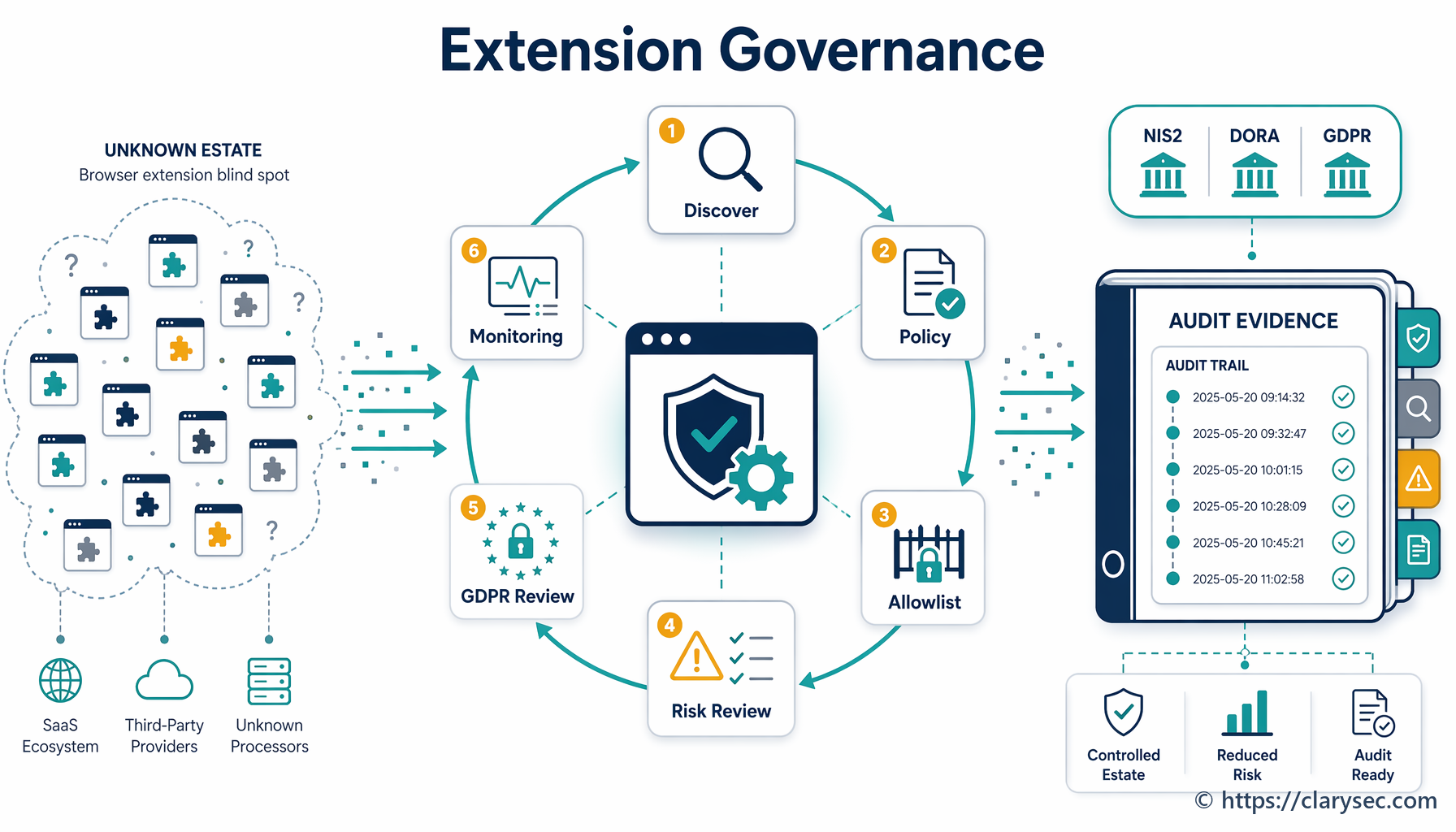
Discovery should cover all managed browsers, profiles, users, devices, and operating systems. It should identify extension name, unique ID, version, publisher, installation source, permission set, install date, update status, user count, business owner, and whether the extension is force-installed, user-installed, sideloaded, or blocked.
Control 8.1, User endpoint devices, is the anchor. The Zenith Blueprint: An Auditor’s 30-Step Roadmap guidance for Control 8.1 states that user endpoint devices “must be reinforced, monitored, and controlled.” That requirement naturally includes the browser, because the browser is now the primary user endpoint interface for SaaS and cloud work.
Control 5.23 also applies when extensions connect to cloud services. Zenith Blueprint: An Auditor’s 30-Step Roadmap frames this control as a response to shadow IT, where users adopt unsanctioned services without governance. A browser extension that sends content to an unknown hosted backend is a cloud-service adoption event, even if no one in procurement approved it.
A mature discovery output should classify every extension into one of five states:
| Extension state | Meaning | Required action |
|---|---|---|
| Approved | Reviewed, justified, and allowed for defined users | Monitor and review periodically |
| Conditional | Allowed with restrictions such as specific groups, sites, or permissions | Enforce conditions and review more frequently |
| Pending review | Discovered or requested but not yet assessed | Block or quarantine until approval |
| Blocked | Known risky, unnecessary, non-compliant, or prohibited | Prevent installation and remove existing instances |
| Exception | Temporarily allowed due to business need and accepted risk | Record owner, expiry date, compensating controls, and approver |
Discovery should not be a one-time project. Extensions update frequently, publishers change ownership, permissions expand, and stores remove malicious packages after users have already installed them. Inventory must become continuous or at least recurrent enough to support vulnerability management and audit evidence.
Step 2, make acceptable use explicit
Once extensions are visible, user expectations must be clear. Many organizations already have policy language that can support extension governance, but it must be applied to the browser explicitly.
[P-EPM] Endpoint Protection - Malware Policy - SME states that users “Must not install unauthorized software or plugins that may introduce risk.” That single sentence gives security teams a strong policy basis to treat browser extensions as controlled software.
[P03-AUP] P03 Acceptable Use Policy, also referenced as the enterprise Acceptable Use Policy, prohibits “Unapproved Tools: Installing or using unauthorised software, hardware, cloud services, or devices”. This is the user-facing foundation. It converts browser extension governance from a technical preference into an enforceable behavioral and compliance requirement.
A strong browser extension policy should answer six practical questions:
| Policy question | Governance answer |
|---|---|
| May users install extensions freely? | No, extensions require approval unless pre-approved by role or group |
| Are browser extensions considered software? | Yes, they are software installed on operational systems |
| Are extension backends considered cloud services? | Yes, when they process, transmit, store, or enrich organizational data |
| Who approves extensions? | Security, IT, privacy, and business owners approve based on risk |
| What happens to unapproved extensions? | They are blocked, removed, or quarantined pending review |
| How are exceptions handled? | Exceptions require documented risk acceptance, expiry, and compensating controls |
This is not about banning every useful extension. It is about moving from implicit trust to explicit approval. Some extensions may be safe, necessary, and productivity-enhancing. Others may be unnecessary, overprivileged, abandoned, or hostile. The governance program must distinguish between them.
Step 3, enforce default-deny with allowlist-by-exception
Control 8.19, Installation of software on operational systems, is the control that turns policy into operation. Browser extensions should not be treated differently from other software simply because users install them through a browser store.
Zenith Blueprint: An Auditor’s 30-Step Roadmap is direct on this point: “no software gets installed unless it’s justified, authorized, and secured.” For browser extensions, this means using enterprise browser management, endpoint management, or device configuration tooling to enforce installation rules.
The most defensible model is default-deny with allowlist-by-exception:
- Block all extensions by default for managed browsers.
- Force-install only essential, approved corporate extensions.
- Maintain an allowlist for approved extensions by user group, department, or role.
- Block sideloaded extensions and untrusted installation sources.
- Prevent users from bypassing policies by switching profiles or unmanaged browsers.
- Remove already-installed extensions that are not approved.
- Review extension permissions and publisher risk before approval.
- Log allowed, blocked, removed, and changed extensions.
Some organizations start with a softer model because of operational complexity. They may inventory first, block known-bad extensions, and then phase in allowlisting for high-risk groups such as finance, engineering, privileged administrators, legal, HR, and customer support. That is acceptable if there is a documented roadmap. What is not defensible is permanent tolerance of unknown extension risk.
Step 4, risk assess extensions like suppliers and software
A browser extension risk review should be lightweight enough for business adoption, but strong enough to withstand audit. The review should combine software risk, supplier risk, cloud risk, data protection, and vulnerability management.
[P-TP] Third party and supplier security policy mandates that “All new suppliers must undergo a documented security assessment before contract execution.” Not every extension developer will require a full enterprise supplier onboarding process, but the supplier-risk principle still applies. If a developer can push code updates into employee browsers or process organizational data through a backend service, the organization has a third-party dependency.
[P-ASR] Application Security Requirements Policy - SME reinforces the same requirement from a software perspective: “Any third-party tool, plugin, or external code library used in an application must be recorded and reviewed annually for security impact and patch status.”
Use the following risk model to standardize decisions:
| Risk factor | Low risk | Medium risk | High risk |
|---|---|---|---|
| Permissions | No access to page data | Access to active tab or limited sites | Read and write access to all sites |
| Publisher | Verified publisher with strong history | Known company with privacy policy | Unknown individual, unclear ownership, no privacy policy |
| Data access | Operates locally without sensitive data | Sees limited business data | Accesses personal data, financial data, secrets, or session content |
| Connectivity | No external backend | Connects to known service | Connects to unknown or opaque third-party backend |
| Update model | Official store, regular updates | Infrequent updates, limited changelog | Sideloaded, abandoned, or update source unclear |
| Business need | Required for approved workflow | Useful but replaceable | Convenience only with high permissions |
| Vulnerability history | No adverse findings | Past issues remediated | Known compromise, malicious behavior, or unresolved vulnerability |
| Privacy posture | Clear privacy notice and limited collection | Broad policy but acceptable controls | No clear policy or excessive collection |
A high-risk extension should not be approved unless there is a critical business need, documented compensating controls, and senior risk acceptance. Examples of compensating controls include limiting usage to a hardened browser profile, restricting to specific URLs, blocking data entry into sensitive applications while active, using DLP monitoring, or requiring a vendor contract and privacy addendum.
Step 5, integrate privacy and GDPR review
Browser extension governance often fails because privacy review is disconnected from endpoint tooling. Yet many extensions can see personal data displayed in SaaS applications, HR systems, support tickets, CRM records, email, analytics platforms, and collaboration tools.
Under GDPR Article 5(2), the organization must demonstrate accountability. Under Article 25, it must implement data protection by design and by default. Under Article 32, it must apply appropriate technical and organizational measures for security of processing. If an extension exfiltrates personal data, the event may become a personal data breach under Article 4(12), triggering assessment and possibly Article 33 notification obligations.
A privacy-aware extension review should ask:
| GDPR review area | Extension review question | Evidence to retain |
|---|---|---|
| Data categories | Can the extension access personal data, special category data, or financial data? | Data access assessment |
| Purpose limitation | Is the extension necessary for a defined business purpose? | Business justification |
| Data minimization | Are requested permissions limited to the minimum needed? | Permission review |
| Processor relationship | Does the extension provider process data on behalf of the organization? | Supplier and privacy assessment |
| International transfers | Does data leave the jurisdiction or approved hosting region? | Transfer assessment |
| Retention | Does the provider store data, logs, prompts, screenshots, or metadata? | Privacy notice and retention review |
| Security | Are encryption, access controls, and vulnerability practices adequate? | Security due diligence |
| Breach response | Can the provider notify the organization of incidents? | Contractual or documented response evidence |
Not every extension requires a full DPIA. However, extensions with broad page access, AI processing, screen capture, email access, CRM access, HR data access, customer support data, or regulated financial data should trigger a structured privacy assessment.
Step 6, log and monitor for audit and incident response
An extension governance program without logs is not auditable. It also weakens incident response, because the organization cannot determine when an extension was installed, who used it, which version was present, when permissions changed, or whether a blocked installation attempt occurred.
[P-LM] Logging and Monitoring Policy - SME identifies logs for “software installations” as a key governance requirement. Browser extension installation is a software installation event and should be captured accordingly.
At minimum, logs should include:
| Log event | Why it matters |
|---|---|
| Extension installed | Confirms deployment and supports change evidence |
| Extension blocked | Shows preventive control operation |
| Extension removed | Confirms remediation |
| Extension updated | Supports vulnerability and change review |
| Permission changed | Detects risk increase after approval |
| Policy changed | Shows administrative control and accountability |
| Sideload attempt | Indicates bypass behavior or malware risk |
| Store source changed | Detects untrusted installation path |
| High-risk extension detected | Triggers triage and removal |
| User exception granted | Supports risk acceptance evidence |
These logs should feed into monitoring processes under Controls 8.15 and 8.16. Depending on risk, they may also flow to a SIEM, endpoint platform, or compliance evidence repository. Alerts should be configured for blocked high-risk extensions, sudden spikes in extension requests, changes to permissions for approved extensions, attempts to install from non-official sources, and installation attempts by privileged users.
Monitoring is also a NIS2 and DORA advantage. NIS2 Article 23 incident reporting depends on early detection and impact assessment. DORA requires robust ICT incident handling and resilience evidence. GDPR breach assessment depends on knowing what happened, when, and what data may have been affected.
What the auditor wants to see
An auditor is rarely satisfied with a statement such as “we block risky extensions.” They want evidence of governance. The evidence must connect policy, risk assessment, technical enforcement, monitoring, and management accountability.
| Audit question | Strong answer | Evidence artifact |
|---|---|---|
| Are browser extensions in scope? | Yes, they are treated as software on user endpoint devices | ISMS scope, asset register, endpoint standard |
| Are users prohibited from installing unapproved extensions? | Yes, acceptable use and endpoint policies define the rule | Endpoint Protection - Malware Policy - SME, P03 Acceptable Use Policy |
| Is there an approved extension list? | Yes, approved extensions are documented by business owner and user group | Allowlist export, approval register |
| Are new extensions risk assessed? | Yes, requests trigger software, supplier, vulnerability, and privacy checks | Risk assessment record |
| Are extension developers treated as suppliers where relevant? | Yes, high-risk providers undergo due diligence | Supplier assessment |
| Are cloud-connected extensions reviewed? | Yes, external backends are assessed under cloud service governance | Cloud service review |
| Are installations technically enforced? | Yes, default-deny and group allowlists are enforced in browser management | Configuration export |
| Are changes logged? | Yes, install, block, removal, update, and admin changes are logged | SIEM or admin console logs |
| Are exceptions controlled? | Yes, exceptions require owner, expiry, approver, and compensating controls | Exception register |
| Are reviews repeated? | Yes, extensions are reviewed periodically and after major changes | Review schedule and evidence |
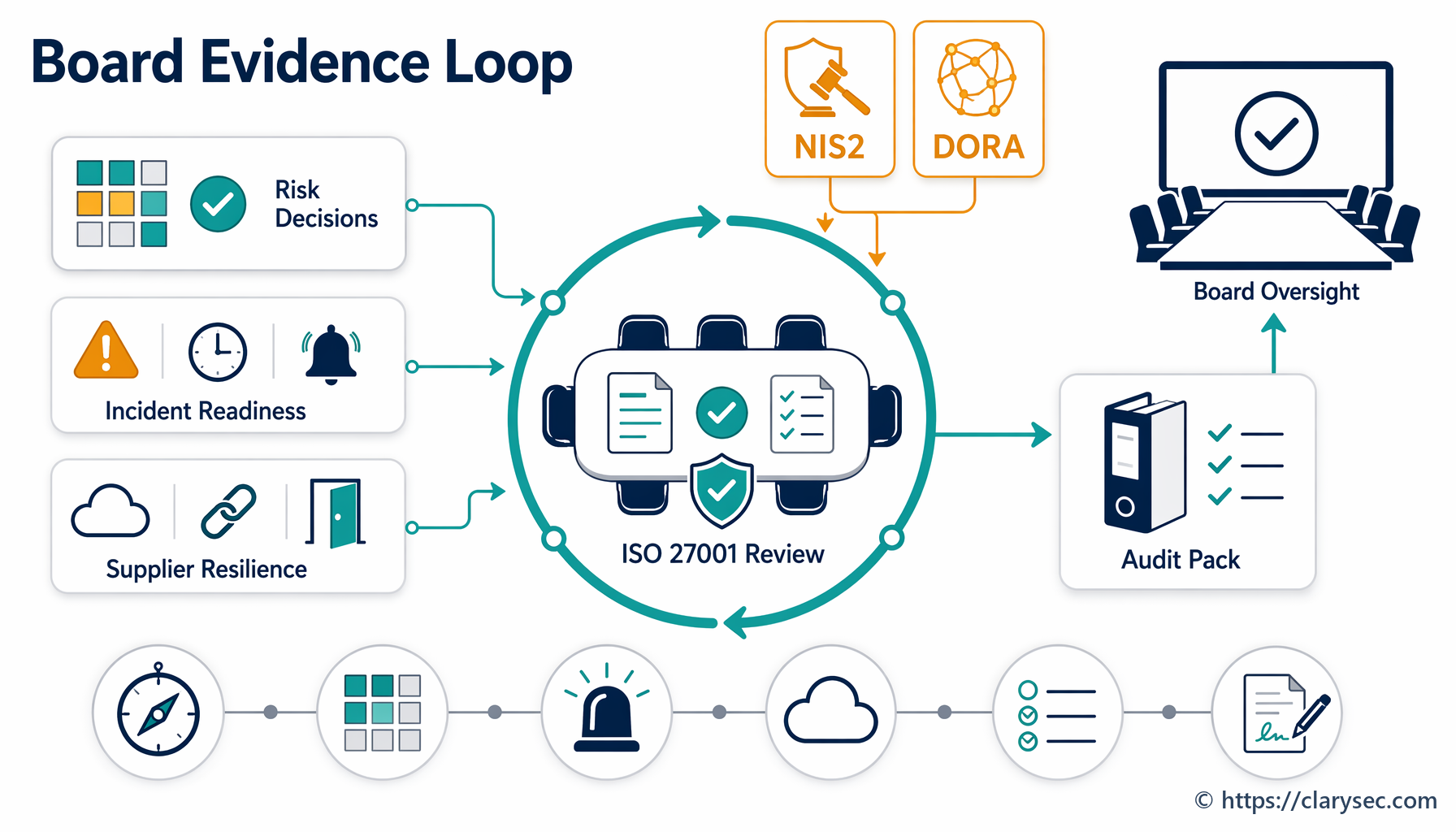
This is where Zenith Controls: The Cross-Compliance Guide becomes valuable. It helps organizations show how one control activity supports multiple compliance expectations. A single browser extension approval workflow can support ISO/IEC 27001 Control 8.19, NIS2 cyber hygiene, DORA ICT risk management, and GDPR accountability if the evidence is retained and mapped clearly.
Crosswalk, ISO/IEC 27001:2022 to NIS2, DORA, and GDPR
A practical crosswalk helps CISOs explain why browser extension governance is not a niche technical control. It is a compliance control with broad regulatory value.
| ISO/IEC 27001:2022 control | NIS2 alignment | DORA alignment | GDPR alignment | Browser extension evidence |
|---|---|---|---|---|
| 5.10 Acceptable use of information and other associated assets | Article 21 cyber hygiene and user practices | Article 5 governance expectations | Article 5(2) accountability | Acceptable use rules, user awareness, policy attestations |
| 5.19 Information security in supplier relationships | Article 21 supply-chain security | Article 28 ICT third-party risk management | Articles 28 and 32 where processing applies | Supplier review, provider assessment, contract analysis |
| 5.23 Information security for use of cloud services | Article 21 ICT and network security | Articles 6 and 28 ICT risk and third-party dependencies | Articles 25 and 32 privacy by design and security | Cloud backend review, SaaS integration approval |
| 8.1 User endpoint devices | Article 21 endpoint security and access control | Article 6 ICT risk management framework | Article 32 security of processing | Browser configuration, managed profiles, endpoint inventory |
| 8.8 Management of technical vulnerabilities | Article 21 vulnerability handling | Article 6 protection and prevention | Article 32 technical measures | Vulnerable extension tracking, remediation records |
| 8.15 Logging | Article 23 incident evidence | ICT incident handling and resilience evidence | Articles 5(2), 32, and 33 accountability and breach evidence | Installation logs, blocked attempts, policy changes |
| 8.16 Monitoring activities | Article 21 detection and Article 23 reporting | ICT monitoring and incident detection | Articles 32 and 33 breach detection | Alerts, SIEM events, anomaly reports |
| 8.19 Installation of software on operational systems | Article 21 secure configuration and software control | ICT change control expectations, including COBIT BAI06 Managed IT Changes as an audit lens | Articles 25 and 32 controlled processing environment | Request, approval, testing, deployment, allowlist evidence |
The DORA mapping deserves special attention. Some auditors and assessors will use COBIT-style language when reviewing ICT change governance. COBIT BAI06 is commonly understood as Managed IT Changes. If browser extensions are software and their installation changes the user computing environment, then extension installation belongs inside the same governed change logic. Zenith Controls: The Cross-Compliance Guide supports this audit lens by showing how ISO/IEC 27001 control evidence can be reused across compliance expectations.
A 90-day implementation plan for browser extension governance
Organizations do not need to solve everything in a single week. A practical program can be built in phases, especially if business disruption must be managed carefully.
| Timeline | Objective | Actions | Deliverables |
|---|---|---|---|
| Days 1 to 15 | Establish scope and ownership | Assign IT, security, privacy, procurement, and business owners, confirm managed browsers and user groups | Governance owner list, browser scope, initial risk statement |
| Days 16 to 30 | Discover current state | Inventory installed extensions, permissions, publishers, versions, users, and installation sources | Extension inventory, high-risk findings, initial executive summary |
| Days 31 to 45 | Define policy and decision rules | Update acceptable use, endpoint, cloud, and supplier procedures to include extensions | Policy updates, approval criteria, exception process |
| Days 46 to 60 | Build risk assessment workflow | Create request form, scoring model, privacy questions, supplier triage, and approval records | Extension request workflow, risk matrix, evidence templates |
| Days 61 to 75 | Enforce technical controls | Configure default-deny or phased allowlisting, block sideloading, remove known risky extensions | Browser management configuration, allowlist, blocklist |
| Days 76 to 90 | Monitor and evidence | Send logs to monitoring tools, create alerts, test audit evidence, report to management | Logging dashboard, alert rules, audit pack, management report |
For high-risk organizations, especially financial entities under DORA or essential and important entities under NIS2, the first enforcement phase should prioritize users with access to critical systems, regulated data, privileged administration consoles, finance platforms, customer support tools, and developer environments.
The board-level message
Browser extension governance should not be presented to executives as a browser hardening project. It should be presented as a control over unvetted third-party code in regulated workflows.
The board and management body need to understand four points:
- The browser is now a core business platform.
- Extensions can access sensitive SaaS data and authenticated sessions.
- Unmanaged extensions create supplier, privacy, incident, and resilience risk.
- ISO/IEC 27001:2022 provides a defensible control model that supports NIS2, DORA, and GDPR evidence.
That framing moves the discussion away from technical preference and toward operational resilience. It also supports funding for enterprise browser management, endpoint integration, monitoring, privacy review, supplier triage, and audit evidence automation.
From blind spot to strategic control
Maria’s audit issue was not caused by one analyst installing one productivity tool. It was caused by an unmanaged risk class. The organization had built a strong compliance program around visible assets, visible vendors, visible SaaS platforms, and visible endpoints, but the browser extension layer remained invisible.
That gap is now too important to ignore.
The fix is not complicated, but it must be deliberate. Treat the browser as part of the endpoint. Treat extensions as software. Treat extension developers and backends as suppliers where relevant. Treat permissions as data access. Treat installation as change. Treat logs as compliance evidence.
A defensible program starts with four actions:
- Discover every extension across managed browsers and endpoints.
- Define acceptable use and default-deny rules using Endpoint Protection - Malware Policy - SME, P03 Acceptable Use Policy, and the enterprise Acceptable Use Policy.
- Assess extension requests using supplier, cloud, vulnerability, and privacy criteria from Third party and supplier security policy and Application Security Requirements Policy - SME.
- Enforce and monitor installation activity using browser management, logging, and evidence practices aligned to Logging and Monitoring Policy - SME.
For CISOs preparing for NIS2, DORA, GDPR, or ISO/IEC 27001:2022 audits, browser extension governance is a high-value control improvement because it closes a real attack path while producing reusable evidence across frameworks.
To accelerate the work, download Zenith Blueprint: An Auditor’s 30-Step Roadmap and map your evidence with Zenith Controls: The Cross-Compliance Guide. If you want to turn browser extension chaos into an audit-ready governance program, schedule a Clarysec assessment or demo and start with a practical inventory, risk map, and 90-day control plan.
Frequently Asked Questions
About the Author

Igor Petreski
Compliance Systems Architect, Clarysec LLC
Igor Petreski is a cybersecurity leader with over 30 years of experience in information technology and a dedicated decade specializing in global Governance, Risk, and Compliance (GRC).Core Credentials & Qualifications:• MSc in Cyber Security from Royal Holloway, University of London• PECB-Certified ISO/IEC 27001 Lead Auditor & Trainer• Certified Information Systems Auditor (CISA) from ISACA• Certified Information Security Manager (CISM) from ISACA • Certified Ethical Hacker from EC-Council