BYOD Governance for ISO 27001, NIS2, DORA and GDPR
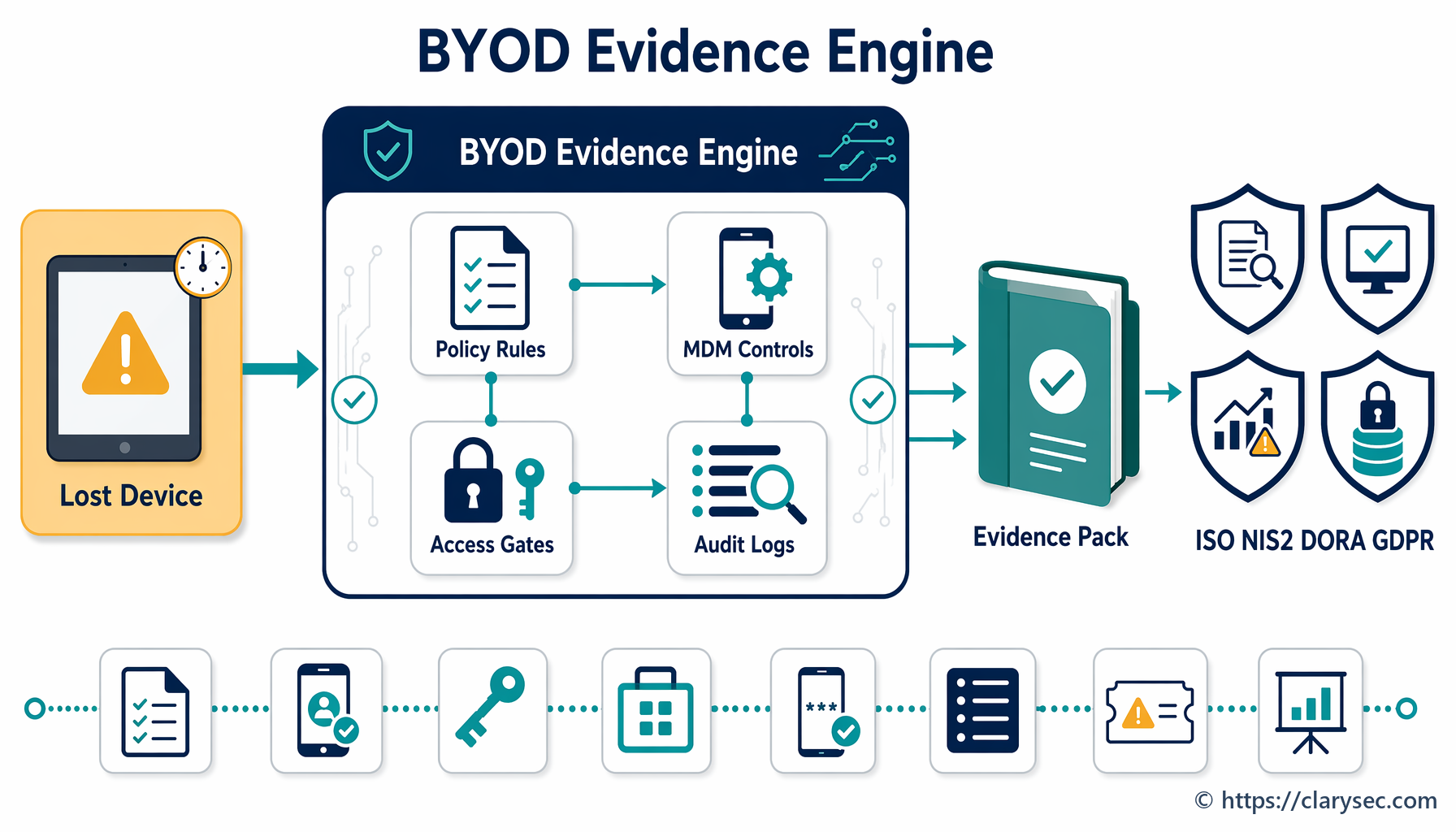
The Lost iPad at 8:12 AM
At 8:12 AM, Sarah’s screen lit up with an ordinary support ticket: “Lost iPad, Sales Director.”
Sarah was the CISO of a fast-growing fintech firm, and she knew immediately that this was not an ordinary asset issue. The sales director was a heavy user of his personal iPad. He accessed CRM records, email, sensitive client prospect lists, collaboration workspaces and payment pipeline dashboards from hotel rooms, airport lounges and customer sites.
Within minutes, the situation deteriorated. The device was not enrolled in mobile device management. There was no confirmation that it was encrypted. There was no remote wipe capability. Conditional access rules existed, but the sales director had been granted an exception months earlier because he was “always travelling.” The privacy team could not confirm what client data had been cached locally. The compliance manager forwarded a new message from the external auditor: “Please provide evidence that personal mobile devices accessing customer data are governed, monitored, encrypted and removable from service if compromised.”
The lost iPad was not the real explosion. It was the warning shot.
This is the mobile device and BYOD governance problem in 2026. Personal phones and tablets are no longer employee conveniences. They are business endpoints, identity factors, data stores, payment approval tools, privileged access companions and incident reporting channels. A single personal device may hold an authenticator app for administrator access, corporate email with personal data, cached cloud files, screenshots of regulated information, active browser sessions into SaaS consoles and access tokens for operational tools.
For CISOs, compliance managers and boards, the question is no longer, “Do we allow BYOD?” The real question is, “Can we prove that every mobile access path is governed, risk assessed, technically controlled, monitored and recoverable?”
The answer should not require separate compliance programs for ISO 27001, NIS2, DORA and GDPR. A well-scoped ISO/IEC 27001:2022 ISO/IEC 27001:2022 Information Security Management System can absorb mobile and BYOD risk into policies, asset ownership, access control, device compliance, logging, incident response, privacy controls and supplier evidence. Clarysec’s approach is to build that evidence once, then reuse it across NIS2 cyber hygiene, DORA ICT risk management and GDPR Article 32 security of processing.
Why BYOD Is Now a Board-Level Compliance Issue
Hybrid work has made mobile access permanent. Sales executives approve contracts from personal iPhones. Finance managers authorize payments from tablets. Engineers use authenticator apps on their own phones. Executives travel with corporate email on personal devices because it is convenient. Contractors access tickets from mobile browsers. Support teams receive incident alerts through mobile messaging apps.
This flexibility creates a governance gap when access grows faster than policy and control design.
NIS2 makes the gap visible at management level. Article 20 requires management bodies to approve cybersecurity risk-management measures, oversee implementation and receive training. Article 21 requires appropriate and proportionate technical, operational and organisational measures, including risk analysis, incident handling, business continuity, supply chain security, secure acquisition and maintenance, effectiveness assessment, cyber hygiene, cryptography, HR security, access control and asset management. Mobile and BYOD governance touches almost every one of these themes.
DORA raises the stakes for financial entities. Since January 2025, DORA has required a documented ICT risk management framework, management body oversight, ICT business continuity, ICT incident management, digital operational resilience testing and ICT third-party risk management. If employees access critical or important functions through mobile devices, those devices are part of the ICT risk surface. A mobile device management or unified endpoint management provider may also become relevant to ICT third-party evidence if it protects access to regulated operations.
GDPR adds the accountability lens. Article 5 requires personal data to be processed securely and requires the controller to demonstrate compliance. Article 32 requires appropriate technical and organisational measures, including confidentiality, integrity, availability, resilience and the ability to restore access where needed. In practice, privacy reviewers ask concrete questions: Who can access personal data from mobile devices? How is access restricted? What happens when a phone is lost? Can corporate data be wiped without invading personal privacy? Are logs retained? Is breach assessment evidence available?
ISO/IEC 27001:2022 gives the operating model. Clauses 4.1 to 4.4 require organizations to determine internal and external issues, interested-party requirements, regulatory obligations, scope and dependencies. Clause 5 requires leadership, roles and responsibilities. Clause 6 requires risk assessment and treatment. Clauses 8.2 and 8.3 require the organization to perform information security risk assessments and implement risk treatment plans.
That means BYOD cannot live in a forgotten IT memo. It belongs inside the ISMS scope, where legal obligations, customer expectations, operational dependencies and risk treatment decisions are managed.
The ISO 27001 Control Cluster for Mobile and BYOD Governance
Clarysec normally starts mobile governance with a three-control cluster from ISO/IEC 27001:2022 Annex A, supported by ISO/IEC 27002:2022 implementation guidance.
| Control theme | Mobile governance meaning | Typical evidence |
|---|---|---|
| A.8.1 User endpoint devices | Smartphones, tablets and laptops must be hardened, managed and monitored according to risk | MDM enrollment reports, encryption status, OS baseline compliance, malware protection, remote wipe capability |
| A.6.7 Remote working | Off-site access must be governed by policy, eligibility, secure access and user behavior expectations | Remote working policy, BYOD agreement, VPN or conditional access rules, training records |
| A.7.9 Security of assets off-premises | Devices and media outside controlled premises must be physically protected and tracked | Asset inventory, assigned ownership, lost-device procedure, travel guidance, encryption evidence |
In Zenith Controls: The Cross-Compliance Guide Zenith Controls, Clarysec treats these controls as mutually reinforcing. For user endpoint devices, Zenith Controls classifies control A.8.1 as preventive, supporting confidentiality, integrity and availability, mapped to the Protect cybersecurity concept and the operational capabilities of asset management and information protection.
The guide also explains why endpoint device controls connect directly to acceptable use, remote working, access restriction, secure authentication, physical protection, confidentiality obligations and awareness training.
“Endpoint devices are primary platforms through which acceptable use policies are enforced.”
Source: Zenith Controls, User endpoint devices, control 8.1 Zenith Controls
For remote working, Zenith Controls maps A.6.7 to A.7.9 security of assets off-premises, A.8.1 user endpoint devices, A.5.1 policies for information security, A.6.3 information security awareness, education and training, A.5.14 information transfer, A.8.20 networks security, A.8.22 segregation of networks, A.7.7 clear desk and clear screen, A.5.29 information security during disruption and A.5.30 ICT readiness for business continuity.
This mapping mirrors how audits actually unfold. An auditor does not stop at, “Do you have a BYOD policy?” They test whether the policy is implemented, whether devices are enrolled, whether access depends on compliance, whether logs exist, whether users are trained, whether lost-device incidents are handled and whether exceptions are risk accepted.
The Policy Foundation: Saying the Governance Rules Out Loud
A defensible BYOD program starts with explicit rules. Clarysec’s policy library provides both SME and enterprise patterns, so organizations can scale requirements without losing audit clarity.
For SMEs, Clarysec’s Mobile Device and BYOD Policy-sme Mobile Device and BYOD Policy - SME creates a simple governance gate:
“Personal BYOD devices must be approved by the GM before use.”
Source: Mobile Device and BYOD Policy-sme, Governance Requirements, clause 5.1.1 Mobile Device and BYOD Policy - SME
That short sentence closes a common audit gap. It prevents silent personal-device access, creates an approval point and gives the business owner or general manager a visible governance role. It also supports ISO 27001 clauses 5.1 to 5.3, where top management must demonstrate leadership, communicate expectations and assign responsibilities.
The SME policy also makes baseline enforcement clear:
“The following controls must be enforced on all mobile devices (company-owned and BYOD):”
Source: Mobile Device and BYOD Policy-sme, Governance Requirements, clause 5.2.1 Mobile Device and BYOD Policy - SME
For regulated or larger organizations, Clarysec’s Mobile device and byod policy Mobile device and byod policy is more prescriptive:
“All mobile devices (corporate or personal) accessing organizational resources must be:
5.1.1 Registered and enrolled in an approved mobile device management (MDM) platform.
5.1.2 Configured with technical security controls, including enforced encryption and authentication.
5.1.3 Monitored for compliance with defined operating system (OS) and patching baselines.”
Source: Mobile device and byod policy, Governance Requirements, clause 5.1 Mobile device and byod policy
This is audit-ready language. The auditor can test the population of mobile devices, compare it with access logs, sample enrollment records and verify that encryption, authentication and patch baselines are enforced.
BYOD also requires privacy-sensitive consent boundaries. The enterprise policy states:
“Bring Your Own Device (BYOD) access shall be granted only upon formal acceptance of the organization’s Bring Your Own Device (BYOD) Usage Agreement, which includes:
5.2.1 Consent to monitoring of corporate containers or managed applications
5.2.2 Acknowledgement of mobile device management (MDM) controls such as remote wipe or lockout
5.2.3 Agreement to voluntary participation and the right to withdraw”
Source: Mobile device and byod policy, Governance Requirements, clause 5.2 Mobile device and byod policy
This clause is central to GDPR alignment. It clarifies that monitoring applies to corporate containers or managed applications, documents employee acknowledgement of lockout or remote wipe and preserves the right to withdraw. It helps separate legitimate corporate security monitoring from excessive surveillance of personal life.
From Policy to Controls: MDM, Containers, Access and Logs
Policy only becomes governance when it is implemented and evidenced. The practical baseline starts with enrollment.
“All mobile devices must be enrolled in a mobile device management (MDM) solution before accessing corporate systems.”
Source: Mobile device and byod policy, Policy Implementation Requirements, clause 6.1.1 Mobile device and byod policy
For enterprise environments, the same implementation layer should enforce encryption, PIN, passcode or biometric authentication, inactivity lockout, supported OS versions, jailbreak or root detection, patch baselines and wipe or reimaging after repeated failed login attempts.
For BYOD, the better design is usually managed applications or corporate containers instead of whole-device surveillance. The policy captures this:
“Corporate data must be stored only within encrypted, managed containers.”
Source: Mobile device and byod policy, Policy Implementation Requirements, clause 6.6.1 Mobile device and byod policy
This supports GDPR data minimisation and Article 32 security of processing because business data is restricted to managed areas and personal areas are not treated as corporate repositories. It also gives the business a practical answer when a personal phone is lost: revoke sessions, wipe corporate data, preserve logs and assess exposure without wiping personal photos, messages or applications.
Conditional access then connects identity to device posture. At minimum, sensitive systems should require enrollment, MFA, encryption, supported OS, screen lock, no jailbreak or root failure, managed application access and restrictions on downloads, clipboard sharing or screen capture where risk requires it. This gives practical effect to A.8.1 user endpoint devices, A.8.3 information access restriction and A.8.5 secure authentication.
Logging closes the loop. The enterprise policy requires:
“Mobile access logs must be captured and retained for at least 90 days, with integration to the central SIEM platform where applicable.”
Source: Mobile device and byod policy, Governance Requirements, clause 5.6 Mobile device and byod policy
For smaller environments, Clarysec’s Logging and Monitoring Policy-sme Logging and Monitoring Policy - SME adds a practical minimum:
“BYOD and remote systems must have local logging enabled for authentication events and antivirus detections”
Source: Logging and Monitoring Policy-sme, Policy Implementation Requirements, clause 6.3.1 Logging and Monitoring Policy - SME
A mobile governance program without logs is difficult to defend. A lost-device investigation needs access history, failed attempts, device compliance status, session revocation evidence and any relevant DLP or container activity.
Where Mobile Governance Fits in the 30-Step Roadmap
Clarysec’s Zenith Blueprint: An Auditor’s 30-Step Roadmap Zenith Blueprint places mobile and BYOD governance across multiple implementation phases. It does not treat BYOD as a single policy document.
In the Controls in Action phase, Step 16, People Controls II, the Zenith Blueprint addresses remote working and BYOD:
“Personal device usage (BYOD) should be either prohibited or allowed only under strict conditions, such as enrollment in a Mobile Device Management (MDM) solution that supports data containerization and remote wipe of corporate data if the device is lost or if the user exits the company.”
Source: Zenith Blueprint, Controls in Action phase, Step 16, People Controls II Zenith Blueprint
In Step 19, Technological Controls I, the Zenith Blueprint frames endpoints as the starting point of digital interaction:
“User endpoint devices, laptops, smartphones, tablets, desktops, and even thin clients, are where digital interaction begins. They’re the doors and windows into your systems.”
Source: Zenith Blueprint, Controls in Action phase, Step 19, Technological Controls I Zenith Blueprint
Step 18, Physical Controls II, covers off-premises asset security. That includes devices left in cars, tablets used in public spaces, laptops checked into luggage and files stored offline. The principle is simple: even if a device is lost or stolen, the data must remain inaccessible.
| Zenith Blueprint phase and step | Mobile governance output | Audit value |
|---|---|---|
| Controls in Action, Step 16 | Remote working and BYOD conditions | Shows policy, eligibility, training and MDM expectations |
| Controls in Action, Step 18 | Off-premises asset protection | Shows asset assignment, travel behavior and encryption evidence |
| Controls in Action, Step 19 | Endpoint hardening and management | Shows device compliance, patching, monitoring and conditional access |
This layered approach is how Sarah moved from panic to governance. She did not buy a tool and declare the issue solved. She connected people rules, physical behavior and technical enforcement into one auditable system.
A One-Week BYOD Evidence Pack Sprint
A practical way to close the gap is to build a BYOD evidence pack. This is the set of artifacts a CISO can hand to an auditor, regulator, customer assessor or board committee.
| Day | Action | Evidence produced |
|---|---|---|
| Day 1 | Define mobile access scope under ISO 27001 clauses 4.1 to 4.4 | Mobile use-case inventory, interested-party requirements, in-scope systems |
| Day 2 | Approve the BYOD rule and assign ownership | Approved policy, RACI, management approval record |
| Day 3 | Configure the technical baseline | MDM enrollment export, encryption settings, OS baseline, authentication rules |
| Day 4 | Connect access to device compliance | Conditional access policy, non-compliant device denial evidence, exception list |
| Day 5 | Capture logging and incident evidence | SIEM sample, mobile access logs, incident ticket template, lost-device workflow |
| Day 6 | Test lost-device response | Tabletop minutes, session revocation evidence, remote wipe test, breach assessment notes |
| Day 7 | Approve exceptions and residual risk | Risk acceptance record, compensating controls, expiry date, risk owner approval |
For Day 1, identify corporate-owned phones, personal phones used for MFA, BYOD tablets accessing dashboards, contractor mobile devices, privileged users accessing admin consoles and any mobile access to systems processing personal data or financial transactions.
For Day 6, test a realistic scenario: a sales director reports that a personal phone with managed corporate email was stolen at an airport. The SME policy sets a clear reporting expectation:
“Lost, stolen, or compromised devices must be reported to the GM within 1 hour”
Source: Mobile Device and BYOD Policy-sme, Policy Implementation Requirements, clause 6.4.1 Mobile Device and BYOD Policy - SME
The exercise should test whether the team can identify the device, revoke sessions, remotely wipe corporate data, preserve logs, assess personal data exposure, decide whether GDPR breach analysis is needed and determine whether NIS2 or DORA reporting thresholds could be triggered.
Cross-Compliance: One Mobile Program, Four Evidence Stories
The value of ISO 27001-based BYOD governance is reuse. One control set can generate evidence for several obligations if it is structured well.
| Framework | Mobile and BYOD question | Evidence from Clarysec approach |
|---|---|---|
| ISO/IEC 27001:2022 | Are mobile risks identified, treated and controlled through the ISMS? | Scope, risk assessment, Statement of Applicability, policy approval, MDM reports, logs, incident records |
| NIS2 | Are cyber hygiene, access control, asset management, incident handling and training implemented? | Board approval, BYOD policy, training records, access controls, lost-device workflow, supplier evidence |
| DORA | Are mobile devices part of ICT risk, incident management, resilience testing and third-party governance? | ICT risk register, device compliance, incident classification, testing evidence, MDM supplier due diligence |
| GDPR Article 32 | Are personal data processing activities protected with appropriate technical and organisational measures? | Containerization, encryption, access restriction, logging, breach assessment, data protection by design records |
The same logic applies at control level.
| ISO/IEC 27001:2022 Annex A control | NIS2 evidence value | DORA evidence value | GDPR Article 32 evidence value |
|---|---|---|---|
| A.8.1 User endpoint devices | Supports cyber hygiene, asset management and access control policies | Supports ICT asset protection, endpoint monitoring and resilience testing | Supports encryption, confidentiality, integrity and secure access to personal data |
| A.6.7 Remote working | Supports secure remote access, training and incident reporting expectations | Supports ICT risk framework procedures and remote-work incident handling | Supports organisational rules for processing personal data outside controlled premises |
| A.7.9 Security of assets off-premises | Supports asset protection, continuity and third-party handling expectations | Supports mitigation of theft or loss risks for devices used remotely | Supports prevention of accidental loss, destruction or unauthorized access |
For NIS2, scope matters. Digital infrastructure providers, cloud providers, data centre providers, content delivery networks, DNS providers, TLD registries, trust service providers, public electronic communications providers, B2B managed service providers and managed security service providers may fall within essential or important entity categories depending on size, sector and national implementation. Unmanaged mobile access to operational systems is not a minor IT exception in that context. It is a governance issue.
For DORA, the MDM or UEM provider can become part of third-party risk evidence if it supports access to critical or important functions. DORA-minded organizations should document due diligence, service levels, data locations, incident assistance, security measures, audit rights, exit arrangements and provider participation in testing where relevant.
For GDPR, a lost personal phone is not automatically a notifiable personal data breach. It becomes a serious concern if corporate data is accessible, unencrypted, cached outside managed containers or exposed through active sessions. The organization must know what data was accessible, whether controls prevented unauthorized access and whether logs support the conclusion.
How Auditors Will Test BYOD Governance
A mature program should be prepared for different audit styles.
| Auditor background | Likely audit approach | Evidence they will expect |
|---|---|---|
| ISO 27001 auditor | Trace mobile risk from context, scope, risk assessment and Statement of Applicability to implemented controls | ISMS scope, mobile risk records, SoA, policy, enrollment reports, access rules, corrective actions |
| NIST CSF assessor | Compare current and target profiles across GOVERN, IDENTIFY, PROTECT, DETECT, RESPOND and RECOVER outcomes | CSF profile, prioritized action plan, device inventory, monitoring, response plans, recovery evidence |
| COBIT 2019 or ISACA auditor | Focus on governance objectives, accountability, performance, risk ownership and control effectiveness | Management approval, RACI, metrics, exception register, control testing, issue remediation |
| DORA reviewer | Treat mobile access as part of ICT risk, incident management, resilience testing and third-party dependency | ICT risk framework, incident classification, resilience test records, MDM supplier register, exit plan |
| GDPR auditor or privacy reviewer | Assess whether mobile processing of personal data is lawful, necessary, secured and demonstrable | BYOD consent boundaries, containerization, DLP, encryption, access logs, breach assessment records |
The Zenith Blueprint audit checklist for remote working is direct: auditors will check whether the policy is implemented, not merely documented. Be ready to present the formal policy, explain enforcement such as VPN usage, endpoint encryption or MDM, show BYOD enrollment or restrictions, provide training records and demonstrate that remote employees understand their duties.
NIST CSF 2.0 gives a useful complementary model. Its GOVERN Function requires legal, regulatory and contractual cybersecurity requirements to be understood and managed, cybersecurity risk to be integrated into enterprise risk management, roles and authorities to be defined, policies to be established and monitored, and performance to be evaluated. For mobile governance, a practical target profile might say: all devices accessing personal data or critical business systems are enrolled, encrypted, compliant, monitored and removable within one hour of compromise notification.
Common BYOD Audit Findings
Mobile governance findings rarely come from one catastrophic failure. They usually come from small exceptions that were never closed.
Common findings include:
- BYOD allowed in practice but not formally approved
- Authenticator apps treated as outside the ISMS scope
- MDM configured for corporate devices but not personal devices with corporate access
- Executives excluded from device compliance baselines
- Conditional access bypassed through legacy protocols or unmanaged browsers
- Personal devices accessing email without containerization
- Mobile logs retained in SaaS platforms but not reviewed or exported
- Lost-device procedure exists but staff do not know the reporting timeframe
- No privacy language explaining what the company can and cannot monitor
- No evidence that mobile exceptions are time-bound and risk accepted
- MDM supplier not included in ICT third-party risk management
- No tabletop exercise for mobile compromise
- No mapping from BYOD controls to GDPR Article 32, NIS2 or DORA evidence
Each finding is fixable. The problem is usually not a lack of tools. It is a lack of ownership, evidence design and cross-compliance mapping.
The Board-Level Story
Management does not need every MDM configuration detail. It needs a clear accountability narrative.
A strong board-level BYOD position says:
- We know which mobile devices access organizational resources.
- We distinguish corporate-owned and BYOD access.
- BYOD is voluntary, approved and governed by agreement.
- Corporate data is encrypted and isolated.
- Access depends on device compliance.
- Logs are retained and reviewed.
- Lost or compromised devices are reported quickly.
- Corporate data can be wiped or access revoked.
- Personal data risks are assessed under GDPR.
- Exceptions are approved, time-bound and reviewed.
This connects mobile governance to risk appetite, operational resilience, legal accountability and customer trust. It also gives management bodies the evidence they need to demonstrate oversight under NIS2 and DORA.
How Clarysec Helps
Clarysec’s mobile and BYOD governance model combines policy, implementation and cross-compliance mapping.
First, the policy library gives organizations ready-to-adapt governance language. The Mobile Device and BYOD Policy-sme is practical for smaller businesses that need clear approval and reporting rules. The Mobile device and byod policy supports regulated environments requiring MDM, encryption, authentication, OS baselines, DLP, containers, logging and formal BYOD agreements.
Second, the Zenith Blueprint provides the implementation route. It shows where mobile governance belongs in the 30-step audit roadmap: remote working, off-premises asset security and endpoint device controls. This prevents the common mistake of treating BYOD as a single document rather than a living control system.
Third, Zenith Controls provides the cross-compliance compass. It connects ISO/IEC 27001:2022 Annex A controls A.8.1, A.6.7 and A.7.9 to related controls, supporting standards and audit expectations. That mapping helps CISOs answer the regulator’s real question: show that your mobile governance is proportionate, implemented and effective.
Next Steps: Build Your Defensible BYOD Evidence Pack
If your organization allows mobile or BYOD access, do not wait for a lost iPad to expose the evidence gap.
Start with a focused assessment:
- List every mobile access path to corporate data and critical systems.
- Compare actual access against the Mobile device and byod policy Mobile device and byod policy or Mobile Device and BYOD Policy-sme Mobile Device and BYOD Policy - SME.
- Build a one-page mobile risk register entry linked to ISO/IEC 27001:2022 ISO/IEC 27001:2022.
- Use Zenith Blueprint: An Auditor’s 30-Step Roadmap Zenith Blueprint to implement remote working, off-premises asset and endpoint controls.
- Use Zenith Controls: The Cross-Compliance Guide Zenith Controls to map evidence to NIS2, DORA, GDPR, NIST and COBIT 19 expectations.
- Use Logging and Monitoring Policy-sme Logging and Monitoring Policy - SME to define practical logging expectations for smaller environments.
- Run a lost-device tabletop exercise and preserve the evidence.
Clarysec can help you turn unmanaged mobile access into a defensible, auditable governance program. Download the policies, map your controls with Zenith Controls, implement the roadmap with Zenith Blueprint and schedule a Clarysec assessment before your next auditor asks the 8:12 AM question.
About the Author

Igor Petreski
Compliance Systems Architect, Clarysec LLC
Igor Petreski is a cybersecurity leader with over 30 years of experience in information technology and a dedicated decade specializing in global Governance, Risk, and Compliance (GRC).Core Credentials & Qualifications:• MSc in Cyber Security from Royal Holloway, University of London• PECB-Certified ISO/IEC 27001 Lead Auditor & Trainer• Certified Information Systems Auditor (CISA) from ISACA• Certified Information Security Manager (CISM) from ISACA • Certified Ethical Hacker from EC-Council