CISA KEV Governance for ISO 27001, NIS2 and DORA
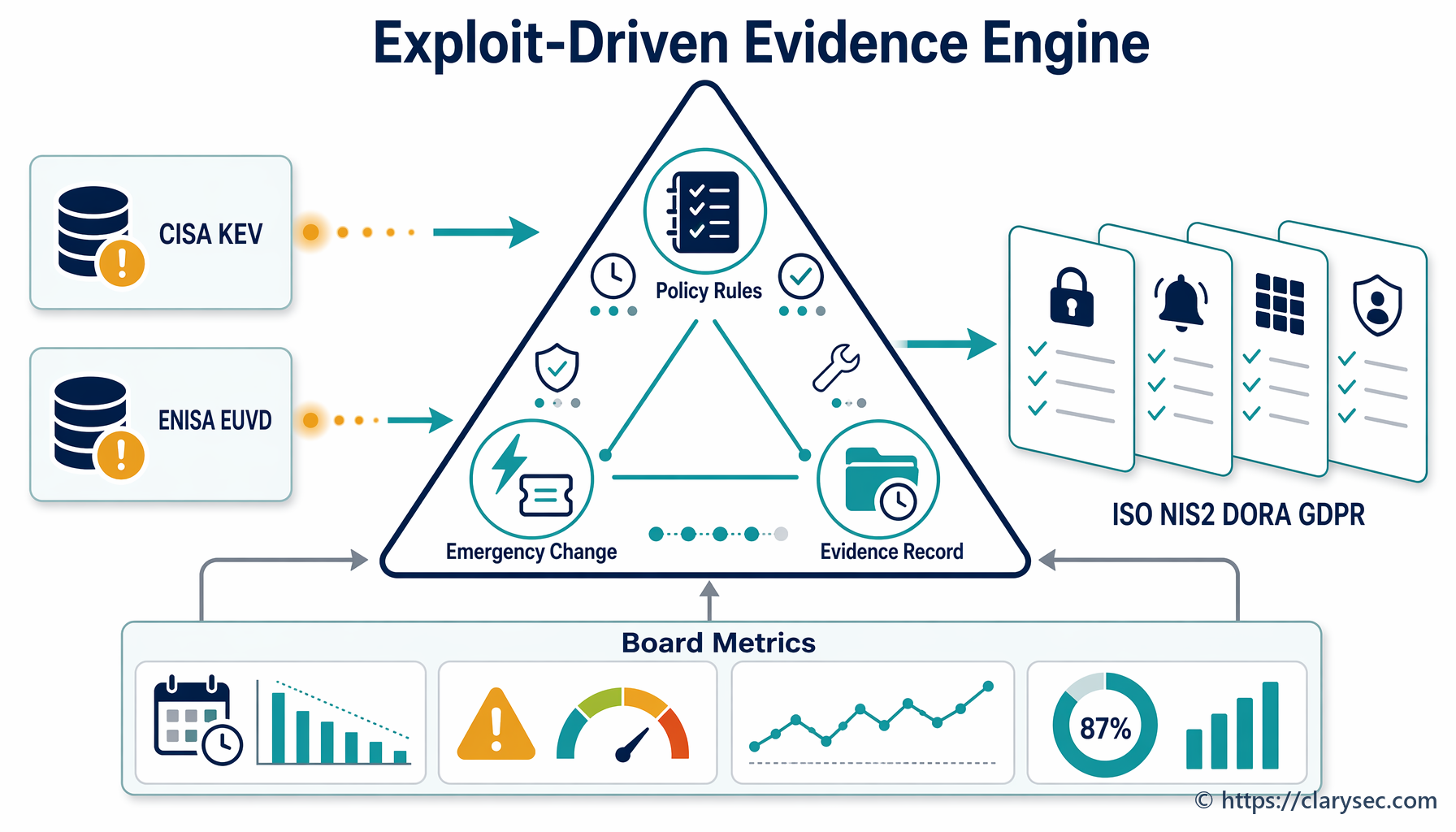
The Friday vulnerability that became a board question
It is 16:40 on a Friday. Your SOC lead forwards a CISA KEV alert, the vulnerability scanner confirms exposure on an internet-facing gateway, and ENISA EUVD has a matching exploited vulnerability record. The vendor has released a patch, but the production owner warns that applying it immediately may disrupt a customer-facing service. Legal asks whether personal data could be affected. The DORA lead asks whether the platform supports a critical or important function. The NIS2 coordinator asks whether this could become a significant incident.
The CISO asks the only question that matters:
“Can we prove we made the right decision, fast enough, with the right approvals?”
That is the real problem in known exploited vulnerability governance in 2026. It is not only about identifying CVEs or pushing patches faster. It is about converting exploit intelligence into a defensible operating model: intake, triage, prioritization, emergency change, compensating controls, supplier escalation, exception approval, evidence retention, management reporting and regulator-ready remediation decisions.
Many organizations already have vulnerability SLAs. Some have threat intelligence feeds. A few run continuous exposure management. But when a vulnerability is already exploited in the wild, the risk context changes. A known exploited vulnerability listed in CISA KEV or ENISA EUVD should not sit in the same queue as routine patch backlog. It should trigger a different governance path because the risk is no longer theoretical.
Clarysec’s position is simple: exploit-driven remediation should be managed as an evidence-producing business process, not as an informal technical scramble. That process can be built on ISO/IEC 27001:2022 ISO/IEC 27001:2022, reinforced by ISO/IEC 27002:2022 ISO/IEC 27002:2022, and mapped across NIS2, DORA, GDPR, NIST CSF 2.0 and COBIT 19 governance expectations.
From patching to provable governance
Traditional vulnerability management often starts with severity: CVSS score, asset criticality, exposure and patch availability. Exploit-driven governance adds a sharper question: is this vulnerability already being used by attackers, and do we have affected assets, suppliers, cloud services or data flows?
That shift changes the workflow. A known exploited vulnerability should trigger:
- Threat intelligence validation from trusted sources such as CISA, ENISA, national CERTs, vendors, ISACs and MSSPs.
- Asset correlation, including internet exposure, business function, data classification and supplier dependency.
- Emergency risk decisioning, including patch now, isolate, disable function, apply workaround, monitor or temporarily accept residual risk.
- Change approval with traceability, even when the change is expedited.
- Evidence capture, including timestamps, approvals, logs, screenshots, scan results, vendor statements and compensating control records.
- Management reporting, especially when the vulnerability affects critical services, personal data, regulated financial services or NIS2 essential or important services.
- Post-remediation validation and lessons learned.
ISO 27001:2022 gives this workflow a governance skeleton. Clauses 4.1 to 4.4 require the organization to understand internal and external issues, interested parties, legal and regulatory requirements, interfaces and dependencies, then define and maintain the ISMS scope. In vulnerability governance, that means the scope must include the real systems, cloud services, third parties and regulated services where exploited vulnerability exposure can create business impact.
Clauses 5.1 to 5.3 move the issue beyond IT operations. Top management must align the ISMS with strategic direction, assign responsibilities, allocate resources, communicate the importance of conformity and receive performance reporting. In practice, a CISA KEV match on a critical service is not only a patch ticket. It is an executive accountability event.
Clauses 6.1.1 to 6.1.3 provide the risk backbone: risk criteria, risk owners, likelihood and consequence assessment, treatment options, Statement of Applicability, treatment plan and residual-risk acceptance. This is the mechanism that turns “we could not patch yet” into a documented, approved, time-bound exception with compensating controls.
Clause 8.1 then matters when the team moves from decision to execution. It requires operational planning and control, including control of planned changes and review of unintended changes. In a KEV event, the organization must be fast without becoming uncontrolled.
The Clarysec control triangle for exploited vulnerabilities
Clarysec’s Zenith Controls: The Cross-Compliance Guide Zenith Controls treats known exploited vulnerability governance as a combination of three central ISO/IEC 27002:2022 control themes. It cites the topic-related controls as “Threat intelligence (5.7)”, “Management of Technical Vulnerabilities (8.8)” and “Change Management (8.32).”
Together, those controls form a practical triangle:
| Governance question | ISO/IEC 27002:2022 control theme | Operational evidence |
|---|---|---|
| How did we know this vulnerability mattered? | 5.7 Threat intelligence | CISA KEV or ENISA EUVD intake, vendor advisory, CERT alert, validation notes, affected asset query |
| How did we assess and remediate it? | 8.8 Management of technical vulnerabilities | Vulnerability record, scan result, risk rating, owner, SLA, patch or workaround, verification scan |
| How did we safely change production? | 8.32 Change management | Emergency change ticket, approval, test result, rollback plan, deployment log, post-change review |
This triangle prevents a common audit failure: treating vulnerability management as a scanner output rather than a governed decision chain. An auditor, regulator or customer assurance team will not only ask whether a patch was applied. They will ask how the organization knew, prioritized, approved, implemented and verified the decision.
The Zenith Blueprint: An Auditor’s 30-Step Roadmap Zenith Blueprint makes this concrete in the Controls in Action phase, Step 22, where it tells teams to build a threat intelligence register:
Establish a documented list of threat intelligence sources (5.7), from vendors, ISACs, or open sources, and determine how intel is validated and integrated into decision-making. Define who receives threat updates and how they’re applied (e.g., patch prioritization, awareness training).
In Step 19, the Zenith Blueprint frames vulnerability management as modern cyber hygiene and stresses expedited remediation for critical vulnerabilities:
Managing vulnerabilities is one of the most critical areas of modern cyber hygiene. While firewalls and antivirus tools provide protection, they can be undermined if unpatched systems or misconfigured services are left exposed.
It also warns that scan findings must not be archived passively. They must be triaged, assigned and tracked to closure. That discipline is exactly what CISA KEV and ENISA EUVD governance requires.
Policy turns urgency into rules
A governance model only works when it is reflected in policy. Clarysec’s Enterprise Vulnerability and Patch Management Policy Vulnerability and Patch Management Policy, also referenced in toolkit contexts as P19 Vulnerability and Patch Management Policy, assigns the monitoring and escalation requirement clearly:
Monitor threat advisories (e.g., CVE, CISA KEV, vendor bulletins) and escalate critical vulnerabilities.
From section “Roles and Responsibilities”, policy clause 4.5.1.
The same enterprise policy defines an aggressive remediation expectation for critical vulnerabilities:
Critical (CVSS 9.0-10.0): Immediate review; patching deadline of 72 hours maximum.
From section “Governance Requirements”, policy clause 5.2.1.
For SMEs, Clarysec’s Vulnerability and Patch Management Policy-sme Vulnerability and Patch Management Policy-sme - SME, also referenced as P19S Vulnerability and Patch Management Policy-sme, makes the same concept operational and direct:
Trusted threat intelligence advisories (e.g., CISA, ENISA, national CERT alerts)
From section “Policy Implementation Requirements”, policy clause 6.2.1.3.
It also sets the practical patching standard:
Critical patches must be applied within 3 days of release, especially for internet-facing systems
From section “Policy Implementation Requirements”, policy clause 6.1.1.
That phrase “especially for internet-facing systems” matters. Known exploited vulnerability governance must prioritize exposed systems, remote access services, identity infrastructure, edge devices, SaaS administration panels and systems processing sensitive or regulated data.
But what happens when the business cannot patch within the SLA? The enterprise policy closes the loop:
If a vulnerability cannot be remediated within the defined SLAs due to operational, technical, or vendor constraints, a formal Exception Request must be submitted.
From section “Risk Treatment and Exceptions”, policy clause 7.1.
The SME version requires patch logs that support auditability:
Logs must include the device name, update applied, patching date, and reason for any delay
From section “Governance Requirements”, policy clause 5.4.2.
These policy clauses create the evidence spine. They allow the CISO to say: we have rules for intelligence intake, prioritization, patch deadlines, exceptions and delay reasons. That is the difference between reactive patching and governed remediation.
Emergency change without losing control
Known exploited vulnerabilities often force emergency changes. Waiting for the next Change Advisory Board meeting may be negligent. Bypassing change management entirely may be reckless. The answer is expedited, traceable change control.
Clarysec’s Enterprise Change Management Policy Change Management Policy, also referenced as P05 Change Management Policy, states:
Emergency changes may proceed with expedited verbal or delegated approval from authorized roles.
From section “Policy Implementation Requirements”, policy clause 6.5.1.
For SMEs, Clarysec’s Change Management Policy Change Management Policy - SME recognizes the same operational reality:
Emergency or unplanned changes may be implemented immediately in response to critical outages or threats. However:
From section “Risk Treatment and Exceptions”, policy clause 7.4.1.
The word “however” is where governance lives. Emergency change should still document the trigger, affected systems, risk decision, approver, implementation time, validation result and retrospective review. The Zenith Blueprint, Controls in Action phase, Step 21, describes change management as a repeatable workflow where changes are evaluated, authorized, implemented and reviewed. It warns that many incidents are caused not by attackers, but by mismanaged change: a firewall rule opened too widely, a debug setting left enabled or a forgotten dependency after migration.
For known exploited vulnerability remediation, the minimum emergency change evidence should include:
| Evidence item | Why it matters |
|---|---|
| Threat source and timestamp | Shows when the organization became aware of active exploitation |
| Affected asset list | Proves scope analysis and prioritization |
| Business owner and risk owner | Shows accountable decision-making |
| Patch or workaround decision | Shows selected treatment option |
| Emergency approval | Shows controlled authorization under pressure |
| Test or rollback note | Shows operational risk was considered |
| Deployment logs | Shows implementation occurred |
| Validation scan or configuration check | Shows remediation effectiveness |
| Exception record if not patched | Shows residual risk was formally handled |
| Management notification | Shows escalation for critical exposure |
This is not bureaucracy. It is the minimum viable audit trail for a decision made under adversarial pressure.
Mapping CISA KEV and ENISA EUVD to ISO 27001 evidence
ISO 27001:2022 does not require a specific threat intelligence source. It requires the organization to identify requirements, manage risk, implement controls, retain documented information and improve. CISA KEV and ENISA EUVD can become authoritative inputs into that management system.
| Exploit-driven activity | ISO 27001:2022 and Annex A evidence |
|---|---|
| Maintain a KEV and EUVD source register | Clauses 4.1, 4.2, 4.4 and Annex A 5.7 evidence |
| Correlate exploited CVEs to assets and suppliers | Clause 6.1 risk assessment, Annex A 5.9, 5.19, 5.20, 5.21, 5.22 and 5.23 evidence |
| Prioritize internet-facing and critical services | Clause 6.1 risk criteria and treatment prioritization |
| Apply patches or mitigations | Annex A 8.8 Management of technical vulnerabilities |
| Use emergency change approval | Clause 8.1 and Annex A 8.32 Change management |
| Record delays and exceptions | Clause 6.1.3 residual-risk acceptance and treatment plan |
| Preserve evidence | Annex A 5.28 Collection of evidence and Clause 7.5 documented information |
| Report trends to management | Clauses 5.3, 9.1 and 9.3 performance and management review |
| Update controls after incidents or near misses | Annex A 5.27 Learning from information security incidents and Clause 10 improvement |
The Zenith Blueprint, Risk Management phase, Step 13, recommends traceability between risks, controls and clauses:
Cross-reference regulations: If certain controls are implemented specifically to comply with GDPR, NIS2, or DORA, you can note that in either the Risk Register (as part of risk impact justification) or in the SoA notes.
For a known exploited vulnerability, the risk register entry should not say only “Patch CVE.” It should identify the threat source, affected service, regulatory relevance, risk owner, treatment, control references and evidence location.
Cross-compliance mapping for NIS2, DORA, GDPR and governance reporting
The value of exploit-driven governance is that one controlled workflow can answer multiple regulatory questions. The same ticket, change record, exception form, supplier email and validation scan can support different evidence narratives when they are mapped deliberately.
| Framework | Relevant requirements | How exploit-driven governance provides evidence |
|---|---|---|
| ISO/IEC 27001:2022 | Clauses 6.1.2, 6.1.3 and 8.1, Annex A 5.7, 8.8 and 8.32 | Demonstrates risk assessment, risk treatment, operational control, threat intelligence, vulnerability management and controlled change |
| NIS2 Directive | Article 20, Article 21 and Article 23 | Shows management oversight, vulnerability handling, cyber hygiene, supply-chain consideration and incident reporting assessment |
| DORA | Articles 5, 6, 9, 13, 17, 28 and 30 | Shows ICT governance, ICT risk management, protection, threat intelligence, incident management and third-party risk control |
| GDPR | Articles 5(2), 25 and 32 | Shows accountability, data protection by design and default, and appropriate technical and organisational security measures |
| NIST CSF 2.0 | GOVERN, IDENTIFY, PROTECT, DETECT, RESPOND and RECOVER | Translates the workflow into executive risk, asset context, controls, telemetry, escalation and recovery outcomes |
| COBIT 19 | Governance, risk optimization, performance monitoring and assurance | Shows decision rights, ownership, metrics, risk appetite alignment, exception oversight and independent assurance |
NIS2 changes the conversation for essential and important entities because Article 20 makes cybersecurity a management body accountability issue. Article 21 requires appropriate and proportionate technical, operational and organizational measures, including incident handling, business continuity, supply-chain security, vulnerability handling and disclosure, cyber hygiene, access control, asset management and authentication.
Article 23 adds staged reporting for significant incidents, including early warning within 24 hours, notification within 72 hours and final reporting within one month after the incident notification. A CISA KEV or ENISA EUVD match is not automatically a reportable incident. But it should trigger a documented incident assessment when exploitation, service disruption, customer harm or data impact is plausible.
DORA adds a sector-specific lens for financial entities. It applies from 17 January 2025 and requires governance, documented ICT risk management, testing, resilience, incident management and ICT third-party risk control. Article 13 is especially relevant because it requires capabilities around vulnerability and cyber threat intelligence, lessons learned and monitoring of technological developments. Article 17 requires an ICT-related incident management process that records incidents and significant cyber threats, classifies by priority and severity, escalates, identifies root causes and restores secure operations.
DORA Articles 28 and 30 also force supplier discipline. If a payment platform depends on a cloud WAF, managed database, identity provider or SaaS workflow engine affected by a known exploited vulnerability, the evidence cannot stop at “vendor says patched.” It should include supplier notification, criticality assessment, contract rights used, compensating controls, customer impact assessment and post-remediation verification.
GDPR adds the data-centric question. Article 32 requires security of processing, while Article 5(2) creates accountability. The privacy review should start before a confirmed breach, not after exfiltration is proven.
| GDPR evidence question | Practical answer |
|---|---|
| Does the affected asset process personal data? | Data inventory reference and controller or processor role |
| What categories of personal data are involved? | Data classification and processing purpose |
| Could exploitation affect confidentiality, integrity or availability? | CIA impact assessment |
| Were encryption, access controls or segmentation in place? | Control evidence and configuration reference |
| Was a personal data breach suspected or confirmed? | Incident assessment and legal review |
| Was supervisory authority notification considered? | GDPR breach decision record |
| Were data subjects affected? | Impact and communication assessment |
A practical KEV and EUVD remediation record
Consider a realistic scenario. ENISA EUVD and CISA KEV indicate active exploitation of a vulnerability affecting an internet-facing file transfer service. The service supports customer onboarding and stores limited personal data. A vendor patch exists, but the application owner requests a maintenance window and one related SaaS component depends on supplier remediation.
Create one record in the vulnerability governance register with these fields:
| Field | Example entry |
|---|---|
| Intelligence source | CISA KEV, ENISA EUVD, vendor bulletin, national CERT advisory |
| Date and time identified | 2026-05-29 16:40 UTC |
| Vulnerability | CVE identifier, vendor product, affected versions |
| Exploitation status | Known exploited, public exploit available, vendor confirms active targeting |
| Asset correlation | Internet-facing onboarding file transfer gateway, production |
| Business service | Customer onboarding, regulated customer workflow |
| Data impact | Personal data present, limited identifiers and uploaded documents |
| Regulatory flags | ISO 27001 ISMS scope, NIS2 service assessment, GDPR Article 32 evidence, DORA if financial service support applies |
| Initial risk rating | Critical due to active exploitation and internet exposure |
| Treatment decision | Emergency patch within 24 hours, WAF rule immediately, increased logging |
| Change path | Emergency change with delegated approval |
| Approver | CISO delegate and service owner |
| Compensating controls | IP restriction, WAF virtual patch, EDR rule, SIEM monitoring, temporary upload limits |
| Exception needed | Required only for the SaaS component pending supplier remediation |
| Validation | Scanner clean, version verified, logs reviewed for indicators |
| Evidence location | Ticket link, SIEM query, change record, patch log, screenshot, vendor notice |
| Lessons learned | Add service to weekly exposure check and supplier notification playbook |
Then apply the Clarysec policy rules:
- Use the Enterprise Vulnerability and Patch Management Policy if you operate a larger organization with formal roles, SLAs and escalation.
- Use the SME Vulnerability and Patch Management Policy-sme if you need a lightweight but auditable model.
- Use the Enterprise Change Management Policy or SME Change Management Policy to document emergency approval, testing, deployment and retrospective review.
- Link the record to the Risk Register and Statement of Applicability as recommended in Zenith Blueprint, Step 13.
- Tag the controls in Zenith Controls as 5.7, 8.8 and 8.32, then add supporting evidence for supplier management, cloud governance, logging, incident management and business continuity where relevant.
Finally, preserve audit evidence. Clarysec’s Enterprise Audit and Compliance Monitoring Policy Audit and Compliance Monitoring Policy, also referenced as P33 Audit and Compliance Monitoring Policy, defines an explicit objective:
To generate defensible evidence and an audit trail in support of regulatory inquiries, legal proceedings, or customer assurance requests.
From section “Objectives”, policy clause 3.4.
That is the point of the workflow. You are not only fixing a vulnerability. You are producing defensible evidence that the organization acted proportionately, promptly and under control.
How auditors will test the same KEV decision
A mature known exploited vulnerability process should survive different audit lenses.
An ISO 27001:2022 auditor will start with the ISMS scope, interested parties, regulatory obligations, risk assessment method, Statement of Applicability and documented information. They will ask whether threat intelligence is integrated into risk assessment, whether vulnerability management is repeatable, whether emergency changes are controlled, whether residual risk is accepted by the right risk owner and whether evidence is retained.
A NIS2-oriented assessor will focus on management accountability, Article 21 risk-management measures, supplier vulnerabilities, incident handling, business continuity and Article 23 significant incident assessment. They will care about timestamps, escalation, decision records and whether management bodies were informed where appropriate.
A DORA auditor or competent authority will ask whether the ICT risk management framework captured the affected asset, business function, dependency and third-party service. They will expect incident classification, significant cyber threat records, management escalation, root-cause follow-up, supplier evidence, testing and remediation tracking.
A GDPR reviewer will ask whether personal data was involved, whether confidentiality, integrity or availability could have been affected, what technical and organizational measures were in place, whether breach notification was assessed and whether accountability evidence exists.
A NIST CSF 2.0 assessor may use the CSF Core and Profiles to test whether governance, identification, protection, detection, response and recovery outcomes are defined and measured. A practical Target Profile could state: “All known exploited vulnerabilities affecting internet-facing critical assets are triaged within 24 hours, treated within 72 hours or formally excepted with compensating controls and risk owner approval.”
A COBIT 19 auditor will ask who is accountable, whether governance objectives are defined, whether risk appetite drives urgency, whether performance indicators are reviewed, whether exceptions are monitored and whether assurance functions test the process independently.
The same evidence record should answer all of them. That is the value of cross-compliance engineering.
Metrics the board should see
Boards do not need a list of every CVE. They need decision-quality metrics that show exposure, responsiveness and residual risk. For known exploited vulnerability governance, Clarysec recommends a concise management report with:
| Metric | Why it matters |
|---|---|
| Number of KEV or EUVD matches this period | Shows threat exposure volume |
| Percentage affecting internet-facing assets | Shows external attack surface risk |
| Percentage affecting critical services or personal data | Shows business and regulatory relevance |
| Median time to triage | Shows intake speed |
| Median time to remediate | Shows operational effectiveness |
| SLA breach count | Shows control performance issues |
| Open exceptions by risk owner | Shows residual risk accountability |
| Supplier-caused remediation delays | Shows third-party dependency risk |
| Confirmed exploitation events | Shows incident relevance |
| Repeat vulnerable assets | Shows systemic hygiene problems |
These metrics support ISO 27001 management review, NIS2 management accountability, DORA ICT risk reporting and NIST CSF governance communication. They also help business owners understand why patching capacity, asset inventory quality, supplier contracts and maintenance windows are not “IT details.” They are resilience decisions.
Common failure patterns to eliminate
In Clarysec assessments, known exploited vulnerability governance usually fails in predictable ways.
First, intelligence sources are informal. One security engineer follows CISA KEV, another follows vendor bulletins, and a third relies on scanner output. There is no documented threat intelligence register, no validation rule and no ownership.
Second, asset correlation is weak. The organization knows a CVE exists but cannot quickly identify where the product runs, whether it is internet-facing, who owns it, what data it processes or which supplier manages it.
Third, emergency change is either too slow or too uncontrolled. Teams wait days for approval, or they patch production without rollback notes, validation or retrospective review.
Fourth, exceptions are vague. “Cannot patch due to business impact” is not a risk acceptance. A proper exception must define the constraint, affected assets, compensating controls, residual risk, approver, expiry date and review cadence.
Fifth, evidence is scattered. Scanner screenshots, chat approvals, vendor emails, SIEM queries and change records live in different places. During an audit or regulator inquiry, the organization cannot reconstruct the decision timeline.
The remedy is not more noise. It is a single exploit-driven governance workflow that integrates intelligence, risk, change, incident, supplier and evidence processes.
Build your exploit-driven evidence engine
Known exploited vulnerabilities will remain a high-volume operational concern in 2026. CISA KEV and ENISA EUVD make exploitation intelligence more visible, but visibility alone does not satisfy ISO 27001:2022, NIS2, DORA or GDPR evidence expectations. You need a governed process that converts intelligence into action and action into proof.
Start with four moves:
- Build a threat intelligence register using Zenith Blueprint: An Auditor’s 30-Step Roadmap Zenith Blueprint, Controls in Action phase, Step 22.
- Align policy rules with Clarysec’s Vulnerability and Patch Management Policy Vulnerability and Patch Management Policy or Vulnerability and Patch Management Policy-sme Vulnerability and Patch Management Policy-sme - SME.
- Use Zenith Controls: The Cross-Compliance Guide Zenith Controls to map 5.7 Threat intelligence, 8.8 Management of Technical Vulnerabilities and 8.32 Change Management to ISO, NIS2, DORA, GDPR, NIST and COBIT evidence needs.
- Test one real KEV or EUVD case end-to-end, from intake to remediation, exception handling, emergency change, validation and management reporting.
Clarysec can help you turn this into a working, audit-ready operating model: policies, registers, evidence templates, cross-compliance mappings and board-level reporting that make exploit-driven remediation defensible before the auditor, the regulator and your customers.
Download the Zenith Blueprint, explore Zenith Controls, or request a Clarysec readiness assessment to build your CISA KEV and ENISA EUVD governance workflow before the next Friday vulnerability becomes a board question.
About the Author

Igor Petreski
Compliance Systems Architect, Clarysec LLC
Igor Petreski is a cybersecurity leader with over 30 years of experience in information technology and a dedicated decade specializing in global Governance, Risk, and Compliance (GRC).Core Credentials & Qualifications:• MSc in Cyber Security from Royal Holloway, University of London• PECB-Certified ISO/IEC 27001 Lead Auditor & Trainer• Certified Information Systems Auditor (CISA) from ISACA• Certified Information Security Manager (CISM) from ISACA • Certified Ethical Hacker from EC-Council