From Compliance to Resilience: How CISOs Can Fix the Governance Gap
The 3 AM Alert: A Governance Failure in Disguise
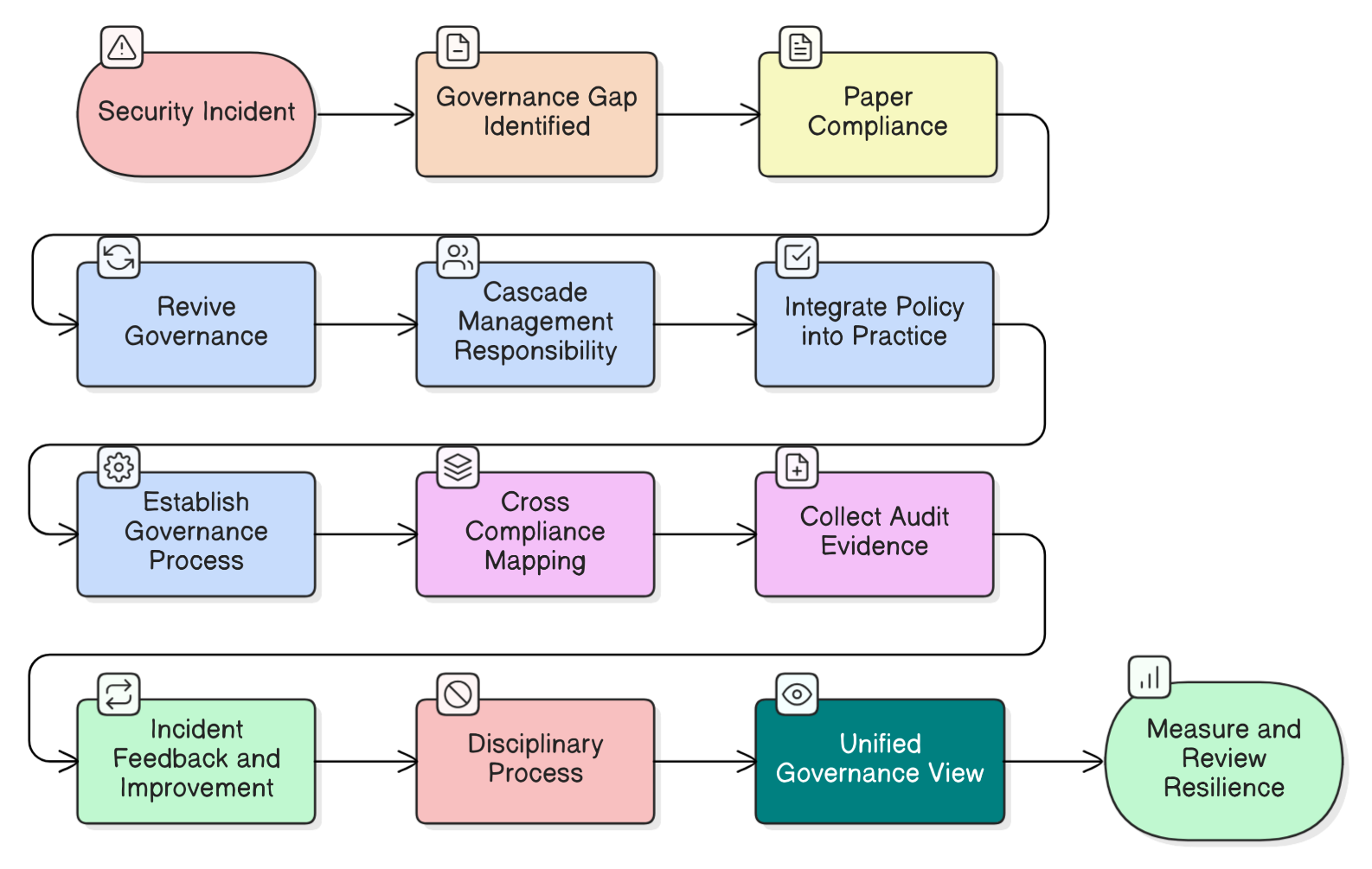
Maria, the CISO of a fast-growing fintech firm, was jolted awake by a P1 alert. A production database, supposedly isolated, was communicating with an unknown external IP address. Her SOC team was already engaged, tracing the connection back to a misconfigured cloud storage bucket created by a marketing analytics team testing a new customer segmentation tool. The immediate damage was contained, but the post-mortem revealed a far more dangerous problem, one that had nothing to do with firewalls or malware.
The marketing manager who commissioned the tool had no formal security oversight. The DevOps engineer who spun up the environment bypassed standard security checks to meet a tight deadline. The data in the bucket, though anonymized, was sensitive enough to trigger contractual notification clauses with several key clients.
The root cause was not a technical vulnerability. It was a catastrophic failure of governance. Maria had policies, she had tools, and she had a talented team. What she lacked was a governance framework that was alive, enforced, and understood beyond the security department. Her company was compliant on paper, its ISO/IEC 27001:2022 certificate still shiny on the wall, but it was not resilient in practice.
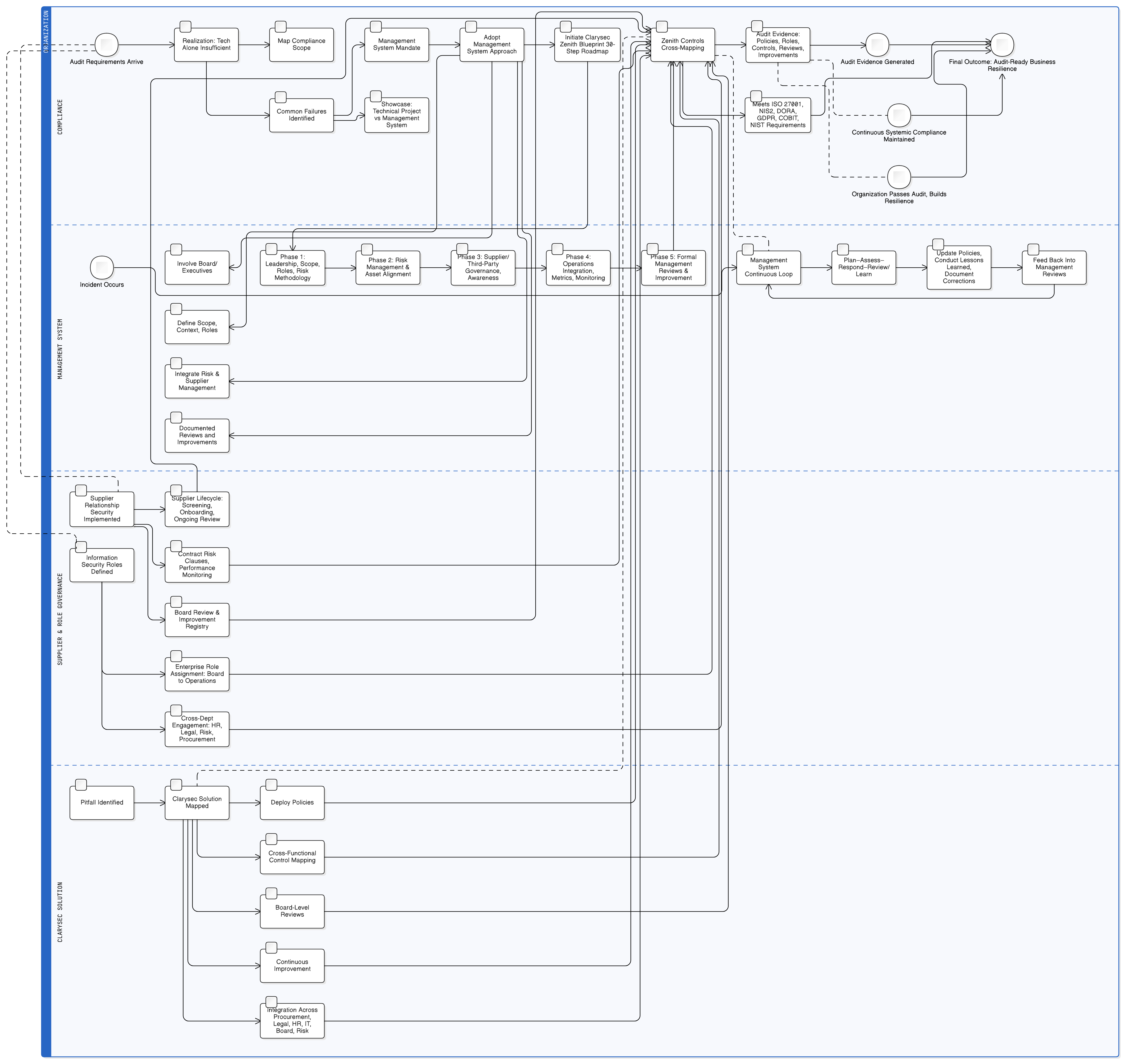
This is the critical gap where many organizations, and their CISOs, stumble. They mistake the artifacts of governance, the policies and checklists, for governance itself. This article breaks down where this thinking goes wrong and provides a concrete roadmap for transforming paper compliance into sustained business control using Clarysec’s integrated toolkit.
Beyond the Binder: Redefining Governance as a Verb
For too long, governance has been treated as a noun, a static collection of documents stored on a server. True information security governance, however, is a verb. It is the continuous set of actions that leadership takes to direct, monitor, and support security as a core business function. It is about creating a system where everyone, from the boardroom to the development team, understands their role in protecting the organization’s information assets.
Frameworks from ISO/IEC 27001:2022 to NIS2 begin with this truth: governance is a management function, not a technical one. According to ISO/IEC 27014:2020, top management must create an information security strategy aligned with organizational goals. This strategy must ensure security requirements meet both internal and external needs, including legal, regulatory, and contractual commitments. To confirm this, leadership must commission independent audits, foster a culture that actively supports security, and ensure objectives, roles, and resources are well-coordinated.
The problem is that this “tone at the top” often fails to translate into action at the operational level. This is where the most critical, and often misunderstood, control comes into play: management responsibilities.
The Cascading Effect: Why Security Cannot Stop at the CISO
The single greatest point of failure in any Information Security Management System (ISMS) is the assumption that the CISO is solely responsible for security. In reality, the CISO is the conductor, but the managers of each business unit are the musicians. If they do not play their part, the result is noise, not harmony.
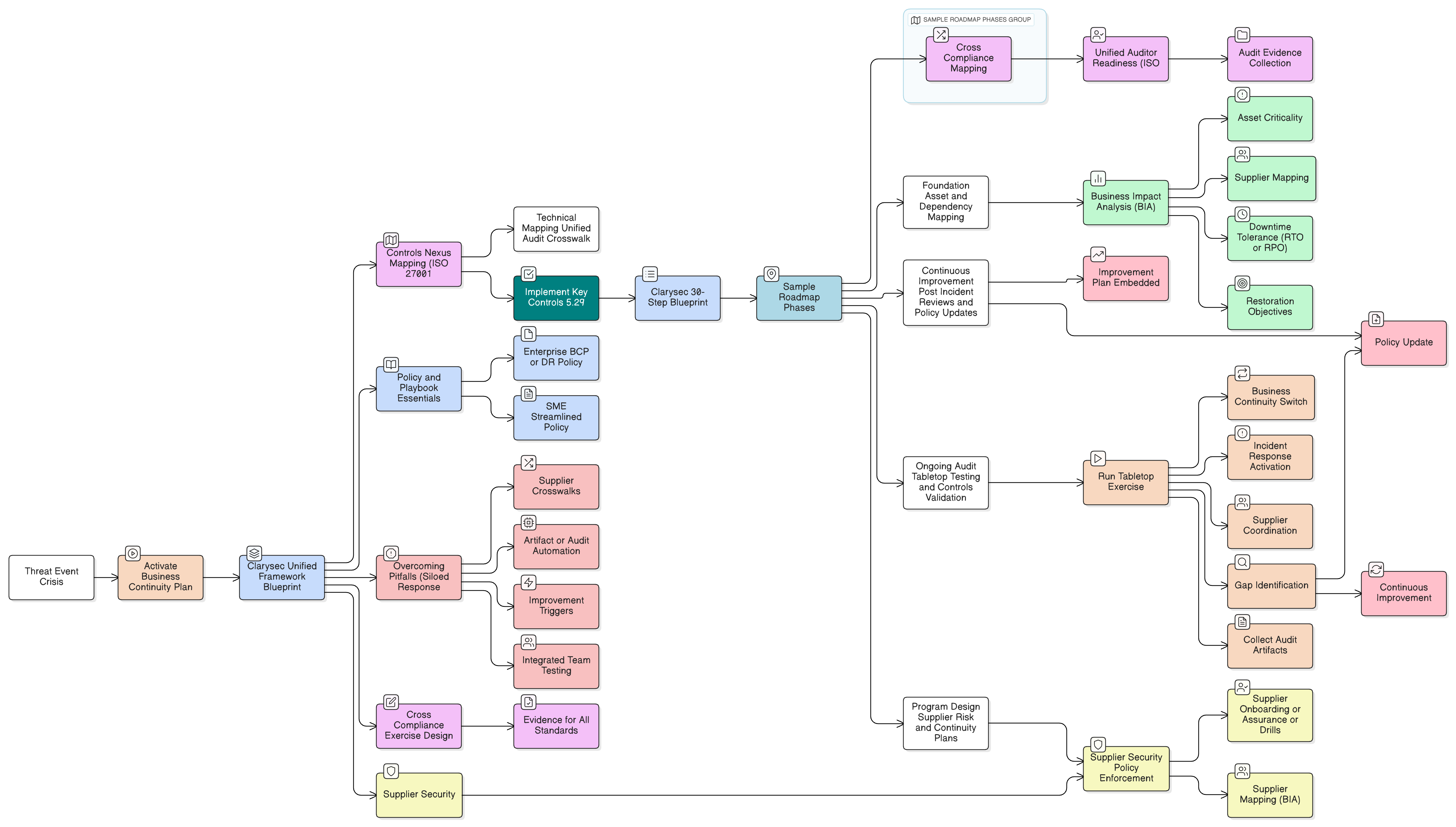
This is precisely what ISO/IEC 27001:2022 addresses in control 5.4, “Management responsibilities.” This control mandates that information security responsibilities are assigned and enforced throughout the organization. As our Zenith Blueprint: An Auditor’s 30-Step Roadmap highlights in Step 23, this control is about ensuring that security leadership cascades through every layer of the organization.
“Ultimately, Control 5.4 reinforces that security leadership does not stop at the CISO. It must cascade through every layer of operational management, because the success or failure of your ISMS often hinges not on policies or tools, but on whether managers actively champion security in their own domains.” Zenith Blueprint
In Maria’s case, the marketing manager saw security as a blocker, not a shared responsibility. The DevOps engineer saw a deadline, not a duty of care. A living governance framework would have embedded security checkpoints into the project initiation process and performance metrics for the DevOps team. This transforms governance from a compliance burden into a tool for avoiding disaster.
From Theory to Practice: Building Governance with Actionable Policies
A policy on a shelf is an artifact; a policy integrated into daily operations is a control. To operationalize governance, organizations need an unambiguous definition of duties. Our Governance Roles & Responsibilities Policy is designed to achieve exactly this. One of its core objectives is:
“To maintain a governance model that enforces segregation of duties, eliminates conflicts of interest, and enables escalation of unresolved security issues.” Governance Roles & Responsibilities Policy
This statement transforms a high-level principle into a concrete, auditable requirement. It creates a framework for layered accountability, where every management tier is on record for owning its part of the security program. For smaller organizations, the Governance Roles & Responsibilities Policy - SME simplifies this, stating directly in clause 4.3.3 that every employee “Must report incidents and compliance issues to the General Manager immediately.” This clarity removes ambiguity and empowers everyone to act.
Let’s return to Maria’s incident and see how she could use the Clarysec toolkit to rebuild her governance approach, turning a reactive failure into a proactive, resilient system.
Policy as the Foundation: First, she would implement the Governance Roles & Responsibilities Policy. Working with HR, she would integrate specific security duties into job descriptions for all managers, from marketing to finance. This makes security a formal part of their role, not an afterthought.
Defining the “How”: Next, she would use the policy to establish a clear process. Clause 7.2.2 of the policy states, “Governance-related risks must be reviewed by the ISMS Steering Committee and validated during internal audits.” This creates a formal venue where the marketing manager’s new project would have been reviewed before any cloud environment was created, preventing the initial misconfiguration.
Leveraging Cross-Compliance Intelligence: To understand the full scope of her new governance model, Maria would consult Zenith Controls: The Cross-Compliance Guide. This resource shows how “Management responsibilities” (ISO 5.4) is not an isolated task but a central hub connecting to other critical controls. For instance, it reveals the direct link between 5.4 and 5.8 (“Information security in project management”), ensuring that management provides the necessary oversight to embed security into all new initiatives.
This proactive approach moves governance from a reactive, post-incident analysis to a business-enabling function. It ensures that when a manager wants to launch a new tool, their first thought is not “How do I get this past security?” but “Who on the security team do I need to partner with?”
The Auditor Is Coming: Proving Your Governance Is Real
A skilled auditor is trained to look for evidence of implementation, a concept the Zenith Blueprint calls the alignment of policy with “reality.” When an auditor assesses your governance framework, they are not just reading documents; they are testing your organization’s muscle memory. They probe for evidence that governance is alive, active, and responsive.
Different auditors will scrutinize your governance framework from different angles. Here is how they would test Maria’s new, robust governance model:
The ISO/IEC 27001:2022 Auditor: This auditor will go straight to the evidence of leadership commitment required by Clause 5.1. They will ask for the minutes from management review meetings (Clause 9.3). They will look for agenda items where security performance was discussed, resources were allocated, and decisions were made based on risk assessments. They want to see that leadership is not just receiving reports but actively steering the ISMS.
The COBIT 2019 Auditor: A COBIT auditor thinks in terms of enterprise goals. They will focus on governance objectives like EDM03 (“Ensured Risk Optimization”). They will ask to see the risk reports presented to the board and want to know if management is tracking key security indicators and taking corrective action when those indicators trend negative. For them, governance is about ensuring security enables and protects business value.
The ISACA Auditor: Guided by frameworks like ITAF, this auditor is keenly focused on the “tone at the top.” They will conduct interviews with senior leaders to gauge their understanding and commitment. A slow or dismissive response from management to a previous audit finding is a major red flag, indicating a weak governance culture.
The NIS2 or DORA Regulator: With regulations like NIS2 and DORA, the stakes are higher. These frameworks place direct, personal liability on management bodies for cybersecurity failures. An auditor from a competent authority will demand evidence that the board has approved the cybersecurity risk management framework, overseen its implementation, and received specialized training. They are looking for proof that management is not just aware but actively engaged and accountable.
To satisfy these diverse audit approaches, you need to present more than just policies. You need a portfolio of evidence.
| Audit Focus Area | Required Evidence |
|---|---|
| Top Management Engagement | Management review meeting minutes, approved budgets, board presentations, and strategic communications. |
| Effectiveness Reviews | Action logs from management decisions, tracked mitigation actions from risk assessments. |
| Accountability & Response | RACI matrices, job descriptions with security duties, incident reports showing escalation to management. |
| Formal Assignment | Signed charters for security committees, formal role descriptions for risk owners, annual attestations from department heads. |
If your evidence amounts to policy PDFs and no operational logs, you will fail the audit. The Zenith Controls guide helps you assemble the right portfolio to demonstrate evidence, not just intent.
The Feedback Loop: Turning Incidents into Resilience
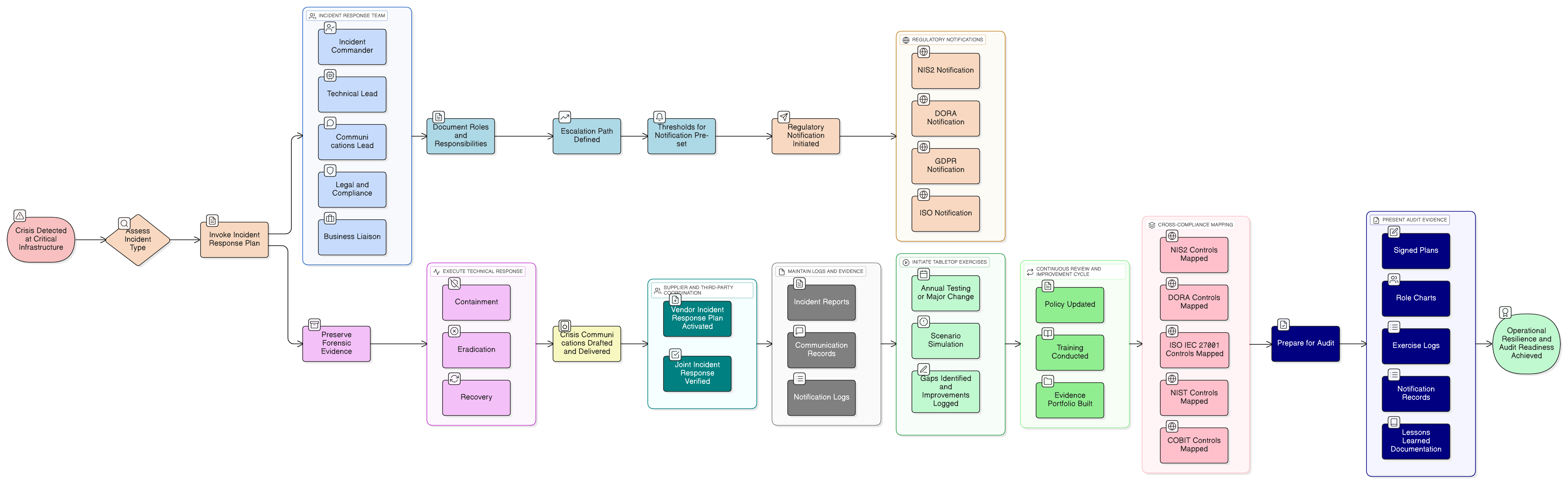
Ultimately, the strongest proof of a resilient governance framework is how the organization responds to failure. True resilience means learning, adapting, and acting. As the Zenith Blueprint states when discussing control 5.24 (“Information security incident management planning and preparation”):
“What defines a secure organization is not the absence of incidents, but the preparedness to handle them when they arise… This control is about improvement, not just closure. Auditors will ask: ‘What did you learn from your last incident?’ They’ll expect to see root cause analysis, lessons captured, and most importantly, evidence that something changed as a result.”
In Maria’s case, the “something that changed” was not just a firewall rule. It was the implementation of a governance process that required management sign-off for new projects, a clear RACI matrix for cloud deployments, and mandatory security training for the marketing team. Her ability to demonstrate this learning loop would turn a potential major non-conformity into evidence of a mature, improving ISMS.
This is where governance proves its value. A failure is no longer just a technical problem to be fixed but an organizational lesson to be learned and integrated. As the Governance Roles & Responsibilities Policy states in section 9.1.1.4, “Significant audit findings or incidents involving governance failure” are not buried; they are reviewed, escalated, and acted upon.
Making Governance Stick: The Role of Accountability
Even with the best policies and management buy-in, governance can fail if there are no consequences for non-compliance. A truly robust framework must be supported by a fair, consistent, and well-communicated disciplinary process. This is the focus of ISO/IEC 27001:2022 control 6.4, “Disciplinary process.”
This control ensures that the rules of the ISMS are not optional. It provides the enforcement mechanism that demonstrates leadership’s commitment to security. As detailed in Zenith Controls, this process is a critical risk treatment for insider threats and negligence. It works in tandem with other controls: monitoring activities (8.16) may identify a policy breach, while the disciplinary process (6.4) dictates the formal response.
“Disciplinary actions are more defensible when employees have been adequately trained and made aware of their responsibilities. Control 6.4 relies on 6.3 (Information security awareness, education and training) to ensure personnel cannot claim ignorance of policies they’ve violated.”
An auditor will check that this process is applied consistently at all levels, ensuring that a senior executive who violates the clean desk policy is subject to the same process as an intern. This is the final link in the chain, turning governance from guidance into an enforceable standard.
The Unified Compliance Map: A Single View of Governance
The pressure of modern governance is that it never sits in a single framework. Regulations like NIS2 and DORA have elevated management responsibility from a best practice to a legal mandate with personal liability. A resilient CISO must be able to demonstrate governance in a way that satisfies multiple auditors simultaneously.
This unified table, derived from the mappings in Zenith Controls, shows how the principle of management responsibility is a universal requirement across major frameworks.
| Framework/Standard | Relevant Clause/Control | How It Maps to Executive Responsibility (ISO 5.4) |
|---|---|---|
| ISO/IEC 27001:2022 | Clauses 5.1, 5.2, 9.3 | Requires active leadership, integration of the ISMS into business processes, and regular management reviews. |
| EU NIS2 | Article 21(1) | Management bodies must approve and oversee cybersecurity risk management practices, with personal liability for failures. |
| EU DORA | Article 5(2) | The management body holds ultimate responsibility for the entity’s ICT risk management framework and operational resilience. |
| EU GDPR | Articles 5(2), 24(1) | The accountability principle requires controllers (senior management) to demonstrate compliance and implement appropriate measures. |
| NIST SP 800-53 | PM-1, PM-9 | Leadership must establish the security program plan and create a risk executive function for unified oversight. |
| COBIT 2019 | EDM03 | The board and executive management must evaluate, direct, and monitor security initiatives to ensure alignment with business goals. |
The takeaway is clear: all auditors, regardless of their framework, are converging on the same demand: “Show me the governance in action.”
Conclusion: Turning Your Governance from a Checkbox into a Compass
The painful truth is that “compliant” organizations are breached every day. “Resilient” organizations, however, survive and adapt. Resilience requires the deep integration of policy, technology, and true executive ownership. It is not a parade of forms but a culture where security and business strategy move in lockstep.
Start by asking the hard questions:
- Is our security leadership visible? Do managers outside of security actively participate in risk decisions?
- Are responsibilities clear? Can every manager articulate their specific duties for protecting information in their domain?
- Is governance integrated? Are security considerations built into our project management, procurement, and HR processes from the start?
- Do we learn from our mistakes? When an incident occurs, does it trigger a review of our governance framework, not just our technical controls?
The difference between surviving an incident or failing under regulatory scrutiny is how deeply governance is woven into the fabric of your operations. It is the compass that guides your organization through uncertainty. In the moment of crisis, only real governance stands between compliance and catastrophe.
Next Steps: Make Your Resilience Measurable
- Use the Zenith Blueprint to perform a reality check on your management accountability and ensure security has visibility across the business.
- Implement Clarysec’s policies like the Governance Roles & Responsibilities Policy as living documents that drive training, escalation, and correction.
- Leverage Zenith Controls to ensure you are audit-ready across ISO/IEC 27001:2022, NIS2, DORA, and more, with concrete mappings and evidence packs.
Ready to evolve your governance from a checkbox to a compass? Book an ISMS governance review with Clarysec and get your executive team truly in the driver’s seat.
References:
- Zenith Blueprint: An Auditor’s 30-Step Roadmap
- Zenith Controls: The Cross-Compliance Guide
- Governance Roles & Responsibilities Policy
- Governance Roles & Responsibilities Policy - SME
- ISO/IEC 27001:2022, ISO/IEC 27014:2020, ISO/IEC 27005:2022, DORA, NIS2, GDPR, NIST SP 800-53 Rev.5, COBIT 2019.
Frequently Asked Questions
About the Author

Igor Petreski
Compliance Systems Architect, Clarysec LLC
Igor Petreski is a cybersecurity leader with over 30 years of experience in information technology and a dedicated decade specializing in global Governance, Risk, and Compliance (GRC).Core Credentials & Qualifications:• MSc in Cyber Security from Royal Holloway, University of London• PECB-Certified ISO/IEC 27001 Lead Auditor & Trainer• Certified Information Systems Auditor (CISA) from ISACA• Certified Information Security Manager (CISM) from ISACA • Certified Ethical Hacker from EC-Council