The Weak Link: A CISO’s Playbook for Building a NIS2-Compliant Supply Chain Risk Program

The alert was innocuous, a minor blip from a third-party monitoring service. For Anya, the CISO of a mid-sized logistics firm, it was the third such notification in a month from the same supplier: “Log-in Anomaly Detected.” The supplier, a small but critical provider of fleet management software, assured her it was nothing. A false positive. But Anya knew better. These weren’t just technical glitches; they were tremors, signaling a deeper instability in a critical part of her supply chain. With her company now classified as an “important entity” under the NIS2 Directive, these tremors felt like the precursor to an earthquake.
The old way of managing suppliers, a handshake and a loosely worded contract, is officially dead. NIS2 makes it painfully clear that an organization’s cybersecurity posture is only as strong as its weakest link. The weak link is no longer “out there”- it is inside your supply chain. Under NIS2, failure to manage vendor risk is not just a technical lapse. It is a board-level regulatory threat, with operational, reputational, and financial repercussions. Anya’s problem wasn’t just a single, shaky supplier. It was a systemic vulnerability woven into the fabric of her operations, and the auditors would be looking for it. She needed more than a quick fix; she needed a playbook.
This guide provides that playbook. We will walk through a structured approach for CISOs, compliance managers, and auditors to build a defensible, cross-regulatory supply chain risk program. By leveraging a robust framework like ISO/IEC 27001:2022 and Clarysec’s expert toolkits, you can bridge urgent supply chain risks with actionable methods to satisfy NIS2, DORA, GDPR, and beyond.
The Risk Mandate: How NIS2 Redefines Supply Chain Security
The NIS2 directive transforms supply chain security from mere best practice into a legally binding obligation. It demands a risk-based, ongoing approach to securing ICT and OT supply chains, extending its scope across numerous sectors and holding management directly accountable for compliance failures. This means:
- Expanded Scope: Every supplier, sub-processor, cloud provider, and outsourcer that touches your ICT environment is in scope.
- Continuous Improvement: NIS2 mandates a living process of risk assessment, monitoring, and adaptation, not a “one and done” review. This process must be driven by both internal events (incidents, breaches) and external changes (new laws, supplier service updates).
- Mandatory Controls: Incident response, vulnerability handling, regular security testing, and robust encryption are now required across the supply chain, not just within your own perimeter.
This blurs the boundaries between internal security and third-party risk. Your supplier’s cyber failure is your regulatory crisis. A structured framework like ISO/IEC 27001:2022 becomes indispensable, providing the controls and processes needed to build a resilient and auditable program that meets NIS2’s demands. The journey begins not with technology, but with a strategy focused on three core controls:
- 5.19 - Information security in supplier relationships: Establishing the strategic framework for managing supplier risk.
- 5.20 - Addressing information security within supplier agreements: Codifying security expectations into legally binding contracts.
- 5.22 - Monitoring, review and change management of supplier services: Ensuring continuous oversight and adaptation throughout the supplier lifecycle.
Mastering these three areas will transform your supply chain from a source of anxiety into a well-managed, compliant, and resilient asset.
Step 1: Building the Governance Foundation with Control 5.19
Anya’s first realization was that she couldn’t treat all suppliers equally. The provider of her office stationery was not the same as the provider of her critical fleet management software. The first step in building a NIS2-compliant program is to understand and classify your supplier ecosystem based on risk.
Control 5.19, Information security in supplier relationships, is the strategic cornerstone. It forces you to move beyond a simple vendor list and create a tiered system of governance. This process must be driven by clear, board-endorsed policy. Clarysec’s Third-Party and Supplier Security Policy directly links this activity to the organization’s broader risk management framework:
“P6 – Risk Management Policy. Guides the identification, assessment, and mitigation of risks associated with third-party relationships, including inherited or systemic risks from supplier ecosystems.” From section ‘Related Policies and Linkages’, policy clause 10.2.
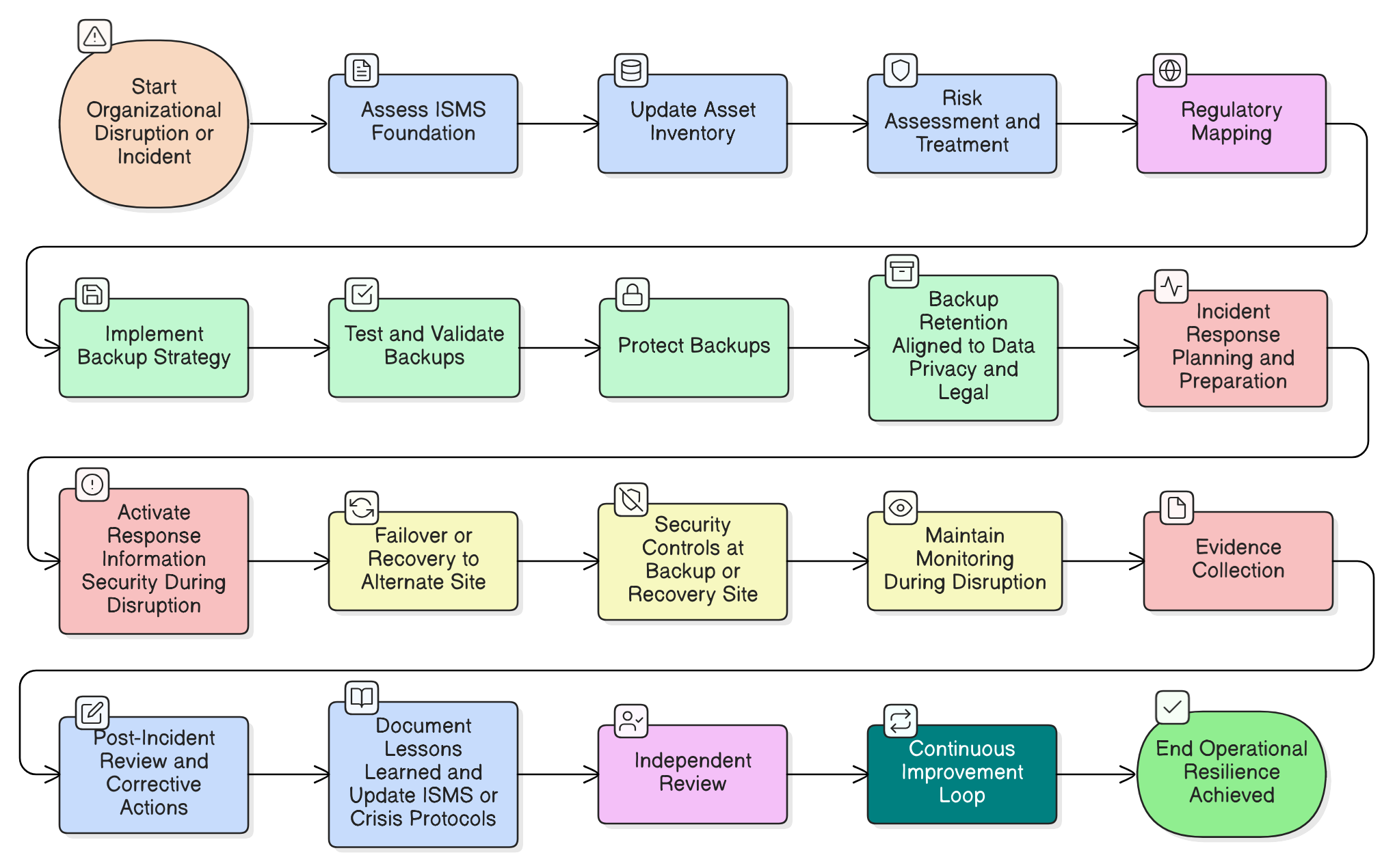
This integration ensures that risks from downstream dependencies, or “fourth-party” exposures, are managed as part of your own ISMS. The classification process itself should be methodical. In Step 23 of the ‘Audit & Improvement’ phase, the Zenith Blueprint: An Auditor’s 30-Step Roadmap guides organizations to classify suppliers based on critical questions:
- Does the supplier handle or process your sensitive or regulated information?
- Do they provide infrastructure or platforms upon which your critical operations depend?
- Do they manage or maintain systems on your behalf?
- Could their compromise directly impact your confidentiality, integrity, or availability objectives?
Anya used this logic to re-evaluate her fleet management software provider. They processed real-time location data (sensitive), their platform was integral to daily operations (critical infrastructure), and a compromise could halt deliveries (high availability impact). Instantly, they were reclassified from a “standard vendor” to a “critical, high-risk supplier.”
This risk-based tiering dictates the level of due diligence, contractual rigor, and ongoing monitoring required. As our Zenith Controls: The Cross-Compliance Guide clarifies, this approach directly aligns with the expectations of major regulations.
| Regulation | Requirement | How Control 5.19 Addresses It |
|---|---|---|
| NIS2 | Article 21(2)(d) obligates risk management for supply chains. | Provides the framework for identifying and tiering supplier risk. |
| DORA | Articles 28-30 force critical IT and financial service supplier classification. | Establishes the process for classifying ICT providers by criticality. |
| GDPR | Article 28 requires controllers to use only processors providing guarantees. | Forms the basis for the due diligence needed to assess guarantees. |
This foundational step is not just an internal exercise; it’s the bedrock upon which your entire defensible supply chain security program is built.
Step 2: Forging Ironclad Agreements with Control 5.20
With her high-risk supplier identified, Anya pulled up their contract. It was a standard procurement template, with a vague confidentiality clause and little else related to cybersecurity. It contained no specific security controls, no breach notification timeline, and no right to audit. In the eyes of a NIS2 auditor, it was worthless.
This is where Control 5.20, Addressing information security within supplier agreements, becomes critical. It is the mechanism for translating the risks identified in 5.19 into enforceable, legally binding obligations. A contract is not just a commercial document; it is a primary security control.
Your policies must drive this transformation. The Third-Party and Supplier Security Policy establishes this as a core objective:
“Align third-party security controls with applicable regulatory and contractual obligations, including GDPR, NIS2, DORA, and ISO/IEC 27001 standards.” From section ‘Objectives’, policy clause 3.6.
This clause transforms the policy from a guideline into a direct mandate for procurement and legal teams. For Anya, this meant going back to the supplier to renegotiate. The new contract addendum included specific, non-negotiable clauses:
- Breach Notification: The supplier must report any suspected security incident affecting her company’s data or services within 24 hours, not “in a reasonable timeframe.”
- Right to Audit: The company reserves the right to conduct security assessments or request third-party audit reports (like a SOC 2 Type II) annually.
- Security Standards: The supplier must adhere to specific security controls, such as multi-factor authentication for all administrative access and regular vulnerability scanning of their platform.
- Sub-processor Management: The supplier must disclose and obtain prior written approval for any of their own subcontractors who will handle the company’s data.
- Exit Strategy: The contract must define procedures for secure data return or destruction upon termination, ensuring a clean offboarding process.
As Zenith Controls highlights, this practice is central to multiple frameworks. GDPR’s Article 28(3) mandates detailed data processing agreements. DORA’s Article 30 prescribes an exhaustive list of contractual provisions for critical ICT providers. By implementing a robust Control 5.20, Anya wasn’t just satisfying ISO/IEC 27001:2022; she was building a defensible position for NIS2, DORA, and GDPR audits simultaneously.
Step 3: The Watchtower- Continuous Monitoring with Control 5.22
Anya’s initial problem, the recurring security alerts, stemmed from a classic failure: “sign and forget.” A strong contract is useless if it’s filed away and never referenced again. The final piece of the puzzle is Control 5.22, Monitoring, review and change management of supplier services. This is the operational control that ensures the promises made in the contract are kept.
This control transforms supplier management from a static, onboarding activity into a dynamic, ongoing process. According to Zenith Controls, this involves several interconnected activities:
- Performance Reviews: Regularly scheduled meetings (e.g., quarterly for high-risk suppliers) to discuss performance against security SLAs, review incident reports, and plan for upcoming changes.
- Audit Artifact Review: Proactively requesting and analyzing supplier audit reports, certifications, and penetration test results. An auditor will check if you are not just collecting these reports but are actively tracking and managing any exceptions they contain.
- Change Management: When a supplier changes their service- by migrating to a new cloud provider or introducing a new API- this must trigger a security review on your end. This prevents suppliers from unknowingly introducing new risks into your environment.
- Continuous Monitoring: Leveraging tools and intelligence feeds to stay informed about a supplier’s external security posture. A sudden drop in a security rating or news of a breach should trigger an immediate response.
This continuous loop of monitoring, reviewing, and adapting is the essence of the “ongoing risk management process” that NIS2 demands. It ensures that trust is never assumed; it is continuously verified.
An Actionable Example: The Supplier Review Checklist
To make this practical, Anya’s team created a checklist for their new quarterly reviews with the fleet management provider, based on the audit methodologies outlined in Zenith Controls.
| Review Area | Evidence to Collect & Discuss | Desired Outcome |
|---|---|---|
| SLA & Performance | Uptime reports, incident logs, support ticket resolution times. | Verify compliance with contractual availability and support commitments. |
| Security Incidents | Detailed report on all security alerts (including “false positives”), root cause analysis, and remediation actions. | Confirm transparent reporting and effective incident handling. |
| Compliance & Audits | Latest SOC 2 report or penetration test summary. | Review findings and track the supplier’s remediation plan for any identified vulnerabilities. |
| Vulnerability Management | Patching cadence reports for critical systems. | Ensure the supplier is meeting their obligation to patch critical vulnerabilities in a timely manner. |
| Upcoming Changes | Discussion of the supplier’s product roadmap, infrastructure changes, or new sub-processors. | Proactively assess the security implications of future changes before they are implemented. |
This simple tool transformed the conversation from a generic catch-up into a focused, evidence-based security governance meeting, creating an auditable record of continuous oversight.
Defining Your Line in the Sand: Risk Acceptance in a NIS2 World
The initial incident with the supplier forced Anya to confront a fundamental question: what level of risk is acceptable? Even with the best contracts and monitoring, some residual risk will always remain. This is where a clear, management-approved definition of risk acceptance criteria is non-negotiable.
In Step 10 of its ‘Risk & Implementation’ phase, the Zenith Blueprint provides critical guidance on this point. It’s not enough to say “we accept low risks.” You must define what that means in the context of your legal and regulatory obligations.
“Also consider legal/regulatory requirements in your acceptance criteria. Some risks might be unacceptable regardless of likelihood due to laws… Similarly, NIS2 and DORA impose certain baseline security requirements – not meeting them (even if the probability of incident is low) may pose unacceptable compliance risk. Incorporate these perspectives: e.g. “Any risk that could lead to non-compliance with applicable laws (GDPR, etc.) is not acceptable and must be mitigated.””
This was a game-changer for Anya. She worked with her legal and procurement teams to update their risk management policy. The new criteria explicitly stated that any critical supplier failing to meet the baseline security requirements mandated by NIS2 would represent an unacceptable risk, triggering an immediate risk treatment plan. This took the ambiguity out of decision-making and created a clear governance trigger. As stated in the Third-Party and Supplier Security Policy:
“High-risk exceptions (e.g., suppliers handling regulated data or supporting critical systems) must be approved by the CISO, Legal, and Procurement Leadership and entered into the ISMS Exception Register.” From section ‘Risk Treatment and Exceptions’, policy clause 7.3.
The Auditor Is Here: Navigating the Multi-Lens Scrutiny
Six months later, when the internal auditors arrived to conduct a NIS2 readiness assessment, Anya was prepared. She knew they would view her supply chain program through multiple lenses.
The ISO/IEC 27001:2022 Auditor: This auditor focused on process and evidence. They asked for the supplier inventory, verified its risk-categorization, sampled contracts for specific security clauses, and reviewed the minutes from quarterly review meetings. Her structured approach, built on controls 5.19, 5.20, and 5.22, provided a clear, auditable trail.
The COBIT 2019 Auditor: With a governance mindset, this auditor wanted to see linkage to business objectives. They asked how supplier risk was reported to the executive risk committee. Anya presented her risk register, showing how the supplier’s risk rating was determined and how it mapped to the company’s overall risk appetite.
The NIS2 Assessor: This individual had a laser focus on systemic risk to essential services. They didn’t just care about the contract; they wanted to know what would happen if the supplier went offline entirely. Anya walked them through her business continuity plan, which now included a section on critical supplier failure, developed in line with ISO/IEC 22301:2019 principles.
The GDPR Auditor: Seeing that the supplier processed location data, this auditor immediately honed in on data protection. They requested the Data Processing Agreement (DPA) and evidence of her due diligence in ensuring the supplier provided “sufficient guarantees” as required by Article 28. Because her process integrated privacy from the start, the DPA was robust.
This multi-lens audit perspective shows that a well-implemented ISMS based on ISO/IEC 27001:2022 doesn’t just satisfy one standard. It creates a resilient, defensible position across the entire regulatory landscape. The table below summarizes how these steps create auditable evidence for any inspection.
| Step | Policy/Control Ref | NIS2 Map | GDPR Map | DORA Map | Action Evidence |
|---|---|---|---|---|---|
| Tier suppliers | 5.19, Blueprint S10/S23 | Article 21 | Article 28 | Art. 28-30 | Risk-tiered supplier inventory in the ISMS. |
| Security contract clauses | 5.20, ISO/IEC 27036-2 | Article 22 | Article 28(3) | Art. 30 | Sample contracts with security addendums, SLAs. |
| Ongoing review | 5.22, ISO/IEC 22301 | Article 21 | Article 32 | Art. 31 | Meeting minutes, performance dashboards, audit logs. |
| Data protection terms | 5.20, ISO/IEC 27701 | Recital 54 | Arts. 28, 32 | Art. 30 | Executed Data Processing Agreements (DPAs). |
| Incident notification | 5.22, ISO/IEC 27036-2 | Article 23 | Arts. 33, 34 | Art. 31 | Supplier incident logs, communication records. |
| Exit/termination | 5.20, ISO/IEC 27001:2022 A.5.11 | Relevant for resilience | Article 28(3) | Art. 30 | Data destruction certificates, offboarding checklists. |
Your Playbook for Action
Anya’s story is not unique. CISOs and compliance managers across the EU are facing the same challenge. The threat of regulatory fines and the personal liability imposed by NIS2 make supply chain risk a top-tier business concern. The good news is that the path forward is clear. By leveraging the structured, risk-based approach of ISO/IEC 27001:2022, you can build a program that is both compliant and genuinely resilient.
Don’t wait for an incident to force your hand. Start building your NIS2-compliant supply chain framework today:
- Establish Governance: Use Clarysec’s Third-Party and Supplier Security Policy - SME or enterprise templates to define your rules of engagement.
- Know Your Ecosystem: Apply the classification criteria from the Zenith Blueprint to identify and tier your critical, high-risk suppliers.
- Strengthen Your Contracts: Audit your existing supplier agreements against the requirements of ISO/IEC 27001:2022 Control 5.20, using the cross-compliance guidance in Zenith Controls to meet NIS2, DORA, and GDPR expectations.
- Implement Continuous Monitoring: Schedule your first quarterly security review with your most critical supplier and use our checklist as a guide. Document all findings in your ISMS.
- Prepare Audit Evidence: Compile sample contracts, review minutes, incident logs, and risk assessments mapped to the core controls for every critical supplier.
Your supply chain doesn’t have to be your weakest link. With the right framework, processes, and tools, you can turn it into a source of strength and a cornerstone of your cybersecurity strategy.
Ready to build a supply chain that satisfies regulators and the board? Download the Clarysec Zenith Blueprint to accelerate your journey to compliance and resilience today.
Frequently Asked Questions
About the Author

Igor Petreski
Compliance Systems Architect, Clarysec LLC
Igor Petreski is a cybersecurity leader with over 30 years of experience in information technology and a dedicated decade specializing in global Governance, Risk, and Compliance (GRC).Core Credentials & Qualifications:• MSc in Cyber Security from Royal Holloway, University of London• PECB-Certified ISO/IEC 27001 Lead Auditor & Trainer• Certified Information Systems Auditor (CISA) from ISACA• Certified Information Security Manager (CISM) from ISACA • Certified Ethical Hacker from EC-Council