Continuous Compliance Monitoring for NIS2 and DORA
The Friday afternoon question every CISO now has to answer
At 16:40 on a Friday, the CISO of a cloud-based payments platform receives three messages within ten minutes.
The first is from the CFO: “Our banking partner wants updated evidence that we meet DORA expectations for ICT third-party risk and incident reporting.”
The second is from General Counsel: “Our managed security service may put us in scope under national NIS2 implementation. Can we prove management oversight and control effectiveness?”
The third is from the Head of Engineering: “We patched the critical vulnerability, but the backlog shows 38 overdue medium findings. Do we need to escalate?”
This is the moment when annual compliance collapses.
A policy PDF, a risk register last updated before the previous audit, and a folder of screenshots are not enough for NIS2 and DORA. These regimes expect living governance, management oversight, incident workflows, supplier visibility, resilience testing, corrective action, and demonstrable control effectiveness.
For many CISOs, the pressure is not theoretical. NIS2 transposition across EU Member States has shifted cybersecurity from a technical program into a management accountability issue. DORA applies from 17 January 2025 and gives financial entities a sector-specific operational resilience rulebook for ICT risk, incident reporting, testing, and third-party risk. Cloud, SaaS, managed service, managed security, data centre, content delivery, trust service, and public electronic communications providers may also face direct or indirect obligations depending on scope, size, sector, national classification, and customer contracts.
The practical question is no longer, “Do we have a control?”
It is, “Who owns the control, what metric proves it is working, how often do we collect evidence, and what happens when the metric fails?”
That is the core of continuous compliance monitoring for NIS2 and DORA. In Clarysec implementations, we use ISO/IEC 27001:2022 as the management-system backbone, ISO/IEC 27002:2022 as the control language, Zenith Blueprint: An Auditor’s 30-Step Roadmap as the implementation sequence, and Zenith Controls: The Cross-Compliance Guide as the cross-compliance compass that connects ISO/IEC 27001:2022 evidence to NIS2, DORA, GDPR, NIST CSF 2.0, COBIT 2019, and audit expectations.
Why NIS2 and DORA make periodic compliance insufficient
NIS2 and DORA differ in legal structure, supervisory model, and scope, but they create the same operational pressure. Cybersecurity and ICT resilience must be governed continuously.
NIS2 requires essential and important entities to apply appropriate and proportionate technical, operational, and organisational measures using an all-hazards approach. Those measures include risk analysis, information system security policies, incident handling, business continuity, crisis management, supply chain security, secure acquisition and development, vulnerability handling, effectiveness assessment, cyber hygiene, training, cryptography, HR security, access control, asset management, and multi-factor authentication where appropriate. Management bodies must approve cybersecurity risk-management measures, oversee implementation, and receive training.
DORA makes this even more explicit for financial entities. It requires internal governance and control arrangements for ICT risk, a documented ICT risk management framework, management-body responsibility, ICT-related incident management and reporting, digital operational resilience testing, ICT third-party risk management, audit follow-up, training, and communication arrangements. DORA also makes clear that financial entities remain responsible for compliance when they use ICT third-party service providers.
This creates a new compliance reality. A CISO cannot wait until audit month to discover that:
- privileged access reviews were missed for two quarters;
- supplier exit plans were documented but never tested;
- incident severity criteria do not map to regulatory reporting thresholds;
- backups are configured but restoration evidence is missing;
- management never reviewed overdue risk treatments;
- cloud contracts lack audit rights, subcontractor visibility, or incident notification clauses.
The old project-based model creates panic cycles. Teams scramble before an audit, collect screenshots, update policy dates, and hope the evidence tells a coherent story. NIS2 and DORA are designed to make that approach fail. They focus on accountability, proportionality, resilience, and evidence of operation.
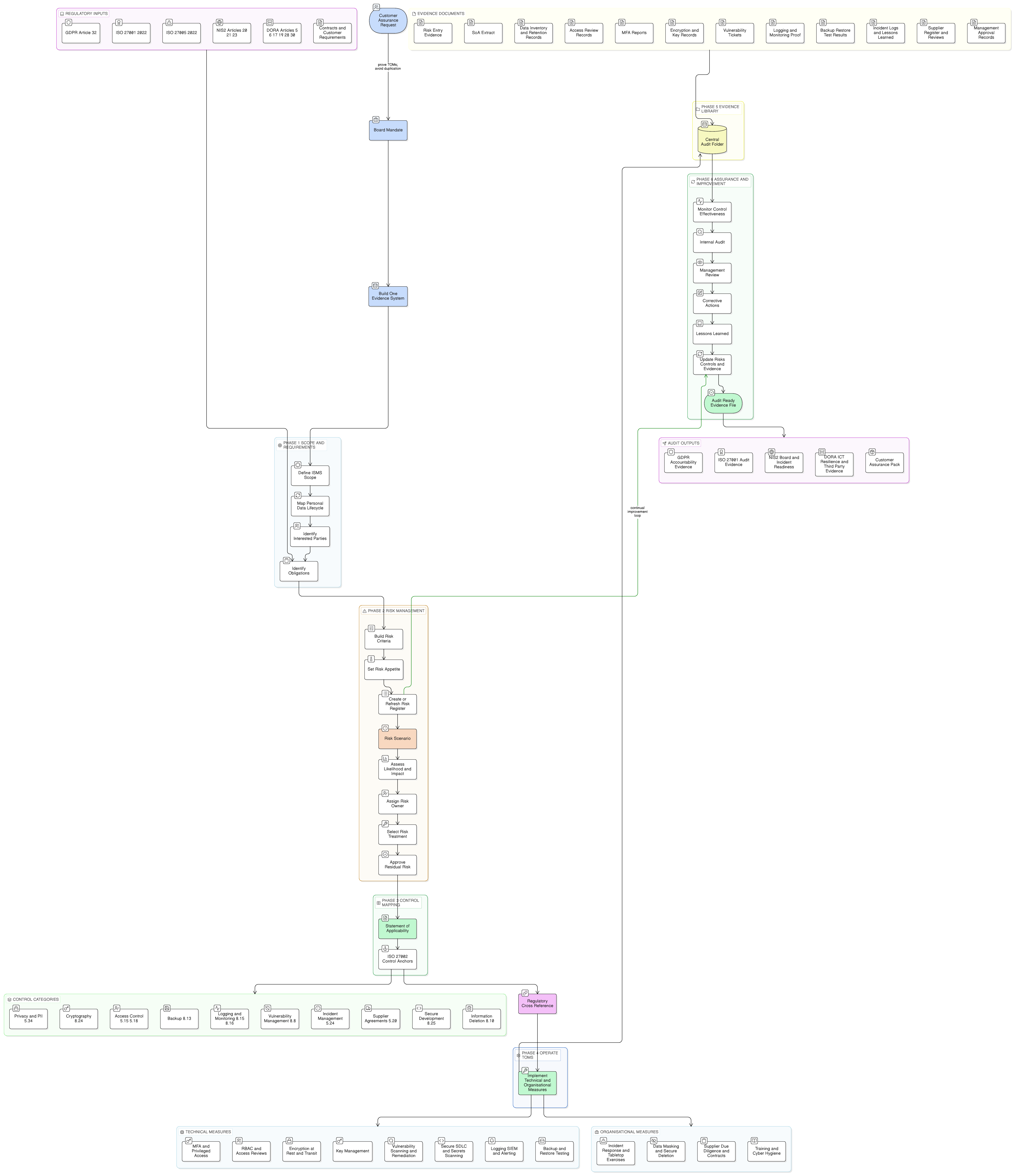
ISO/IEC 27001:2022 provides the operating system for this problem. Its clauses require organizations to understand context, interested parties, legal and contractual requirements, scope, leadership, roles, risk assessment, risk treatment, Statement of Applicability, operational planning, performance evaluation, internal audit, management review, nonconformity handling, and continual improvement. That structure is ideal for combining NIS2, DORA, GDPR, customer assurance, and internal risk into one continuous monitoring model.
Continuous compliance is not more dashboards. It is a governed evidence cadence.
Build the compliance engine on ISO/IEC 27001:2022
Many organizations misunderstand ISO/IEC 27001:2022 as only a certification framework. In practice, it is a risk management system for making security governance repeatable, measurable, and auditable.
That matters because NIS2 and DORA are not isolated checklists. They require an operating model that can absorb legal requirements, translate them into controls, assign ownership, monitor performance, and improve when gaps are found.
The foundational ISO/IEC 27001:2022 clauses provide that model:
| ISO/IEC 27001:2022 clause | Continuous compliance purpose | NIS2 and DORA value |
|---|---|---|
| 4.1 Understanding the organization and its context | Defines internal and external factors affecting cybersecurity and resilience | Captures regulatory exposure, business dependencies, threat environment, and operational context |
| 4.2 Understanding the needs and expectations of interested parties | Identifies regulators, customers, partners, suppliers, and legal obligations | Brings NIS2, DORA, GDPR, contracts, and supervisory expectations into the ISMS |
| 4.3 Determining the scope of the ISMS | Defines services, locations, technologies, suppliers, and business boundaries | Prevents regulated ICT services and critical dependencies from falling outside monitoring |
| 5.1 Leadership and commitment | Requires top management accountability and integration into business processes | Supports management-body accountability under NIS2 and DORA |
| 5.3 Organizational roles, responsibilities and authorities | Assigns ISMS responsibilities and authorities | Creates accountable control ownership and escalation paths |
| 6.1.3 Information security risk treatment | Selects controls and produces the Statement of Applicability | Converts obligations into a unified control framework |
| 9.1 Monitoring, measurement, analysis and evaluation | Requires monitoring of ISMS performance and effectiveness | Supports KPI, KRI, and evidence cadence design |
| 9.2 Internal audit | Tests whether the ISMS conforms and is effectively implemented | Supports independent assurance and regulatory defensibility |
| 9.3 Management review | Brings performance, risk, audit, and improvement information to leadership | Supports board-level oversight and decisions |
| 10.1 Continual improvement | Requires ongoing improvement of suitability, adequacy, and effectiveness | Converts findings into corrective action and resilience improvement |
For a FinTech, SaaS provider, managed security service, or ICT supplier to financial entities, this structure prevents duplicate compliance projects. One ISMS can map obligations to controls once, then reuse evidence across NIS2, DORA, GDPR, NIST CSF 2.0, COBIT 2019, ISO/IEC 27001:2022 certification, and customer assurance reviews.
Start with control ownership, not tools
The first failure pattern in continuous compliance is tool-first implementation. A company buys a GRC platform, imports hundreds of requirements, assigns everything to “Security,” and calls it continuous monitoring. Six months later, the dashboard is red, engineering disputes vulnerability evidence, legal says supplier documents are incomplete, and management cannot see residual risk clearly.
ISO/IEC 27001:2022 avoids this by requiring responsibilities and authorities to be assigned and communicated. NIS2 and DORA reinforce the same expectation through management accountability, defined roles, and oversight.
Clarysec’s Governance Roles and Responsibilities Policy - SME states:
Each role with a security responsibility must be recorded in a central log and acknowledged in writing.
That clause is more important than most dashboards. If backup testing, vulnerability remediation, supplier due diligence, incident classification, and privileged access review do not have named owners, there is no reliable evidence cadence.
The Information Security Policy makes this operational for enterprise environments:
Collect and retain audit evidence for audits and control reviews.
It also requires control owners to:
Report control performance and any gaps or issues to the ISMS Manager.
In Zenith Controls, this topic maps directly to ISO/IEC 27002:2022 control 5.2 Information Security Roles and Responsibilities, 5.35 Independent Review of Information Security, and 5.36 Compliance with Policies, Rules and Standards for Information Security.
| ISO/IEC 27002:2022 control referenced in Zenith Controls | Continuous compliance role | Why it matters for NIS2 and DORA |
|---|---|---|
| 5.2 Information Security Roles and Responsibilities | Assigns accountable owners for controls, evidence, KPIs, KRIs, and escalation | Supports management oversight, role clarity, and operational accountability |
| 5.35 Independent Review of Information Security | Tests whether monitoring is objective, complete, and effective | Supports NIS2 effectiveness assessment and DORA audit expectations |
| 5.36 Compliance with Policies, Rules and Standards for Information Security | Verifies that policies, standards, and obligations are followed | Converts legal and contractual obligations into measurable compliance checks |
The Zenith Blueprint gives a practical starting point in the ISMS Foundation & Leadership phase, Step 4: Roles and Responsibilities in the ISMS. It recommends formal appointment, job description updates, KPI alignment, organization-wide communication, and department-level responsibility.
A typical appointment record may say:
“Effective immediately, you are appointed as Information Security Officer with responsibility to oversee and coordinate the ISMS, including risk management, control implementation, and compliance monitoring.”
That appointment is not bureaucracy. It is audit evidence for ISO/IEC 27001:2022 leadership and role assignment. It also supports NIS2 management oversight and DORA governance. Regulators, certification auditors, and banking customers want to see that responsibility is not implied. It is assigned, acknowledged, resourced, and monitored.
A practical control ownership register should include these fields:
| Field | Example | Audit value |
|---|---|---|
| Control domain | Incident handling | Shows control coverage and scope |
| Regulatory drivers | NIS2 Article 23, DORA Articles 17 to 19 | Links evidence to obligations |
| ISO/IEC 27002:2022 reference | 5.24 to 5.30 | Connects operational control to the ISMS |
| Owner | Head of Security Operations | Establishes accountability |
| Backup owner | SOC Manager | Reduces key-person dependency |
| KPI | 95 percent of high-severity alerts triaged within SLA | Proves performance expectation |
| KRI | Any untriaged critical alert older than 4 hours | Defines risk escalation |
| Evidence cadence | Weekly dashboard, monthly review, quarterly test | Makes compliance continuous |
| Evidence location | GRC evidence library | Enables audit retrieval |
| Escalation path | ISMS Manager, Risk Committee, Management Body | Connects operations to governance |
This register becomes the bridge between policy and proof.
Define KPIs and KRIs that prove control effectiveness
Once owners exist, they need to know what “good” looks like. Continuous compliance monitoring runs on meaningful indicators, not broad intentions.
“Improve patching” is not a KPI. “Review suppliers regularly” is not evidence. “Maintain resilience” is not a measurable control.
Clarysec separates the two indicator types clearly:
- KPI, a Key Performance Indicator, measures whether the process is operating as expected.
- KRI, a Key Risk Indicator, signals increasing risk or a threshold breach requiring escalation.
The enterprise Risk Management Policy states:
KRIs (Key Risk Indicators) and security metrics shall be defined for critical risks and monitored monthly.
It also requires escalation logic:
Escalation triggers shall be embedded in the monitoring logic (e.g., where residual risk increases by more than one level or treatment deadlines are missed).
For smaller organizations, Clarysec’s Risk Management Policy - SME takes a proportionate approach:
Progress on risk mitigation must be reviewed quarterly.
It also allows lightweight metrics:
Informal metrics may be tracked (e.g., number of open risks, overdue actions, new incidents).
That proportionality matters. A multinational bank and a 60-person FinTech supplier do not need identical telemetry, but both need assigned ownership, repeatable measurement, escalation thresholds, and evidence of corrective action.
A practical KPI and KRI model for NIS2 and DORA looks like this:
| Domain | Control owner | KPI | KRI or escalation trigger | Evidence cadence |
|---|---|---|---|---|
| Vulnerability management | Head of Infrastructure or DevOps | Critical vulnerabilities remediated within approved SLA | Any internet-facing critical vulnerability outside SLA | Weekly operational review, monthly ISMS report |
| Incident management | SOC Manager | 100 percent of incidents classified by severity and service impact | Potential NIS2 significant incident or DORA major ICT-related incident not escalated within workflow | Daily during incident, monthly trend review |
| Supplier risk | Procurement and Security | 100 percent of critical ICT suppliers risk-assessed before onboarding | Critical supplier without current due diligence, audit right, incident clause, or exit plan | Monthly register check, quarterly supplier review |
| Backup and recovery | IT Operations | Restore tests completed for critical services within defined interval | Failed restore test for critical or important function | Monthly backup evidence, quarterly restore test |
| Access control | IAM Owner | Privileged access reviewed within cycle | Orphaned admin account or missed privileged access review | Weekly exception scan, monthly attestation |
| Security awareness | HR or Security Awareness Owner | Required training completed within defined timeframe | Repeated phishing simulation failure above approved threshold | Monthly training report, quarterly awareness review |
| Compliance monitoring | ISMS Manager | High-risk evidence items collected by due date | Evidence overdue by more than 10 business days | Monthly compliance dashboard, quarterly management review |
These metrics support more than ISO/IEC 27001:2022 certification. They also support NIS2 cybersecurity risk-management measures, NIS2 incident reporting readiness, DORA ICT risk management, DORA third-party risk, GDPR accountability, NIST CSF 2.0 governance outcomes, and COBIT-style performance management.
Establish an evidence cadence before the audit asks for it
Many organizations collect evidence randomly. A screenshot appears in a Teams channel. A Jira ticket is linked in an email. A supplier questionnaire is stored in procurement. A backup test is described verbally. During audit week, the ISMS Manager becomes a forensic investigator.
Continuous compliance requires planned cadence and clean evidence hygiene.
Clarysec’s Audit and Compliance Monitoring Policy - SME states:
Each audit must include a defined scope, objectives, responsible personnel, and required evidence.
It also says:
Evidence must be retained for at least two years, or longer where required by certification or client agreements.
For enterprise organizations, the Audit and Compliance Monitoring Policy adds automation expectations:
Automated tools shall be deployed to monitor configuration compliance, vulnerability management, patch status, and privileged access.
Automation should be targeted. High-risk and high-frequency controls should not depend on manual screenshots. The best evidence model combines automated telemetry, owner attestations, exception logs, ticketing records, test results, and management review minutes.
| Cadence | Evidence type | Examples | Review audience |
|---|---|---|---|
| Real-time or event-driven | Security operations evidence | SIEM alerts, incident classification, vulnerability detection, major incident escalation | SOC, Incident Manager, Control Owner |
| Weekly | Operational control evidence | Critical vulnerability status, privileged access exceptions, backup job failures, configuration drift | Control owners, ISMS Manager |
| Monthly | KPI and KRI evidence | Risk metrics, overdue actions, patch SLA performance, supplier register changes | ISMS Manager, Risk Owner |
| Quarterly | Governance and assurance evidence | Risk treatment progress, supplier reviews, access recertification, resilience testing outcomes | Risk Committee, Management Body |
| Annually or planned cycle | Independent review evidence | Internal audit, control testing plan, management review, policy review | Top management, auditors |
A naming convention also matters. Evidence should be easy to retrieve without heroic effort. For example:
- weekly vulnerability report:
YYYY-MM-DD_Vulnerability-SLA_ControlOwner - monthly privileged access review:
YYYY-MM_IAM-Privileged-Review_Attestation - quarterly supplier review:
YYYY-QX_Critical-Supplier-Review - incident pack:
INC-YYYY-###_Timeline-Classification-RCA-CAPA
This is where policy becomes operational. Evidence retention is not an archive task. It is part of the control.
Map one evidence item to many obligations
Continuous compliance becomes powerful when one evidence item satisfies multiple frameworks. That is why Zenith Controls is central to Clarysec’s cross-compliance approach.
Consider incident handling. Under NIS2, significant incidents require staged reporting, including early warning within 24 hours of awareness, notification within 72 hours, and final reporting within one month, subject to national implementation and incident facts. DORA requires financial entities to manage, classify, escalate, and report major ICT-related incidents using required processes and templates. GDPR requires controllers to assess and manage personal data breaches where confidentiality, integrity, or availability of personal data is affected.
A single incident evidence pack can support all three if it includes:
- incident timeline and awareness time;
- classification rationale;
- affected services and jurisdictions;
- client, transaction, or user impact;
- personal data impact assessment;
- root cause;
- mitigation and recovery actions;
- communications and notifications;
- management escalation record;
- corrective action entry.
The same cross-compliance logic applies to supplier risk. NIS2 requires supply chain security and attention to direct supplier and service-provider relationships. DORA requires ICT third-party risk strategy, registers, pre-contract due diligence, contractual clauses, audit rights, service levels, exit strategies, and concentration risk monitoring. NIST CSF 2.0 treats supply chain risk as a lifecycle governance discipline. ISO/IEC 27001:2022 ties these requirements into scope, interested-party requirements, risk treatment, and operational control of externally provided processes.
A practical evidence matrix helps control owners understand why evidence matters:
| Evidence item | NIS2 value | DORA value | ISO/IEC 27001:2022 value | GDPR value |
|---|---|---|---|---|
| Incident classification record | Supports significant incident assessment | Supports major ICT-related incident classification | Supports incident control operation and monitoring | Supports breach triage accountability |
| Supplier register | Supports supply chain security | Supports ICT third-party register | Supports control of externally provided processes | Supports processor and subprocessor oversight |
| Vulnerability SLA report | Supports cybersecurity risk-management measures | Supports ICT protection and detection | Supports risk treatment and vulnerability management | Supports appropriate security measures |
| Restore test report | Supports business continuity and crisis readiness | Supports operational resilience and recovery | Supports backup and continuity readiness | Supports availability and resilience of processing |
| Management review minutes | Supports management oversight | Supports management-body responsibility | Supports leadership, performance review, and improvement | Supports accountability evidence |
This approach prevents duplicate compliance work. The organization collects one strong evidence set, then maps it to multiple obligations.
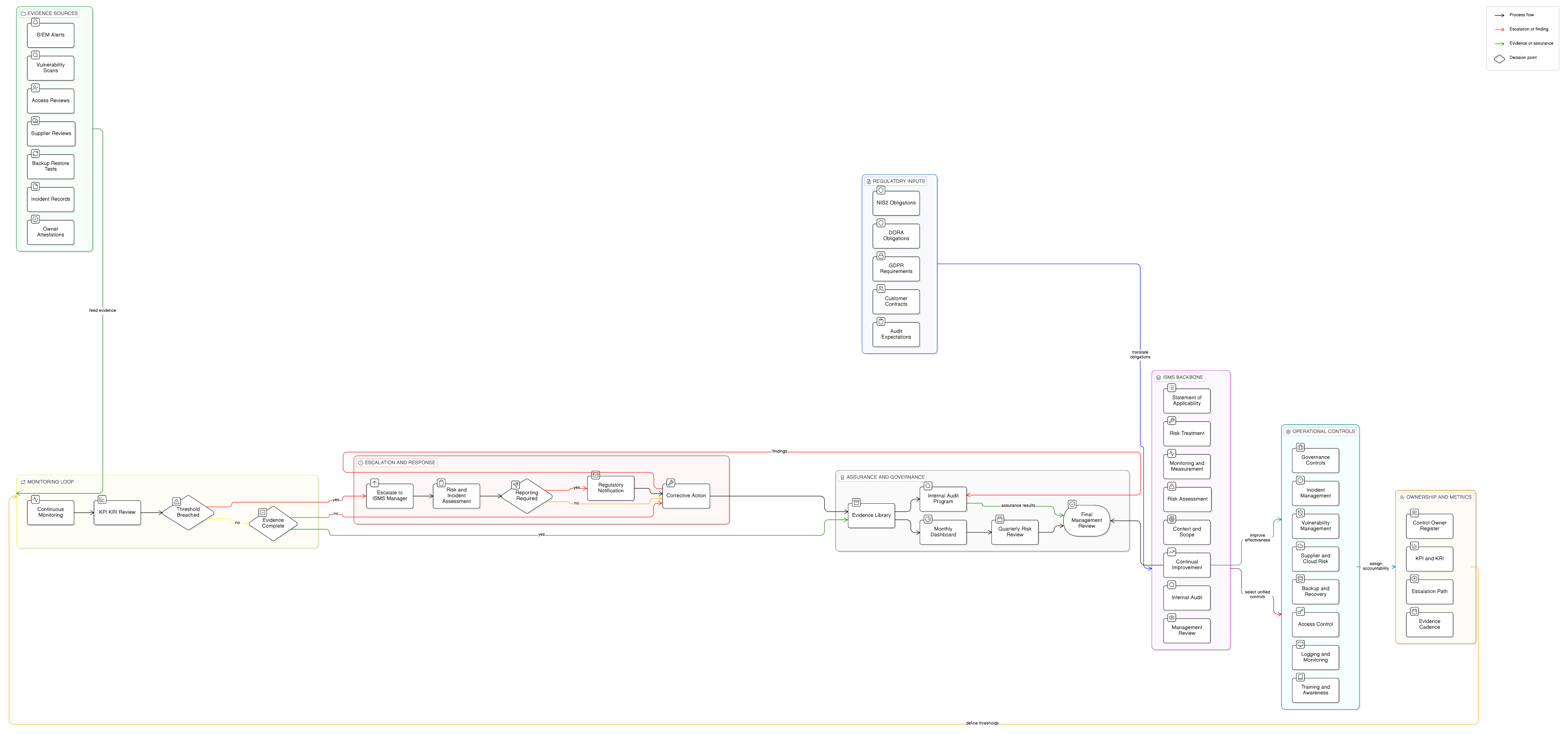
The Clarysec monitoring model, from obligation to owner to proof
A robust monitoring model follows a simple sequence.
First, define the obligation. For example, DORA requires ICT third-party risk to be managed as part of ICT risk management, with registers, due diligence, contractual requirements, audit rights, and exit strategies for critical or important functions. NIS2 requires supply chain security and appropriate corrective action.
Second, translate the obligation into ISO/IEC 27001:2022 ISMS requirements. This includes interested-party requirements, scope, risk assessment, risk treatment, Statement of Applicability, operational control, monitoring, internal audit, management review, and improvement.
Third, select operational controls. In Zenith Controls, core governance controls for continuous compliance include ISO/IEC 27002:2022 controls 5.2, 5.35, and 5.36. Supporting controls often include 5.19 Information Security in Supplier Relationships, 5.21 Managing Information Security in the ICT Supply Chain, 5.22 Monitoring, Review and Change Management of Supplier Services, 5.23 Information Security for Use of Cloud Services, 5.24 Information Security Incident Management Planning and Preparation, 5.26 Response to Information Security Incidents, 5.30 ICT Readiness for Business Continuity, 5.31 Legal, Statutory, Regulatory and Contractual Requirements, 8.8 Management of Technical Vulnerabilities, 8.13 Information Backup, 8.15 Logging, 8.16 Monitoring Activities, and 8.9 Configuration Management.
Fourth, assign the owner and cadence. Supplier risk may involve Procurement, Legal, Security, and the Business Service Owner, but one accountable owner must maintain the register and report exceptions.
Fifth, define KPIs, KRIs, and evidence. Supplier KPIs may include percentage of critical ICT suppliers with completed due diligence, percentage with approved contract clauses, number without tested exit plans, and number of overdue supplier reviews. KRIs may include unresolved high-risk supplier findings, concentration risk above tolerance, or missing audit rights for a service supporting a critical or important function.
Sixth, report and escalate. Monthly ISMS dashboards should not merely show green status. They should identify overdue evidence, risk movement, missed treatment deadlines, and management decisions required.
Seventh, audit and improve. Evidence gaps become corrective actions, not excuses.
This aligns with the Zenith Blueprint Audit, Review & Improvement phase. Step 25, Internal Audit Program, recommends covering relevant ISMS processes and controls over the audit cycle, with an annual full-scope audit and smaller quarterly spot-checks for high-risk areas where appropriate. Step 28, Management Review, calls for inputs such as changes in requirements, monitoring and measurement results, audit results, incidents, nonconformities, opportunities for improvement, and resource needs. Step 29, Continual Improvement, uses the CAPA Log to capture issue description, root cause, corrective action, responsible owner, target date, and status.
That is continuous compliance in practice.
A practical scenario, critical vulnerability on a public API
At 02:15, a SIEM alert fires. A vulnerability scan has identified a critical remote code execution vulnerability on a public-facing API gateway supporting a regulated payment service.
The continuous monitoring model should respond without waiting for a meeting.
First, the asset inventory classifies the gateway as critical. The vulnerability management KPI clock starts. The KRI for unpatched critical vulnerabilities increments. If the asset is internet-facing and the exploit is active, the escalation threshold is triggered immediately.
Second, the ticket is routed to the on-call DevOps team. The Head of DevOps, as the vulnerability management control owner, receives an automated notification. The SOC Manager tracks whether exploitation indicators exist. The ISMS Manager monitors whether incident criteria are met.
Third, evidence is collected as a by-product of the workflow. The SIEM alert, vulnerability scan, asset classification, ticket timestamps, response chat, patch record, validation scan, and closure approval are attached to the evidence pack.
Fourth, the team assesses whether the event is only a vulnerability, a security event, or an incident. If service impact, compromise indicators, customer impact, or personal data exposure exist, the incident workflow triggers NIS2, DORA, GDPR, and contractual reporting assessments.
Fifth, management receives a concise report. If the vulnerability was remediated within four hours, the evidence supports control effectiveness. If it missed SLA, the CAPA log records root cause, corrective action, owner, target date, and status.
This single event generates useful evidence for vulnerability management, incident readiness, monitoring, access to critical assets, management review, and continual improvement.
How auditors and regulators will test the same monitoring model
A mature continuous compliance program must survive different audit lenses. The evidence does not change, but the questions do.
| Auditor lens | Likely audit question | Evidence they expect |
|---|---|---|
| ISO/IEC 27001:2022 auditor | Are roles assigned, risks treated, controls operating, and evidence retained? | Scope, interested-party requirements, risk register, Statement of Applicability, owner register, monitoring results, internal audit, management review, CAPA log |
| NIS2 regulator or assessor | Has management approved and overseen appropriate cybersecurity risk-management measures? | Management minutes, risk approvals, incident workflow, supplier controls, continuity evidence, training records, corrective actions |
| DORA competent authority or internal audit | Does the ICT risk framework connect governance, resilience, testing, incident reporting, third-party risk, and audit follow-up? | ICT risk framework, resilience strategy, incident classification records, testing results, supplier register, contract evidence, audit reports |
| NIST CSF 2.0 assessor | Does the organization have governance outcomes, prioritized gaps, measurable performance, and review cycles? | Current and target profiles, risk action plan, governance metrics, supply chain oversight, operational KPI reports |
| COBIT 2019 or ISACA auditor | Are governance objectives, management practices, process ownership, metrics, and assurance activities defined and effective? | RACI, process descriptions, performance metrics, exception reports, control testing, management oversight records |
For ISO/IEC 27002:2022 control 5.35 Independent Review of Information Security, an ISO/IEC 27001:2022 auditor will focus on the internal audit plan, scope, competence, findings, and corrective actions. A NIS2 or DORA regulator will focus on whether management understood the findings, funded remediation, and reduced systemic risk. A NIST CSF 2.0 assessor may map the review to the GOVERN function, including oversight and performance adjustment.
The same evidence set serves all of them if it is complete, current, and connected to ownership.
Common pitfalls that weaken continuous compliance
The first pitfall is treating NIS2 and DORA as separate projects. That creates duplicate registers, conflicting metrics, and exhausted control owners. Use ISO/IEC 27001:2022 as the ISMS backbone and map obligations through one control library.
The second pitfall is assigning controls to teams instead of people. “IT owns backups” is not enough. A named owner must attest, report exceptions, and escalate risk.
The third pitfall is collecting evidence without evaluating effectiveness. A backup success screenshot does not prove recoverability. A restore test does. A supplier questionnaire does not prove third-party resilience. Contractual clauses, audit rights, incident notification terms, performance reports, and exit planning create stronger evidence.
The fourth pitfall is measuring activity instead of risk. Counting vulnerabilities is useful. Tracking overdue critical vulnerabilities on internet-facing systems is better. Counting suppliers is useful. Tracking critical suppliers without exit plans is better.
The fifth pitfall is weak corrective action discipline. The Zenith Blueprint Step 29 is clear that findings need issue description, root cause, corrective action, responsible owner, target date, and status. If the CAPA log is not reviewed, continuous compliance becomes continuous accumulation of known weaknesses.
What management should see every month
Management bodies under NIS2 and DORA do not need raw scanner exports. They need a decision-quality view of cyber and ICT risk.
A monthly board or management dashboard should include:
- top cyber and ICT risks with residual risk movement;
- overdue risk treatments and missed deadlines;
- significant incidents, major ICT-related incident candidates, and lessons learned;
- critical supplier risk exceptions;
- vulnerability SLA performance for critical assets;
- backup and recovery test status;
- privileged access review exceptions;
- compliance evidence completion rate;
- audit findings and CAPA status;
- resource decisions required.
This directly supports ISO/IEC 27001:2022 management review and the governance expectations of NIS2 and DORA. It also aligns with NIST CSF 2.0, where executives set priorities, accountability, resources, and risk appetite while managers translate those priorities into target profiles and action plans.
Build your NIS2 and DORA evidence rhythm this week
You do not need to boil the ocean to start. A useful first week can be simple.
Day 1, create a control owner register for five domains: governance and risk management, incident management and reporting, vulnerability and patch management, supplier and cloud risk, and business continuity and recovery.
Day 2, define one KPI and one KRI for each domain. Keep them specific, measurable, and tied to risk appetite.
Day 3, map each evidence item to NIS2, DORA, ISO/IEC 27001:2022, GDPR, and customer assurance value.
Day 4, set evidence cadence, storage location, naming convention, retention rule, and reviewer.
Day 5, run a tabletop escalation. Use a cloud outage or critical vulnerability scenario. Confirm classification, regulatory reporting assessment, customer communication, evidence storage, and CAPA creation.
If your organization is still managing NIS2 and DORA through spreadsheets, annual workshops, and scattered evidence folders, now is the time to shift to a monitored operating rhythm.
Start with three actions:
- Build a control owner register for your highest-risk domains.
- Define one KPI, one KRI, one evidence item, and one cadence per control.
- Run a 30-minute evidence review and open CAPA items for anything missing.
Clarysec can help you accelerate the shift with the Zenith Blueprint for implementation sequencing, Zenith Controls for cross-compliance mapping, and Clarysec’s policy library, including the Information Security Policy, Risk Management Policy, Audit and Compliance Monitoring Policy, Governance Roles and Responsibilities Policy - SME, Risk Management Policy - SME, and Audit and Compliance Monitoring Policy - SME.
The goal is not more compliance paperwork. The goal is to answer the Friday afternoon question with confidence:
“Yes, we know who owns the control, we know the KPI, we have the evidence, we know the exceptions, and management has reviewed the risk.”
Contact Clarysec to build a continuous compliance monitoring model that is audit-ready, board-ready, and resilient enough for NIS2, DORA, and the next regulation that follows.
Frequently Asked Questions
About the Author

Igor Petreski
Compliance Systems Architect, Clarysec LLC
Igor Petreski is a cybersecurity leader with over 30 years of experience in information technology and a dedicated decade specializing in global Governance, Risk, and Compliance (GRC).Core Credentials & Qualifications:• MSc in Cyber Security from Royal Holloway, University of London• PECB-Certified ISO/IEC 27001 Lead Auditor & Trainer• Certified Information Systems Auditor (CISA) from ISACA• Certified Information Security Manager (CISM) from ISACA • Certified Ethical Hacker from EC-Council