Customer-Managed Keys for Cloud PII Governance
The Friday afternoon question: who really controls the key?
It is 16:40 on a Friday when the CISO of a European SaaS provider receives a customer security questionnaire from a large financial institution. The questions look simple, but the implications are not:
- Do you use customer-managed encryption keys for production personal data?
- Can the customer revoke your access to their data?
- Are keys stored in the same cloud account as the encrypted data?
- Is key administration access reviewed quarterly?
- How do you prove that EU customer PII remains protected during cloud support access, backup replication and incident response?
- If a key is disabled, what happens to service continuity?
- Can you evidence this for ISO/IEC 27001:2022, ISO/IEC 27701:2025, GDPR, NIS2 and DORA?
The engineering team says, “Yes, the cloud provider encrypts everything at rest.” Legal points to the data processing agreement. The privacy lead asks whether the company is acting as controller, processor, joint controller or subprocessor. The customer replies, “That is not enough. We need BYOK or HYOK, documented key ownership, cloud region controls, audit logs and contractual evidence.”
A similar scene is playing out across fintech, SaaS, health technology, digital infrastructure and managed service provider environments. One CISO might be facing a bank that wants proof that customer PII is shielded from unauthorized access on a US-based hyperscaler. Another might be responding to a DORA due diligence review, a NIS2 supply-chain questionnaire or a GDPR transfer risk assessment. In each case, “encrypted at rest” is no longer a complete answer.
Customer-managed keys, CMKs, Customer-Managed Encryption Keys, CMEK, Bring Your Own Key, BYOK, and Hold Your Own Key, HYOK, are not just cloud platform features. They are governance mechanisms. They connect cryptographic control evidence, cloud shared responsibility, supplier assurance, privacy management, data residency, incident response and operational resilience.
The control is technical. The failure is usually managerial.
CMK, BYOK and HYOK in plain governance language
Cloud encryption is often described in a way that hides the real governance decision. “Encrypted at rest” can mean the cloud provider controls everything, the SaaS provider controls the key, the customer controls the key in the provider’s key management service, or the customer keeps the key outside the provider’s environment.
A provider-managed key means the cloud or SaaS provider controls most of the key lifecycle. A customer-managed key means the customer has administrative control over key creation, rotation, disablement and access policy in a key management service. BYOK usually means the customer generates or imports key material into the provider’s key management environment. HYOK usually means the customer retains the key outside the provider environment, often in an external HSM or external key manager, and the cloud service depends on that external control plane to decrypt or use data.
For cloud PII governance, the question is not “is encryption enabled?” The better question is: who can make the data unreadable, who can authorize decryption, who can inspect key usage, and who can prove it?
Clarysec’s Enterprise Cloud Usage Policy states the expectation directly:
Customer-managed keys (CMKs) or Bring Your Own Key (BYOK) shall be used where supported by the cloud provider.
From section ‘Policy Implementation Requirements’, policy clause 6.4.2. Cloud Usage Policy
That sentence changes the audit conversation. It turns encryption from a default infrastructure claim into a governed decision. The organization must assess whether CMK is supported, whether it is contractually required, whether it applies to all relevant PII stores, and whether exceptions are approved.
Clarysec’s Enterprise Cryptographic Controls Policy adds the evidence requirement:
A centralized Key Management Register must be maintained to record all cryptographic keys, their lifecycle status, assigned custodians, and usage contexts.
From section ‘Governance Requirements’, policy clause 5.2. Cryptographic Controls Policy
CMK without a register is a configuration. CMK with ownership, lifecycle status, custodianship, usage context, access reviews, rotation evidence and incident playbooks is a control.
Why customer-managed keys matter for cloud PII
Customer-managed cloud encryption keys do not magically solve sovereignty, privacy or third-party risk. A cloud provider may still process metadata, operate infrastructure, provide support, manage backups or be subject to lawful access processes. CMK is not a legal transfer mechanism and it does not replace GDPR role mapping, processor agreements or data minimization.
But CMK changes the risk model in three practical ways.
First, it creates a separable control plane. If access to encrypted PII depends on a key controlled by the customer or by a segregated tenant, the organization can implement stronger approval, monitoring and revocation workflows.
Second, it produces better evidence. A key register, KMS logs, HSM records, IAM policy history, privileged access reviews, rotation events and disablement tests give auditors something measurable.
Third, it strengthens contractual assurance. A SaaS provider serving banks, health platforms, public bodies or critical sectors can answer customer due diligence with detail: “Here is how your PII is encrypted, here is who controls the key, here is how access is logged, here is how backups and replicas are covered, and here is the tested exit process.”
This is why Clarysec treats customer-managed key governance as part of the PII lifecycle. The Enterprise Data Protection and Privacy Policy sets the objective:
Implement technical and organizational measures (TOMs) that protect the Confidentiality, Integrity, and Availability of personal information (PII) throughout its lifecycle.
From section ‘Objectives’, policy clause 3.3. Data Protection and Privacy Policy
Encryption is one technical and organizational measure. CMK governance is the management system around it.
The ISO/IEC 27001:2022 control story: from risk to SoA
ISO/IEC 27001:2022 is a risk-based management system standard. That matters because CMK should not be presented as a disconnected cloud feature. It should appear as a risk treatment for defined information security and privacy scenarios.
Clauses 4.1 to 4.4 require the organization to determine internal and external issues, interested-party requirements, ISMS scope and dependencies with other organizations. This is where cloud PII, customer contracts, EU data subjects, financial-sector customers, processors, subprocessors, cloud regions and key management dependencies belong in the ISMS boundary.
Clauses 6.1.1 to 6.1.3 then require information security risk assessment and risk treatment. The organization identifies risks to confidentiality, integrity and availability, assigns risk owners, evaluates likelihood and impact, selects treatment options, compares selected controls with Annex A, prepares the Statement of Applicability and obtains risk-owner approval for the treatment plan and residual risk.
CMK should be linked to scenarios such as:
- Unauthorized cloud administrator access to PII.
- Supplier support access without customer approval.
- Cross-region replication of regulated PII.
- Key compromise or excessive key administrator privilege.
- Cloud account takeover enabling decryption.
- Backup restoration into an unauthorized region.
- Key deletion or disablement causing service outage.
- Exit from a cloud provider or SaaS platform where encrypted data must be returned or destroyed.
The central ISO/IEC 27001:2022 Annex A controls are A.5.23 Information security for use of cloud services, A.5.34 Privacy and protection of PII, and A.8.24 Use of cryptography. Supporting controls include supplier relationship controls, supplier agreements, ICT supply-chain security, monitoring supplier services, logging, monitoring, backups, continuity and legal or contractual requirements.
Clarysec’s Zenith Controls describes ISO/IEC 27001:2022 control A.5.23, information security for use of cloud services, as a preventive control supporting confidentiality, integrity and availability, aligned to Protect, supplier relationship security, and the Governance, Ecosystem and Protection domains Zenith Controls. It describes A.5.34, privacy and protection of PII, as a preventive control aligned to Identify and Protect, information protection, legal and compliance. It describes A.8.24, use of cryptography, as a preventive control supporting confidentiality, integrity and availability, aligned to Protect, secure configuration and the Protection domain.
That mapping is powerful because it shows CMK as a cloud governance, privacy governance and cryptographic lifecycle control at the same time.
What the Zenith Blueprint says: encryption is a lifecycle
Clarysec’s Zenith Blueprint: An Auditor’s 30-Step Roadmap treats cryptography as a risk-treatment policy issue in the Risk Management phase, Step 14: Risk Treatment Policies and Regulatory Cross-References Zenith Blueprint. The sample cryptography policy guidance says the organization should define key management, including how keys are “generated, distributed, stored, rotated, and revoked,” and gives the example that encryption keys should be stored securely in a key vault or HSM with access limited to authorized personnel.
In the Controls in Action phase, Step 20: Controls 8.18-8.26, the Zenith Blueprint is even more direct:
Key management is central to this control. Strong encryption means nothing if the keys are exposed, mishandled, or forgotten. Keys should be generated securely, stored in encrypted key vaults or hardware security modules (HSMs), rotated on a schedule, and revoked when compromised or no longer needed.
That is the operating principle for customer-managed cloud encryption keys. If a tenant has CMK but no owner, no rotation schedule, no access review, no incident trigger, no recovery process and no evidence trail, the organization has a weak control with a strong label.
The Zenith Blueprint, in the Controls in Action phase, Step 23: Organizational controls, also frames cloud control correctly. It explains that cloud service use must address selection, use and management of cloud services as a design principle, and that the organization remains accountable for data, configurations, access policies and incident response readiness. The cloud provider may supply KMS, HSM, logging and policy features. The accountable organization must decide who can administer keys, which workloads use them, how logs are reviewed, what contracts require, and how exceptions are approved.
A practical CMK governance model for PII
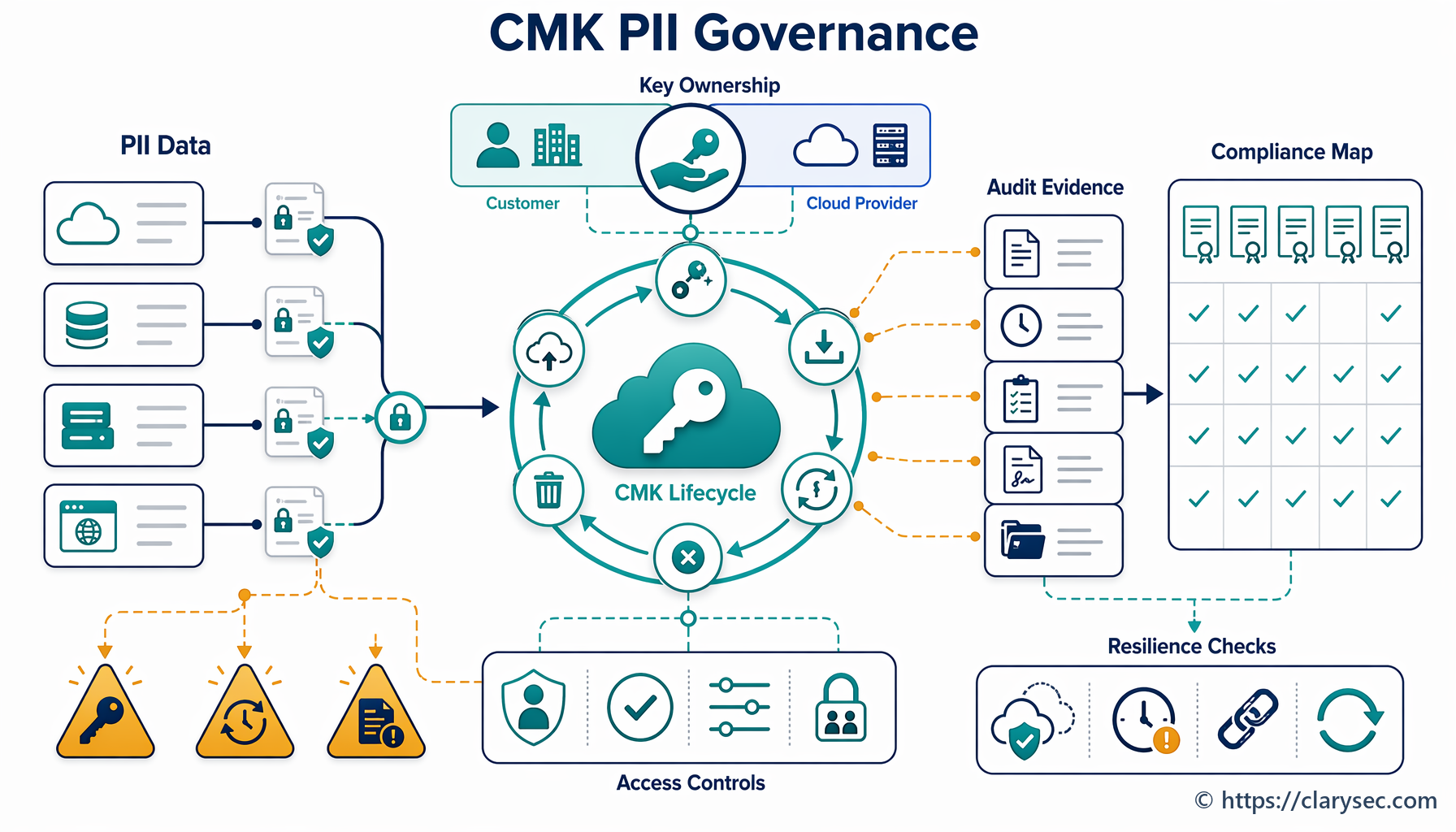
A workable CMK governance model needs five layers: data, key, identity, supplier and evidence.
| Layer | Governance question | Required evidence |
|---|---|---|
| Data | Which PII stores, backups, logs and replicas require customer-managed encryption? | Data inventory, classification, processing register, region map |
| Key | Who owns the key, where is it stored, how is it rotated, and what happens if it is disabled? | Key Management Register, KMS policy, HSM records, rotation events, recovery tests |
| Identity | Who can administer, use, disable or schedule deletion of the key? | IAM roles, privileged access reviews, separation of duties, MFA evidence |
| Supplier | What does the cloud or SaaS provider do, and what remains customer responsibility? | Contract clauses, shared-responsibility register, subprocessor review, audit rights |
| Evidence | How will the organization prove control operation over time? | Logs, monitoring alerts, REG08, REG09, REG12, SoA, risk treatment plan |
Clarysec’s PII policies are designed around this pattern. The Enterprise Cloud PII Processor Policy requires the shared-responsibility boundary to be recorded before customer onboarding or material service change:
[Processor] The Information Security Lead MUST record the cloud shared-responsibility boundary for PII access, administration, logging, backup, encryption, vulnerability management and deletion in REG08 before customer onboarding or material service change.
From section ‘4.2 Cloud Configuration, Tenant Isolation, Access and Logging’, policy clause 4.2.1. Cloud PII Processor Policy
This is the control many organizations miss. They enable CMK but fail to record whether the customer, SaaS provider, hyperscaler, subprocessor or managed service provider controls key administration, logging, backup encryption, deletion and restoration.
Clarysec’s Enterprise PII Security and Access Control Policy adds a procurement gate:
[Processor] The Vendor / Procurement Owner MUST record processor encryption responsibilities, customer-managed protection responsibilities and service capability boundaries in REG08 before onboarding, renewal or material service change.
From section ‘4.5 Encryption and secure storage’, policy clause 4.5.4. PII Security and Access Control Policy
In practice, CMK governance begins before the cloud service is approved. A vendor cannot be onboarded for PII processing until the organization understands whether CMK, BYOK or HYOK is supported, what data types it covers, how it affects backups and exports, whether logs show key usage, and whether customer revocation is operationally safe.
Hands-on example: BYOK for a regulated SaaS tenant
Consider a SaaS provider offering a regulated analytics platform to an EU bank. The bank requires BYOK for all customer PII. The platform uses a cloud database, object storage, message queue, search index, backups and centralized logs.
The practical workflow should look like this.
Step 1: Open the risk record and scope the processing.
The Information Security Lead identifies the processing role. The SaaS provider is a PII processor for the bank. The team records the customer tenant, PII categories, regions, systems, backups and subprocessors in REG08. The risk scenario is unauthorized access to bank customer PII through a cloud provider, SaaS administrator or compromised service account.
Step 2: Map the key coverage.
The application owner lists every data store and confirms whether the customer-managed key covers primary storage, indexes, attachments, temporary files, backups, replicated storage, logs and exports. If the search index cannot use BYOK, that becomes an exception with risk acceptance or redesign.
Step 3: Define key custody and access.
The customer owns the key material in the cloud KMS or an approved external key manager. The SaaS provider receives only the minimum key-use permission required by the application role. Key administration is separated from application administration. Break-glass access requires approval, MFA and logging.
Step 4: Update the Key Management Register.
The register records key ID, alias, tenant, environment, data category, custodian, rotation schedule, expiry if applicable, dependent services, backup dependency, deletion window and incident contact. This implements the Cryptographic Controls Policy requirement for a centralized register.
Step 5: Record region and transfer safeguards.
If EU PII is involved, region constraints and replication routes are documented. The Enterprise Cloud Usage Policy states:
Data residency requirements must be enforced contractually (e.g., EU-only storage for GDPR-regulated data).
From section ‘Policy Implementation Requirements’, policy clause 6.6.2.
For cloud PII, the Cloud PII Processor Policy adds a blocking rule:
[Processor] The System Owner / Application Owner MUST block cloud region, storage, backup, replication or support-access changes involving customer PII until REG08 and REG09 routing evidence is complete.
From section ‘4.5 Location, Transfer and Disclosure Routing’, policy clause 4.5.2.
Step 6: Configure logging and monitoring.
Key usage logs, administrative changes, failed decrypt attempts, key policy changes and scheduled deletion events are routed to the SIEM. The SME Cloud Usage Policy-sme provides a concise baseline:
Activity logging for login attempts and data access
From section ‘Policy Implementation Requirements’, policy clause 6.2.4. Cloud Usage Policy - SME
Enterprise environments should expand this into KMS-specific detections, including anomalous decrypt volume, decrypt from unexpected regions, key policy changes outside change windows, key disablement and new service principal permissions.
Step 7: Review and test.
Before go-live, the team tests normal encryption and decryption, key rotation, key disablement, backup restore, customer revocation and incident alerting. The outcome is stored in REG12 as control evidence.
The PII Security and Access Control Policy requires recurring review:
[Both] The Information Security Lead MUST review cryptographic administration access for PII systems at least quarterly and record the outcome in REG12.
From section ‘4.5 Encryption and secure storage’, policy clause 4.5.3.
CMK governance is complete only when the organization can show who requested it, what PII it protects, which systems depend on it, who can administer it, how it is logged, how it is rotated, how it affects resilience, and where the evidence lives.
GDPR, ISO/IEC 27701:2025 and transfer safeguards
GDPR applies broadly to automated personal data processing and can apply to organizations outside the EU when they offer goods or services to individuals in the EU or monitor their behavior. Cloud location alone does not determine applicability.
CMK governance supports GDPR Article 32 security of processing, accountability and breach impact analysis. It also supports the broader Article 5 principles by helping protect personal data through appropriate technical and organizational measures. For special category data, health data, biometric data, criminal-offence-related data or other high-risk PII, CMK may be part of a stronger safeguard package.
Under ISO/IEC 27701:2025, the PIMS must distinguish controller, processor, joint controller, subprocessor and shared-responsibility obligations. CMK matters because it affects who controls encryption, who can authorize decryption, who can revoke access and who must evidence protection.
For international transfer governance, Clarysec’s Enterprise International PII Transfer Policy adds a useful evidence trigger:
[Conditional] The Information Security Lead MUST record technical safeguard dependency status in REG09 or REG12 before approval where the transfer relies on technical controls.
From section ‘4.3 Transfer risk review and safeguards’, policy clause 4.3.3. International PII Transfer Policy
This is especially relevant when a transfer risk review relies on encryption, key separation, customer-held keys, region restriction or support-access controls. The organization must record whether the safeguard is actually operating and whether the key remains outside the reach of the transfer scenario being assessed.
NIS2 and DORA: encryption as resilience and supplier governance
NIS2 Article 21 requires appropriate and proportionate technical, operational and organizational measures to manage risks to network and information systems and to prevent or minimize incident impact. Its minimum areas include risk analysis, incident handling, business continuity, supply-chain security, acquisition and maintenance security, effectiveness assessment, cyber hygiene, cryptography and encryption policies, HR security, access control, asset management, MFA, secured communications and emergency communications.
For CMK governance, the direct bridge is Article 21(2)(h), cryptography and encryption policies. The broader mapping includes supply-chain security, access control, asset management, incident handling, business continuity and effectiveness assessment. Article 20 also requires management bodies to approve cybersecurity risk-management measures, oversee implementation and follow training. CMK decisions should not be hidden in a cloud engineering backlog. Management should understand the trade-off: CMK can reduce unauthorized access risk, but key disablement, deletion, misconfiguration or unavailability can create service disruption.
DORA applies to financial entities from 17 January 2025 and establishes requirements for ICT risk management, incident reporting, resilience testing, cyber-threat information sharing and ICT third-party risk management. For financial entities using cloud or SaaS providers for critical or important functions, CMK becomes part of resilience and third-party evidence.
DORA Article 28 requires financial entities to manage ICT third-party risk as part of the ICT risk management framework and remain fully responsible for compliance when using ICT services. Article 30 requires contracts to cover service and data processing locations, data availability, authenticity, integrity and confidentiality protections, access, recovery, return of data, incident assistance, cooperation with authorities, termination rights and stronger controls for critical or important functions.
This is where CMK must be embedded into supplier contracts. The Enterprise Third party and supplier security policy requires supplier governance to address:
Data handling requirements, including storage location, access controls, and return or destruction clauses
From section ‘Governance Requirements’, policy clause 5.3.2. Third party and supplier security policy
The SME version sets a baseline encryption obligation:
All data shared with suppliers must be protected through encryption and transmitted using secure protocols (e.g., HTTPS, SFTP).
From section ‘Policy Implementation Requirements’, policy clause 6.2.3. Third-Party and Supplier Security Policy - SME
For DORA-regulated customers, those clauses need to become specific: Who controls the CMK? Does the supplier support BYOK for all relevant services? Can the financial entity inspect logs? Is the key included in exit testing? Are subcontractors bound to equivalent encryption and data-location obligations?
Cross-compliance mapping: one CMK model, many obligations
| Governance theme | ISO/IEC 27001:2022 and ISO/IEC 27002:2022 | ISO/IEC 27701:2025 and GDPR | NIS2 | DORA | NIST CSF 2.0 and COBIT 2019 audit view |
|---|---|---|---|---|---|
| Key ownership and lifecycle | Risk treatment, SoA, A.8.24 Use of cryptography, A.5.23 cloud services | PII TOMs, processor responsibilities, accountability | Article 21 cryptography and encryption policies | ICT risk framework, data confidentiality and integrity | GOVERN policy, IDENTIFY assets, PROTECT data security, governance of risk and controls |
| Cloud shared responsibility | A.5.23 cloud use, A.5.19 to A.5.22 supplier controls | Processor and subprocessor boundary, privacy by design | Article 21 supply-chain security | Articles 28 and 30 ICT third-party contracts | GV.SC supply chain outcomes and supplier assurance |
| Data residency and transfers | Legal and contractual requirements, cloud exit and monitoring | GDPR territoriality, transfer safeguards, PII routing evidence | Risk measures for service impact | Data processing and storage locations in contracts | Requirements management and third-party oversight |
| Logging and monitoring | A.8.15 logging, A.8.16 monitoring | Breach detection and accountability evidence | Incident handling and reporting | Incident recording, classification and reporting | DETECT, RESPOND and audit evidence review |
| Resilience and key availability | Backups, disruption security, ICT readiness | Availability of PII where required by service | Business continuity and crisis management | Continuity, recovery, testing and exit plans | RECOVER, resilience testing and management assurance |
The value of this mapping is efficiency. The same CMK evidence can support the ISO/IEC 27001:2022 Statement of Applicability, ISO/IEC 27701:2025 PIMS controls, GDPR security of processing, NIS2 cyber risk management, DORA ICT third-party risk, NIST CSF 2.0 profiles and COBIT 2019 audit expectations.
How auditors will test customer-managed key governance
A CMK program is only as strong as the evidence it produces. Different auditors approach the same control from different angles.
| Auditor or reviewer | Focus area | Evidence they will request |
|---|---|---|
| ISO/IEC 27001:2022 auditor | ISMS integration, risk treatment and SoA | Risk assessment, SoA entries for A.5.23, A.5.34 and A.8.24, cloud and cryptography policies, Key Management Register, access reviews, rotation evidence |
| ISO/IEC 27701:2025 PIMS auditor | PII roles, processor instructions and shared responsibility | REG08 entries, processing role records, subprocessor responsibilities, PII access boundaries, backup and deletion evidence |
| GDPR reviewer or DPA | Security of processing, accountability and transfer safeguards | Article 32 TOMs, breach scenario analysis, transfer risk evidence, REG09 or REG12 technical safeguard dependency records |
| DORA examiner | ICT third-party risk and resilience | ICT supplier register, contract clauses, audit rights, tested exit strategy, key revocation and recovery evidence |
| NIS2 supervisor or cyber audit team | Management approval, encryption policy and incident readiness | Board or management approval, encryption policy, incident playbooks, KMS alerts, lessons learned and corrective actions |
| NIST CSF 2.0 or COBIT 2019-oriented auditor | Governance, supplier assurance and control performance | Accountabilities, supplier monitoring, measurable control outcomes, exception tracking and management reporting |
The common thread is the evidence chain: risk assessment, policy, procedure, register, operational logs, review records and management oversight.
Common CMK failures that create audit findings
The most common audit finding is not lack of encryption. It is ungoverned encryption.
Typical findings include:
- The cloud service uses encryption, but the organization cannot say whether keys are provider-managed or customer-managed.
- CMK is enabled for primary databases, while backups, logs, search indexes or exports use provider-managed keys.
- Key administrators also have privileged application access, weakening separation of duties.
- Key rotation is documented in policy but not evidenced in KMS logs.
- Key disablement has never been tested, so operational impact is unknown.
- Supplier contracts say “industry-standard encryption” but do not specify key ownership, region, support access, audit rights or data return.
- Incident response playbooks do not include key compromise, unauthorized key policy changes or mass decrypt events.
- Transfer risk reviews rely on encryption but do not prove where the key is controlled.
- The SoA includes cryptography but not cloud-service governance or supplier monitoring.
- Customer commitments promise BYOK, but onboarding does not verify that all data stores support it.
Clarysec’s SME Cryptographic Controls Policy-sme provides simple requirements that often close basic gaps:
Access to keys must be restricted to authorized personnel and reviewed every six months
From section ‘Policy Implementation Requirements’, policy clause 6.3.2. Cryptographic Controls Policy - SME
Key rotation must occur in accordance with expiry schedules or upon suspected compromise
From section ‘Policy Implementation Requirements’, policy clause 6.3.4.
For enterprise PII environments, those baselines usually need to be strengthened with quarterly cryptographic administration reviews, SIEM monitoring, customer-specific key records, privileged access workflows, supplier contract clauses and resilience testing.
Customer-managed key governance checklist for cloud PII
Use this checklist before offering CMK, BYOK or HYOK to customers, or before accepting it from a supplier.
| Check | Evidence to collect | Owner |
|---|---|---|
| PII scope confirmed | Data inventory, processing activity, tenant map, classification | Privacy Lead and System Owner |
| CMK coverage verified | Database, object storage, backups, logs, replicas, exports, analytics stores | Application Owner |
| Key register updated | Key ID, custodian, lifecycle, rotation, usage context, dependent services | Information Security Lead |
| Access model approved | IAM policy, privileged roles, MFA, separation of duties, break-glass process | Security Architect |
| Cloud boundary recorded | REG08 shared-responsibility entry for encryption, logging, backup and deletion | Information Security Lead |
| Region and transfer route approved | REG09 routing evidence, contract region clauses, replication settings | Privacy Lead |
| Supplier terms updated | Key ownership, audit rights, support access, incident notice, exit, deletion | Procurement Owner |
| Monitoring enabled | KMS logs, SIEM rules, alerts for policy change, disablement and anomalous decrypt | SOC or IT Operations |
| Rotation and recovery tested | Rotation record, restore test, key disablement impact test | Platform Owner |
| Audit evidence retained | REG12 review, SoA mapping, risk treatment approval, management reporting | Compliance Manager |
This checklist turns a cloud configuration into an audit-ready operating model.
The leadership decision: control, resilience and trust
Customer-managed encryption keys are attractive because they promise control. But control creates responsibility. If the customer controls the key, the customer may also be able to interrupt the service. If the SaaS provider administers the key, the customer may challenge whether it is truly customer-managed. If HYOK is used, latency, availability, disaster recovery and support processes become design issues. If BYOK is offered to regulated customers, onboarding, contracts and support must be precise.
For CISOs and business owners, the right decision is risk-based. Use customer-managed keys where PII sensitivity, customer assurance, regulatory expectations, cloud sovereignty, supplier concentration or contractual commitments justify the added operational complexity. Use provider-managed keys where risk is lower, CMK is not supported, or operational resilience would be harmed, but document the rationale and compensating controls.
The worst answer is ambiguity.
A board or management body does not need to understand every KMS API call. It does need to approve the risk posture: which PII services require CMK, where exceptions are allowed, how key loss affects continuity, how supplier contracts enforce responsibilities, and how the organization proves control operation.
Make CMK governance audit-ready with Clarysec
If your organization is being asked for customer-managed keys, BYOK, HYOK, cloud sovereignty evidence or GDPR Article 32 encryption assurance, do not start with a cloud console. Start with governance.
Clarysec can help you:
- Map CMK governance into your ISO/IEC 27001:2022 risk assessment, Statement of Applicability and audit evidence.
- Extend your ISO/IEC 27701:2025 PIMS with processor, controller, subprocessor and cloud shared-responsibility records.
- Build REG08, REG09 and REG12 evidence flows for PII encryption, region routing, transfer safeguards and cryptographic access reviews.
- Align CMK controls to GDPR, NIS2, DORA, NIST CSF 2.0 and COBIT 2019 audit expectations.
- Use Zenith Blueprint Zenith Blueprint and Zenith Controls Zenith Controls to turn cryptography, cloud service governance and supplier assurance into one coherent compliance story.
- Deploy enterprise or SME-ready policies, including Cloud Usage Policy Cloud Usage Policy, Cryptographic Controls Policy Cryptographic Controls Policy, PII Security and Access Control Policy PII Security and Access Control Policy, Cloud PII Processor Policy Cloud PII Processor Policy, and Third party and supplier security policy Third party and supplier security policy.
The next time a customer asks, “Who controls the key?”, your answer should not be a screenshot. It should be a governed, tested and audit-ready control model.
Get PECB ISO/IEC 27701 certified and stand up your PIMS
- ✓ Official PECB courseware and two exam attempts
- ✓ Certification fee and first-year AMF included, where applicable
- ✓ Self-study or live online · course assigned within 1 business day
Frequently Asked Questions
About the Author

Igor Petreski
Compliance Systems Architect, Clarysec LLC
Igor Petreski is a cybersecurity leader with over 30 years of experience in information technology and a dedicated decade specializing in global Governance, Risk, and Compliance (GRC).Core Credentials & Qualifications:• MSc in Cyber Security from Royal Holloway, University of London• PECB-Certified ISO/IEC 27001 Lead Auditor & Trainer• Certified Information Systems Auditor (CISA) from ISACA• Certified Information Security Manager (CISM) from ISACA • Certified Ethical Hacker from EC-Council