ISO 27001 Data Lifecycle Governance for 2026
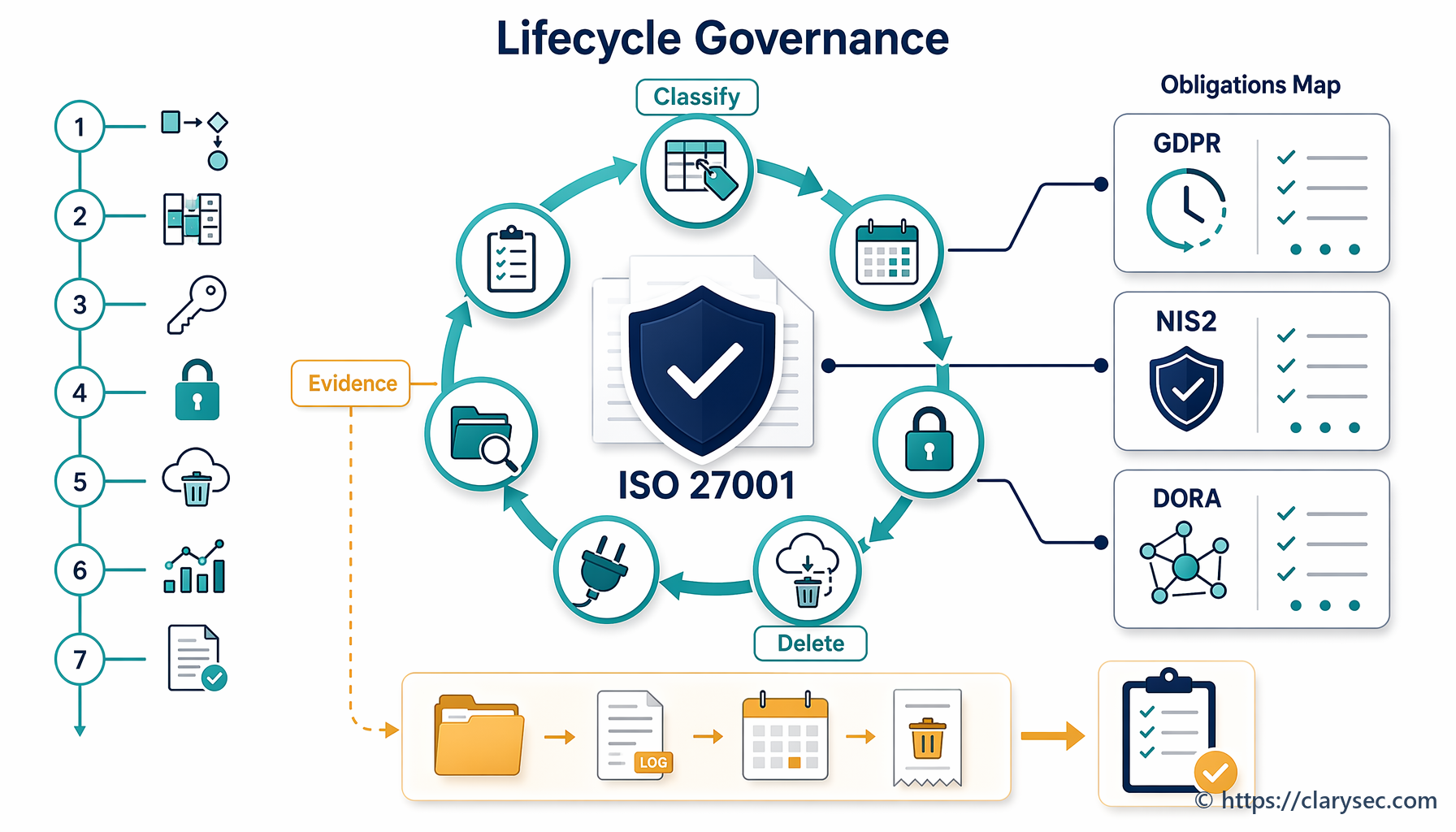
Maria, the CISO of a rapidly scaling fintech, had the kind of Friday afternoon that turns a compliance gap into a board-level problem.
The company had just expanded into new EU markets. Revenue was up, customer onboarding was accelerating and new SaaS tools were being added weekly. Then three messages landed almost at once.
Legal warned that data protection authorities were increasing enforcement around GDPR storage limitation. Compliance reminded her that the company’s DORA ICT risk obligations were now a live operational reality. The board asked whether the organization’s NIS2 exposure, including supplier and cyber hygiene requirements, was under control.
Then a customer requested deletion of their account and all associated personal data.
The simple request became a cross-functional scramble. Legal said some records might be needed for a contractual dispute. Finance said statutory records had to be retained. Product confirmed the customer’s data existed in the production database, analytics platform, support tickets, object storage, Kubernetes logs, database snapshots and a third-party customer success tool. Cloud engineering asked which backups contained the data. The DPO asked whether any copy was still processed outside the EU. Maria asked for evidence.
Someone finally said the sentence that exposed the real issue:
“We do not have one place where this lifecycle is visible.”
That is the 2026 data lifecycle governance problem. It is not just data retention. It is classification, ownership, lawful basis, access, location, replication, backup retention, legal hold, cloud offboarding, supplier deletion, archive review, incident evidence and defensible disposal.
For SMEs, fintechs, managed service providers, cloud-first companies and regulated organizations, the risk is no longer that data is missing. The risk is that data is everywhere, duplicated, stale, over-permissioned, under-classified and impossible to prove deleted.
A mature ISO 27001 data lifecycle governance program turns that scramble into a controlled workflow.
Why data lifecycle governance changed in 2026
GDPR, NIS2 and DORA are often treated as three separate compliance checklists. That is the wrong operating model. They are different regulatory expressions of the same business requirement: know your data, protect it according to risk, retain it for the right reason and prove what happened to it.
GDPR Article 5 requires personal data to be processed lawfully, fairly and transparently, collected for specified purposes, limited to what is necessary, accurate, retained only as long as needed and protected against unauthorized or unlawful processing, accidental loss, destruction or damage. Article 5(2) adds accountability, meaning the controller must be able to demonstrate compliance. GDPR retention governance is therefore not a spreadsheet exercise. It requires operational evidence.
NIS2 makes cybersecurity a management body issue. Article 20 sets governance expectations for management bodies, while Article 21 requires appropriate and proportionate technical, operational and organizational measures. These include risk analysis, information system security policies, incident handling, business continuity, supply chain security, secure development, effectiveness assessment, cyber hygiene, training, cryptography, access control and asset management. Unknown or obsolete data is not only a privacy problem. It is an attack surface problem.
DORA makes ICT risk management, operational resilience and ICT third-party risk directly enforceable for financial entities. Articles 5 and 6 place responsibility on the management body and require a documented ICT risk management framework. DORA also expects financial entities to protect data availability, authenticity, integrity and confidentiality, maintain incident handling capabilities, test resilience and govern ICT third-party dependencies.
DORA generally acts as the sector-specific regime for overlapping operational cybersecurity obligations for financial entities, while NIS2 remains relevant for the wider ecosystem, including cloud providers, managed service providers and many digital infrastructure organizations. This matters because a fintech may be directly under DORA, while its SaaS or managed service provider may be in the NIS2 perimeter.
ISO/IEC 27001:2022 is the management system that can hold these obligations together. Clauses 4.1 to 4.4 require the organization to understand its context, interested parties, legal and contractual requirements and ISMS scope. Clauses 5.1 to 5.3 require leadership, roles and responsibilities. Clauses 6.1.2 and 6.1.3 require information security risk assessment, risk treatment, control selection, comparison with Annex A and retained documented information.
This structure is why ISO 27001 is not “another checklist.” It is the operating system for data lifecycle governance.
The lifecycle model: seven questions every data owner must answer
A practical data lifecycle governance model should answer seven questions for every important data category:
- What is the data?
- Why do we process it?
- Who owns it?
- How sensitive is it?
- Where does it live and replicate?
- How long must it be retained, or suspended from deletion?
- How do we protect, review, delete and prove it?
Clarysec’s approach connects these questions to ISO 27001 controls and operational evidence. In the Zenith Blueprint: An Auditor’s 30-Step Roadmap, the Controls in Action phase treats asset inventory and classification as operational foundations, not paperwork. Step 22 explains that the inventory should include physical assets, digital assets, logical assets, service-related assets and people in terms of responsibilities, access and exposure.
The Zenith Blueprint states:
“Each asset should have a defined owner , not the person using it, but the one accountable for its use, protection, and lifecycle.”
That sentence is the pivot point. Data lifecycle governance fails when ownership is assigned to “IT” or “the business.” It works when a named accountable owner can approve classification, retention, access, legal hold decisions, archive review and deletion evidence.
Clarysec’s Asset Management Policy - SME reinforces the same discipline:
“Ownership, purpose, access privileges, and renewal timelines must be documented.”
This requirement appears in the Asset Management Policy - SME, section “Policy Implementation Requirements,” clause 6.6.2. Without ownership and purpose, retention becomes guesswork and deletion becomes dangerous.
Classification is the first retention control
Many organizations try to build retention schedules before they have reliable classification. That usually fails.
If a customer support export, HR document, transaction record or application log is not classified, the organization cannot consistently decide who should access it, where it can be stored, whether it can be used in testing, how strongly it must be encrypted, whether it requires legal hold protection, or how it should be deleted.
Clarysec’s Data Classification and Labeling Policy - SME is direct:
“All documents, files, and systems must be classified as soon as they are created or received.”
This appears in the Data Classification and Labeling Policy - SME, section “Policy Implementation Requirements,” clause 6.1.1.
The enterprise Data Classification and Labeling Policy connects classification to the full handling chain:
“All data handling, transmission, access, storage, and disposal of information must align with its classification level. At a minimum:”
This appears in the Data Classification and Labeling Policy, section “Policy Implementation Requirements,” clause 6.3.1.
The Zenith Blueprint adds implementation guidance for ISO/IEC 27002:2022 control 5.12, Classification of Information. A classification scheme should define levels such as Public, Internal, Confidential and Restricted, include criteria based on harm from unauthorized access, loss or modification, apply to all forms of information and remain independent of storage format or location.
In plain language, classification follows the content, not the storage location.
A restricted dataset does not become lower risk because it moved from a database to a SaaS analytics tool. A legal hold record does not lose its status because it was exported to CSV. Personal data does not stop being regulated because it appears inside a log message.
Classification should become metadata in the asset register, retention register, data map, access review, cloud onboarding checklist and disposal record.
The ISO 27001 control spine for lifecycle governance
The most effective data lifecycle programs have a control spine. The spine connects ISO/IEC 27002:2022 controls to operational proof.
Clarysec’s Zenith Controls: The Cross-Compliance Guide provides the cross-compliance guide for this work. For data lifecycle governance, three controls are central: 5.33 Protection of Records, 5.34 Privacy and Protection of PII, and 8.10 Information Deletion.
In Zenith Controls, ISO/IEC 27002:2022 control 5.33, Protection of Records, is described through preventive control attributes supporting confidentiality, integrity and availability, with operational capabilities in legal and compliance, asset management and information protection. It connects to backup, classification, secure disposal of equipment, legal and regulatory requirements, compliance with policies, access control and incident response.
Control 5.34, Privacy and Protection of PII, supports confidentiality, integrity and availability. Zenith Controls ties it to asset inventory, data masking, cloud security, classification, information transfer, access control, identity management and security review of projects and changes.
Control 8.10, Information Deletion, is preventive and focused on confidentiality. Zenith Controls connects it to labeling, information transfer, intellectual property, privileged access, data masking, data leakage prevention, records protection, configuration management and compliance with policies and standards.
Together, these controls create the lifecycle chain.
| Lifecycle stage | Primary ISO/IEC 27002:2022 control focus | What the organization must prove |
|---|---|---|
| Create or receive data | 5.9 inventory, 5.12 classification | Data is identified, classified and assigned an accountable owner |
| Use and share data | 5.14 information transfer, 5.15 access control, 5.16 identity management | Access and transfer match sensitivity, role and purpose |
| Store and archive data | 5.33 protection of records, 8.13 information backup | Records are protected, recoverable and integrity-controlled |
| Process PII | 5.34 privacy and protection of PII | PII is minimized, protected and governed by lawful purpose |
| Use cloud and SaaS | 5.23 cloud services, 5.19 supplier relationships | Provider controls, locations, contracts and deletion duties are known |
| Retain or suspend deletion | 5.31 legal requirements, 5.33 protection of records | Retention schedules and legal holds are applied |
| Delete or dispose | 8.10 information deletion, 7.14 secure disposal or re-use of equipment | Deletion is secure, complete, logged and verified |
This table is not only for auditors. It is an operating model for CISOs, DPOs, compliance managers and business owners who need one governance language across privacy, cybersecurity and resilience.
Build the retention register before the deletion process
A deletion process without a retention register is dangerous. It can remove records that must be preserved, miss data that should be erased, or fail to distinguish between operational deletion and legal hold suspension.
Clarysec’s Data Retention Policy and Secure Disposal Policy - SME sets the baseline:
“A Retention Register is established and maintained, listing key record categories, legal requirements, and assigned retention periods.”
This appears in the Data Retention Policy and Secure Disposal Policy - SME, section “Governance Requirements,” clause 5.1.1.
For enterprise programs, Clarysec’s Data Retention and Disposal Policy defines the objective:
“To establish and enforce consistent retention schedules based on information classification, asset type, applicable laws, and risk exposure.”
This appears in the Data Retention and Disposal Policy, section “Objectives,” clause 3.3.
A usable retention register should connect legal, operational, security and cloud realities.
| Retention register field | Why it matters |
|---|---|
| Record category | Groups data into lifecycle classes such as HR, customer, security logs or financial records |
| Business owner | Assigns accountability for retention and deletion decisions |
| System or repository | Identifies where the authoritative record lives |
| Replicas and downstream systems | Captures analytics tools, SaaS exports, logs, warehouses and backups |
| Classification | Determines protection, access and deletion rigor |
| PII or special category indicator | Supports GDPR, DPIA and privacy control decisions |
| Lawful basis or processing purpose | Links retention to GDPR accountability |
| Retention period | Defines normal lifecycle duration |
| Legal hold status | Prevents inappropriate destruction |
| Deletion method | Defines secure erasure, cryptographic erasure, anonymization or physical destruction |
| Evidence location | Points to disposal logs, tickets, certificates or automated reports |
| Review frequency | Prevents stale schedules and archive drift |
A small fintech retention register might include:
| Record type | Classification | Retention period | Legal basis or justification | Disposal method |
|---|---|---|---|---|
| Customer KYC documents | Confidential PII | 5 years after account closure | AMLD Article 40 retention expectation | Cryptographic erasure |
| System audit logs | Confidential | 12 months rolling | ICT risk, incident investigation and DORA evidence | Secure overwrite or managed log expiry |
| Marketing consent records | Internal PII | Active consent plus 1 year | GDPR Article 7 consent evidence | Standard deletion with audit trail |
| Legal hold documents | Varies | Until hold is lifted | Legal, investigation or audit preservation | No disposal permitted |
The important point is that retention must be risk-based and evidence-backed. GDPR storage limitation requires personal data not to be retained longer than necessary, but it also allows retention where a lawful obligation or legitimate need exists. NIS2 expects asset management, access control and cyber hygiene. DORA expects documented ICT risk management and continuity discipline. The retention register is where these obligations become decisions.
Legal holds must be engineered, not emailed
A mature lifecycle program must delete data when it is no longer needed, but it must not delete records under legal hold, investigation or audit preservation.
The Data Retention Policy and Secure Disposal Policy - SME is explicit:
“No record subject to Legal Hold and Deletion Suspension may be destroyed or altered, even if its retention period has expired.”
This appears in the Data Retention Policy and Secure Disposal Policy - SME, section “Policy Implementation Requirements,” clause 6.3.4.
The enterprise Data Retention and Disposal Policy applies the same governance principle:
“If a legal hold and deletion suspension is issued (e.g., pending litigation, investigation, or audit), data otherwise subject to destruction must be preserved beyond its normal retention period.”
This appears in the Data Retention and Disposal Policy, section “Policy Implementation Requirements,” clause 6.4.1.
Legal hold should not be an email that may or may not reach system administrators. It should be a status in the retention register, linked to systems, record categories, custodians and deletion automation.
A defensible legal hold workflow includes:
- Trigger, such as litigation, regulatory inquiry, security incident, audit or internal investigation
- Hold owner, normally legal or compliance
- Affected record categories, systems and custodians
- Suspension instructions for deletion jobs, backup expiry and archive purge
- Access restrictions to preserve integrity
- Periodic review of the hold
- Release approval and documented return to normal retention
- Evidence of what was preserved, by whom and when
This is especially important during incident response. Logs, images, exports and communications may need preservation even where normal retention has expired. Deletion must be controlled enough to stop, justify and resume.
Cloud and SaaS deletion is where lifecycle governance breaks
In 2026, most organizations do not lose lifecycle control in their primary database. They lose it in cloud storage buckets, SaaS exports, support platforms, CRM attachments, collaboration workspaces, API logs, data warehouses, snapshots and backup vaults.
The Zenith Blueprint, Controls in Action phase, Step 23, covering ISO/IEC 27002:2022 control 5.23, Information Security for Use of Cloud Services, warns that cloud providers secure infrastructure but the customer remains accountable for data, configurations, access policies and incident response readiness. Misconfigured buckets, public dashboards and excessive cloud IAM permissions are governance failures, not provider failures.
It also states that cloud usage must be treated as part of the ISMS. Organizations must classify cloud services, understand data processed or stored in them, evaluate provider posture, establish contractual clauses and manage changes or scope growth.
Clarysec’s Cloud Usage Policy - SME translates that into offboarding requirements:
“Confirmation of secure deletion procedures before account closure”
This appears in the Cloud Usage Policy - SME, section “Policy Implementation Requirements,” clause 6.3.5.
The enterprise Cloud Usage Policy requires governance over:
“Data ownership and return or deletion upon termination”
This appears in the Cloud Usage Policy, section “Governance Requirements,” clause 5.4.1.
For DORA-regulated financial entities, this is not optional hygiene. DORA Article 28 requires ICT third-party risk management, a register of ICT contractual arrangements, pre-contract due diligence, concentration risk consideration, audit and access rights, termination rights and exit strategies for ICT services supporting critical or important functions. Article 30 requires contract terms covering service descriptions, processing and storage locations, availability, authenticity, integrity and confidentiality protections, data access, recovery, return, incident assistance and transition support.
For NIS2 entities, supplier decisions must consider supply chain cybersecurity and the vulnerabilities and resilience of products and services. Data lifecycle governance must therefore extend to suppliers, not stop at procurement approval.
A one-week sprint to create a lifecycle control pack
Do not start by trying to map every system in the company. Start with one high-risk data flow and create a repeatable control pack.
Day 1: Choose one high-risk data flow
Select a meaningful data flow such as customer onboarding, employee offboarding, payment dispute handling, support ticket management or security logging.
For a fintech, customer onboarding is a strong candidate because it may include identity documents, PII, transaction records, fraud signals, third-party verification providers, cloud storage, support access and regulatory retention.
Day 2: Build the mini asset and data inventory
Use the Zenith Blueprint, Controls in Action phase, Step 22, ISO/IEC 27002:2022 control 5.9, to capture physical, digital, logical, service-related and responsibility-based assets.
Document data categories collected, systems of record, SaaS platforms receiving copies, APIs, integrations, user roles, privileged roles, backup locations, archive locations, data owner, system owner, classification, PII flags and supplier dependencies.
The goal is not perfection. The goal is to reveal hidden replication points.
Day 3: Apply classification and access logic
Apply the Data Classification and Labeling Policy and classify each data category. Then check whether access permissions reflect classification.
Restricted customer identity documents should not be broadly accessible through support tooling. Security logs containing identifiers should not be exported casually into unmanaged spreadsheets. Access should map to role, purpose, approval and review evidence.
Day 4: Create retention and legal hold entries
Use the Data Retention and Disposal Policy and Data Retention Policy and Secure Disposal Policy - SME to create retention entries for each record category. Include lawful basis, business purpose, legal requirement, retention period, deletion method and legal hold status.
If there is an active dispute, incident or investigation, mark deletion suspension and record the approver.
Day 5: Verify cloud and supplier deletion
Use the Cloud Usage Policy and Cloud Usage Policy - SME to check every cloud or SaaS provider in the flow.
Confirm data ownership terms, return or deletion at termination, deletion timelines, backup deletion behavior, subprocessor implications, deletion evidence and incident assistance obligations.
For DORA environments, update the ICT third-party register and exit plan. For NIS2 environments, document supplier risk considerations and cyber hygiene dependencies.
Day 6: Define evidence and monitoring
Evidence should not be created after the audit request. Define it during process design.
The Data Retention and Disposal Policy requires disposal to be:
“Logged in the Disposal Register, including asset ID, classification, method, and operator”
This appears in the Data Retention and Disposal Policy, section “Policy Implementation Requirements,” clause 6.5.3.2.
A strong evidence pack includes retention register entries, access review results, deletion tickets, disposal register logs, cloud deletion confirmations, legal hold approvals, backup retention settings, supplier contract clauses and archive review records.
Day 7: Update risks and the Statement of Applicability
Update the ISO 27001 risk register and Statement of Applicability. If the lifecycle review found unmanaged SaaS exports, indefinite backup retention, excessive access, unclear deletion terms or missing ownership, those are risks requiring treatment.
This one-week sprint creates a repeatable lifecycle control pack. Repeat it for the next data flow, then the next.
Cross-compliance mapping: one lifecycle program, many obligations
The value of ISO 27001 data lifecycle governance is that the same evidence can support privacy, cyber hygiene, ICT risk and audit expectations.
| Obligation area | Lifecycle governance contribution |
|---|---|
| GDPR | Supports lawful basis, minimization, storage limitation, integrity and confidentiality, erasure handling and accountability evidence |
| NIS2 | Supports risk analysis, security policies, cyber hygiene, asset management, access control, supplier security, continuity and incident readiness |
| DORA | Supports ICT risk governance, data confidentiality and integrity, incident records, resilience testing, third-party registers, exit planning and contract controls |
| NIST CSF 2.0 | Supports GOVERN, IDENTIFY, PROTECT, DETECT, RESPOND and RECOVER outcomes through profiles, data inventories, access management, monitoring and recovery |
| COBIT 2019 | Supports governance of records, risk, operations, information at rest, privacy and compliance monitoring |
NIST CSF 2.0 is useful for executive communication because its GOVERN Function expects legal, regulatory, contractual and privacy obligations to be understood and managed, risk appetite to be established, leadership accountability to be clear, policies to be enforced and outcomes to be reviewed. Its asset management outcomes require inventories and lifecycle management for hardware, software, systems, services and data.
COBIT 2019 adds governance language for boards and audit committees. Zenith Controls maps Protection of Records to COBIT processes such as managing backups and restore, managing security of information at rest and managing records. It maps Privacy and Protection of PII to privacy, information protection and privacy program governance. It maps Information Deletion to risk and operations objectives, reinforcing deletion as a governed process rather than an ad hoc cleanup task.
What auditors will actually test
A lifecycle governance program is only credible if it survives audit testing.
An ISO/IEC 27001:2022 auditor will start with scope, interested-party requirements, risks, Statement of Applicability, documented information and operational control evidence. For lifecycle governance, expect sampling. The auditor may pick a contract, HR record, log set or financial record and trace it through creation, storage, backup, access and disposal.
Using the audit lens in Zenith Controls for Protection of Records, auditors check whether records in scope are identified, whether retention schedules exist, how records are stored, how access is controlled and how integrity is protected.
For Information Deletion, Zenith Controls explains that auditors review retention and deletion policies, deletion methods, responsibilities, deletion logs, audit trails, media destruction certificates and evidence from sanitization tools. They also examine whether backups and archives are covered.
A privacy or PII auditor will review privacy policies, data inventories, DPIAs or PIAs, training logs and technical measures such as encryption at rest and in transit. They may sample a data subject request, confirm where relevant data exists, verify whether deletion or restriction was applied, and check that exceptions such as legal hold are justified.
A NIST-oriented assessor may examine alignment with NIST CSF outcomes and technical controls such as NIST SP 800-53 AU-11 Audit Record Retention, plus media sanitization practices informed by NIST SP 800-88. They may test backup restoration, inspect log retention rules, verify encryption and check whether unnecessary PII is minimized.
A COBIT or ISACA auditor will focus on governance processes and evidence quality. They will ask who owns records, whether business process controls preserve integrity, whether compliance monitoring detects over-retention and whether operations include secure deletion tasks.
Common lifecycle governance failure patterns
Clarysec frequently sees the same patterns in SMEs and regulated organizations.
The first is classification without enforcement. Data is labeled confidential, but access rights, SaaS sharing, exports and deletion methods do not change.
The second is retention without replicas. The schedule covers the primary system, but not logs, backups, data warehouses, support exports, spreadsheets or third-party platforms.
The third is cloud offboarding without proof. The contract says data will be deleted, but nobody knows the deletion method, timeline, backup behavior or evidence format.
The fourth is legal hold by email. Legal sends instructions, but deletion jobs continue because no operational system consumes the hold status.
The fifth is audit evidence after the fact. Teams reconstruct deletion and retention evidence manually, creating inconsistency and avoidable doubt.
The sixth is backup resurrection. Data deleted from production reappears during restoration or testing because backup retention and purge logic were never aligned with the data retention policy.
Each failure is preventable when classification, inventory, retention, cloud governance, deletion and evidence are designed as one lifecycle.
The Clarysec data lifecycle governance operating model
Clarysec’s model is straightforward: establish a lifecycle control spine, then attach regulatory obligations and evidence to it.
The control spine includes:
- Asset and data inventory
- Ownership and purpose
- Classification and labeling
- Lawful basis and processing purpose
- Retention register
- Legal hold and deletion suspension
- Cloud and supplier lifecycle clauses
- Access control and privileged access governance
- Backup and archive rules
- Secure deletion and disposal register
- Logging, monitoring and incident evidence
- Periodic review and risk treatment updates
The Zenith Blueprint provides the implementation roadmap through Controls in Action steps for inventory, classification, cloud governance and information deletion. Zenith Controls provides the cross-compliance guide showing how ISO/IEC 27002:2022 controls connect to GDPR, NIS2, DORA, NIST, COBIT, ISO/IEC 27701, ISO/IEC 27018, ISO/IEC 27017, ISO/IEC 27040, ISO 15489 and ISO 22301. Clarysec’s policies provide the operational clauses that teams can implement immediately.
Lifecycle governance cannot live only in privacy, security or IT. It must be a shared management system.
If your organization cannot answer where regulated data lives, who owns it, how long it is retained, what prevents deletion during legal hold, how SaaS data is removed and what evidence proves disposal, now is the time to fix it.
Start with one high-risk data flow. Use Zenith Blueprint: An Auditor’s 30-Step Roadmap to build the inventory and classification foundation. Use Zenith Controls: The Cross-Compliance Guide to map Protection of Records, Privacy and Protection of PII and Information Deletion across GDPR, NIS2, DORA, NIST and COBIT. Then implement the relevant Clarysec policies, including Data Classification and Labeling Policy, Data Retention and Disposal Policy, Cloud Usage Policy and their SME equivalents where appropriate.
The practical goal is not to keep less data blindly. It is to keep the right data, for the right reason, under the right controls, for the right time, with evidence that stands up to customers, regulators, auditors and the board.
Download the Clarysec policy toolkits, map your controls with Zenith Controls, or use the Zenith Blueprint to run your first lifecycle control sprint before the next deletion request becomes an audit finding.
About the Author

Igor Petreski
Compliance Systems Architect, Clarysec LLC
Igor Petreski is a cybersecurity leader with over 30 years of experience in information technology and a dedicated decade specializing in global Governance, Risk, and Compliance (GRC).Core Credentials & Qualifications:• MSc in Cyber Security from Royal Holloway, University of London• PECB-Certified ISO/IEC 27001 Lead Auditor & Trainer• Certified Information Systems Auditor (CISA) from ISACA• Certified Information Security Manager (CISM) from ISACA • Certified Ethical Hacker from EC-Council