Data Sharing Agreement Governance for GDPR and ISO 27701
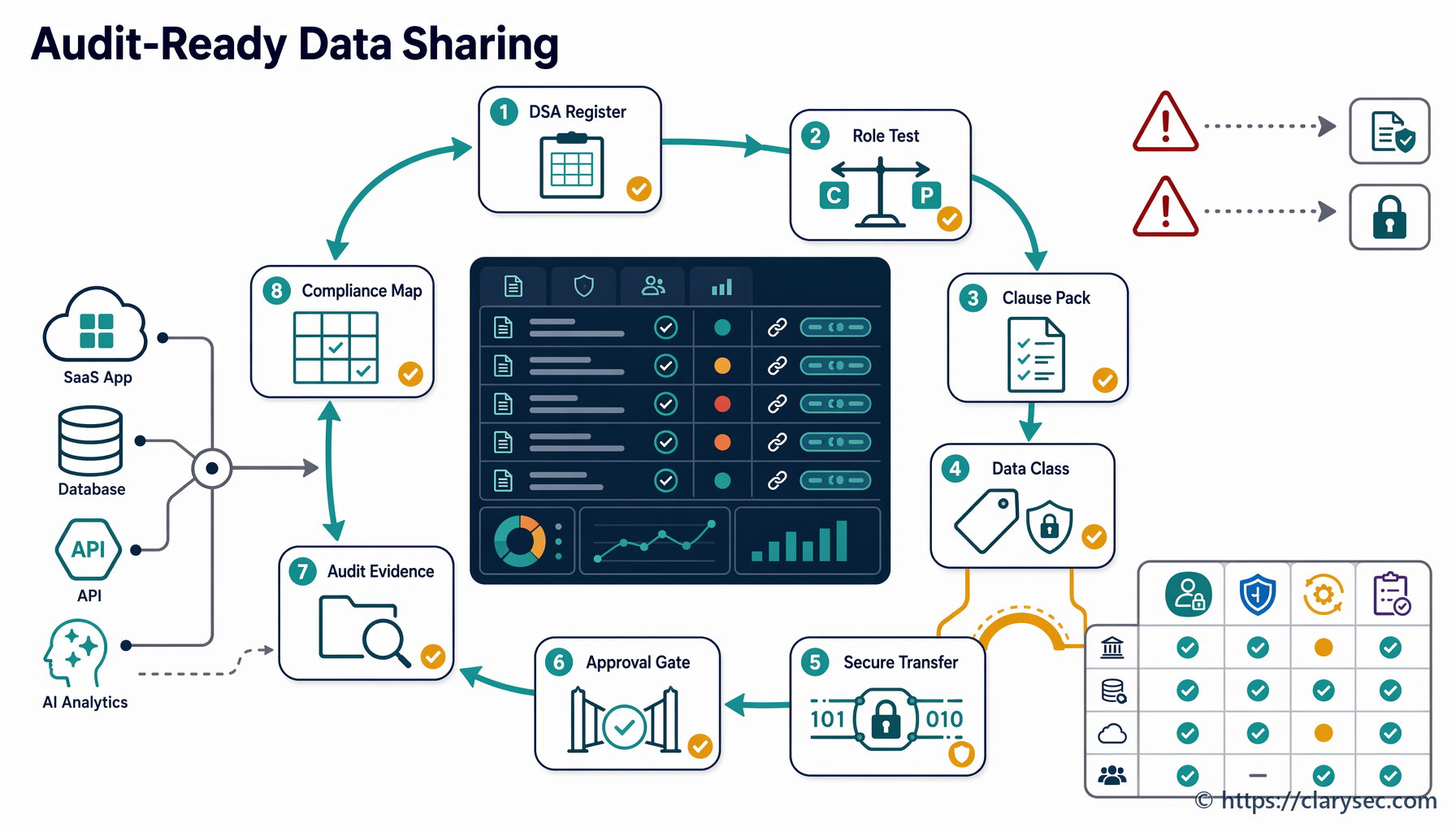
It is 4 PM on a Tuesday, and Sarah, the CISO at a rapidly growing FinTech, is staring at a data sharing agreement from a strategic AI analytics partner. Sales is excited. The partner promises better customer insights, stronger personalization, and faster churn prediction. Legal is cautious. The agreement is full of vague phrases like “commercially reasonable security” and says almost nothing about incident response timelines, data subject rights handling, retention, deletion, audit rights, or exit planning.
Sarah sees the risk immediately. Is the partner acting as a processor, an independent controller, or a joint controller? Who validates the lawful basis under GDPR? If a customer submits an erasure request, what process ensures the data is deleted from the partner environment, derived datasets, and AI training pipelines where applicable? If the partner suffers a breach, who tells whom, when, and with what evidence?
This is not one bad contract. It is the operating model breaking down.
Modern SaaS, FinTech, healthtech, managed service, and platform businesses share data constantly through APIs, integrations, analytics partnerships, support tooling, cloud platforms, affiliates, public sector requests, and AI services. The commercial language often moves faster than the governance. A contract is signed, an API key is issued, and personal data begins flowing before privacy, security, procurement, engineering, and the DPO have agreed on the basics.
Under GDPR, a data sharing agreement is not just a legal artifact. It is evidence of lawfulness, fairness, transparency, purpose limitation, minimisation, storage limitation, integrity, confidentiality, and accountability. Under ISO/IEC 27701:2025, it becomes part of a Privacy Information Management System, or PIMS, where the organization can demonstrate that personal information is collected, used, disclosed, shared, retained, protected, and disposed of through governed processes.
Clarysec treats data sharing governance as a cross-functional control system, not a contract template exercise. Using the Zenith Blueprint, Zenith Controls, and Clarysec’s PIMS policy set, organizations can move from ad-hoc agreement review to an audit-ready lifecycle that connects legal clauses, registers, risk decisions, technical controls, and compliance evidence.
Why data sharing agreements fail in real audits
Most organizations do not fail because they never wrote a contract. They fail because the contract is detached from operational reality.
A privacy reviewer asks for the data sharing register. Legal sends the signed agreement. The reviewer then asks for the lawful basis, disclosure purpose, recipient role, PII categories, retention rule, processing location, transfer method, data subject request routing, technical safeguards, and review evidence. Suddenly, the signed agreement is only one piece of the puzzle.
GDPR Article 5 requires personal data processing to follow lawfulness, fairness, transparency, purpose limitation, data minimisation, accuracy, storage limitation, and integrity and confidentiality. Article 5(2) adds accountability, meaning the controller must be able to demonstrate compliance. Article 6 requires a valid lawful basis. Article 9 raises the bar for special categories of personal data, including health, biometric, genetic, political, religious, and other sensitive categories.
In practice, a data sharing agreement governance process must answer these questions before recurring external sharing begins:
- Who is the recipient, and what is their privacy role?
- What personal data is shared, and for what purpose?
- What lawful basis supports the disclosure?
- Is the new purpose compatible with the original collection purpose?
- Have individuals been informed through a privacy notice or other transparency mechanism?
- Which registers, approvals, and risk decisions evidence the sharing?
- How are data subject rights routed between parties?
- What retention, deletion, return, and termination obligations apply?
- What safeguards protect transfer, storage, access, logging, onward disclosure, and auditability?
- What happens if the partner changes purpose, location, subcontractors, or data categories?
The Zenith Blueprint, Controls in Action phase, Step 23, captures the audit truth clearly:
The foundation of this control is data awareness. The organization must know what PII it collects, where it resides, why it is being processed, and who can access it. Without this baseline, any privacy promises are hollow. Classification and labelling (5.12–5.13) become essential here, because PII cannot be protected if it isn’t identified.
If the agreement does not tie back to the inventory, classification, retention, security controls, and rights process, it is not governance. It is a document in a repository.
Data sharing is not the same as processing on behalf of a customer
A frequent mistake is treating every third-party personal data relationship as a processor scenario. GDPR requires role analysis. A processor acts on behalf of a controller. A controller determines purposes and means. Joint controllers jointly determine purposes and means. Some recipients are independent controllers receiving data for their own purposes.
This distinction changes the agreement model.
A processor agreement focuses on documented instructions, confidentiality, subprocessors, assistance, security, breach notification, deletion or return, and audit support. A controller-to-controller data sharing agreement focuses more heavily on lawful basis, purpose, transparency, recipient independence, onward disclosure limits, DSR coordination, retention, security safeguards, and allocation of responsibilities. A joint controller arrangement requires transparent allocation of obligations and clarity on shared decision-making.
Clarysec’s PIMS policies make this classification a required gate. The Enterprise Processor, Subprocessor and Third-Party Privacy Management Policy states:
[Both] The Privacy Lead / PIMS Manager MUST classify each third-party privacy relationship as controller, joint controller, processor, subprocessor, or other third-party relationship in REG08 before contract approval or before PII processing begins, whichever occurs first.
For SMEs, the same principle is expressed more simply. The Data Protection and Privacy Policy - SME, Governance Requirements 5.2.2, requires:
Contracts with third parties handling personal data must include data protection clauses and must be reviewed by the GM or legal adviser
The lesson is practical: before drafting clauses, classify the relationship. The role drives the agreement, approvals, safeguards, responsibilities, and evidence.
The data sharing governance lifecycle
A mature data sharing agreement workflow should feel like a controlled business process, not an emergency legal escalation. Clarysec typically implements it through seven connected gates.
| Governance gate | Decision to make | Evidence to retain |
|---|---|---|
| 1. Intake | What data sharing activity is proposed, by whom, and for what business purpose? | Intake form, business owner, recipient, dataset, intended start date |
| 2. Role classification | Is the recipient a controller, joint controller, processor, subprocessor, or other third party? | REG08 relationship classification and approval |
| 3. Lawful basis and purpose | What GDPR lawful basis supports the disclosure, and is the purpose compatible? | REG02 processing record, lawful basis note, compatibility assessment if needed |
| 4. Data and classification | Which PII categories and classifications are shared? | Data inventory, classification label, minimisation review |
| 5. Contract and safeguards | Which agreement clauses, security controls, transfer terms, and onward sharing limits apply? | DSA, DPA, joint controller terms, security annex, transfer controls |
| 6. Operational integration | How are DSRs, incidents, retention, deletion, audit requests, and reviews handled? | DSR workflow, incident interface, retention schedule, review calendar |
| 7. Ongoing assurance | Is the sharing still necessary, secure, lawful, and aligned with notices and registers? | Periodic review, audit evidence, corrective actions, termination evidence |
The Enterprise PII Collection, Use, Disclosure and Sharing Policy makes the controller-side requirement explicit:
[Controller] The Vendor / Procurement Owner MUST record recipient identity, recipient role, disclosure purpose, PII categories, sharing frequency, processing location and authority source in REG08 before recurring external sharing begins.
REG08 is the recipient and third-party privacy relationship register. It should not live separately from the processing inventory. The Enterprise PII Processing Inventory and Lawful Basis Policy requires:
[Both] The Vendor / Procurement Owner MUST verify that external recipient, processor, subprocessor, and data-sharing entries in REG02 align with REG08 before agreement approval or material relationship change.
This closes a common audit gap. REG02 may say “product analytics for internal improvement,” while REG08 says “analytics partner for benchmarking.” If the purpose, recipient, lawful basis, data categories, or retention rules do not align, the organization has an accountability defect.
What every data sharing agreement should contain
A data sharing agreement under GDPR and ISO 27701:2025 should not rely on generic confidentiality language. It should reflect the real data flow, role classification, risk profile, and operational interfaces.
| Clause area | Why it matters |
|---|---|
| Parties and roles | Confirms whether each party is an independent controller, joint controller, processor, or other recipient |
| Purpose and lawful basis | Links the disclosure to a valid purpose and lawful basis under GDPR |
| Data categories and data subjects | Limits the agreement to defined PII categories and affected individuals |
| Data minimisation | Prevents sharing fields that are not necessary for the purpose |
| Transparency obligations | Allocates privacy notice and communication responsibilities |
| Special category conditions | Adds explicit safeguards and justification where Article 9 data is involved |
| Transfer method | Requires secure channels such as encrypted APIs, SFTP, secure portals, or equivalent controls |
| Access control | Defines who can access shared data and how access is approved, reviewed, and revoked |
| Retention and deletion | Sets retention limits, deletion triggers, return obligations, and evidence requirements |
| Onward disclosure | Restricts sharing with affiliates, subcontractors, public bodies, or commercial partners without conditions |
| DSR cooperation | Defines routing, acknowledgement, identity validation, response coordination, and closure evidence |
| Incident notification | Defines notification timelines, content, escalation contacts, and cooperation expectations |
| Audit and assurance | Allows evidence review, control attestations, certifications, or audit support |
| Change control | Requires reassessment for new purposes, new data categories, new locations, or new recipients |
| Termination | Covers data return, destruction, access revocation, and certification of deletion |
The Zenith Blueprint, Controls in Action phase, Step 23, gives the supplier agreement lens:
Key areas typically addressed in supplier agreements include:
✓ Confidentiality obligations , including scope, duration, and third-party disclosure restrictions; ✓ Access control responsibilities , such as who can access your data, how credentials are managed, and what monitoring is in place; ✓ Technical and organizational measures for data protection, encryption, secure transmission, backup, and availability commitments; ✓ Incident reporting timelines and protocols , often with defined timeframes (e.g., “notify within 24 hours”); ✓ Right to audit , including frequency, scope, and access to relevant evidence (e.g., pen test reports, SoA, certifications); ✓ Subcontractor controls , requiring your supplier to pass on equivalent security obligations to their downstream partners; ✓ End-of-contract provisions , such as data return or destruction, asset recovery, and account deactivation.
Enterprise legal governance reinforces the point. The Legal and Regulatory Compliance Policy, Governance Requirements 5.3.1.2, identifies contracts involving:
Contracts involving data sharing, intellectual property rights, liability limitations, or audit clauses
That places data sharing governance at the intersection of privacy, legal, commercial risk, supplier assurance, and security operations.
Classification and secure transfer are the missing bridge
Many data sharing failures start with poor classification. If the business owner cannot state whether the dataset is public, internal, confidential, restricted, or contains regulated PII, the agreement will be vague and the technical controls will be inconsistent.
Clarysec’s Data Classification and Labeling Policy - SME states:
Data-sharing agreements or Non-Disclosure Agreements (NDAs) must reference classification handling requirements.
For enterprise environments, the Data Classification and Labeling Policy requires that certain data:
May only be shared externally under an NDA or equivalent contractual safeguards
The classification label should appear in the agreement or security annex. If support ticket history is classified as confidential and contains PII, the agreement should define permitted recipients, approved transfer methods, storage locations, access controls, monitoring, deletion expectations, and assurance evidence.
The Zenith Blueprint, Controls in Action phase, Step 22, explains the operational side of information transfer:
At its core, this control demands that the organization:
✓ Define how information may be transferred, both internally and externally; ✓ Determine what methods are permitted (e.g., encrypted email, secure portals, SFTP, APIs, physical delivery with encryption); ✓ Align transfer methods with information classification (as defined in 5.12 and made visible via 5.13); ✓ And ensure that all parties involved in the transfer understand their roles, responsibilities, and obligations.
For SMEs, the Third-Party and Supplier Security Policy - SME makes the expectation direct:
All data shared with suppliers must be protected through encryption and transmitted using secure protocols (e.g., HTTPS, SFTP).
Enterprise supplier governance adds more detail. The Third party and supplier security policy requires data handling requirements including:
Data handling requirements, including storage location, access controls, and return or destruction clauses
These requirements should not be buried in a questionnaire. They should be enforceable contract terms and traceable to REG08, technical configuration, and audit evidence.
Example: approving Sarah’s AI analytics partner
Sarah’s FinTech wants to share pseudonymized customer IDs, transaction patterns, usage metrics, and support tier information with an AI analytics partner for personalization and churn prediction. The partner may combine the data with its analytics models and provide insights back to the FinTech.
A governed workflow would look like this.
First, the Vendor or Procurement Owner creates the REG08 entry. The Privacy Lead or PIMS Manager classifies the relationship. If the partner determines analytics purposes and model design beyond Sarah’s instructions, the role may be independent controller or joint controller rather than processor.
| Field | Example value |
|---|---|
| Recipient | AI Analytics Inc. |
| Recipient role | Independent controller, pending final legal validation |
| Lawful basis | Legitimate interests, LIA on file |
| PII categories | Customer ID, transaction history, usage metrics, support tier |
| Safeguards | Pseudonymization, field minimisation, encrypted API, access logging |
| Purpose | Product personalization and churn prediction |
| Sharing frequency | Daily via API |
| Processing location | EU, Ireland |
| Governing agreement | DSA-2026-042 |
| Review date | 2027-04-01 |
Second, REG02 is reconciled. If the processing inventory only describes “internal product analytics,” it must be updated before external sharing begins. The lawful basis must be documented, and if the purpose has changed, a compatibility assessment or legitimate interests assessment may be needed.
Third, the data owner applies classification and minimisation. Administrator email domains may not be necessary. Account IDs may be replaced with partner-specific pseudonymous IDs. Support tier may be retained only if it is required for the approved purpose.
Fourth, legal, privacy, and security negotiate the data sharing agreement and security annex. The agreement prohibits re-identification, restricts onward disclosure, defines retention, requires deletion evidence, specifies incident notification timelines, includes audit or assurance rights, and defines exit steps.
Fifth, the privacy notice and DSR workflow are updated. The Enterprise PII Principal Rights Management Policy requires:
[Both] The Vendor / Procurement Owner MUST track third-party acknowledgement of rights-related notifications in REG08 before the related REG06 request is closed.
For SMEs, the Data Protection and Privacy Policy - SME gives a practical service-level expectation:
The Privacy Coordinator must acknowledge requests within 3 working days and respond within 30 days
Finally, engineering enforces the agreement. API credentials are scoped. Transfers use HTTPS. Logs capture data pulls. Alerts detect unusual activity. Access is reviewed. Retention is automated where possible. The agreement becomes a living control system, not a PDF.
Cross-compliance mapping for GDPR, ISO 27701, DORA, NIS2, NIST, and COBIT 19
Data sharing governance rarely belongs to one framework. It touches GDPR accountability, ISO/IEC 27701:2025 privacy operations, ISO/IEC 27001:2022 management system requirements, ISO/IEC 27002:2022 security controls, DORA third-party risk, NIS2 supply chain security, NIST CSF 2.0 outcomes, and COBIT 19 governance expectations.
ISO/IEC 27001:2022 clause 4.2 requires organizations to understand interested parties and their relevant requirements. Clause 5.1 requires leadership to integrate information security requirements into business processes. For data sharing, that means partner dependencies, contractual requirements, regulatory obligations, and risk decisions must be inside the ISMS and PIMS, not outside them.
The most relevant ISO/IEC 27002:2022 controls are:
- 5.14 Information transfer
- 5.20 Addressing information security within supplier agreements
- 5.34 Privacy and protection of PII
Zenith Controls helps organizations use these controls as mapping anchors. It links ISO/IEC 27002:2022 control 5.14 to data in transit protection and contractual requirements, including NIST CSF 2.0 PR.DS-02 and GV.SC-05, DORA Article 30(2)(d), and GDPR Article 46 where international transfer safeguards are relevant. It links control 5.20 to supplier agreement governance, including NIS2 Article 21(2)(d) supply chain security and DORA Chapter V on ICT third-party risk. It links control 5.34 to privacy and protection of PII, including GDPR Article 5(2) accountability and supporting controls such as encryption, deletion, supplier management, and purpose limitation.
| Framework lens | What data sharing governance must prove |
|---|---|
| GDPR | Lawful basis, transparency, purpose limitation, minimisation, retention, security, accountability, rights cooperation |
| ISO/IEC 27701:2025 | PIMS role clarity, privacy controls, documented processing, disclosure governance, evidence of privacy operations |
| ISO/IEC 27001:2022 | ISMS scope, risk assessment, treatment, supplier controls, transfer controls, monitoring, audit, management review |
| ISO/IEC 27002:2022 | Information transfer, supplier agreement security, privacy and protection of PII |
| NIS2 | Management oversight, supply chain security, all-hazards risk management, incident handling, training, access control |
| DORA | ICT third-party lifecycle, contractual registers, incident support, audit rights, data location, exit and resilience |
| NIST CSF 2.0 | GOVERN, IDENTIFY, PROTECT, DETECT, RESPOND, RECOVER outcomes for third-party and data risk |
| COBIT 19 | Governance objectives, accountability, risk ownership, control performance, assurance and improvement |
The goal is not seven compliance programs. The goal is one governed data sharing lifecycle that produces reusable evidence.
How auditors will test your data sharing agreements
A strong governance process must withstand sampling. Auditors will not stop at the signed agreement. They will test the lifecycle.
An ISO/IEC 27001:2022 and ISO/IEC 27701:2025 auditor will ask whether the ISMS and PIMS scope include external sharing, whether the risk assessment covers the relationship, whether controls were selected and operated, and whether management reviews third-party privacy and security risk.
A GDPR reviewer or supervisory authority will focus on accountability. They will ask what personal data was shared, why, on what lawful basis, whether individuals were informed, how long data was retained, whether special category data was involved, whether international transfers were assessed, and whether rights requests were routed and evidenced.
A DORA reviewer, especially in financial services, will ask whether the arrangement supports a critical or important function, whether it is in the ICT contractual register, whether the contract includes incident assistance, audit rights, data location, subcontracting conditions, termination rights, and tested exit planning.
A NIST CSF 2.0 assessor will look for GOVERN outcomes in supplier risk management, PROTECT outcomes in data-in-transit controls, RESPOND outcomes in incident interfaces, and RECOVER outcomes in exit and continuity planning.
A COBIT 19 or ISACA-style auditor will focus on decision rights, risk appetite, benefits realization, resource optimization, compliance obligations, metrics, exceptions, and continual improvement.
| Audit test | Expected evidence |
|---|---|
| Select one active data sharing partner | Signed DSA or equivalent, REG08 entry, role classification |
| Trace to processing inventory | REG02 entry with purpose, lawful basis, PII categories, retention, recipients |
| Verify classification | Data classification record and handling requirements referenced in agreement |
| Verify security controls | Encryption, secure protocol, access control, logging, storage location, monitoring evidence |
| Verify DSR process | REG06 request evidence, recipient notification, acknowledgement tracked in REG08 |
| Verify retention and termination | Retention rule, deletion procedure, return or destruction clause, deletion certificate if ended |
| Verify review | Periodic review record, changes assessed, exceptions and corrective actions tracked |
If your team cannot assemble this evidence quickly, the process is too dependent on memory.
Common data sharing governance pitfalls
Clarysec repeatedly sees five failure patterns.
The first is confusing a DPA with a data sharing agreement. Processor clauses do not solve controller-to-controller or joint controller accountability.
The second is weak register hygiene. REG02 and REG08 disagree. The privacy notice refers broadly to “business partners,” but the processing inventory has no matching disclosure purpose.
The third is poor DSR routing. A data subject asks for erasure, but no one knows which recipients must be notified or how acknowledgement is tracked.
The fourth is generic security language. “Appropriate security” is not enough. The agreement should specify transfer methods, encryption, access controls, logging, storage location, incident timelines, deletion, and assurance.
The fifth is ignoring onward disclosure. Modern SaaS ecosystems include cloud platforms, AI services, analytics vendors, support tools, managed providers, affiliates, and public bodies. Data sharing governance must control downstream disclosure where it affects accountability.
The Processor, Subprocessor and Third-Party Privacy Management Policy captures the operational linkage for processor and subprocessor relationships:
[Both] The Vendor / Procurement Owner MUST ensure that processor and subprocessor contracts include privacy assistance, security assurance, incident interface through PII15, return or deletion through PII10, transfer linkage through PII13, and audit or assurance cooperation before approval.
Even where the relationship is controller-to-controller, the governance logic remains valuable: privacy assistance, security assurance, incident interface, transfer linkage, return or deletion, and audit cooperation must be designed deliberately.
Practical checklist for your next data sharing agreement
Use this checklist before approving recurring external sharing of personal data.
- Confirm the recipient’s privacy role in REG08.
- Confirm REG02 and REG08 are aligned before approval.
- Document the disclosure purpose and lawful basis.
- Check whether a new purpose requires compatibility assessment.
- Identify PII categories, data subject categories, and special category data.
- Apply data minimisation and remove unnecessary fields.
- Reference classification handling requirements in the agreement.
- Define approved transfer methods and encryption requirements.
- Specify access control, logging, monitoring, and storage location expectations.
- Allocate transparency responsibilities and privacy notice updates.
- Define DSR routing, acknowledgement, tracking, and closure evidence.
- Define retention, deletion, return, and termination evidence.
- Restrict onward disclosure and require change notification.
- Include incident notification timelines and cooperation requirements.
- Include audit, assurance, or evidence review rights.
- Schedule periodic review and reassessment triggers.
Where Clarysec fits
Clarysec’s value is not only templates. It is the connection between policy, registers, evidence, audit logic, and cross-compliance mapping.
The Zenith Blueprint gives implementation teams a 30-step roadmap for turning control requirements into working practices. For data sharing, Step 22 helps teams design information transfer rules, while Step 23 connects privacy, supplier agreements, legal requirements, PII protection, and contractual obligations.
Zenith Controls provides the cross-compliance compass. For this topic, it links ISO/IEC 27002:2022 controls 5.34, 5.14, and 5.20 to the broader audit story: privacy protection, information transfer, and supplier agreement governance. It helps CISOs, DPOs, compliance managers, procurement teams, and auditors speak the same language when mapping GDPR, ISO/IEC 27701:2025, ISO/IEC 27001:2022, NIS2, DORA, NIST CSF 2.0, and COBIT 19 expectations.
Clarysec’s PIMS policy set then gives organizations the operating rules: classify privacy relationships, maintain processing and recipient registers, verify register alignment, define lawful basis, manage data subject rights, control supplier and third-party clauses, enforce classification handling, and preserve evidence.
If your organization shares personal data with partners, platforms, affiliates, public bodies, analytics providers, AI services, or SaaS ecosystem participants, do not start with the contract. Start with governance.
Use Zenith Blueprint: An Auditor’s 30-Step Roadmap to place data sharing inside your ISMS and PIMS implementation plan. Use Zenith Controls: The Cross-Compliance Guide to map ISO/IEC 27002:2022 controls 5.34, 5.14, and 5.20 against GDPR, NIS2, DORA, NIST, and COBIT assurance expectations. Then implement Clarysec’s PIMS policies, including the PII Collection, Use, Disclosure and Sharing Policy, PII Processing Inventory and Lawful Basis Policy, and Processor, Subprocessor and Third-Party Privacy Management Policy, so every agreement is backed by registers, workflows, safeguards, and evidence.
The practical next action is simple: select your three highest-risk external data sharing relationships and test them against REG02, REG08, lawful basis, DSR routing, transfer controls, retention, and audit evidence. If the evidence chain breaks, Clarysec can help you rebuild it into an audit-ready data sharing governance model.
About the Author

Igor Petreski
Compliance Systems Architect, Clarysec LLC
Igor Petreski is a cybersecurity leader with over 30 years of experience in information technology and a dedicated decade specializing in global Governance, Risk, and Compliance (GRC).Core Credentials & Qualifications:• MSc in Cyber Security from Royal Holloway, University of London• PECB-Certified ISO/IEC 27001 Lead Auditor & Trainer• Certified Information Systems Auditor (CISA) from ISACA• Certified Information Security Manager (CISM) from ISACA • Certified Ethical Hacker from EC-Council