Detection Engineering for Audit-Ready SIEM in 2026
Detection Engineering for Audit-Ready SIEM in 2026
At 08:17 on a Tuesday morning, the CISO of a scaling fintech SaaS provider receives two messages within the same minute.
The first is from the SOC analyst: “We have 312 failed login alerts from last night. Most look like noise, but one account had a successful login from a new geography after repeated failures.”
The second is from the compliance manager: “Our enterprise customer has asked for evidence that our SIEM detections are tested, tuned, owned and mapped to incident reporting obligations under NIS2, DORA and GDPR. They want it before renewal.”
A year earlier, the CISO had been relieved when the company passed its ISO 27001:2022 audit. The certificate helped win enterprise customers. But one auditor comment kept resurfacing in board meetings: “You have strong log collection coverage, but the link between SIEM alerts and a documented risk-based detection strategy is unclear. How do you prove the rules are effective? How do you manage alert noise? How would you defend this to a DORA or NIS2 regulator?”
That is the reality of detection engineering in 2026. The old evidence pack, SIEM screenshots, log source lists and retention settings, is no longer enough. Regulators, customers, auditors and boards want proof that monitoring is governed as a lifecycle. They want to see why each detection exists, what risk it mitigates, who owns it, how it was tested, how tuning decisions were approved, how alerts become incidents, and whether the evidence can support timely regulatory notification.
Many organizations discover the same painful gap. They collect logs, but cannot prove the logs are complete. They generate alerts, but cannot show tuning history. They escalate incidents, but cannot reconstruct the decision path that turned an event into a reportable incident. They outsource SOC operations, but cannot evidence supplier oversight. They claim ISO alignment, but their Statement of Applicability does not explain how logging, monitoring and incident response support NIS2, DORA or GDPR.
Detection engineering is no longer just the craft of writing Sigma rules, correlation searches or behavioral analytics. It is the discipline of turning SIEM use cases into managed control objects inside the ISMS.
Why detection engineering became a compliance issue
NIS2, DORA and GDPR do not tell your SOC which SIEM query to write. They do create strong expectations that security events are detected, assessed, escalated and evidenced in time.
NIS2 applies to many essential and important entities, including digital infrastructure providers, managed service providers, managed security service providers and certain digital providers. For detection engineering, the governance signal is in Articles 20 and 21. Management bodies must approve cybersecurity risk-management measures, oversee implementation and receive cybersecurity training. Measures must be appropriate, proportionate and based on an all-hazards approach. The minimum areas include incident handling, business continuity, supply chain security, secure development, effectiveness assessment, basic cyber hygiene, access control, asset management and, where appropriate, MFA and secure communications.
The reporting signal is Article 23. Essential and important entities must notify significant incidents without undue delay through a staged process: early warning within 24 hours of awareness, incident notification within 72 hours, updates where requested, and a final report no later than one month after the incident notification. A SIEM alert is not automatically a reportable incident, but if the organization cannot show when awareness occurred, how severity was assessed and who made the escalation decision, the reporting clock becomes difficult to defend.
DORA raises the bar for financial entities. It applies from 17 January 2025 and creates uniform requirements for ICT risk management, ICT incident reporting, digital operational resilience testing, ICT third-party risk and oversight. For financial entities that are also identified under NIS2 national transposition, DORA generally acts as the sector-specific Union legal act for corresponding ICT risk-management and reporting requirements. DORA Article 17 is central for detection engineering because it requires an ICT-related incident management process to detect, manage and notify incidents, record ICT-related incidents and significant cyber threats, identify root causes, establish early warning indicators, classify incidents, define escalation, communicate to stakeholders and report major incidents to senior management and the management body.
GDPR adds the privacy accountability layer. Article 5 requires appropriate security and accountability. Article 33 requires personal data breach notification to the supervisory authority without undue delay and, where feasible, not later than 72 hours after becoming aware of the breach. For SIEM programs, this means the organization must be able to show how unauthorized access, suspicious authentication, privilege misuse, anomalous processing and potential data exfiltration are detected and assessed.
ISO/IEC 27001:2022 gives the management-system backbone. Clauses 4 to 10 require context, interested-party requirements, scope, leadership, risk assessment, risk treatment, operational planning and control, monitoring and measurement, internal audit, management review and continual improvement. ISO/IEC 27002:2022 provides practical Annex A control guidance, including 8.15 Logging, 8.16 Monitoring activities, 8.17 Clock synchronization, 5.24 Information security incident management planning and preparation, 5.25 Assessment and decision on information security events, 5.26 Response to information security incidents, 5.27 Learning from information security incidents, 5.28 Collection of evidence, 5.31 Legal, statutory, regulatory and contractual requirements, 5.33 Protection of records and 5.34 Privacy and protection of PII.
The key point is simple: detection engineering is where regulatory timelines meet technical reality.
From “we collect logs” to “we operate detections”
A mature detection program starts with a better question.
Not: “Do we have a SIEM?”
But: “Can we prove our detections are risk-based, tested, tuned, monitored, escalated and improved?”
Clarysec’s enterprise Information Security Policy sets the governance baseline:
“All implemented controls shall be auditable, supported by documented procedures and retained evidence of operation.”
That sentence changes how SIEM work is managed. A detection is not complete when the query is deployed. It is complete when the organization can show the procedure, evidence and operating record behind it.
The Logging and Monitoring Policy makes this operational. For enterprise environments, Clause 5.2.2 requires the SIEM to:
“Support rule-based alerting and correlation”
The same policy also requires:
“Alert thresholds must be based on contextual behavior and correlation (e.g., login failure frequency, lateral movement indicators).”
For smaller organizations, the Logging and Monitoring Policy-sme provides proportionate language that still supports auditability:
“If centralized logging (e.g., SIEM or a cloud dashboard) is used, it must support integrity checks and access controls”
It also requires:
“Alerts must be reviewed promptly and documented, including the resolution outcome”
And for escalation:
“High-priority alerts must be escalated to the GM and Privacy Coordinator within 24 hours”
That is the bridge many SMEs need. They may not have a 24x7 internal SOC, but they can still evidence that alerts are reviewed, outcomes are documented, logs are protected and high-priority events reach accountable leadership.
The audit-ready SIEM use-case lifecycle
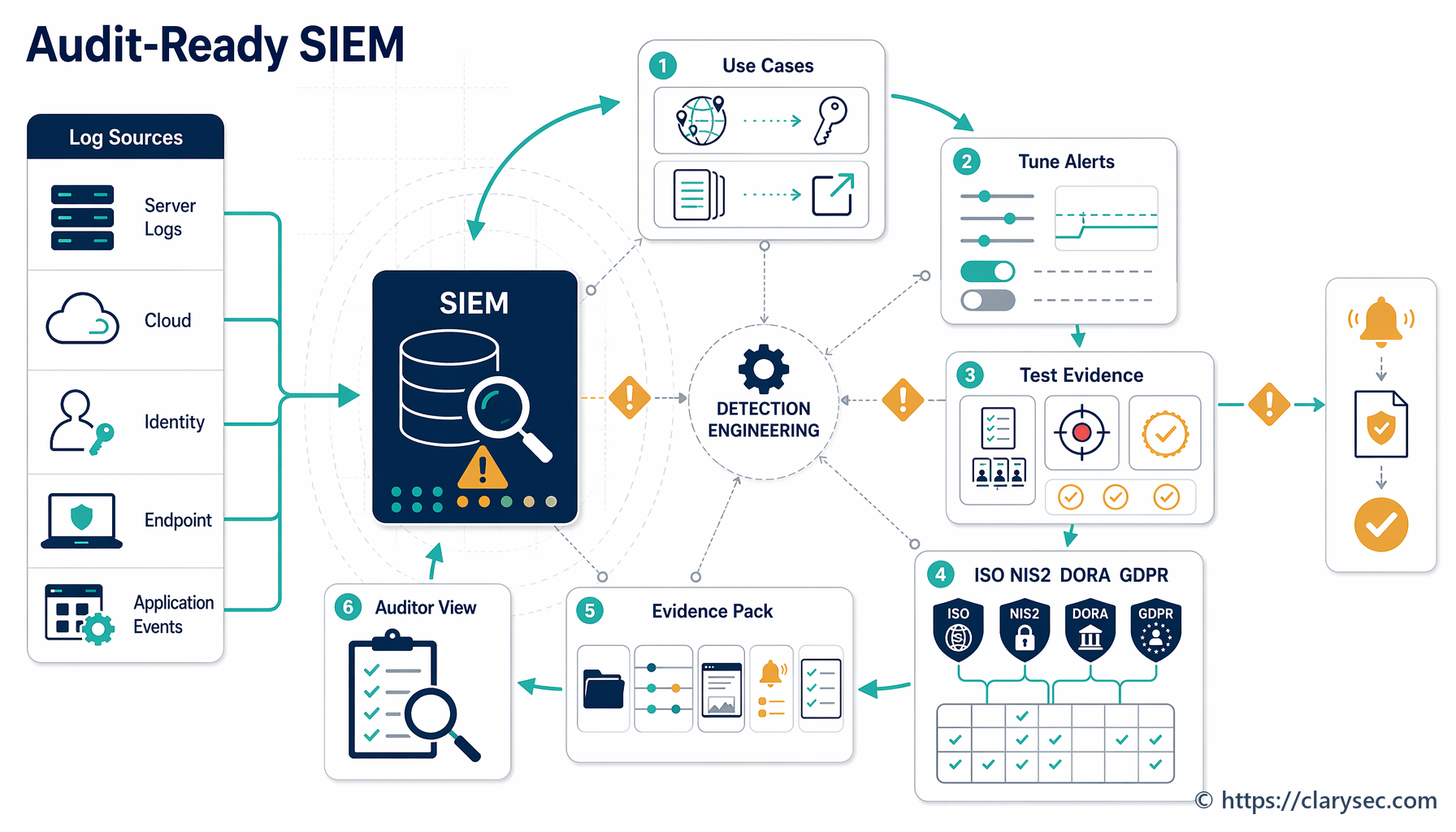
Clarysec recommends treating each SIEM detection as a mini-control with a lifecycle record. The lifecycle must be simple enough for operations, but structured enough for auditors.
| Lifecycle stage | What the team does | Evidence to retain | Compliance value |
|---|---|---|---|
| 1. Risk trigger | Link the use case to a risk scenario, regulatory obligation, threat intelligence or recent incident | Risk register entry, threat scenario, requirement mapping | Shows why the detection exists |
| 2. Detection design | Define behavior, data sources, detection logic, severity and expected response | Use-case specification, data source list, rule logic, severity matrix | Shows intentional design |
| 3. Data validation | Confirm logs are generated, forwarded, timestamped, parsed and protected | Log source validation, parser checks, NTP evidence, access control evidence | Supports incident reconstruction |
| 4. Development review | Peer-review the rule and confirm alignment with risk and response requirements | Review notes, version history, approval record | Shows controlled change |
| 5. Test | Run safe simulation, tabletop, red-team scenario or replayed event | Test ticket, screenshots, event ID, result, defects | Proves the detection works |
| 6. Deploy and tune | Deploy in production, review early alerts and adjust thresholds or enrichment | Change record, tuning rationale, approval | Proves alert fatigue is controlled |
| 7. Triage | Assess alert quality, business context, false positives and impact | Triage notes, analyst decision, closure reason | Supports event assessment |
| 8. Escalate | Route valid events to incident response, privacy, legal or management | Escalation ticket, timestamps, notifications | Supports NIS2, DORA and GDPR timing evidence |
| 9. Review or retire | Measure performance, update the rule or retire it when no longer relevant | KPI report, monthly review, retirement record | Supports continual improvement |
This lifecycle aligns with the Zenith Blueprint: An Auditor’s 30-Step Roadmap. In the Controls in Action phase, Step 19, Technological Controls I, Clarysec advises:
“Ensure all critical systems (servers, domain controllers, firewalls) are forwarding logs to your SIEM or log collector. Validate that log retention aligns with your logging policy (e.g., 90 days live, 1 year archive). Pick a recent incident or event and demonstrate how you traced it using your logs.”
That last sentence is where audits often succeed or fail. The auditor does not only want to know that logs exist. They want to see an event traced across systems, with timestamps, correlated context and a decision trail.
The Zenith Blueprint also emphasizes time synchronization in Step 19 because detection engineering depends on reliable timelines. A brute force alert, VPN login, endpoint process execution and cloud console action may look unrelated if clocks drift. During an incident, that drift can undermine root cause analysis and reporting.
The ISO control relationships behind effective detection
Clarysec’s Zenith Controls: The Cross-Compliance Guide helps teams understand how ISO/IEC 27001:2022 and ISO/IEC 27002:2022 controls interact across compliance frameworks. It does not create separate “Zenith controls.” It maps and explains relationships between recognized controls, audit evidence and compliance expectations.
For control 8.15, Logging, Zenith Controls explains that logging is the foundational data layer for monitoring. For control 8.16, Monitoring activities, it highlights that monitoring depends on logs to analyze security events, detect anomalies and identify potential breaches. The guide states:
“Without robust logging, monitoring lacks data; conversely, without monitoring, logs would not be examined to detect information security events and anomalies.”
For control 5.25, Assessment and decision on information security events, the guide frames triage as the bridge between raw alerts and formal incident handling. This mapping matters because alert tuning is not only a SOC quality task. It affects whether events are correctly classified, whether evidence is preserved and whether management can rely on incident metrics.
| ISO/IEC 27002:2022 control area | Detection engineering interpretation | Common failure | Clarysec evidence |
|---|---|---|---|
| 8.15 Logging | Generate, protect, retain and analyze security-relevant logs | Critical logs are missing, incomplete or mutable | Log source register, retention evidence, integrity checks |
| 8.16 Monitoring activities | Analyze logs and behavior for anomalies, then take action | Alerts exist but are not reviewed or tuned | Use-case library, alert review tickets, tuning log |
| 8.17 Clock synchronization | Maintain consistent time across systems | Timelines cannot be reconstructed | NTP configuration, clock drift checks, audit screenshots |
| 5.25 Assessment and decision on information security events | Decide whether an event is benign, suspicious or an incident | No documented decision criteria | Triage matrix, incident threshold criteria, escalation evidence |
| 5.26 Response to information security incidents | Contain, eradicate, communicate and recover | Incident process starts too late | IR ticket, timeline, communications, lessons learned |
| 5.28 Collection of evidence | Preserve logs, snapshots and forensic material | Evidence is overwritten or unauthenticated | Chain of custody, protected records, forensic export |
| 5.33 Protection of records | Protect audit and incident records from loss or tampering | Evidence cannot be trusted | Access control, retention configuration, immutable storage evidence |
| 5.34 Privacy and protection of PII | Monitor personal-data risks proportionately | Excessive logging or weak breach assessment | PII access monitoring, privacy review, breach worksheet |
The lifecycle becomes auditable when these relationships are visible in the ISMS. In Zenith Blueprint, Risk Management phase, Step 13, Risk Treatment Planning and Statement of Applicability, Clarysec recommends mapping controls to risks and clauses, adding Annex A references to risk treatment plans and noting where controls support GDPR, NIS2 or DORA. For detection engineering, the SoA entry for logging and monitoring should not say only “Implemented.” It should describe log sources, SIEM coverage, alert use-case lifecycle, incident linkage, evidence retention and supplier dependencies.
Two practical use cases that turn alerts into evidence
A detection engineering program becomes real when it is applied to high-risk scenarios. Two common examples are privileged access abuse and insider data exfiltration.
Use case 1: impossible travel followed by privileged action
A fintech platform uses SSO, MFA and privileged access management for production administration. The risk scenario is unauthorized access to production customer data using compromised administrative credentials. GDPR relevance exists because personal data may be accessed. DORA relevance exists because ICT systems supporting financial services may be affected. NIS2 relevance may exist depending on the entity’s sector and classification.
The detection correlates SSO logs, VPN logs, cloud IAM logs and privileged access management logs. It triggers when the same identity authenticates from two geographically distant locations in an impossible timeframe, then performs a privileged action such as role assignment, production database access or security group modification.
Severity is contextual. Impossible travel without privileged action may be medium. Impossible travel followed by privileged action is high. Impossible travel followed by data export is critical. The severity model should consider whether the account is a break-glass account, production administrator, service desk operator or ordinary user.
Testing should use a controlled test account, simulated login locations or replayed logs in a test SIEM index. Evidence should include event IDs, screenshots, analyst notes and expected response. Tuning should enrich the rule with known VPN egress ranges, device trust, MFA result and service principal exclusions, without suppressing the risk entirely.
Use case 2: potential insider data exfiltration
A risk assessment identifies a high-priority risk: an authorized employee exfiltrating sensitive customer data. The detection starts with a simple rule: generate an alert if a user downloads more than 500 MB from the production customer database within one hour.
In silent mode, the rule generates hundreds of alerts because the data science team regularly pulls large datasets. This is where the Logging and Monitoring Policy requirement for contextual behavior and correlation becomes critical. A better rule generates a high-priority alert when a user not in the approved data science group downloads more than 500 MB from the production customer database, from an unusual device, outside an approved job window or followed by upload to an unsanctioned destination.
The test is straightforward. A red-team or purple-team exercise attempts controlled exfiltration using a test account. The SOC confirms whether the alert fires, whether the ticket is created, whether escalation occurs and whether evidence is preserved.
For smaller teams, the Incident Response Policy-sme anchors the legal timeline:
“Response timelines, including data recovery and notification obligations, must be documented and aligned with legal requirements, such as the GDPR 72-hour personal data breach notification requirement.”
The Evidence Collection and Forensics Policy-sme adds a proportionate evidence requirement:
“A simple chain-of-custody log (e.g., Excel file or template document) must be maintained for each incident.”
For both use cases, the evidence pack should include the use-case specification, risk owner, log source list, test result, tuning history, triage ticket, escalation timeline, chain-of-custody record and post-review note. This is the difference between saying “the SIEM alerted” and proving “the organization detected, assessed, escalated and preserved evidence according to approved criteria.”
Alert tuning is a compliance control
Alert fatigue creates compliance risk. If analysts routinely ignore alerts, if thresholds are arbitrary, or if suppressions are undocumented, monitoring exists on paper but fails operationally.
A good tuning record answers five questions:
- What changed?
- Why did it change?
- What evidence supports the change?
- Who approved it?
- What risk remains?
Consider a lateral movement detection that generates 400 alerts per week because vulnerability scanners authenticate across endpoints. A weak tuning response is: “Suppress scanner account.” A defensible response is: “Suppress scanner account only when the source host is an approved scanner, the destination is in approved scan scope, authentication occurs during an approved scan window and no interactive logon occurs. Any deviation remains alertable.”
The enterprise Incident Response Policy strengthens this through governance metrics:
“The CISO shall define, approve, and periodically review all monitoring and measurement criteria used to evaluate the effectiveness of incident response. These metrics must be documented, reviewed at least annually, and used to inform ISMS improvements, internal audit planning, and post-incident remediation activities.”
For SIEM use cases, Clarysec recommends the following metrics.
| Metric | Why it matters | Evidence source |
|---|---|---|
| Alert volume by use case | Detects noise, drift and attack patterns | SIEM reports |
| False positive rate | Shows tuning effectiveness | Triage closure reasons |
| Mean time to triage | Shows responsiveness | Ticket timestamps |
| Mean time to escalate | Supports regulatory reporting readiness | Alert and incident tickets |
| Detection test pass rate | Proves use cases work | Test records |
| Log source health | Shows monitoring coverage | SIEM ingestion reports |
| Critical alert review rate | Shows governance discipline | SOC review logs |
| Post-incident rule updates | Shows learning and improvement | Change records and lessons learned |
These metrics should feed ISO management review and internal audit. ISO 27001:2022 clauses 9.1 to 9.3 require monitoring and measurement, internal audit and management review. Clauses 10.1 and 10.2 require continual improvement and corrective action. A detection program that measures only SIEM uptime is incomplete. It must measure whether security events become timely, accurate decisions.
Testing detections with tabletop and red-team evidence
A SIEM use case that has never been tested is an assumption. In 2026, assumptions do not survive audits.
The enterprise Security Testing and Red-Teaming Policy requires a security testing program that includes:
“red-teaming exercises, consisting of scenario-based simulations of real attacks, including social engineering and other tactics, to test the organisation’s detection and response capabilities as a whole.”
Vulnerability scans prove exposure. Penetration tests prove exploitability. Red-team and purple-team exercises prove whether detection and response work under realistic conditions. For ransomware, cloud privilege escalation or data exfiltration, testing should validate telemetry across endpoint, identity, network, cloud and application layers.
The Zenith Blueprint, Controls in Action phase, Step 23, tells teams to validate incident management capabilities by selecting a recent event or conducting a tabletop exercise, capturing decisions, roles and communications, and updating the plan with lessons learned. It also stresses evidence preservation, including log snapshots, backups and secure isolation of impacted systems.
A practical detection test record should include:
- Scenario name and risk
- Date and environment
- Participants
- Expected telemetry
- Actual telemetry observed
- Alert generated or not generated
- Triage decision
- Escalation decision
- Evidence preserved
- Defects raised
- Retest date
This record becomes high-value audit evidence because it links technical detection to incident response, training and continual improvement.
Cross-compliance mapping for one detection lifecycle
A well-designed evidence pack can serve multiple frameworks if the mapping is intentional. Clarysec uses Zenith Controls as the cross-compliance guide, then records mapping in the risk register and SoA as recommended in Zenith Blueprint Step 13.
| Framework or regulation | What detection engineering must demonstrate | Evidence generated by the lifecycle |
|---|---|---|
| ISO/IEC 27001:2022 | Risk-based controls, operational control, monitoring, audit, management review and improvement | SoA, risk treatment plan, control operation evidence, audit records |
| ISO/IEC 27002:2022 | Logging, monitoring, event assessment, response, evidence collection and learning from incidents | Log source register, use-case library, triage tickets, post-incident reviews |
| NIS2 | Board oversight, proportionate measures, incident handling, effectiveness assessment and staged reporting readiness | Management reporting, alert escalation timestamps, incident severity decisions |
| DORA | ICT incident detection, classification, escalation, root cause analysis, management reporting and third-party dependency oversight | Incident lifecycle records, early warning indicators, classification matrix, supplier SOC evidence |
| GDPR | Security accountability, personal-data breach assessment and evidence of appropriate technical and organizational measures | PII access monitoring, breach assessment worksheet, chain-of-custody log |
| NIST CSF 2.0 | Governed, risk-based cybersecurity outcomes across Govern, Identify, Protect, Detect, Respond and Recover | CSF profile mapping, current-target gaps, POA&M, detection and response evidence |
NIST CSF 2.0 is especially useful as a communication layer. Its Govern function requires organizational context, stakeholder expectations, legal and regulatory obligations, dependency understanding, risk appetite and risk prioritization. Detect, Respond and Recover outcomes help translate SIEM engineering into board and customer assurance terms.
DORA and NIS2 also add supplier scrutiny. Financial entities remain responsible for compliance when ICT services are outsourced, must maintain a register of ICT third-party arrangements and must include service levels, incident assistance, cooperation, audit rights, contingency measures and exit provisions in contracts. NIS2 requires supply chain security and consideration of direct suppliers and service providers.
Zenith Controls links ISO/IEC 27002:2022 control 8.16 Monitoring activities with 5.22 Monitoring, review and change management of supplier services. In practice, the SIEM use-case library should identify which detections depend on third-party telemetry, which supplier dashboards are monitored and which contractual clauses guarantee access to logs during incidents.
How auditors examine the same SIEM program
A mature detection engineering program should survive several audit perspectives.
| Auditor lens | Core question | Strong evidence |
|---|---|---|
| ISO 27001 auditor | Are logging, monitoring and response risk-based, controlled and improved? | Risk mapping, SoA, lifecycle records, internal audit, management review |
| NIS2 reviewer | Can management prove proportionate measures and staged reporting readiness? | Alert timelines, severity decisions, management notifications, incident reports |
| DORA reviewer | Can the entity detect, classify, manage and report ICT incidents? | Classification matrix, early warning indicators, root cause records, supplier evidence |
| GDPR privacy auditor | Can the organization assess and evidence personal-data breach decisions? | PII access logs, breach worksheet, chain of custody, notification decision |
| NIST CSF assessor | Are governance, detection, response and recovery outcomes integrated? | CSF profile, gap plan, detection metrics, response evidence |
| COBIT or ISACA-style auditor | Who owns the process and how is performance assured? | Process ownership, KPIs, exception approvals, supplier reviews |
A dashboard alone is weak evidence. A risk-linked use-case record with test results, tuning history, triage decisions and management metrics is strong evidence.
The defensible 2026 SIEM evidence pack
If a board, customer or auditor asks whether detections are effective, prepare an evidence pack that tells a coherent story.
At minimum, include:
- Detection engineering standard or procedure
- SIEM use-case inventory with owner, risk and status
- Log source inventory with criticality and health status
- Retention and integrity evidence
- Time synchronization evidence
- Use-case design records
- Test records and red-team or tabletop results
- Alert triage tickets with documented outcomes
- Tuning change log with rationale and approvals
- Escalation matrix and incident linkage
- Chain-of-custody records for sampled incidents
- Metrics dashboard reviewed by management
- Supplier SOC or SIEM service review evidence
- SoA mapping to ISO controls and regulatory obligations
- Corrective action records and lessons learned
The Zenith Blueprint gives the implementation path. Step 19 handles logging and monitoring improvements. Step 23 validates incident management and evidence handling. Step 13 maps controls to risks and external regulations in the SoA. Together, these steps prevent the common disconnect between the SOC, compliance team and management review.
Make every SIEM alert audit-ready
Detection engineering in 2026 is a board, compliance and resilience issue. The question is no longer whether your organization has logs. The question is whether you can prove that your detections are risk-based, tested, tuned, owned, escalated and improved.
Start with one high-risk scenario this week. Pick a detection that matters, such as privileged access abuse, impossible travel, suspicious data export or ransomware behavior. Build the use-case record, validate the log sources, test the detection, tune the threshold, connect escalation to incident response and map the control in the SoA.
Then repeat.
Clarysec helps organizations build that proof without drowning teams in paperwork. Use Zenith Blueprint: An Auditor’s 30-Step Roadmap, the Logging and Monitoring Policy, the Incident Response Policy, Zenith Controls: The Cross-Compliance Guide and the SME variants where proportionate controls are needed.
The outcome is not just a cleaner SIEM. It is a defensible detection engineering program that stands up to customers, auditors, regulators and the board.
Contact Clarysec to build an audit-ready SIEM detection lifecycle, or download the Clarysec policy and toolkit set to start turning your highest-risk alerts into reliable compliance evidence today.
Frequently Asked Questions
About the Author

Igor Petreski
Compliance Systems Architect, Clarysec LLC
Igor Petreski is a cybersecurity leader with over 30 years of experience in information technology and a dedicated decade specializing in global Governance, Risk, and Compliance (GRC).Core Credentials & Qualifications:• MSc in Cyber Security from Royal Holloway, University of London• PECB-Certified ISO/IEC 27001 Lead Auditor & Trainer• Certified Information Systems Auditor (CISA) from ISACA• Certified Information Security Manager (CISM) from ISACA • Certified Ethical Hacker from EC-Council