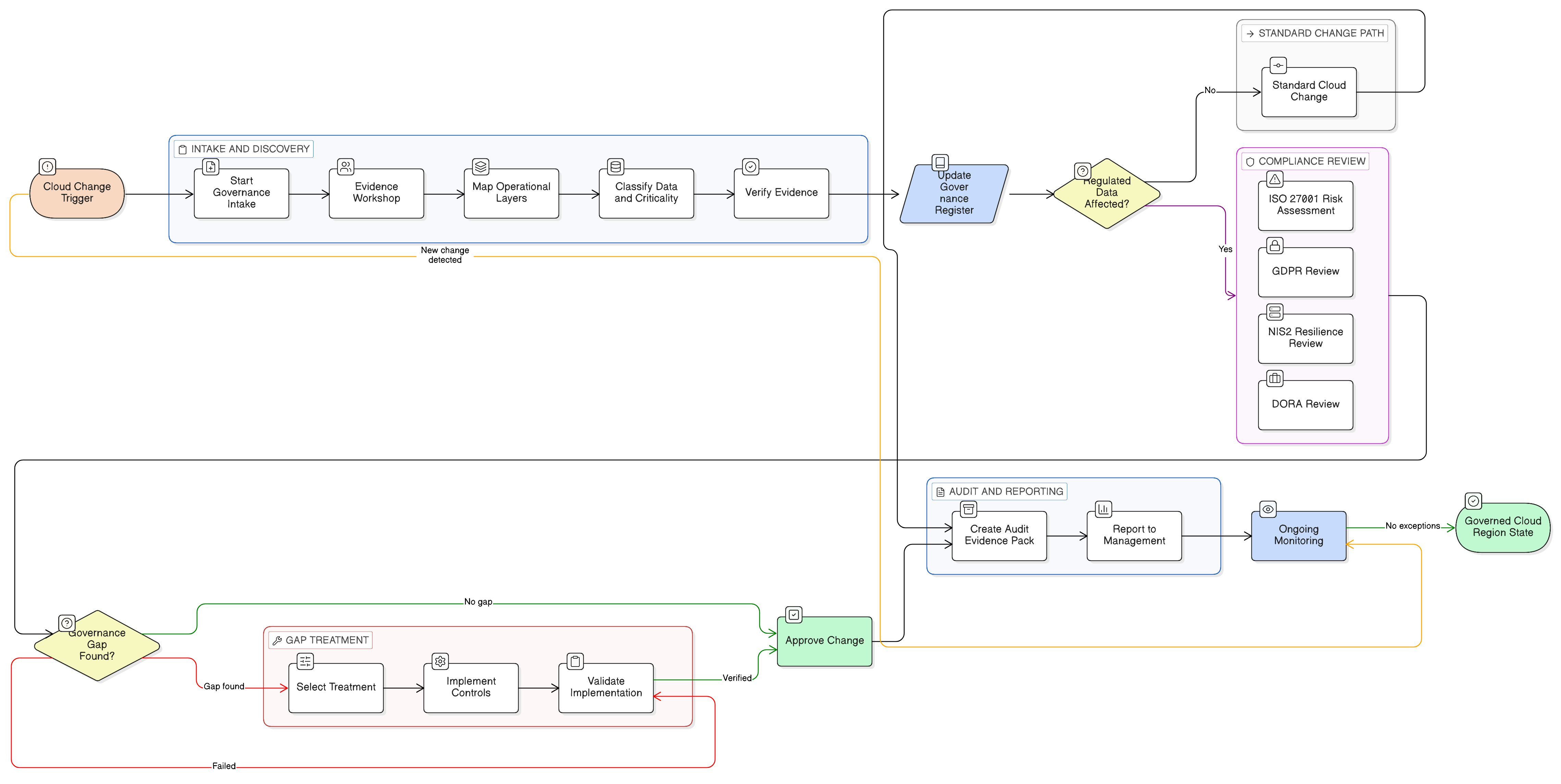
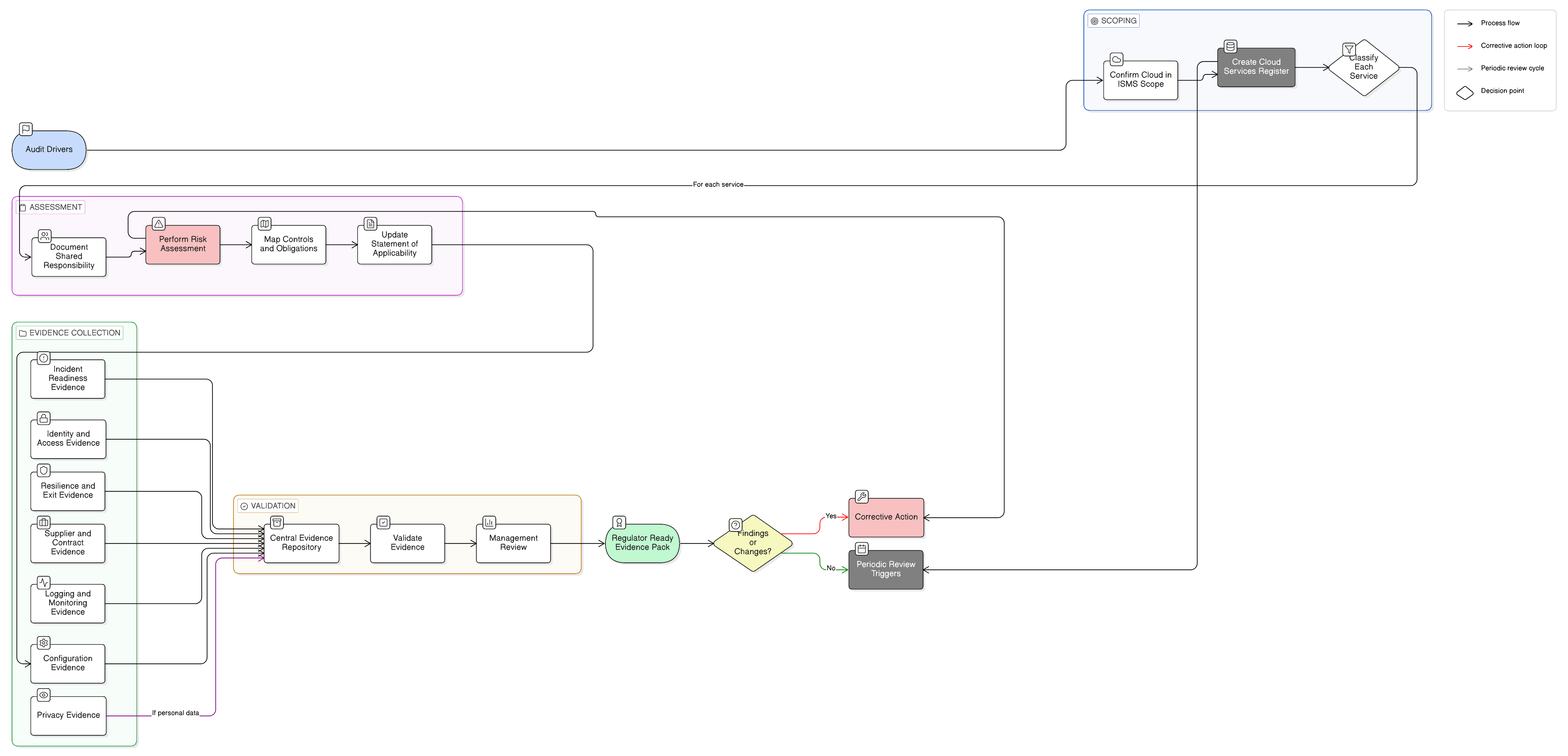
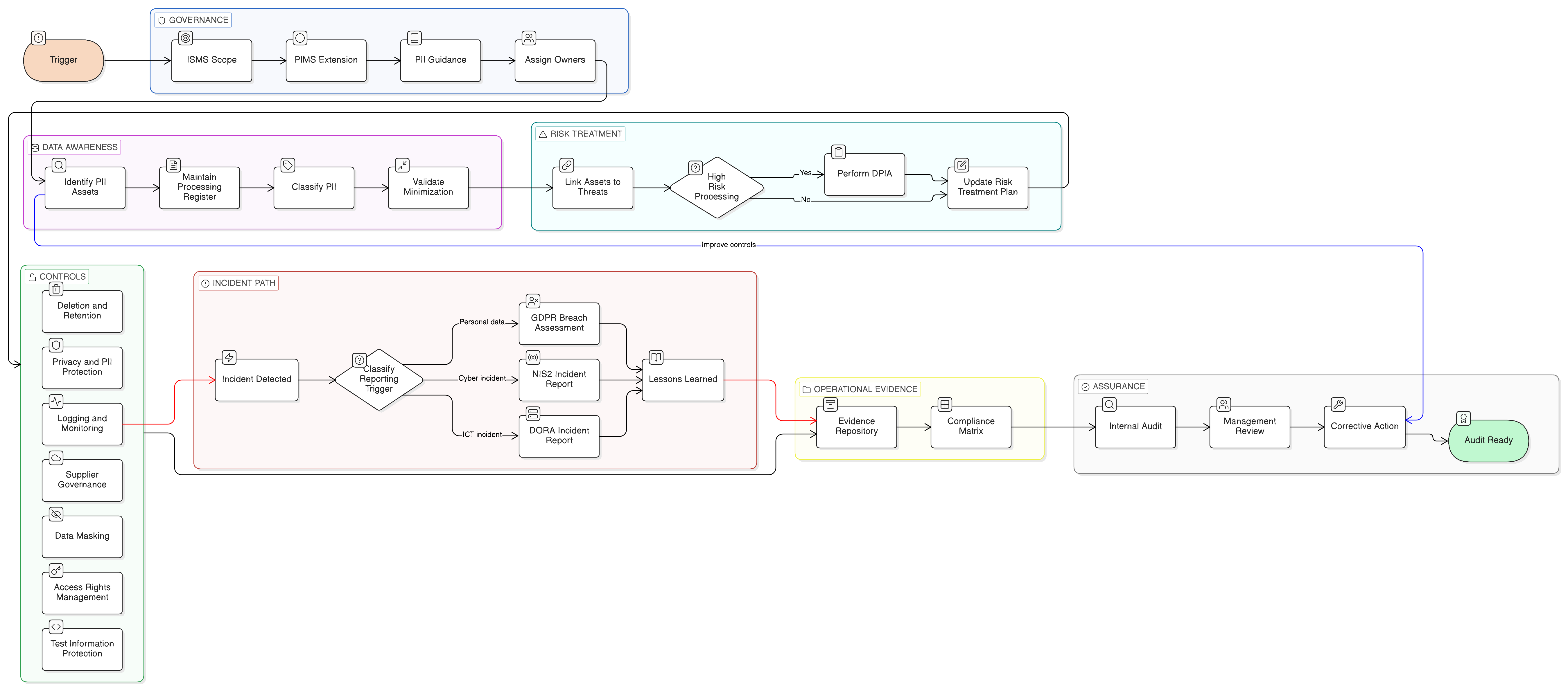
DPIA Governance for ISO 27001, NIS2 and DORA
It is 17:40 on a Thursday and Maria, the CISO of a fast-growing fintech, is being asked to approve a release before quarter end.
Product calls it a breakthrough, a biometric-based payment authentication and behavioral analytics feature that will make customer access seamless and reduce fraud. Engineering says no new core database is being created. Sales says a regulated financial customer is waiting. The release manager has already marked the ticket as a standard change.
Then the DPO asks three questions.
Will the feature combine biometric or behavioral data with account attributes? Will a cloud sub-processor receive telemetry or authentication signals? Has anyone assessed whether the change creates a high risk to individuals?
The room goes quiet.
Maria has an ISO/IEC 27001:2022 risk register. Legal has a GDPR record of processing activities. Procurement has a supplier questionnaire. The cloud team has a provider security review. The change manager has a ticket. The board has just been briefed on NIS2 accountability and DORA operational resilience expectations.
None of those records tells the full story on its own.
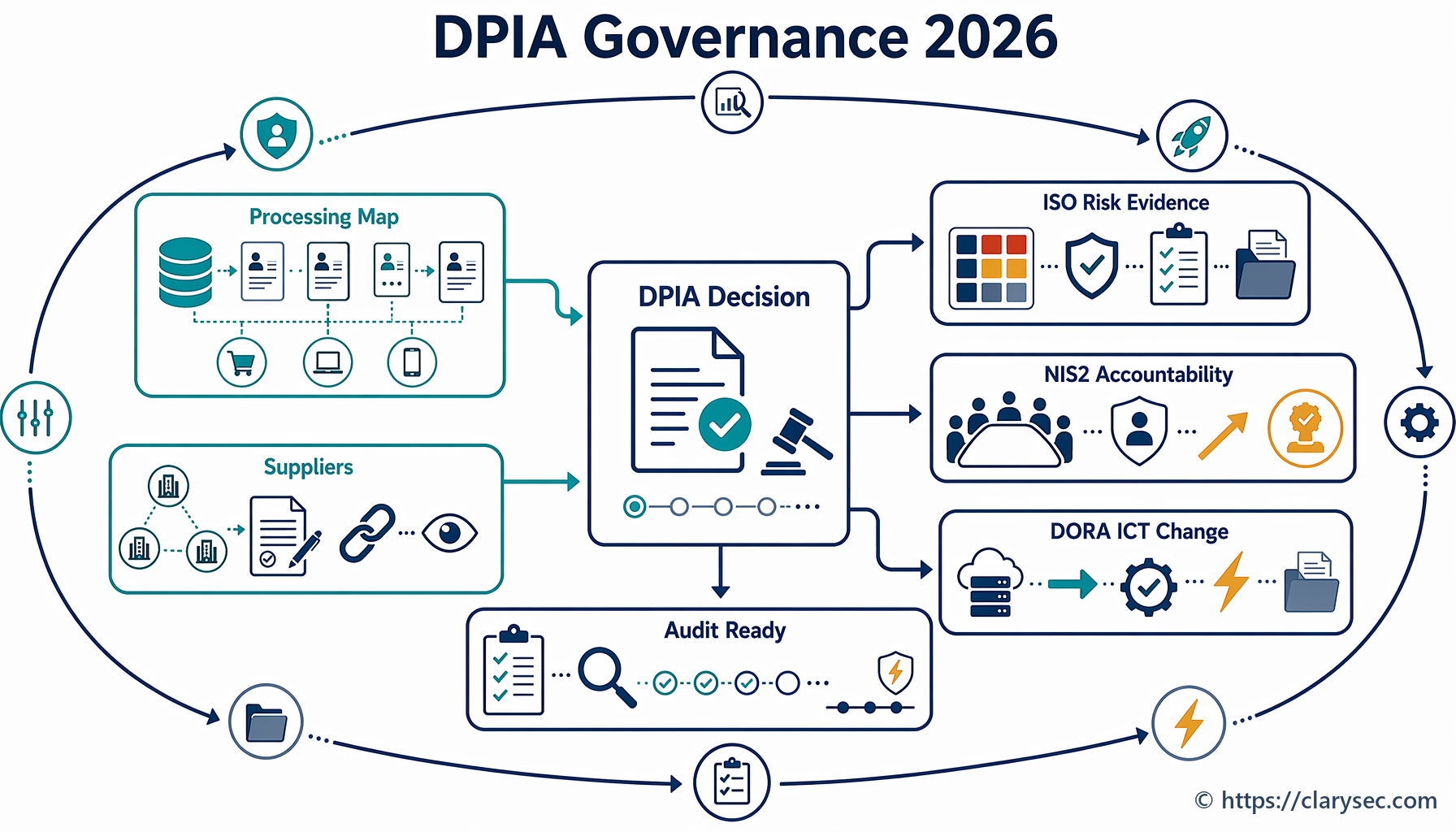
This is the DPIA governance problem in 2026. Data Protection Impact Assessments cannot sit in a privacy folder waiting for a regulator. They must become decision records that connect GDPR Articles 25, 30, 32, 35 and 36 with ISO/IEC 27001:2022 risk evidence, NIS2 cybersecurity risk-management measures, DORA ICT change governance, supplier assurance and board-level accountability.
The organizations that struggle are not usually ignoring compliance. They are doing privacy review, security review, cloud review and change review separately. The organizations that succeed create one traceable governance workflow where DPIA triggers, risk assessment, supplier due diligence, control mapping, testing and residual risk approval all form a single evidence chain.
Why siloed DPIAs fail in 2026
GDPR introduced the DPIA as a formal mechanism for assessing processing that is likely to result in a high risk to individuals. In many companies, it became a legal or privacy task, a form completed when a project looked sensitive.
That model is no longer defensible.
A personal-data processing change is rarely just a privacy event. It is also:
- An information security risk event under ISO/IEC 27001:2022.
- A cybersecurity governance event under NIS2 if network and information systems, suppliers or security controls are affected.
- An ICT change and resilience event under DORA for financial entities and relevant ICT service providers.
- A supplier and cloud risk event when processors, sub-processors, APIs, SDKs or hosted services are involved.
When those assessments happen separately, the gaps become dangerous. A privacy team may approve a DPIA without understanding vulnerabilities in a biometric SDK. An IT team may release a change without realizing it involves special category data or behavioral monitoring. A security team may review a cloud service without connecting it to the specific rights-and-freedoms risks identified in the DPIA.
The answer is not more paperwork. The answer is integrated governance.
A DPIA should be treated as the trigger that starts a coordinated risk workflow across privacy, security, cloud, suppliers, engineering, legal and management.
The GDPR foundation: DPIA governance starts with processing awareness
A DPIA cannot be honest if the organization cannot explain what it processes, why it processes it, who receives it and how long it is retained.
GDPR accountability requires more than a statement of intent. Article 5 establishes core principles such as lawfulness, fairness, transparency, purpose limitation, data minimisation, accuracy, storage limitation, integrity and confidentiality. It also requires the controller to demonstrate compliance. Article 25 requires privacy by design and by default. Article 30 requires records of processing activities. Article 32 requires security of processing. Article 35 requires a DPIA where processing is likely to result in high risk. Article 36 requires prior consultation where high risk remains without sufficient mitigation.
For SaaS, fintech, cloud and managed-service organizations, this means every material change should be screened for privacy impact. The trigger is not whether a project is labelled “privacy.” The trigger is whether the change affects personal data, processing purpose, lawful basis, recipients, retention, access rights, suppliers, cloud locations or residual risk.
Clarysec’s Data Protection and Privacy Policy - SME turns this into an operational requirement:
“The Privacy Coordinator must maintain a register of all personal data processing activities, including data categories, purpose, lawful basis, and retention periods”
From section “Governance Requirements”, policy clause 5.2.1.
The same SME policy embeds privacy into delivery:
“Privacy by design and by default must be enforced in all new systems and services”
From section “Governance Requirements”, policy clause 5.3.1.
For enterprise environments, Clarysec’s Data Protection and Privacy Policy makes the DPIA gate explicit:
“All significant changes to systems or processes involving personal information (PII) shall require a documented Data Protection Impact Assessment (DPIA), reviewed by the Data Protection Officer (DPO).”
From section “Governance Requirements”, policy clause 5.6.
That clause is the bridge between GDPR accountability and operational control. It moves the DPIA from a legal afterthought into project governance and change approval.
Connecting the DPIA to ISO/IEC 27001:2022 risk evidence
ISO/IEC 27001:2022 provides the management-system structure that DPIA governance needs.
Clauses 4.1 to 4.4 require the organization to understand its context, interested parties, requirements, ISMS scope and interacting processes. Privacy laws, customer contracts, NIS2 obligations, DORA requirements, processor duties and supplier dependencies all belong in that context.
Clauses 5.1 to 5.3 require leadership, policy alignment, resources, roles and responsibilities. This is where many DPIAs fail. A DPO may identify high risk, but without risk owners, escalation rules and management-backed acceptance criteria, the DPIA becomes a document instead of a decision.
Clauses 6.1.1 to 6.1.3 require risk-based planning, a documented information security risk assessment process, risk acceptance criteria, risk owners, treatment planning, control selection, a Statement of Applicability and approval of residual risk. That is the structure a DPIA should use.
A DPIA may identify harms such as profiling risk, unauthorized disclosure, unlawful secondary use, identity fraud, discrimination or excessive retention. The ISMS translates those harms into risk scenarios, likelihood and impact analysis, treatment actions, Annex A controls and residual-risk approvals.
Clarysec’s Risk Management Policy - SME defines the minimum discipline:
“Each risk entry must include: description, likelihood, impact, score, owner, and treatment plan.”
From section “Governance Requirements”, policy clause 5.1.2.
For enterprise environments, Clarysec’s Risk Management Policy connects treatment planning to ISO/IEC 27001:2022 evidence:
“The Risk Officer shall ensure that treatments are realistic, time-bound, and mapped to ISO/IEC 27001 Annex A controls.”
From section “Policy Implementation Requirements”, policy clause 6.4.2.
The Zenith Blueprint: An Auditor’s 30-Step Roadmap, Risk Management phase, Step 13, Risk Treatment Planning and Statement of Applicability, explains the role of the SoA clearly:
“The SoA is effectively a bridging document : it links your risk assessment/treatment to the actual controls you have.”
That is the audit-ready DPIA model. A DPIA finding should not end with “risk accepted.” It should map to the risk register, treatment plan, Statement of Applicability, supplier review, cloud due diligence, change ticket, test evidence and management decision.
One decision record, multiple compliance outputs
A mature DPIA governance workflow does not duplicate every regulation. It collects evidence once and reuses it intelligently.
| DPIA governance question | Evidence created | ISO/IEC 27001:2022 evidence | GDPR accountability value | NIS2 or DORA value |
|---|---|---|---|---|
| What processing is changing? | Processing register update and DPIA intake | Scope, context, asset and process evidence | Supports records of processing and privacy by design | Shows operational risk awareness |
| What could harm individuals? | Privacy risk scenario and impact assessment | Risk assessment result and risk owner | Supports DPIA reasoning and accountability | Aligns with risk-based cybersecurity governance |
| What controls reduce the risk? | Safeguards, TOMs and treatment plan | SoA, treatment plan and Annex A implementation status | Supports security of processing and privacy by default | Supports cybersecurity and ICT risk measures |
| Who else processes or accesses the data? | Supplier, processor and cloud review | Supplier and cloud control evidence | Supports processor oversight and transfer governance | Supports supply-chain and ICT third-party risk |
| What changed in production? | Change record, test evidence and approval | Change management and operational control evidence | Shows controls were considered before release | Supports change risk and resilience expectations |
| Who accepted residual risk? | DPO, risk owner and management approval | Residual risk acceptance and management review input | Shows accountable decision-making | Supports board or management-body oversight |
This evidence chain aligns directly with ISO/IEC 27001:2022 Clause 8.1, which requires planned and controlled operational processes, documented evidence, control of planned changes and review of unintended changes. Clause 8.2 requires risk assessments at planned intervals or when significant changes are proposed or occur. Clause 8.3 requires implementation of the risk treatment plan. Clause 9 then turns evidence into assurance through monitoring, measurement, internal audit and management review.
The Data Protection and Privacy Policy - SME makes timing explicit:
“The Privacy Coordinator must assess privacy risks annually and during major system changes”
From section “Risk Treatment and Exceptions”, policy clause 7.1.1.
If a major personal-data change does not trigger DPIA screening and ISMS reassessment, the governance process is incomplete.
NIS2: DPIA governance becomes management accountability
NIS2 expands the governance pressure on organizations in essential and important sectors. It applies to many public and private entities in listed sectors that meet relevant size thresholds, and it can apply regardless of size in specific cases such as trust services, DNS, TLD registries, public electronic communications services, sole essential-service providers or entities with systemic risk roles.
For DPIA governance, the key point is not only scope. It is management responsibility.
NIS2 Article 20 requires management bodies of essential and important entities to approve cybersecurity risk-management measures, oversee their implementation and follow training. Article 21 requires appropriate and proportionate technical, operational and organisational measures based on risk exposure, size, likelihood, severity, societal and economic impact, state of the art and relevant standards.
Article 21(2) includes domains that frequently overlap with DPIA outcomes, including:
- Risk analysis and information system security policies.
- Incident handling.
- Business continuity and crisis management.
- Supply-chain security.
- Security in network and information systems acquisition, development and maintenance.
- Vulnerability handling and disclosure.
- Policies to assess the effectiveness of cybersecurity risk-management measures.
- Cyber hygiene and training.
- Cryptography and encryption.
- HR security, access control and asset management.
- MFA, continuous authentication, secured communications and secured emergency communications.
A DPIA for a new biometric, behavioral analytics or cloud-based processing activity should therefore ask NIS2-relevant questions. Does the processing depend on a new supplier? Does it introduce a new API, SDK, identity flow or access model? Does it change incident impact? Does it require encryption, stronger logging, secure development checks or management approval?
The practical management question becomes simple: can the organization prove that a privacy-impacting change was considered as part of cybersecurity risk management before implementation?
That proof should be visible in the DPIA intake, updated processing register, risk register, treatment plan, Statement of Applicability, supplier due diligence, security test evidence, change approval and residual risk acceptance.
DORA: ICT change and third-party evidence are unavoidable
DORA applies from 17 January 2025 and creates a uniform EU framework for ICT risk management, major ICT-related incident reporting, digital operational resilience testing, cyber threat and vulnerability information sharing, ICT third-party risk management and oversight of critical ICT third-party service providers.
For financial entities, DORA generally acts as a sector-specific Union legal act for ICT risk management and incident reporting obligations, while NIS2 remains relevant for broader ecosystem coordination and non-DORA entities.
DPIA governance matters under DORA because personal-data processing usually lives inside ICT systems, third-party services, cloud environments and operational workflows.
DORA Article 5 requires internal governance and control frameworks for ICT risk management, with management-body responsibility. Article 6 requires a documented ICT risk management framework integrated into overall risk management. Articles 8 to 14 cover asset and dependency identification, protection and prevention, detection, continuity, backup, recovery, lessons learned and crisis communications.
DORA Article 28 requires financial entities to manage ICT third-party risk as an integral part of ICT risk management and remain responsible when using ICT services. It requires registers of ICT service contracts, pre-contract assessments, due diligence, concentration risk assessment, audit and inspection planning, termination rights and exit strategies. Article 30 requires written contracts with clear service descriptions, data locations, confidentiality, integrity, availability protections, recovery and return of data, incident assistance, cooperation with authorities, termination rights and additional safeguards for critical or important functions.
For a DPIA, that changes the supplier question. “Do we have a DPA?” is not enough. The better question is: can we prove the ICT dependency, data location, subcontracting, security standards, resilience, audit rights, incident support and exit strategy were assessed before approving the processing?
Clarysec’s Cloud Usage Policy makes this pre-activation control explicit:
“All cloud use must undergo risk-based due diligence before activation, including provider assessment, legal compliance validation, and control validation reviews.”
From section “Governance Requirements”, policy clause 5.2.
A DPIA should not approve a new analytics processor, identity provider, biometric SDK or cloud telemetry platform unless cloud due diligence, legal validation and control validation are complete or explicitly tracked as treatment actions.
The ISO/IEC 27002:2022 anchors: privacy, projects and change
Clarysec’s Zenith Controls: The Cross-Compliance Guide treats ISO/IEC 27002:2022 controls as cross-compliance anchors. For DPIA governance, three controls are especially important.
| ISO/IEC 27002:2022 control | Why it matters for DPIA governance | Cross-compliance value |
|---|---|---|
| 5.34 Privacy and protection of PII | Requires awareness and protection of personal data across its lifecycle | Supports GDPR accountability, ISO/IEC 27001:2022 Annex A, NIS2 risk measures and DORA data protection expectations |
| 5.8 Information security in project management | Embeds security and privacy impact thinking into project design | Supports privacy by design, secure development, NIS2 acquisition and development measures |
| 8.32 Change management | Ensures changes are evaluated, authorized, tested, implemented and reviewed | Supports ISO operational control, DORA ICT change governance and audit traceability |
The Zenith Controls entry for 5.34, Privacy and protection of PII, classifies it as preventive, associated with confidentiality, integrity and availability, aligned to Identify and Protect cybersecurity concepts, and tied to information protection plus legal and compliance capabilities.
The Zenith Blueprint, Controls in Action phase, Step 23, makes the practical point:
“The foundation of this control is data awareness. The organization must know what PII it collects, where it resides, why it is being processed, and who can access it.”
The Zenith Controls entry for 5.8, Information security in project management, classifies it as preventive, associated with confidentiality, integrity and availability, aligned to Identify and Protect, and positioned across governance, ecosystem and protection domains.
The Zenith Blueprint, Controls in Action phase, Step 22, states:
“The goal of this control isn’t to weigh down projects with red tape. It’s to ensure that security is treated as a design input, not a testing phase.”
Privacy must be treated the same way. A DPIA after go-live is often a damage report. A DPIA during design is risk prevention.
The Zenith Controls entry for 8.32, Change management, classifies it as preventive, associated with confidentiality, integrity and availability, aligned to Protect, and tied to application security plus system and network security capabilities.
The Zenith Blueprint, Controls in Action phase, Step 21, is direct:
“Change is inevitable, but in cybersecurity, uncontrolled change is dangerous.”
Clarysec’s Change Management Policy - SME captures the trigger:
“If a change involves sensitive data, system access rights, or external integrations, a security impact review is required. The designated security or compliance contact must assess whether the change introduces additional risks and recommend additional safeguards.”
From section “Risk Treatment and Exceptions”, policy clause 7.5.1.
For enterprise environments, Clarysec’s Change Management Policy sets the CAB expectation:
“Assess changes for security and compliance risks prior to Change Advisory Board approval.”
From section “Roles and Responsibilities”, policy clause 4.6.1.
Practical example: approving a biometric analytics feature
Maria does not need three separate governance projects. She needs one integrated project intake and risk workflow.
The product team proposes biometric payment authentication with behavioral analytics. The feature collects biometric templates, device metadata, account attributes, IP addresses, authentication events and fraud signals. It uses a cloud analytics provider and a third-party biometric SDK. Customer-success teams will receive aggregated dashboard access.
The change ticket should trigger a DPIA screening and risk assessment before resource allocation or CAB approval.
| Intake field | Example answer |
|---|---|
| Personal data involved | Biometric template, user ID, IP address, device metadata, account role, authentication events |
| Processing purpose | Payment authentication, fraud detection and customer-success analytics |
| Lawful basis to confirm | Contract necessity, legitimate interests or explicit consent, subject to DPO review |
| New supplier or cloud service | Biometric SDK provider and EU-region cloud analytics processor |
| Sensitive or special category data | Biometric data requires high-risk review where used for unique identification |
| Access model change | Customer-success team receives aggregated dashboard access |
| Retention change | Event logs retained for 180 days, biometric templates retained according to service terms |
| DPIA required | Yes, biometric processing, monitoring and new supplier dependency require review |
The integrated assessment should then produce one risk dossier.
| Assessment section | Primary framework | Questions to answer | Evidence or output |
|---|---|---|---|
| Processing description | GDPR Article 35 | What data is processed, why, by whom and for how long? | Data flow, RoPA update, DPIA intake |
| Necessity and proportionality | GDPR Article 35 | Is the processing necessary and the least intrusive viable approach? | DPO review and justification |
| Risk to individuals | GDPR Article 35 | Could individuals face identity theft, discrimination, profiling, exclusion or financial harm? | DPIA risk analysis and ISO risk register entry |
| Security risk assessment | ISO/IEC 27001:2022 Clause 6.1.2 | What confidentiality, integrity and availability threats exist? | Risk register entries with likelihood, impact, owner and treatment |
| NIS2 impact analysis | NIS2 Article 21 | Does the change affect suppliers, secure development, access control, incident handling or continuity? | Supplier assessment, secure development checklist, management evidence |
| DORA resilience analysis | DORA Articles 8, 9, 24 and 30 | Is this an ICT change affecting resilience, testing or contractual obligations? | Change record, test plan, contract review and exit evidence |
| Risk treatment and controls | ISO/IEC 27001:2022 Clause 6.1.3 | Which TOMs and Annex A controls reduce the risk? | Treatment plan and updated Statement of Applicability |
Example risk entries might look like this:
| Risk scenario | Likelihood | Impact | Treatment examples | Control mapping |
|---|---|---|---|---|
| Excessive collection beyond stated purpose | Medium | High | Data minimisation review, event schema approval, retention limit | 5.34, 5.31, 8.10 |
| Unauthorized access to biometric or behavioral dashboard | Medium | High | Role-based access, MFA, logging, quarterly access review | 5.15, 5.18, 8.15, 8.16 |
| Cloud processor misconfiguration exposes telemetry | Low | High | Cloud due diligence, encryption, configuration baseline, monitoring | 5.23, 8.9, 8.24, 8.16 |
| Biometric SDK vulnerability compromises authentication data | Medium | High | Supplier due diligence, secure development review, security testing | 5.21, 8.25, 8.28, 8.29 |
| Profiling creates unfair customer impact | Medium | High | DPO review, transparency wording, objection handling where applicable | 5.34, 5.8 |
Before release, the change record should contain DPIA completion or a DPO-approved treatment plan, the updated processing register, supplier and cloud due diligence, security impact review, test results, rollback plan, monitoring plan and residual risk approval.
After release, the owner should verify logs, alerts, access roles, dashboards, retention rules and deletion workflows. This closes the planned-change loop under ISO/IEC 27001:2022 Clause 8.1 and supports DORA-style operational resilience discipline.
What auditors will ask
A unified DPIA gives different auditors one coherent evidence trail.
| Auditor lens | Likely audit focus | Evidence that should exist |
|---|---|---|
| ISO/IEC 27001:2022 auditor | Whether significant changes triggered risk assessment, treatment, SoA updates and operational control | DPIA intake, risk register, treatment plan, SoA notes, change record, internal audit trail |
| GDPR privacy reviewer | Whether high-risk processing was assessed before deployment and safeguards were documented | DPIA, processing register, lawful basis analysis, DPO review, transparency and retention evidence |
| NIS2-oriented auditor | Whether management-approved risk measures cover security policies, supply chain, incident handling, continuity, access, encryption and vulnerability handling | Board or management review records, control mapping, supplier review, incident and continuity linkage |
| DORA-oriented auditor | Whether ICT change, third-party dependency, resilience, testing and contract evidence are integrated into ICT risk governance | ICT risk assessment, provider register, contract clauses, testing evidence, exit plan, incident support evidence |
| NIST CSF assessor | Whether governance, risk, asset, supplier, protection, detection, response and recovery outcomes are connected | Current and target profile, gap plan, asset inventory, supplier risk records, monitoring and response evidence |
| COBIT 2019 or ISACA auditor | Whether change enablement, risk management, security services and assurance practices are controlled | CAB records, impact analysis, approvals, testing, segregation of duties, post-change review |
NIST CSF 2.0 is useful as a communication layer because its GOVERN function puts strategy, expectations, policy, roles, oversight and supply-chain risk management at the center. COBIT 2019 adds process assurance, especially around structured change enablement, impact analysis, approvals, testing and post-change evaluation.
A GDPR regulator may start with individual rights and freedoms. An ISO auditor may start with documented risk assessment and control implementation. A DORA reviewer may start with ICT dependency and resilience. A NIS2 reviewer may start with management oversight and proportional cybersecurity measures.
The same DPIA evidence chain should satisfy all of them.
DPIA decisions must survive incidents
A DPIA is not only a pre-release approval artifact. It should improve breach and incident readiness.
GDPR defines a personal data breach as a security breach causing accidental or unlawful destruction, loss, alteration, unauthorized disclosure of or access to personal data. NIS2 requires notification of significant incidents without undue delay, including an early warning within 24 hours, notification within 72 hours and a final report no later than one month after the incident notification. DORA requires financial entities to detect, manage, log, classify, escalate and notify major ICT-related incidents through initial, intermediate and final reporting, with client notification when financial interests are affected.
If the DPIA recorded data flows, processors, access controls, retention, logging, encryption, pseudonymisation and incident responsibilities, the incident team can answer critical questions faster. What personal data was involved? Which systems and suppliers were affected? Which individuals or customers may be impacted? Was encryption in place? Which logs are available? Which reporting clocks apply? Which customer or regulator communications are required?
This is why DPIA governance should connect to ISO/IEC 27001:2022 incident controls, business continuity controls and ICT readiness controls, as well as NIS2 and DORA incident lifecycle expectations.
Common DPIA governance failures
The failures are usually caused by disconnected workflows, not lack of effort.
| Failure | Why it creates risk | Better practice |
|---|---|---|
| Processing register updated after go-live | The register becomes a historical inventory instead of a design control | Update RoPA before approval |
| DPIA screening absent from change intake | Privacy risk is discovered too late | Add mandatory personal-data, supplier, access and retention questions |
| DPIA risks stay in a privacy folder | Security treatment and residual risk approval are not traceable | Convert DPIA findings into ISMS risk register entries |
| Supplier reviews focus only on questionnaires | Processing purpose, data location, subprocessors, audit rights and exit may be missed | Combine security, privacy, legal and resilience due diligence |
| SoA lacks privacy and cloud rationale | Auditors see controls but not the risk logic | Map controls to DPIA findings, GDPR, NIS2 and DORA obligations |
| Residual risk is accepted informally | Management accountability is not demonstrable | Record DPO, risk owner and management approval with conditions |
The DPIA governance checklist
Use this checklist to integrate DPIAs into the ISMS, NIS2 readiness and DORA ICT change governance.
| Governance activity | Owner | Minimum evidence |
|---|---|---|
| DPIA screening embedded in project and change intake | Change manager and DPO | Intake form, trigger decision and rationale |
| Processing register updated before approval | Privacy Coordinator or DPO | Purpose, lawful basis, data categories, retention and recipients |
| Privacy risks translated into ISMS risks | Risk Officer and system owner | Risk entries with likelihood, impact, owner and treatment plan |
| Controls mapped to the SoA | ISMS manager | Applicable Annex A controls, justification and implementation status |
| Supplier and cloud due diligence completed | Procurement, security and legal | Provider assessment, contract clauses, data location and exit evidence |
| Security and privacy testing completed | Engineering and security | Test results, access review, logging validation and vulnerability evidence |
| Residual risk accepted | Risk owner, DPO and management where required | Approval record, conditions and review date |
| Post-change review performed | Change owner and service owner | Review notes, incidents, metrics and corrective actions |
This is not bureaucracy. It is operational accountability. It helps the CISO prove security was considered, the DPO prove privacy risk was assessed, the compliance manager prove controls map across frameworks and the business owner prove that innovation was governed responsibly.
How Clarysec helps
Clarysec’s approach is designed for organizations facing overlapping 2026 obligations and fragmented evidence.
The policy toolkit gives you the governance language. The Data Protection and Privacy Policy defines when DPIAs are required and who reviews them. The Risk Management Policy defines how risk entries must be structured and mapped. The Change Management Policy ensures privacy and security impacts are assessed before approval. The Cloud Usage Policy requires due diligence before cloud activation.
The Zenith Blueprint gives the implementation roadmap. Step 13 turns risk treatment and the Statement of Applicability into a cross-compliance bridge. Step 22 embeds security into project management. Step 21 makes change intentional, justified and auditable. Step 23 turns PII protection into a lifecycle control based on data awareness, lawful use, access restriction, supplier oversight and operational privacy processes.
The Zenith Controls guide gives the cross-compliance compass. For DPIA governance, ISO/IEC 27002:2022 controls 5.34, 5.8 and 8.32 connect privacy protection, project governance and change control to GDPR accountability, NIS2 cybersecurity measures, DORA ICT risk governance, NIST CSF outcomes and COBIT 2019 assurance.
If your organization is preparing for GDPR accountability reviews, ISO/IEC 27001:2022 certification, NIS2 readiness or DORA operational resilience, start by integrating DPIA triggers into project and change intake. Link DPIA findings to the risk register. Map treatments in the SoA. Validate suppliers and cloud services before activation. Retain one decision record that management, auditors and regulators can follow.
The best DPIA is not the one written after a regulator asks for it. It is the one that shaped the system before customers, auditors or incidents tested it.
Review your current DPIA process against Clarysec’s policy toolkit, use the Zenith Blueprint to build audit-ready traceability, and use Zenith Controls to map one control framework across GDPR, ISO/IEC 27001:2022, NIS2, DORA, NIST CSF and COBIT 2019. Then turn your next privacy-impacting change into a governed, evidence-backed release decision instead of a last-minute compliance scramble.
Frequently Asked Questions
About the Author

Igor Petreski
Compliance Systems Architect, Clarysec LLC
Igor Petreski is a cybersecurity leader with over 30 years of experience in information technology and a dedicated decade specializing in global Governance, Risk, and Compliance (GRC).Core Credentials & Qualifications:• MSc in Cyber Security from Royal Holloway, University of London• PECB-Certified ISO/IEC 27001 Lead Auditor & Trainer• Certified Information Systems Auditor (CISA) from ISACA• Certified Information Security Manager (CISM) from ISACA • Certified Ethical Hacker from EC-Council