DPO Handover File for GDPR and ISO 27701
The notification landed in Maria’s inbox with the harmless subject line, “Team Update.” David, the Data Protection Officer for her fast-growing fintech company, had accepted a new role. He would be gone in two weeks.
At first, Maria, the CISO, treated it like any other senior departure. HR would run offboarding, IT would disable access, Legal would review open matters, and the new DPO would receive a handover call. Then the real questions started.
“Where is the DPIA for the biometric login feature?”
“Can I see the correspondence with the Belgian DPA about last year’s cross-border data flow inquiry?”
“What was the rationale for accepting the residual privacy risk on the AI-driven credit scoring model?”
By 08:17 the following Monday, the board wanted assurance that GDPR accountability remained intact. A large enterprise customer had sent a privacy due diligence questionnaire asking for the latest RoPA, DPIA register, breach log, subprocessor list, retention schedule and evidence of privacy advice. Product wanted approval for an analytics change. Support was holding three data subject requests. Procurement was renegotiating a processor agreement. Security was investigating an event that might involve personal data.
David’s handover was a 30-minute call and a shared drive full of inconsistent folder names. The context, the debates, the risk appetite decisions, the regulator history and the informal advice had walked out the door with him.
That is where privacy governance either proves it is a management system, or reveals it was one person’s memory.
A DPO handover file for GDPR and ISO/IEC 27701:2025 is not an HR exit pack. It is an accountability continuity file. It tells the incoming DPO, Privacy Lead, PIMS Manager, auditor, regulator or executive sponsor what is being processed, why it is lawful, which risks are open, where the evidence lives, who owns the next action, and what deadlines cannot be missed.
The hidden privacy risk: accountability trapped in one role
GDPR makes accountability explicit. Article 5(2) requires controllers to be responsible for, and able to demonstrate compliance with, the core principles of lawfulness, fairness and transparency, purpose limitation, data minimisation, accuracy, storage limitation, integrity and confidentiality. Articles 4, 6, 9, 10 and 30 add the operational vocabulary and evidence expectations that must survive a role change: personal data, processing, lawful basis, special category conditions, breach definitions and records of processing activities.
The issue is not whether an organization had a capable DPO. The issue is whether the privacy program can function when the DPO changes.
When a DPO leaves, the organization must still know:
- Which processing activities are active, paused, retired or under review.
- Which lawful bases and special category conditions support each activity.
- Which DPIAs contain unresolved risks or conditional approvals.
- Which data subject requests are open, extended, rejected or appealed.
- Which breaches were notified, not notified or still under assessment.
- Which processors, subprocessors and transfer mechanisms are in place.
- Which regulator communications, customer commitments and audit actions are pending.
- Which privacy advice was given, when it was given and under what assumptions.
This is the classic key person dependency. The DPO’s brain becomes the primary repository for privacy decisions, risk assessments and regulatory interactions. When that person leaves, the organization loses more than a role holder. It loses the traceability needed to demonstrate compliance.
Clarysec’s Enterprise Privacy Roles, Responsibilities and Accountability Policy [C1] makes role transition an evidence obligation:
[All] The Privacy Lead / PIMS Manager MUST record role handover evidence in REG01 and REG12 within 10 business days of a role change.
From section ‘Implementation’, policy clause 7.1.6.
The same policy also requires communication evidence after reassignment or departure:
[All] The Privacy Lead / PIMS Manager MUST update role change communication evidence in REG11 within 10 business days after role reassignment or departure.
From section ‘Accountability evidence and communication’, policy clause 4.5.4.
Those two clauses turn a personnel change into an auditable privacy control. The handover is no longer informal knowledge transfer. It becomes documented PIMS evidence.
What a DPO handover file actually is
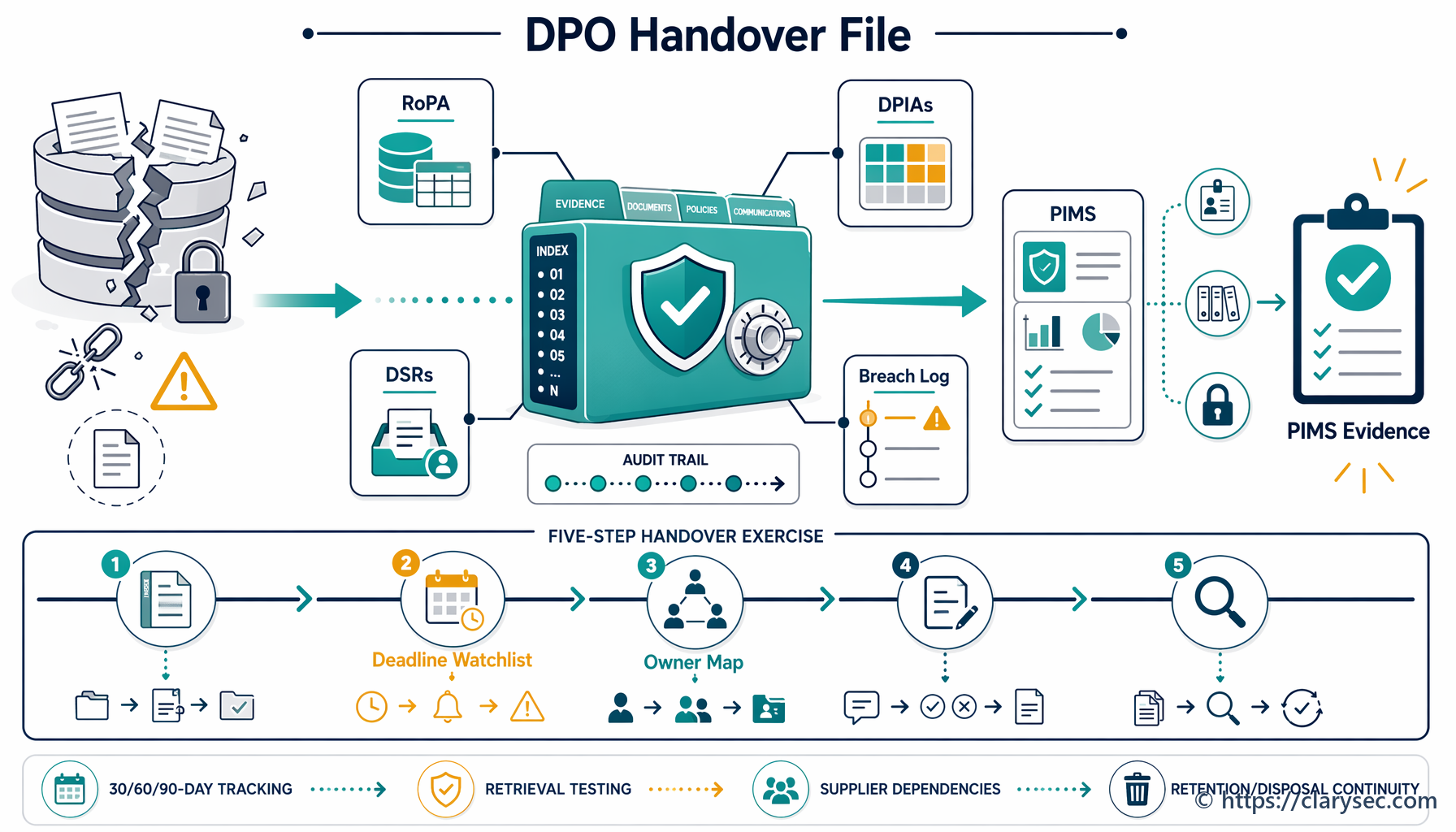
A good DPO handover file is not a single PDF. It is a controlled evidence bundle with an index, owners, links, status fields, decision history and retrieval rules. It should allow an incoming DPO to understand the organization’s privacy posture within hours, not weeks.
Think of it as the flight recorder for the privacy program. It must show not only what happened, but why decisions were made and what must happen next.
A practical DPO handover file should answer four questions:
- What privacy obligations and decisions are currently active?
- What evidence proves those obligations are being managed?
- Who owns each open item during and after the transition?
- What risks, deadlines or regulatory sensitivities need immediate attention?
The file should not duplicate every record. Duplication creates stale evidence. Instead, it should point to the authoritative record, explain status, identify ownership and flag the next required decision.
Clarysec’s Enterprise PIMS Documented Information and Evidence Management Policy [C2] establishes the evidence foundation:
[All] The Privacy Lead / PIMS Manager MUST maintain a PIMS documented information index in REG12 before initial PIMS publication and quarterly thereafter.
From section ‘PIMS documented information control’, policy clause 4.1.1.
It also requires retrieval evidence:
[All] The Privacy Lead / PIMS Manager MUST record audit evidence retrieval requests and fulfilment status in REG12 within five business days of receiving the request.
From section ‘Access, protection, retrieval, and disclosure’, policy clause 4.4.4.
A DPO handover file should therefore be built around REG12 or an equivalent documented information index. If privacy evidence cannot be located quickly during a transition, it cannot support accountability when an auditor, customer or regulator asks for proof.
The core anatomy of an audit-ready DPO handover file
Clarysec implementations typically divide the DPO handover file into ten sections. These sections give the incoming DPO a single operating view without replacing the authoritative systems of record.
| Handover section | Purpose | Typical evidence |
|---|---|---|
| 1. PIMS scope and governance | Defines boundaries, committees, escalation routes and accountability model | PIMS scope, governance calendar, escalation map, management review outputs |
| 2. Roles and delegations | Shows who owns, supports and approves privacy activities | role register, delegation log, REG01 entries, REG11 communications |
| 3. RoPA and processing inventory | Shows what personal data is processed and why | RoPA, data maps, lawful basis register, data category inventory |
| 4. DPIA and high-risk decision file | Preserves risk reasoning, advice and approvals | DPIA register, DPIA reports, REG04 advice, residual risk decisions |
| 5. Data subject rights register | Protects response deadlines and consistency | DSR log, validation records, response templates, exemptions |
| 6. Breach and incident privacy file | Keeps breach assessment context intact | breach log, notification decisions, regulator notices, lessons learned |
| 7. Processor and supplier privacy file | Maintains third-party accountability | processor list, DPAs, subprocessor notices, due diligence, exit risks |
| 8. Retention and disposal file | Links storage limitation to business rules | retention schedule, disposal logs, legal hold register |
| 9. Regulator, customer and audit file | Prevents missed undertakings and evidence gaps | authority correspondence, customer commitments, audit findings, corrective actions |
| 10. Transition action plan | Turns handover into controlled execution | open actions, owners, due dates, priority and escalation status |
The most valuable part of the file is often not the documents themselves. It is the context between documents. A DPIA may show a conclusion, but the incoming DPO also needs to know what advice was given, which residual risks were accepted, which conditions were attached, and whether those conditions are still monitored.
The GDPR backbone: RoPA, DPIAs, DSRs, breaches and lawful basis
A DPO handover file should begin with the GDPR operating backbone. This is where many transitions fail because the departing DPO understands the history behind the records, while the incoming DPO sees only fragments.
The Enterprise Data Protection and Privacy Policy [C3] assigns the DPO responsibility for key records:
Maintains the Record of Processing Activities (RoPA) in accordance with GDPR Article 30.
From section ‘Roles and Responsibilities’, policy clause 4.2.2.
It also states:
Leads regulatory engagement, conducts Data Protection Impact Assessments (DPIAs), and manages breach notification processes.
From section ‘Roles and Responsibilities’, policy clause 4.2.3.
And for rights management:
The Data Protection Officer (DPO) shall maintain documented processes for Data Subject Request (DSR) intake, validation, tracking, and response.
From section ‘Policy Implementation Requirements’, policy clause 6.4.1.
These are not separate administrative tasks. They form a chain of accountability.
If a data subject requests erasure, the incoming DPO needs the RoPA to identify systems and processors, the lawful basis register to assess whether erasure applies, the retention schedule to check storage limitation, supplier records to coordinate deletion downstream, and the DSR register to evidence the timeline and response. If the DPO changes mid-request, the handover file must preserve that chain.
For smaller organizations, Clarysec’s Data Protection and Privacy Policy-sme [C4] uses scaled language while preserving the same accountability principle:
Maintains records of processing activities
From section ‘Roles and Responsibilities’, policy clause 4.2.1.
It also requires:
The Privacy Coordinator must maintain a register of all personal data processing activities, including data categories, purpose, lawful basis, and retention periods
From section ‘Governance Requirements’, policy clause 5.2.1.
And for rights requests:
All responses to data subject requests must be logged in a secure register, with access restricted to the Privacy Coordinator and GM
From section ‘Policy Implementation Requirements’, policy clause 6.5.4.
For both enterprise and SME environments, the handover file should include a privacy operations dashboard showing the status of RoPA, DPIAs, DSRs, breaches, retention reviews and supplier reviews. This is how an organization proves that GDPR accountability does not depend on a single person.
ISO/IEC 27701:2025: role transition as controlled PIMS evidence
ISO/IEC 27701:2025 extends privacy governance into a structured Privacy Information Management System. That means role transition should be treated like any other controlled process: planned, assigned, evidenced, reviewed and improved.
The handover file should include PIMS continuity fields for every major privacy process:
- Process name, such as DPIA, RoPA, DSR, breach assessment or supplier privacy review.
- PIMS role, such as DPO, Privacy Lead, PIMS Manager, controller representative or processor representative.
- Operating role, such as controller, processor, joint controller or subprocessor.
- Current owner and temporary delegate.
- Evidence register reference.
- Last review date and next review date.
- Open decisions and unresolved risks.
- Escalation route.
- Links to policy clauses, procedures and templates.
- Audit status, including last evidence request and response.
The Enterprise Privacy Information Management System Policy [C5] makes privacy advice itself an evidence object:
[All] The Data Protection Officer / Privacy Advisor MUST record privacy advice on PIMS scope, DPIA criteria, and high-risk decisions in REG04 before approval of the relevant decision.
From section ‘Roles and Responsibilities’, policy clause 5.1.3.
This clause is critical during handover. The DPIA report may show the final approval, but REG04 or an equivalent privacy advice register preserves the professional reasoning behind the decision. Without it, the new DPO may be unable to explain why the organization approved a high-risk processing activity or what monitoring conditions were attached.
Clarysec also connects role transition to broader governance. The Enterprise Governance Roles and Responsibilities Policy [C6] states:
Delegations shall be tracked in the Roles and Responsibilities Register, and the original owner retains ultimate accountability.
From section ‘Policy Implementation Requirements’, policy clause 6.2.5.
This prevents the most dangerous transition gap: everyone assumes someone else is covering DSRs, DPIAs, breach assessments or regulator responses. A strong DPO handover file includes a delegation table and clearly states whether each responsibility is permanent, interim or advisory.
Building the repository with the Zenith Blueprint
A handover file is only as useful as the repository behind it. A chaotic shared drive is not a PIMS evidence system.
Clarysec’s Zenith Blueprint: An Auditor’s 30-Step Roadmap [C7] treats documentation as a living management system. In the ISMS Foundation & Leadership phase, Step 6, “Documented Information and Building the ISMS Library,” the Zenith Blueprint advises organizations to create a structured ISMS documentation repository:
Now is a good time to set up a structure for storing all your ISMS documentation (your “ISMS library”). For example:
✓ A main folder named “ISMS Documentation” with subfolders like: ✓ Policies and Procedures: containing the approved versions of policies (e.g., InfoSec Policy, Acceptable Use Policy) and procedures (incident response procedure, backup procedure, etc.). ✓ Risk Assessment & SoA: a folder for risk assessment reports, risk register (working file), and the Statement of Applicability (when drafted). ✓ Training & Awareness Records: training logs, copies of any content delivered, attendance sheets. ✓ Audit and Review: internal audit reports, management review meeting minutes, corrective action logs. ✓ Incident Records: incident log, incident reports, lessons learned documents. ✓ Assets & Inventory: lists of assets, data classification results, etc. ✓ Annex A Controls (or “Controls Library”): possibly the list of controls and any documentation of how they’re implemented.
Make sure this repository is accessible but secure. For instance, policies might be in a public-read folder for all employees, but the risk assessment folder might be restricted to the ISMS team and top management.
From the ISMS Foundation & Leadership phase, Step 6: Documented Information and Building the ISMS Library.
For a DPO handover file, the same pattern becomes a PIMS library. A practical top-level folder is “PIMS DPO Handover and Accountability,” with restricted access for the DPO, Privacy Lead, legal counsel, CISO, internal audit and approved executives.
| Folder | What goes inside | Access guidance |
|---|---|---|
| 00 Handover Index | REG12 index, transition checklist, owner map | DPO, PIMS Manager, internal audit |
| 01 Governance and Roles | role register, delegations, committee minutes, escalation paths | DPO, executives, legal, CISO |
| 02 RoPA and Data Maps | RoPA, data flow maps, lawful basis mapping, data categories | DPO, privacy team, process owners |
| 03 DPIA and Privacy Advice | DPIAs, REG04 advice, residual risk approvals, high-risk decisions | DPO, legal, risk owners |
| 04 DSR Management | DSR register, templates, validation evidence, response status | restricted privacy team |
| 05 Breach and Incident Privacy | breach log, assessment notes, notification decisions, regulator letters | DPO, legal, CISO, incident team |
| 06 Processors and Transfers | supplier register, DPAs, subprocessor notices, transfer assessments | DPO, procurement, legal, supplier owner |
| 07 Retention and Disposal | retention schedule, disposal evidence, legal holds | DPO, records owner, legal |
| 08 Audit and Regulator Evidence | evidence requests, fulfilment status, audit findings, corrective actions | DPO, internal audit, compliance |
| 09 Customer Commitments | privacy questionnaires, contractual commitments, remediation promises | DPO, sales legal, account owner |
| 10 Lessons Learned | post-incident reviews, audit lessons, improvement actions | DPO, CISO, management review team |
For SMEs, the same principle can be implemented more simply. Clarysec’s Audit and Compliance Monitoring Policy-sme [C8] states:
All evidence must be stored in a centralized audit folder.
From section ‘Policy Implementation Requirements’, policy clause 6.2.1.
The maturity level can vary, but the principle should not. Privacy evidence must be centralized, controlled, indexed and retrievable.
The ISO control anchors: roles, records and PII protection
The DPO handover file maps strongly to three ISO/IEC 27002:2022 organizational controls presented in Clarysec’s Zenith Controls: The Cross-Compliance Guide [C9]. These are ISO controls, not a separate control set created by Zenith.
| ISO/IEC 27002:2022 control | Control theme | Why it matters for DPO handover |
|---|---|---|
| 5.2 Information security roles and responsibilities | Defined and allocated security responsibilities | Shows who owns privacy decisions, delegated duties, residual risk approvals and escalation to management |
| 5.33 Protection of records | Protection of records from loss, destruction, falsification and unauthorized access | Protects RoPA, DPIA, DSR, breach, retention, supplier and regulator evidence |
| 5.34 Privacy and protection of PII | Privacy and PII protection aligned to legal, statutory, regulatory and contractual requirements | Connects lawful basis, rights handling, incident escalation, processor governance and transparency |
These controls also connect to ISO/IEC 27001:2022 management system requirements. Clause 5.3 requires organizational roles, responsibilities and authorities to be assigned and communicated. Clause 7.5 requires documented information to be controlled. Clause 6.1 requires risk and opportunity planning, including risk treatment. Clause 8.1 requires operational planning and control. Clause 9.1 requires monitoring and evaluation. Clause 10.2 requires corrective action.
A DPO handover file supports each of these expectations by turning role transition into controlled, auditable evidence.
A one-session exercise to build the DPO handover file
You do not need to wait for a resignation letter. Run this exercise before a DPO departure, during an internal privacy audit or after appointing a new privacy lead.
Step 1: Create the handover index
Open REG12, or your documented information index, and create a section named “DPO Handover File.” Add fields for:
- Evidence item.
- Process area.
- Authoritative location.
- Owner.
- Backup owner.
- Last reviewed.
- Next review.
- Confidentiality level.
- Open action.
- Audit relevance.
Populate the first 25 entries. Start with the RoPA, DPIA register, DSR register, breach log, supplier register, retention schedule, privacy advice register, regulator correspondence file, privacy risk register and PIMS scope.
Step 2: Build the 30, 60 and 90-day deadline watchlist
Create a red zone dashboard for items due in the next 30, 60 and 90 days. Include:
- Open data subject requests.
- Pending DPIA approvals.
- Open breach assessments.
- Regulator or customer response deadlines.
- Supplier review dates.
- Transfer or subprocessor notice deadlines.
- Retention review milestones.
- Audit corrective actions.
This is the page the incoming DPO reads first.
Step 3: Map high-risk processes to named owners
Use the Roles and Responsibilities Register. For each process, document whether the departing DPO was accountable, responsible, consulted or informed. Assign an interim owner for every live process. Track the delegation and communicate the change, consistent with Privacy Roles, Responsibilities and Accountability Policy and Governance Roles and Responsibilities Policy.
Step 4: Preserve decision context
For each active DPIA or high-risk decision, add a concise decision history note:
- What was proposed?
- Why was a DPIA needed or not needed?
- What privacy advice was given?
- What risks remain?
- Who accepted residual risk?
- What conditions must be monitored?
This is where REG04 becomes essential. Without recorded advice, the incoming DPO may see only the final approval and miss the constraints behind it.
Step 5: Test retrieval
Ask internal audit or compliance to request five items from the handover file:
- The RoPA entry for a high-risk processing activity.
- The DPIA and advice record for the same activity.
- The processor agreement supporting it.
- The retention rule that applies to the data.
- The most recent DSR or breach decision involving that process, if any.
If the team cannot retrieve these within the timeframe set by policy, the handover file is not ready.
Supplier, processor and cloud dependencies
Many DPO transitions fail at the boundary between privacy, procurement, security and operations.
A departing DPO may know that a processor has an unresolved audit finding, that a subprocessor notice needs review or that a contract lacks adequate incident assistance terms. If that knowledge is not captured, the incoming DPO inherits hidden risk.
Clarysec’s Third-Party and Supplier Security Policy-sme [C10] sets the evidence foundation:
A Supplier Register must be maintained and updated by the administrative or procurement contact. It must include:
From section ‘Governance Requirements’, policy clause 5.4.
The handover file should link the supplier register to:
- Data processing agreements.
- Subprocessor lists.
- Transfer documentation.
- Security due diligence.
- Incident notification clauses.
- Audit rights.
- Exit and deletion obligations.
- Open remediation items.
This is also where NIS2 and DORA matter.
NIS2 requires essential and important entities to adopt appropriate technical, operational and organizational cybersecurity risk-management measures. Its risk-management areas include incident handling, business continuity, supply-chain security, secure acquisition and development, vulnerability handling, effectiveness assessment, cyber hygiene, training, cryptography, HR security, access control and asset management.
DORA requires financial entities to maintain ICT governance, ICT risk management, incident classification and reporting, digital operational resilience testing and ICT third-party risk management. For critical or important functions, DORA also expects strong contractual safeguards, access and audit rights, termination rights, exit strategies and transition arrangements.
A DPO handover file should identify where privacy-relevant suppliers are also part of operational resilience obligations. If a processor supports a critical financial service or an important digital service, the incoming DPO needs to understand the regulatory impact of supplier failure, delayed incident notification or contract weakness.
Incident and breach continuity
Privacy breach context is highly perishable. During a DPO transition, it is easy to lose why a decision was made not to notify, why a notification was delayed or why a particular group of individuals was considered affected.
GDPR defines a personal data breach broadly, including accidental or unlawful destruction, loss, alteration, unauthorized disclosure of, or access to personal data. Incident response must therefore include privacy triage, not only technical containment.
The Zenith Blueprint, in the Controls in Action phase, Step 23, emphasizes the legal interface in privacy-related controls:
The control also introduces a legal interface into the ISMS. Privacy officers, legal advisors, or data protection officers (DPOs) must be involved in defining how personal data is handled, especially when it comes to international transfers, cross-border processing, or data subject rights such as access, correction, and deletion. These aren’t just rights, they’re operational obligations , and they must be supported with structured, auditable processes.
From an audit perspective, this control is increasingly in focus. Auditors, regulators, and customers alike want to see:
✓ Where PII resides, ✓ What lawful basis governs its processing, ✓ How access is restricted, ✓ How incidents are reported, ✓ And how the organization honors rights and maintains transparency.
From the Controls in Action phase, Step 23: Organizational controls (5.19–5.37).
For every open or recently closed personal data incident, the handover file should include a breach continuity sheet.
| Breach continuity field | Why it matters |
|---|---|
| Incident reference | Links privacy analysis to the security incident record |
| Date and time detected | Supports reporting timeline analysis |
| Systems and data subjects affected | Defines scope and impact |
| Controller or processor role | Determines notification and contractual duties |
| Initial privacy assessment | Preserves early triage reasoning |
| Security severity rating | Connects technical severity to privacy risk |
| Notification decision and rationale | Explains whether regulator or individual notice was required |
| Regulator and customer communications | Preserves external commitments |
| Root cause and lessons learned | Supports corrective action and improvement |
| Corrective actions and owners | Prevents remediation gaps after transition |
This also supports NIS2 and DORA incident expectations. NIS2 uses staged reporting for significant incidents, including early warning, notification, updates where required and a final report. DORA requires financial entities to detect, manage, classify and notify major ICT-related incidents, with initial, intermediate and final reporting and root-cause analysis. A new DPO must be able to distinguish a security incident, a personal data breach, a significant NIS2 incident and a major DORA ICT-related incident, including when one event triggers multiple workflows.
Retention and disposal: the quiet handover risk
Retention rules often become stale during role transitions because they sit between legal, records management, IT and business owners. Yet GDPR storage limitation requires personal data not to be kept longer than necessary for the purposes of processing.
The Enterprise Data Retention and Disposal Policy [C11] assigns a privacy control role:
Reviews and validates retention schedules for personal data to ensure a lawful basis for continued storage.
From section ‘Roles and Responsibilities’, policy clause 4.3.2.
The handover file should identify retention schedules requiring review, systems where deletion is technically constrained, legal holds, archived datasets, backup retention issues and processor deletion dependencies.
A useful test is simple. Choose one RoPA entry and ask whether the incoming DPO can determine the retention period, deletion trigger, system owner, processor involvement, backup treatment and evidence of last review. If not, retention accountability is not transition-ready.
Cross-compliance mapping: one file, many expectations
A strong DPO handover file does not replace legal obligations, but it gives auditors and regulators a coherent evidence trail across frameworks.
| Framework or regulation | What it expects | How the DPO handover file helps |
|---|---|---|
| GDPR | Demonstrable accountability, lawful processing, rights handling, breach governance and processor oversight | Preserves RoPA, lawful basis, DPIAs, DSR logs, breach decisions and processor evidence |
| ISO/IEC 27701:2025 | PIMS governance, role clarity, privacy risk management and documented evidence | Shows privacy roles, PIMS scope, evidence index, advice records and process ownership |
| ISO/IEC 27001:2022 | Risk-based management system, leadership, assigned responsibilities, documented information and control operation | Links privacy evidence to ISMS scope, risk treatment, supplier controls, incidents and continuity |
| NIS2 | Management accountability, cyber risk management, incident handling, supply chain and training | Identifies privacy dependencies in cyber incidents, suppliers, assets, access and continuity |
| DORA | ICT governance, incident reporting, testing, third-party risk and resilience for financial entities | Connects privacy records to ICT risk, critical suppliers, incident classification and exit evidence |
| NIST CSF 2.0 | Govern, Identify, Protect, Detect, Respond and Recover outcomes with profiles and gap analysis | Turns handover into a current-state profile, target-state gap list and action plan |
| COBIT 2019 | Governance objectives, control ownership, evidence quality, accountability and performance monitoring | Provides role-based evidence, decision traceability, audit trail and management oversight |
NIST CSF 2.0 is especially useful as a communication layer. Its GOVERN function expects legal, regulatory, contractual, privacy and civil liberties obligations to be understood and managed. Its Organizational Profiles method helps organizations define current and target states, gather policies and risk inputs, identify gaps and create prioritized action plans.
That is exactly what a DPO handover file does. It defines the current privacy posture, identifies target continuity requirements and creates a prioritized remediation list.
How auditors examine a DPO handover process
A serious auditor will not stop at asking for the DPO’s name. They will test whether the privacy function is resilient.
| Auditor lens | Likely question | Evidence from the handover file |
|---|---|---|
| ISO/IEC 27001:2022 | Are roles, records and control responsibilities maintained during personnel change? | role register, delegation log, REG12 evidence index, access review, policy references |
| ISO/IEC 27701:2025 | Does the PIMS continue to operate when the DPO changes? | PIMS scope, DPIA records, REG04 advice, RoPA, DSR procedures, breach records |
| GDPR | Can the organization demonstrate privacy accountability after the DPO changes? | RoPA, DPIAs, DSR register, breach log, lawful basis mapping, regulator correspondence |
| NIST CSF 2.0 | Is the current privacy and cyber risk posture understood and communicated? | current profile, target gaps, risk register, supplier list, incident and recovery actions |
| DORA | Are ICT incident and third-party privacy dependencies preserved for operational resilience? | critical supplier records, incident classifications, contract register, exit plans, testing evidence |
| NIS2 | Are management, incident, supply-chain and continuity responsibilities clear? | board reporting, incident playbook, supplier register, continuity links, training records |
| COBIT 2019 | Is accountability governed, monitored and evidenced? | RACI, control ownership, audit trail, corrective actions, management review minutes |
The most common finding is not that no handover file exists. It is that the file does not link evidence to decisions. Auditors do not only want documents. They want traceability.
Common failure patterns and Clarysec fixes
The first failure pattern is the inbox handover. The departing DPO forwards emails, but there is no indexed evidence register. Clarysec fixes this by forcing evidence into REG12 and linking each item to a process, owner and review date.
The second is the template handover. The organization has DPIA and DSR templates, but no current status. Clarysec fixes this with a red zone dashboard of open deadlines, high-risk decisions and unresolved actions.
The third is policy without delegation. Policies say the DPO owns privacy, but nobody records interim responsibility. Clarysec fixes this through the Roles and Responsibilities Register, role handover evidence in REG01 and REG12, and communication evidence in REG11.
The fourth is the supplier blind spot. Processor privacy records are not linked to procurement and security records. Clarysec fixes this by connecting the supplier register, DPA repository, subprocessor list, incident clauses, exit duties and security due diligence.
The fifth is the incident context gap. The technical incident record exists, but the privacy breach reasoning is missing. Clarysec fixes this by requiring breach continuity sheets that preserve notification analysis, data subject impact, regulator decisions and lessons learned.
Your 30-day DPO handover readiness checklist
If your DPO or privacy lead changed tomorrow, could you prove continuity? Use this checklist.
- Confirm the DPO, Privacy Lead, PIMS Manager and backups are recorded in the role register.
- Record role handover evidence in REG01 and REG12 within 10 business days.
- Update role change communication evidence in REG11 within 10 business days.
- Verify the REG12 PIMS documented information index is current.
- Create a 30, 60 and 90-day privacy deadline watchlist.
- Review open DSRs and confirm response owners.
- Review all active DPIAs and high-risk decisions.
- Confirm REG04 includes privacy advice for PIMS scope, DPIA criteria and high-risk decisions.
- Reconcile the RoPA against systems, suppliers and retention schedules.
- Review open and recent breach assessments.
- Confirm processor, subprocessor and supplier records are complete.
- Validate retention schedules for personal data.
- Test retrieval of five critical evidence items.
- Report transition status to management.
- Add lessons learned to the PIMS improvement plan.
Make privacy continuity audit-ready before the role changes
The best time to build a DPO handover file is before anyone resigns, before a regulator asks, and before an incident forces the issue.
Clarysec helps organizations turn privacy governance into operational evidence by combining policy templates, PIMS registers, handover workflows, audit-ready repositories and cross-compliance mappings. Start with the Zenith Blueprint for the 30-step implementation roadmap, use Zenith Controls to connect ISO/IEC 27002:2022 controls to wider compliance expectations, and align your internal clauses with Clarysec’s privacy and evidence management policies.
If your DPO changed tomorrow, would your organization retain the context behind every DPIA, breach decision, RoPA entry and regulator commitment?
If the answer is uncertain, the next step is practical. Build the handover index, map the evidence, assign interim owners and test retrieval this week. Clarysec can help you make that file complete, controlled and audit-ready.
About the Author

Igor Petreski
Compliance Systems Architect, Clarysec LLC
Igor Petreski is a cybersecurity leader with over 30 years of experience in information technology and a dedicated decade specializing in global Governance, Risk, and Compliance (GRC).Core Credentials & Qualifications:• MSc in Cyber Security from Royal Holloway, University of London• PECB-Certified ISO/IEC 27001 Lead Auditor & Trainer• Certified Information Systems Auditor (CISA) from ISACA• Certified Information Security Manager (CISM) from ISACA • Certified Ethical Hacker from EC-Council