DPO Independence for ISO 27701 and GDPR
Sarah, the CISO of a fast-growing FinTech, felt the problem before the risk committee meeting even started. A misconfigured cloud storage bucket had briefly exposed a staging database containing customer test data. The engineering team had fixed the configuration quickly. No production system was affected. The incident report described the event as minor.
But the person presenting that report was Mark, the Head of IT.
Mark was also the company’s designated Data Protection Officer.
As Head of IT, Mark emphasized remediation speed, limited operational impact, and why notification to the supervisory authority was unnecessary. As DPO, he should have been asking harder questions: why staging data existed in that form, whether the dataset contained identifiable individuals, whether environment segregation had failed, whether the incident exposed a systemic privacy weakness, and whether data subjects could face risk even if the data was not “production PII.”
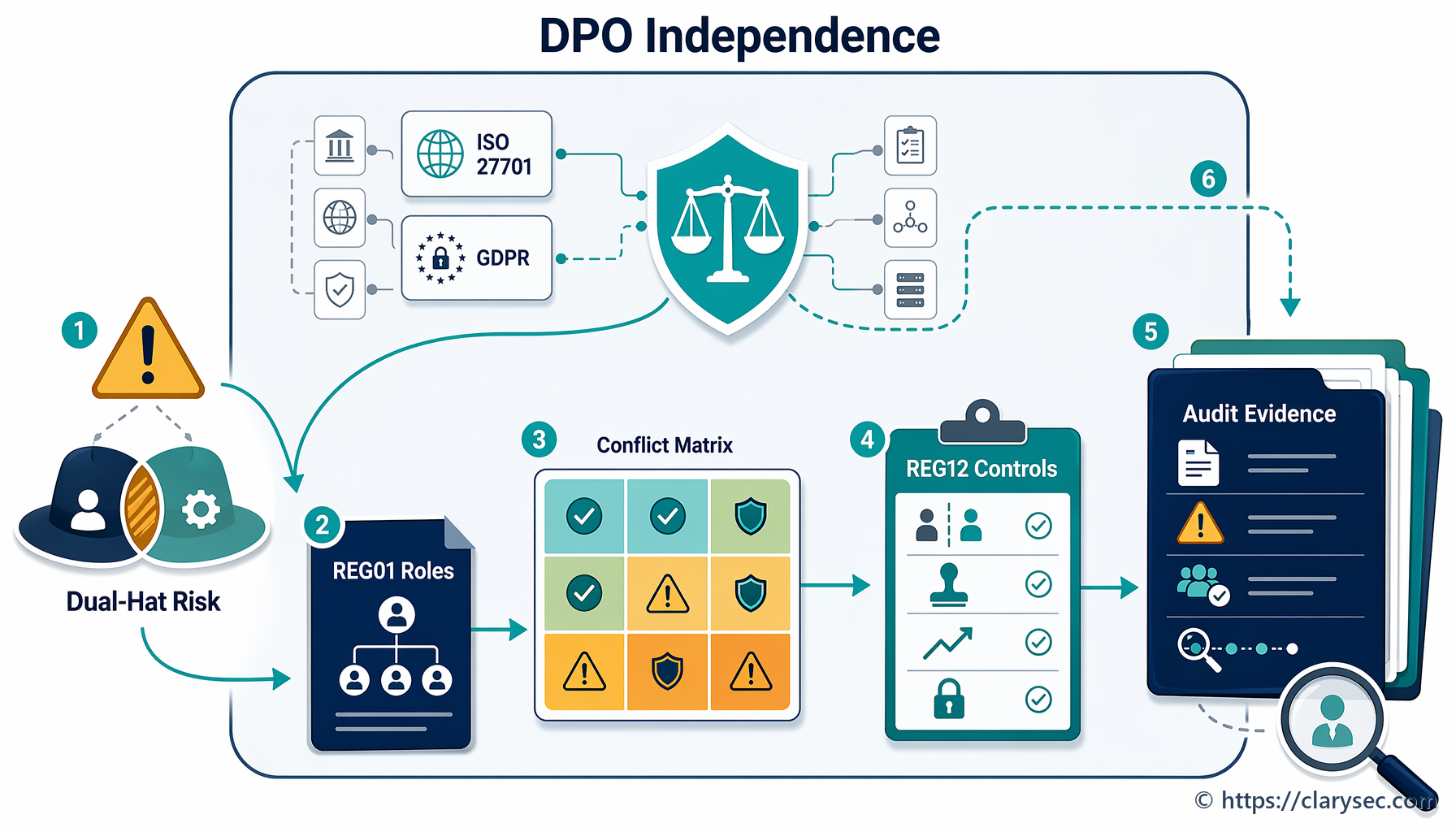
This is the DPO independence problem in its most practical form. The issue is not whether Mark acted in bad faith. The issue is structural. A person cannot objectively monitor, challenge, and advise on decisions that they also own, approve, or defend.
The same problem appears in SaaS companies preparing for ISO/IEC 27701:2025 PIMS readiness reviews, healthcare vendors answering customer audits, financial entities facing DORA scrutiny, and SMEs trying to keep privacy governance lightweight. The organization has a DPO or privacy advisor on paper. The privacy notice is updated. The DPIA template exists. The breach register is ready. Then the auditor asks a simple question:
“Who is your DPO or privacy advisor, and what else do they do?”
If the answer is “Head of IT,” “CISO,” “General Counsel,” “COO,” “Head of HR,” “Head of Marketing,” or “the person who approves access, leads incidents, signs DPIAs, and reviews the same controls,” the organization does not merely have a staffing issue. It has a governance issue.
For ISO/IEC 27701:2025 and GDPR accountability, DPO independence is not ceremonial. It is a control. It connects role design, segregation of duties, management review, risk treatment, evidence registers, internal audit, and escalation paths.
That is where Clarysec helps organizations turn independence from a vague legal phrase into a repeatable, auditable operating model using the [P02] Governance Roles and Responsibilities Policy, [P02S] Governance Roles and Responsibilities Policy - SME, [PIMS] Privacy Roles, Responsibilities and Accountability Policy, [DP] Data Protection and Privacy Policy, Zenith Blueprint: An Auditor’s 30-Step Roadmap, and Zenith Controls: The Cross-Compliance Guide.
The real risk of the dual-hat DPO
GDPR permits a DPO to perform other tasks, but not if those tasks create a conflict of interest. Article 38 requires that the DPO not receive instructions regarding the exercise of DPO tasks, not be penalized for performing those tasks, and not hold additional duties that compromise independence.
The conflict usually appears when the DPO holds a position that determines the purposes or means of processing personal data. Common high-risk combinations include:
- DPO and Head of IT or CIO
- DPO and CISO or Information Security Lead
- DPO and Head of Marketing
- DPO and Head of HR
- DPO and COO
- DPO and internal audit lead
- DPO and product owner for high-risk data processing
Some combinations are not automatically prohibited, but all must be tested. Legal counsel, compliance managers, security leaders, and privacy program managers may understand data protection deeply, but the question is whether they can monitor independently, challenge decisions, and escalate concerns without reviewing their own work.
| Scenario | Why independence matters | Conflict signal |
|---|---|---|
| DPIA approval for a new AI analytics feature | The DPO must challenge necessity, proportionality, lawful basis, transparency, and safeguards | The DPO also owns product launch deadlines or revenue targets |
| Breach assessment after unauthorized access to logs | The DPO must advise on personal data breach classification and notification | The DPO manages the team whose control failure caused the incident |
| Processor onboarding for cloud analytics | The DPO must challenge transfer, retention, subprocessor, and access risks | The DPO negotiated the contract and wants approval completed |
| Access approval to sensitive customer data | The DPO must monitor least privilege and accountability | The same person approves, provisions, and reviews access |
| Internal audit of privacy controls | The auditor must objectively test privacy governance | The DPO wrote the process, performed the control, and reviews the evidence |
The risk is not theoretical. A conflicted DPO may downplay privacy risks to protect budgets, avoid recommendations that create operational friction, hesitate to report a breach that reflects poorly on their department, or lack the independence to challenge senior management.
GDPR accountability makes this evidence-critical. Article 5(2) requires the controller to be responsible for, and able to demonstrate, compliance with the principles of lawful, fair, transparent, purpose-limited, minimized, accurate, retention-controlled, secure, and accountable processing. A DPO conflict that is not assessed, approved, mitigated, and evidenced weakens that demonstration.
What independence means inside a PIMS
In a Privacy Information Management System, independence does not always mean the DPO must be external. It means the DPO or privacy advisor can perform monitoring and advisory duties without being structurally blocked, operationally conflicted, or pressured to approve decisions they should challenge.
Clarysec separates three concepts that organizations often merge:
- Independence, the ability to advise, monitor, and escalate without interference.
- Segregation of duties, the separation of incompatible responsibilities such as approving and executing high-risk actions.
- Conflict of interest governance, the documented workflow for identifying, evaluating, approving, mitigating, and reviewing unavoidable role combinations.
This starts with leadership and role assignment. ISO/IEC 27001:2022 clause 5.3 requires top management to ensure that responsibilities and authorities for roles relevant to information security are assigned and communicated. In a PIMS built on an ISMS, that governance discipline extends naturally to privacy roles.
The [P02] Governance Roles and Responsibilities Policy states its objective:
“To maintain a governance model that enforces segregation of duties, eliminates conflicts of interest, and enables escalation of unresolved security issues.”
This quote comes from the Enterprise Governance Roles and Responsibilities Policy, section “Objectives”, policy clause 3.2.
The same policy makes the evidence expectation explicit:
“Segregation of duties is enforced and documented”
This quote comes from the Enterprise Governance Roles and Responsibilities Policy, section “Governance Requirements”, policy clause 5.4.3.
For SMEs, Clarysec recognizes that perfect separation is not always possible. The [P02S] Governance Roles and Responsibilities Policy - SME states:
“Risk treatment must include the identification of any cases where individuals may have conflicting duties (e.g. access approval and monitoring). Mitigation measures may include assigning review authority to a different person or implementing compensating controls (e.g. logs or spot checks).”
This quote comes from the SME Governance Roles and Responsibilities Policy-sme, section “Risk Treatment and Exceptions”, policy clause 7.2.1.
That is the practical standard for smaller organizations. Do not pretend there is no conflict. Identify it, approve it, mitigate it, record it, and review it.
REG01 and REG12: the Clarysec evidence workflow
In many organizations, role conflicts are handled informally. Someone says, “We are too small for a separate DPO,” and the decision never reaches a register. Months later, an auditor asks for evidence, and the organization has only an org chart.
The [PIMS] Privacy Roles, Responsibilities and Accountability Policy turns this into a controlled workflow. It requires top management approval before sensitive role combinations are assigned:
“[All] Top Management MUST approve role combinations involving the Privacy Lead / PIMS Manager, Data Protection Officer / Privacy Advisor, Information Security Lead, Incident Response Coordinator, or Internal Audit / Compliance Reviewer in REG01 before assignment.”
This quote comes from the Privacy Roles, Responsibilities and Accountability Policy, section “Role combination, segregation, and independence”, policy clause 4.2.2.
It also requires compensating controls for unavoidable conflicts:
“[All] The Privacy Lead / PIMS Manager MUST record compensating controls for unavoidable segregation conflicts in REG12 before approving a role combination.”
This quote comes from the Privacy Roles, Responsibilities and Accountability Policy, section “Role combination, segregation, and independence”, policy clause 4.2.4.
And it requires rapid logging of independence concerns:
“[All] The Data Protection Officer / Privacy Advisor MUST record role independence concerns or conflict-of-interest concerns in REG12 within five business days of identification.”
This quote comes from the Privacy Roles, Responsibilities and Accountability Policy, section “Role combination, segregation, and independence”, policy clause 4.2.5.
This is the difference between privacy documentation and privacy governance. The policy does not simply say “the DPO should be independent.” It defines who approves role combinations, where conflicts are logged, how fast independence concerns must be recorded, and how compensating controls are attached.
The [DP] Data Protection and Privacy Policy reinforces the independence requirement:
“Acts independently to oversee compliance with data protection regulations.”
This quote comes from the Enterprise Data Protection and Privacy Policy, section “Roles and Responsibilities”, policy clause 4.2.1.
A practical DPO conflict of interest matrix
A simple conflict matrix helps management decide which role combinations are acceptable, which need mitigation, and which should be prohibited.
| Role 1 | Role 2 | Conflict level | Recommended action or compensating controls |
|---|---|---|---|
| Head of IT or CIO | Data Protection Officer | High | Avoid where possible. The DPO should not oversee the same infrastructure function they manage |
| CISO or Information Security Lead | Data Protection Officer | High | Document in REG01 only if unavoidable, use external privacy review for breaches and DPIAs |
| Head of Marketing | Data Protection Officer | High | Avoid. Marketing often determines purposes and means for customer data use |
| Head of HR | Data Protection Officer | High | Avoid. HR manages sensitive employee data and related policies |
| Internal Audit Staff | Data Protection Officer | High | Avoid. Internal audit must be able to independently review the DPO function |
| Legal Counsel | Data Protection Officer | Medium | Assess carefully, document in REG01, separate DPO advice from legal privilege where needed |
| Head of Compliance | Data Protection Officer | Medium | Assess carefully, define mandate, reporting line, and independent review controls |
| External Consultant | Data Protection Officer | Low | Often effective if the contract guarantees independence, access, resources, and escalation rights |
The matrix is not a substitute for governance. It is a triage tool that feeds REG01 approvals, REG12 concerns, management review, and internal audit planning.
Five steps to manage DPO conflicts before auditors find them
When a customer asks, “Our DPO is also our security lead. Is that acceptable?” the answer depends on evidence.
Step 1: Record the role combination in REG01
Start with the role assignment register. Record the person, formal role, reporting line, delegated authorities, privacy-relevant operational responsibilities, approval status, and review date.
| REG01 field | Example content |
|---|---|
| Person | Jane Smith |
| Role 1 | Data Protection Officer / Privacy Advisor |
| Role 2 | Information Security Lead |
| Role 3 | Incident Response Coordinator |
| Approval required | Top Management approval required before assignment |
| Initial conflict rating | High for breach assessment and access monitoring, medium for DPIA review |
| Approval decision | Approved with compensating controls for 12 months |
| Review date | Quarterly and after any personal data breach |
This implements the [PIMS] Privacy Roles, Responsibilities and Accountability Policy requirement for top management approval before assignment.
Step 2: Perform a conflict assessment
Ask where the DPO could be reviewing their own work.
| Question | If yes, conflict exists |
|---|---|
| Does the DPO approve the processing activity they later monitor? | Yes |
| Does the DPO manage the team whose failure they may need to challenge? | Yes |
| Does the DPO decide breach severity and also own remediation metrics? | Yes |
| Does the DPO have commercial or operational KPIs tied to approval? | Yes |
| Can the DPO escalate directly to top management without filtering? | If no, independence concern exists |
The goal is not to create a perfect org chart. The goal is to prevent self-approval, hidden influence, and weak escalation.
Step 3: Record compensating controls in REG12
If the organization cannot immediately separate roles, record controls in REG12.
| Conflict | Compensating control |
|---|---|
| DPO is also Incident Response Coordinator | Legal counsel or external privacy advisor reviews personal data breach notification decisions |
| DPO is also Information Security Lead | Internal audit tests privacy monitoring evidence independently every quarter |
| DPO approves access to privacy logs | Another manager performs access review using immutable logs |
| DPO facilitates DPIAs | DPIA approval requires product owner, legal, privacy, and top management sign-off |
| DPO joins supplier selection | Procurement or risk committee performs independent supplier privacy due diligence |
This aligns with the [SME-ISP] Information Security Policy - SME:
“No task may be delegated in a manner that removes oversight or breaches segregation of duties (e.g., one person must not approve and execute the same high-risk action alone).”
This quote comes from the SME Information Security Policy-sme, section “Roles and Responsibilities”, policy clause 4.5.3.
It also aligns with the [P02S] Governance Roles and Responsibilities Policy - SME:
“Delegation must not remove oversight or permit unauthorized self-approval.”
This quote comes from the SME Governance Roles and Responsibilities Policy-sme, section “Roles and Responsibilities”, policy clause 4.5.2.
Step 4: Document DPO advice and independence concerns
A frequent audit failure is that DPO advice happens in meetings, chat threads, or informal calls, but nothing is recorded. The [PIMS] Privacy Roles, Responsibilities and Accountability Policy requires:
“[All] The Data Protection Officer / Privacy Advisor MUST record privacy advice, monitoring observations, or independence concerns in REG12 when requested for material privacy decisions or compliance concerns.”
This quote comes from the Privacy Roles, Responsibilities and Accountability Policy, section “Roles and Responsibilities”, policy clause 5.1.3.
It also requires timely review of referred conflicts:
“[All] The Data Protection Officer / Privacy Advisor MUST review referred material role conflicts and record advice in REG12 within 10 business days of referral.”
This quote comes from the Privacy Roles, Responsibilities and Accountability Policy, section “Governance and Oversight”, policy clause 6.1.3.
| REG12 field | Example content |
|---|---|
| Decision | Launch customer behavior analytics feature |
| DPO advice | Proceed only with DPIA completion, updated privacy notice, retention limit, opt-out mechanism, and access restriction |
| Independence concern | Product owner requested launch approval before DPIA completion |
| Escalation | Escalated to PIMS Manager and CEO |
| Outcome | Launch delayed until safeguards were implemented |
| Evidence links | DPIA, privacy notice update, access review, management approval |
This record protects the organization, but it also protects the DPO. It proves that independent advice was given, even when the business preferred a faster path.
Step 5: Feed conflicts into management review and internal audit
DPO independence is not a one-time appointment check. It must be reviewed through management review, internal audit, and corrective action tracking.
The [P02] Governance Roles and Responsibilities Policy includes compliance review of:
“Reviewing any conflicts of interest or unauthorized delegations”
This quote comes from the Enterprise Governance Roles and Responsibilities Policy, section “Enforcement and Compliance”, policy clause 8.2.1.3.
The [DP] Data Protection and Privacy Policy also keeps top management involved in exceptions:
“Exceptions shall be approved by the Data Protection Officer (DPO) and Top Management before implementation.”
This quote comes from the Enterprise Data Protection and Privacy Policy, section “Risk Treatment and Exceptions”, policy clause 7.3.1.
That dual approval matters. The DPO advises and monitors. Top management owns the decision and the residual risk.
How Zenith Blueprint and Zenith Controls map the issue
The Zenith Blueprint frames role assignment early in the ISMS Foundation & Leadership phase, Step 4: Roles and Responsibilities in the ISMS. It notes:
“If applicable (especially if you handle personal data, you might have a Data Protection Officer by law). They ensure the ISMS aligns with privacy laws and perhaps coordinate audits.”
Step 4 also emphasizes that the ISMS Manager or Security Officer often coordinates implementation, risk assessments, audits, and awareness programs, and “must have direct access to top management to escalate issues.” The same principle applies to the DPO. A privacy advisor who cannot reach top management when a product team rejects DPIA recommendations is not meaningfully independent.
In the Controls in Action phase, Step 22: Organizational controls, the Zenith Blueprint explains segregation of duties:
“Segregation of duties (SoD) is a fundamental control principle designed to reduce the risk of fraud, error, or abuse by ensuring that no individual has excessive authority or access that could be exploited without detection.”
It also gives the SME reality:
“Where staff size limits functional segregation, organizations can implement compensating controls. These might include multi-step approvals, automated workflow reviews, or audit logging with regular review. The point isn’t perfection, it’s awareness.”
Step 23 connects privacy officers, legal advisors, and DPOs to privacy operations:
“Privacy officers, legal advisors, or data protection officers (DPOs) must be involved in defining how personal data is handled, especially when it comes to international transfers, cross-border processing, or data subject rights such as access, correction, and deletion.”
It continues with the evidence auditors expect:
“From an audit perspective, this control is increasingly in focus. Auditors, regulators, and customers alike want to see:
✓ Where PII resides,
✓ What lawful basis governs its processing,
✓ How access is restricted,
✓ How incidents are reported,
✓ And how the organization honors rights and maintains transparency.”
The Zenith Blueprint also explains independent review as an objectivity control:
“It requires that the organization’s approach to managing information security be subject to independent review at planned intervals , so that blind spots can be revealed, assumptions can be challenged, and trust can be validated through fresh eyes.”
And clarifies:
“Independent” in this context doesn’t always mean external. It means functionally separate from the operational ownership of the ISMS.”
For DPO independence, this means the internal audit of privacy governance should not be performed by the person whose DPO role is under review. If the organization is too small, use an external reviewer or peer review approved by top management.
Zenith Controls identifies the topic-related ISO/IEC 27002:2022 controls as “Information Security Roles and Responsibilities” 5.2, “Segregation of Duties” 5.3, and “Independent Review of Information Security” 5.35. That mapping matters because privacy independence is not isolated from ISMS governance. It is part of the same audit logic: define responsibilities, separate incompatible duties, and independently review the management system.
Cross-framework mapping for ISO 27701, GDPR, NIS2, DORA, NIST CSF, and COBIT 19
DPO independence is usually discussed as a GDPR issue, but auditors and regulators see the same weakness through multiple frameworks.
| Framework lens | What it asks in practice | DPO conflict governance evidence |
|---|---|---|
| ISO/IEC 27701:2025 PIMS | Are privacy roles, responsibilities, monitoring, and accountability defined and operating? | DPO appointment, REG01 role assignment, REG12 independence concerns, PIMS management review minutes |
| GDPR | Can the controller demonstrate accountability, privacy governance, and appropriate safeguards? | DPO advice records, conflict assessment, DPIA challenge evidence, breach advice logs |
| ISO/IEC 27001:2022 and ISO/IEC 27002:2022 | Are responsibilities assigned, duties segregated, and independent reviews performed? | RACI matrix, SoD assessment, internal audit independence, control owner list |
| NIS2 | Does management approve and oversee risk measures, training, incident handling, continuity, and supply chain controls? | Management body decisions, escalation records, cybersecurity and privacy governance minutes |
| DORA | Does the management body oversee ICT risk, third-party risk, internal audit, resilience, and incident reporting? | ICT role map, third-party conflict review, internal audit plan, corrective action tracking |
| NIST CSF 2.0 | Are governance, legal obligations, risk appetite, roles, and oversight integrated into ERM? | Current and Target Profiles, governance gap register, POA&M, policy review evidence |
| COBIT 19 and ISACA audit lens | Are decision rights, assurance independence, risk ownership, and monitoring responsibilities separated? | Decision rights matrix, assurance plan, conflict logs, remediation tracking |
NIS2 Article 20 places responsibility on management bodies to approve and oversee cybersecurity risk-management measures and training. Article 21 requires appropriate technical, operational, and organizational measures, including risk analysis, incident handling, continuity, supply chain security, effectiveness assessment, training, cryptography, HR security, access control, asset management, MFA where appropriate, and secure communications. If the DPO is also an operational security owner, privacy oversight must still be preserved.
DORA Article 5 requires financial entities to maintain an internal governance and control framework for ICT risk management, with the management body ultimately responsible. Article 28 requires ICT third-party risk management, due diligence, contractual safeguards, concentration-risk assessment, and conflict-of-interest consideration. A DPO who also owns ICT risk or third-party approval creates a governance issue that must be controlled.
NIST CSF 2.0 places these questions in the GOVERN function: legal, regulatory, contractual, privacy, and civil liberties obligations must be understood and managed, roles must be clear, oversight must exist, and cybersecurity risk must align with enterprise risk management. A DPO conflict can be treated as a governance gap, assigned an owner, documented in a plan of action, and monitored.
How auditors test DPO independence
Different auditors use different language, but their questions converge.
| Auditor background | Likely audit question | Evidence Clarysec prepares |
|---|---|---|
| ISO/IEC 27701:2025 PIMS auditor | Are privacy responsibilities assigned, conflicts identified, and monitoring independent? | PIMS role map, REG01 approvals, REG12 conflict logs, privacy advice records |
| ISO/IEC 27001:2022 auditor | Are information security roles defined, incompatible duties segregated, and independent review performed? | RACI, SoD matrix, internal audit plan, management review actions |
| GDPR-focused auditor or regulator | Can the organization demonstrate accountability and independent DPO advice? | DPO appointment, escalation records, DPIA advice, breach advice, training oversight |
| NIST CSF assessor | Are governance roles, legal obligations, risk tolerance, and oversight integrated into ERM? | CSF Current and Target Profiles, governance gap plan, risk register |
| DORA reviewer | Does management oversee ICT risk and conflicts in third-party and incident governance? | ICT governance framework, internal audit plan, incident reporting roles, supplier conflict review |
| NIS2 reviewer | Does the management body approve and oversee risk measures, training, and incident handling? | Board minutes, training records, risk measures, escalation evidence |
| COBIT 19 or ISACA auditor | Are decision rights, assurance independence, and monitoring responsibilities properly separated? | Governance charter, assurance map, conflict register, remediation tracking |
An auditor will not accept “our DPO is independent” as a sufficient answer. The answer must be evidence-based: here is the appointment, here is the role map, here is the conflict assessment, here is the approval, here are the compensating controls, here is the advice log, here is the escalation trail, and here is the management review record.
Training: independence fails when people bypass the DPO
A DPO cannot remain independent if the organization does not know when to involve them. Product managers, security engineers, HR, sales operations, procurement, support, and incident responders need practical triggers.
The [DPS] Data Protection and Privacy Policy - SME describes the DPO or privacy function as supporting:
“Supports risk assessments, training, and policy implementation”
This quote comes from the SME Data Protection and Privacy Policy-sme, section “Roles and Responsibilities”, policy clause 4.2.3.
The [AT-SME] Information Security Awareness and Training Policy - SME connects this to GDPR training expectations:
“Article 39 – Requires Data Protection Officers to oversee awareness and training where applicable”
This quote comes from the SME Information Security Awareness and Training Policy-sme, section “Reference Standards and Frameworks”, policy clause 11.4.2.
Training should teach staff to involve the DPO before:
- Launching a new processing purpose
- Using special category, biometric, health, fraud, or offence-related data
- Onboarding a processor for customer data
- Performing DPIAs, transfer assessments, retention changes, or privacy notice updates
- Closing an incident where unauthorized access to personal data may have occurred
- Making a business decision that rejects or modifies privacy advice
The last point matters. Accountability does not require the business to agree with every DPO recommendation. It does require the organization to record advice, document decisions, and show who accepted residual risk.
Build a DPO Independence Evidence Pack
For ISO/IEC 27701:2025 and GDPR readiness, Clarysec recommends a DPO Independence Evidence Pack. It should be lightweight enough for SMEs but strong enough for enterprise audits.
| Evidence item | Purpose |
|---|---|
| DPO or privacy advisor appointment record | Shows formal role assignment, scope, authority, and reporting line |
| REG01 role combination approval | Shows top management approved sensitive role combinations before assignment |
| Role conflict assessment | Shows incompatible duties were identified and rated |
| REG12 conflict and independence concern log | Shows concerns, advice, compensating controls, and resolution |
| DPO advice register | Shows privacy input on DPIAs, incidents, transfers, rights, retention, and processors |
| Escalation path | Shows the DPO can reach top management without interference |
| Internal audit independence check | Shows privacy governance is not reviewed solely by operational owners |
| Management review minutes | Shows leadership reviewed conflicts, exceptions, incidents, and improvement actions |
| Training records | Shows staff know when to involve the DPO |
| Corrective action tracker | Shows unresolved conflicts are treated and followed up |
This evidence pack maps directly to the Zenith Blueprint 30-step approach. Step 4 establishes roles and responsibilities. Steps 8 to 16 build the risk engine and assign risk owners. Step 22 operationalizes segregation of duties. Step 23 addresses legal and privacy interfaces, including DPO involvement and independent review.
Turn DPO independence into evidence, not intention
If your DPO, privacy advisor, security lead, legal counsel, compliance manager, or internal auditor wears more than one hat, do not wait for an audit or incident to expose the conflict.
Start with three actions this week:
- Map every privacy governance role and operational role into REG01.
- Identify where the DPO or privacy advisor may approve, execute, monitor, or audit the same activity.
- Record unavoidable conflicts and compensating controls in REG12, then put them into management review.
Clarysec can help you operationalize this with the Privacy Roles, Responsibilities and Accountability Policy, Governance Roles and Responsibilities Policy, Governance Roles and Responsibilities Policy - SME, Data Protection and Privacy Policy, Zenith Blueprint: An Auditor’s 30-Step Roadmap, and Zenith Controls: The Cross-Compliance Guide.
DPO independence is not about bureaucracy. It is about making sure privacy advice can be heard, conflicts can be challenged, and accountability can be demonstrated when it matters most.
Download the Clarysec policy set, use the Zenith Blueprint to build your evidence workflow, or request a readiness assessment to test whether your DPO independence model would stand up to ISO/IEC 27701:2025, GDPR, NIS2, DORA, NIST CSF 2.0, and COBIT 19 scrutiny.
About the Author

Igor Petreski
Compliance Systems Architect, Clarysec LLC
Igor Petreski is a cybersecurity leader with over 30 years of experience in information technology and a dedicated decade specializing in global Governance, Risk, and Compliance (GRC).Core Credentials & Qualifications:• MSc in Cyber Security from Royal Holloway, University of London• PECB-Certified ISO/IEC 27001 Lead Auditor & Trainer• Certified Information Systems Auditor (CISA) from ISACA• Certified Information Security Manager (CISM) from ISACA • Certified Ethical Hacker from EC-Council