DSPM in 2026: Cloud Data Risk to Audit Evidence
At 08:17 on a Monday morning, the CISO of a fast-growing fintech receives three messages that turn a normal week into a governance test.
Engineering writes first: “We found an old analytics bucket with exported customer records. It is not public, but several service accounts can read it.”
The DPO follows: “Can we prove where special category data and financial identifiers are stored, who can access them, and whether we are still within purpose and retention?”
Then the COO adds the pressure that every security leader now recognizes: “A banking customer is asking how our cloud data controls map to ISO/IEC 27001:2022, NIS2, DORA and GDPR. They want evidence by Friday.”
The policies exist. The access review was completed last quarter. The asset register says “AWS data lake.” The security dashboard has alerts. But none of those artifacts answer the real business question: which sensitive data exists, where it lives, who or what can reach it, which exposures matter most, who owns remediation, and what proof can be shown to auditors, regulators, customers and management?
That is the 2026 Data Security Posture Management problem.
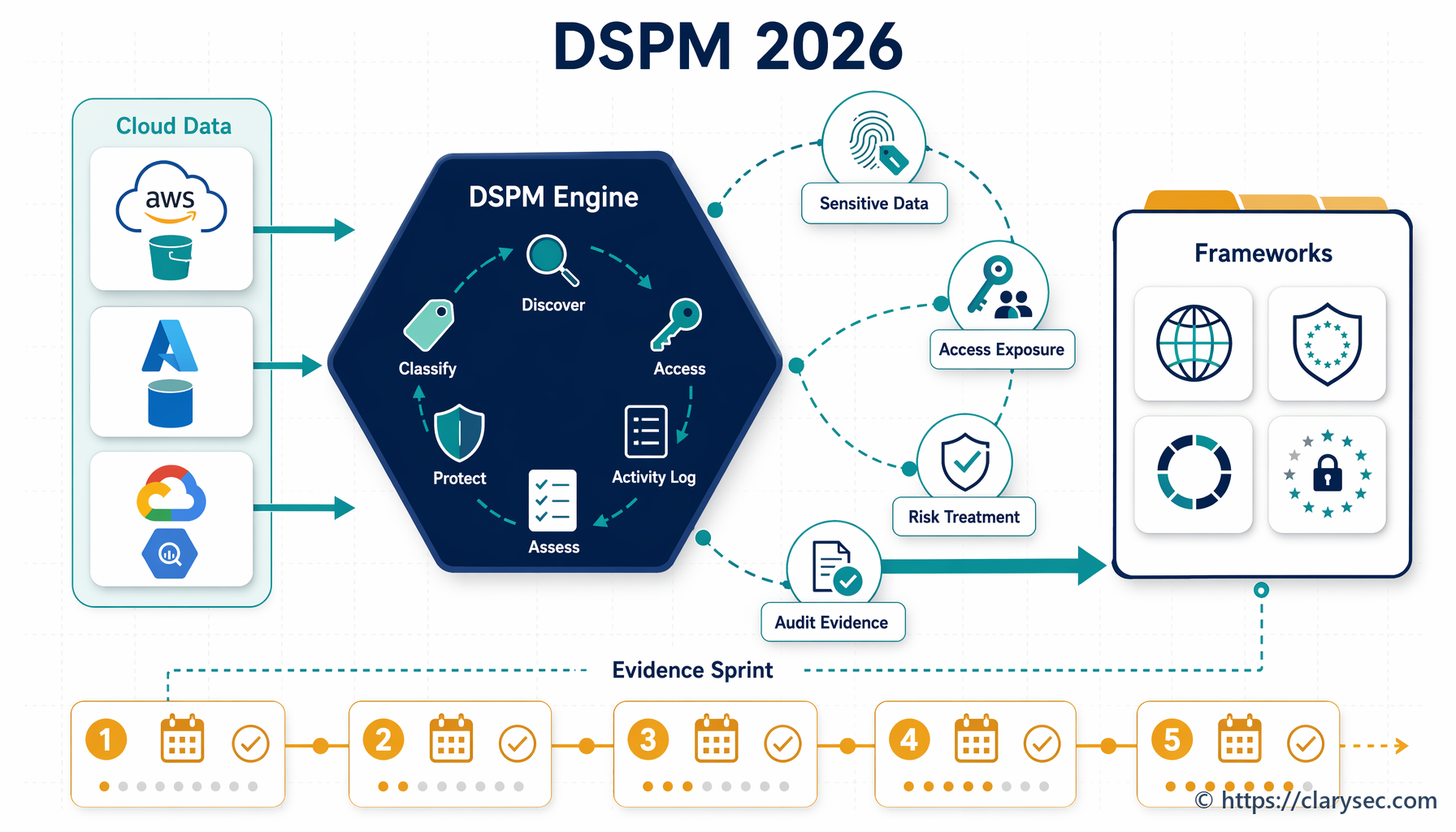
For CISOs, compliance leaders and DPOs, DSPM is no longer a niche cloud security tool category. It has become an evidence-driven operating model for governing sensitive data across cloud platforms, SaaS applications, data warehouses, development environments, backups, service accounts and third-party providers. Done well, DSPM connects sensitive data discovery, access exposure, cloud data risk and regulatory evidence into one repeatable control system.
What DSPM Really Means in 2026
Data Security Posture Management should answer six questions continuously:
- What sensitive and regulated data do we have?
- Where is it stored, copied, processed, exported and backed up?
- Who, or what, can access it?
- Which exposures increase business, regulatory or operational risk?
- Who owns remediation and by when?
- What evidence can we show when challenged?
A DSPM tool may scan object stores, databases, SaaS repositories, warehouses, code repositories and developer environments. But a DSPM program decides what those findings mean. It defines how data is classified, how risk is scored, which owners are accountable, how remediation is tracked and how evidence is retained.
Clarysec frames DSPM around three linked evidence domains:
| DSPM evidence domain | What it proves | Typical evidence |
|---|---|---|
| Sensitive data discovery | The organization knows what regulated or critical data exists and where it resides | Data inventory, classification output, repository scans, data owner mapping |
| Access exposure | The organization can identify and correct excessive, stale or risky access | IAM review results, privileged access reports, public exposure checks, orphan account remediation |
| Cloud data risk | The organization governs cloud data locations, services, configurations and provider dependencies | Cloud service register, storage configuration snapshots, encryption status, CSPM findings, remediation tickets |
These evidence domains should not live in separate spreadsheets. Sensitive data discovery without access reduction is only awareness. Access reduction without data sensitivity is blind pruning. Cloud posture without data context misses the highest-risk intersections. DSPM becomes valuable when it feeds one asset inventory, one risk register, one remediation workflow and one compliance evidence cadence.
That is why Zenith Blueprint: An Auditor’s 30-Step Roadmap starts with disciplined asset and risk management. In the Risk Management phase, Step 9 instructs organizations to inventory information assets by recording owner, location and classification, and to flag personal data assets and critical service assets for GDPR and NIS2 relevance. The Blueprint gives a practical example: a “Customer Database” owned by IT, hosted on AWS, containing personal and financial data with high sensitivity. That is the DSPM starting point, not a generic cloud list, but an inventory enriched with sensitivity, location and accountability.
Later, in the Controls in Action phase, Step 19, the Zenith Blueprint states the access principle that should guide every DSPM program:
Access to information should be as open as necessary, but as restricted as possible.
That sentence is the governance heart of DSPM.
Why ISO/IEC 27001:2022 Is the Anchor for DSPM Governance
ISO/IEC 27001:2022 gives DSPM its management system spine. Clauses 4.1 to 4.4 require the organization to understand context, interested parties, legal and regulatory obligations, scope, interfaces and dependencies. For DSPM, this means the ISMS scope should not merely say “cloud platform.” It should identify the data processing environment, cloud services, outsourced ICT services, critical repositories, business processes and regulatory expectations.
Clauses 6.1.1 to 6.1.3 and 6.2 are where DSPM becomes governed risk. ISO/IEC 27001:2022 requires a consistent information security risk assessment process, risk acceptance criteria, risk owners, risk treatment, control selection, a Statement of Applicability and measurable objectives. A scan result saying “10,000 customer records in a non-production bucket” is not yet governance. Under an ISO/IEC 27001:2022 aligned DSPM model, that finding becomes:
- An asset inventory update
- A classification confirmation
- A risk entry with likelihood, impact, score, owner and treatment plan
- A control mapping in the Statement of Applicability
- A remediation task with due date and acceptance decision
- Evidence for access review, cloud governance, monitoring and audit
The Risk Management Policy - SME captures the minimum structure required to prevent DSPM from becoming a noisy dashboard. Clause 5.1.2 states:
Each risk entry must include: description, likelihood, impact, score, owner, and treatment plan.
That requirement is small but powerful. Every material data exposure must be assigned to a named owner and a treatment path.
The ISO/IEC 27002:2022 Controls That Make DSPM Auditable
In Zenith Controls: The Cross-Compliance Guide, Clarysec maps ISO/IEC 27001:2022 and ISO/IEC 27002:2022 requirements into a practical audit and cross-compliance view. For DSPM, three ISO/IEC 27002:2022 controls are especially central:
| ISO/IEC 27002:2022 control | DSPM relevance | Attributes documented in Zenith Controls |
|---|---|---|
| 5.9 Inventory of information and other associated assets | Establishes the baseline for repositories, data sets, owners, locations and classifications | Preventive control, supports confidentiality, integrity and availability, maps to Identify and Asset Management, spans Governance, Ecosystem and Protection |
| 5.18 Access rights | Turns exposure findings into access governance, least privilege and periodic review | Preventive control, supports confidentiality, integrity and availability, maps to Protect and Identity and Access Management |
| 5.23 Information security for use of cloud services | Governs cloud service selection, use, shared responsibility, configuration and provider dependencies | Preventive control, supports confidentiality, integrity and availability, maps to Protect and Supplier Relationships Security, spans Governance, Ecosystem and Protection |
These controls define what DSPM must prove.
For control 5.9, a DSPM program must show that information and associated assets are known, owned and maintained. For control 5.18, it must show that access rights match business and security requirements, not historical convenience. For control 5.23, it must show that cloud services are governed, not merely consumed.
The Zenith Blueprint makes the cloud governance issue explicit in Step 23:
The cloud is no longer a destination, it’s the default.
The same section warns that misconfigured storage, exposed dashboards and excessive cloud IAM permissions are not provider failures. They are failures of governance. DSPM belongs inside the ISMS because it converts cloud data exposure into accountable risk treatment.
Mapping DSPM to NIS2, DORA and GDPR
The reason DSPM has become board-level is not only technical. It is regulatory.
NIS2: Management oversight and evidence of cyber hygiene
NIS2 changes the conversation because cybersecurity risk management is a management body responsibility. Article 20 requires management bodies of essential and important entities to approve cybersecurity risk management measures, oversee their implementation and receive training. For DSPM, this means leadership cannot simply ask whether the security team has a tool. They need evidence that sensitive data exposure, cloud data risk and remediation are being governed.
Article 21 requires appropriate and proportionate technical, operational and organizational measures. Its minimum areas include risk analysis, security policies, incident handling, business continuity, supply chain security, secure acquisition and development, effectiveness assessment, cyber hygiene, cryptography, human resources security, access control, asset management and authentication.
DSPM supports these expectations by proving that:
- Data assets and repositories are identified
- Sensitive data is classified and protected
- Excessive access is detected and remediated
- Cloud data stores are governed and monitored
- Suppliers and cloud services are visible
- Incident impact can be assessed by data type, location and affected service
- Encryption, MFA and access controls are applied where appropriate
NIS2 Article 23 also makes timing critical. Significant incidents require an early warning within 24 hours, an incident notification within 72 hours and a final report within one month. Without DSPM, the first 24 hours are often spent answering basic questions: which data was affected, who had access, was personal data involved, was there cross-border impact? With DSPM evidence integrated into incident response, those answers are faster and more defensible.
DORA: ICT operational resilience depends on data control
For financial entities, DORA applies from 17 January 2025 and functions as a sector-specific operational resilience regime. It covers ICT risk management, major ICT-related incident reporting, digital operational resilience testing, cyber threat and vulnerability information sharing, ICT third-party risk and contractual arrangements with ICT third-party service providers.
Article 5 requires management bodies to define, approve, oversee and remain responsible for ICT risk management arrangements, including policies for data availability, authenticity, integrity and confidentiality. Article 6 requires a documented ICT risk management framework covering policies, procedures, ICT protocols and tools to protect information assets, ICT assets and physical infrastructure. It must be reviewed, improved using lessons learned, audited and connected to a digital operational resilience strategy.
DSPM gives DORA programs the data-level view many ICT risk frameworks lack. A system can be marked “critical,” but resilience planning also needs to know the sensitive data inside it, the cloud dependencies around it and the access paths that could affect confidentiality, integrity, availability and authenticity.
For fintech SMEs, DORA may apply directly if they are financial entities such as payment institutions, electronic money institutions, investment firms, crypto-asset service providers or account information service providers. SaaS providers may also become relevant as ICT third-party service providers when supporting financial services, especially critical or important functions.
GDPR: Accountability starts with knowing the data
GDPR makes DSPM unavoidable because Article 5 requires personal data processing to follow principles of lawfulness, fairness and transparency, purpose limitation, data minimisation, accuracy, storage limitation, integrity and confidentiality. Article 5(2) adds accountability: the controller must be able to demonstrate compliance.
The word “demonstrate” is where DSPM earns its place.
If a business cannot discover personal data across cloud storage, SaaS exports, test environments, analytics warehouses and shadow repositories, it cannot credibly demonstrate minimisation or storage limitation. If it cannot show who has access, it cannot credibly demonstrate integrity and confidentiality. If it cannot map repositories to purposes and owners, it cannot support accurate records of processing, deletion workflows or privacy risk reviews.
The Data Classification and Labeling Policy - SME turns this principle into a recurring control activity. Clause 8.1.1 states:
The GM or IT Lead must perform regular audits of file shares, systems, and repositories to verify correct classification and labeling.
For larger organizations, the Data Classification and Labeling Policy adds automation. Clause 8.3.2 calls for:
Automated classification validation using Data Loss Prevention (DLP) and discovery tools
Manual classification alone cannot keep up with data sprawl. DSPM supplies the validation layer.
The Clarysec DSPM Operating Model
A mature DSPM program is not a one-time scan. It is a repeatable operating model: discover, classify, expose, treat and evidence.
1. Discover repositories and data flows
Start with cloud accounts, object stores, databases, file shares, SaaS platforms, warehouses, backups, code repositories and non-production environments. The Asset Management Policy requires in clause 6.1.1:
The IT Asset Manager must maintain a comprehensive and centralized asset inventory covering all information assets used by or connected to the organization.
DSPM discovery should update the asset inventory directly. If the tool finds a new data warehouse, unmanaged analytics bucket or SaaS export, it should not remain a security-only artifact. It should become an owned asset record with location, sensitivity and business purpose.
2. Classify sensitive and regulated data
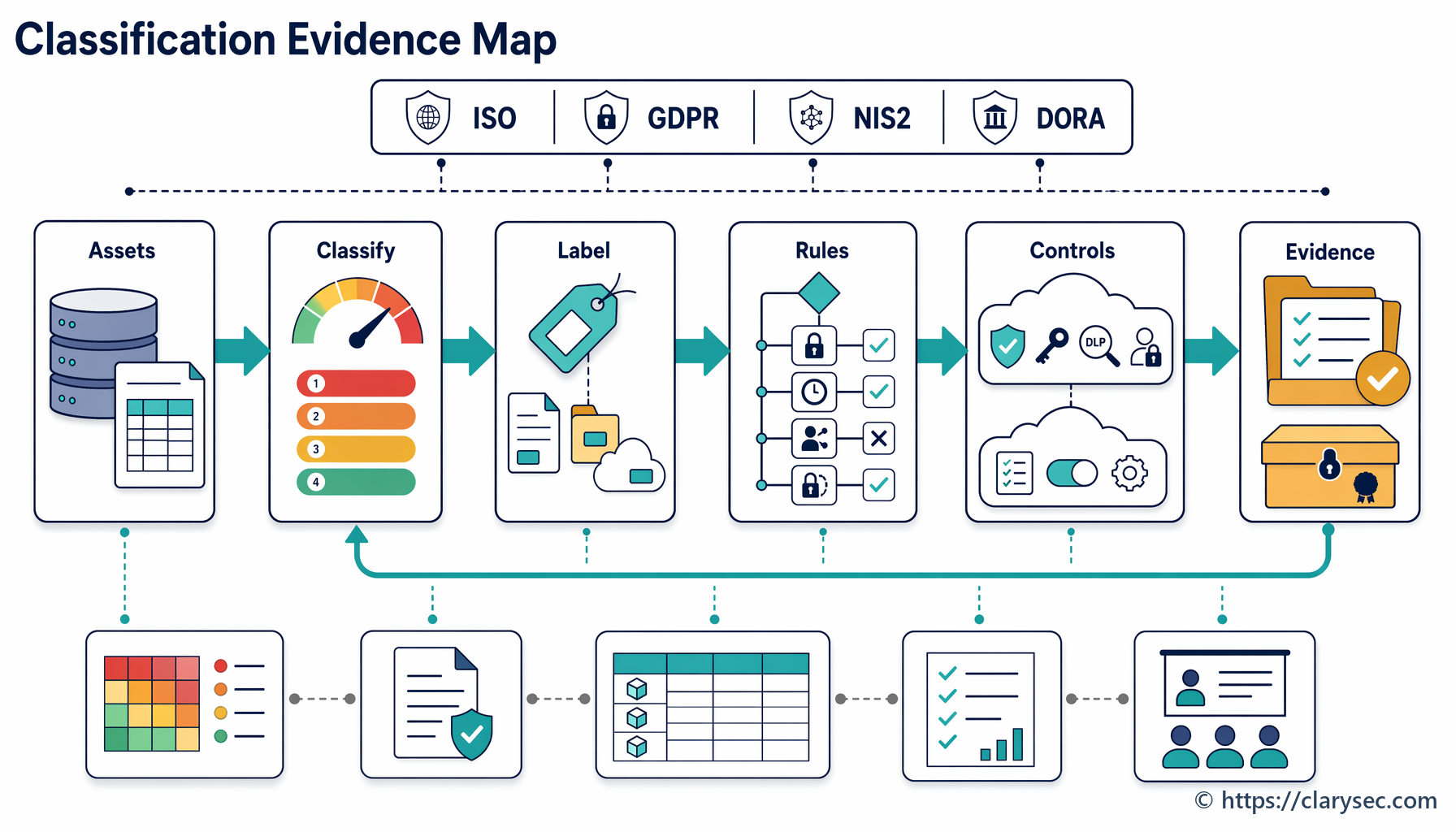
DSPM should identify personal data, financial data, credentials, secrets, intellectual property, employee data and regulated business records. Classification should map to owners, processing purposes, environments and retention expectations.
This is where prioritization begins. A public marketing file and a database snapshot containing payment records are not the same risk. Classification allows security teams to focus first on the exposures that affect customers, critical services, regulated processes and business resilience.
3. Analyze access exposure
Access exposure is often the finding that gets executive attention. It includes public exposure, broad internal groups, dormant users, shared admin roles, service accounts with excessive privileges, cross-tenant access, stale third-party permissions and developer access to production data.
The Access Control Policy - SME is direct. Clause 5.5.2 states:
Reviews must identify and correct excessive or outdated privileges.
The Access Control Policy adds a key enterprise requirement:
Access to classified or regulated data must be based on:
The detailed criteria continue in the policy, but the governance trigger is already clear. Classified or regulated data cannot be accessed on convenience, inheritance or historical role accumulation. DSPM provides the evidence to challenge those access paths.
4. Govern cloud data risk
DSPM must be joined with cloud governance. The Cloud Usage Policy - SME states:
A Cloud Service Register must be maintained by the IT provider or GM. It must record:
From a DSPM perspective, the Cloud Service Register is the bridge between data discovery and service accountability. It identifies where data can be stored, which providers are approved, who owns the service and what controls apply.
The Cloud Usage Policy adds the configuration side:
Configuration drift must be detected and remediated using Cloud Security Posture Management (CSPM) tools.
DSPM and CSPM are complementary. CSPM tells you whether a bucket, database or storage service is misconfigured. DSPM tells you whether the data inside is sensitive and who can access it. Together, they allow risk-based prioritization.
5. Log and monitor sensitive data access
DSPM cannot rely only on static permissions. It should be supported by logs showing access activity, permission changes and shared resource use. The Logging and Monitoring Policy - SME identifies relevant access log categories in clause 5.4.3:
Access logs: File access (especially for sensitive or personal data), permission changes, shared resource usage
This turns DSPM from a snapshot into a monitoring capability. It also strengthens incident response, privacy investigation and audit evidence.
6. Convert findings into risk treatment and audit evidence
Finally, DSPM findings must be reviewed, risk-rated, assigned, treated and retained as evidence. The Audit and Compliance Monitoring Policy explains the purpose of monitoring as:
Support continual improvement and readiness for certifications, assessments, and regulatory reviews
This is the end-state: DSPM evidence that is useful during an incident, ready for ISO/IEC 27001:2022 audits, credible for NIS2 oversight, relevant to DORA ICT risk reviews and practical for GDPR accountability.
A Five-Day DSPM Evidence Sprint
Imagine the Monday fintech scenario again. A banking customer wants evidence by Friday. Clarysec would structure a focused DSPM evidence sprint like this:
| Day | Action | Clarysec toolkit output | Compliance value |
|---|---|---|---|
| Day 1 | Build the data asset baseline from cloud storage, databases, SaaS repositories and data warehouses | Asset inventory with owner, location and classification fields | Supports ISO/IEC 27001:2022 context, scope and risk planning, plus ISO/IEC 27002:2022 control 5.9 |
| Day 2 | Run sensitive data discovery and validate high-risk repositories | Classification register and exception list | Supports GDPR accountability and Clarysec classification policy requirements |
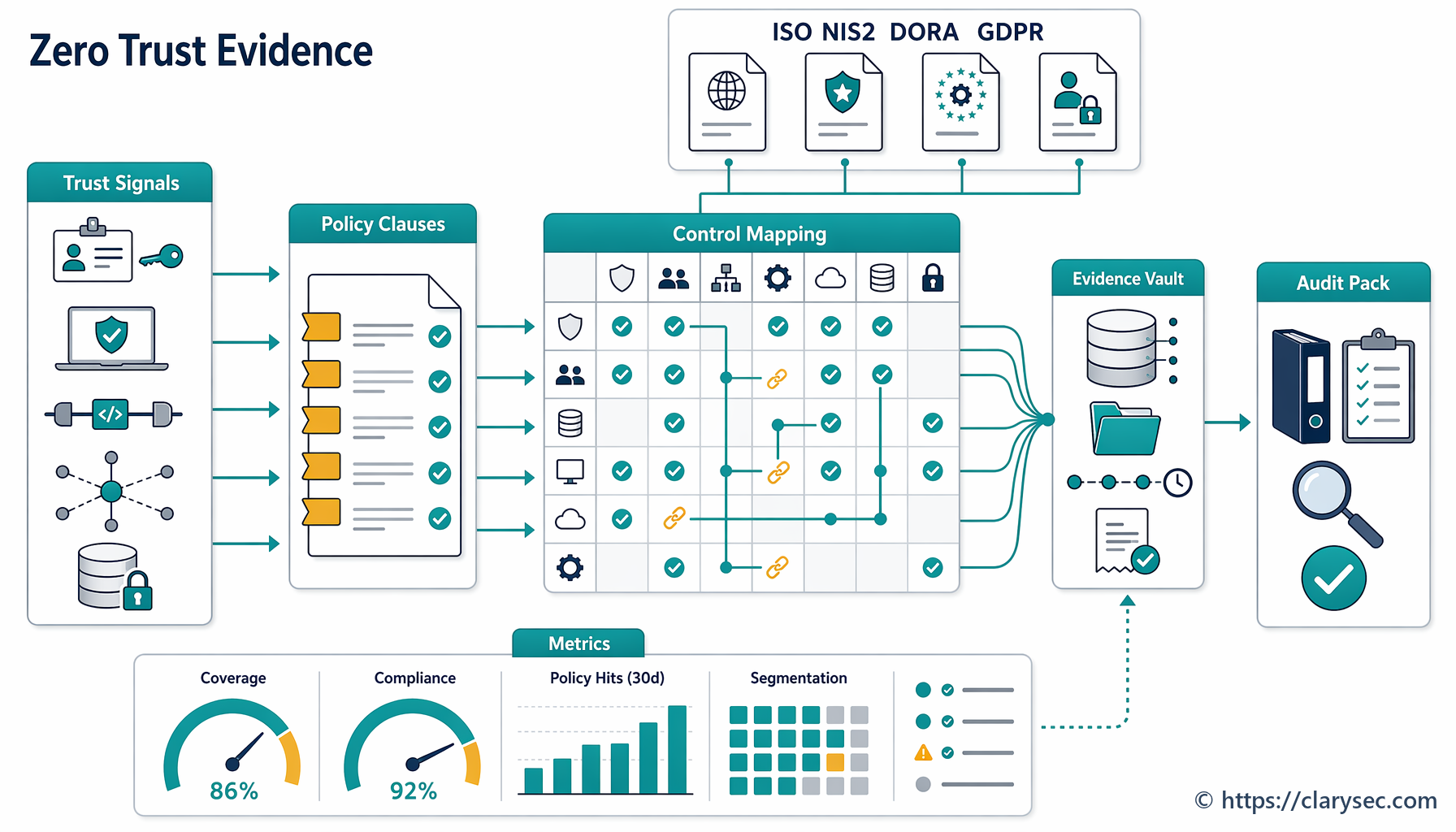
| Day 3 | Compare sensitive repositories against IAM, groups, service accounts and external sharing | Access exposure report and remediation tickets | Supports ISO/IEC 27002:2022 control 5.18, NIS2 access control and DORA ICT risk controls |
| Day 4 | Join DSPM findings with CSPM and Cloud Service Register records | Cloud data risk register | Supports ISO/IEC 27002:2022 control 5.23, NIS2 supply chain security and DORA ICT third-party risk |
| Day 5 | Update risk register, SoA notes and management reporting | Risk treatment plan, SoA cross-reference, evidence pack | Supports audit readiness, board oversight and customer assurance |
The practical step that changes everything is Day 5. Too many organizations stop at Day 3 with a spreadsheet of exposures. Clarysec pushes the results into the risk register and Statement of Applicability.
The Zenith Blueprint explains in Step 13 that the Statement of Applicability is a bridging document linking risk assessment and treatment to actual controls. It also recommends cross-referencing controls implemented for GDPR, NIS2 or DORA in the risk register or SoA notes.
For DSPM, a finding like “customer records in unmanaged analytics bucket with broad read access” becomes a structured compliance story:
- Risk: unauthorized access to personal and financial data in unmanaged analytics storage
- Owner: Head of Data Platform
- Impact: GDPR confidentiality risk, DORA ICT risk if supporting financial services, NIS2 access control and asset management relevance
- Treatment: remove broad access, move data to approved storage, apply retention, enable access logging, update Cloud Service Register
- Controls: ISO/IEC 27002:2022 controls 5.9, 5.18 and 5.23, plus related access, logging and classification policies
- Evidence: DSPM scan, IAM diff, remediation ticket, log configuration, updated inventory and management sign-off
This is audit-ready DSPM.
One DSPM Evidence Set, Many Framework Questions
The value of DSPM increases when evidence is reusable. A single well-designed evidence set can answer multiple regulatory and framework questions.
| Framework or regulation | What it asks in practice | DSPM evidence that helps |
|---|---|---|
| ISO/IEC 27001:2022 | Are information security risks identified, owned, treated and monitored within the ISMS? | Data asset inventory, risk register entries, SoA mappings, risk treatment plans |
| NIS2 | Are appropriate technical, operational and organizational measures in place for asset management, access control, cyber hygiene, incident readiness and cloud dependencies? | Sensitive data discovery, access exposure remediation, cloud register, incident data impact evidence |
| DORA | Are ICT risks to information assets, ICT assets and critical or important functions governed, tested, audited and improved? | Cloud data risk register, third-party service mapping, critical data store exposure records, resilience evidence |
| GDPR | Can the controller demonstrate data minimisation, purpose limitation, integrity, confidentiality and accountability? | Classification records, personal data locations, access logs, retention exceptions, remediation proof |
| NIST CSF 2.0 | Can the organization understand, assess, prioritize and communicate cybersecurity risks aligned to mission and legal requirements? | DSPM risk dashboard, prioritized exposure backlog, governance reporting |
| COBIT 2019 or ISACA audit lens | Are governance objectives, management practices, ownership and assurance activities operating effectively? | Control ownership matrix, evidence cadence, issue tracking, management review records |
NIST CSF 2.0 is especially useful as a communication layer. It helps organizations understand, assess, prioritize and communicate cybersecurity risk. DSPM findings map naturally into Govern, Identify, Protect and Detect conversations, especially when executives need a non-technical risk narrative.
How Auditors Will Look at DSPM Evidence
Auditors will not certify your DSPM tool. They will assess whether the operating model produces reliable evidence and drives control improvement.
| DSPM finding | Audit lens | Clarysec-enabled evidence |
|---|---|---|
| Publicly exposed cloud database with personal data | ISO/IEC 27001:2022 auditor | Risk assessment record under clauses 6.1.2 and 6.1.3, risk treatment plan, SoA references to controls 5.9, 5.18 and 5.23, remediation ticket and updated asset inventory |
| Publicly exposed cloud database with personal data | NIS2 reviewer | Evidence of Article 21 measures for risk analysis, asset management, access control and incident handling, plus management reporting for Article 20 oversight |
| Publicly exposed cloud database with personal data | DORA ICT risk auditor | Evidence that the finding is handled inside the ICT risk management framework under Article 6 and supports data confidentiality, integrity, availability and authenticity expectations under Article 5 |
| Publicly exposed cloud database with personal data | GDPR reviewer or DPO | Classification result, personal data location, access logs, security of processing evidence, remediation proof and accountability evidence under Article 5(2) |
| Publicly exposed cloud database with personal data | COBIT 2019 or ISACA auditor | Ownership matrix, issue tracking, escalation evidence, management review and assurance testing records |
A dashboard alone will not satisfy these lenses. Auditors want to trace from context and scope to risk assessment, risk treatment, control implementation, monitoring and improvement.
Common DSPM Failure Patterns
Clarysec often sees the same problems when organizations implement DSPM too quickly.
First, the organization buys a tool but never updates the asset inventory. The result is discovery without ownership.
Second, classification is technically accurate but not mapped to business purpose, retention or GDPR records. The result is privacy evidence that still requires manual interpretation.
Third, access exposure findings are sent to engineering without risk ranking. The result is backlog fatigue.
Fourth, cloud posture and data posture are separated. CSPM reports public exposure, DSPM reports sensitive data, but nobody joins them to prioritize the dangerous overlap.
Fifth, findings are remediated but not retained as audit evidence. The organization becomes safer, but cannot prove it.
A strong DSPM operating model avoids these failures by tying every material finding to asset ownership, classification, access governance, cloud service management, risk treatment and evidence retention.
Board-Level DSPM Metrics That Actually Matter
Management does not need a list of every sensitive table. It needs risk indicators that show direction, accountability and residual exposure. Effective DSPM reporting should include:
- Number of sensitive repositories by environment and owner
- Percentage of sensitive repositories with confirmed classification
- Number of high-risk access exposures open and overdue
- Sensitive data in non-approved cloud services
- Sensitive data in non-production environments
- Public or external exposure involving regulated data
- Critical data stores without sufficient logging
- Remediation time by owner and severity
- Accepted residual risks involving personal or financial data
- Evidence completeness for audit and regulatory review
These metrics align with NIS2 management oversight, DORA governance expectations, GDPR accountability and ISO/IEC 27001:2022 performance evaluation.
From Cloud Data Chaos to Controlled Evidence
The regulatory landscape of 2026 is unforgiving. Cloud adoption, SaaS sprawl, development velocity and analytics duplication have created a perfect storm of hidden data risk. Waiting for an incident, customer audit or regulator request to reveal your data security posture is no longer a viable strategy.
DSPM is the bridge between the reality of modern cloud data and the evidence expectations of ISO/IEC 27001:2022, NIS2, DORA and GDPR. It replaces guesswork with discovery, uncertainty with classification, unmanaged access with remediation, and scattered artifacts with reusable audit evidence.
The Clarysec approach is practical:
- Use Zenith Blueprint: An Auditor’s 30-Step Roadmap to anchor DSPM in asset inventory, risk treatment, access restriction, cloud governance and the Statement of Applicability.
- Use Zenith Controls: The Cross-Compliance Guide to map DSPM activities to ISO/IEC 27002:2022 controls 5.9, 5.18 and 5.23, then reuse evidence across NIS2, DORA, GDPR, NIST CSF 2.0 and COBIT 2019 audit lenses.
- Use Clarysec policies such as Asset Management Policy, Data Classification and Labeling Policy - SME, Data Classification and Labeling Policy, Access Control Policy - SME, Access Control Policy, Cloud Usage Policy - SME, Cloud Usage Policy, Logging and Monitoring Policy - SME, Risk Management Policy - SME and Audit and Compliance Monitoring Policy to turn DSPM from tool output into a controlled operating model.
If your organization is facing cloud data sprawl, over-permissive access, shadow repositories, customer assurance pressure or regulatory evidence gaps, the next step is not another spreadsheet. It is a DSPM evidence sprint that produces an asset baseline, classification map, exposure register, cloud data risk view, risk treatment plan and audit-ready evidence pack.
Clarysec can help you build that operating model, align it to ISO/IEC 27001:2022, and make the same evidence work for NIS2, DORA, GDPR and customer due diligence. Download the Clarysec toolkits, book a DSPM evidence assessment, or start with a five-day sprint to turn cloud data risk into defensible compliance evidence.
Frequently Asked Questions
About the Author

Igor Petreski
Compliance Systems Architect, Clarysec LLC
Igor Petreski is a cybersecurity leader with over 30 years of experience in information technology and a dedicated decade specializing in global Governance, Risk, and Compliance (GRC).Core Credentials & Qualifications:• MSc in Cyber Security from Royal Holloway, University of London• PECB-Certified ISO/IEC 27001 Lead Auditor & Trainer• Certified Information Systems Auditor (CISA) from ISACA• Certified Information Security Manager (CISM) from ISACA • Certified Ethical Hacker from EC-Council