Employee Privacy Governance for GDPR and ISO/IEC 27701
Sarah, the CISO of a fast-growing SaaS company, walked into the audit kick-off meeting confident.
Her team had spent the last year hardening customer-facing platforms, aligning the ISMS with ISO/IEC 27001:2022, and documenting GDPR controls for customer data. Security questionnaires were cleaner. Customer due diligence was faster. The board had finally started to see compliance as a sales enabler.
Then the lead auditor changed direction.
“Your customer data governance looks solid,” he said. “Now let’s talk about your internal PII principals. Your employees.”
He asked for the data lifecycle from application to termination. He asked for the lawful basis and proportionality assessment for the new remote work monitoring tool. He asked for the supplier security annex for the cloud HRIS. He asked how access to payroll, health records, disciplinary notes, and monitoring data was reviewed after role changes.
The room went quiet.
Sarah’s organization had policies, but they were scattered across HR documents, IT procedures, procurement templates, and legal folders. Employee privacy was treated as “HR’s thing,” separate from security architecture, vendor risk, incident response, access control, and audit evidence. The company had focused on the front door, customer data, while leaving the internal HR door loosely governed.
That is the real employee privacy governance problem. Not whether the organization has a privacy notice, but whether it can prove, activity by activity, that employee PII is collected fairly, used for a defined purpose, protected through least privilege, retained only as long as needed, disclosed transparently, and deleted or returned when the relationship ends.
ISO/IEC 27701:2025 and GDPR push organizations toward an operational privacy management system, not a static policy library. For CISOs, HR leaders, compliance managers, auditors, and business owners, the goal is to turn employee privacy into a governed workflow with accountable owners, registers, evidence, supplier controls, and management oversight.
Clarysec’s approach is deliberately practical. It connects ISO/IEC 27701:2025 PIMS thinking, GDPR accountability, ISO/IEC 27001:2022 governance, ISO/IEC 27002:2022 controls, and cross-compliance expectations from NIS2, DORA, NIST CSF 2.0, and COBIT 2019 into one audit-ready operating model.
Why Employee Privacy Is a CISO Blind Spot
Many organizations mature privacy governance around customers first. Customer privacy notices, cookie banners, marketing consent records, processor contracts, and customer-facing breach communications are visible to buyers, regulators, and sales teams.
Employee privacy is more fragmented.
Employee PII appears across recruitment, onboarding, payroll, benefits, access management, security logs, device management, productivity tools, collaboration platforms, performance reviews, training systems, travel systems, whistleblowing channels, background screening, health and safety records, and offboarding archives.
Under GDPR, personal data includes information relating to an identified or identifiable person. Processing includes collection, storage, retrieval, use, disclosure, erasure, and destruction. That makes most HR and workforce technology activities GDPR-relevant.
Employee data also frequently includes higher-risk categories. Health information may appear in sick leave or occupational health files. Trade union membership may be processed in payroll or employee relations. Biometric data may be used for physical access, timekeeping, or identity verification. GDPR Article 9 creates stricter conditions for special categories of personal data, so HR cannot rely on generic “business need” reasoning.
The employment relationship also creates legal complexity. Consent may be unreliable because employees may not feel free to refuse. Many processing activities instead rely on contract, legal obligation, legitimate interests, or specific employment law requirements, depending on jurisdiction and purpose.
The practical consequence is simple: employee privacy cannot be governed through a single generic control. Payroll, workplace monitoring, recruitment screening, emergency contact management, access logging, and disciplinary case management each require different purposes, lawful bases, retention rules, access restrictions, vendor obligations, and evidence.
Clarysec’s Employee Privacy Policy Employee Privacy Policy makes that specificity operational:
“[Controller] The Process Owner / Business Owner MUST document the employee PII categories, employee population, collection source, processing purpose, system, internal recipient category, external recipient category and retention linkage in REG02 before the processing activity is approved.”
From section “Employee processing inventory and HR processing purposes”, policy clause 4.1.2.
That clause changes the operating model. HR cannot simply activate a new tool or process. The owner must document what is collected, why it is collected, who receives it, where it lives, and how retention is linked before approval.
The GDPR Foundation: Lawful, Fair, Limited, and Demonstrable
GDPR Article 5 sets the baseline for employee privacy governance: lawfulness, fairness and transparency, purpose limitation, data minimization, accuracy, storage limitation, integrity and confidentiality, and accountability.
For HR teams, those principles translate into practical questions:
| GDPR principle | Employee privacy question | Evidence to maintain |
|---|---|---|
| Lawfulness, fairness, transparency | What lawful basis applies and how were employees informed? | Lawful basis record, employee privacy notice, monitoring notice |
| Purpose limitation | Is the data used only for the approved HR, security, payroll, or legal purpose? | REG02 processing inventory, purpose statement, approval record |
| Data minimization | Are only necessary employee data fields collected? | Data category review, system configuration, DPIA or risk review |
| Accuracy | How are HR records corrected and kept current? | Correction workflow, HRIS change logs, employee self-service records |
| Storage limitation | When is employee data deleted or anonymized? | Retention schedule, disposal logs, legal hold register |
| Integrity and confidentiality | Who can access employee PII and how is it protected? | Access matrix, access reviews, encryption records, privileged access logs |
| Accountability | Can the organization prove the above? | Policies, registers, approvals, audit logs, training records, management review |
Clarysec’s Data Protection and Privacy Policy Data Protection and Privacy Policy states the lawful basis principle directly:
“All processing shall be based on a valid legal ground (e.g., consent, contract, legal obligation).”
From section “Policy Implementation Requirements”, policy clause 6.1.1.
For SMEs, Clarysec’s Data Protection and Privacy Policy-sme Data Protection and Privacy Policy - SME makes personnel data explicitly in scope:
“This policy applies to data relating to customers, personnel, vendors, and any other identifiable individuals.”
From section “Scope”, policy clause 2.2.
The same SME policy turns accountability into a register requirement:
“The Privacy Coordinator must maintain a register of all personal data processing activities, including data categories, purpose, lawful basis, and retention periods”
From section “Governance Requirements”, policy clause 5.2.1.
For employee privacy, the register is not bureaucracy. It is the control surface. Without it, the organization cannot reliably answer basic audit questions such as which HR systems contain employee PII, what lawful basis supports workforce analytics, which managers can see salary data, when unsuccessful candidate records are deleted, and which vendor hosts occupational health records.
ISO/IEC 27701:2025 and ISO/IEC 27001:2022: From HR Policy to PIMS Evidence
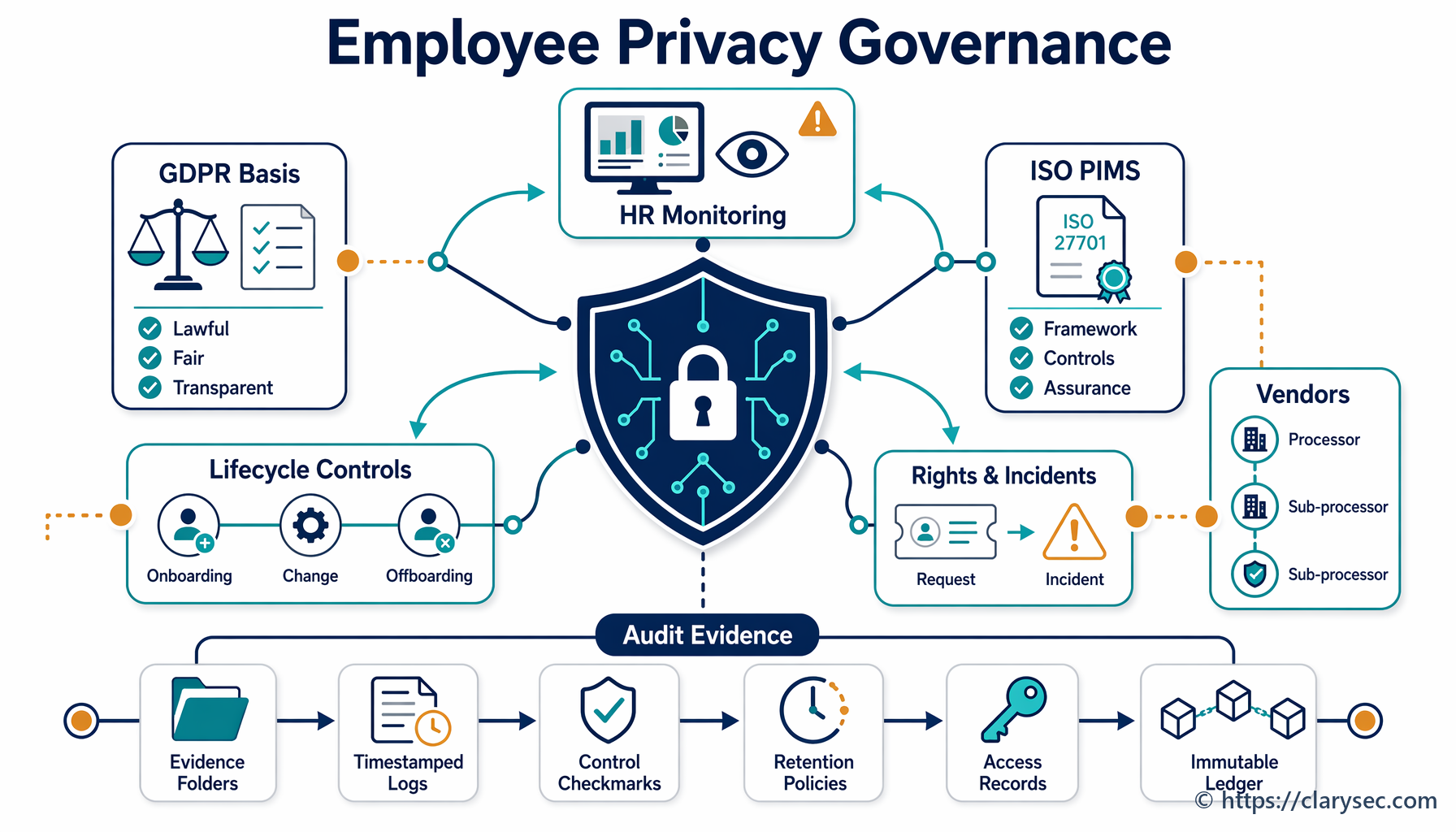
ISO/IEC 27701:2025 extends privacy governance into a structured privacy information management system, or PIMS. For employee privacy, that means HR data must be governed through defined roles, documented processing activities, privacy notices, rights handling, supplier oversight, retention rules, incident workflows, and continual improvement.
This fits naturally into ISO/IEC 27001:2022. Employee privacy belongs inside the ISMS because it depends on the same management system disciplines: scope, context, interested parties, leadership, risk assessment, controls, evidence, monitoring, internal audit, management review, and improvement.
Three ISO/IEC 27001:2022 clauses are especially important:
- Clause 4.1, Context of the organization, requires the organization to understand internal and external issues, including legal and workforce privacy obligations.
- Clause 4.2, Needs and expectations of interested parties, includes employees, regulators, customers, auditors, suppliers, insurers, and works councils where applicable.
- Clause 5.1, Leadership and commitment, requires top management to integrate the ISMS into business processes and support continual improvement.
Clarysec’s Zenith Blueprint: An Auditor’s 30-Step Roadmap Zenith Blueprint frames the practical baseline in the Controls in Action phase, Step 23, when discussing ISO/IEC 27002:2022 control 5.34, Privacy and Protection of Personally Identifiable Information:
“The foundation of this control is data awareness. The organization must know what PII it collects, where it resides, why it is being processed, and who can access it. Without this baseline, any privacy promises are hollow.”
From the Controls in Action phase, Step 23: Organizational controls, Control 5.34.
Clarysec’s Zenith Controls: The Cross-Compliance Guide Zenith Controls identifies the topic-related ISO/IEC 27002:2022 controls as “Privacy and Protection of PII” control 5.34, “Terms and Conditions of Employment” control 6.2, and “Responsibilities After Termination or Change of Employment” control 6.5.
Those controls show why employee privacy is not only a privacy-office issue. It touches employment terms, acceptable use, confidentiality, role changes, access reviews, offboarding, supplier contracts, security monitoring, and post-employment responsibilities.
The Seven Questions of Employee Privacy Governance
A practical employee privacy program starts with seven operating questions. Each question must produce evidence, not only discussion.
| Governance question | Evidence to maintain | Typical owner |
|---|---|---|
| What employee PII do we process? | HR processing inventory, data categories, system list, employee population | HR process owner and Privacy Lead |
| Why do we process it? | Purpose statement, lawful basis, special category condition where needed | Process owner and DPO or Privacy Lead |
| Who can access it? | Role-based access matrix, approval records, privileged access review | HR, IT, Security |
| What do employees know? | Employee privacy notice, onboarding disclosure, monitoring notice, awareness records | Privacy Lead and HR |
| How long do we keep it? | Retention schedule, deletion rules, legal hold exceptions, disposal logs | Records owner and HR |
| Which vendors touch it? | HRIS, payroll, screening, benefits, DPA, subprocessor review, deletion clauses | Procurement and Vendor Owner |
| How do we respond to rights requests and incidents? | DSR register, response workflow, breach triage records, notification decisions | DPO, Privacy Lead, Legal, Security |
This model is evidence-first because auditors do not only want to hear that HR data is protected. They want to see the register, notice, access review, vendor record, retention schedule, deletion log, and incident workflow.
Workplace Monitoring: The High-Friction Test
Workplace monitoring is where employee privacy governance is most often tested. Monitoring may be legitimate, but it must be proportionate, transparent, purpose-bound, and access-controlled. “Security monitoring” cannot become a blanket justification for productivity surveillance, behavioral scoring, keystroke logging, covert recording, or excessive employee profiling.
Clarysec’s Acceptable Use Policy-sme Acceptable Use Policy - SME sets a practical boundary:
“Monitoring must be limited to legitimate business purposes and carried out in compliance with applicable privacy laws.”
From section “Policy Implementation Requirements”, policy clause 6.3.2.
For enterprise environments, Clarysec’s Acceptable Use Policy Acceptable Use Policy requires monitoring expectations to be communicated:
“Be disclosed to users through onboarding, privacy notices, and awareness training”
From section “Enforcement and Compliance”, policy clause 8.1.2.2.
A mature approval workflow for a new productivity monitoring tool should include these steps before activation:
- Define the purpose precisely, such as security monitoring, workforce planning, insider-risk detection, productivity analytics, or disciplinary evidence.
- Identify the employee population, including employees, contractors, remote workers, privileged users, or regulated functions.
- Document monitored data categories, such as application usage, URLs, screenshots, location, communications metadata, or content.
- Confirm lawful basis and necessity. If legitimate interests is used, document proportionality, safeguards, and employee impact.
- Update transparency records. The Employee Privacy Policy requires:
“[Controller] The Privacy Lead / PIMS Manager MUST maintain an employee privacy notice record in REG07 before employee PII is collected directly or indirectly for a new or materially changed purpose.”
From section “Employee data collection and employee privacy notices”, policy clause 4.2.3.
- Update the processing inventory. The Employee Privacy Policy also requires:
“[Controller] The Process Owner / Business Owner MUST record the employee monitoring purpose, employee population, monitoring system, monitored data categories, internal recipient categories, external recipient categories and retention linkage in REG02 before employee monitoring is enabled or materially changed.”
From section “Employee monitoring and high-impact HR processing”, policy clause 4.6.1.
- Restrict access. The Data Protection and Privacy Policy-sme states:
“User access to personal data must be limited to roles with a documented business need”
From section “Governance Requirements”, policy clause 5.3.2.
Line managers should not automatically receive raw monitoring data. HR, security, legal, and management views should be defined by purpose and need. Access to disciplinary evidence should be separately approved, logged, and periodically reviewed.
A Practical HR Monitoring Approval Record
A defensible workflow for a monitoring tool can be built using Clarysec registers and approvals.
| Clarysec record | What to enter for the monitoring tool | Approval checkpoint |
|---|---|---|
| REG02 processing inventory | Employee population, monitored data categories, purpose, system name, internal recipients, external recipients, retention linkage | Must be complete before enablement |
| REG07 privacy notice record | Updated employee notice text, collection source, transparency timing, onboarding or awareness reference | Must be approved before collection |
| REG08 vendor record | Vendor purpose, employee PII categories, hosting region, subprocessors, incident notice, return or deletion terms | Must be approved before contract signature or renewal |
| Access matrix | HR analyst role, security role, manager view limits, privileged admin list, review cadence | Must be approved before production access |
| Retention schedule | Raw event retention, aggregated analytics retention, disciplinary case retention, deletion trigger | Must be linked to disposal process |
| Risk assessment or DPIA trigger review | Necessity, proportionality, employee impact, safeguards, special category risk, monitoring intrusiveness | Required when risk is high or monitoring is intrusive |
This gives the organization a defensible answer if an employee asks, “Why are you collecting this?” or an auditor asks, “Show me where this monitoring was approved.”
Lifecycle Controls: Onboarding, Role Changes, Offboarding, and Deletion
Employee privacy governance must follow the employee lifecycle.
During onboarding, privacy and security responsibilities should be embedded into employment terms, acceptable use, confidentiality, awareness training, and privacy notices. ISO/IEC 27002:2022 control 6.2, Terms and conditions of employment, supports this expectation by requiring information security responsibilities to be reflected in employment arrangements.
During role changes, access must be reviewed. A manager moving from HR to Finance should not retain HRIS access. A developer moving out of a privileged engineering role should not retain access to production logs containing employee identifiers. Access creep is both a security risk and a privacy risk.
The Zenith Blueprint, in the Controls in Action phase, Step 16, explains ISO/IEC 27002:2022 control 6.5, Responsibilities After Termination or Change of Employment:
“If the employee is transferring internally, special attention should be paid to access rights. Previous privileges that are no longer necessary must be revoked to avoid ‘access creep.’”
From the Controls in Action phase, Step 16: People Controls II, Off-boarding and Role Change Process, Control 6.5.
During offboarding, access removal must be timely and complete across HRIS, payroll, VPN, identity providers, collaboration platforms, document repositories, physical access, privileged accounts, and vendor portals. Departing personnel should also be reminded of continuing confidentiality obligations.
Retention and deletion are often the weakest lifecycle controls. Old payroll exports remain in shared drives. Former employee mailboxes are archived without review. Recruitment folders retain CVs indefinitely. Managers keep disciplinary notes locally. Backups preserve records long after active systems delete them.
Clarysec’s Data Retention and Disposal Policy Data Retention and Disposal Policy links retention directly to privacy obligations:
“Ensure retention of personally identifiable information (PII) complies with data privacy laws and organizational privacy notices”
From section “Policy Implementation Requirements”, policy clause 6.2.2.3.
The Zenith Blueprint, in the Controls in Action phase, Step 19, explains ISO/IEC 27002:2022 control 8.10, Information Deletion:
“This control ensures that data is not kept longer than necessary, and when it is no longer needed, it must be securely and reliably deleted.”
From the Controls in Action phase, Step 19: Technological Controls I, Control 8.10.
Deletion should be governed at three levels:
- Business level, with defined retention for recruitment, payroll, benefits, performance, training, health and safety, access logs, monitoring records, grievances, and offboarding files.
- System level, with configured retention in HRIS, ticketing systems, logging platforms, mailboxes, endpoint tools, and backups where feasible.
- Evidence level, with deletion logs, disposal certificates, approvals, and legal hold exceptions.
If HR cannot explain why a former employee’s monitoring records remain available two years later, the organization may have a GDPR accountability issue even if no breach occurred.
Employee Rights Requests and Incidents
Employees have rights to access, rectification, erasure, restriction, portability where applicable, and objection, subject to legal conditions and exemptions. These requests can be more sensitive than customer requests because they often arise during grievances, disciplinary proceedings, restructures, terminations, or whistleblowing investigations.
Clarysec’s enterprise privacy policy requires a documented DSR process:
“The Data Protection Officer (DPO) shall maintain documented processes for Data Subject Request (DSR) intake, validation, tracking, and response.”
From section “Policy Implementation Requirements”, policy clause 6.4.1.
The Data Protection and Privacy Policy-sme provides operational timing:
“The Privacy Coordinator must acknowledge requests within 3 working days and respond within 30 days”
From section “Policy Implementation Requirements”, policy clause 6.5.2.
The Employee Privacy Policy adds an employee-specific routing requirement:
“[Controller] The Privacy Lead / PIMS Manager MUST record or route each employee rights request in REG06 within two business days of receipt.”
From section “Employee rights handling”, policy clause 4.5.1.
HR teams often receive informal requests first, such as “Send me everything you have about my performance review” or “I want all monitoring data collected about me.” If HR treats the request only as an employee relations issue, privacy deadlines may be missed.
A mature workflow defines intake channels, identity validation, scope clarification, search locations, exemptions review, third-party data handling, response approval, and evidence retention. It also clarifies when Legal, HR, Security, and the DPO must be involved.
The same evidence discipline applies to incidents. GDPR defines a personal data breach as a security breach leading to accidental or unlawful destruction, loss, alteration, unauthorized disclosure of, or access to personal data. A payroll misdirected email, excessive manager access to health records, or compromised HRIS account may trigger privacy breach assessment, not only IT incident response.
HR Vendors and the Hidden Processor Chain
Most employee PII now flows through vendors. Payroll providers, HRIS platforms, recruitment systems, background screening services, benefits administrators, learning platforms, occupational health providers, engagement tools, and employee monitoring providers may all process employee PII.
Controller and processor roles must be clear. Where the organization determines the purposes and means of processing employee data, it acts as controller. Where a provider processes data on the controller’s instructions, it is typically a processor. Subprocessor chains matter because employee data may move through hosting providers, analytics tools, support systems, and regional affiliates.
The Employee Privacy Policy requires vendor governance before HR vendor onboarding or renewal:
“[Controller] The Vendor / Procurement Owner MUST record the service purpose, employee PII categories, processing instructions, processing location, subprocessor involvement, rights-assistance expectations, incident-notification expectations and return or deletion expectations in REG08 before HR vendor onboarding or renewal is approved.”
From section “HR processors, payroll, HRIS, benefits and screening vendors”, policy clause 4.7.2.
Clarysec’s Third party and supplier security policy Third party and supplier security policy supports this by requiring supplier governance to cover:
“Data handling requirements, including storage location, access controls, and return or destruction clauses”
From section “Governance Requirements”, policy clause 5.3.2.
The Zenith Blueprint, in the Controls in Action phase, Step 23, explains supplier agreements under ISO/IEC 27002:2022 control 5.20, Addressing information security within supplier agreements:
“The structure of the agreement matters. These clauses might be in a Master Services Agreement, a dedicated Data Processing Agreement (DPA), or a standalone security annex. What matters is that they exist, and that they are understood and accepted by both parties.”
From the Controls in Action phase, Step 23: Organizational controls, Control 5.20.
For HR vendors, the contract checklist should include purpose, instructions, confidentiality, access control, encryption, hosting location, subprocessor approval, breach notification timing, DSR assistance, audit rights, retention, return, deletion, and end-of-contract support.
Cross-Compliance Mapping for Employee Privacy Governance
Employee privacy is not isolated from cybersecurity governance. NIS2, DORA, NIST CSF 2.0, and COBIT 2019 all reinforce the same theme: organizations need documented, accountable, testable governance over risk, access, suppliers, incidents, training, and continuity.
NIS2 Article 20 emphasizes management body approval, oversight, liability, and cybersecurity training. Article 21 requires appropriate technical, operational, and organizational cybersecurity risk management measures, including policies on risk analysis, incident handling, business continuity, supply chain security, HR security, access control, asset management, training, cryptography, and control effectiveness.
DORA is relevant for financial entities and ICT providers serving them. It requires ICT risk management, incident reporting, digital operational resilience testing, information sharing, and ICT third-party risk management. HR SaaS tools, identity systems, and managed services can become part of that dependency map.
NIST CSF 2.0 adds the GOVERN function, which expects organizations to understand legal and regulatory obligations, stakeholder expectations, dependencies, risk appetite, and risk management strategy. Employee privacy fits naturally into this governance layer.
| Framework | Employee privacy governance relevance | Clarysec control relationship |
|---|---|---|
| GDPR | Lawful basis, transparency, rights, special categories, breach definition, accountability, retention | Employee Privacy Policy, Data Protection and Privacy Policy, REG02, REG06, REG07 |
| ISO/IEC 27701:2025 | PIMS roles, privacy controls, documented processing, accountability, privacy operations | Employee privacy operating model, PIMS registers, privacy notices, rights workflow |
| ISO/IEC 27001:2022 | Context, interested parties, legal obligations, leadership, policy, responsibilities, continual improvement | ISMS governance, executive ownership, audit evidence |
| ISO/IEC 27002:2022 | PII protection, employment terms, termination responsibilities, deletion, supplier agreements, access control | Zenith Controls mapping for 5.34, 6.2, 6.5, plus supporting controls |
| NIS2 | HR security, access control, asset management, incident handling, supply chain security, training | Cross-compliance governance for digital providers and essential or important entities |
| DORA | ICT third-party risk, operational resilience, incident handling, testing, dependency management | HR SaaS vendor oversight where financial entities or ICT providers are in scope |
| NIST CSF 2.0 | Governance, stakeholder expectations, legal and privacy obligations, risk profiles, action plans | Current and target profile for employee privacy maturity |
| COBIT 2019 | Governance objectives, management accountability, risk ownership, control monitoring | ISACA-style assurance over ownership, process performance, and evidence |
What Auditors Will Ask
Different auditors examine the same HR process through different lenses. A strong employee privacy program must satisfy all of them without creating separate evidence silos.
| Auditor perspective | Likely audit question | Evidence expected |
|---|---|---|
| ISO/IEC 27701:2025 PIMS auditor | Is employee PII governed through defined roles, records, notices, rights workflows, and processor oversight? | REG02, REG06, REG07, REG08, privacy policy, employee notice, role assignments |
| ISO/IEC 27001:2022 auditor | Are legal, regulatory, contractual, and interested-party requirements reflected in scope, policy, risk treatment, and controls? | ISMS scope, risk register, Statement of Applicability, policy approvals, management review, internal audit results |
| ISO/IEC 27002:2022 control auditor | Are PII protection, employment terms, access changes, deletion, and supplier agreements implemented? | Access reviews, employment clauses, offboarding checklist, deletion logs, vendor security annex |
| GDPR auditor or regulator | Can the controller demonstrate lawful basis, transparency, minimization, retention, rights handling, and breach triage? | Processing records, notices, DSR tracker, lawful basis assessment, DPIA or risk review, breach register |
| NIST CSF 2.0 assessor | Does employee privacy risk appear in organizational context, stakeholder expectations, dependencies, and target profile gaps? | Current profile, target profile, prioritized action plan, risk register, dependency mapping |
| COBIT 2019 or ISACA auditor | Are governance objectives, accountability, performance metrics, risk ownership, and control monitoring operating effectively? | RACI, KPIs, control testing results, issue logs, management reporting, remediation tracking |
The Zenith Blueprint reinforces this evidence-oriented audit mindset for PII protection:
“From an audit perspective, this control is increasingly in focus. Auditors, regulators, and customers alike want to see:
✓ Where PII resides,
✓ What lawful basis governs its processing,
✓ How access is restricted,
✓ How incidents are reported,
✓ And how the organization honors rights and maintains transparency.”
From the Controls in Action phase, Step 23: Organizational controls, Control 5.34.
That list is a practical audit agenda for employee privacy.
A 90-Day Sprint to Build Audit-Ready Employee Privacy
Organizations do not need to solve everything at once. A focused 90-day sprint can create the foundation.
| Timeline | Action | Output |
|---|---|---|
| Days 1 to 15 | Identify employee privacy scope across HR systems, payroll, recruitment, monitoring, access control, collaboration tools, and vendors | Scope map and process owner list |
| Days 16 to 35 | Build or refresh REG02 for employee processing | Data categories, purposes, lawful bases, employee populations, systems, recipients, retention links |
| Days 36 to 50 | Update employee privacy notices in REG07 | Notice records for collection sources, monitoring, recipients, retention, rights, vendor processing |
| Days 51 to 65 | Review access and role-based permissions | Access matrix, removed access creep, privileged access review evidence |
| Days 66 to 75 | Review HR vendors in REG08 | Processing locations, subprocessors, incident expectations, DSR assistance, return or deletion terms |
| Days 76 to 85 | Test rights and incident workflows | Tabletop results for employee DSR and payroll breach scenarios |
| Days 86 to 90 | Report to management | Gap report, remediation owners, risk decisions, ISO/IEC 27701:2025 and GDPR readiness view |
Common pitfalls to avoid include treating HR as exempt because it is internal, using vague lawful basis descriptions, mixing security monitoring with productivity surveillance, allowing uncontrolled manager access, onboarding HR SaaS without privacy review, retaining former employee data indefinitely, and failing to rehearse employee DSR handling.
Turn the Blind Spot Into a Governed System
Employee privacy governance under ISO/IEC 27701:2025 and GDPR is not solved by publishing a notice. It is solved by building a repeatable operating model: processing inventory, lawful basis mapping, transparency, access control, vendor governance, retention, deletion, rights handling, breach response, and audit evidence.
Clarysec gives teams the structure to do that without starting from a blank page:
- Use the Employee Privacy Policy to govern HR processing, monitoring, employee notices, rights requests, and HR vendors.
- Use the Data Protection and Privacy Policy and Data Protection and Privacy Policy-sme to anchor lawful basis, registers, access restrictions, and DSR workflows.
- Use the Acceptable Use Policy and Acceptable Use Policy-sme to define privacy-aware monitoring boundaries.
- Use the Data Retention and Disposal Policy to align employee retention and deletion with privacy notices and legal obligations.
- Use the Third party and supplier security policy to control HR processors, payroll, HRIS, benefits, screening, and monitoring vendors.
- Use the Zenith Blueprint to implement the 30-step roadmap from governance to control operation and audit readiness.
- Use Zenith Controls as your cross-compliance compass for GDPR, ISO/IEC 27701:2025, ISO/IEC 27001:2022, ISO/IEC 27002:2022, NIS2, DORA, NIST CSF 2.0, and COBIT 2019 alignment.
If your HR team is about to deploy a monitoring tool, renew an HRIS contract, respond to an employee rights request, or prepare for a PIMS audit, start with one question:
Can we prove what employee PII we process, why we process it, who can access it, how long we keep it, which vendors touch it, and how employees can exercise their rights?
If the answer is not yet “yes,” Clarysec can help you build the evidence trail. Download the Clarysec employee privacy policy toolkit, review your HR processing inventory, or schedule a privacy governance assessment to turn employee privacy from an audit surprise into a managed, measurable program.
Frequently Asked Questions
About the Author

Igor Petreski
Compliance Systems Architect, Clarysec LLC
Igor Petreski is a cybersecurity leader with over 30 years of experience in information technology and a dedicated decade specializing in global Governance, Risk, and Compliance (GRC).Core Credentials & Qualifications:• MSc in Cyber Security from Royal Holloway, University of London• PECB-Certified ISO/IEC 27001 Lead Auditor & Trainer• Certified Information Systems Auditor (CISA) from ISACA• Certified Information Security Manager (CISM) from ISACA • Certified Ethical Hacker from EC-Council