End-of-Life Tech: ISO 27001 Evidence for NIS2 and DORA
The unsupported server that became a board problem
Maria, the CISO of a mid-sized fintech firm, is staring at a slide titled “Known Risks and Mitigations.” Her Q3 board presentation is in two days, and the slide feels less like a risk update and more like a confession.
The fallout from the Windows 10 end-of-support cycle was painful enough. But that was only the visible part of a deeper problem. In one corner of the estate, a critical finance application still runs on a Windows Server 2012 R2 platform. In another, a fleet of OT controllers inherited through an acquisition uses proprietary firmware that has not been updated since the manufacturer was absorbed by another vendor. A network audit has just flagged a core VPN appliance as officially end-of-life, with no future firmware security patches.
Then the Monday risk meeting starts.
“The payment reporting application still runs on an unsupported operating system, and the vendor says the replacement project will take nine months.”
The CISO looks at the infrastructure manager. The compliance manager looks at the DPO. The CFO asks whether cyber insurance covers this. The COO asks whether the system can be isolated. Internal audit asks for the risk acceptance record. Someone mentions NIS2, DORA and GDPR Article 32, and the conversation stops being technical.
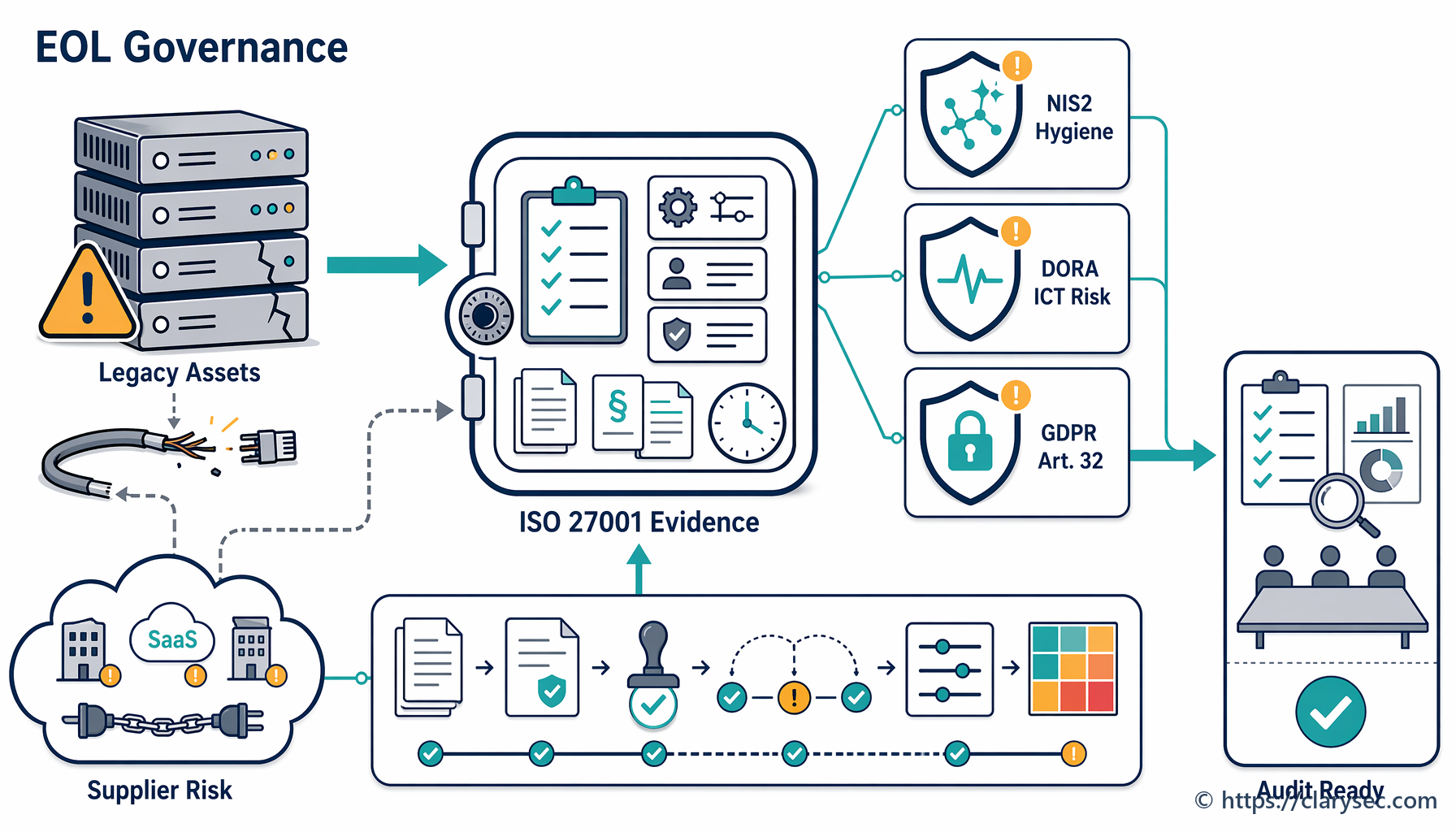
In 2026, end-of-life systems are not just patching problems. They are evidence problems. They affect cyber hygiene, ICT risk, supplier governance, privacy accountability, incident reporting, business continuity and board oversight.
The technical question, “Can we patch it?” is only the beginning. The governance question is sharper:
Can you prove that every unsupported asset is known, owned, risk-assessed, controlled, monitored, time-bound and reviewed by management?
That is where ISO/IEC 27001:2022 becomes practical. It gives CISOs, compliance teams and business owners a structured way to convert legacy technology into auditable evidence: asset records, lifecycle status, risk register entries, Statement of Applicability decisions, exception approvals, compensating controls, segmentation rules, supplier support records, migration plans, incident playbook links and management review minutes.
Clarysec’s Zenith Controls: The Cross-Compliance Guide Zenith Controls treats ISO/IEC 27002:2022 controls 5.9, 8.8 and 8.9 as central to end-of-life governance: inventory of information and other associated assets, management of technical vulnerabilities and configuration management. These are not isolated controls. They connect lifecycle governance, vulnerability handling, hardening, monitoring, supplier assurance, resilience and audit readiness.
Why end-of-life technology is now a compliance risk
End-of-life technology includes any product, component, service or integration that no longer receives normal vendor support, security updates, firmware fixes, maintenance commitments or compatibility assurance. It may still function. It may still support revenue. It may even be business-critical. But if the vendor no longer provides routine security maintenance or incident support, the risk profile changes.
The 2026 estate is broad. Organizations are dealing with unsupported operating systems, obsolete database engines, expired vendor support agreements, legacy Java runtimes, unsupported VPN appliances, firewall firmware outside maintenance, industrial IoT sensors, OT controllers, SaaS API deprecations and cloud marketplace images that are no longer maintained.
Modern regulations do not ask only whether a system is working. They ask whether the organization can manage risk to services, customers, data subjects and the wider ecosystem.
Under NIS2, Article 21 requires appropriate and proportionate technical, operational and organisational measures to manage risks to network and information systems. The required measures include risk analysis, incident handling, business continuity, supply chain security, vulnerability handling, cyber hygiene, cryptography, access control and asset management. Article 20 makes management bodies responsible for approving and overseeing cybersecurity risk-management measures. Unsupported systems therefore become a board-level concern, especially for essential and important entities.
For financial entities, DORA applies directly from 17 January 2025 and creates a detailed operating model for ICT risk. It requires governance and organisation under Article 5, an ICT risk management framework under Article 6, identification of ICT assets and dependencies under Article 8, protection and prevention under Article 9, detection under Article 10, response and recovery under Article 11, backup and restoration under Article 12, incident management under Article 17, incident classification under Article 18, incident reporting under Article 19 and ICT third-party risk management under Articles 28 to 30. If an unsupported asset supports a critical or important function, the evidence expectation increases.
GDPR adds accountability. Article 5 requires integrity and confidentiality, and the controller must be able to demonstrate compliance. Article 32 requires appropriate technical and organisational measures to ensure a level of security appropriate to the risk, including confidentiality, integrity, availability, resilience, restoration and regular testing where relevant. If an unsupported system processes personal data, the organization must justify why the residual risk is acceptable and what safeguards are in place.
NIST CSF 2.0 helps translate this into operational language through GOVERN, IDENTIFY, PROTECT, DETECT, RESPOND and RECOVER outcomes. COBIT 2019 adds governance questions around ownership, objectives, risk appetite, performance monitoring and assurance. ISO/IEC 27001:2022 provides the management system that ties these expectations into one evidence model.
The ISO 27001:2022 control chain for end-of-life systems
End-of-life governance fails when teams treat it as a single control. It is a chain.
First, the organization needs asset visibility. ISO/IEC 27001:2022 Annex A control 5.9, supported by ISO/IEC 27002:2022 control guidance 5.9, is the foundation because unsupported technology cannot be governed if it is not identified. Your CMDB or asset register must record more than hostname and owner. It should include lifecycle status, vendor support date, criticality, data classification, service dependency, supplier, location, support contract and risk owner.
Second, the organization needs vulnerability management. Annex A control 8.8, management of technical vulnerabilities, is where end-of-life becomes a risk decision. Unsupported systems may have known vulnerabilities, missing patches, weak cryptography, obsolete protocols or components that cannot be fixed without replacement. The vulnerability may be technically visible but operationally hard to remediate.
Third, the organization needs configuration management. Annex A control 8.9 matters because unsupported systems must not drift. If a legacy server must remain in production, its configuration baseline should be stricter, not looser. Services should be minimized, administrative access restricted, insecure protocols disabled, network exposure reduced and monitoring increased.
ISO/IEC 27001:2022 clauses 4, 5 and 6 provide the governance wrapper. The organization determines its context and interested parties, defines the ISMS scope, assigns leadership accountability, assesses information security risk, selects treatments, prepares the Statement of Applicability and obtains approval for residual risk. Clause 6.1.2 addresses information security risk assessment. Clause 6.1.3 addresses information security risk treatment. This is why unsupported systems belong inside the ISMS, not in an informal spreadsheet owned only by infrastructure.
Clarysec policy evidence auditors expect to see
A strong end-of-life programme is policy-backed. It is not a list of old servers. It is a repeatable decision process.
For SMEs, Clarysec’s Asset Management Policy - SME Asset Management Policy - SME gives a simple lifecycle requirement:
“When an asset reaches end of life or is no longer required, it must be securely retired:”
This comes from the Asset Management Policy - SME, section “Policy Implementation Requirements,” policy clause 6.5.1.
For enterprise environments, Clarysec’s Asset Management Policy Asset Management Policy requires asset records to include lifecycle evidence:
“Ensures that each asset record includes key metadata: unique identifier, asset type, owner, classification level, location, and lifecycle status.”
This comes from the Asset Management Policy, section “Roles and Responsibilities,” policy clause 4.3.2.
That phrase, “lifecycle status,” is where many programmes fail. They know the asset exists, but they do not know whether it is supported, in extended support, pending decommissioning, isolated, under exception or approved for temporary risk acceptance.
For OT and IoT, Clarysec’s SME Internet of Things (IoT) / Operational Technology (OT) Security Policy-sme Internet of Things (IoT) / Operational Technology (OT) Security Policy - SME states:
“The inventory must be reviewed quarterly to identify outdated, unsupported, or unpatched devices”
This comes from section “Governance Requirements,” policy clause 5.1.2.
The enterprise IoT / OT Security Policy IoT / OT Security Policy makes replacement explicit:
“Unsupported or end-of-life devices must be identified in the asset register and prioritized for replacement.”
This comes from section “Governance Requirements,” policy clause 5.3.3.
Network infrastructure has its own evidence requirement. Clarysec’s SME Network Security Policy-sme Network Security Policy - SME states:
“Network equipment must be procured from approved vendors that provide ongoing support and firmware security patches”
This comes from section “Governance Requirements,” policy clause 5.2.1.
When patching cannot happen, the exception must be formal. Clarysec’s enterprise Vulnerability and Patch Management Policy Vulnerability and Patch Management Policy says:
“If a vulnerability cannot be remediated within the defined SLAs due to operational, technical, or vendor constraints, a formal Exception Request must be submitted.”
This comes from section “Risk Treatment and Exceptions,” policy clause 7.1.
Clarysec’s SME Information Security Policy-sme Information Security Policy - SME makes deviations auditable:
“Any deviation from this policy must be documented, clearly explaining why the deviation is necessary, which alternative protective measures are in place, and the date defined for re-evaluation.”
This comes from section “Risk Treatment and Exceptions,” policy clause 7.2.1.
Together, these clauses create the trail auditors follow: asset status, owner, risk entry, exception, compensating controls, remediation plan, monitoring and review.
A practical lifecycle model for unsupported technology
The most useful model is simple. Classify every unsupported or soon-to-be unsupported asset into one of five lifecycle states.
| Lifecycle state | Meaning | Required evidence | Typical decision |
|---|---|---|---|
| Supported | Vendor provides normal security updates and support | Asset record, support reference, patch status | Continue monitoring |
| End-of-support approaching | Vendor support ends within the planning window | Migration owner, target date, dependency map | Plan replacement |
| Extended support | Vendor provides paid or limited support | Contract, scope, residual risk, budget approval | Time-bound treatment |
| Unsupported with compensating controls | No normal support, but business need remains | Risk acceptance, segmentation, monitoring, exception record | Temporary tolerance |
| Decommission pending | Asset no longer required or replacement is ready | Decommission plan, data migration, secure disposal evidence | Retire |
This lifecycle state should live in the asset register, not in a separate legacy systems file. If you use a CMDB, add fields for vendor support date, extended support status, risk owner, data classification, service criticality, compensating controls, exception expiry date and migration milestone.
Clarysec’s Risk Management Policy-sme Risk Management Policy - SME provides the minimum structure for the risk record:
“Each risk entry must include: description, likelihood, impact, score, owner, and treatment plan.”
This comes from section “Governance Requirements,” policy clause 5.1.2.
For enterprise teams, Clarysec’s Risk Management Policy Risk Management Policy supports the same risk-based discipline. A good risk entry is specific, owned and testable.
| Field | Example entry |
|---|---|
| Risk ID | R-073 |
| Description | Critical Finance Application Server FIN-APP-01 runs on an unsupported operating system and no longer receives vendor security updates. |
| Asset at risk | FIN-APP-01, financial data, personal data and reporting services |
| Likelihood | High, because known vulnerabilities may remain unpatched and automated exploitation is common |
| Impact | Critical, because compromise could trigger financial loss, personal data exposure and service disruption |
| Risk score | Critical |
| Risk owner | Head of Financial Systems |
| Treatment decision | Accept temporarily with compensating controls |
| Treatment plan | Isolate the server, restrict privileged access, increase monitoring, maintain tested backups and decommission through Project Phoenix by Q4 2027 |
| Review cycle | Monthly for technical evidence and quarterly for management acceptance |
This is not passive risk acceptance. It is a documented business decision with controls, ownership, review and a target end date.
Using Zenith Blueprint to make the process auditable
The fastest way to operationalize the model is to use Clarysec’s Zenith Blueprint: An Auditor’s 30-Step Roadmap Zenith Blueprint as the workflow.
In the Risk Management phase, Step 9, Zenith Blueprint instructs organizations to inventory assets and identify vulnerabilities. It explains that information assets include software, operating systems, cloud services, hardware, network equipment, services, processes and third-party services. It also advises organizations to record name, owner, location and classification, and to flag personal data assets for GDPR relevance and critical service assets for potential NIS2 applicability.
For end-of-life systems, extend Step 9 with four additional fields:
- Vendor support status
- End-of-support date
- Extended support contract reference
- Lifecycle decision
Then record vulnerabilities such as unsupported software version, unpatched firmware, legacy encryption, obsolete protocol, vendor no longer issues fixes or SaaS API version deprecated.
In the Controls in Action phase, Step 19, Zenith Blueprint explains vulnerability management in practical terms:
“Managing vulnerabilities is one of the most critical areas of modern cyber hygiene. While firewalls and antivirus tools provide protection, they can be undermined if unpatched systems or misconfigured services are left exposed.”
It also gives the response for systems that cannot be patched immediately:
“For systems that cannot be patched immediately, perhaps due to legacy software or downtime restrictions, implement compensating controls. This might include isolating the system behind a firewall, limiting access, or increasing monitoring. And in all cases, record and formally accept the residual risk , showing that the issue is not forgotten.”
Step 13 of Zenith Blueprint gives the treatment choices: mitigate, avoid, transfer or accept. For end-of-life assets, avoid often means decommission. Mitigate means isolate, harden, monitor and replace. Transfer may involve outsourcing or paid support, but accountability remains. Accept must be explicit, approved, documented and time-bound.
Compensating controls that reduce real risk
Compensating controls should not be cosmetic. “We accept the risk” is not a control. “It is behind a firewall” may be insufficient if broad internal traffic is allowed.
A credible compensating control set should reduce likelihood, limit blast radius, increase detection and preserve recovery. For an unsupported server, VPN appliance, OT device or legacy application, the evidence package should include:
- Confirmed business owner and technical owner
- Removal of internet exposure unless formally justified
- Restricted network segment or isolated legacy VLAN
- Allowlisted source, destination and port flows
- MFA for administrative access where technically possible
- Hardened bastion host for administration
- Removal of unused services, accounts and protocols
- Disabled legacy cryptography where possible
- Secure configuration baseline and file integrity monitoring
- Centralized logging and SIEM correlation
- Alerts for anomalous behaviour, failed logins and outbound connections
- Authenticated vulnerability scans where safe
- Tested backups and restoration records
- Documented vendor support limitations
- Replacement or decommission date
- Monthly review for high-risk exceptions
Clarysec’s enterprise Endpoint Protection / Malware Policy Endpoint Protection / Malware Policy reinforces the need for a defined outcome:
“A time-bound remediation plan or decommissioning schedule”
This comes from section “Risk Treatment and Exceptions,” policy clause 7.2.4.
Monitoring evidence is also essential. Clarysec’s enterprise Audit and Compliance Monitoring Policy Audit and Compliance Monitoring Policy states:
“Automated tools shall be deployed to monitor configuration compliance, vulnerability management, patch status, and privileged access.”
This comes from section “Policy Implementation Requirements,” policy clause 6.4.1.
If a legacy firewall is unsupported, can your tooling prove its firmware version, configuration baseline, privileged access history and vulnerability exposure? If a legacy server is isolated, can you prove segmentation still works after a network change? Those questions define audit-ready evidence.
Cross-compliance mapping for end-of-life risk
The same evidence can satisfy multiple obligations when structured correctly. The table below aligns key evidence to ISO/IEC 27001:2022, NIS2, DORA, GDPR and NIST CSF 2.0.
| Evidence item | ISO/IEC 27001:2022 and ISO/IEC 27002:2022 anchor | NIS2 relevance | DORA relevance | GDPR relevance | NIST CSF 2.0 relevance |
|---|---|---|---|---|---|
| Asset register with lifecycle status | Clause 6 risk process, Annex A 5.9 inventory of information and other associated assets | Article 21(2)(i) access control and asset management | Article 8 ICT asset and dependency identification | Article 5 accountability and Article 32 security of processing | ID.AM asset management |
| Unsupported system risk entry | Clauses 6.1.2 and 6.1.3 risk assessment and treatment | Article 21(2)(a) risk analysis and information system security | Article 6 ICT risk management framework | Article 32 risk-appropriate measures | GV.RM and ID.RA risk management |
| Exception approval | Risk treatment approval and Statement of Applicability rationale | Article 20 management body oversight | Article 5 governance and management responsibility | Article 5 accountability | GV.RR and GV.OV roles and oversight |
| Compensating controls | Annex A 8.8 vulnerability management and 8.9 configuration management | Article 21(2)(e) vulnerability handling and maintenance | Articles 9, 10 and 11 protection, detection, response and recovery | Article 32 confidentiality, integrity, availability and resilience | PR.PS, PR.IR and DE.CM protective and monitoring outcomes |
| Supplier support record | Annex A supplier relationship and ICT supply-chain controls | Article 21(2)(d) supply chain security | Articles 28 to 30 ICT third-party risk and contractual provisions | Processor and security assurance where personal data is involved | GV.SC supply chain risk management |
| Migration roadmap | Risk treatment plan and continual improvement | Article 21 corrective risk measures | Article 6 ICT risk framework and Article 13 learning and evolving | Ongoing appropriateness of measures | CSF Profile action planning |
| Monitoring and logging | Annex A 8.15 logging and 8.16 monitoring activities | Article 21 incident handling and detection readiness | Articles 10, 17 and 18 detection, incident management and classification | Breach detection and investigation evidence | DE.CM and RS.MA monitoring and response analysis |
| Backup and recovery test | Annex A 8.13 information backup and 5.30 ICT readiness for business continuity | Article 21(2)(c) business continuity and backup management | Articles 11 and 12 response, recovery, backup and restoration | Article 32 availability and restoration | RC.RP recovery planning |
NIS2 Article 23 also matters. If an unsupported system causes or contributes to a significant incident, the entity may need staged reporting, including early warning within 24 hours, notification within 72 hours and a final report within one month. End-of-life assets must therefore be integrated into incident playbooks, not treated as background infrastructure.
DORA incident evidence is more detailed. Financial entities must detect, manage, record, classify and report ICT-related incidents. Classification considers affected clients, affected transactions, reputational impact, duration, geographic spread, data losses, criticality of services and economic impact. If a legacy payment component or customer portal dependency is unsupported, its lifecycle status should be visible during incident classification.
GDPR focuses on personal data. If unsupported infrastructure processes personal data, the organization should show why selected measures are appropriate to risk, how confidentiality and integrity are protected, how availability and restoration are maintained, and how breach detection works.
Supplier and SaaS end-of-life: the hidden dependency
Many end-of-life problems are not inside the data centre. They sit in supplier dependencies.
A SaaS vendor retires an API version. A managed firewall provider announces that a hardware model will stop receiving firmware updates. A cloud marketplace image is no longer maintained. A payment processor changes integration requirements. An OT vendor offers only paid extended support. A database vendor supports the product, but not the version your application requires.
NIS2 Article 21 requires entities to consider supplier vulnerabilities, product quality and suppliers’ cybersecurity practices. DORA Articles 28 to 30 require financial entities to manage ICT third-party risk, maintain registers of ICT service arrangements, distinguish support for critical or important functions, assess risk before contracting, include contractual security and incident obligations, and maintain exit strategies.
In the Controls in Action phase, Step 23, Zenith Blueprint describes the supplier change problem:
“A supplier relationship is not static. Over time, the scope evolves. A project expands. A new system is integrated. A minor support contract turns into a critical data processing agreement.”
It also warns that supplier service changes can happen “outside the formal contract review process, outside security oversight, and far outside the original risk assumptions.”
For end-of-life management, supplier contracts should define patch and firmware support expectations, product retirement notification timelines, vulnerability disclosure obligations, incident assistance, extended support limits, exit support, data return, subcontractor changes and assurance rights. Under DORA, contracts supporting critical or important functions may also need performance targets, cooperation with authorities, audit and inspection rights, provider contingency testing and transition periods for exit.
How auditors will test your evidence
End-of-life assets are attractive to auditors because they reveal whether the management system works under pressure. The question is not only “Do you have unsupported systems?” Most organizations do. The question is “Do you know them, govern them and reduce risk in a controlled way?”
| Auditor lens | Likely audit question | Evidence that works |
|---|---|---|
| ISO/IEC 27001:2022 auditor | Are end-of-life assets identified, risk-assessed, treated and reflected in the SoA? | Asset register, risk assessment, treatment plan, SoA rationale, exception approvals, management review minutes |
| NIS2 supervisory lens | Has management approved appropriate and proportionate measures for cyber hygiene, vulnerability handling and suppliers? | Board minutes, Article 21 mapping, vulnerability evidence, supplier support records, corrective action plan |
| DORA supervisory lens | Does the unsupported ICT asset support a critical or important function, and is it covered by ICT risk, testing, continuity and third-party controls? | ICT dependency map, critical function assessment, resilience test evidence, supplier register, exit plan |
| GDPR and privacy lens | Does the unsupported system process personal data, and are Article 32 measures justified and demonstrable? | Data inventory, processing role, risk assessment, access controls, encryption, logging, backup tests, breach playbook |
| NIST CSF 2.0 lens | Is there a Current Profile, Target Profile and prioritized action plan for lifecycle and vulnerability gaps? | CSF profile, gap analysis, roadmap, progress metrics |
| COBIT 2019 or ISACA-style lens | Are governance objectives, ownership, risk appetite, performance metrics and assurance activities defined? | RACI, risk appetite alignment, KPI and KRI reports, control testing results, issue tracking |
A good ISO auditor will follow the trail from scope to risk assessment to treatment to SoA to implementation evidence. A NIS2 reviewer will focus on management oversight and appropriate measures. A DORA reviewer will ask whether the unsupported asset threatens operational resilience. A DPO or GDPR auditor will ask whether personal data is involved and whether the safeguards are demonstrably appropriate.
Management review: where legacy risk becomes governance
Unsupported systems should appear in management review as a risk theme, not just as individual tickets. The board or management body does not need to debate every obsolete library, but it does need visibility into material risk exposure.
A useful management review pack includes:
- Number of supported, approaching end-of-support, extended support and unsupported assets
- Unsupported assets supporting critical services
- Unsupported assets processing personal data
- Internet-facing unsupported assets
- High and medium risks accepted by management
- Exceptions expiring in the next 30, 60 and 90 days
- Migration roadmap status and budget constraints
- Supplier end-of-life notifications and support gaps
- Incidents or near misses involving legacy technology
- Residual risk trend and overdue treatment actions
This aligns with ISO/IEC 27001:2022 leadership and performance expectations, NIS2 management accountability, DORA governance and NIST CSF GOVERN outcomes. It also prevents a common failure mode: the risk is known to IT but invisible to leadership.
The Clarysec approach to audit-ready end-of-life governance
Clarysec helps organizations convert end-of-life technology from an unmanaged weakness into a structured control programme. The approach combines Zenith Blueprint, policy templates and Zenith Controls cross-compliance mapping.
A typical internal project or Clarysec-assisted engagement follows this rhythm:
- Define scope by service, business process, geography and regulatory exposure
- Identify assets, owners, data types, suppliers and lifecycle status
- Classify unsupported and soon-to-be unsupported technology
- Map assets to critical services, personal data and regulated operations
- Record technical vulnerabilities and vendor support limitations
- Create risk entries with likelihood, impact, score, owner and treatment plan
- Select treatment: mitigate, avoid, transfer or accept
- Define compensating controls and monitoring evidence
- Update the SoA and policy exception register
- Build a migration, replacement or decommission roadmap
- Review supplier contracts and extended support terms
- Report residual risk to management
- Test evidence through an audit lens
This is not about pretending every legacy system can disappear immediately. Regulated entities, manufacturers, SaaS providers, fintech firms and SMEs often have real operational constraints. The point is to make those constraints explicit, controlled and time-bound.
Next steps: tame the tech graveyard before the audit does
End-of-life systems are not a sign of failure. They are a test of governance. The organizations that manage them well will not be the ones with no legacy technology. They will be the ones that can prove every legacy risk is known, owned, controlled, reviewed and moving toward closure.
Start with three actions this week:
- Add lifecycle status, vendor support date and exception expiry fields to your asset register.
- Create a risk entry for every unsupported asset supporting critical services or processing personal data.
- Require a time-bound exception with compensating controls for every system that cannot be patched or replaced immediately.
Clarysec can help you accelerate this with Zenith Blueprint: An Auditor’s 30-Step Roadmap Zenith Blueprint, Asset Management Policy Asset Management Policy, Vulnerability and Patch Management Policy Vulnerability and Patch Management Policy, Audit and Compliance Monitoring Policy Audit and Compliance Monitoring Policy and Zenith Controls: The Cross-Compliance Guide Zenith Controls.
If your organization still has unsupported operating systems, obsolete network devices, expired vendor support, legacy OT controllers or SaaS dependencies approaching retirement, do not wait for the next incident or audit finding. Download the Clarysec toolkits, map your evidence, and book a Clarysec assessment to turn your legacy technology risk into a defensible ISO 27001:2022 evidence programme.
Become a PECB ISO/IEC 27001 Lead Implementer or Lead Auditor
- ✓ Official PECB courseware and two exam attempts
- ✓ Certification fee and first-year AMF included, where applicable
- ✓ Self-study or live online · course assigned within 1 business day
Frequently Asked Questions
About the Author

Igor Petreski
Compliance Systems Architect, Clarysec LLC
Igor Petreski is a cybersecurity leader with over 30 years of experience in information technology and a dedicated decade specializing in global Governance, Risk, and Compliance (GRC).Core Credentials & Qualifications:• MSc in Cyber Security from Royal Holloway, University of London• PECB-Certified ISO/IEC 27001 Lead Auditor & Trainer• Certified Information Systems Auditor (CISA) from ISACA• Certified Information Security Manager (CISM) from ISACA • Certified Ethical Hacker from EC-Council