Endpoint Malware Defense: ISO 27001 Evidence for EU Rules
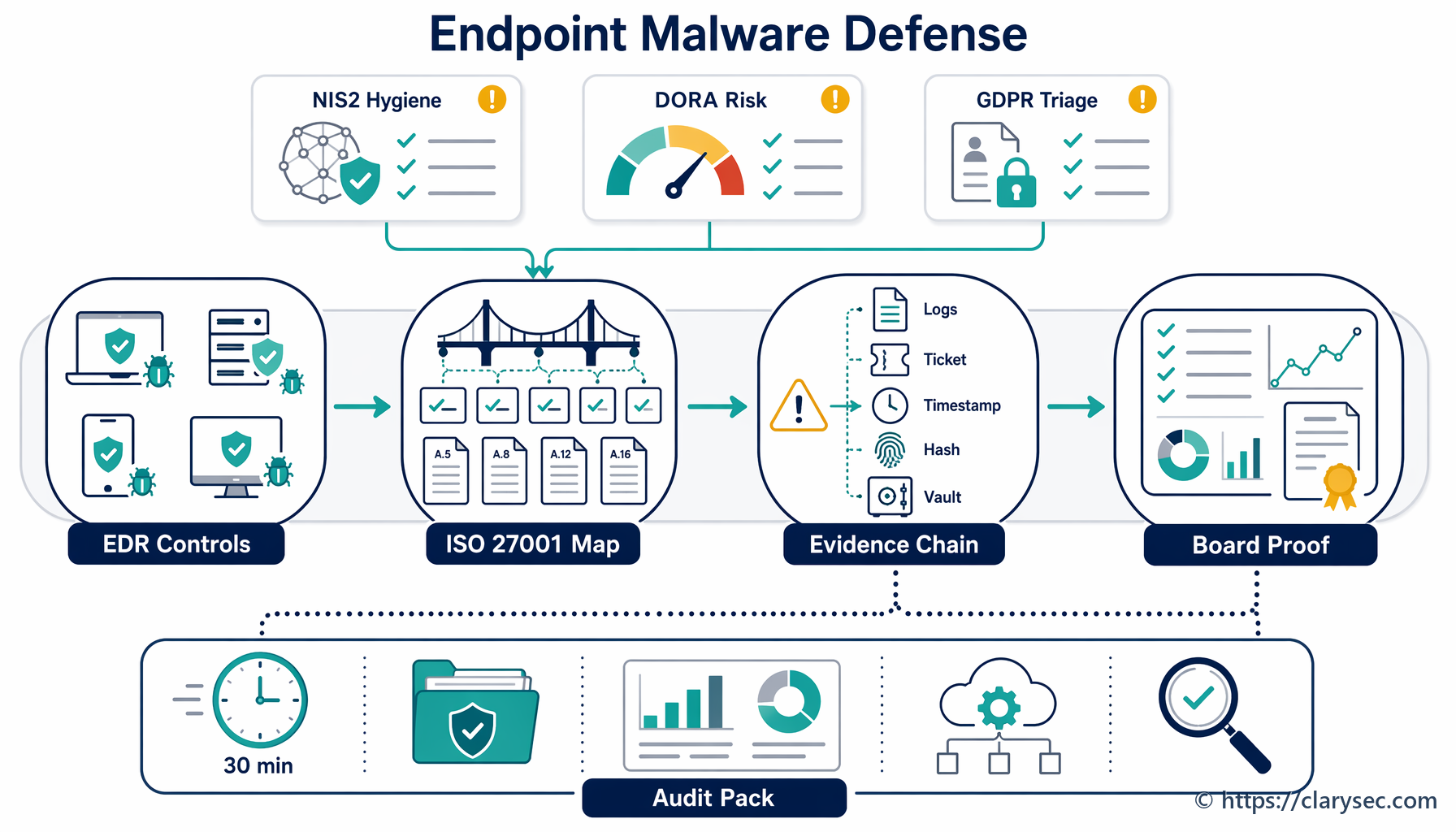
It is 07:42 on a Monday. A finance manager opens a supplier invoice from an email thread that looks legitimate. Minutes later, the endpoint detection console flags suspicious script execution, a persistence attempt, and outbound traffic to an unfamiliar domain. The EDR agent isolates the laptop automatically. The ransomware chain is broken before encryption begins.
Security worked. But the hard question comes next.
The CISO is not only asked, “Did we stop the malware?” The CEO and board ask, “Can we prove this was resilience by design, not luck? Can we show auditors, customers, regulators, and insurers that our endpoint protection worked in a way that satisfies ISO/IEC 27001:2022, NIS2 cyber hygiene, DORA ICT risk management, and GDPR Article 32?”
That is the defining endpoint security challenge in 2026. Endpoint protection is no longer just an IT operations function. It is a compliance evidence system.
A single malware alert on a laptop can become an ISO/IEC 27001:2022 audit sample, a NIS2 significant incident assessment, a DORA ICT-related incident record, a GDPR personal data breach triage, a supplier risk discussion, and a board governance review. The organizations that handle this well do not just deploy EDR. They connect policy, inventory, technical controls, monitoring, incident response, legal triage, supplier contracts, metrics, and continual improvement into one defensible control narrative.
Clarysec sees the same pattern across SaaS, fintech, managed service, and regulated digital environments. Most organizations already own strong tools: EDR, antivirus, MDM, vulnerability scanners, SIEM, email security, web filtering, backup platforms, and ticketing systems. The gap is usually not the technology. The gap is evidence design.
This article shows how to build audit-ready endpoint malware evidence using ISO/IEC 27001:2022 as the ISMS backbone, Clarysec’s Endpoint Protection / Malware Policy Endpoint Protection / Malware Policy, the SME Endpoint Protection - Malware Policy Endpoint Protection - Malware Policy - SME, the Zenith Blueprint: An Auditor’s 30-Step Roadmap Zenith Blueprint, and Zenith Controls: The Cross-Compliance Guide Zenith Controls.
Why endpoint malware defense is now a board-level compliance issue
The modern endpoint is where identity, business data, user behavior, attacker tradecraft, and regulatory accountability meet. Laptops connect from home networks and airports. Developers run local tools. Executives travel with cached email and files. Contractors may use managed or semi-managed devices. Mobile phones approve MFA prompts. Cloud workloads and servers behave like endpoints from an EDR perspective.
In the Zenith Blueprint, Controls in Action phase, Step 19: Technological Controls I, Clarysec describes user endpoint devices as the “doors and windows” into the organization:
User endpoint devices, laptops, smartphones, tablets, desktops, and even thin clients, are where digital interaction begins. They’re the doors and windows into your systems. And, like any physical structure, they must be reinforced, monitored, and controlled.
That framing matters because endpoint protection is not only about malware blocking. It must prove that the organization knows which devices exist, governs how they are used, enforces security baselines, detects compromise, responds consistently, preserves evidence, restores operations, and improves after incidents.
A mature endpoint malware defense program should answer four audit questions without hesitation:
- Do we know every endpoint that can access business systems or personal data?
- Is each endpoint protected by approved, centrally managed malware defense or EDR?
- Can we prove configuration, scanning, updates, alerts, quarantine, isolation, investigation, and closure?
- Can we connect endpoint events to risk treatment, incident response, regulatory reporting, supplier oversight, and management review?
ISO/IEC 27001:2022 provides the management system needed to answer those questions. Clauses 4.1 to 4.4 require the organization to define context, interested parties, legal and contractual obligations, interfaces, dependencies, and ISMS scope. For endpoint protection, the scope cannot stop at “corporate IT.” It must consider remote work, privileged workstations, mobile devices, cloud access, supplier-managed devices, endpoint logs, outsourced SOC or MDR services, and any endpoint that can affect information security.
Clauses 5.1 to 5.3 make leadership accountability explicit. Top management must support the ISMS, assign roles, provide resources, and ensure policy alignment. In endpoint terms, the board cannot approve cyber hygiene objectives while leaving EDR licensing, patch backlog, BYOD exceptions, or MDR escalation gaps unresolved.
Clauses 6.1.1 to 6.1.3 create the risk treatment engine. Endpoint malware risks must be identified, assessed, treated, mapped to Annex A controls, reflected in the Statement of Applicability, and accepted by risk owners where residual risk remains. Clauses 8.1 to 8.3 then turn risk treatment into controlled operations, planned changes, risk assessment at intervals or after significant changes, and risk treatment results.
The audit story is not “we installed EDR.” The audit story is “endpoint malware risk is identified, assessed, treated, operated, monitored, tested, evidenced, reported, and improved.”
The Clarysec policy bridge from EDR settings to audit evidence
Policy is where technical reality becomes auditable intent. Without policy, endpoint configurations are just tool settings. With policy, those settings become control requirements.
Clarysec’s enterprise Endpoint Protection / Malware Policy establishes that bridge in clause 1.3:
This policy directly supports compliance with ISO/IEC 27001:2022 Clause 8.1 and Annex A Control 8.7 and is aligned with regional cybersecurity obligations under GDPR, NIS2, and DORA.
That one clause gives the organization a direct line from endpoint operations to ISO/IEC 27001:2022, NIS2, DORA, and GDPR. Auditors can then test whether the organization’s actual endpoint program matches the policy commitment.
The same enterprise policy sets the expected operating model in Governance Requirements, clause 5.2:
All endpoints must be enrolled in centrally managed malware protection systems (e.g., EDR, antivirus, or equivalent platforms) with an enforced baseline configuration.
This is exactly the type of statement auditors like because it is testable. If “all endpoints” must be enrolled, the evidence must show the full endpoint population, the expected EDR population, enrollment status, exceptions, compensating controls, and remediation progress.
For SMEs, the Endpoint Protection - Malware Policy gives direct, operational requirements. Clause 5.1.3 states:
All endpoints must be recorded in the IT asset inventory and linked to the endpoint protection tool in use
Clause 5.2.1 adds:
All endpoints must run only organization-approved antivirus or EDR (endpoint detection and response) solutions
Clause 6.1.1.1 requires:
Run real-time antivirus and antimalware scanning continuously
And clause 8.1.1 requires:
Malware events must be monitored continuously through the antivirus console or centralized EDR dashboard
Together, these clauses create a simple but powerful evidence test: show the inventory, show the endpoint protection tool, show the approved configuration, show continuous monitoring, show events, show tickets, and show closure.
ISO/IEC 27001:2022 and ISO/IEC 27002:2022 endpoint control mapping
Endpoint protection often fails audits because teams treat it as one control. In reality, endpoint malware defense depends on multiple reinforcing controls.
The central ISO/IEC 27002:2022 controls are A.8.1 User endpoint devices and A.8.7 Protection against malware. But effective endpoint defense also relies on vulnerability management, logging, monitoring, incident response, backup, web filtering, removable media control, access restriction, supplier management, cloud service governance, awareness, and business continuity.
Zenith Controls maps ISO/IEC 27002:2022 control A.8.7, Protection against malware, as preventive, detective, and corrective. It supports confidentiality, integrity, and availability, and connects naturally to system and network security, information protection, and detection capabilities. It also shows that A.8.1, User endpoint devices, is a preventive control supporting confidentiality, integrity, and availability through asset management and endpoint governance.
| ISO/IEC 27002:2022 control area | Endpoint and malware evidence to keep | Why it matters in audit |
|---|---|---|
| A.8.1 User endpoint devices | Asset inventory, MDM or UEM compliance reports, encryption status, screen lock settings, remote wipe capability, BYOD controls | Proves endpoints are known, governed, and protected before access is granted |
| A.8.7 Protection against malware | EDR deployment reports, real-time protection settings, update status, detections, quarantines, isolation records, false positive handling | Proves malware prevention, detection, and response are active and centrally managed |
| A.8.8 Management of technical vulnerabilities | Vulnerability scans, patch SLAs, remediation tickets, exception approvals, compensating controls | Shows malware exposure is reduced by fixing exploitable weaknesses |
| A.8.15 Logging and A.8.16 Monitoring activities | Endpoint logs, SIEM correlation, alert triage, escalation evidence, dashboards, review records | Shows malware events are visible, reviewed, and acted upon |
| A.5.24 to A.5.28 Incident management | Incident procedures, classification records, response actions, lessons learned, evidence preservation | Shows suspected malware becomes controlled incident handling, not informal troubleshooting |
| A.8.13 Backups and A.5.30 ICT readiness for business continuity | Backup success reports, restoration tests, immutable backup settings, recovery exercises | Shows ransomware resilience includes recoverability |
| A.5.19 to A.5.23 Supplier and cloud service controls | MDR contracts, EDR service SLAs, supplier security requirements, cloud endpoint coverage, exit arrangements | Shows outsourced endpoint services remain under ISMS control |
Zenith Controls is especially useful because it shows how endpoint defense depends on adjacent controls. Protection against malware connects to A.5.7 Threat intelligence because malware defenses must adapt to changing tactics. It connects to A.8.8 Management of technical vulnerabilities because malware frequently exploits known weaknesses. It connects to A.8.15 Logging and A.8.16 Monitoring activities because detections, quarantines, scans, and updates must be collected and reviewed. It connects to A.8.23 Web filtering because malicious sites remain a common infection path. It connects to A.7.10 Storage media because removable media can introduce malware if not controlled.
User endpoint devices also connect to A.5.10 Acceptable use of information and other associated assets, A.6.7 Remote working, A.8.3 Information access restriction, A.8.5 Secure authentication, A.6.3 Information security awareness, education and training, and A.6.6 Confidentiality or non-disclosure agreements.
In plain language, a secure endpoint is not only a device with an agent. It is a policy-enforced work environment.
Turning a malware alert into a defensible evidence chain
Return to the Monday morning malware event. The EDR agent isolated the laptop, but compliance readiness depends on the evidence chain that follows.
A good endpoint malware evidence chain includes:
- The asset record showing owner, business function, criticality, device type, operating system, data access profile, and encryption status.
- The endpoint protection record showing EDR agent health, policy applied, tamper protection, update status, and real-time scanning.
- The detection record showing alert ID, timestamp, process tree, detection logic, severity, affected files, network indicators, and automated actions.
- The SIEM record correlating DNS, email, identity, proxy, cloud, and endpoint telemetry.
- The ticket record showing triage, escalation, containment, eradication, recovery, root cause, and closure.
- The incident decision showing whether the event remained a security event or became an incident.
- The regulatory triage showing whether NIS2, DORA, or GDPR thresholds were considered.
- The lessons learned record showing policy tuning, patching, awareness action, supplier ticket, or risk register update.
The Endpoint Protection / Malware Policy reinforces this response model through its Policy Implementation Requirements, clause 6.3, titled:
Response and Containment Actions
For SMEs, clause 6.3.1.2 is even more direct:
The IT Support Provider must quarantine the device, confirm the infection, and conduct root cause analysis
A blocked malware event should not disappear into a console. If it matters enough to detect, it matters enough to classify, document, and close.
NIS2 cyber hygiene evidence from endpoint protection
NIS2 makes basic cyber hygiene a governance issue. Covered organizations must understand whether they are in scope, whether they are essential or important entities, and how national transposition obligations apply.
For endpoint malware defense, Article 21 is the key provision. It requires appropriate and proportionate technical, operational, and organizational measures to manage risks to network and information systems and prevent or minimize incident impact. The measures include risk analysis and information system security policies, incident handling, business continuity, supply chain security, secure acquisition and maintenance including vulnerability handling, effectiveness assessment, basic cyber hygiene and training, cryptography, HR security, access control, asset management, and where appropriate MFA or continuous authentication.
Endpoint evidence maps directly to those expectations.
| NIS2 Article 21 area | Endpoint malware defense evidence |
|---|---|
| Risk analysis and security policies | Endpoint risk assessment, Endpoint Protection / Malware Policy, Statement of Applicability, risk treatment plan |
| Incident handling | EDR alert records, incident tickets, severity assessment, containment actions, lessons learned |
| Business continuity | Ransomware scenarios, backup reports, restoration tests, recovery procedures |
| Supply chain security | MDR or MSP contracts, responsibility matrix, incident support terms, audit rights |
| Vulnerability handling | Patch SLAs, vulnerability scans, exception approvals, exploited vulnerability analysis |
| Effectiveness assessment | Internal audit results, EDR test detections, phishing simulations, tabletop exercises |
| Basic cyber hygiene and training | Endpoint baseline compliance, awareness completion records, phishing and malware training |
| Access control and asset management | Endpoint inventory, user-device mapping, conditional access, privileged workstation controls |
NIS2 Article 23 also matters because malware can become a significant incident. If it causes or could cause severe operational disruption, financial loss, or considerable material or non-material damage to others, staged reporting may be required. NIS2 includes an early warning within 24 hours, incident notification within 72 hours, intermediate updates if requested, and a final report within one month after notification.
Endpoint evidence supports each stage. The EDR alert provides the first indicator. Asset inventory identifies affected services and criticality. SIEM data and tickets support impact analysis. Containment records prove action. Root cause analysis supports final reporting.
A NIS2-ready answer is not “we have antivirus.” It is “we know our endpoints, enforce protection, monitor continuously, classify incidents, train users, manage vulnerabilities, preserve evidence, and report when thresholds are met.”
DORA ICT risk management and endpoint malware defense
For financial entities, DORA creates a sector-specific digital operational resilience framework. Endpoint malware defense maps strongly to ICT risk management, incident management, testing, continuity, recovery, and ICT third-party risk.
DORA Article 5 places responsibility for ICT risk on the management body. Article 6 requires a sound, comprehensive, and documented ICT risk management framework. Articles 8 and 9 require identification and classification of ICT-supported business functions, information assets, ICT assets, dependencies, cyber threats, vulnerabilities, configurations, and interdependencies. They also cover policies and tools for protection, prevention, detection, access control, strong authentication, change management, and patching.
Articles 11 and 12 are central for ransomware resilience. They require ICT business continuity policy, response and recovery plans, backup policies, restoration procedures, testing, and integrity checks. Article 17 requires an ICT-related incident management process to detect, manage, classify, record, escalate, communicate, and restore operations after incidents. Article 19 creates reporting duties for major ICT-related incidents. Articles 24 to 26 address digital operational resilience testing. Articles 28 to 30 address ICT third-party risk and contractual arrangements.
| DORA concern | Endpoint evidence that helps |
|---|---|
| ICT asset identification | Endpoint inventory, owner, business function, criticality, dependency mapping |
| Protection and prevention | EDR baseline, patch status, access control, encryption, web filtering, secure configuration |
| Detection | EDR alerts, SIEM correlation, early warning indicators, threat intelligence enrichment |
| ICT-related incident management | Malware incident ticket, severity classification, roles, actions, escalation, root cause |
| Recovery and restoration | Device rebuild record, backup or file restoration evidence, integrity checks |
| Resilience testing | EDR simulation, phishing simulation, vulnerability scans, penetration tests, tabletop exercises |
| ICT third-party risk | MDR or EDR supplier contract, SLAs, audit rights, incident assistance, exit plans |
For a financial entity, the same malware incident that proves A.8.7 operation can also show DORA supervisory evidence: asset classification, control operation, incident management, recovery capability, testing history, third-party responsibility, and management oversight.
GDPR Article 32 and personal data breach triage
GDPR Article 32 requires controllers and processors to implement technical and organizational measures appropriate to risk. These measures include the confidentiality, integrity, availability, and resilience of processing systems and services, the ability to restore availability and access to personal data, and regular testing, assessment, and evaluation of security measures.
Endpoint malware becomes GDPR evidence when an endpoint can access personal data: customer records, support tickets, HR files, exports, payment-related information, health information, special category data, authentication logs, or cloud applications containing personal data.
The privacy question is fact-specific. Did malware execute? Did it access files? Did it capture credentials? Were tokens stolen? Was data exfiltrated? Was the endpoint encrypted? Was the account disabled? Were sessions revoked? Were logs available? Was affected personal data identified? Was risk to individuals assessed?
Endpoint telemetry is often the only way to answer those questions credibly.
A GDPR-ready endpoint evidence pack should connect data classification and processing records, endpoint access paths, encryption, access restriction, EDR telemetry, SIEM logs, exfiltration analysis, credential reset actions, restoration records, legal review, breach decisioning, and lessons learned.
Privacy teams should participate in endpoint incident playbook design. Waiting until after a malware incident to ask whether personal data was affected creates avoidable accountability risk.
Build a 30-minute endpoint malware evidence pack
Before your next audit, choose one endpoint malware detection from the last 90 days, even if it was low severity or a blocked test file. Build an evidence pack as if the auditor selected it as a sample.
Use the Zenith Blueprint, Controls in Action phase, Step 19, as your review script. Step 19 instructs teams to review malware protection strategy by checking that all endpoints have centrally managed anti-malware or EDR installed, active, and auto-updated, that real-time scanning covers file types, network activity, and removable media, that gateway protections exist, that recent malware logs or quarantines are investigated and resolved, and that users receive ongoing phishing and malware awareness training.
Collect this evidence:
- Asset record: device name, serial number, user, owner, business unit, location, device type, operating system, criticality, data access profile.
- EDR enrollment: screenshot or export showing agent installed, active, updated, policy applied, tamper protection enabled.
- Baseline compliance: encryption, screen lock, firewall, local admin status, patch level, prohibited software status.
- Detection record: alert ID, timestamp, detection name or behavior, severity, process tree, affected files, network indicators.
- Containment action: quarantine, isolation, process kill, file removal, device rebuild, credential reset.
- Investigation notes: analyst triage, root cause, phishing path, web path, exploit path, affected data assessment.
- Incident decision: security event or incident, NIS2, DORA, and GDPR threshold assessment where relevant.
- Closure evidence: ticket closure, approval, lessons learned, risk register update if needed.
- Metrics: time to detect, time to contain, time to remediate, similar alert count, false positive status.
- Improvement action: blocked domain, mail rule tuning, patch deployment, user awareness assignment, supplier escalation.
Now compare the evidence pack to your policy. If the enterprise policy says all endpoints must be enrolled in centrally managed malware protection with an enforced baseline, can you prove it? If the SME policy says malware events must be monitored continuously through the antivirus console or centralized EDR dashboard, can you show the dashboard, reviewer, alert, ticket, and closure?
That is how EDR data becomes audit evidence.
How different auditors test the same endpoint controls
Different assurance teams will view endpoint protection through different lenses. The evidence can be the same, but the questions change.
| Auditor lens | What they usually test | Evidence that satisfies the question |
|---|---|---|
| ISO/IEC 27001:2022 auditor | Whether endpoint controls are selected through risk treatment, included in the Statement of Applicability, implemented, monitored, and improved | Risk assessment, SoA entry, endpoint policy, EDR deployment report, monitoring tickets, internal audit results |
| NIS2 cyber hygiene reviewer | Whether endpoint security supports proportionate risk management, incident handling, vulnerability handling, access control, asset management, and training | Endpoint inventory, baseline compliance, EDR alerts, incident records, patch metrics, training records |
| DORA ICT risk reviewer | Whether endpoint defense supports ICT asset identification, resilience, incident management, testing, continuity, and ICT third-party oversight | ICT asset mapping, incident classification, resilience test results, backup evidence, MDR contract, management reporting |
| GDPR privacy reviewer | Whether endpoint controls support security of processing and breach assessment | Data access mapping, encryption, logs, exfiltration analysis, breach triage, containment and restoration evidence |
| NIST CSF 2.0 assessor | Whether governance, identify, protect, detect, respond, and recover outcomes are integrated | Current and target profile, asset inventory, access controls, monitoring, incident response, recovery evidence |
| COBIT 2019 style governance reviewer | Whether ownership, objectives, performance, risk, and assurance are defined | RACI, KPIs, KRIs, board reporting, control owner evidence, exceptions, remediation tracking |
| ISACA internal auditor | Whether controls are designed effectively and operating consistently across samples | Sample testing, screenshots, configuration exports, exception approvals, re-performance of monitoring checks |
NIST CSF 2.0 is particularly useful as executive bridge language. Its GOVERN function supports stakeholder expectations, legal obligations, risk appetite, accountability, policy, resources, and oversight. Its operational functions help explain how asset management, access control, data protection, monitoring, incident response, containment, eradication, recovery, and communications work together.
In Clarysec projects, ISO/IEC 27001:2022 provides the formal ISMS backbone, Zenith Controls provides the cross-compliance mapping guide, and NIST CSF 2.0 provides a board-friendly communication layer.
Supplier-managed endpoint services are part of the evidence model
Many organizations outsource parts of endpoint defense to MSPs, MSSPs, MDR providers, cloud desktop providers, or EDR vendors. Outsourcing can improve capability, but it does not outsource accountability.
NIS2 Article 21 includes supply chain security and supplier relationships. DORA goes further for financial entities by requiring ICT third-party risk strategy, registers of contractual arrangements, due diligence, concentration risk analysis, audit and inspection rights, termination rights, incident assistance, exit strategies, and clear allocation of responsibilities. ISO/IEC 27001:2022 Annex A includes supplier relationship controls, supplier agreements, ICT supply chain controls, monitoring and change management of supplier services, and cloud service acquisition, use, management, and exit.
Endpoint outsourcing evidence should include:
- Supplier due diligence before onboarding.
- Contract clauses for monitoring, incident notification, access, data location, audit rights, service levels, and cooperation.
- Responsibility matrix for alert triage, isolation, root cause analysis, reporting, and evidence preservation.
- Reports showing supplier performance and SLA compliance.
- Evidence that supplier incidents and platform outages are reviewed.
- Exit plan if the EDR or MDR provider fails, is terminated, or becomes unacceptable.
- Confirmation that logs and forensic evidence remain available to the organization.
A common audit failure is an MDR dashboard without ownership. The organization can see alerts, but cannot prove who owns the risk, what the provider must do, how alert quality is reviewed, or how evidence is preserved for regulatory and legal purposes.
Metrics that turn endpoint tools into management evidence
Boards and regulators do not need raw alert volume. They need indicators that show whether endpoint malware risk is controlled.
| Metric | Why it matters |
|---|---|
| Endpoint coverage percentage | Shows whether known endpoints are protected by approved EDR or anti-malware |
| Unmanaged endpoint count | Highlights inventory, onboarding, or shadow IT failures |
| Agent health percentage | Shows whether agents are active, updated, and reporting |
| Critical endpoint patch compliance | Connects malware exposure to vulnerability management |
| Mean time to detect | Shows monitoring effectiveness |
| Mean time to isolate | Shows containment speed for ransomware and malware |
| Malware recurrence by user or business unit | Identifies training, process, or access weaknesses |
| Quarantine failure rate | Shows whether response actions are reliable |
| High-risk exceptions open beyond SLA | Shows governance discipline |
| Restore test success rate | Shows resilience if malware causes disruption |
| Incidents with root cause completed | Shows learning and continual improvement |
These metrics support ISO/IEC 27001:2022 performance evaluation and management review, NIS2 management body oversight, DORA governance and ICT risk strategy, GDPR accountability, and internal audit planning.
The enterprise Endpoint Protection / Malware Policy, Enforcement and Compliance section, clause 8.2 states:
Internal Audit must perform periodic reviews of endpoint protection compliance, including:
Internal audit can turn the metrics above into a quarterly control test: sample endpoints, compare inventory to EDR enrollment, verify real-time scanning, review patch status, confirm users cannot disable protection, inspect recent malware alerts, and trace selected alerts from detection to closure.
Common endpoint evidence gaps Clarysec finds
Even mature organizations struggle with endpoint evidence quality. The same gaps appear repeatedly:
- Asset inventory and EDR inventory do not match.
- Developer workstations are less controlled than standard laptops.
- Mobile devices are excluded from endpoint evidence.
- BYOD access is allowed without enforceable device posture controls.
- EDR agents are installed but tamper protection is disabled.
- Alerts are monitored by a provider, but escalation rules are vague.
- Quarantined malware is not linked to an incident ticket.
- Root cause analysis is skipped for “blocked” detections.
- Patch exceptions lack risk owner approval or expiry dates.
- Logs are retained for too short a period to support breach assessment.
- Backup restoration is tested generally but not against ransomware scenarios.
- Board reporting shows alert counts rather than risk reduction.
The cure is not more spreadsheets. The cure is a connected operating model where policy, inventory, endpoint configuration, monitoring, incident response, supplier management, regulatory triage, metrics, and audit testing reinforce each other.
Ten business days to make endpoint malware defense audit-ready
If you need a fast starting point, take these actions in the next ten business days:
- Export your endpoint inventory and EDR inventory, then reconcile them.
- Identify unmanaged, inactive, outdated, duplicate, and exception endpoints.
- Confirm real-time scanning, tamper protection, auto-update, isolation, and quarantine settings.
- Sample five malware alerts and trace each one to investigation and closure.
- Check whether endpoint events can support NIS2, DORA, and GDPR incident triage.
- Review MDR, MSP, and EDR supplier contracts for incident support, evidence access, audit rights, SLAs, and exit terms.
- Add endpoint coverage, agent health, isolation time, patch compliance, and root cause completion to management reporting.
- Run an internal audit sample using the Zenith Blueprint Step 19 checklist.
- Use Zenith Controls to map A.8.1 and A.8.7 to logging, monitoring, vulnerability management, incident response, supplier controls, and recovery.
- Update your governance baseline using Clarysec’s Endpoint Protection / Malware Policy or SME Endpoint Protection - Malware Policy.
Endpoint malware defense in 2026 is not just about stopping ransomware. It is about proving that your organization can prevent, detect, contain, recover, report, and improve.
Clarysec can help you turn endpoint protection from a tool deployment into a defensible cross-compliance evidence system. Download the Endpoint Protection / Malware Policy, start with the SME Endpoint Protection - Malware Policy if you need a leaner operating model, use the Zenith Blueprint to implement the controls, and use Zenith Controls to connect your endpoint evidence to ISO/IEC 27001:2022, NIS2, DORA, GDPR Article 32, NIST CSF 2.0, and audit expectations.
About the Author

Igor Petreski
Compliance Systems Architect, Clarysec LLC
Igor Petreski is a cybersecurity leader with over 30 years of experience in information technology and a dedicated decade specializing in global Governance, Risk, and Compliance (GRC).Core Credentials & Qualifications:• MSc in Cyber Security from Royal Holloway, University of London• PECB-Certified ISO/IEC 27001 Lead Auditor & Trainer• Certified Information Systems Auditor (CISA) from ISACA• Certified Information Security Manager (CISM) from ISACA • Certified Ethical Hacker from EC-Council