ENISA EUVD 2026: ISO 27001 for NIS2 and CRA
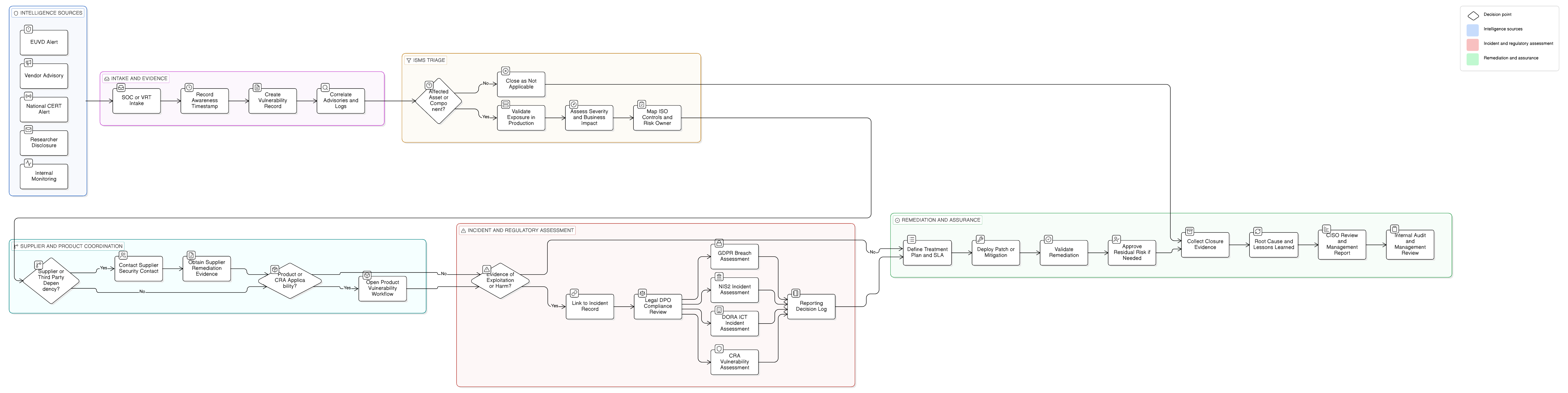
It is 08:17 on a Tuesday in 2026. Maria, the CISO of a fast-growing fintech SaaS platform, receives two signals within minutes. First, the SOC posts an ENISA EU Vulnerability Database alert into the incident channel. The affected component is not in Maria’s own codebase directly. It sits inside a third-party authentication SDK, embedded in a mobile app maintained by an outsourced development partner.
Then a security researcher emails the public security contact with the subject line: “Vulnerability Disclosure - Your SaaS Product”. The researcher claims that, under specific conditions, the flaw could expose non-critical customer metadata.
There is no confirmed breach. No customer has reported harm. The scanner dashboard is not red. But the questions arrive immediately.
Are we exposed? Which customer-facing services use the SDK? Is this an NIS2 significant incident, a DORA ICT-related incident, a GDPR personal data breach, or a Cyber Resilience Act product-security issue? Do we need to notify a supplier, a customer, a competent authority or ENISA? Most importantly, can we prove when we became aware?
That is where many organizations discover that vulnerability intelligence is not a feed problem. It is an operating model problem.
The ENISA EUVD will become a practical reference point for EU vulnerability intelligence, coordinated vulnerability disclosure and product-security transparency. But the database itself will not tell Maria whether the affected service is in NIS2 scope, whether DORA applies because of financial services activities, whether personal data exposure is likely, or whether CRA reporting readiness is triggered. Those decisions must happen inside a governed, documented and auditable information security management system.
Clarysec’s approach is to make EUVD operational through ISO/IEC 27001:2022 governance, ISO/IEC 27002:2022 control implementation, policy ownership and cross-compliance evidence. The goal is not to create another spreadsheet called “EUVD tracker.” The goal is to build a defensible vulnerability intelligence and reporting model that can survive regulator questions, customer audits, ISO 27001 certification audits and board review.
Why ENISA EUVD changes vulnerability management in 2026
For years, many security teams treated vulnerability intelligence as a patching input. A CVE appears, a scanner detects exposure, operations deploys a patch, and the ticket closes. That model is no longer enough for EU-regulated organizations.
NIS2 moves cybersecurity risk management into governance. Article 20 requires management bodies of essential and important entities to approve cybersecurity risk-management measures, oversee implementation and receive cybersecurity training. Article 21 requires proportionate technical, operational and organizational measures, including policies, incident handling, business continuity, supply chain security, secure acquisition and maintenance, vulnerability handling and disclosure, effectiveness assessment, cyber hygiene, cryptography, HR security, access control, asset management and, where appropriate, multi-factor authentication or continuous authentication.
Article 23 adds staged reporting for significant incidents, including an early warning within 24 hours of becoming aware, an incident notification within 72 hours, and a final report within one month. If an EUVD alert becomes an exploited service disruption, the organization needs evidence of awareness, triage, impact assessment, mitigation and reporting decisions.
DORA creates a parallel but sector-specific regime for financial entities. It requires internal governance and control arrangements for ICT risk, management body accountability, incident management processes, third-party ICT risk management, testing, resilience, contractual controls and reporting of major ICT-related incidents under DORA Article 19. For in-scope financial entities, DORA operates as the sector-specific framework for ICT risk and incident reporting.
GDPR adds another dimension. If exploitation could cause unauthorized access, disclosure, loss, alteration or destruction of personal data, the vulnerability workflow must connect to personal data breach assessment. GDPR’s accountability principle means the controller must demonstrate compliance, not merely assert that it acted reasonably.
The Cyber Resilience Act makes vulnerability handling and coordinated disclosure a product-security obligation for products with digital elements. It also creates reporting expectations for actively exploited vulnerabilities and severe security incidents where applicable. Even when the final legal reporting decision requires specialist review, the operational evidence is security evidence: affected product, affected version, exploitability, mitigation, disclosure status, customer impact, supplier coordination and timeline.
Once a vulnerability is publicly visible through EUVD, auditors and regulators can ask why it was not assessed, why affected assets were not identified, why suppliers were not contacted, or why reporting was not considered. The strongest organizations will be able to answer six questions with evidence:
- Which EUVD alerts matter to us?
- Which assets, products, suppliers and customers are affected?
- Who owns the decision?
- What remediation or mitigation deadline applies?
- When does vulnerability handling become incident reporting?
- How do we prove closure and management oversight?
The ISO 27001:2022 foundation for EUVD evidence
ISO/IEC 27001:2022 is the natural management-system backbone for EUVD operationalization because it starts with context, interested parties, scope, risk and evidence.
Clauses 4.1 to 4.4 require the organization to define internal and external issues, interested parties, legal, regulatory and contractual requirements, ISMS scope, interfaces and dependencies. For EUVD readiness, the ISMS scope cannot stop at internal servers. It must consider SaaS products, cloud services, outsourced development, managed service providers, ICT suppliers, customer commitments, regulatory obligations and product vulnerability expectations.
Clauses 5.1 to 5.3 require leadership, policy alignment, resources, communication, accountability and reporting responsibilities. This is where top management accepts that vulnerability intelligence is not a technical courtesy. It is a business risk signal.
Clauses 6.1.1 to 6.1.3 provide the mechanism for risk assessment, risk treatment, control selection, Annex A comparison, Statement of Applicability, residual risk approval and treatment planning. When an EUVD entry affects the environment, the response should trigger a repeatable risk workflow that connects affected assets, likelihood, impact, existing controls, treatment options and risk owner approval.
Clauses 8.1 to 8.3 and 9.1 to 9.3 turn that model into an operating cycle. Organizations must plan and control ISMS processes, retain documented information, control externally provided processes, reassess risks, implement treatment plans, monitor and measure performance, conduct internal audits and perform management reviews.
In practical terms, Clarysec maps EUVD into three layers:
| Layer | ISO 27001:2022 purpose | EUVD operating question | Evidence artifact |
|---|---|---|---|
| Governance | Scope, interested parties, accountability, legal obligations | Are NIS2, DORA, GDPR, customer and CRA-related expectations identified? | ISMS scope, legal register, role matrix, policy approvals |
| Risk and controls | Risk assessment, treatment, Statement of Applicability | Is the vulnerability relevant, prioritized and assigned? | Vulnerability risk record, SoA mapping, treatment plan |
| Assurance | Monitoring, internal audit, management review | Can we prove timely response and improvement? | Patch logs, supplier evidence, incident decisions, audit findings, management review minutes |
The key principle is simple. EUVD alerts must become records inside the ISMS, not informal chat messages that disappear after the patch is deployed.
The ISO 27001 control set that makes EUVD actionable
The most important ISO/IEC 27001:2022 Annex A controls for EUVD operations are 5.7 Threat intelligence, 8.8 Management of technical vulnerabilities, 5.21 Managing information security in the ICT supply chain, and 5.31 Legal, statutory, regulatory and contractual requirements.
Clarysec maps these through Zenith Controls: The Cross-Compliance Guide Zenith Controls, which acts as a cross-compliance compass for ISO/IEC 27001:2022, ISO/IEC 27002:2022, NIS2, DORA, GDPR, NIST CSF and audit evidence planning.
The Zenith Controls mapping for ISO/IEC 27002:2022 control 5.7, Threat intelligence, tags it as preventive, detective and corrective, supporting confidentiality, integrity and availability, and aligning with Identify, Detect and Respond cybersecurity concepts. Its operational capability is threat and vulnerability management, with defense and resilience security domains.
The Zenith Controls mapping for ISO/IEC 27002:2022 control 8.8, Management of technical vulnerabilities, tags it as preventive, supporting confidentiality, integrity and availability, and aligning with Identify and Protect. Its operational capability is threat and vulnerability management, and its security domains include governance, ecosystem, protection and defense.
The Zenith Controls mapping for ISO/IEC 27002:2022 control 5.21, Managing information security in the ICT supply chain, tags it as preventive, supporting confidentiality, integrity and availability, and aligning with Identify. Its operational capability is supplier relationships security, with governance, ecosystem and protection domains.
The Zenith Blueprint: An Auditor’s 30-Step Roadmap Zenith Blueprint also emphasizes control 5.31 in Step 23, Legal, statutory, regulatory and contractual requirements:
Security doesn’t exist in a vacuum. It operates within a web of obligations, some defined by law, others by contract, and still others by sector-specific regulation.
That is the governance bridge between EUVD and regulatory reporting. A vulnerability record may start as threat intelligence, become a technical vulnerability ticket, trigger supplier cooperation, then become an incident or legal notification decision.
| ISO/IEC 27002:2022 control | EUVD role | Supporting ISO 27001:2022 mechanism | Cross-compliance relevance |
|---|---|---|---|
| 5.7 Threat intelligence | Ingest EUVD, CERT, vendor and sector intelligence, then contextualize it | Clauses 4, 6, 8 and 9 for scope, risk, operations and review | NIS2 risk measures, NIST CSF Identify and Detect, DORA threat and incident awareness |
| 8.8 Management of technical vulnerabilities | Validate exposure, assign severity, remediate or mitigate, record closure | Risk treatment, operational control, monitoring and evidence retention | NIS2 vulnerability handling, CRA product vulnerability workflow, NIST CSF vulnerability management |
| 5.21 Managing information security in the ICT supply chain | Trace affected suppliers, contract obligations, supplier remediation and evidence | Externally provided processes, supplier risk treatment, management review | NIS2 supply chain security, DORA ICT third-party risk, NIST CSF GV.SC |
| 5.31 Legal, statutory, regulatory and contractual requirements | Map NIS2, DORA, GDPR, CRA, customer and sector obligations into procedures | Interested parties, legal register, risk treatment, internal audit and management review | Regulatory accountability, audit readiness, customer assurance and board oversight |
This is why EUVD should not be treated as just another feed. It is a control integration point.
Clarysec’s policy model: from alert to accountable decision
A mature EUVD operating model needs policy language that tells teams what to do before the first critical alert arrives.
Clarysec’s Vulnerability and Patch Management Policy Vulnerability and Patch Management Policy gives enterprise teams a clear monitoring and escalation mandate:
Monitor threat advisories (e.g., CVE, CISA KEV, vendor bulletins) and escalate critical vulnerabilities.
The same policy requires a central evidence base:
A centralized Vulnerability Management Register must be maintained by the Security Operations Team and reviewed monthly by the CISO or delegated authority.
For SMEs, Clarysec’s Vulnerability and Patch Management Policy - SME Vulnerability and Patch Management Policy - SME makes the source model explicit by including:
Trusted threat intelligence advisories (e.g., CISA, ENISA, national CERT alerts)
It also preserves the audit trail:
A patch log must be maintained and reviewed during audits and incident response activities
Those clauses prevent a common failure. If an EUVD alert arrives and nobody knows whether it belongs in a vulnerability register, incident queue, supplier tracker or legal assessment, the organization loses time. Policy language makes the first move automatic.
The CVD dimension is handled through Clarysec’s Coordinated Vulnerability Disclosure Policy Coordinated Vulnerability Disclosure Policy, which provides the intake, acknowledgement, severity assessment and validation workflow:
Upon receipt of a report, the VRT shall record it and send an acknowledgement to the reporter within 2 business days, assigning a tracking reference. The VRT shall perform a preliminary severity assessment, for example using CVSS scoring, and validate the issue, including with support from IT and development teams where necessary, within a target timeframe of 5 business days. Critical vulnerabilities, such as those enabling remote code execution or a major data breach, shall be expedited.
It also connects third-party vulnerabilities to supplier cooperation:
For any confirmed critical or high-risk vulnerability, the CISO shall immediately inform senior management and the relevant system owners. Where the vulnerability affects products or services provided by a supplier or other third party, the VRT shall notify the supplier’s security contact without undue delay and seek cooperation on remediation.
Clarysec’s Application Security Requirements Policy - SME Application Security Requirements Policy - SME reinforces product and supplier expectations by requiring teams to:
specify obligations for vulnerability disclosure, response times, and patching.
For supplier contracts, Clarysec’s Third-Party and Supplier Security Policy - SME Third-Party and Supplier Security Policy - SME includes:
Data breach notification timelines (e.g., within 24-72 hours)
Finally, Clarysec’s Incident Response Policy Incident Response Policy ties regulated data and sector reporting into the incident decision through clause 6.4.1:
| Policy clause | Reporting or assessment area | Practical EUVD relevance |
|---|---|---|
| 6.4.1.1 | GDPR Article 33, 72-hour notification to the supervisory authority | Assess whether exploitation caused a personal data breach |
| 6.4.1.2 | GDPR Article 34, notification to data subjects where high risk applies | Assess whether affected individuals must be informed |
| 6.4.1.3 | NIS2 Article 23, significant incident reporting timelines | Assess early warning, 72-hour notification and final report duties |
| 6.4.1.4 | DORA Article 17 incident management and DORA Article 19 major ICT-related incident reporting | Assess financial-sector incident classification and reporting |
The SME version keeps the same practical trigger. Clarysec’s Incident Response Policy - SME Incident Response Policy - SME states:
Where customer data is involved, the General Manager must assess legal notification obligations based on the applicability of GDPR, NIS2, or DORA.
That is the bridge between “we saw a vulnerability” and “we assessed whether this is reportable.”
A hands-on EUVD intake record
Assume the EUVD publishes or updates a vulnerability entry affecting the authentication SDK in Maria’s mobile app. The SDK is maintained by a vendor, integrated by an outsourced development partner, and used by customers who authenticate to a fintech SaaS product. Public exploit discussion exists, but there is no confirmed exploitation in tenant logs.
A defensible intake record should capture both technical and regulatory context.
| Field | Example entry | Why it matters |
|---|---|---|
| Awareness timestamp | 2026-02-10 08:17 CET, EUVD alert matched by SOC analyst | Supports reporting timeline analysis and audit evidence |
| Source | ENISA EUVD, vendor advisory, national CERT cross-reference, researcher report | Shows trusted intelligence source and correlation |
| Affected asset | Customer mobile app authentication module, SDK version 4.8.2 | Links vulnerability to product and service ownership |
| Supplier dependency | SDK vendor and outsourced mobile development partner | Triggers supplier contact and contract evidence |
| Data classification | Customer identifiers, session tokens, possible personal data | Connects to GDPR and incident impact assessment |
| Initial severity | Critical pending validation, CVSS and business impact reviewed | Supports prioritization and escalation |
| Threat context | Public exploit discussion, no confirmed exploitation in logs | Separates vulnerability exposure from incident confirmation |
| NIS2 assessment | Potential service impact, no confirmed disruption yet | Preserves decision logic for Article 23 escalation |
| DORA assessment | Applicable if the service supports financial entity scope or critical functions | Avoids duplicate or missed sector reporting |
| CRA assessment | Product vulnerability workflow triggered for applicability review | Connects product security obligations to vulnerability evidence |
| Treatment | Upgrade SDK, force token rotation, enhance monitoring, supplier confirmation | Creates remediation and mitigation plan |
| Residual risk | Accepted by system owner for 48-hour rollout window | Shows risk ownership and compensating controls |
| Closure evidence | Patch log, deployment ticket, supplier attestation, scan result, management update | Creates audit-ready proof |
This record is not a compliance decoration. It is the control center for decisions.
A practical workflow looks like this:
- SOC receives the EUVD alert and creates a vulnerability record.
- The asset owner confirms whether the affected component exists in production.
- The security team performs severity assessment using technical severity, exploitability, exposure, data sensitivity and service criticality.
- The supplier owner contacts the SDK vendor or outsourced development partner using predefined security contacts.
- The incident response lead decides whether there is evidence of exploitation, service impact or customer harm.
- Legal, DPO and compliance assess whether GDPR, NIS2, DORA or CRA-related workflows are triggered.
- Engineering deploys the patch or mitigation.
- Security validates remediation through scan, version check, log review or compensating control test.
- The CISO reviews critical and high records and reports trends to management review.
In the Controls in Action phase, Step 19, Technological Controls I, the Zenith Blueprint explains technical vulnerability management in plain audit terms:
The control is not about perfection, it’s about having an organized, transparent, and accountable process.
That sentence matters. Regulators and auditors do not expect every vulnerability to be fixed instantly. They expect the organization to know what exists, prioritize it, take proportionate action, record exceptions and prove follow-through.
Threat intelligence is a decision function, not a mailbox
The biggest mistake in EUVD planning is assigning the feed to one analyst and calling that “threat intelligence.” The Zenith Blueprint, in the Controls in Action phase, Step 22, Organizational controls, explains ISO/IEC 27002:2022 control 5.7 this way:
The best threat intelligence sources are often a blend of internal monitoring, external partnerships, and community engagement.
It also warns that intelligence must become action:
Where this control truly comes alive is in decision-making. Threat intelligence should directly influence which controls are tightened, which assets are reclassified or isolated, what scenarios are tested in tabletop exercises, and how quickly patches or mitigations are deployed.
For EUVD, intelligence consumers must be defined by role.
| Role | EUVD responsibility | Evidence expected |
|---|---|---|
| SOC analyst | Monitor EUVD and related advisories, open records, correlate logs | Alert record, IoC search, detection notes |
| Vulnerability manager | Validate exposure, score risk, assign remediation | Vulnerability register, SLA, exception record |
| Product owner | Confirm affected product versions and customer impact | Product dependency record, release plan |
| Supplier manager | Contact supplier, obtain remediation evidence, track contract obligations | Supplier ticket, attestation, updated contract clause |
| Incident response lead | Determine exploitation, impact and escalation | Incident triage record, decision log |
| Legal and DPO | Assess GDPR, NIS2, DORA and CRA-related notifications | Legal assessment, reporting decision |
| CISO | Inform management, accept residual risk, drive resources | Management report, risk acceptance |
NIST CSF 2.0 can help structure this model. Its GOVERN Function emphasizes stakeholder expectations, legal and regulatory obligations, risk appetite, leadership accountability, defined roles, policy, resources and oversight. Its operational functions help organize asset inventories, vulnerability identification, protection, detection, response, recovery and improvement. The NIST CSF Profile method can be used to define the current and target state for EUVD operations, then convert gaps into a prioritized action plan.
In Clarysec terms, NIST CSF is a useful organizing layer, ISO/IEC 27001:2022 is the auditable management system, and Zenith Controls is the cross-compliance compass that keeps mappings coherent.
Supplier and product vulnerability tracking
NIS2 Article 21 makes supply chain security part of the minimum cybersecurity risk-management measures. Article 21(3) requires entities to consider vulnerabilities specific to each direct supplier and service provider, the quality of products, and supplier cybersecurity practices, including secure development procedures. Recitals 85 and 86 emphasize third-party risk from data processing, managed services, software suppliers and managed security service providers.
DORA is more prescriptive for financial entities. It requires ICT third-party risk to be managed as part of the ICT risk framework, with information registers, due diligence, concentration risk analysis, written contracts, audit and inspection rights, incident assistance, subcontracting visibility, security requirements, termination rights and tested exit strategies.
EUVD will make weak supplier visibility painfully obvious. If a supplier component is affected, the organization needs more than a procurement contact. It needs:
- A named supplier security contact.
- Contractual vulnerability notification duties.
- Product and version inventory.
- SBOM or component transparency where relevant.
- Remediation SLAs and workaround duties.
- Audit or assurance rights.
- Incident support obligations.
- Exit or replacement plans for critical dependencies.
This is why Clarysec maps EUVD operations to ISO/IEC 27002:2022 control 5.21 through Zenith Controls. The governance, ecosystem and protection domains fit the practical supplier problem: you cannot remediate what you cannot trace, and you cannot evidence what you did not require contractually.
For CRA reporting readiness, the same supplier and product vulnerability record becomes vital. Even when the final regulatory decision requires legal analysis, the operational proof comes from security and engineering evidence.
When an EUVD vulnerability becomes an incident
Not every vulnerability is an incident. But every serious vulnerability should be capable of becoming an incident record quickly.
The practical trigger is this: if EUVD intelligence indicates possible exposure, open a vulnerability record. If there is evidence of exploitation, service impact, regulated data exposure, customer harm or operational disruption, link or convert it to an incident record.
NIS2 Article 23 requires notification of significant incidents affecting service provision, including incidents that cause or could cause severe operational disruption or financial loss, or affect others through considerable material or non-material damage. DORA requires financial entities to record ICT-related incidents and significant cyber threats, classify major ICT-related incidents, report them under Article 19 where required, communicate to clients where financial interests are affected, and close with root-cause analysis. GDPR requires personal data breach assessment where a security incident causes accidental or unlawful destruction, loss, alteration, unauthorized disclosure of, or access to, personal data.
The Zenith Blueprint, Controls in Action phase, Step 16, People Controls II, reinforces the importance of reporting culture:
Promote a “low-threshold reporting” mindset , the message should be: “When in doubt, report.”
For EUVD, this applies to engineers and suppliers as much as employees. If a developer sees an affected dependency, if a supplier confirms exploitability, or if support sees suspicious customer behavior, the organization should prefer early triage over delayed certainty.
How auditors will test your EUVD program
A strong EUVD operating model should be designed for multiple audit lenses. The same evidence can satisfy different expectations if it is structured well.
| Auditor lens | What they will ask | Strong evidence |
|---|---|---|
| ISO 27001:2022 auditor | Are legal obligations identified, risks assessed, controls selected, operations evidenced and reviews performed? | ISMS scope, legal register, SoA, vulnerability register, risk treatment records, internal audit, management review |
| NIS2 competent authority or assurance reviewer | Did management approve measures, did you manage vulnerabilities and suppliers, did you assess significant incident reporting? | Board minutes, vulnerability handling procedure, supplier evidence, incident decision log, 24-hour and 72-hour assessment records |
| DORA auditor or supervisor | Is ICT risk board-owned, are incidents classified, are third-party ICT dependencies controlled? | ICT risk framework, incident classification, ICT contract register, supplier due diligence, exit plans, root-cause reports |
| GDPR auditor or DPO review | Was personal data exposure assessed and accountability demonstrated? | Data map, breach assessment, DPO review, containment evidence, communications decision |
| NIST CSF assessor | Are current and target outcomes defined across Govern, Identify, Protect, Detect, Respond and Recover? | CSF profile, gap plan, asset inventory, detection evidence, response playbooks, recovery validation |
| COBIT 2019 or ISACA-style auditor | Are governance objectives, risk ownership, process performance and control monitoring defined? | RACI, KRIs, process metrics, management reporting, control testing, improvement actions |
An ISO 27001 auditor will typically sample a high-severity EUVD-triggered record and ask whether it ties to scope, interested-party obligations, risk assessment, treatment, Annex A controls, operational evidence and review. A NIST-oriented assessor will focus on outcomes. A COBIT-style auditor will focus on governance, ownership, performance and assurance. A DORA reviewer will pay close attention to ICT third-party dependencies, contract controls and incident classification.
Board reporting without CVE noise
NIS2 and DORA place management bodies at the center of cybersecurity accountability. But executives do not need a dump of EUVD entries. They need decision-quality reporting.
A monthly vulnerability intelligence report should include:
- Critical and high EUVD-matched vulnerabilities affecting scoped assets.
- Open vulnerabilities outside remediation SLA.
- Supplier-caused delays and contract escalations.
- Vulnerabilities linked to incidents or near misses.
- CRA product vulnerability workflow triggers and outcomes.
- NIS2, DORA or GDPR reporting assessments.
- Residual risks accepted and by whom.
- Trends by business service, product, supplier and root cause.
- Control effectiveness metrics and improvement actions.
This maps directly to ISO/IEC 27001:2022 clause 9.3 management review expectations, including changes in context, interested-party needs, performance trends, audit results, objective fulfilment, feedback, risk assessment results, treatment status and improvement opportunities.
Common EUVD readiness failures
The organizations that struggle with vulnerability intelligence usually fail in predictable ways.
First, they do not have a reliable asset and software inventory. EUVD relevance cannot be assessed without product names, versions, libraries, cloud services, suppliers and data flows.
Second, they separate vulnerability management from incident response. The vulnerability team closes tickets, while the incident team never assesses whether exploitation occurred. That creates reporting blind spots.
Third, supplier contracts are silent. If a supplier is not obligated to notify, cooperate, patch, provide evidence or support incident response, the customer has little leverage during a critical window.
Fourth, legal and DPO teams are involved too late. If GDPR, NIS2, DORA or CRA-related reporting decisions start after engineering has already patched and moved on, the awareness timeline becomes unclear.
Fifth, management reporting is too technical. Boards receive long lists of CVEs without business impact, regulatory relevance, supplier trends or residual risk decisions.
Clarysec’s methodology fixes this by connecting the controls. In the Zenith Blueprint, Step 19 strengthens technical vulnerability management, Step 22 operationalizes threat intelligence, Step 16 strengthens incident reporting culture, and Step 23 keeps legal, statutory, regulatory and contractual obligations visible.
A 30-day EUVD readiness sprint
If your organization needs a fast path, start with a focused 30-day sprint.
Week one: define scope and obligations. Confirm whether the organization is potentially an essential or important entity under NIS2, whether DORA applies to financial activities, whether GDPR applies to personal data processing, and where CRA-related product vulnerability obligations may be relevant. Update the ISMS legal and contractual register.
Week two: build the intake workflow. Add EUVD, national CERTs, vendor advisories and sector feeds to the vulnerability intelligence source list. Define who opens records, who validates exposure, who contacts suppliers, who assesses reporting and who approves residual risk.
Week three: connect suppliers and products. Identify critical products, customer-facing services, direct ICT suppliers, outsourced developers, cloud providers and managed security providers. Confirm security contacts, contract clauses, vulnerability response obligations and evidence expectations.
Week four: test the workflow. Run a tabletop exercise using a realistic EUVD alert. Require the team to produce a vulnerability record, supplier communication, incident assessment, legal notification decision, patch log, residual risk approval and management summary.
The output should not be a slide deck. It should be an evidence pack that an auditor can sample.
Make EUVD a control system, not another feed
By 2026, the organizations that handle ENISA EUVD well will not be the ones that simply subscribe to more alerts. They will be the ones that convert public vulnerability intelligence into risk-based action, supplier accountability, coordinated disclosure, reporting decisions and audit evidence.
Clarysec can help you build that model using the Zenith Blueprint Zenith Blueprint, Clarysec’s policy library and Zenith Controls Zenith Controls. We map ISO/IEC 27001:2022 clauses and ISO/IEC 27002:2022 controls to NIS2, DORA, GDPR, NIST CSF and COBIT-style audit expectations, then turn the mapping into practical registers, playbooks, supplier clauses and management reporting.
If your team is preparing for NIS2 vulnerability handling, CRA reporting readiness, CVD operations or EUVD-driven vulnerability intelligence, start with a Clarysec EUVD readiness review. We will help you identify gaps, prioritize controls and build the evidence trail before the first critical alert tests your program.
About the Author

Igor Petreski
Compliance Systems Architect, Clarysec LLC
Igor Petreski is a cybersecurity leader with over 30 years of experience in information technology and a dedicated decade specializing in global Governance, Risk, and Compliance (GRC).Core Credentials & Qualifications:• MSc in Cyber Security from Royal Holloway, University of London• PECB-Certified ISO/IEC 27001 Lead Auditor & Trainer• Certified Information Systems Auditor (CISA) from ISACA• Certified Information Security Manager (CISM) from ISACA • Certified Ethical Hacker from EC-Council