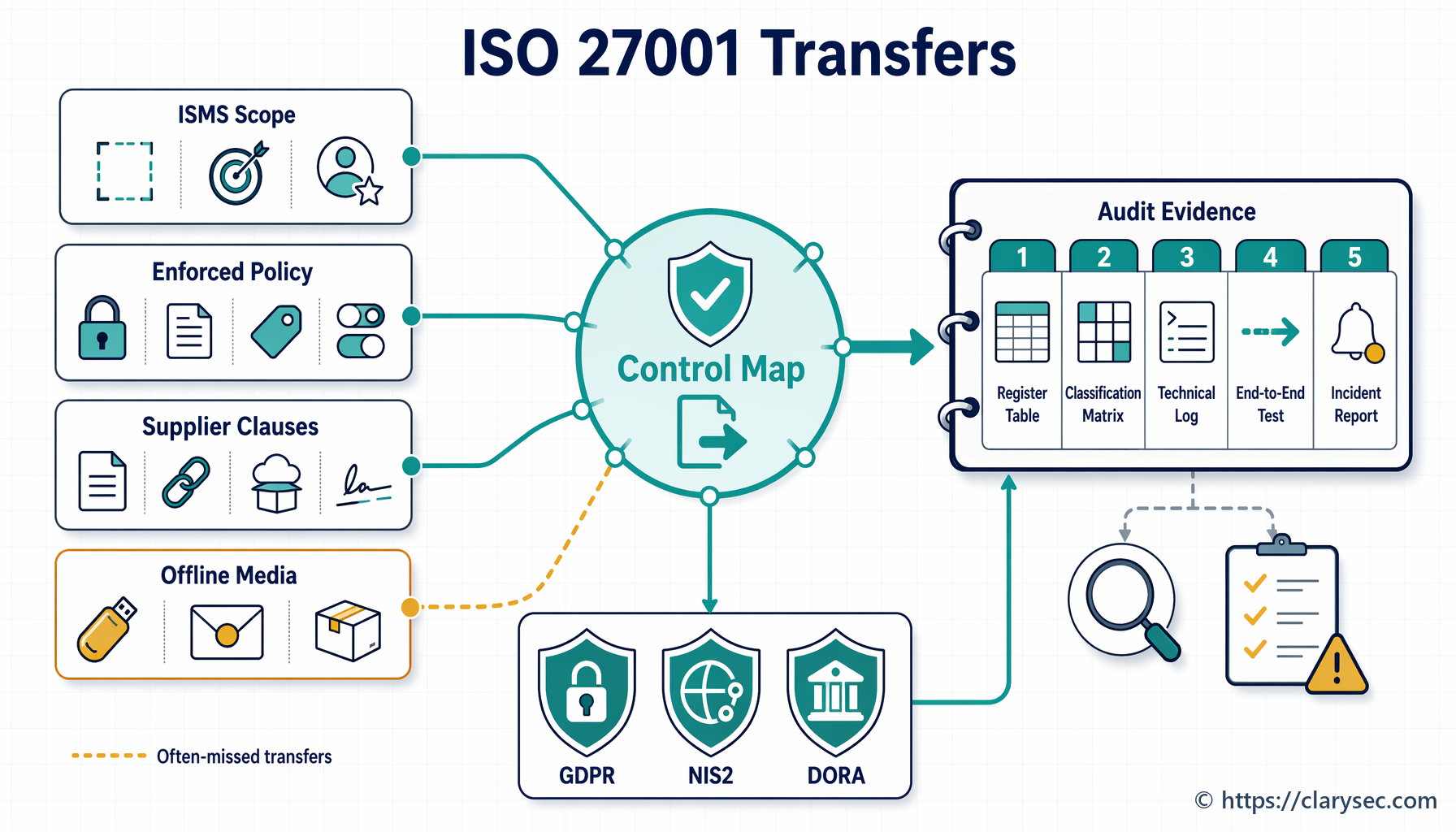
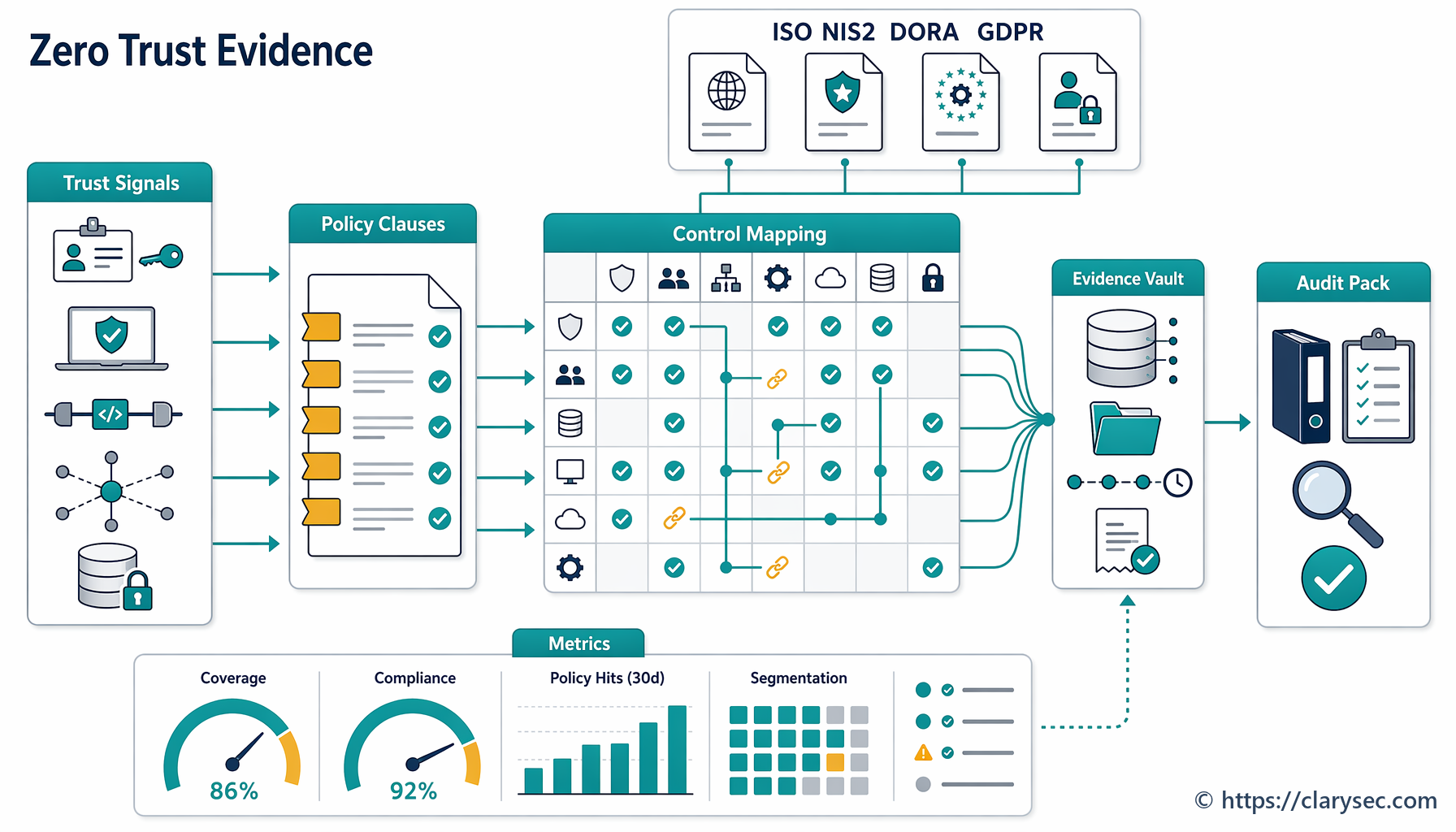
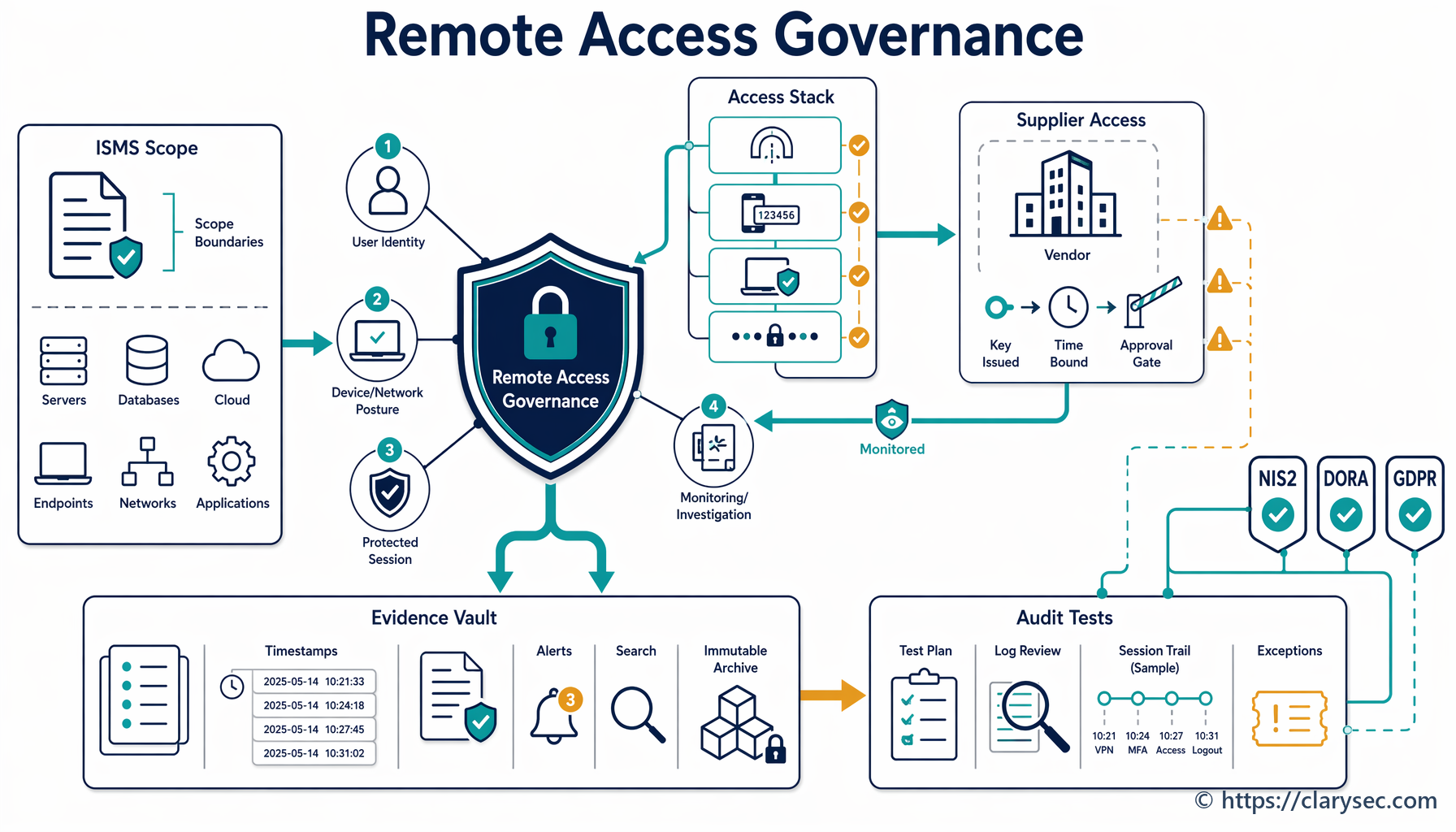
EU Digital Identity Wallet Compliance Evidence Map 2026
A fintech product team is two weeks away from launching wallet-based onboarding. The new flow will let EU customers prove selected identity attributes through the EU Digital Identity Wallet instead of uploading identity documents manually. The CISO likes the security upside. The DPO likes the promise of data minimisation. The head of compliance sees fewer abandoned onboarding journeys and a cleaner customer experience.
Then the audit committee asks the question that changes the room:
“If a regulator, bank partner, customer auditor or supervisory authority asks how this wallet integration is governed, what evidence do we show?”
That is the real 2026 problem.
The EU Digital Identity Wallet, often shortened to EUDI Wallet, is not just another product feature. For regulated digital services, payment providers, trust-service ecosystems, public-sector interfaces and high-assurance onboarding journeys, it becomes part of the organisation’s identity assurance chain. It touches personal data, authentication events, supplier dependencies, access governance, logging, cryptography, incident reporting and board accountability.
The trap is treating eIDAS2 and the EUDI Wallet as a standalone legal implementation. The practical answer is different: bring wallet relying-party adoption into the same evidence system used for ISO/IEC 27001:2022, GDPR, NIS2, DORA, NIST CSF 2.0 and COBIT 2019.
That is where Clarysec’s approach is strongest. We do not turn every new regulation into another spreadsheet. We map obligations to policies, controls, owners, audit trails and repeatable proof.
This article shows how to build that evidence spine using Clarysec’s Zenith Blueprint: An Auditor’s 30-Step Roadmap, Zenith Controls: The Cross-Compliance Guide, and Clarysec policy templates for privacy, identity, logging, supplier governance and regulatory compliance.
The 2026 wallet evidence problem is bigger than eIDAS2
Most discussions about the EU Digital Identity Wallet focus on trust, interoperability and user experience. Those matter. But a CISO, compliance manager, DPO or auditor has a more operational question: what controls prove that wallet-derived identity attributes are used securely, lawfully and proportionately?
A relying party that accepts wallet assertions should be able to answer:
- Which wallet attributes are requested, and why?
- Which legal basis supports the processing?
- Are users, administrators and service accounts uniquely identifiable?
- Are wallet verification services, identity brokers, API gateways and cloud components in the supplier register?
- Are authentication and verification events logged in a way that supports investigation without over-collecting personal data?
- Is there an incident process if wallet onboarding is abused, unavailable or compromised?
- For financial entities, is the wallet integration covered by DORA ICT risk management, third-party risk and incident classification?
- For NIS2 entities, does wallet reliance affect essential or important service delivery, access control, business continuity or customer communications?
NIS2 is especially relevant because its scope includes many digital infrastructure providers, cloud services, managed service providers, managed security service providers and trust service providers. The directive also classifies qualified trust service providers, DNS providers, TLD registries and several other entities as essential in specific circumstances. By 2026, many organisations will no longer be asking whether the law is coming. They will be answering supervisory, customer and internal audit questions about implementation.
For financial services, DORA adds another layer. It applies from 17 January 2025 and establishes a uniform ICT risk, incident, testing and third-party risk framework for financial entities. NIS2 recognises DORA as a sector-specific Union legal act for many overlapping financial-sector cybersecurity obligations. In practice, that means a wallet-based onboarding feature at a payment institution, crypto-asset service provider, investment firm or account information service provider must be evidenced through DORA-style ICT risk governance, even if NIS2 still matters for coordination and ecosystem dependencies.
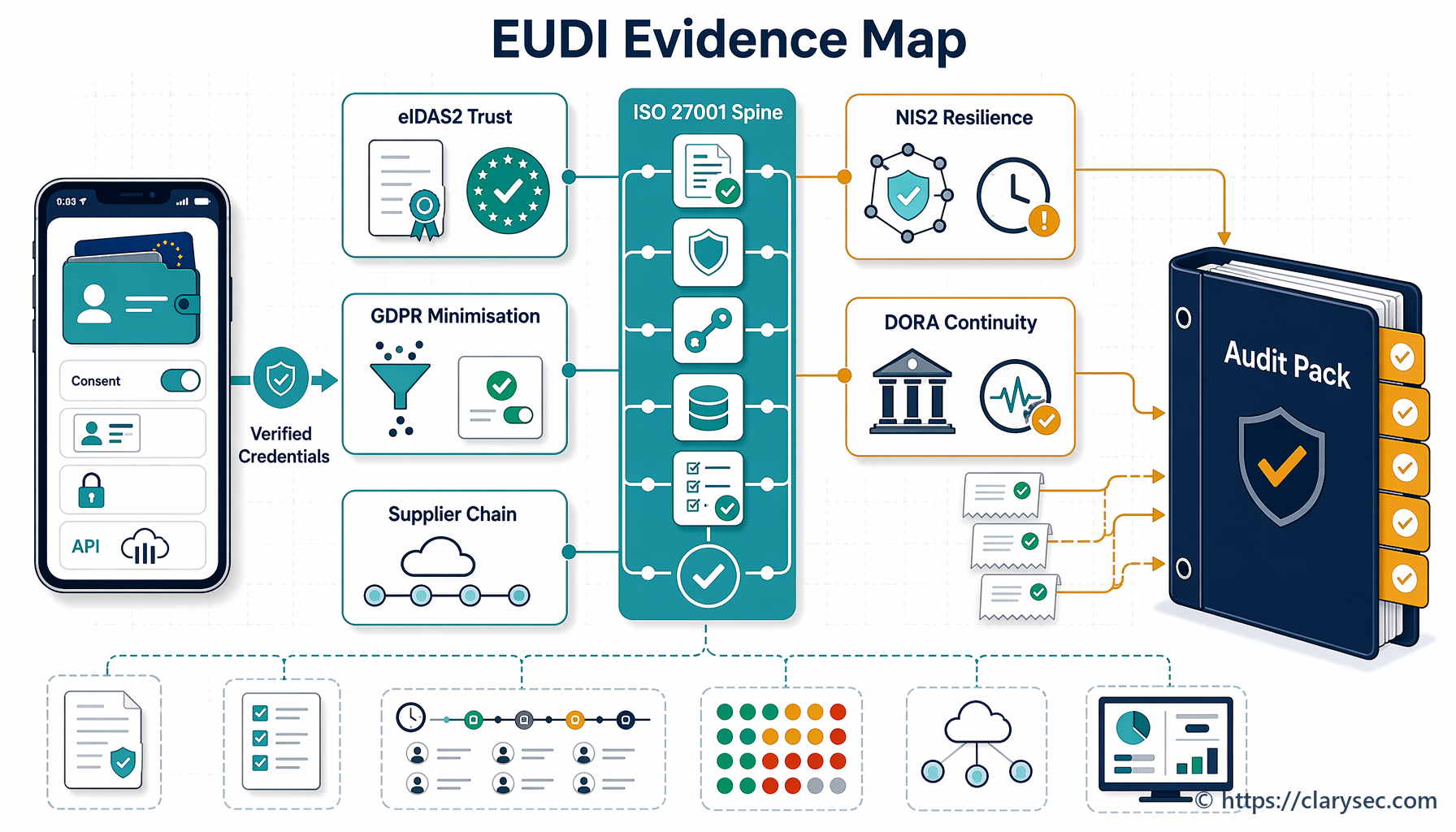
The wrong response is to create one evidence pack for eIDAS2, one for GDPR, one for NIS2, one for DORA and one for ISO certification. The right response is to use the ISMS as the evidence operating model.
Use ISO 27001 as the evidence spine
ISO/IEC 27001:2022 is useful because it is not limited to a technology checklist. It requires organisations to define context, interested parties, legal and contractual obligations, scope, interfaces, dependencies, leadership responsibilities, risk assessment, risk treatment, the Statement of Applicability and continual improvement.
That matters for wallet adoption because the risk is not only in an API call. The risk is in the end-to-end business process.
A wallet relying-party implementation affects:
- customer onboarding and account access;
- privacy notices, RoPA entries and lawful-basis records;
- identity proofing and authentication models;
- supplier contracts and assurance;
- logging, monitoring and evidence preservation;
- incident classification and reporting;
- data retention, deletion and correction;
- audit and compliance monitoring;
- board-level risk reporting.
Clarysec’s enterprise compliance policy makes this operating model explicit:
“All legal and regulatory obligations must be mapped to specific policies, controls, and owners within the Information Security Management System (ISMS).”
From Legal and Regulatory Compliance Policy, section “Policy Implementation Requirements”, policy clause 6.2.1.
For SMEs, the same principle is scaled to a practical compliance register:
“Where a regulation applies across multiple areas (e.g., GDPR applies to retention, security and privacy), this must be clearly mapped in the Compliance Register and training materials.”
From Legal and Regulatory Compliance Policy - SME, section “Governance Requirements”, policy clause 5.2.2.
The organisation should not ask, “Which department owns eIDAS2?” It should ask, “Which ISMS risks, controls, policies, owners and evidence records are affected by wallet reliance?”
In Zenith Blueprint, the Risk Management phase, Step 14, states:
“For each regulation, if applicable, you may create a simple mapping table (could be an appendix in a report) that lists the regulation’s key security requirements and the corresponding controls/policies in your ISMS. This isn’t mandatory in ISO 27001, but it’s a useful internal exercise to ensure nothing fell through the cracks. It also impresses auditors/assessors that you’re not managing security in a vacuum but aware of legal context.”
That is the foundation: build a single mapping table that connects wallet relying-party obligations to GDPR, NIS2, DORA, ISO/IEC 27001:2022 Annex A controls, Clarysec policies and evidence records.
A practical evidence map for EU Digital Identity Wallet relying parties
The EUDI Wallet becomes manageable when it is treated as a defined business process inside the ISMS, with mapped data, identities, suppliers, logs, incidents and owners.
| Wallet evidence question | Primary ISMS control area | GDPR evidence | NIS2 or DORA evidence | Clarysec toolkit evidence |
|---|---|---|---|---|
| Which attributes do we request from the wallet? | Privacy and PII protection, information classification, legal register | Data minimisation, lawful basis, purpose limitation, retention | DORA data confidentiality and ICT risk governance where financial services apply | Data Protection and Privacy Policy, Legal and Regulatory Compliance Policy, Compliance Register |
| How do we know identities are unique and traceable? | Identity management, access rights, privileged access | Accountability and security of processing | NIS2 Article 21(2)(i) access control and asset management, DORA access governance | User Account and Privilege Management Policy, IAM lifecycle evidence |
| How is wallet authentication protected? | Secure authentication, authentication information, monitoring | Access control, security by design, breach prevention | NIS2 Article 21(2)(j) MFA or continuous authentication where appropriate, DORA ICT protection | Authentication configuration, MFA coverage, session controls, logs |
| Which suppliers support verification or onboarding? | Supplier relationships, supplier agreements, cloud services | Processor or controller role analysis, data processing agreements | NIS2 supply-chain security, DORA ICT third-party register and exit strategy | Third-Party and Supplier Security Policy, supplier due diligence, contract clauses |
| What gets logged and retained? | Logging, monitoring, evidence collection | Accountability, breach detection, proportional retention | NIS2 incident handling, DORA incident classification and reporting | Logging and Monitoring Policy, immutable logs, incident runbooks |
| What happens if wallet onboarding fails or is abused? | Incident response, business continuity, ICT readiness | Personal data breach assessment where applicable | NIS2 24-hour and 72-hour reporting, DORA initial, intermediate and final reports | Incident playbook, evidence collection, post-incident review |
This table is not a legal opinion. It is a control and evidence model that CISOs, compliance teams and auditors can use to structure proof.
Identity management is where auditors will start
For a wallet relying party, identity is the obvious control family. But identity management is not the same as authentication. Identity management answers “who exists in the system and how is that identity governed?” Authentication answers “how is the claimed identity verified at access time?”
In Zenith Controls, ISO/IEC 27002:2022 control 5.16, Identity management, is treated as a preventive control supporting confidentiality, integrity and availability. It ties directly to access control, authentication information, access rights, supplier relationships, compliance monitoring and privileged access. The cross-compliance mapping links this area to GDPR security and accountability, NIS2 access control and asset management, DORA identity and access governance, NIST SP 800-53 identifier management and COBIT 2019 identity lifecycle governance.
For wallet evidence, the organisation should be able to prove:
- customer and workforce identities are not confused;
- administrative identities are unique and traceable;
- supplier identities are governed with the same discipline as employees;
- non-human identities, such as API clients and service accounts, have owners;
- identities are de-provisioned when no longer required;
- exceptions, break-glass accounts and privileged identities are controlled.
Clarysec’s SME account policy captures the principle in plain language:
“Each account must be unique, traceable to a specific individual, and linked to a business role.”
From User Account and Privilege Management Policy - SME, section “Policy Implementation Requirements”, policy clause 6.1.2.
For enterprises, the requirement is stricter about shared accounts:
“All user identities must be associated with a unique identifier. The use of shared or generic accounts is prohibited, except for approved break-glass or emergency accounts subject to strict controls.”
From User Account and Privilege Management Policy, section “Governance Requirements”, policy clause 5.3.
Supporting standards reinforce the same evidence logic. ISO/IEC 24760-1:2019 provides identity lifecycle concepts such as registration, binding, use and de-registration. ISO/IEC 29115:2013 supports risk-based identity assurance. ISO/IEC 27005:2024 treats identity and access weaknesses as risk treatment topics. ISO/IEC 27018:2020 extends identity management expectations for public cloud PII processing. ISO/IEC 29100:2011 adds the privacy lens by linking identifiability to personal information handling.
For EUDI Wallet adoption, the audit question is simple: can you trace every privileged action, configuration change, wallet verification integration change and supplier access event to a unique identity with an approved role?
If the answer is no, the wallet project is not audit-ready.
Secure authentication: wallet trust does not remove your control duties
A common misconception is that wallet-based identity proof removes the relying party’s authentication obligations. It may improve assurance for specific identity attributes, but it does not remove your duty to secure systems, sessions, APIs, administrative interfaces and customer journeys.
In Zenith Blueprint, Controls in Action phase, Step 19, Clarysec states:
“Authentication is the first and most critical line of defense between a threat actor and your systems, data, and services. If authentication is weak, everything else, encryption, monitoring, segmentation, can be bypassed.”
The same step explains that modern authentication must be risk-based, stronger for higher-value targets, and supported by MFA, secure credential storage, TLS, token protection, secrets management, secure session handling and authentication log review.
In Zenith Controls, ISO/IEC 27002:2022 control 8.5, Secure authentication, is mapped as a preventive control in the identity and access management capability. It ties to identity management, authentication information, privileged access, information access restriction, monitoring activities, incident management and privacy protection of PII. It also cross-maps to GDPR security and data protection by design, NIS2 cybersecurity risk management and MFA or continuous authentication where appropriate, DORA ICT risk governance, NIST SP 800-53 IA and AC families, and COBIT 2019 logical access governance.
For a wallet relying party, secure authentication evidence should include:
- wallet verification endpoint authentication and authorisation;
- administrator MFA for wallet configuration panels;
- secure API authentication between onboarding services;
- secrets vaulting for wallet integration keys or certificates;
- session timeouts and token protection where appropriate;
- failed authentication alerts and brute-force protections;
- separate controls for customer login, employee access and machine-to-machine access.
Clarysec’s logging policy for SMEs provides a practical evidence requirement:
“Authentication logs: Successful and failed login attempts, session duration, MFA usage”
From Logging and Monitoring Policy - SME, section “Governance Requirements”, policy clause 5.4.2.
For enterprise environments, audit reliability becomes central:
“Log files must be immutable or version-controlled, with access granted only to authorized personnel.”
From Logging and Monitoring Policy, section “Policy Implementation Requirements”, policy clause 6.5.1.
This is the bridge between identity assurance and incident response. If wallet onboarding is attacked through credential stuffing, token replay, administrative compromise or supplier misuse, authentication logs become the evidence trail.
GDPR: the wallet promise is minimisation, but you must prove it
The EU Digital Identity Wallet can support privacy-enhancing onboarding because a relying party may request specific attributes instead of collecting full identity documents. But GDPR accountability is not based on good intentions. It requires demonstrable compliance.
Wallet-derived attributes are personal data when they relate to an identified or identifiable person. Some use cases may also touch biometric data, identity verification data, sanctions screening, fraud risk or other sensitive processing contexts.
GDPR principles require lawful, fair and transparent processing, specified purposes, data minimisation, accuracy, storage limitation, integrity and confidentiality, plus accountability. A relying party should be able to prove why each wallet attribute is requested, how long it is retained, who can access it, how it is protected and how reuse is controlled.
Clarysec’s enterprise privacy policy states:
“Only data necessary for a specific, legitimate business purpose may be collected and processed.”
From Data Protection and Privacy Policy, section “Policy Implementation Requirements”, policy clause 6.2.1.
The SME version is deliberately concise:
“Only the minimum personal data necessary must be collected and retained”
From Data Protection and Privacy Policy - SME, section “Policy Implementation Requirements”, policy clause 6.2.1.
In Zenith Controls, ISO/IEC 27002:2022 control 5.34, Privacy and protection of PII, is mapped to asset inventory, data masking, cloud service governance, information classification, secure transfer, access control, identity management and project change review. It also connects to ISO/IEC 27701:2021 for privacy management, ISO/IEC 27018 for cloud PII processing and ISO/IEC 29100 privacy principles.
For wallet adoption, the privacy evidence pack should include:
- data flow diagram for wallet attributes;
- lawful-basis register entry;
- attribute minimisation decision record;
- retention schedule for wallet-derived data;
- privacy notice update;
- DPIA or privacy risk assessment where the use case is high risk;
- access control matrix for wallet data;
- data deletion and correction process;
- monitoring evidence showing access to wallet-derived PII is controlled.
Many organisations over-collect because the wallet makes verified data easier to obtain. That is backwards. The security and privacy benefit comes from requesting less, not from storing more verified identity data than the business needs.
NIS2 and DORA: board accountability meets wallet resilience
NIS2 and DORA both push cybersecurity into governance. They require management bodies to approve, oversee and be responsible for risk measures. They also expect proportionate technical, operational and organisational controls.
NIS2 Article 21 requires risk management measures covering policies, incident handling, business continuity, supply-chain security, secure acquisition and development, vulnerability handling, control effectiveness, cyber hygiene, training, cryptography, HR security, access control, asset management and, where appropriate, MFA or continuous authentication. For wallet relying parties in NIS2 sectors, the wallet integration should appear in the risk assessment, asset inventory, supplier register, incident plan and access control framework.
NIS2 Article 23 adds staged significant-incident reporting. Essential and important entities must provide an early warning within 24 hours, a notification within 72 hours and a final report within one month, with recipient communications where applicable. If a wallet integration failure could cause operational disruption, financial loss or material or non-material harm to service recipients, it should be included in incident classification logic.
DORA is more specific for financial entities. It requires an internal governance and control framework for ICT risk, board-approved resilience strategy, ICT policies, business continuity and response plans, audit plans, third-party policies, incident reporting channels and a documented ICT risk management framework. It also requires ICT-related incident management, classification using criteria such as affected clients, downtime, geographic spread, data loss, criticality and economic impact, plus reporting of major ICT-related incidents.
For wallet-based onboarding in financial services, evidence should show:
- the wallet integration is in the ICT asset and process inventory;
- risks are assessed and accepted by the right owner;
- criticality is assessed for customer onboarding or account access;
- resilience and fallback options exist;
- incidents can be classified under DORA criteria;
- client notifications are planned where financial interests are affected;
- outsourced reporting, if used, does not remove accountability.
The key is proportionality. A small fintech and a large bank will not produce the same evidence volume, but both need traceable governance.
Supplier and cloud dependencies: your wallet flow is only as strong as the chain
Most wallet relying-party implementations involve external services: cloud hosting, API gateways, verification libraries, identity brokers, KYC vendors, fraud engines, logging platforms, managed detection and response providers, or customer support tooling. That makes supplier governance central.
NIS2 requires entities to consider supplier-specific vulnerabilities and the overall quality and cybersecurity practices of suppliers and service providers. DORA goes further for financial entities by requiring a register of ICT service contractual arrangements, pre-contracting assessments, concentration-risk analysis, due diligence, audit and inspection approaches, termination rights and tested exit strategies for ICT services supporting critical or important functions.
In Zenith Blueprint, Controls in Action phase, Step 23, Clarysec instructs teams to compile a full supplier list, classify providers by access to systems, data or operational control, embed expectations in contracts, identify subcontractors, define change triggers and build a cloud service evaluation process. The same step recommends evaluating data location, access model, logging and encryption before future cloud services are approved.
Clarysec’s SME supplier policy gives a clean minimum-access rule:
“Suppliers must be granted access only to the minimum systems and data required to perform their function.”
From Third-Party and Supplier Security Policy - SME, section “Policy Implementation Requirements”, policy clause 6.2.1.
NIST CSF 2.0 supports this integrated view. Its GOVERN function includes legal, regulatory, contractual and privacy obligations, risk appetite, accountability, policy, resourcing and oversight. Its supply chain outcomes call for supplier roles, criticality prioritisation, contractual cybersecurity requirements, due diligence, monitoring, incident planning and post-relationship provisions.
COBIT 2019 auditors will look for governance maturity. They will ask whether supplier responsibilities, identity lifecycle, privacy controls and monitoring are embedded in business processes, not just security team checklists. For identity and logical access, COBIT 2019 DSS05.04, Manage user identity and logical access, is particularly relevant when assessing whether account ownership, approvals, privilege assignment and removal are controlled.
Build a wallet relying-party evidence pack in one afternoon
A practical Clarysec-style exercise starts with one specific use case, not a broad programme statement. Use “customer onboarding using wallet-provided legal name, date of birth and address” as the first record. Add the business owner, system owner, data owner and risk owner.
Record:
- purpose of processing;
- wallet attributes requested;
- whether attributes are stored, cached or only verified;
- systems and APIs involved;
- suppliers and subprocessors;
- countries or cloud regions involved;
- fallback process if wallet verification fails;
- customer communication touchpoints.
Then add the use case to the compliance register.
| Requirement area | Wallet-specific interpretation | Owner | Evidence |
|---|---|---|---|
| GDPR data minimisation | Request only legal name, date of birth and address because these are necessary for onboarding | DPO | DPIA, lawful-basis register, attribute minimisation decision |
| Identity management | Admin and support access to wallet onboarding records must be unique and role-based | IAM owner | IAM export, access review, joiner-mover-leaver records |
| Secure authentication | Admin consoles and APIs must use MFA or strong machine authentication | Security engineering | MFA report, API credential inventory, secrets vault evidence |
| Supplier governance | Verification and cloud providers must be assessed and contractually controlled | Procurement and CISO | Supplier assessment, DPA, security annex, exit plan |
| Incident response | Wallet onboarding abuse or outage must be classifiable and reportable | Incident manager | Incident playbook, NIS2 or DORA reporting matrix, tabletop record |
Next, review the Statement of Applicability and risk treatment plan. For EUDI Wallet use cases, the following ISO/IEC 27002:2022 control areas are commonly relevant.
| ISO/IEC 27002:2022 control | Control name | Wallet evidence relevance |
|---|---|---|
| 5.16 | Identity management | Unique identities, account ownership, joiner-mover-leaver lifecycle and non-human identity governance |
| 8.5 | Secure authentication | MFA, API authentication, secure sessions, credential protection and authentication logs |
| 5.34 | Privacy and protection of PII | Attribute minimisation, lawful processing, privacy risk assessment and access to wallet-derived PII |
| 5.19 | Information security in supplier relationships | Supplier classification, due diligence and supplier security responsibilities |
| 5.20 | Addressing information security within supplier agreements | Contractual security, privacy, audit, incident and termination clauses |
| 5.21 | Managing information security in the ICT supply chain | Supply-chain risk, subcontractors, integration dependencies and supplier vulnerabilities |
| 5.23 | Information security for use of cloud services | Cloud approval, data location, encryption, logging and access model |
| 8.15 | Logging | Authentication, verification, administrative and incident-relevant events |
| 8.16 | Monitoring activities | Alerting, detection, review and escalation of suspicious activity |
| 5.24 | Information security incident management planning and preparation | Wallet incident runbooks, roles, communication routes and escalation criteria |
| 5.25 | Assessment and decision on information security events | Triage and classification of wallet-related events |
| 5.26 | Response to information security incidents | Containment, eradication, recovery and communication |
| 5.28 | Collection of evidence | Preservation of logs, investigation records and chain of custody |
| 5.31 | Legal, statutory, regulatory and contractual requirements | eIDAS2, GDPR, NIS2, DORA and contractual obligation mapping |
| 5.36 | Compliance with policies, rules and standards for information security | Internal control testing, exceptions and compliance monitoring |
Finally, run a mini-audit. Pick one wallet onboarding transaction and trace:
- the attribute request justification;
- the transparency step or consent record where applicable;
- the system event log;
- the API authentication evidence;
- the access control record for staff viewing the onboarding result;
- the supplier involved;
- the retention rule;
- the incident classification route if that transaction were fraudulent or exposed.
If you cannot trace the journey, the process is not yet evidence-ready.
How different auditors will test the same wallet flow
Different auditors approach the EU Digital Identity Wallet through different professional lenses. The same evidence can satisfy multiple questions if it is structured well.
| Auditor background | Likely audit focus | Evidence they will request |
|---|---|---|
| ISO/IEC 27001:2022 auditor | Scope, interested parties, risks, SoA controls, control effectiveness and documented evidence | ISMS scope, risk assessment, SoA, policies, access reviews, logs, supplier records |
| ISO/IEC 27007 or ISO/IEC 19011 auditor | Audit trail, sampling, interviews, consistency between policy and implementation | User lifecycle samples, authentication configuration, incident records, staff interviews |
| NIST-oriented assessor | Governance, risk profiles, supply chain, detection, response and recovery outcomes | Current and target profile, POA&M, supplier criticality, monitoring and response evidence |
| COBIT 2019 auditor | Governance objectives, process ownership, maturity and management practices | RACI, process KPIs, board reporting, supplier governance, privacy program records |
| ISACA ITAF auditor | Evidence reliability, control testing, traceability and sufficiency | Immutable logs, sampled transactions, access evidence, exception approvals |
| DORA supervisor or internal reviewer | ICT risk framework, incident lifecycle, third-party register and operational resilience | ICT risk register, incident classification, third-party register, exit strategy, resilience tests |
| GDPR reviewer | Lawful basis, minimisation, transparency, PII security and accountability | RoPA entry, DPIA, privacy notice, retention rule, access logs, breach assessment |
Zenith Controls gives useful audit-methodology detail for these areas. For identity management, auditors commonly trace user identities through onboarding, modification and termination, reconcile HR records with account lists, inspect non-employee and service accounts, and look for shared administrator usage. For secure authentication, auditors compare policies to technical configurations, review MFA coverage, examine password and session controls, and inspect successful and failed login logs. For privacy and PII protection, auditors sample DPIAs, data subject request processes, privacy training, PII inventories, encryption, access logs and retention controls.
Clarysec’s Audit and Compliance Monitoring Policy explains the evidence objective clearly:
“To generate defensible evidence and an audit trail in support of regulatory inquiries, legal proceedings, or customer assurance requests.”
From Audit and Compliance Monitoring Policy, section “Objectives”, policy clause 3.4.
That phrase, defensible evidence, is the difference between a policy library and an audit-ready compliance system.
Common pitfalls in wallet-readiness projects
The first pitfall is collecting too much data. Wallets can make verified attributes easier to obtain, but GDPR pushes the opposite behaviour: collect and retain only what is necessary. If the product team requests full identity information when only age confirmation is required, the privacy control design is already flawed.
The second pitfall is ignoring non-human identities. Wallet integrations often rely on API clients, certificates, service accounts, automation scripts and secrets. If those identities are not owned, rotated, monitored and decommissioned, the relying-party environment is weak even if the wallet ecosystem is strong.
The third pitfall is treating suppliers as procurement paperwork. Under NIS2 and DORA, supplier security is operational. You need due diligence, contract clauses, monitoring, incident cooperation, audit rights and exit plans. For DORA-regulated entities, the ICT third-party register is core compliance evidence.
The fourth pitfall is logging without governance. Over-logging can create privacy risk. Under-logging destroys investigation capability. Define authentication, verification, administrative and incident-relevant events, protect logs from alteration, restrict access and align retention with legal and business needs.
The fifth pitfall is failing to rehearse reporting. NIS2 has 24-hour, 72-hour and one-month reporting expectations for significant incidents. DORA has initial, intermediate and final reporting for major ICT-related incidents. If the first time the organisation maps a wallet-related incident to these timelines is during an actual event, governance has failed.
Turn EUDI Wallet adoption into audit-ready evidence
The EU Digital Identity Wallet will change onboarding and digital trust across Europe. But for CISOs, DPOs, compliance managers, auditors and business owners, the winning move is not to create another isolated compliance programme. The winning move is to bring wallet adoption into the ISMS and map it across privacy, identity, authentication, suppliers, logging, resilience and incident response.
Clarysec can help you do that in a structured way:
- Use Zenith Blueprint to place wallet adoption into the Risk Management phase, Step 14 for regulatory cross-references, Step 19 for secure authentication, and Step 23 for supplier, privacy and legal control implementation.
- Use Zenith Controls to map ISO/IEC 27002:2022 identity management, secure authentication and privacy controls to GDPR, NIS2, DORA, NIST and COBIT 2019 evidence.
- Use Clarysec policy templates such as Legal and Regulatory Compliance Policy, Data Protection and Privacy Policy, User Account and Privilege Management Policy, Logging and Monitoring Policy, Third-Party and Supplier Security Policy - SME and Audit and Compliance Monitoring Policy to convert obligations into owned, testable practices.
- Build a wallet relying-party evidence pack before launch, not after the first audit request.
If your organisation plans to rely on the EU Digital Identity Wallet in 2026, now is the time to ask one question: can we prove, with defensible evidence, that this identity flow is secure, lawful, resilient and governed?
Clarysec’s answer is practical: map it, own it, test it and keep the evidence ready.
Frequently Asked Questions
About the Author

Igor Petreski
Compliance Systems Architect, Clarysec LLC
Igor Petreski is a cybersecurity leader with over 30 years of experience in information technology and a dedicated decade specializing in global Governance, Risk, and Compliance (GRC).Core Credentials & Qualifications:• MSc in Cyber Security from Royal Holloway, University of London• PECB-Certified ISO/IEC 27001 Lead Auditor & Trainer• Certified Information Systems Auditor (CISA) from ISACA• Certified Information Security Manager (CISM) from ISACA • Certified Ethical Hacker from EC-Council