EUCS Cloud Certification Evidence for 2026 Audits
The glow from the boardroom projector illuminated Amelia’s face as she stared at a slide titled “2026 Compliance Horizon.” As CISO of a fast-growing fintech, she had three acronyms on the screen and one recurring operational problem behind all of them: NIS2, DORA and GDPR were all pointing back to the same cloud platforms.
The DORA auditor wanted evidence of ICT third-party risk management for the cloud services hosting payment applications. The NIS2 competent authority had classified the company as an important entity and was asking how supply-chain security was governed. The Data Protection Officer was preparing for a GDPR review focused on processor security, data residency and breach readiness. Procurement then forwarded a short email from a cloud analytics provider:
“We are preparing for EUCS certification. Can this replace your supplier security review?”
For a busy CISO, compliance lead or founder, the tempting answer is yes. A European cloud cybersecurity certification sounds like the exact evidence object that should reduce questionnaires, calm auditors and satisfy customers.
The better answer is more precise: EUCS cloud certification can become powerful cloud provider assurance evidence, but only when it is mapped into your own ISO/IEC 27001:2022 risk assessment, Statement of Applicability, supplier register, cloud service register, contractual controls, incident playbooks and GDPR accountability records.
That distinction matters. NIS2 makes supply-chain security and digital infrastructure resilience a supervisory issue. DORA makes financial entities remain accountable for ICT third-party risk, even when cloud services are outsourced. GDPR requires controllers and processors to demonstrate accountable, lawful and secure processing. ISO/IEC 27001:2022 requires a scoped, risk-based management system that accounts for legal, regulatory, contractual and third-party dependencies.
EUCS does not remove those obligations. It gives you a structured evidence object to evaluate, normalize, challenge and reuse.
Clarysec’s approach is simple: treat EUCS as a high-value supplier assurance input, not as a compliance shortcut. In Zenith Controls: The Cross-Compliance Guide, the cloud assurance cluster starts with ISO/IEC 27002:2022 control 5.23, Information security for use of cloud services, and connects it to 5.20, Addressing information security within supplier agreements, and 5.22, Monitoring, review and change management of supplier services. Those three controls form the backbone for a defensible EUCS evidence review.
Why cloud assurance is breaking under NIS2, DORA and GDPR
By 2026, cloud assurance is no longer just a procurement workflow. It is a board, regulator and audit topic.
The NIS2 Directive, Directive (EU) 2022/2555, expands the cybersecurity obligations of essential and important entities. Its scope includes many sectors that rely heavily on cloud computing, and its digital infrastructure landscape includes cloud computing providers, data centre service providers, content delivery networks, trust service providers, DNS service providers and TLD name registries. Managed service providers and managed security service providers are also in focus.
Article 21 requires appropriate and proportionate technical, operational and organizational measures, including risk analysis, incident handling, business continuity, supply-chain security, secure acquisition and development, vulnerability handling, effectiveness assessment, cyber hygiene, cryptography, access control, asset management and authentication. Article 23 creates staged incident reporting expectations, including early warning within 24 hours and incident notification within 72 hours, subject to the Directive and national implementation. Article 24 allows Member States, in certain circumstances, to require the use of ICT products, services or processes certified under European cybersecurity certification schemes. Article 25 encourages the use of relevant European and international standards.
DORA, Regulation (EU) 2022/2554, is even more direct for financial entities. From 17 January 2025, it requires financial organizations to manage ICT risk, report major ICT-related incidents, test digital operational resilience and govern ICT third-party risk. For entities within its scope, DORA functions as the sector-specific Union legal act for corresponding cybersecurity obligations that overlap with NIS2 national rules.
DORA does not allow outsourcing accountability. Articles 28 to 30 require financial entities to perform due diligence, assess concentration risk, maintain registers of contractual arrangements, include mandatory contractual safeguards, preserve audit and access rights, secure incident assistance, cooperate with competent authorities and maintain exit strategies for ICT services supporting critical or important functions.
GDPR, Regulation (EU) 2016/679, adds the accountability and data protection layer. Article 5 requires controllers to comply with data protection principles and be able to demonstrate compliance. Article 28 governs processor relationships and requires sufficient guarantees from processors. Article 32 requires appropriate technical and organizational measures to ensure security of processing.
The result is a convergence problem. A single cloud provider may be a critical ICT third-party under DORA, a direct supplier in a NIS2 supply chain and a processor or subprocessor under GDPR. If assurance is managed through disconnected questionnaires, certification PDFs and contract folders, every audit becomes a reconstruction exercise.
EUCS can reduce that chaos, but only when it is absorbed into a governed evidence model.
What EUCS can prove, and what it cannot
The EU Cybersecurity Certification Scheme for Cloud Services, commonly referred to as EUCS, is designed to provide a European cloud assurance mechanism under the broader EU cybersecurity certification framework. Its practical value is not the label alone. The value is in the underlying certificate scope, assurance level, assessed services, regions, legal entities, assessment boundaries, validity period and surveillance model.
The right cloud assurance question is not simply, “Does this provider have EUCS?” It is:
- Which exact cloud services are covered?
- Which regions, data locations and legal entities are covered?
- Which assurance level applies?
- What assessment method was used?
- Which shared responsibility assumptions remain with the customer?
- What evidence can be disclosed to customers, regulators and auditors?
- How does the certificate affect audit rights, incident notification, subcontractor transparency and exit planning?
A cloud certificate rarely covers your configuration. If your organization disables MFA, exposes storage, grants excessive administrative privileges, fails to log privileged access or misconfigures regions, the provider’s certification will not save your audit.
That is why EUCS belongs in an evidence matrix, not on a pedestal. It can support provider-side assurance, but your organization must still prove its own governance, configuration, contractual and monitoring controls.
The Zenith Blueprint: An Auditor’s 30-Step Roadmap makes this clear in the Risk Management phase, Step 13, Risk Treatment Planning and Statement of Applicability:
The SoA is effectively a bridging document : it links your risk assessment/treatment to the actual controls you have. By completing it, you also double-check if you missed any controls.
That is the correct mental model for EUCS. The certificate is supplier evidence. Your Statement of Applicability explains why related controls are applicable, how your organization implemented its side of shared responsibility, which supplier evidence was accepted and which residual risks remain.
The ISO 27001 backbone for EUCS evidence
ISO/IEC 27001:2022 gives EUCS a place to live. Its clauses require organizations to understand internal and external issues, identify interested parties and requirements, define ISMS scope, assign leadership responsibilities, assess risks, select controls, maintain a Statement of Applicability and continually improve.
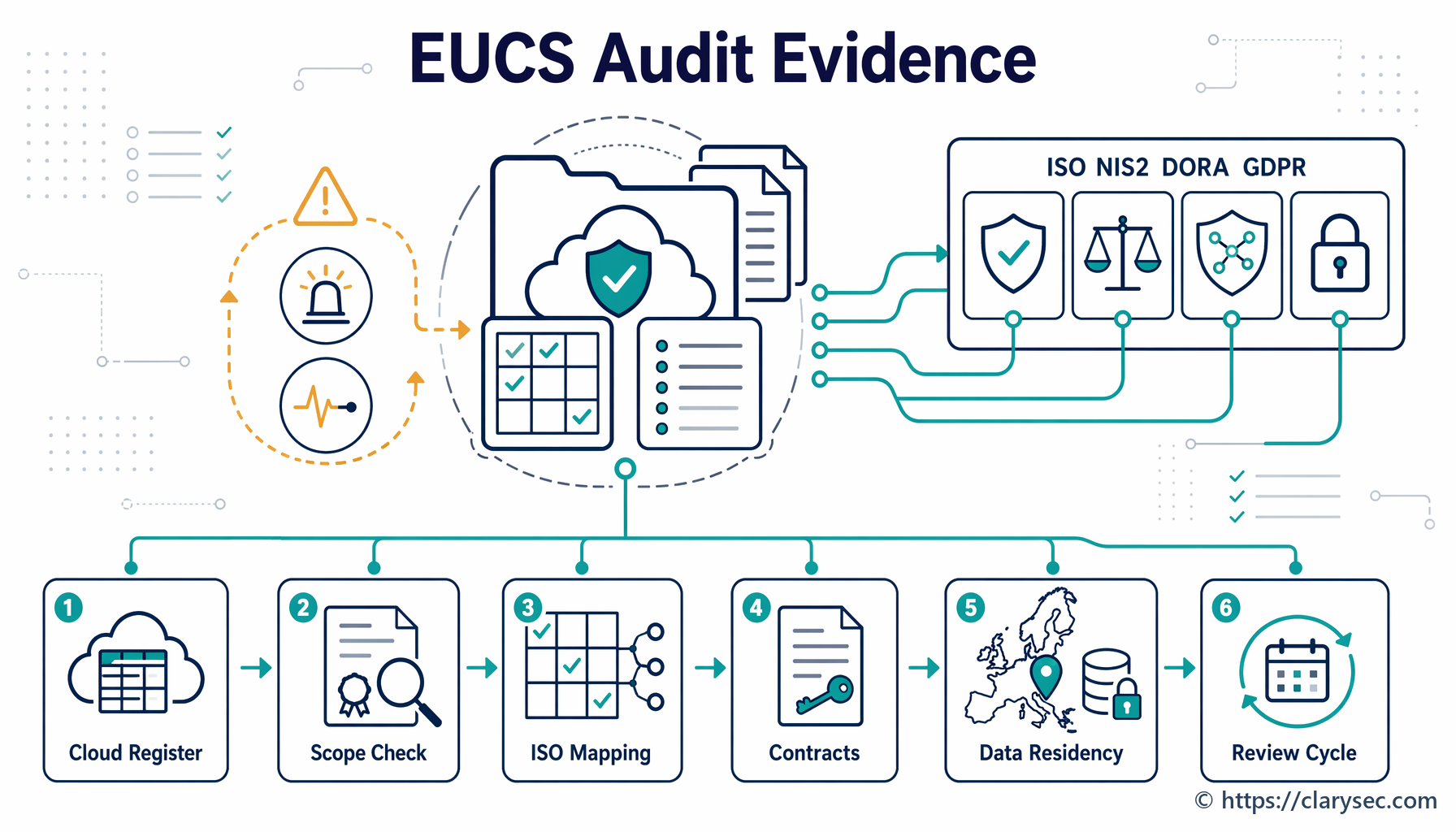
For cloud assurance, EUCS should land in at least six ISMS artefacts.
| ISMS artefact | How EUCS should be used | Auditor question |
|---|---|---|
| ISMS scope | Identify cloud services, regions, legal entities, customer data and outsourced dependencies | Does the ISMS include material cloud dependencies and outsourced services? |
| Risk register | Record provider failure, misconfiguration, data location, subcontractor and incident reporting risks | Are cloud risks assessed against business impact and shared responsibility? |
| Supplier due diligence | Use EUCS as evidence, then verify scope, assurance level, validity and gaps | Does the certificate cover the exact service used? |
| Statement of Applicability | Link cloud, supplier, access, logging, incident and continuity controls to risks and regulations | Is control selection justified and traceable? |
| Cloud Service Register | Record provider, purpose, data types, locations, access and contract details | Can the organization identify all approved cloud services? |
| Contract and audit file | Store certification, agreements, audit rights, notification terms, subcontractor terms and exit provisions | Can the organization prove enforceable supplier obligations? |
Clarysec’s policy library turns these requirements into operating discipline.
The SME Cloud Usage Policy - SME, section Governance Requirements, clause 5.2, sets a baseline for approved cloud services:
Approved cloud services must meet the following baseline criteria: 5.2.1 The provider maintains a strong reputation for availability and security 5.2.2 Multi-factor authentication (MFA) is supported and can be enabled 5.2.3 Data residency and privacy practices comply with applicable legal requirements (e.g., GDPR) 5.2.4 The service provides secure access controls, logging, and data protection capabilities
An EUCS certificate may support 5.2.1 and elements of 5.2.3 and 5.2.4. It does not prove that your tenant has MFA enabled, logging configured, data residency enforced or administrative access reviewed.
For larger organizations, the Enterprise Cloud Usage Policy, section Governance Requirements, clause 5.2, raises the bar:
All cloud use must undergo risk-based due diligence before activation, including provider assessment, legal compliance validation, and control validation reviews.
That sentence is the policy position every EUCS review should follow: provider assessment, legal compliance validation and control validation, not blind acceptance.
Mapping EUCS to ISO 27001, NIS2, DORA and GDPR
EUCS becomes audit-ready when certificate facts are mapped to obligations. A CISO should build a cross-compliance cloud assurance matrix that translates provider evidence into reusable control evidence.
| EUCS evidence item | ISO 27001 and ISO 27002 relevance | NIS2 relevance | DORA relevance | GDPR relevance |
|---|---|---|---|---|
| Certificate scope and covered services | Supports supplier risk assessment and controls 5.19, 5.20, 5.22 and 5.23 | Supports supply-chain security and certification evidence | Supports ICT provider due diligence and register accuracy | Supports processor and subprocessor assessment |
| Assurance level and assessment method | Supports control validation and SoA justification | Shows proportionality to risk and service criticality | Supports critical or important function assessment | Supports accountability for hosted personal data |
| Data location and jurisdiction evidence | Supports legal, regulatory and contractual requirement mapping | Supports service continuity and supply-chain risk analysis | Supports concentration and subcontracting risk assessment | Supports data residency and transfer risk analysis |
| Incident notification commitments | Supports incident planning and supplier agreement controls | Supports significant incident reporting readiness | Supports major ICT incident reporting dependencies | Supports personal data breach response readiness |
| Subcontractor and supply-chain evidence | Supports supplier monitoring and change management | Supports supplier-specific vulnerability assessment | Supports subcontracting chain and concentration risk analysis | Supports processor chain accountability |
| Exit and data return evidence | Supports continuity, termination and secure data handling | Supports all-hazards resilience and continuity | Supports tested exit strategies for critical ICT services | Supports deletion, retention and processing limitation evidence |
This table is not only for compliance documentation. It is the bridge between a provider’s assurance and your organization’s accountability.
NIS2 asks whether your entity took appropriate and proportionate measures. DORA asks whether your financial entity governs ICT third-party risk through due diligence, contracts, monitoring and exit planning. GDPR asks whether personal data processing is lawful, secure and demonstrable. ISO/IEC 27001:2022 asks whether all of this is integrated into a risk-based management system.
A practical example: reviewing EUCS for a cloud analytics provider
Return to Amelia’s fintech, Northstar Pay. The company wants to onboard a cloud analytics platform for fraud detection and transaction reporting. The provider presents an EUCS certificate and claims it should satisfy the security review.
Clarysec would structure the evidence review in six steps.
Step 1: Update the Cloud Service Register
The Cloud Usage Policy - SME, section Governance Requirements, clause 5.3, requires a register that records cloud service name, purpose, responsible owner, data types, country or region, access permissions, administrative accounts, contract details, renewal dates and support contacts.
For enterprises, the Cloud Usage Policy, section Governance Requirements, clause 5.1, starts with ownership:
The organization shall maintain a centralized Cloud Services Register, owned by the CISO, containing:
Northstar Pay records the service before approval, not after go-live.
| Register field | Example entry |
|---|---|
| Cloud service | Provider analytics platform |
| Business purpose | Fraud analytics and transaction trend reporting |
| Application owner | Head of Data Platforms |
| Data types | Customer identifiers, transaction metadata, pseudonymized analytics events |
| Data location | EU region only, contractually restricted |
| Access | SSO, MFA, named admin accounts, least privilege roles |
| Evidence | EUCS certificate, ISO 27001 certificate, security whitepaper, DPA, contract, subprocessor list |
| Review date | Annual review plus review on material service change |
Step 2: Validate certificate scope
The team verifies whether the EUCS certificate covers the exact analytics service, deployment model, region and legal entity Northstar Pay will use. If the certificate covers infrastructure services but excludes the analytics module, the evidence value is limited.
This is where many audits fail. The provider says “certified,” but the customer cannot show that the certificate applies to the service processing regulated data.
Step 3: Map EUCS to risk treatment and the SoA
Using Zenith Blueprint, Step 13, Northstar Pay maps the certificate into the risk register and Statement of Applicability.
| Risk scenario | EUCS evidence value | Customer-side control still required |
|---|---|---|
| Unauthorized access to analytics data | Supports provider infrastructure security assurance | Enforce SSO, MFA, RBAC, admin review and logging |
| Data stored outside approved region | May support provider location controls | Contractual EU-only storage, tenant configuration and periodic verification |
| Provider incident delays reporting | May support incident process assurance | Contractual notification times, escalation contacts and incident playbook |
| Subprocessor change affects risk | May support supply-chain governance | Contract approval rights, subprocessor monitoring and reassessment |
| Cloud outage affects reporting | May support availability controls | Business continuity plan, RTO and RPO analysis, backup or export strategy |
The SoA then records ISO/IEC 27002:2022 controls 5.20, 5.22 and 5.23 as applicable because the organization uses cloud services for regulated processing and important analytics workflows.
Step 4: Confirm contractual clauses and audit rights
The SME Third-Party and Supplier Security Policy - SME, section Governance Requirements, clause 5.3, requires mandatory contract clauses:
Contracts must include mandatory clauses covering: 5.3.1 Confidentiality and non-disclosure 5.3.2 Information security obligations 5.3.3 Data breach notification timelines (e.g., within 24–72 hours) 5.3.4 Audit rights or the availability of compliance evidence 5.3.5 Restrictions on further subcontracting without approval 5.3.6 Termination terms, including secure data return or destruction
EUCS evidence and contractual rights serve different purposes. The certificate supports assurance. The contract creates enforceability.
The Enterprise Third party and supplier security policy, section Policy Implementation Requirements, clause 6.1.2.2, explicitly includes:
Review of audit reports (e.g., SOC 2, ISO 27001, ISAE 3402)
EUCS belongs in that evidence family, alongside other assurance reports. It should not replace contract review, audit rights, incident assistance or exit strategy clauses required by DORA.
Step 5: Enforce data residency for regulated data
The Cloud Usage Policy, section Policy Implementation Requirements, clause 6.6.2, states:
Data residency requirements must be enforced contractually (e.g., EU-only storage for GDPR-regulated data).
For GDPR accountability, a certificate that describes regional controls is useful. It is still not enough. Northstar Pay needs the data processing agreement, contractual EU-only storage language, tenant configuration evidence and a method to monitor change.
If the analytics platform allows administrators to select regions, the audit file should include configuration screenshots, exported settings or other records showing the approved EU region.
Step 6: Schedule annual and event-driven reviews
The Third-Party and Supplier Security Policy - SME, section Policy Implementation Requirements, clause 6.3.1, requires annual review of critical or high-risk suppliers to verify secure access methods, valid security certifications or updated control evidence, incident history and contractual compliance.
The review should also trigger when the provider changes subcontractors, regions, services, identity architecture, encryption model, incident history or certificate status. Assurance evidence ages, and supplier risk is not static.
The Clarysec EUCS evidence pack
A mature EUCS assurance pack contains more than the certificate PDF. Clarysec structures the evidence into seven sections.
| Evidence section | Contents | Why it matters |
|---|---|---|
| 1. Cloud approval | Business justification, owner, risk rating, approval decision | Shows controlled acquisition and use of cloud services |
| 2. Provider assurance | EUCS certificate, other certifications, security overview, shared responsibility model | Shows supplier security evidence and scope |
| 3. Legal and privacy | DPA, data residency terms, subprocessor list, lawful processing mapping | Supports GDPR accountability and contract requirements |
| 4. Technical configuration | MFA, SSO, RBAC, encryption, logging, backup, network restrictions | Proves the customer side of shared responsibility |
| 5. Supplier contract | Security obligations, audit evidence rights, incident notification, subcontracting, termination | Supports ISO, NIS2 and DORA supplier governance |
| 6. Incident and resilience | Provider escalation path, playbook integration, RTO and RPO, test records | Supports NIS2 reporting and DORA operational resilience |
| 7. Monitoring and review | Annual review, certificate validity, incidents, service changes, exceptions | Supports ongoing supplier monitoring and continual improvement |
The Legal and Regulatory Compliance Policy, section Policy Implementation Requirements, clause 6.2.1, captures the operating principle:
All legal and regulatory obligations must be mapped to specific policies, controls, and owners within the Information Security Management System (ISMS).
That is the difference between collecting certificates and building a defensible compliance operating model.
Incident and resilience evidence: where EUCS is not enough
NIS2 and DORA both make incident and resilience readiness a serious test of cloud governance.
A cloud provider’s EUCS certificate may show that the provider has incident management controls. Your organization must still know who receives notifications, how alerts are triaged, how evidence is preserved, how personal data impact is assessed and who communicates with regulators, customers and internal leadership.
For NIS2, provider notification terms must support early warning and incident notification obligations. For DORA, cloud incidents must feed into ICT-related incident classification, escalation, reporting and client communication processes. For GDPR, the breach workflow must support assessment of whether a personal data breach occurred and whether notification to the supervisory authority or affected individuals is required.
NIST CSF 2.0 is useful as an integration language here. Its GOVERN, IDENTIFY, PROTECT, DETECT, RESPOND and RECOVER Functions help organizations translate legal obligations and technical controls into operational outcomes. Its supply-chain outcomes require suppliers to be known, prioritized, contractually governed, monitored, included in incident planning and managed at termination. Its response and recovery outcomes cover triage, escalation, third-party coordination, stakeholder notification, recovery execution and restoration verification.
The certificate goes in the file. The playbook proves readiness.
How auditors will test EUCS evidence
Different auditors approach cloud assurance from different angles. A cross-compliance evidence model prevents the same facts from being reassembled for every review.
| Audit lens | What the auditor will focus on | Evidence they will expect |
|---|---|---|
| ISO 27001 auditor | ISMS scope, risk assessment, SoA, supplier controls, cloud governance, continual improvement | Cloud Service Register, risk register, SoA, supplier assessment, contract, configuration records, review evidence |
| NIS2 supervisor or assessor | Management approval, Article 21 measures, supply-chain security, incident reporting readiness | Board reporting, supplier risk analysis, incident playbook, business continuity evidence, notification workflow |
| DORA auditor | ICT third-party register, critical or important function assessment, contracts, audit rights, exit plans, resilience testing | ICT contract register, due diligence, concentration risk analysis, Article 30 contract clauses, test records, exit strategy |
| GDPR reviewer | Accountability, processing purpose, data categories, data location, security, breach readiness | RoPA inputs, DPA, data residency terms, access controls, breach assessment workflow, processor evidence |
| NIST CSF assessor | Current and Target Profiles, governance, supply-chain risk management, monitoring, response and recovery | Profile gap analysis, supplier lifecycle records, monitoring reports, incident exercises, recovery validation |
| COBIT 2019 or ISACA auditor | Governance objectives, management accountability, service provider oversight, risk optimization, compliance monitoring | Governance minutes, control ownership, performance metrics, third-party oversight records, compliance dashboard |
Zenith Blueprint, Controls in Action phase, Step 23, warns that cloud controls are heavily scrutinized:
This control is often heavily scrutinized. Auditors will ask:
✓ “Which cloud services are you using?” ✓ “Who approved them?” ✓ “How do you ensure data is protected?”
Those questions are the essence of EUCS assurance. A certificate may help answer how provider-side protection is evidenced, but it cannot answer which services are used or who approved them unless your Cloud Service Register and approval workflow are current.
Common EUCS assurance mistakes to avoid
The first mistake is treating EUCS as a universal pass. It is scoped evidence. If the certificate does not cover your purchased service, region, deployment model or legal entity, its assurance value may be limited.
The second mistake is confusing provider controls with customer controls. Provider certification does not prove tenant MFA, RBAC, logging, encryption settings, backups, administrative access reviews or monitoring.
The third mistake is overlooking DORA contract requirements. Financial entities need written rights and obligations, including service descriptions, data locations, information security requirements, access and audit rights, service levels, incident assistance, cooperation with authorities, termination rights and exit strategies for critical or important functions.
The fourth mistake is ignoring GDPR evidence. Data residency language, subprocessor transparency, breach handling, lawful processing and accountability records remain necessary. EUCS may support Article 32 security evidence, but it does not define your lawful basis, processing purpose or retention rules.
The fifth mistake is failing to monitor certificate status. If certification expires, scope changes, surveillance findings emerge or the provider changes architecture, your supplier risk review must capture the change.
A practical 2026 EUCS review checklist
Use this checklist before accepting EUCS as cloud provider assurance evidence:
- Confirm the certification scheme, assurance level, certificate holder and validity period.
- Confirm the exact services, regions, deployment models and legal entities in scope.
- Compare certificate scope to your Cloud Service Register entry.
- Map evidence to ISO/IEC 27002:2022 controls 5.20, 5.22 and 5.23.
- Update the risk register and SoA with certificate evidence and residual risk.
- Validate customer-side controls, especially identity, MFA, logging, encryption, backups and admin access.
- Confirm data residency, subprocessor, breach notification, audit evidence and termination clauses.
- Link incident notification paths to NIS2, DORA and GDPR timelines.
- Review concentration risk and exit strategy for critical or important services.
- Schedule annual review and event-driven reassessment.
Make EUCS evidence work inside your ISMS
EUCS cloud certification can materially improve cloud provider assurance in 2026. It can reduce questionnaire fatigue, strengthen supplier due diligence and support ISO 27001, NIS2, DORA and GDPR evidence. But it only becomes defensible when it is mapped into your governance system.
Clarysec helps organizations turn cloud certification evidence into audit-ready compliance operations through the Zenith Blueprint, Zenith Controls, Cloud Usage Policy, Cloud Usage Policy - SME, Third-Party and Supplier Security Policy - SME, Third party and supplier security policy and Legal and Regulatory Compliance Policy.
If your 2026 roadmap includes EUCS, NIS2 readiness, DORA ICT third-party risk, GDPR cloud processing or ISO/IEC 27001:2022 certification, start with one practical action: build your Cloud Service Register, attach provider assurance evidence, and map every critical cloud service to risks, contracts, controls and owners. That is where cloud assurance becomes defensible.
Frequently Asked Questions
About the Author

Igor Petreski
Compliance Systems Architect, Clarysec LLC
Igor Petreski is a cybersecurity leader with over 30 years of experience in information technology and a dedicated decade specializing in global Governance, Risk, and Compliance (GRC).Core Credentials & Qualifications:• MSc in Cyber Security from Royal Holloway, University of London• PECB-Certified ISO/IEC 27001 Lead Auditor & Trainer• Certified Information Systems Auditor (CISA) from ISACA• Certified Information Security Manager (CISM) from ISACA • Certified Ethical Hacker from EC-Council