GDPR 72-Hour PII Breach Playbook for CISOs
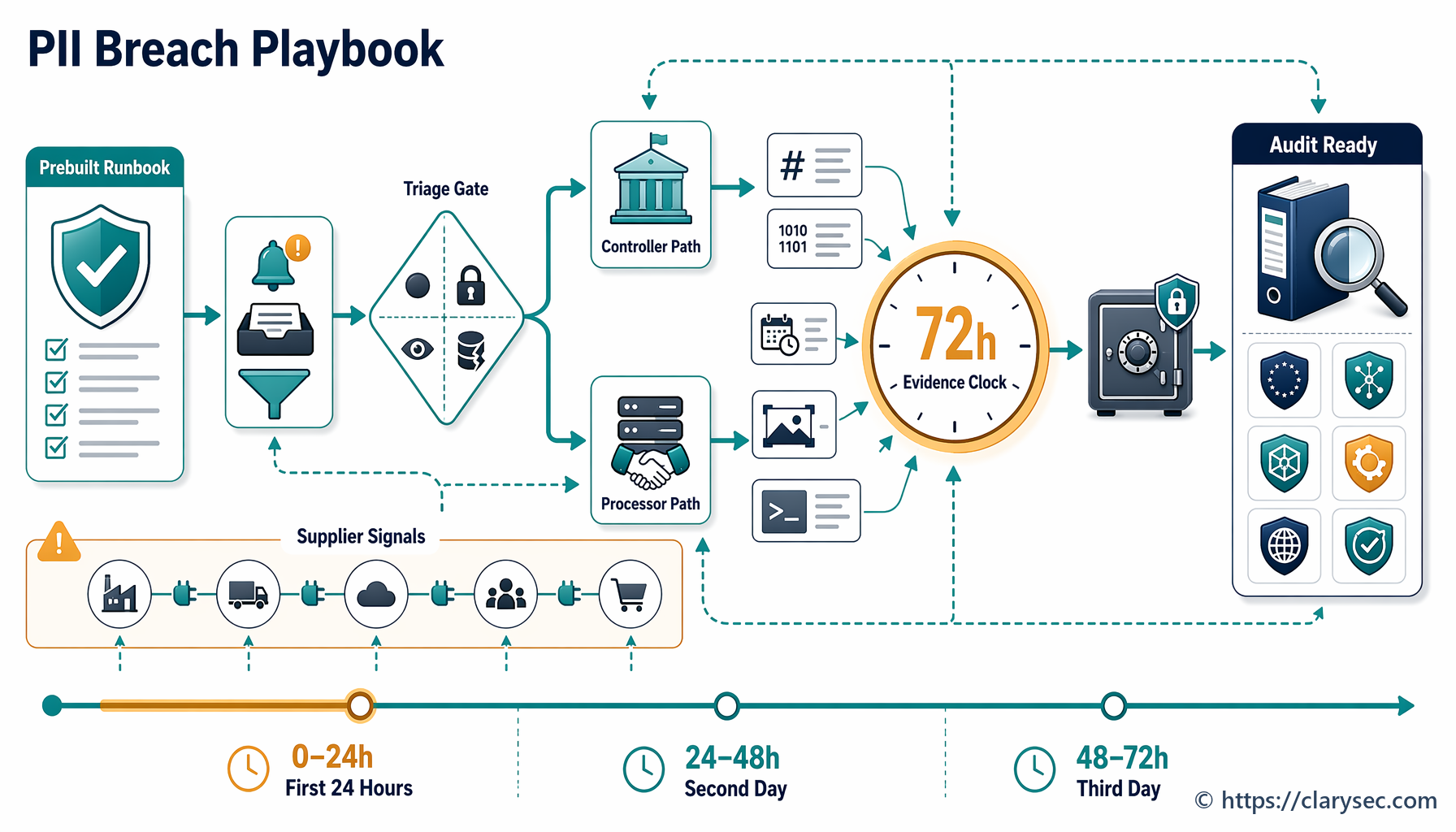
It is 2:13 AM on a Tuesday when the alert fires.
Maria, the CISO of a fast-growing FinTech SaaS platform, wakes to a SOC escalation: anomalous database queries are coming from a developer account. The account touched tables containing customer names, emails, transaction histories, and national identification numbers. Within minutes, the team confirms the developer’s credentials were stolen in a phishing attack. The exposure window is unclear. The attacker’s intent is unknown. The blast radius is still being calculated.
The clock starts now.
For GDPR, Maria may have 72 hours to notify a supervisory authority if the incident is likely to result in a risk to individuals. For NIS2, if the company is an essential or important entity and the incident is significant, an early warning may be due within 24 hours and a formal notification within 72 hours. For DORA, financial-sector ICT incident reporting and operational resilience duties may also be in play. Customers, insurers, legal counsel, executives, and auditors will all want answers.
This is the moment when a generic incident response plan often fails. A malware runbook may explain host isolation. A SOC procedure may explain log preservation. But an ISO/IEC 27701:2025 PII breach management process must answer harder questions under pressure:
- Was personal data exposed, altered, lost, destroyed, or accessed without authorization?
- Is the organization acting as a controller, processor, joint controller, or subprocessor?
- When did awareness occur, and what evidence proves it?
- Is regulatory notification required under GDPR Article 33?
- Are affected individuals at high risk under GDPR Article 34?
- If acting as a processor, how quickly must the controller be notified?
- Which evidence will prove the decision six months later during an audit?
The difference between chaos and control is not the number of security tools in the stack. It is whether the organization has built a disciplined Privacy Information Management System, or PIMS, that connects incident response, privacy governance, evidence handling, supplier escalation, and regulatory reporting into one defensible lifecycle.
Breach management starts before anyone says “breach”
The first operational mistake is assuming PII breach management begins only after legal confirms a personal data breach. In reality, the process begins when a person, system, supplier, or customer notices something that might involve PII.
Clarysec’s Zenith Blueprint: An Auditor’s 30-Step Roadmap Zenith Blueprint places this human trigger in the Controls in Action phase, Step 16: People Controls II. The guide states:
“An effective incident response system begins not with tools, but with people. Control 6.8 emphasizes the importance of ensuring that every employee, contractor, or stakeholder knows how to recognize and report a potential security incident , and feels safe and empowered to do so.”
This matters because many privacy incidents are not first detected by a SIEM. They start with a support agent seeing another customer’s attachment, a payroll employee noticing a misdirected spreadsheet, a customer reporting another user’s invoice, or a supplier reporting a lost laptop.
The Data Protection and Privacy Policy-sme Data Protection and Privacy Policy-sme, section Enforcement and Compliance, clause 8.3.1, turns this into an immediate obligation:
“All personal data breaches or suspected incidents must be reported immediately to the Privacy Coordinator”
For enterprise programs, the Data Protection and Privacy Policy Data Protection and Privacy Policy, section Enforcement and Compliance, clause 8.3.2, assigns leadership:
“The Data Protection Officer (DPO) shall lead breach containment, analysis, and escalation in accordance with ISO/IEC 27035 and GDPR Articles 33 and 34.”
That is the shift from “IT is looking into it” to “the PIMS breach lifecycle has been activated.”
The first pressure point: event, security incident, privacy incident, or PII breach
At 2:13 AM, Maria’s team has an alert. They do not yet have a confirmed notifiable breach. The first critical decision is classification.
The Zenith Blueprint, Controls in Action phase, Step 23: Organizational controls, explains ISO/IEC 27002:2022 control 5.25, Assessment and decision on information security events:
“Not every anomaly is a disaster. Not every alert signals compromise. In the real world, security teams and business units are inundated with noise, login attempts, log anomalies, minor policy violations, shadow IT activity. The real challenge isn’t just in detection, but in distinguishing the harmless from the harmful, and knowing what demands escalation.”
A privacy breach lifecycle must make that distinction repeatable. It should not depend on who happens to be on call, which lawyer joins first, or whether the CISO is comfortable with uncertainty.
A practical Clarysec classification model separates four stages:
| Classification stage | Question | Typical owner | Required evidence |
|---|---|---|---|
| Event | Did something unusual happen? | Helpdesk, SOC, business owner | Ticket, report, alert, email, log extract |
| Security incident | Did the event threaten or compromise information security? | Incident Response Coordinator | Incident ticket, triage notes, affected systems |
| Privacy incident | Could the event involve PII or privacy obligations? | Privacy Lead or DPO | PII categories, data subjects, processing role |
| Confirmed or suspected PII breach | Was PII exposed, lost, altered, destroyed, or accessed unlawfully or accidentally? | DPO, Privacy Lead, legal, business owner | Risk assessment, notification decision, evidence register |
The word “suspected” is essential. Clarysec does not advise waiting for perfect certainty before opening the privacy breach workflow. The breach register should open when a PII breach is reasonably suspected, then be updated as facts mature.
The PII Incident and Breach Management Policy PII Incident and Breach Management Policy, section Classification and breach assessment, clause 4.2.3, requires controllers to document the decision before external action:
“[Controller] The Data Protection Officer / Privacy Advisor MUST assess the risk to affected PII principals for each confirmed or reasonably suspected PII breach and record the notification recommendation, risk rationale, and advice in REG10 before the external notification decision is made.”
That clause is the operational core of audit-ready GDPR breach response: assess risk, record rationale, capture advice, decide, and preserve the evidence in REG10.
The 72-hour clock is an evidence problem, not a calendar reminder
Many teams treat GDPR’s 72-hour notification requirement as a deadline on a project plan. In a real incident, the hard part is proving when awareness occurred, what was known at that time, how quickly the organization acted, and why the notification decision was reasonable.
The Incident Response Policy-sme Incident Response Policy-sme, section Purpose, clause 1.2, frames the objective:
“This policy enables the organization to minimize harm, protect customer data, and meet regulatory obligations such as the GDPR 72-hour personal data breach notification requirement.”
The Data Protection and Privacy Policy-sme, section Enforcement and Compliance, clause 8.3.3, states:
“Where required, notification to authorities and affected individuals must occur within 72 hours”
For enterprise programs, the Data Protection and Privacy Policy, section Enforcement and Compliance, clause 8.3.3, states:
“Breaches meeting the legal notification threshold shall be reported to supervisory authorities within 72 hours.”
The point is not to notify every anomaly. The point is to make a defensible decision fast enough that required notification can happen on time. A mature PIMS therefore uses internal deadlines that are shorter than external legal deadlines.
| Time from awareness | PIMS action | Evidence to capture in REG10 |
|---|---|---|
| 0 to 4 hours | Open PII incident record, assign owner, preserve initial evidence, identify processing role | Intake report, awareness timestamp, assigned roles, initial systems and data involved |
| 4 to 12 hours | Contain exposure, identify PII categories, determine controller or processor obligations | Containment actions, affected data types, role assessment, supplier or customer dependencies |
| 12 to 24 hours | Perform preliminary risk assessment and decide if supervisory notification is likely | Risk rationale, likely impact, uncertainty, DPO advice, legal input |
| 24 to 48 hours | Prepare notification or no-notification rationale, coordinate customer or controller communications | Draft notice, decision log, approvals, customer notifications, evidence references |
| 48 to 72 hours | Submit required notification, document delay rationale if needed, prepare individual communication if high risk | Submission evidence, regulator reference, final decision, communication plan |
| After 72 hours | Continue investigation, update regulator if needed, notify individuals where required, complete lessons learned | Follow-up reports, corrective actions, closure approval, improvement backlog |
The PII Incident and Breach Management Policy, section Notification and communications, clause 4.4.1, makes the documentation requirement explicit:
“[Controller] The Privacy Lead / PIMS Manager MUST prepare a documented regulatory notification decision for every confirmed PII breach without undue delay and within an internal deadline that supports applicable external notification timelines, and MUST retain the notification, no-notification rationale, or delay rationale in REG10.”
A regulator may challenge a decision. An auditor may test whether the process was followed. But if the organization can show timely evidence, structured criteria, DPO advice, and a documented rationale, it is in a far stronger position than a team that says, “We discussed it on a call.”
Controllers and processors need different breach paths
Modern SaaS companies often operate in more than one privacy role. Maria’s FinTech platform may be a controller for its direct subscribers and a processor for enterprise customers. In another scenario, a B2B support portal may be a processor for customer ticket attachments but a controller for its own internal support metadata.
That distinction changes the notification path.
| Obligation | PII controller role | PII processor role |
|---|---|---|
| Primary duty | To the supervisory authority and affected individuals where thresholds are met | To the affected controller or customer |
| Notification target | Relevant supervisory authority and, if high risk, affected individuals | Customer or controller named in the contract |
| Notification trigger | Risk to the rights and freedoms of individuals | Awareness of a breach affecting customer PII |
| Timeline | Without undue delay and, where feasible, within 72 hours after awareness | Without undue delay and within contractual deadlines, often 24 or 48 hours |
| Risk assessment | Must assess risk to individuals and decide on Article 33 and 34 notification | Provides facts so the controller can assess risk |
For processors, the PII Incident and Breach Management Policy, section Notification and communications, clause 4.4.4, states:
“[Processor] The Privacy Lead / PIMS Manager MUST notify the affected controller or customer without undue delay and within any applicable contractual deadline after becoming aware of a PII breach affecting customer PII, and MUST record initial and follow-up notifications in REG08 and REG10.”
A processor should not wait to complete the controller’s GDPR risk analysis. It must notify the controller with available facts and provide updates as investigation continues. The controller then decides on supervisory authority notification and affected individual communication for its processing.
For high-risk impacts to individuals, the controller must also evaluate direct communication. The PII Incident and Breach Management Policy, clause 4.4.3, states:
“[Controller] The Privacy Lead / PIMS Manager MUST coordinate communication to affected PII principals when the breach assessment identifies a high-risk or equivalent communication trigger, and MUST record the communication content, audience, timing, delivery method, and approval evidence in REG10.”
The enterprise Data Protection and Privacy Policy, section Enforcement and Compliance, clause 8.3.4, reinforces this:
“If a high risk to individuals is identified, affected data subjects shall be notified without undue delay unless an exception applies (e.g., strong encryption is in place).”
That exception must be evidence-based. Saying “the data was encrypted” is not enough. The organization must prove that the exposed data was unreadable to unauthorized parties and that relevant keys were not compromised.
Suppliers can make or break the first 24 hours
Third parties often hold the facts needed for classification and notification. A cloud provider may hold access logs. A payroll processor may know which employees were affected. A managed service provider may have performed the configuration change. A subprocessor may hold forensic telemetry.
Supplier breach terms must therefore be designed before the incident.
The Third party and supplier security policy Third party and supplier security policy, section Governance Requirements, clause 5.3.3, includes contractual governance over:
“Breach notification timeframes (e.g., within 24 or 72 hours, depending on criticality and regulatory requirements)”
For smaller organizations, the Third-Party and Supplier Security Policy-sme Third-Party and Supplier Security Policy-sme similarly supports breach notification timelines in supplier governance.
Clarysec recommends that supplier contracts and data processing agreements define:
- What constitutes a suspected PII breach
- Who must be notified and through which channel
- Initial notification deadline, often shorter than the controller’s regulatory deadline
- Minimum facts required in the first notice
- Update frequency during investigation
- Evidence preservation duties
- Subprocessor notification flow-down
- Support for regulator and data subject communications
- Post-incident corrective action obligations
If supplier agreements use vague phrases like “as soon as practicable,” the controller’s GDPR clock may depend on another organization’s internal debate. That is not a defensible operating model.
Evidence turns response into defensible compliance
During Maria’s incident, the team needs authentication logs, database query records, phishing evidence, access control changes, affected customer lists, containment actions, DPO advice, and communication drafts. In the B2B SaaS portal scenario, the team might need screenshots, object storage permissions, support ticket IDs, IAM changes, and cross-tenant access logs.
The evidence must be preserved properly. Loose screenshots, chat exports, and personal folders are not enough.
The Zenith Blueprint, Controls in Action phase, Step 23, discusses ISO/IEC 27002:2022 control 5.28, Collection of evidence:
“When an information security incident occurs, one of the most critical, yet often overlooked, elements of response is evidence. Not logs, not screenshots, not loose narratives, but properly preserved, chain-of-custody-respecting, tamper-resistant evidence.”
The Evidence Collection and Forensics Policy Evidence Collection and Forensics Policy, section Governance Requirements, clause 5.5, states:
“All collected evidence shall be uniquely identified, labeled, and stored in a secure repository with:”
The PII Incident and Breach Management Policy, section Evidence, recordkeeping, and confidentiality, clause 4.5.1, connects that evidence to the PIMS record:
“[Both] The Incident Response Coordinator MUST maintain a complete REG10 record for every suspected or confirmed PII incident from intake through closure, including facts, timing, classification, assessment, actions, decisions, notifications, evidence references, and closure status.”
REG10 becomes the single source of truth for the incident. REG08 captures customer or controller notifications where applicable. Together, they let security, privacy, legal, and audit teams work from one evidence spine.
| REG10 field | Example entry |
|---|---|
| Incident ID | PII-2026-034 |
| Awareness timestamp | 2026-06-23 02:13 UTC, SOC alert confirmed |
| Processing role | Controller for direct subscribers, processor for enterprise customer datasets |
| PII involved | Names, work emails, transaction histories, national identification numbers |
| Initial classification | Confirmed security incident with suspected PII breach |
| Containment | Developer credentials revoked, sessions terminated, affected database access restricted |
| Risk assessment | Non-public identifiers accessed, identity fraud risk cannot be ruled out |
| Notification decision | Supervisory authority notification approved for controller data, enterprise customers notified as controllers |
| Evidence references | Auth log E-034-01, query export E-034-02, phishing artifact E-034-03 |
| Closure | Root cause fixed, MFA controls strengthened, phishing training updated, customer follow-up completed |
The purpose is not bureaucracy. It is to prevent the organization from reconstructing memory from scattered Slack messages after the regulator calls.
Mapping ISO 27701 PIMS response to ISO 27001 and ISO 27002
A mature PII breach process sits at the intersection of privacy governance and information security management.
ISO/IEC 27001:2022 clauses 4.1 to 4.4 require organizations to understand context, interested parties, ISMS scope, and management system processes. For PII breach management, this means the process must reflect regulatory duties, customer contracts, processing roles, supplier dependencies, and sector obligations before an incident occurs.
The Zenith Controls: The Cross-Compliance Guide Zenith Controls helps map incident controls into a broader assurance model. The most relevant ISO/IEC 27002:2022 controls are:
| ISO/IEC 27002:2022 control | Treatment in Zenith Controls | Why it matters for PII breach management |
|---|---|---|
| 5.24 Information security incident management planning and preparation | Corrective control, Respond and Recover, governance and information security event management | Defines plans, roles, escalation paths, communication templates, and privacy breach readiness |
| 5.25 Assessment and decision on information security events | Detective control, Detect and Respond, information security event management | Creates the structured decision point for classifying privacy incidents and suspected PII breaches |
| 5.26 Response to information security incidents | Corrective control, Respond and Recover, information security event management | Activates containment, coordination, notification support, recovery, and stakeholder communication |
| 5.28 Collection of evidence | Evidence preservation and investigative reliability through the incident lifecycle | Supports GDPR accountability, forensic quality, regulator questions, and audit defensibility |
| 6.8 Information security event reporting | People-driven reporting channel and awareness training | Ensures suspected PII incidents are reported quickly by employees, contractors, and stakeholders |
ISO/IEC 27035 supports structured incident management. ISO/IEC 27037 supports digital evidence handling. ISO/IEC 29134 can support privacy impact assessment logic when breach remediation reveals a need for deeper DPIA review. ISO/IEC 27701:2025 then brings the privacy role context, PII principal impact, controller and processor obligations, and PIMS evidence requirements into the management system.
One incident, many regulatory lenses
Maria’s incident is not only a GDPR question. Because the company provides cloud services to financial-sector customers, NIS2 and DORA may also apply. Customer contracts may impose 24-hour notification. Cyber insurance may require rapid notice. Internal governance may require board reporting.
Creating separate narratives for every framework creates contradiction risk. The Clarysec method is to maintain one evidence spine, then create framework-specific outputs from it.
| Framework or regulation | Incident lens | Clarysec evidence spine output |
|---|---|---|
| GDPR | Personal data breach, risk to individuals, supervisory authority notification, affected individual communication | REG10 decision record, DPO advice, Article 33 and 34 rationale, communication evidence |
| ISO/IEC 27701:2025 | PIMS governance, controller and processor duties, PII principal risk, privacy evidence | PII incident classification, role assessment, REG08 and REG10, corrective actions |
| ISO/IEC 27001:2022 | ISMS context, interested parties, incident response process, continual improvement | Incident record, risk treatment updates, management review input, control effectiveness evidence |
| NIS2 | Significant incident handling, staged reporting, all-hazards security measures | 24-hour early warning evidence, 72-hour incident notification package, one-month final report support |
| DORA | ICT-related incident management for financial entities and digital operational resilience | ICT impact facts, third-party dependencies, resilience testing feedback, incident reporting support |
| NIST CSF 2.0 | Current and Target Profiles, prioritized action plan, risk communication | Gap updates, target improvements, board-level risk narrative |
| COBIT 2019 | Governance, management objectives, accountability, control performance | RACI, decision logs, process metrics, corrective action tracking |
NIS2 Article 21 establishes cybersecurity risk-management measures, including incident handling, business continuity, supply chain security, effectiveness assessment, cyber hygiene, cryptography, access control, asset management, MFA, and secure communications. NIS2 Article 23 creates staged reporting for significant incidents, including early warning within 24 hours, incident notification within 72 hours, updates when requested, and a final report no later than one month after incident notification.
DORA applies from 17 January 2025 and establishes uniform requirements for ICT risk management, ICT-related incident reporting, digital operational resilience testing, information sharing, and ICT third-party risk management for financial entities. For a FinTech supplier, a single incident may therefore be a GDPR breach, a NIS2 significant incident, a DORA-relevant ICT event for customers, and a contractual notification event.
How auditors will test the lifecycle
Auditors rarely stop at “show me your incident response policy.” They test whether the lifecycle works under evidence pressure.
An ISO/IEC 27701:2025 or ISO/IEC 27001:2022 auditor will ask how privacy incidents enter the ISMS and PIMS, who classifies events, how controller and processor duties differ, and how incidents drive corrective action.
A GDPR auditor or supervisory authority will focus on awareness time, risk to individuals, DPO involvement, notification rationale, affected individual communication, and accountability. They may sample incidents that were not notified to test whether the no-notification rationale was documented.
A NIS2 or DORA review will examine significant incident thresholds, staged reporting, ICT impact, third-party dependencies, resilience implications, and whether reporting aligned with the relevant competent authority or customer requirements.
A NIST CSF 2.0 assessor will ask whether the incident changed the organization’s Current Profile and Target Profile. A COBIT 2019 reviewer will focus on governance, accountability, process ownership, metrics, and corrective action tracking.
A strong audit evidence pack should include:
| Evidence item | Why auditors ask for it |
|---|---|
| REG10 incident record | Proves intake, timing, classification, assessment, decisions, notifications, and closure |
| REG08 customer or controller notification record | Proves processor communications and customer update history |
| Original report or alert | Establishes how the incident was detected and when awareness began |
| Timeline of key actions | Shows containment, assessment, approvals, and notification decisions |
| Processing role assessment | Demonstrates controller and processor duty separation |
| PII categories and affected principals | Supports risk assessment and notification scope |
| DPO or Privacy Advisor recommendation | Proves accountable privacy advice before external decision |
| Notification or no-notification rationale | Supports GDPR Article 33 and 34 accountability |
| Evidence repository index | Demonstrates evidence integrity and chain-of-custody discipline |
| Root cause and corrective action plan | Shows continual improvement and control effectiveness review |
This is where Zenith Controls is commercially and operationally valuable. It helps map the same evidence to ISO/IEC 27002:2022 incident controls, GDPR accountability, NIS2 incident handling, DORA resilience expectations, NIST CSF communication, and COBIT governance without rebuilding the audit story each time.
A first 24-hour operating rhythm
A realistic PII breach playbook should feel practical, not theoretical. Consider a cross-tenant SaaS exposure reported by a customer at 08:12.
At 08:12, the customer success team receives the report and follows the reporting behavior from Zenith Blueprint Step 16. The ticket is tagged as a suspected PII incident.
At 08:25, the Incident Response Coordinator opens REG10. The record includes the awareness timestamp, reporter, system, suspected data types, and owner.
At 09:02, engineering reverts the permissions change. Logs are exported before rotation. The evidence custodian labels the customer report, IAM change, access log export, and containment confirmation in the secure repository.
At 10:30, the Privacy Lead determines the organization is acting as a processor for customer support attachments. Under the PII Incident and Breach Management Policy, clause 4.4.4, affected controller customers must be notified without undue delay and within contractual deadlines. REG08 is opened.
At 12:00, the DPO assesses risk to PII principals. The data appears limited, but some attachments may include employee names and internal IDs. The DPO records the risk rationale and recommendation in REG10.
At 15:00, affected controller customers receive the initial notice: what happened, when it was detected, what was contained, what PII may be involved, what is still being analyzed, and when the next update will arrive.
At 18:00, management receives a short briefing: customer notifications sent, regulator notification decisions belong to controllers for customer PII, internal controller processing is still being assessed, evidence is preserved, and root cause analysis is underway.
That rhythm prevents the most common breach failures: missed deadlines, confused roles, undocumented advice, and uncontrolled communications.
Common failure patterns to remove before the next alert
The most damaging privacy breach failures are rarely caused by one missing document. They are caused by disconnects between security, privacy, legal, suppliers, and business owners.
Clarysec commonly sees these patterns:
- Incident response plans exist, but PII breach classification is missing.
- GDPR 72-hour notification is mentioned, but internal deadlines are not shorter than the legal deadline.
- Processor escalation is delayed because teams wait for complete root cause analysis.
- Supplier contracts do not require rapid breach notification or evidence support.
- DPO advice is verbal and never entered into the breach register.
- High-risk individual communication is considered too late.
- Evidence is stored in personal folders, chat threads, or ticket comments.
- No-notification decisions are not documented.
- Lessons learned do not update controls, training, supplier clauses, or risk treatment plans.
The Zenith Blueprint, Step 23, captures why structure matters:
“An incident response without structure becomes a scramble. Emails fly, meetings are called, and decisions are made emotionally or inconsistently. But a mature ISMS turns response into discipline.”
That discipline is the purpose of ISO/IEC 27701:2025 PII breach management.
Build the Clarysec PII breach lifecycle
Clarysec’s approach combines three layers.
First, Zenith Blueprint provides the implementation roadmap. Step 16 ensures people recognize and report suspected incidents. Step 23 operationalizes assessment, decision, response, and evidence collection through ISO/IEC 27002:2022 controls 5.25, 5.26, and 5.28.
Second, the policy set defines authority and obligations. SME policies make reporting, 72-hour awareness, and incident registers practical for smaller organizations. Enterprise policies assign DPO leadership, breach thresholds, affected individual communication, supplier notification terms, evidence handling, and forensic governance. The PIMS-specific PII Incident and Breach Management Policy adds role-based controller and processor duties, REG08, REG10, notification rationale, and closure evidence.
Third, Zenith Controls acts as the cross-compliance compass. It maps incident planning, assessment, response, and evidence into an integrated view across ISO/IEC 27002:2022, GDPR, NIS2, DORA, NIST CSF 2.0, and COBIT-style assurance expectations.
For CISOs, this reduces operational confusion. For DPOs, it creates a defensible privacy decision trail. For compliance managers, it links one incident record to multiple regulatory outputs. For auditors, it creates traceable evidence. For executives, it reduces the chance that a manageable privacy incident becomes a regulatory and reputational crisis.
Your next step
Do not wait for the 2 AM alert to discover whether your PII breach process works.
Start this week with three actions:
- Review whether your incident intake explicitly captures suspected PII incidents.
- Confirm that controller and processor breach duties are separated in policy, contracts, and evidence registers.
- Run a tabletop exercise using a realistic scenario, such as compromised credentials, cross-tenant exposure, a misdirected payroll file, a lost encrypted laptop, or a supplier compromise.
Clarysec can help you operationalize this through the Zenith Blueprint: An Auditor’s 30-Step Roadmap Zenith Blueprint, the Zenith Controls: The Cross-Compliance Guide Zenith Controls, and the ISO/IEC 27701:2025 PIMS policy set, including the PII Incident and Breach Management Policy PII Incident and Breach Management Policy, Data Protection and Privacy Policy Data Protection and Privacy Policy, Incident Response Policy-sme Incident Response Policy-sme, Third party and supplier security policy Third party and supplier security policy, and Evidence Collection and Forensics Policy Evidence Collection and Forensics Policy.
Download the Clarysec PIMS toolkit, book a breach readiness assessment, or schedule a demo to turn your GDPR 72-hour response from a scramble into a disciplined, audit-ready process.
Get PECB ISO/IEC 27701 certified and stand up your PIMS
- ✓ Official PECB courseware and two exam attempts
- ✓ Certification fee and first-year AMF included, where applicable
- ✓ Self-study or live online · course assigned within 1 business day
About the Author

Igor Petreski
Compliance Systems Architect, Clarysec LLC
Igor Petreski is a cybersecurity leader with over 30 years of experience in information technology and a dedicated decade specializing in global Governance, Risk, and Compliance (GRC).Core Credentials & Qualifications:• MSc in Cyber Security from Royal Holloway, University of London• PECB-Certified ISO/IEC 27001 Lead Auditor & Trainer• Certified Information Systems Auditor (CISA) from ISACA• Certified Information Security Manager (CISM) from ISACA • Certified Ethical Hacker from EC-Council