Govern MFA Fatigue and Push Bombing Attacks
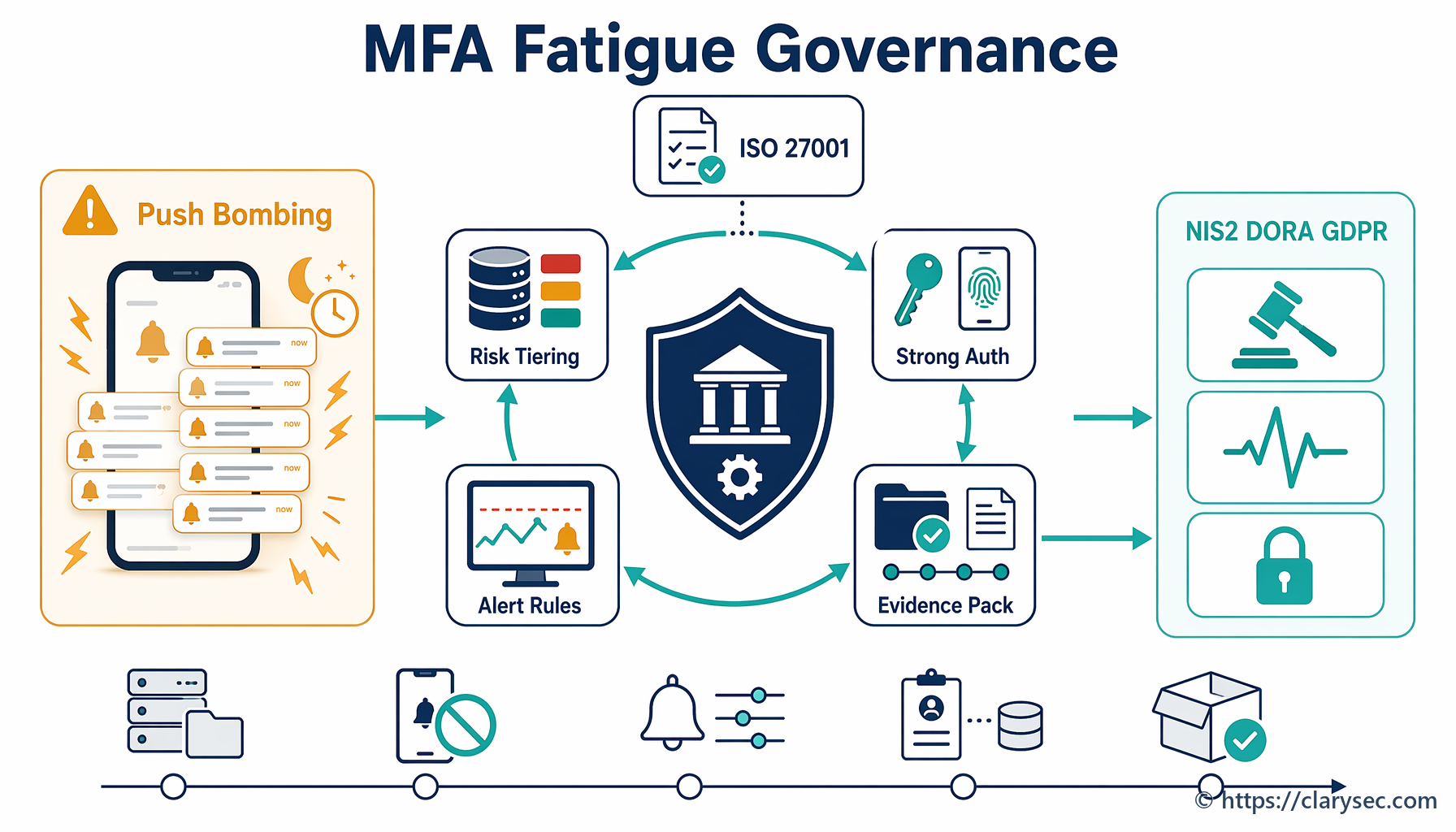
The 2:13 a.m. push notification that became a board question
At 2:13 a.m., a senior finance administrator receives a mobile notification: “Approve sign-in?” She is half asleep, assumes it is a timeout from a cloud finance platform, and taps approve.
By 2:19 a.m., the attacker is inside the identity provider. By 2:31 a.m., they are attempting access to a payroll export, a privileged cloud console, and a shared mailbox used for supplier payments. By 3:05 a.m., the SOC sees repeated MFA prompts, unusual geography, a successful approval, and a new session from an unmanaged device.
The morning conversation is familiar:
- “But we had MFA.”
- “Why did the user approve it?”
- “Did we log the MFA challenge details?”
- “Is this a personal data breach?”
- “Do we have 24-hour or 72-hour reporting obligations?”
- “Will our ISO 27001:2022 auditor treat this as a control failure?”
- “Does this affect NIS2, DORA, GDPR, customer contracts, or cyber insurance?”
This is the governance gap behind MFA fatigue and push bombing. Attackers are not breaking cryptography. They are exhausting human decision-making, exploiting weak authentication design, and looking for unmonitored exceptions. The control failure is rarely “MFA not enabled.” It is usually a chain of weak identity assurance, risky push approval design, missing number matching, unclear privileged access rules, insufficient authentication logging, poor alert triage, undertrained users, and no documented evidence that the organization reviewed and corrected the weakness.
For CISOs, compliance managers, auditors and business owners, MFA fatigue must be treated as an ISMS evidence problem, not only an identity provider setting. The answer combines ISO 27001:2022 risk treatment, ISO/IEC 27002:2022 controls, policy obligations, user awareness, incident response, supplier governance, and cross-framework mappings for NIS2, DORA, GDPR, NIST CSF 2.0 and COBIT 2019.
MFA fatigue is an assurance failure, not a user problem
MFA fatigue, also called push bombing or prompt bombing, occurs when an attacker with a valid password repeatedly triggers MFA approval requests until the user accepts one. Sometimes the attacker adds social engineering, such as a fake helpdesk call, a message claiming “we are testing your account,” or a request to approve a login to stop notifications.
The operational danger is that organizations often treat all MFA as equivalent. It is not.
A simple “approve or deny” push notification is weaker than number matching, phishing-resistant FIDO2 security keys, certificate-based authentication, or conditional access that blocks impossible travel and unmanaged devices. MFA also fails when bypass exceptions are undocumented, service accounts are interactive, legacy protocols remain open, or high-risk access does not require stronger authentication.
In the Zenith Blueprint: An Auditor’s 30-Step Roadmap, Clarysec frames secure authentication in the Controls in Action phase, Step 19: Technological Controls I. The guidance is direct:
Authentication is the first and most critical line of defense between a threat actor and your systems, data, and services. If authentication is weak, everything else, encryption, monitoring, segmentation, can be bypassed.
The same Zenith Blueprint also addresses ISO/IEC 27002:2022 control 5.17 in Step 22:
If identity is the question, “Who are you?”, then authentication is the proof. Control 5.17 is where theory meets trust. It requires that authentication information be managed securely throughout its entire lifecycle, ensuring that the methods and credentials used to verify identity cannot themselves become the weakest link.
Those two statements explain why push bombing belongs in the risk register. Encryption does not help if the attacker becomes an approved user. Network segmentation helps less if privileged cloud access is approved through a fatigued prompt. Monitoring only works if authentication events are logged in enough detail and reviewed quickly.
A mature risk statement should be explicit:
| Risk scenario | Likely cause | Impact | Primary treatment |
|---|---|---|---|
| User approves fraudulent MFA push after password compromise | Repeated prompts, weak push design, poor awareness | Unauthorized access, data exposure, fraud | Phishing-resistant MFA or number matching, prompt limits, user training, alerting |
| Administrator approves unexpected MFA request | Shared device, remote work, no privileged access hardening | Cloud compromise, privilege escalation | Hardware keys for admins, conditional access, privileged access reviews |
| Attacker uses supplier account with MFA exception | Supplier access not governed, exception not reviewed | Third-party path into critical service | Supplier MFA clauses, exception register, monitoring of external identities |
| SOC misses repeated MFA failures | Logs incomplete or not monitored | Delayed detection and reporting | Authentication log scope, SIEM rules, incident escalation playbook |
This is where ISO 27001:2022 matters. The standard requires context, interested parties, leadership, risk assessment, treatment planning, operational control, monitoring, internal audit, management review and continual improvement. MFA fatigue touches all of them.
The ISO 27001:2022 control cluster auditors will test
ISO 27001:2022 provides the management system structure. ISO/IEC 27002:2022 provides implementation guidance for controls. For MFA fatigue and push bombing, auditors will usually focus on a cluster rather than a single control.
| ISO/IEC 27002:2022 control | Why it matters for MFA fatigue | Evidence auditors expect |
|---|---|---|
| 5.17 Authentication information | Governs passwords, tokens, MFA seeds, certificates, recovery codes and authenticator lifecycle | Credential lifecycle procedure, MFA enrollment records, reset controls, exception approvals |
| 8.5 Secure authentication | Requires authentication mechanisms appropriate to risk | MFA policy, conditional access configuration, number matching, phishing-resistant MFA for privileged access |
| 8.15 Logging | Provides authentication event data needed for investigation | Successful and failed login logs, MFA usage, session duration, device and location context |
| 8.16 Monitoring activities | Detects anomalous authentication behavior | SIEM rules, alert tickets, triage records, repeated MFA prompt detections |
| 8.2 Privileged access rights | Ensures privileged access receives stronger governance | Admin access reviews, privileged MFA enforcement, break-glass controls |
| 8.3 Information access restriction | Limits what authenticated users can reach | Role-based access records, data access restrictions, least privilege reviews |
| 5.24 Information security incident management planning and preparation | Establishes incident handling readiness | Authentication incident playbooks, roles, escalation paths |
| 5.25 Assessment and decision on information security events | Ensures alerts are assessed consistently | Event triage records, severity decisions, escalation decisions |
| 5.26 Response to information security incidents | Drives containment and recovery | Session revocation records, password reset evidence, root cause analysis |
| 5.34 Privacy and protection of PII | Links authentication incidents to privacy obligations | PII access analysis, breach assessment, notification decision log |
| 5.19 to 5.22 Supplier relationships | Covers supplier access and supplier service monitoring | Supplier MFA clauses, external account reviews, provider monitoring reports |
Clarysec’s Zenith Controls: The Cross-Compliance Guide maps ISO/IEC 27002:2022 control 8.5 Secure authentication to supporting controls such as 5.17 Authentication information, 8.2 Privileged access rights, 8.16 Monitoring activities, 5.24 Information security incident management planning and preparation, and 5.34 Privacy and protection of PII. This cross-link is important because a screenshot showing “MFA enabled” is not enough. Auditors want proof that authentication is designed, monitored, reviewed and improved based on risk.
A defensible evidence package should include:
- Risk assessment identifying push bombing and social engineering of MFA prompts.
- Authentication standard defining acceptable MFA methods by system criticality.
- Privileged access policy requiring stronger authentication for admin and remote access.
- Identity provider configuration export showing number matching, prompt limits, conditional access and blocked legacy authentication.
- Logs showing successful and failed MFA events, denied prompts, impossible travel and device context.
- Alert rules for repeated MFA prompts, repeated failures and unusual successful approval.
- Incident response records for authentication-related alerts.
- Awareness training content telling users not to approve unexpected prompts.
- Access review records for privileged and high-impact systems.
- Exception register with expiry dates, risk owner approvals and compensating controls.
Policy turns “do not approve unexpected prompts” into evidence
Many organizations tell users not to approve suspicious prompts. That advice is useful, but it is not enough for ISO 27001:2022 certification, NIS2 oversight, DORA resilience, GDPR accountability, customer due diligence, or cyber insurance.
The first policy anchor is P38 Secure Communications and Multi-Factor Authentication (MFA) Policy. It addresses the human side directly:
User Awareness: Users shall receive training to distinguish secure from insecure communication channels. Training shall cover the proper use of Multi-Factor Authentication (MFA) (e.g., not approving unexpected login prompts) and secure communication practices (e.g., verifying video conference links and not discussing confidential topics over unsecured lines).
This turns MFA fatigue into a training obligation, not a blame exercise. It allows the CISO to show that prompt bombing is covered in onboarding, refresher training, role-based training and privileged user briefings.
The same P38 Secure Communications and Multi-Factor Authentication (MFA) Policy also creates a monitoring obligation:
Information Security shall continuously monitor authentication logs for any single-factor login attempts or anomalous Multi-Factor Authentication (MFA) failures. Logs from secure communication systems, where applicable, shall be monitored for unauthorized access attempts or configuration changes.
For SMEs, P11S User Account and Privilege Management Policy - SME sets a practical baseline:
Multi-factor authentication (MFA) must be enabled, where technically feasible, for administrator accounts or sensitive systems.
The phrase “where technically feasible” should never become a loophole. If a system cannot support strong MFA, the exception must be recorded with an owner, expiry date, compensating controls, monitoring and a migration plan. Larger organizations can align the same expectation to P11 User Account and Privilege Management Policy, then test whether policy and operational reality match.
Detection evidence comes from P22S Logging and Monitoring Policy - SME, which requires authentication event logging:
Authentication logs: Successful and failed login attempts, session duration, MFA usage
It also requires urgent review of high-risk authentication signals:
Immediate review upon detection of high-severity alerts (e.g., malware, failed multi-factor authentication (MFA), repeated login failures)
Awareness must evolve as threats evolve. Information Security Awareness and Training Policy - SME supports that loop:
Topics must include emerging threats (e.g., phishing), relevant policy changes, and internal incident trends.
When the SOC detects MFA fatigue attempts, that intelligence should feed user alerts, helpdesk scripts, tabletop exercises and training updates.
A governed MFA fatigue control pack
Assume your organization uses a cloud identity provider, a SaaS CRM, a finance platform, a VPN, and a managed security provider. The goal is to govern MFA fatigue using Clarysec’s Zenith Blueprint, policy library and Zenith Controls cross-compliance guide.
Start with Step 19 in the Zenith Blueprint, which instructs teams to define authentication requirements per system and warns that password-only authentication should be avoided for administrative accounts, cloud consoles, remote access tools and internet-exposed systems. Then apply the practical review activity:
Review your MFA deployment: identify any gaps and plan to close them. Validate that service accounts are non-interactive where possible, have strong credentials, and are documented. Confirm no default credentials remain on any system or application.
Convert that guidance into an operating control pack.
Step 1: classify systems by authentication risk
| System | Risk factor | MFA fatigue governance decision | Evidence |
|---|---|---|---|
| Identity provider admin console | Privileged access to all systems | Phishing-resistant MFA only, no simple push approval | Conditional access policy export |
| Finance platform | Payment and supplier data | Number matching plus device compliance | MFA settings screenshot and access review |
| VPN | Remote network access | MFA required with prompt limits | VPN authentication logs |
| CRM | Customer PII | Number matching for all users and stronger MFA for admins | Authentication policy and logs |
| MSP access account | Third-party privileged access | Named accounts, strong MFA and session logging | Supplier access agreement and monitoring report |
Step 2: remove high-risk push behavior
For administrator and high-impact accounts, disable basic push approval. Use phishing-resistant authenticators where possible. Where push remains, enforce number matching, application context, geographic context, device binding and prompt rate limits. Block legacy authentication and require reauthentication for risky sessions.
Step 3: define alert rules for MFA fatigue
A practical SIEM rule should trigger when one or more of these patterns occurs within a short window:
- Three or more MFA push prompts for one user.
- Two denied prompts followed by one approved prompt.
- MFA approval from a new geography or unmanaged device.
- MFA prompt following a password spray or credential stuffing signal.
- MFA approval for privileged access outside normal working hours.
- New authenticator registration shortly after failed login attempts.
The alert should create an incident ticket, notify the SOC or security lead, and require containment steps: suspend session, revoke refresh tokens, require password reset, verify device, interview user, review access during the session, and classify whether personal data or critical service impact occurred.
Step 4: link privacy and incident records
If the account can access personal data, apply PII Security and Access Control Policy. It requires strong authentication before high-impact PII access:
[Both] The Information Security Lead MUST require strong authentication for privileged, remote, administrative or high-impact PII access before such access is enabled and record the requirement in REG12.
It also requires logging scope to be defined:
[Both] The System Owner / Application Owner MUST define the PII logging scope for authentication events, access events, privileged actions, PII export activity and material configuration changes in REG12 before production use or material change.
When monitoring suggests unauthorized PII access, it creates an incident record obligation:
[Conditional] The Incident Response Coordinator MUST open or link a REG10 record within one business day when monitoring indicates suspected unauthorized PII access, suspected PII disclosure, suspected PII alteration or suspected PII availability loss.
The privacy escalation is completed by PII Incident and Breach Management Policy:
[Conditional] The Privacy Lead / PIMS Manager MUST evaluate applicable legal, sectoral, financial-sector, cybersecurity, contractual, customer, and service-recipient reporting triggers for each high-impact PII incident and record the applicability outcome in REG01, REG08, and REG10.
This is what turns an MFA alert into audit-ready evidence across security, privacy and compliance.
NIS2, DORA and GDPR: one incident, different questions
MFA fatigue is a useful cross-compliance stress test because it touches governance, cyber hygiene, access control, incident detection, supplier access and breach reporting.
| Framework | What the MFA fatigue evidence must answer | Practical evidence |
|---|---|---|
| NIS2 Directive | Did management approve and oversee appropriate cybersecurity risk-management measures, including access control, training, incident handling and MFA where appropriate? | Board reporting, risk treatment plan, MFA policy, training evidence, NIS2 reporting assessment |
| DORA Regulation | Did the financial entity manage ICT risk, detect anomalous activity, classify incidents and feed lessons learned into resilience controls? | ICT asset mapping, strong authentication configuration, incident classification, root cause analysis, third-party access review |
| GDPR | Did the controller or processor apply security appropriate to risk and assess whether unauthorized personal data access occurred? | PII logging scope, REG10 record, breach assessment, Article 32 control evidence, Article 33 notification decision |
NIS2: management accountability and cyber hygiene
NIS2 applies to many essential and important entities, depending on sector, size and Member State designation. Article 20 places accountability on management bodies to approve cybersecurity risk-management measures, oversee implementation and receive training. Article 21 requires appropriate technical, operational and organizational measures, including incident handling, cyber hygiene, supply-chain security, access control, asset management, training, and multi-factor or continuous authentication where appropriate. Article 23 introduces staged incident reporting obligations for significant incidents, including early warning within 24 hours of becoming aware and incident notification within 72 hours.
A push bombing incident therefore becomes a board-level question: was MFA securely designed, or merely enabled?
DORA: authentication as digital operational resilience
For covered financial entities, DORA applies from 17 January 2025. It expects ICT risk management, detection, response, recovery, incident reporting, digital operational resilience testing and ICT third-party risk management.
DORA Article 9 addresses protection and prevention, including access control and authentication measures. Article 10 addresses detection of anomalous activity. Article 17 requires an ICT-related incident management process. In a DORA context, MFA fatigue evidence should show that affected ICT assets were identified, monitoring detected anomalous behavior, the incident was classified using impact criteria, senior management was escalated where required, and lessons learned were fed back into the ICT risk framework.
GDPR: security of processing and accountability
GDPR Article 5(1)(f) requires integrity and confidentiality. Article 5(2) requires accountability. Article 32 requires security appropriate to risk. Article 4 defines a personal data breach as a breach of security leading to accidental or unlawful destruction, loss, alteration, unauthorized disclosure of, or access to personal data.
If an MFA fatigue incident touches personal data, the evidence question is simple: can the organization demonstrate appropriate authentication controls, monitoring, incident response and breach assessment?
Crosswalk for ISO, NIST CSF 2.0, COBIT 2019 and audit evidence
NIST CSF 2.0 is useful because it translates MFA governance into GOVERN, IDENTIFY, PROTECT, DETECT, RESPOND and RECOVER outcomes.
| NIST CSF 2.0 function | MFA fatigue governance activity |
|---|---|
| GOVERN | Define authentication policy, risk appetite, roles, legal obligations and supplier expectations |
| IDENTIFY | Inventory systems, privileged accounts, PII repositories, supplier identities and authentication methods |
| PROTECT | Enforce phishing-resistant MFA, number matching, conditional access and secure credential management |
| DETECT | Monitor MFA failures, prompt bombing, impossible travel and suspicious successful approvals |
| RESPOND | Triage alerts, revoke sessions, reset credentials, preserve evidence and notify stakeholders |
| RECOVER | Restore trusted access, update controls, complete lessons learned and management reporting |
COBIT 2019 adds governance clarity. A COBIT-oriented auditor may look to DSS05.04 Manage identity and logical access, DSS05 Manage security services, APO13 Managed security and MEA03 Managed compliance with external requirements. The focus is not the MFA vendor. It is whether authentication supports business objectives, whether access rights are governed, whether monitoring is effective, and whether management receives meaningful assurance.
A consolidated mapping helps compliance teams avoid fragmented evidence requests:
| ISO/IEC 27002:2022 control | NIS2 | DORA | GDPR | NIST and COBIT audit lens |
|---|---|---|---|---|
| 5.17 Authentication information | Article 21 risk-management measures and access control | Article 9 protection and prevention | Article 32 security of processing | NIST SP 800-53 IA-5, COBIT DSS05.04 |
| 8.5 Secure authentication | Article 21 multi-factor or continuous authentication where appropriate | Article 9 strong authentication and access controls | Article 32 appropriate technical measures | NIST CSF PROTECT, COBIT DSS05.04 |
| 8.15 Logging | Article 21 incident handling and control effectiveness | Article 10 detection support and Article 17 incident process | Article 33 breach assessment support | NIST SP 800-53 AU family, COBIT DSS05 |
| 8.16 Monitoring activities | Article 21 detection and Article 23 reporting readiness | Article 10 anomalous activity detection | Article 33 and 34 breach notification support | NIST SP 800-53 SI-4, NIST CSF DETECT |
| 5.24 to 5.26 Incident management | Article 23 staged incident reporting | Article 17 ICT incident management | Article 33 notification within 72 hours where required | NIST CSF RESPOND, COBIT DSS02 and DSS05 |
What auditors and regulators will ask for
A strong MFA fatigue program should survive multiple audit styles. Clarysec’s Zenith Controls cross-compliance guide shows how ISO/IEC 27002:2022 controls are tested across ISO, NIST, COBIT and ISACA methodologies.
| Auditor background | What they will likely ask | Evidence that answers well |
|---|---|---|
| ISO 27001:2022 certification auditor | Is MFA fatigue risk identified, treated, implemented and reviewed within the ISMS? | Risk register, Statement of Applicability, authentication policy, configuration exports, internal audit results |
| ISO/IEC 27007-style ISMS auditor | Are authentication controls operating effectively and aligned to risk? | MFA coverage reports, privileged access reviews, failed prompt alert tickets |
| NIST assessor | Are authenticator management, access control, audit logging, monitoring and incident response outcomes implemented? | Authenticator records, lockout settings, audit review evidence, incident response records |
| COBIT 2019 auditor | Are identity, access, monitoring and compliance processes governed and measured? | Control ownership, KRIs, management reports, exception register, remediation tracking |
| ISACA ITAF auditor | Is evidence sufficient, reliable and traceable? | Time-stamped logs, screenshots, tickets, approvals, user interviews, test results |
| Privacy auditor | Did unauthorized access to PII trigger assessment and appropriate action? | REG10 incident record, REG12 logging scope, breach assessment, notification decision log |
| NIS2 or DORA regulator | Did the organization detect, escalate, classify and improve after the incident? | Alert timeline, incident ticket, executive escalation, root cause analysis, corrective action plan |
A weak program says, “We asked the user and reset the password.” A governed program produces a SIEM alert, incident ticket, session revocation record, password reset evidence, MFA factor review, access log analysis, PII assessment, reporting trigger evaluation, root cause statement, corrective actions and management review input.
A 30-day action plan for MFA fatigue governance
The goal is not perfection in 30 days. The goal is visibility, ownership and evidence.
Week 1: identify and scope
- List all identity providers, VPNs, cloud consoles, SaaS platforms and privileged access tools.
- Identify systems with personal data, financial data, production access or service-impacting functions.
- Export current MFA methods and exceptions.
- Identify external and supplier accounts.
- Add MFA fatigue and push bombing to the risk register.
- Assign a risk owner and treatment owner.
Week 2: harden authentication
- Disable legacy authentication.
- Require phishing-resistant MFA for administrators where feasible.
- Enable number matching and application context for push MFA.
- Apply conditional access for location, device compliance and impossible travel.
- Limit repeated push prompts.
- Require reauthentication for high-risk actions.
- Make service accounts non-interactive where possible.
- Document exceptions with expiry and compensating controls.
Week 3: monitor and rehearse
- Ensure authentication logs capture success, failure, session duration and MFA usage.
- Create alert rules for repeated prompts, denied prompts followed by approval, new device registration and unusual location.
- Test alerts with a controlled simulation.
- Validate incident ticket creation and escalation.
- Train users with a short “unexpected MFA prompt” exercise.
- Update helpdesk scripts to prevent social engineering during password resets and MFA re-enrollment.
Week 4: evidence and management review
- Store configuration exports and screenshots.
- Record access review outcomes.
- Link training completion to privileged users.
- Review incidents and near misses.
- Update the Statement of Applicability and treatment plan.
- Present residual risk and metrics to management.
- Schedule internal audit sampling.
Make MFA fatigue auditable before it becomes reportable
MFA fatigue is a reminder that security controls fail at the seams: between identity and monitoring, between policy and training, between suppliers and internal access, between incident response and privacy reporting.
The organizations that manage it well do not simply “turn on MFA.” They govern authentication as a lifecycle, monitor it as a threat signal, train users as part of the control, and preserve evidence as part of the ISMS.
Clarysec brings three assets together:
- The Zenith Blueprint: An Auditor’s 30-Step Roadmap, especially Step 19 for secure authentication, Step 22 for authentication information, and Step 16 for personnel-driven incident reporting.
- Clarysec policy templates, including P38 Secure Communications and Multi-Factor Authentication (MFA) Policy, P22S Logging and Monitoring Policy - SME, P11S User Account and Privilege Management Policy - SME, Information Security Awareness and Training Policy - SME, PII Security and Access Control Policy, and PII Incident and Breach Management Policy.
- Zenith Controls: The Cross-Compliance Guide, which maps ISO/IEC 27002:2022 controls 5.17, 8.5, 8.15 and 8.16 to supporting controls, ISO audit expectations, GDPR, NIS2, DORA, NIST and COBIT.
If you are a CISO, compliance manager, auditor or business owner, run a one-week MFA fatigue evidence review. Pull your MFA configuration, authentication logs, privileged access list, supplier access list, incident playbook, training material and exception register. If those artefacts do not tell one coherent story, Clarysec can help you build the control pack before an attacker, auditor or regulator asks for it.
Explore the Zenith Blueprint, review Zenith Controls, or schedule a Clarysec discovery call to turn MFA fatigue from a board-level surprise into a defensible, auditable authentication program.
About the Author

Igor Petreski
Compliance Systems Architect, Clarysec LLC
Igor Petreski is a cybersecurity leader with over 30 years of experience in information technology and a dedicated decade specializing in global Governance, Risk, and Compliance (GRC).Core Credentials & Qualifications:• MSc in Cyber Security from Royal Holloway, University of London• PECB-Certified ISO/IEC 27001 Lead Auditor & Trainer• Certified Information Systems Auditor (CISA) from ISACA• Certified Information Security Manager (CISM) from ISACA • Certified Ethical Hacker from EC-Council