Health Data Governance for EHDS Readiness
It is 08:20 on a Monday morning, and the meeting invite has a deceptively simple title: “EHDS Readiness.”
Anya, the CISO of a fast-growing MedTech company, joins the call with the privacy lead, clinical operations director, procurement owner, and legal counsel. A hospital group wants to connect its patient portal to the company’s analytics platform. A research partner wants pseudonymized datasets. A cloud provider stores backups in several EU regions. A support vendor may need temporary access to production logs. Legal asks whether the organization is acting as a controller, processor, joint controller, or subprocessor for each data flow.
Then the board asks the question that matters most: “Can we prove that we are ready for the European Health Data Space?”
That question is not asking for a list of regulations. It is asking whether the organization can demonstrate controlled, lawful, secure, and accountable health data processing under pressure. GDPR already treats health data as special category personal data. ISO/IEC 27701:2025 raises expectations for a privacy information management system, or PIMS, that shows accountability in practice. ISO/IEC 27001:2022 provides the management-system foundation for security risk, operational control, internal audit, management review, and continual improvement. NIS2 adds cybersecurity governance, incident handling, and supply chain resilience for many healthcare, digital, cloud, SaaS, and ICT service ecosystems. DORA may also matter where health data connects to insurance, payments, regulated financial services, or ICT services supporting financial entities.
The real challenge is not knowing that health data is sensitive. Everyone knows that. The challenge is proving that every collection, sharing event, processor relationship, access grant, retention rule, and DPIA decision is governed, reviewed, and evidenced.
Clarysec’s approach is intentionally practical. We connect the Zenith Blueprint: An Auditor’s 30-Step Roadmap, the PIMS policy set, and Zenith Controls: The Cross-Compliance Guide into a working health data governance model that can survive both a regulator’s question and an auditor’s sampling request.
Why health data governance is different
Health data is not just another field in a data inventory. It can reveal diagnoses, treatments, genetic indicators, disabilities, medication history, mental health status, biometric identifiers, fertility information, clinical outcomes, and details about relatives or vulnerable individuals.
GDPR Article 9 treats health data as special category personal data and generally prohibits processing unless a specific condition applies. Examples include explicit consent, healthcare purposes, public health, research with safeguards, vital interests, or another lawful condition grounded in EU or Member State law. GDPR Article 5 also turns privacy principles into an accountability obligation. Personal data must be processed lawfully, fairly, and transparently, collected for specified and legitimate purposes, minimized, kept accurate, retained only as long as necessary, and protected against unauthorized or unlawful processing and accidental loss, destruction, or damage. The controller must be able to demonstrate compliance.
For EHDS readiness, health data governance must answer seven operational questions:
- What health data do we process, and where is it stored?
- Which role do we play for each activity, controller, processor, joint controller, or subprocessor?
- What lawful basis and special category condition apply?
- Has privacy risk screening or a DPIA been completed before high-risk processing begins?
- Who can access health data, and how often is that access reviewed?
- Which recipients, processors, subprocessors, and cloud providers are involved?
- What evidence proves retention, pseudonymization, secure transfer, incident readiness, and supplier assurance?
ISO/IEC 27701:2025 helps structure these answers as a PIMS. ISO/IEC 27001:2022 provides the backbone through context, scope, leadership, risk assessment, treatment, the Statement of Applicability, operational control, monitoring, internal audit, management review, and improvement. Clauses 4.1 to 4.4 require organizations to define context, interested parties, requirements, scope, and dependencies. That is the right starting point for EHDS readiness because health data flows usually involve hospitals, labs, cloud platforms, clinical partners, research organizations, support vendors, and sometimes public sector bodies.
The mistake we see in real projects is treating health data governance as a privacy notice exercise. A privacy notice matters, but it does not prove that a support engineer cannot export patient logs, that a research dataset is properly pseudonymized, that a processor contract has Article 28 terms, or that a retention job actually deleted expired records.
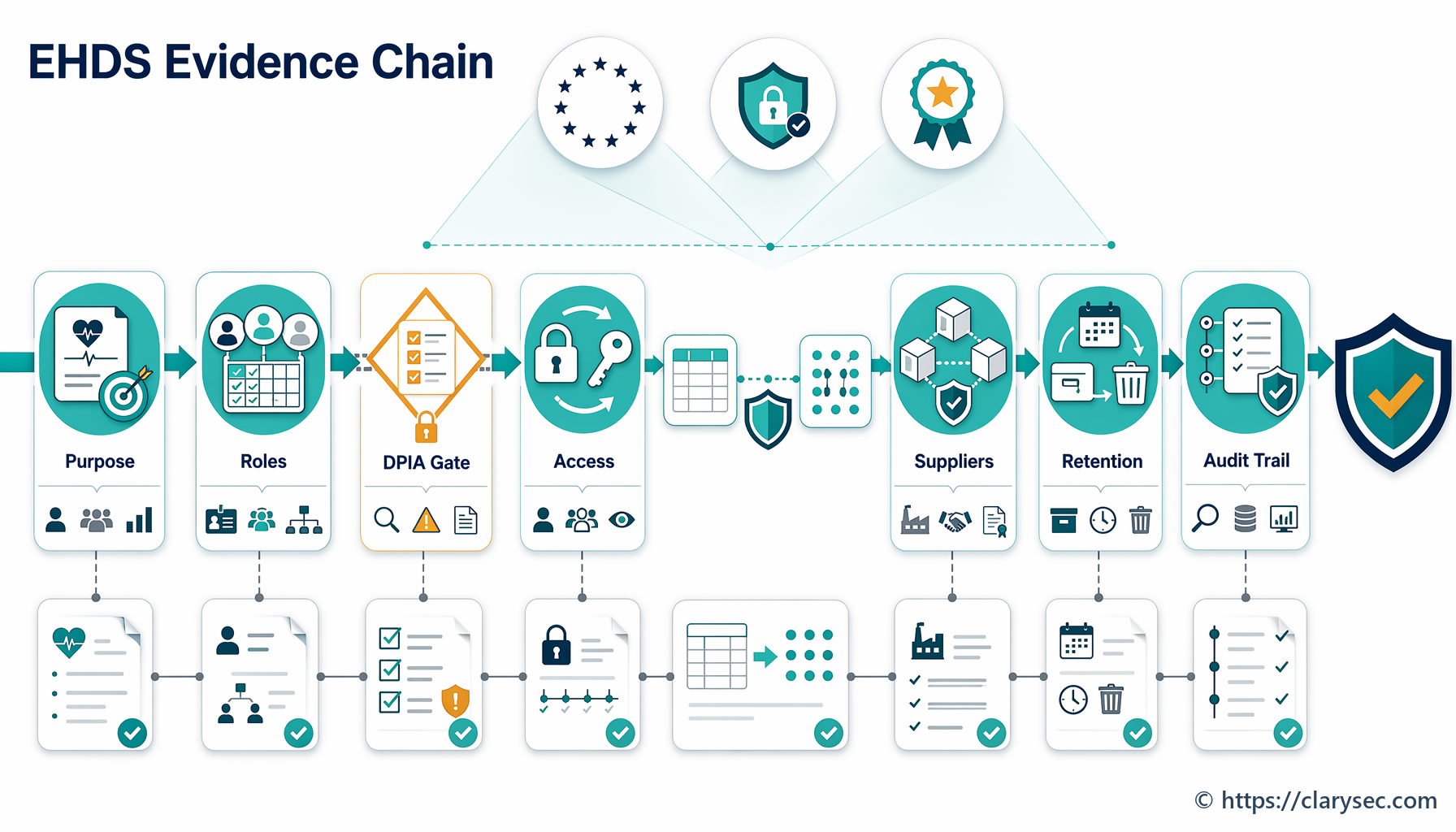
The Clarysec model: one evidence chain from purpose to disposal
Clarysec’s health data governance model starts with a simple principle: if you cannot trace health data from purpose to disposal, you do not have EHDS readiness, you have documentation risk.
The Zenith Blueprint captures the privacy control mindset clearly in Step 23, Organizational controls 5.19 to 5.37:
“personally identifiable information isn’t just another data type, it’s a deeply sensitive representation of trust.”
That statement is especially true for health data. A patient does not experience a breach as a control failure. They experience it as a loss of dignity, confidentiality, and confidence in the care ecosystem.
Clarysec builds the evidence chain using four connected layers.
| Layer | Health data governance question | Clarysec artifact |
|---|---|---|
| Processing governance | Why are we processing this health data, under which role, lawful basis, and special category condition? | PII inventory, lawful basis record, REG02 |
| Privacy risk governance | Is this high-risk processing, and has DPIA screening been completed before processing starts? | Privacy risk assessment, DPIA workflow, REG04 |
| Sharing and supplier governance | Who receives the data, where is it processed, and what contractual controls apply? | External sharing register, vendor due diligence, REG08 |
| Access and evidence governance | Who has access, how is access reviewed, and what logs prove control operation? | Access review register, logging evidence, REG12 |
This is how an organization can walk into an audit and show that the same health data use case is covered by business purpose, privacy law, information security controls, supplier assurance, and operational evidence.
Start with role clarity before you design controls
Health data projects often fail at the first governance hurdle because teams cannot agree on roles. A hospital may be the controller for patient care. A digital health platform may be a processor for hosting portal data. The same platform may be a controller for its employee records or customer account management. Two research institutions may be joint controllers if they jointly determine study purposes and means. A cloud analytics provider may be a subprocessor.
Clarysec’s PIMS policy set is designed around that role reality. It uses PIMS operating role tags such as Both, Controller, Processor, Joint Controller, and Subprocessor. This matters because obligations change depending on whether the organization determines purposes and means or processes data on documented instructions.
For controller-side health data, the PII Processing Inventory and Lawful Basis Policy requires the special category condition to be recorded before processing. Clause 4.2.6 from the Controller purpose and lawful basis records section states:
“[Conditional] The Process Owner / Business Owner MUST record the special category processing condition in REG02 before processing special category PII.”
For EHDS readiness, this is one of the most important controls in the governance stack. It prevents “we collect it because the platform needs it” thinking. A health data field must have a purpose, a lawful basis, a special category condition, a retention rule, an owner, and a processing context.
A practical health data processing register can look like this.
| Register field | Example for a remote monitoring platform |
|---|---|
| Processing activity | Continuous collection of blood pressure readings |
| PIMS role | Processor for hospital customer, controller for platform account data |
| Data categories | Patient ID, device ID, readings, timestamp, alert status |
| Purpose | Remote care monitoring and clinical escalation |
| GDPR lawful basis | Documented per controller instruction or controller legal basis |
| Article 9 condition | Healthcare-related purpose or other documented special category condition |
| Retention period | Contractual and clinical retention schedule |
| Data location | EU cloud region and backup region |
| Recipients | Hospital users, support provider, hosting provider |
| DPIA reference | REG04-DPIA-2026-011 |
| Access review reference | REG12-Q2-2026 |
The Data Protection and Privacy Policy - SME expresses the same discipline in a form smaller organizations can operationalize. Clause 5.2.1 from Governance Requirements states:
“The Privacy Coordinator must maintain a register of all personal data processing activities, including data categories, purpose, lawful basis, and retention periods”
That register becomes the anchor for privacy notices, processor agreements, access control design, retention configuration, and audit sampling.
DPIAs are change-control gates, not paperwork
Under GDPR, high-risk processing can trigger a DPIA. In health data contexts, risk is rarely hypothetical. Large-scale processing, systematic monitoring, profiling, vulnerable individuals, special category data, and innovative technology can all require structured privacy risk assessment.
The Privacy Risk Assessment and DPIA Policy turns this into a pre-processing gate. Clause 4.2.2 from the DPIA triggers and requirement determination section states:
“[Controller] The Process Owner / Business Owner MUST refer processing involving large scale, systematic monitoring, profiling, automated decisions, special category PII, criminal conviction or offence data, vulnerable PII principals, innovative technology, or materially changed processing to the Privacy Lead / PIMS Manager in REG04 before processing begins.”
This clause prevents a common failure pattern: engineering builds the integration, sales announces the go-live date, and privacy is asked to approve the project after the architecture is fixed.
In the Zenith Blueprint, privacy is integrated with security change review. Step 23 addresses ISO/IEC 27002:2022 control 5.34, Privacy and Protection of PII, and links it to data awareness, classification, access control, masking, deletion, and encryption. Step 19 adds practical audit checks for data minimization, information deletion, masking, pseudonymization, test data, and data leakage prevention. A DPIA is therefore not just a legal memo. It should produce technical and organizational actions.
A practical Clarysec DPIA workflow for a new EHDS-facing sharing project follows this sequence:
- Create or update the REG02 processing record for the health data flow.
- Trigger REG04 screening because special category health data and external sharing are involved.
- Identify risks to confidentiality, integrity, availability, patient rights, fairness, purpose limitation, and re-identification.
- Select controls such as pseudonymization, role-based access, EU hosting restriction, supplier clauses, logging, retention limits, DLP, encryption, and incident playbooks.
- Update REG08 with recipient identity, role, processing location, sharing frequency, and authority source.
- Update REG12 with quarterly access review requirements for systems processing sensitive PII.
- Link the risk treatment to the ISO/IEC 27001:2022 risk register and Statement of Applicability.
- Schedule evidence review in internal audit and management review.
The key is that each decision leaves a trail.
Access control must be specific, reviewed, and evidenced
Most health data breaches do not require a sophisticated attacker. Sometimes the problem is excessive access, shared admin accounts, production data copied to testing, or support users retaining access after a project ends.
Clarysec’s enterprise Data Protection and Privacy Policy states:
“All systems shall enforce least privilege access by default.”
The SME Data Protection and Privacy Policy - SME expresses the same operational expectation in plain terms:
“User access to personal data must be limited to roles with a documented business need”
For ISO/IEC 27701:2025 and GDPR health data governance, least privilege must reflect clinical roles, support roles, analytics roles, research roles, emergency access, break-glass procedures, and separation between production and non-production environments.
The PII Security and Access Control Policy adds a concrete evidence requirement. Clause 4.2.3 from the Access control baseline section states:
“[Both] The System Owner / Application Owner MUST review user access to systems processing high-impact or sensitive PII at least quarterly and record the review outcome in REG12.”
Quarterly access review evidence is audit gold. A privacy auditor can sample REG12 and compare it against HR records, ticket approvals, privileged access logs, and application roles. A security auditor can test whether privileged users have MFA, session logging, and emergency access monitoring. A COBIT 2019 or ISACA auditor will usually look for process ownership, control performance, exceptions, and management oversight.
A strong health data access review should confirm that every user has an assigned business owner, every role matches current job function or contractual purpose, dormant accounts are removed, privileged accounts are separated from normal accounts, emergency access is logged and reviewed, support vendor access is time-bound and ticket-linked, API keys and service accounts are included, pseudonymized dataset access remains restricted, and approvals, removals, exceptions, and remediation dates are recorded in REG12.
Auditors do not just ask whether access reviews happen. They ask what changed because of the review.
Pseudonymization is a safeguard, not magic erasure
EHDS readiness will increase attention on secondary use, research, analytics, quality improvement, and data sharing. Pseudonymization is often the right safeguard, but it does not automatically remove data from privacy governance. Re-identification risk, linkage keys, small cohorts, rare disease indicators, and metadata can all preserve sensitivity.
Clarysec’s Data Masking and Pseudonymization Policy is explicit:
“Treat masked and pseudonymized datasets as sensitive data, subject to access logging, retention controls, and incident response procedures.”
The Data Masking and Pseudonymization Policy - SME gives a practical trigger:
“Pseudonymization must be used where data linkage is required without revealing identities:”
The Zenith Controls entry for ISO/IEC 27002:2022 control 5.34, Privacy and Protection of PII, classifies it as a preventive control tied to confidentiality, integrity, and availability. It connects 5.34 to related controls including 5.9 Inventory of information and other associated assets, 5.12 Classification of information, 5.14 Information transfer, 5.15 Access control, 5.16 Identity management, 5.23 Information security for use of cloud services, 8.10 Information deletion, 8.11 Data masking, and 8.12 Data leakage prevention.
That mapping matters. A pseudonymized research extract is not governed only by a masking script. It also needs classification, access approval, secure transfer, cloud controls, retention, logging, and change review. If the linkage key sits in the same environment as the dataset, or if analysts can combine datasets to identify rare conditions, the privacy risk remains high.
| Control objective | Practical implementation |
|---|---|
| Reduce identifiability | Replace direct identifiers with pseudonyms and remove unnecessary quasi-identifiers |
| Protect linkage keys | Store keys separately, restrict access, log all access, and assign accountable custodianship |
| Limit purpose | Bind dataset to the approved research question or contractual purpose |
| Control recipients | Record recipient identity, role, location, sharing frequency, and authority source in REG08 |
| Secure transfer | Use an approved encrypted portal, API, or SFTP aligned to data classification |
| Limit retention | Configure expiry and deletion workflow with evidence logs |
| Monitor usage | Review access logs, exports, and abnormal download behavior |
| Prepare for incidents | Include pseudonymized datasets in breach assessment and incident response scope |
Supplier and processor governance is where readiness often breaks
Health data ecosystems are supplier-heavy. Cloud hosting, managed security, helpdesk support, device manufacturers, API gateways, analytics vendors, e-signature platforms, identity providers, and research processors can all touch sensitive data or metadata.
GDPR Article 28 requires controllers to use processors providing sufficient guarantees and to bind processing through contractual terms. NIS2 also treats supply chain security as a core cybersecurity measure. Its governance model requires management bodies to approve and oversee cybersecurity risk-management measures and requires attention to direct suppliers, service providers, supplier vulnerabilities, cybersecurity practices, and secure development.
The Processor, Subprocessor and Third-Party Privacy Management Policy states:
“[Both] The Privacy Lead / PIMS Manager MUST trigger privacy risk and DPIA screening in REG04 for high-risk processor relationships and material third-party privacy changes before approval, with the REG04 reference recorded in REG08.”
The PII Collection, Use, Disclosure and Sharing Policy adds the sharing record:
“[Controller] The Vendor / Procurement Owner MUST record recipient identity, recipient role, disclosure purpose, PII categories, sharing frequency, processing location and authority source in REG08 before recurring external sharing begins.”
The enterprise Data Protection and Privacy Policy requires procurement and legal review of processor compliance:
“Procurement and Legal and Compliance teams shall verify compliance with Article 28 of the GDPR and require annual reassessment of all high-risk vendors.”
For SMEs, the Third-Party and Supplier Security Policy - SME focuses on a practical assurance point that appears constantly in health data audits. Clause 6.2.4 from Policy Implementation Requirements states:
“Where suppliers are required to store data off-site, the company must obtain assurance regarding data protection, physical security, and the geographic storage location (e.g., EU-only hosting where required by GDPR).”
The Zenith Blueprint, Step 23, control 5.20, Addressing Information Security Within Supplier Agreements, explains why this must be contractual, not assumed:
“Trust, when it comes to suppliers, cannot rest on assumptions. It must be codified.”
For health data, supplier agreements should include service descriptions, data categories, processing locations, subcontracting controls, confidentiality, access control, encryption, incident notification timelines, audit rights, deletion or return, secure development expectations, resilience commitments, and support for regulatory requests.
Retention and disposal are the forgotten EHDS evidence problem
Health data governance often focuses on collection and sharing, but retention is where many organizations accumulate silent risk. Old exports, test datasets, backup copies, abandoned research extracts, archived support tickets, and obsolete device logs can persist long after the original purpose has expired.
GDPR Article 5 requires storage limitation. The Data Retention and Disposal Policy links that principle to operational policy:
“Ensure retention of personally identifiable information (PII) complies with data privacy laws and organizational privacy notices”
The Zenith Controls entry for ISO/IEC 27002:2022 control 5.33, Protection of Records, connects records protection to 5.12 Classification of information, 5.15 Access control, 5.31 Legal, statutory, regulatory and contractual requirements, 5.36 Compliance with policies, rules and standards for information security, 7.14 Secure disposal or re-use of equipment, 8.10 Information deletion, 8.13 Information backup, and 5.26 Response to information security incidents. That is the lifecycle view auditors expect: records must be protected while needed, recoverable where required, restricted during use, and securely destroyed when retention ends.
In the Zenith Blueprint, Step 19 asks auditors to check that automated deletion and retention policies are enforced in repositories and cloud storage, secure erasure or cryptographic erasure is used for decommissioned systems, high-risk deletion logs are maintained and reviewed, and physical destruction is performed for obsolete media.
| Data category | Retention governance |
|---|---|
| Clinical operational data | Follow legal, contractual, and care-related retention requirements with documented controller instruction where applicable |
| Platform telemetry and logs | Minimize identifiers, define short operational retention, and protect logs as sensitive where they reveal health activity |
| Research and secondary use datasets | Bind to approved purpose, apply governance approval where applicable, and pre-set expiry or review date |
| Backups and archives | Align backup retention with business continuity needs and ensure restoration does not reintroduce expired data into active use |
A mature program also tests deletion. It is not enough to have a retention schedule. An auditor may ask for proof that a patient export expired, a research dataset was deleted, a backup aged out, and a vendor certified destruction at contract end.
Cross-compliance: one health data control model, many lenses
A health data governance program cannot be built separately for ISO/IEC 27701:2025, GDPR, ISO/IEC 27001:2022, NIS2, NIST CSF 2.0, COBIT 2019, and DORA. That creates duplicate registers, conflicting evidence, and exhausted teams.
Clarysec uses Zenith Controls as a cross-compliance compass. It does not invent parallel controls. It maps official control concepts into a single operational story.
| Governance area | GDPR and PIMS need | ISO/IEC 27001:2022 and ISO/IEC 27002:2022 support | NIS2, DORA, NIST, COBIT relevance |
|---|---|---|---|
| Health data inventory | Accountability, lawful basis, special category condition, role clarity | Scope, asset inventory, PII protection, classification | NIST GV.OC-03 obligations and COBIT governance objectives |
| DPIA and privacy risk | High-risk processing assessment and mitigation | Risk assessment, risk treatment, change-aware control design | NIST GV.RM risk method and NIS2 risk-management measures |
| Supplier assurance | Article 28, processor guarantees, subprocessor control | Supplier relationships, agreements, ICT supply chain, cloud governance | NIS2 supply chain, DORA ICT third-party risk, NIST GV.SC |
| Access control | Need-to-know and confidentiality | Access control, identity management, access rights, logging | NIS2 access and asset management, DORA confidentiality, COBIT monitoring |
| Retention and disposal | Storage limitation and accountability | Protection of records, deletion, backup, secure disposal | NIST improvement plans and COBIT information lifecycle governance |
| Incident readiness | Personal data breach assessment and notification | Incident planning, event assessment, response, evidence collection | NIS2 reporting model, DORA incident lifecycle, COBIT service continuity |
NIS2 is especially relevant for medium and larger entities in health, cloud, managed service, managed security, digital infrastructure, and other covered sectors. Its operational core resembles a management system: leadership accountability, risk analysis, incident handling, continuity, supply chain security, secure development, control effectiveness, training, cryptography, HR security, access control, asset management, and MFA where appropriate.
DORA matters where a health data organization serves regulated financial entities, insurance ecosystems, payment flows, or ICT services supporting financial-sector operations. Even when DORA is not directly applicable, its discipline is useful for health data processors that want to demonstrate resilience.
NIST CSF 2.0 provides executive language. Its GOVERN Function requires legal, regulatory, contractual, privacy, and civil liberties obligations to be understood and managed. Its Profiles method helps organizations define current and target states, analyze gaps, and create prioritized action plans. For health data, that profile can become the executive dashboard for EHDS readiness.
How auditors will test your health data governance
Different auditors approach the same health data environment from different angles. A strong program anticipates those lenses and prepares evidence once.
| Auditor profile | Key focus areas | Expected evidence |
|---|---|---|
| ISO/IEC 27001:2022 auditor | Scope, interested parties, risk assessment, risk treatment, Statement of Applicability, internal audit, management review | ISMS scope, risk register, SoA, access reviews, supplier evidence, incident procedures, retention logs |
| ISO/IEC 27701:2025 and GDPR auditor | Role clarity, lawful basis, Article 9 condition, DPIA, processor control, rights handling, retention | REG02, REG04, RoPA, DPIA outputs, Article 28 contracts, REG08, retention schedule, deletion evidence |
| NIST CSF 2.0 assessor | GOVERN outcomes, risk strategy, roles, obligations, supply chain governance, profiles | Organizational profile, target profile, gap plan, supplier prioritization, monitoring evidence |
| COBIT 2019 or ISACA auditor | Governance objectives, process ownership, capability, metrics, exceptions, management oversight | Control performance metrics, issue logs, risk acceptance records, management review outputs |
The SME Data Protection and Privacy Policy - SME supports this by requiring:
“The Privacy Coordinator must assess privacy risks annually and during major system changes”
That clause closes a common audit gap. The inventory must be alive, and privacy risk must be reassessed when systems or processing materially change.
A 30-day EHDS readiness sprint using Clarysec
For organizations that already have an ISMS or PIMS foundation, Clarysec recommends a focused 30-day sprint to expose the biggest health data governance gaps.
Week 1: Map the health data reality
Select one critical health data service, such as a patient portal, remote monitoring platform, lab integration, claims health dataset, or research extract. Build or update the processing inventory. Identify controller, processor, joint controller, and subprocessor roles. Record data categories, purposes, lawful basis, special category condition, systems, locations, recipients, and retention.
Use the PII Processing Inventory and Lawful Basis Policy and Data Protection and Privacy Policy as the baseline.
Week 2: Run DPIA and risk treatment
Trigger REG04 screening for special category processing, external sharing, vulnerable individuals, systematic monitoring, or material change. Translate DPIA risks into security and privacy controls. Link those controls to the ISO/IEC 27001:2022 risk treatment plan and Statement of Applicability.
Use Zenith Blueprint, Step 23 for PII protection and supplier controls, and Step 19 for deletion, masking, pseudonymization, test data, and DLP checks.
Week 3: Validate suppliers and sharing
Populate REG08 for recurring external sharing. Confirm Article 28 processor terms, subprocessor controls, processing locations, audit rights, incident notification obligations, return or deletion terms, and supplier assurance evidence. For cloud and managed service providers, review data location, encryption, logging, backup, resilience, and exit arrangements.
Use the Processor, Subprocessor and Third-Party Privacy Management Policy, PII Collection, Use, Disclosure and Sharing Policy, and Third-Party and Supplier Security Policy - SME if the organization is using the SME policy set.
Week 4: Test access, retention, and audit evidence
Run a sample access review for the selected system and record outcomes in REG12. Test whether retention rules are technically implemented. Confirm pseudonymized datasets are still treated as sensitive. Review logging and incident response procedures. Prepare an evidence pack as if an auditor will sample the service tomorrow.
A strong evidence pack includes the processing record, role determination, lawful basis, special category condition, DPIA screening, DPIA output where required, data flow diagram, supplier and sharing register, processor agreement, subprocessor list, access review results, retention schedule, deletion logs, masking or pseudonymization evidence, incident response procedure, breach triage workflow, and management review or risk acceptance record.
The board-level question: can you demonstrate trust?
EHDS readiness will reward organizations that can demonstrate controlled, lawful, secure, and accountable health data sharing. It will expose organizations that rely on informal approvals, incomplete inventories, generic vendor contracts, unmanaged exports, and untested retention schedules.
The good news is that the work does not need to be fragmented. ISO/IEC 27701:2025 gives the privacy management structure. GDPR gives the legal accountability baseline. ISO/IEC 27001:2022 and ISO/IEC 27002:2022 give the security management and control architecture. NIS2, DORA, NIST CSF 2.0, and COBIT 2019 provide additional governance, resilience, supplier, and audit perspectives.
Clarysec brings these together into one evidence-led operating model. The Zenith Blueprint gives teams the 30-step roadmap. Zenith Controls gives cross-compliance mapping for controls such as Privacy and Protection of PII, Information Security in Supplier Relationships, Addressing Information Security Within Supplier Agreements, and Protection of Records. Clarysec’s PIMS policies turn obligations into assignable actions, registers, reviews, and evidence.
If your organization handles health data and is preparing for ISO/IEC 27701:2025, GDPR accountability, and European Health Data Space readiness, start with one service and prove the chain from purpose to disposal.
Clarysec can help you build or validate your health data processing inventory, implement REG02, REG04, REG08, and REG12 evidence workflows, align ISO/IEC 27701:2025 PIMS governance with ISO/IEC 27001:2022 controls, map GDPR, NIS2, DORA, NIST CSF 2.0, and COBIT 2019 requirements through Zenith Controls, prepare audit-ready evidence using Zenith Blueprint, and deploy enterprise or SME privacy, supplier, access, pseudonymization, and retention policies.
Your next action is simple: choose your highest-risk health data flow and run the 30-day readiness sprint. If the evidence chain breaks, Clarysec’s toolkit shows you exactly where to repair it.
Become a PECB ISO/IEC 27001 Lead Implementer or Lead Auditor
- ✓ Official PECB courseware and two exam attempts
- ✓ Certification fee and first-year AMF included, where applicable
- ✓ Self-study or live online · course assigned within 1 business day
About the Author

Igor Petreski
Compliance Systems Architect, Clarysec LLC
Igor Petreski is a cybersecurity leader with over 30 years of experience in information technology and a dedicated decade specializing in global Governance, Risk, and Compliance (GRC).Core Credentials & Qualifications:• MSc in Cyber Security from Royal Holloway, University of London• PECB-Certified ISO/IEC 27001 Lead Auditor & Trainer• Certified Information Systems Auditor (CISA) from ISACA• Certified Information Security Manager (CISM) from ISACA • Certified Ethical Hacker from EC-Council