ISO 27001 Threat Intelligence for NIS2 and DORA
At 07:42 on a Tuesday morning, the CISO of a European fintech receives four messages before coffee.
The first is a national CERT alert warning that a remote access vulnerability is being actively exploited. The second is a vendor bulletin confirming that the affected component is used inside a managed file transfer service. The third is a managed detection and response notification flagging unusual outbound traffic from a non-production subnet. The fourth is from the CFO: “Does this affect our DORA readiness pack, and do we need to notify anyone under NIS2?”
This is the threat intelligence problem in 2026. It is not about collecting more feeds. It is about proving that relevant cyber threat intelligence is received, validated, routed, acted upon, and converted into risk, detection, vulnerability, incident, supplier, and board evidence.
Many organizations already subscribe to vendor advisories, CISA alerts, ENISA updates, national CERT notices, ISAC bulletins, cloud provider security notifications, CVE feeds, MDR reports, exploitability databases, and dark web monitoring. Yet when a real advisory lands, teams still scramble. The SOC writes a detection rule. Infrastructure searches asset inventories that may not be current. Compliance asks whether the event affects NIS2 or DORA. Management wants a clear answer before the organization even knows whether the vulnerable component is in production.
The problem is not a lack of data. It is the lack of an auditable operating model.
A threat feed that nobody uses is not a control. A vulnerability advisory that does not change patch priority is not evidence. A supplier notice that never reaches the risk register is not supply chain security. A CSIRT alert that does not update monitoring, incident triage, or management reporting is just inbox noise.
Clarysec’s approach is simple: threat intelligence must become an operating system for risk decisions. It must be embedded in the ISMS scope, risk assessment, Statement of Applicability, incident playbooks, vulnerability triage, logging and monitoring, supplier governance, management reporting, and audit evidence pack.
Why threat intelligence is now a board-level control
NIS2 changed the tone of cybersecurity governance. It brings many SaaS providers, cloud providers, managed service providers, managed security service providers, digital infrastructure organizations, and digital service providers into scope as essential or important entities depending on sector, size, and Member State designation.
NIS2 Article 21 requires appropriate and proportionate technical, operational, and organizational measures to manage risks. These include risk analysis, incident handling, business continuity, supply chain security, security in acquisition, development and maintenance including vulnerability handling and disclosure, effectiveness assessment, basic cyber hygiene and training, cryptography, human resources security, access control, asset management, and MFA or continuous authentication where appropriate.
NIS2 Article 20 also requires management bodies to approve cybersecurity risk-management measures, oversee implementation, and receive training. For essential entities, the maximum administrative fine can reach at least EUR 10 million or 2 percent of worldwide annual turnover, whichever is higher. For important entities, it can reach at least EUR 7 million or 1.4 percent.
For threat intelligence, the board-level question becomes: how do we know that emerging threats are changing our controls before they become incidents?
DORA adds another layer for financial entities and relevant ICT third-party providers. It applies from 17 January 2025 and requires a sound, comprehensive, and well-documented ICT risk management framework integrated into the overall risk management system. DORA’s framework expects organizations to identify and classify ICT-supported business functions and assets, protect and prevent, detect anomalous activity, respond and recover, manage backups and restoration, learn from ICT incidents, communicate during crises, and manage ICT third-party risk.
DORA also requires ICT-related incident management, classification, and reporting. Articles 17, 18, and 19 cover incident management processes, classification of ICT-related incidents and cyber threats, and reporting of major ICT-related incidents. Article 10 focuses on detection of anomalous activities. Articles 6 to 11 describe the ICT risk management framework, identification, protection, prevention, detection, response, and recovery expectations.
In plain language, DORA expects threat-aware resilience. Not static resilience. Not annual-policy resilience. Threat-aware resilience.
ISO/IEC 27001:2022 provides the management system engine that connects these expectations. Clauses 4.1 to 4.4 require the organization to understand its internal and external context, interested parties, legal and regulatory obligations, ISMS scope, dependencies, and interacting processes. Clauses 6.1.1 to 6.1.3 require a repeatable risk assessment and risk treatment process, control selection, comparison with Annex A, a Statement of Applicability, treatment planning, and risk-owner approval of residual risk.
Threat intelligence belongs there, not as a dashboard on the side, but as input to context, risk, control selection, treatment, monitoring, management review, and continual improvement.
The compliance trap: threat feeds without decision traceability
The most common failure pattern is deceptively simple: the organization receives threat intelligence but cannot prove how it changes decisions.
A weak evidence chain usually looks like this:
| Signal received | Weak response | Auditor concern |
|---|---|---|
| CERT alert on active exploitation | Forwarded to IT mailbox | No evidence of risk assessment, ownership, or action |
| Vendor bulletin on critical patch | Added to ticket backlog | No prioritization based on asset criticality or exploit activity |
| MDR detection of suspicious command line | Closed as false positive | No documented triage criteria or learning loop |
| Supplier notice about compromised dependency | Filed in procurement folder | No supplier risk update or compensating control review |
| ISAC warning about sector campaign | Mentioned in SOC meeting | No monitoring, awareness, or incident playbook update |
This is where Clarysec’s implementation method helps organizations move from “we receive intelligence” to “we operationalize intelligence.”
In Zenith Blueprint: An Auditor’s 30-Step Roadmap Zenith Blueprint, the Controls in Action phase explicitly turns threat intelligence into an auditable practice. Step 22, Organizational controls, states:
Establish a documented list of threat intelligence sources (5.7), from vendors, ISACs, or open sources, and determine how intel is validated and integrated into decision-making. Define who receives threat updates and how they’re applied (e.g., patch prioritization, awareness training). Create a short threat trends briefing to distribute quarterly to key stakeholders.
That instruction is the bridge between threat data and compliance evidence. A threat intelligence register is not just a list of sources. It proves relevance, ownership, validation, routing, integration, and business use.
ISO 27001 control logic: the threat intelligence chain
ISO/IEC 27002:2022 control 5.7, Threat intelligence, requires organizations to collect and analyze information relating to information security threats and use it to produce threat intelligence. In Zenith Controls: The Cross-Compliance Guide Zenith Controls, control 5.7 is classified as preventive, detective, and corrective. It supports confidentiality, integrity, and availability, aligns with Identify, Detect, and Respond cybersecurity concepts, and sits within threat and vulnerability management as an operational capability.
That classification matters. Threat intelligence prevents by informing hardening, patching, training, and supplier controls. It detects by shaping monitoring, SIEM rules, and hunting tasks. It corrects by improving incident response, lessons learned, and risk treatment.
Zenith Controls also maps ISO/IEC 27002:2022 control 5.7 to supporting controls:
| ISO/IEC 27002:2022 control relationship | Why it matters in practice |
|---|---|
| 5.6 Contact with special interest groups | ISACs, CERTs, professional forums, and sector communities are intelligence sources, not networking extras |
| 8.7 Protection against malware | Indicators of compromise, malicious URLs, hashes, command-and-control infrastructure, and attack patterns update endpoint and email defenses |
| 8.8 Management of technical vulnerabilities | Exploit-in-the-wild intelligence changes vulnerability priority and patch urgency |
| 8.15 Logging | Logs provide the factual record needed to search for indicators and reconstruct activity |
| 8.16 Monitoring activities | Threat intelligence tells the SOC what to monitor, while monitoring produces internal intelligence |
| 5.25 Assessment and decision on information security events | Intelligence-backed triage helps decide whether an event is a security incident |
The vulnerability connection is especially important. Zenith Controls treats control 8.8, Management of technical vulnerabilities, as preventive and directly connected to control 5.7 because real-world threat intelligence informs which vulnerabilities are actively exploited. It also connects 8.8 to 8.16, Monitoring activities, because observed exploitation attempts should escalate patch urgency.
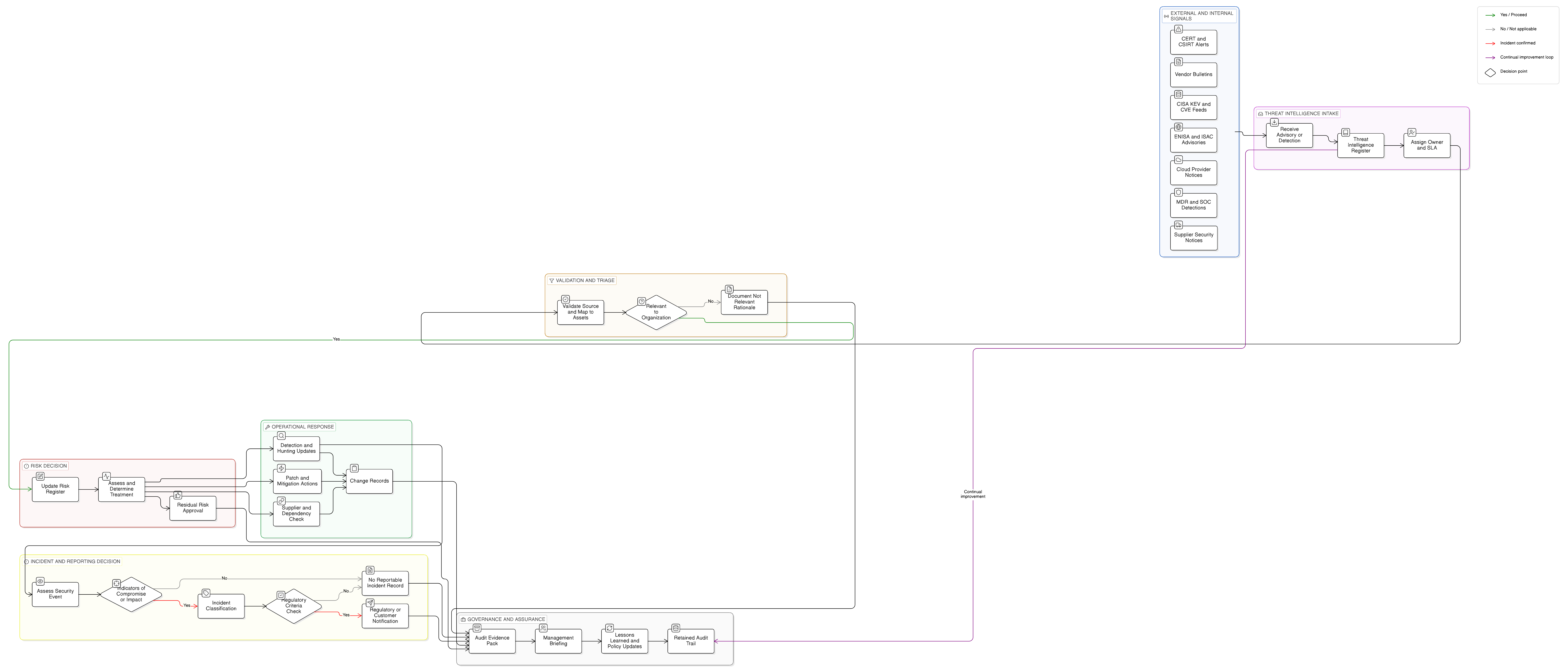
That creates a practical threat intelligence chain:
- External or internal intelligence arrives.
- Relevance is validated against assets, suppliers, geography, sector, business services, and data.
- Risk is updated.
- Patch and configuration priorities change.
- Detection logic is tuned.
- Incident playbooks and classification thresholds are reviewed.
- Supplier and cloud dependencies are checked.
- Management receives trend reporting.
- Evidence is retained for auditors, regulators, and customers.
Policies that turn intelligence into accountable behavior
Policies are where control logic becomes role-based accountability. Clarysec’s SME and enterprise policy sets include threat intelligence hooks across risk management, endpoint protection, vulnerability management, logging, monitoring, and audit evidence.
For SMEs, the Endpoint Protection - Malware Policy Endpoint Protection - Malware Policy - SME sets a direct expectation in Governance Requirements clause 5.4.1:
The IT Support Provider must monitor credible threat intelligence sources (e.g., CISA, ENISA, major antivirus vendors) and ensure that detection signatures remain current
The value of this clause is assignment. Threat intelligence is not “someone in IT should check alerts.” It is an explicit provider obligation.
The Vulnerability and Patch Management Policy Vulnerability and Patch Management Policy - SME reinforces the same model in Roles and Responsibilities clause 4.2.1:
Monitors systems for vulnerabilities and available patches using vendor alerts, threat intelligence advisories, and operating system notifications
It also identifies, in Policy Implementation Requirements clause 6.2.1.3, the type of source that should trigger action:
Trusted threat intelligence advisories (e.g., CISA, ENISA, national CERT alerts)
For enterprises, the Vulnerability and Patch Management Policy Vulnerability and Patch Management Policy states in Roles and Responsibilities clause 4.5.1:
Monitor threat advisories (e.g., CVE, CISA KEV, vendor bulletins) and escalate critical vulnerabilities.
The escalation requirement is crucial. A vulnerability becomes urgent when exploitability, exposure, business criticality, data sensitivity, and threat activity converge.
The Risk Management Policy Risk Management Policy embeds threat intelligence into analysis. Policy Implementation Requirements clause 6.2.2 states:
The analysis shall consider the effectiveness of existing controls, relevant threat intelligence, asset criticality, and vulnerability severity.
That clause is the heart of audit-ready threat intelligence. It proves that risk analysis is not theoretical.
The Logging and Monitoring Policy Logging and Monitoring Policy turns intelligence into detection. Its Purpose clause 1.2 states:
Audit logging, monitoring, and threat detection are critical for anomaly detection, threat response, forensic review, audit readiness, and legal compliance. This policy ensures that all system-generated events are properly recorded, retained, and correlated with time-synchronized accuracy.
Finally, the Audit and Compliance Monitoring Policy Audit and Compliance Monitoring Policy explains why evidence discipline matters. Objectives clause 3.4 requires the organization to generate evidence:
To generate defensible evidence and an audit trail in support of regulatory inquiries, legal proceedings, or customer assurance requests.
When NIS2, DORA, a customer, or an ISO auditor asks what you knew, when you knew it, who decided, and what changed, this evidence trail is the difference between mature assurance and a defensive scramble.
Build the Threat Intelligence Register
A mature register has two layers: source governance and event tracking. Source governance defines what the organization trusts, who owns it, how it is validated, and what action it can trigger.
| Source name | Type | Validation process | Integration point | Owner |
|---|---|---|---|---|
| CISA KEV Catalog | Operational | Cross-reference with asset inventory and exposure | Trigger emergency patch prioritization | Vulnerability management |
| ENISA advisories | Strategic | Review by risk owner or risk committee | Update risk scenarios and management briefing | CISO |
| Sector ISAC | Tactical | Analyze IOCs for relevance to technology stack | Update SIEM, EDR, and hunting tasks | SOC lead |
| Cloud provider bulletins | Operational | Verify affected services and regions | Escalate to cloud engineering | DevOps lead |
| Vendor patch notifications | Operational | Confirm product, version, and deployment scope | Add to patch cycle or emergency change | IT operations |
| MDR notifications | Tactical and operational | Triage against logs, assets, and known baselines | Open detection, investigation, or incident case | Security operations |
| Supplier security notices | Operational | Map to contracted services and data flows | Update supplier risk and compensating controls | Supplier owner |
Event tracking captures how a specific advisory became evidence. Returning to the Tuesday morning file transfer scenario, the register entry should capture enough information to support risk, response, and compliance decisions.
| Field | Example entry |
|---|---|
| Date and time received | 2026-05-26 07:42 UTC |
| Source | National CERT alert, vendor bulletin, MDR notification |
| Source type | Government advisory, supplier advisory, internal detection |
| Affected technology | Managed file transfer service, version range, dependent libraries |
| Business owner | Head of Platform Operations |
| Risk owner | CISO |
| Asset linkage | External file transfer gateway, customer reporting workflow |
| Initial severity | High pending exposure validation |
| Required actions | Exposure check, patch status, detection review, supplier confirmation |
| Compliance relevance | NIS2 Article 21, NIS2 Article 23 if significant incident criteria are met, DORA ICT risk and incident lifecycle if applicable |
| Evidence location | Ticket, risk register update, SIEM change, management note |
This is not bureaucracy. It is the factual record that proves your organization has a defined intake, validation, triage, escalation, and evidence process.
From advisory to audit evidence: a practical workflow
A threat intelligence workflow must answer six questions quickly: are we exposed, how bad is it, what must change, who owns it, do we need to report, and what evidence must be retained?
1. Validate exposure and business impact
ISO/IEC 27001:2022 clauses 4.1 to 4.4 require the ISMS to reflect the organization’s actual context, obligations, and dependencies. The first task is not patching blindly. It is validating exposure.
Ask:
- Do we run the affected technology?
- Is it internet-facing?
- Is it used by a critical business service?
- Does it process personal data?
- Is it operated by a supplier or managed service provider?
- Is it relevant to a DORA critical or important function?
- Is it relevant to services in scope for NIS2?
- Are there customer contractual notification duties?
- Are logs available, complete, and time-synchronized?
If personal data may be affected, GDPR accountability also enters the analysis. GDPR requires appropriate security of processing and demonstrable accountability, including the ability to assess whether a personal data breach occurred and whether notification is required.
2. Update the risk register
The Risk Management Policy Risk Management Policy - SME gives a simple timing rule in Governance Requirements clause 5.1.3:
Risks must be reviewed quarterly and updated when significant events occur.
A credible active-exploitation advisory is a significant event. The update should not wait for the next quarterly review.
| Risk element | Updated assessment |
|---|---|
| Threat | Active exploitation of managed file transfer vulnerability |
| Vulnerability | Affected version, exposed interface, weak configuration, missing patch |
| Asset | Customer data exchange platform |
| Consequence | Service disruption, unauthorized data access, regulatory reporting, customer trust impact |
| Likelihood | Increased due to active exploitation in the wild |
| Existing controls | MFA, WAF, endpoint protection, SIEM monitoring, backup, supplier SLA |
| Control gaps | Patch not confirmed, detection not tuned, supplier evidence pending |
| Treatment | Emergency patch, temporary network restriction, IOC hunt, supplier attestation, customer impact assessment |
| Residual risk owner | CISO and Platform Operations owner |
This connects directly to ISO/IEC 27001:2022 clauses 6.1.1-6.1.3. The organization identifies risk, analyzes likelihood and consequences, prioritizes treatment, selects controls, maintains the Statement of Applicability, creates a treatment plan, and obtains residual risk approval.
3. Prioritize vulnerability treatment using exploit intelligence
The Zenith Blueprint, Controls in Action phase, Step 19, Technological Controls I, explains why vulnerability management is core cyber hygiene:
Managing vulnerabilities is one of the most critical areas of modern cyber hygiene. While firewalls and antivirus tools provide protection, they can be undermined if unpatched systems or misconfigured services are left exposed. To meet this control, organizations should implement a structured and repeatable process for identifying, assessing, and addressing vulnerabilities.
CVSS alone is not enough. A medium-scored vulnerability under active exploitation on an internet-facing system may be more urgent than a high-scored vulnerability buried inside a segmented lab.
| Factor | Question | Evidence |
|---|---|---|
| Exploit activity | Is exploitation observed or reported by trusted sources? | CERT alert, CISA KEV reference, vendor bulletin, MDR report |
| Exposure | Is the asset internet-facing or reachable by suppliers? | Asset inventory, cloud security posture, network scan |
| Business criticality | Does it support essential services or critical functions? | Business impact analysis, DORA function mapping |
| Data sensitivity | Does it process personal data, regulated financial data, or confidential client data? | Data inventory, DPIA, processing records |
| Compensating controls | Can WAF, firewall rules, segmentation, EDR, or feature disablement reduce risk? | Change ticket, firewall rule, EDR policy |
| Operational risk | Could emergency patching disrupt critical service delivery? | Change assessment, rollback plan, continuity plan |
This produces a defensible decision. It also supports NIS2 Article 21(2)(e) for vulnerability handling, NIS2 Article 21(2)(g) for cyber hygiene, and DORA ICT risk management expectations.
4. Convert intelligence into monitoring and detection
Threat intelligence must reach logging and monitoring. The Logging and Monitoring Policy Logging and Monitoring Policy - SME states in Policy Implementation Requirements clause 6.2.1:
Security tools (e.g., antivirus, firewalls, VPNs) must be configured to generate alerts for defined threat scenarios, including:
The excerpt sets the control intent clearly: defined threat scenarios should drive alerting.
The Zenith Blueprint, Controls in Action phase, Step 19, describes monitoring activities this way:
If logging is the act of recording what happens in your environment, monitoring is the act of watching, understanding, and responding to those events. This control is about actively observing networks, systems, and applications to detect unusual activity, not just after the fact, but in real-time or near-real-time, where possible.
For the file transfer scenario, the SOC or IT provider should:
- Add or validate IOCs from the CERT and vendor advisory.
- Search logs for known exploit paths, suspicious uploads, web shell indicators, unusual process execution, and unexpected outbound connections.
- Confirm that authentication, admin activity, file access, API, and network logs are retained.
- Tune SIEM alerts for the exploit pattern.
- Create a case note explaining what was searched, what was found, and who reviewed it.
- Escalate to incident classification if indicators show compromise, data exposure, or service impact.
This is where incident reporting becomes practical. NIS2 Article 23 requires staged significant incident reporting, including early warning within 24 hours, notification within 72 hours, intermediate updates upon request, and a final report no later than one month after the notification. DORA requires financial entities to detect, manage, classify, and report major ICT-related incidents through the staged process defined by the regulation and related technical standards.
Threat intelligence helps determine whether the organization is still in vulnerability response, security event assessment, or regulated incident reporting.
One workflow, multiple compliance obligations
Threat intelligence is an ideal integrated compliance workflow because the same evidence supports several regimes.
| Framework or regulation | What it expects | Threat intelligence evidence |
|---|---|---|
| ISO/IEC 27001:2022 | Context-aware ISMS, risk assessment, control selection, treatment planning, continual improvement | ISMS scope, risk register, Statement of Applicability, treatment plan, management review inputs |
| ISO/IEC 27002:2022 | Threat intelligence, vulnerability management, logging, monitoring, incident assessment, malware protection | Threat intelligence register, IOC updates, SIEM rules, patch tickets, incident triage notes |
| NIS2 | Risk management, incident handling, cyber hygiene, vulnerability handling, supply chain security, governance oversight | Article 20 and 21 evidence, management briefings, CSIRT workflow, supplier advisory follow-up |
| DORA | ICT risk framework, detection, continuity, incident lifecycle, resilience testing, third-party ICT risk | ICT asset classification, detection cases, incident classification records, resilience test inputs, ICT supplier records |
| GDPR | Security of processing, accountability, breach detection and notification support | Data impact assessment, access logs, monitoring evidence, breach assessment record |
| NIST CSF 2.0 | Govern, Identify, Protect, Detect, Respond, Recover outcomes | Current Profile, Target Profile, prioritized action plan, risk communications |
| COBIT 2019 audit lens | Governance over risk, controls, performance, assurance, and accountability | Control ownership, management metrics, assurance evidence, issue remediation tracking |
NIST CSF 2.0 is especially useful for executive communication. Its Core Functions, Govern, Identify, Protect, Detect, Respond, and Recover, turn technical intelligence into a board-readable story:
- Govern: threat intelligence sources, owners, and reporting lines are defined.
- Identify: affected assets, suppliers, business services, and data are mapped.
- Protect: patching, hardening, segmentation, and endpoint signatures are updated.
- Detect: monitoring rules, IOCs, and hunting tasks are deployed.
- Respond: incident playbooks, triage rules, and notification thresholds are reviewed.
- Recover: backups, restoration priorities, and lessons learned are validated.
This turns raw cyber threat intelligence into risk governance.
The auditor’s view: what they will ask for
A strong threat intelligence process should survive different audit styles. An ISO auditor, NIS2 reviewer, DORA supervisory authority, NIST CSF assessor, COBIT 2019-oriented auditor, ISACA professional, or privacy reviewer may use different language, but they all converge on evidence.
| Auditor lens | Likely audit question | Evidence that answers it |
|---|---|---|
| ISO/IEC 27001:2022 auditor | How does external and internal context influence ISMS risks and controls? | Threat intelligence register, risk methodology, updated risk register, Statement of Applicability rationale |
| ISO/IEC 27002:2022 control reviewer | How are controls 5.7, 8.8, 8.16, 8.15, 8.7, and 5.25 connected? | Source list, vulnerability triage, SIEM tuning, malware signature updates, event assessment records |
| NIS2 reviewer | How do you meet management oversight, cyber hygiene, vulnerability handling, incident handling, and supply chain security? | Article 20 and 21 mapping, management briefings, CSIRT reporting procedure, supplier advisory workflow |
| DORA supervisory authority | How does threat intelligence update ICT risk, detection, resilience testing, and incident classification? | ICT risk framework, critical function mapping, detection cases, incident classification records, resilience test scope |
| NIST CSF assessor | What is your Current Profile, Target Profile, and prioritized action plan? | CSF profile, gap assessment, action plan, continuous update log |
| COBIT 2019 or ISACA auditor | Who owns the control, how is performance measured, and how are exceptions remediated? | RACI, KPIs, KRIs, exception register, remediation tickets, management sign-off |
| GDPR auditor or privacy reviewer | How did monitoring and vulnerability management protect personal data and support breach assessment? | Data processing map, logs, breach assessment, technical and organizational measures evidence |
Zenith Controls provides the cross-compliance interpretation for these discussions. For control 8.16, Monitoring activities, the guide connects monitoring to GDPR security and breach accountability, NIS2 incident handling and reporting, and DORA detection and response expectations. For control 8.8, Management of technical vulnerabilities, it connects vulnerability handling to GDPR security of processing, NIS2 Article 21(2)(e), and DORA proactive ICT risk management.
That is the evidence convergence auditors want to see.
Management reporting: the quarterly threat trends briefing
The threat intelligence register should not die in the SOC. The Zenith Blueprint recommends a short quarterly threat trends briefing for key stakeholders. Clarysec recommends a one-page management report with five sections:
- Top three relevant threat trends by business impact.
- Most exposed technologies or suppliers.
- Critical vulnerabilities patched, mitigated, or accepted.
- Detection and response improvements made.
- Decisions required from management.
A strong management briefing does not list 400 CVEs. It explains risk movement. For example:
- Ransomware targeting managed service providers increased supplier review priority.
- Exploitation of file transfer platforms triggered emergency patching and a compensating firewall rule.
- Cloud identity attacks caused MFA exception review and conditional access hardening.
- Sector ISAC intelligence led to new phishing simulations for finance and support teams.
- DORA critical function mapping revealed one monitoring gap in a third-party workflow.
This briefing supports NIS2 management accountability, DORA ICT risk governance, ISO/IEC 27001:2022 management review, and customer assurance.
Common failure patterns
Threat intelligence programs often look mature on slides but weak under audit. The most common failure patterns are:
- Too many feeds and no validation criteria.
- No link between intelligence and asset inventory.
- No documented risk update after major advisories.
- Patch priority based only on scanner severity.
- Supplier advisories handled outside the ISMS.
- SOC rules updated without change records.
- Incident thresholds not aligned to NIS2 or DORA reporting workflows.
- Board reporting focused on alert volume instead of business risk.
- No evidence that lessons learned changed controls.
- No owner for maintaining the threat intelligence register.
The fix is not buying another feed. The fix is control integration.
A 10-point readiness checklist for 2026
Use this checklist as a practical internal review.
| Readiness question | Yes or no |
|---|---|
| Do we maintain an approved threat intelligence register with source owners and validation rules? | |
| Are CERT, CSIRT, ISAC, vendor, cloud, MDR, and supplier advisories routed to named roles? | |
| Do significant advisories trigger risk register review outside the quarterly cycle? | |
| Does vulnerability prioritization include exploit activity, asset criticality, data sensitivity, and exposure? | |
| Are IOCs and threat scenarios converted into monitoring rules or hunting tasks? | |
| Are endpoint signatures, cloud detections, and dynamic threat intelligence feeds checked for currency? | |
| Are supplier notices assessed against supply chain risk and contractual obligations? | |
| Are incident classification criteria aligned to NIS2 and DORA reporting workflows where applicable? | |
| Does management receive a quarterly threat trends briefing? | |
| Can we produce an evidence pack for an auditor, regulator, or customer within one business day? |
If the answer to any of these is “no,” the organization does not simply have a threat intelligence problem. It has an ISMS integration problem.
How Clarysec helps turn threat intelligence into evidence
Clarysec’s method is designed for organizations that need practical security and credible compliance at the same time.
Zenith Blueprint gives the 30-step implementation route, including Step 22 for the threat intelligence register and Step 19 for vulnerability management and monitoring activities. Clarysec’s enterprise and SME policies turn those expectations into role-based procedures for risk management, vulnerability handling, endpoint protection, logging, monitoring, and audit evidence. Zenith Controls then provides the cross-compliance interpretation, showing how ISO/IEC 27002:2022 controls connect to NIS2, DORA, GDPR, NIST CSF 2.0, COBIT 2019, and audit evidence.
For the Tuesday morning CISO, the answer to the CFO becomes clear:
“We received the advisory, validated exposure, updated the risk register, prioritized patching based on active exploitation, tuned monitoring, checked supplier dependency, assessed incident reporting thresholds, briefed management, and retained evidence. We are not guessing. We are following our ISMS.”
That is what ISO 27001 threat intelligence for NIS2 cyber hygiene and DORA ICT risk evidence should look like in 2026.
Next steps
If your organization receives threat intelligence but cannot prove how it changes risk decisions, controls, detection, incident response, supplier management, and regulatory evidence, start with three actions this week:
- Build or refresh your Threat Intelligence Register using Zenith Blueprint, Controls in Action phase, Step 22.
- Map your current process against ISO/IEC 27002:2022 controls 5.7, 8.8, 8.15, 8.16, 8.7, and 5.25 using Zenith Controls.
- Align your policies, especially Risk Management Policy, Vulnerability and Patch Management Policy, Logging and Monitoring Policy, and Audit and Compliance Monitoring Policy, so every advisory can become defensible evidence.
Clarysec can help you turn threat feeds, advisories, supplier notices, vulnerability intelligence, and detection signals into an ISO/IEC 27001:2022-aligned, NIS2-ready, DORA-aware operating model.
Download the Clarysec toolkits, request a walkthrough, or book a readiness assessment to see how your current threat intelligence process would stand up to an ISO auditor, NIS2 reviewer, DORA supervisory authority, or customer assurance request.
Frequently Asked Questions
About the Author

Igor Petreski
Compliance Systems Architect, Clarysec LLC
Igor Petreski is a cybersecurity leader with over 30 years of experience in information technology and a dedicated decade specializing in global Governance, Risk, and Compliance (GRC).Core Credentials & Qualifications:• MSc in Cyber Security from Royal Holloway, University of London• PECB-Certified ISO/IEC 27001 Lead Auditor & Trainer• Certified Information Systems Auditor (CISA) from ISACA• Certified Information Security Manager (CISM) from ISACA • Certified Ethical Hacker from EC-Council