ISO 27701:2025 PIMS Audit and GDPR Proof
Sarah, the Compliance Manager at fintech provider InnovatePay, opened an email from her CEO that sounded simple but changed the entire privacy programme.
“Great work on the new PIMS policies for our ISO 27701 push. Now, how do we know any of this is actually working? And how do we prove it to auditors, banking clients and regulators?”
That is the moment where a Privacy Information Management System succeeds or fails.
InnovatePay already had an ISO/IEC 27001:2022 certified Information Security Management System. Its privacy team had built DPIA templates, processor records, retention rules, breach procedures and data subject rights workflows. The policy folder looked mature. The issue was proof.
GDPR Article 5(2) makes accountability explicit. Controllers are responsible for the privacy principles and must be able to demonstrate compliance. Enterprise banking clients were asking deeper third-party risk questions because of DORA. NIS2 had raised executive concern with management body obligations. Internal leadership wanted confidence that privacy was not a binder of good intentions.
Sarah did not need another policy. She needed an assurance engine.
That is the real value of ISO 27701:2025 PIMS audit and management review governance. It turns privacy operations into evidence. Internal audits test whether controls work. Management review turns findings, privacy risk, supplier issues, monitoring results and regulatory change into decisions. Corrective action fixes root causes. Evidence registers make the story traceable.
For SaaS, fintech, HR technology, managed services, health platforms and data-rich SMEs, this is the difference between saying “we have privacy controls” and proving “our privacy management system is operating, reviewed and improving.”
The PIMS assurance gap in GDPR accountability
Most privacy programmes can answer basic operational questions:
- Do we have a DPIA process?
- Do we maintain a processor register?
- Do we respond to data subject rights requests?
- Do we have a breach procedure?
- Do we keep privacy notices and retention rules?
Fewer can answer the questions auditors and enterprise customers actually ask:
- When was the PIMS last audited?
- Who audited it, and were they independent enough?
- What requirements, policies and GDPR obligations were tested?
- What evidence was sampled?
- Which findings were raised?
- What did management decide?
- Were corrective actions verified for effectiveness?
- Can we trace the evidence from requirement to control to review?
That is the PIMS assurance gap.
ISO/IEC 27001:2022 provides the management-system foundation through risk assessment, objectives, internal audit under Clause 9.2, management review under Clause 9.3 and corrective action under Clause 10.2. ISO 27701:2025 extends that assurance logic into privacy and PII processing governance. GDPR then gives the legal reason why the evidence matters, especially through Article 5(2), Article 24 and, where security of processing is involved, Article 32.
A PIMS must show that the organization:
- Knows whether it acts as controller, processor, joint controller or subprocessor
- Tracks legal, regulatory, contractual and customer privacy requirements
- Tests privacy controls through planned audits and monitoring
- Records evidence gaps and nonconformities
- Escalates material issues to leadership
- Reviews privacy objectives, risks and supplier assurance
- Verifies corrective actions after closure
- Retains evidence in a form that auditors can trust
Clarysec’s model is built around this closed loop.
REG12 as the spine of ISO 27701:2025 PIMS audit governance
The practical centre of Clarysec’s PIMS assurance model is REG12, the evidence register for PIMS monitoring, audit, corrective action and management review.
The first linked policy obligation is deliberately direct. In the PIMS Monitoring, Audit and Improvement Policy, clause 4.2.1 states:
“[All] The Internal Audit / Compliance Reviewer MUST prepare a risk-based PIMS internal audit programme in REG12 annually before the first planned PIMS audit cycle.”
This prevents the common failure where the audit programme is created two weeks before certification or only after a customer asks for evidence. A PIMS audit programme should be risk-based, approved, documented and available before the first audit cycle begins.
The same policy turns auditor independence into evidence. Clause 4.2.3 states:
“[All] The Internal Audit / Compliance Reviewer MUST record auditor independence and conflict-of-interest checks in REG12 before each audit assignment.”
This is especially important for SMEs, where one person may design privacy processes, operate them and be tempted to audit them. Independence does not always mean a large internal audit department. It means objectivity, conflict awareness and a documented rationale for why the assigned reviewer can perform the audit impartially.
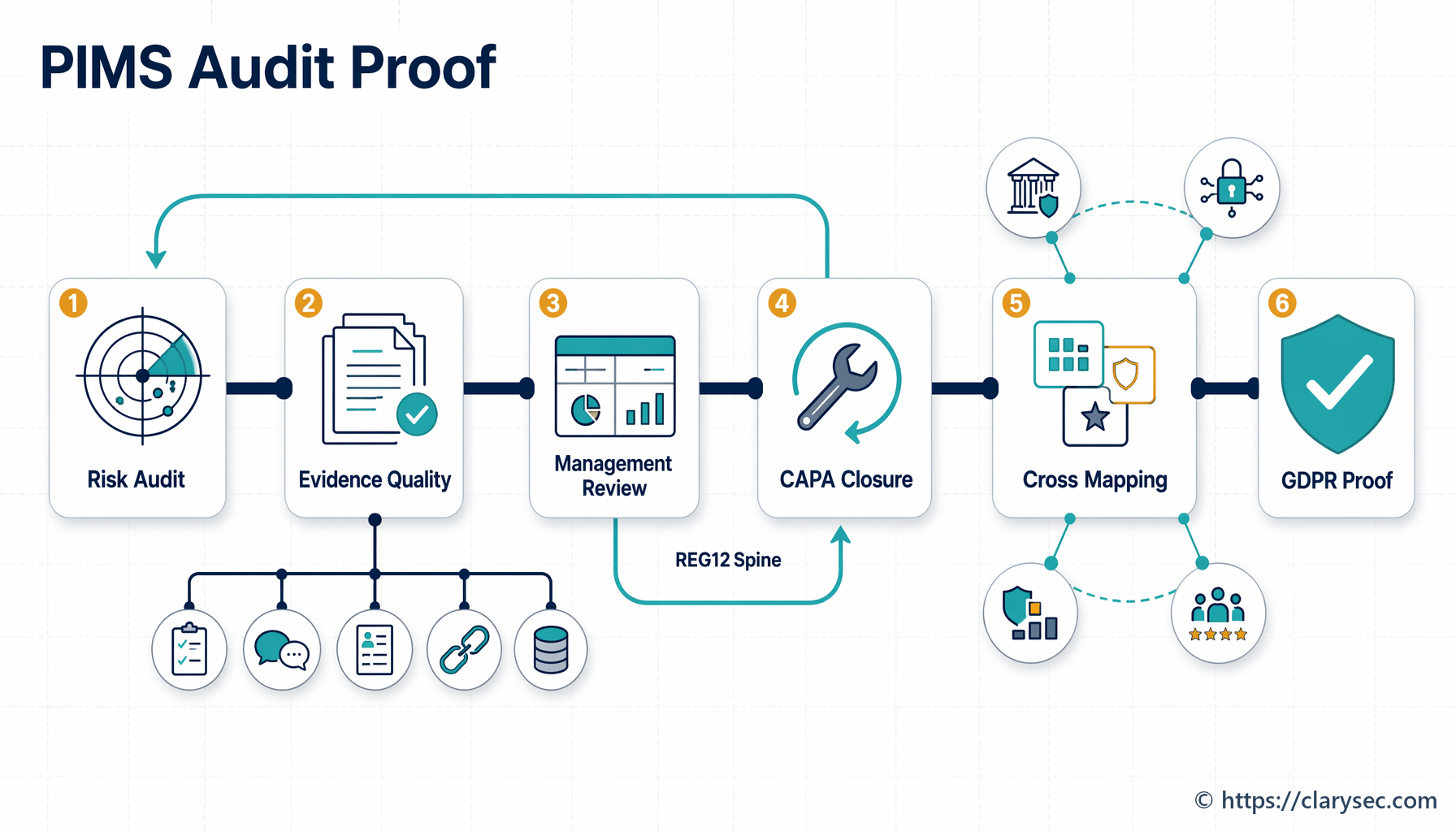
A strong REG12-driven assurance cycle follows ten steps:
- Plan a risk-based PIMS internal audit programme
- Define scope, criteria, objectives and evidence requirements
- Confirm auditor independence and conflicts of interest
- Execute sampling, interviews and evidence review
- Record findings, evidence gaps and nonconformities
- Assign corrective actions with owners and due dates
- Verify corrective action effectiveness
- Feed results into management review
- Update objectives, risks, resources and controls
- Retain traceable evidence for ISO, GDPR and customer assurance
This is how privacy governance becomes operationally credible.
Building a risk-based PIMS internal audit programme
The Zenith Blueprint: An Auditor’s 30-Step Roadmap places internal audit in the Audit, Review & Improvement phase, Step 25: Internal Audit Program. It reinforces that internal audits should be planned at intervals, cover important processes and previous audit results, ensure objectivity and impartiality, and report results to management.
Its practical advice is simple:
“When planning audits, consider focusing more effort on areas that are critical or have had issues in the past.”
For InnovatePay, that meant prioritising biometric authentication data, cross-border transfers to a US-based subprocessor, data subject rights fulfilment and supplier assurance for banking clients. For another SaaS provider, it might mean processor onboarding, support ticket privacy escalations, deletion workflows and breach assessment.
A usable PIMS audit programme should include the following components.
| Audit component | What to define | Example for ISO 27701:2025 and GDPR |
|---|---|---|
| Scope | Processes, locations, products, systems and PIMS roles | Controller marketing processing, processor customer platform, subprocessor onboarding |
| Criteria | Policies, ISO 27701:2025 requirements, GDPR obligations, contracts and procedures | PIMS policies, data processing agreements, DPIA procedure, retention policy |
| Frequency | Annual full audit plus risk-based spot checks | Full PIMS audit annually, quarterly checks for rights requests and processor changes |
| Independence | Auditor assignment and conflict check | Security governance peer audits privacy evidence, external consultant audits high-risk DPIA process |
| Evidence | Registers, tickets, logs, approvals, meeting minutes and reports | REG12, DPIA register, processor register, breach log, management review minutes |
| Reporting | Findings, severity, owners and deadlines | Minor nonconformity for incomplete evidence traceability, CAPA assigned to privacy owner |
| Follow-up | Effectiveness verification | Sample three corrected records within 30 days of closure |
Clarysec’s broader audit policies support the same structure. The Audit and Compliance Monitoring Policy - SME, clause 5.1.1 states:
“The General Manager (GM) must approve an annual audit plan.”
Clause 5.2.3 adds:
“Each audit must include a defined scope, objectives, responsible personnel, and required evidence.”
For larger organizations, the Audit and Compliance Monitoring Policy, clause 5.2 states:
“A risk-based Audit Plan shall be developed and approved annually, taking into account:”
Clause 5.4 states:
“The organization shall maintain an Audit Register containing:”
The point is not bureaucracy. The point is traceability. A planned audit programme, approved audit plan and maintained audit register create the first layer of evidence that the PIMS is governed rather than improvised.
Executing the audit: sampling, interviews and evidence quality
The Zenith Blueprint, Step 26: Audit Execution, recommends interviews, documentation review, observation, sampling and factual recording of evidence. It states:
“As you gather evidence, record your findings. Note where things conform to the requirement (positive findings) and where they do not (potential nonconformities or observations).”
A PIMS audit should not stop at asking whether a process exists. It should test whether the process works.
Sarah’s team selected InnovatePay’s CRM platform. The PIMS data map said inactive customer accounts should be anonymised after two years. The auditor requested the last quarter’s anonymisation report, sampled five records and verified that personal data was no longer recoverable. That sample created objective evidence.
The same approach can be applied across privacy domains:
- Select a DPIA and verify approval, risk treatment, residual risk acceptance and action tracking
- Select a processor and verify contract clauses, due diligence and ongoing monitoring
- Select a rights request and verify identity checks, deadline tracking and response approval
- Select a breach assessment and verify whether the GDPR personal data breach definition was applied
- Select a retention rule and verify deletion or anonymisation evidence
- Select a privacy objective and verify measurement evidence
Clarysec’s privacy policies support this audit discipline. The Data Protection and Privacy Policy - SME, clause 5.3.3 states:
“Regular privacy audits or control checks must be performed and logged”
The enterprise Data Protection and Privacy Policy, clause 5.4 states:
“An internal privacy compliance audit shall be conducted annually or upon major organizational or regulatory changes. Audit scope shall include:”
That change trigger matters. A PIMS audit programme should respond to new AI features, new countries, new subprocessors, new categories of personal data, material incidents, acquisitions, regulatory change and major customer commitments.
During InnovatePay’s audit, the team found a minor nonconformity. Corrective actions for privacy incidents were being logged, but effectiveness verification was not consistently documented. Some actions were marked complete, but there was no independent evidence that the root cause was eliminated.
That was not a privacy failure. It was the assurance system doing its job.
The PIMS Documented Information and Evidence Management Policy, clause 4.3.4 requires exactly this kind of gap to be captured:
“[All] The Internal Audit / Compliance Reviewer MUST record evidence completeness, accuracy, or traceability gaps in REG12 during each scheduled audit or compliance review.”
Evidence quality is part of accountability. If a control operates but cannot be traced, sampled or linked to a requirement, it may be treated as unproven by auditors, customers or regulators.
A practical REG12 audit example for rights requests and processors
Consider a B2B SaaS provider that acts as a processor for customer account data and as a controller for employee and marketing data. It is preparing for ISO 27701:2025 readiness and receives a customer questionnaire asking for evidence of GDPR accountability.
The privacy team creates a REG12 audit entry:
- Audit name: Q2 PIMS internal audit, rights requests and processor governance
- PIMS role coverage: Controller and processor obligations
- Scope: Data subject rights workflow, customer support escalation, processor register, subprocessor approval and privacy monitoring evidence
- Criteria: PIMS Data Protection and Privacy Policy, PIMS Monitoring, Audit and Improvement Policy, GDPR rights obligations, processor accountability obligations and customer DPA requirements
- Auditor: Compliance reviewer from security operations, with conflict check recorded
- Sampling: Five rights requests, three customer tickets involving privacy support, five subprocessors, two vendor risk reviews and two DPA change approvals
- Evidence required: Tickets, timestamps, response approvals, identity verification checks, supplier due diligence, customer notices and REG entries
- Findings: One rights request had complete ticket evidence but no linked closure approval. One subprocessor review had expired assurance evidence.
- CAPA: Update rights request closure checklist, assign privacy operations owner, refresh supplier assurance evidence and verify within 30 days
- Management review input: Include rights evidence quality issue and supplier assurance trend
That single entry creates a defensible audit story. It shows planning, scope, criteria, independence, sampling, findings, corrective actions and escalation to management review.
Management review: where privacy becomes executive governance
Internal audit tells the organization what is working and what is not. Management review decides what to do about it.
Many organizations weaken privacy governance at this point. They treat management review as a slide deck rather than a decision forum. Minutes are written, but there is no clear record of privacy risk decisions, resource approvals, corrective action status, supplier issues, objectives or interested-party changes.
The PIMS Monitoring, Audit and Improvement Policy, clause 4.3.5 makes the required inputs explicit:
“[Both] Top Management MUST review PIMS nonconformity, corrective action, monitoring result, audit result, privacy risk, supplier assurance, and interested-party change inputs in REG12 during each management review.”
The Zenith Blueprint, Step 28: Management Review, recommends inputs such as previous actions, internal and external changes, performance and effectiveness, audit results, monitoring results, objectives, incidents, nonconformities, improvement opportunities and resource needs.
Its key message is direct:
“This is crucial - management review isn’t just a presentation; it’s about making decisions.”
For InnovatePay, Sarah structured the management review around executive decisions rather than compliance theatre:
- Status of previous actions, even though this was the first review
- Changes in context, including DORA expectations from banking clients
- Privacy objectives, including DSAR average response time
- Monitoring results, including breach and incident status
- Internal audit results and the minor CAPA verification finding
- Supplier assurance, including cross-border subprocessor review
- Resource needs, including ticketing workflow changes
- Continual improvement, including vendor management automation
The CEO approved a minor ticketing system configuration change to add a mandatory verification step for privacy incident corrective actions. That decision was recorded in the minutes and linked to the CAPA record in REG12.
For organizations integrating ISMS and PIMS governance, the Information Security Policy, clause 5.3 also supports management review cadence:
“Management review activities (per ISO/IEC 27001 Clause 9.3) shall be conducted at least annually and shall include:”
A combined ISMS and PIMS review can be efficient, but only if privacy does not disappear into generic security reporting. The agenda must preserve PIMS-specific inputs such as processing roles, data subject rights, DPIAs, processor assurance, retention, breach assessment, privacy objectives and GDPR obligations.
CAPA: closing findings by fixing root causes
Corrective and preventive action is where assurance becomes improvement. A finding should not die as “document updated.” The organization must identify root cause, implement a meaningful fix, assign ownership, set deadlines, verify effectiveness and retain evidence.
The Zenith Blueprint, Step 29: Continual Improvement, states:
“A corrective action is a step (or steps) you will take to eliminate the root cause of the nonconformity so it doesn’t recur.”
The difference between weak correction and strong corrective action is visible in the evidence.
| Finding | Weak correction | Strong corrective action |
|---|---|---|
| Rights request closure approval missing | Add approval to one ticket | Update closure checklist, train support leads, add required workflow field and sample future tickets |
| Subprocessor assurance expired | Upload new SOC report | Add supplier evidence expiry tracking, assign owner and review all critical subprocessors |
| DPIA risk treatment not linked to engineering work | Add a note to the DPIA | Create mandatory linkage between DPIA actions and product backlog, then verify closure evidence |
| Management review omitted privacy objectives | Add slide next year | Update management review agenda template and REG12 required input checklist |
| Evidence not traceable | Rename files | Implement evidence naming rules, register links and audit sampling requirements |
The Audit and Compliance Monitoring Policy - SME reinforces management ownership of corrective action. Clause 5.4.2 states:
“The GM must approve a corrective action plan and track its implementation.”
Clause 5.4.3 adds:
“Audit findings and status updates must be included in the ISMS management review process.”
For PIMS-specific verification, the PIMS Monitoring, Audit and Improvement Policy, clause 4.4.7 requires:
“[All] The Internal Audit / Compliance Reviewer MUST verify corrective action effectiveness in REG12 within 30 days of reported corrective action closure.”
Sarah applied this exactly. Her team first performed a correction by retrospectively verifying the last three privacy incident corrective actions. Then IT implemented the root-cause corrective action by making verification a mandatory workflow step. Thirty days later, the auditor sampled three new privacy-related tickets and confirmed that each had completed verification. Only then was the CAPA closed.
That is the narrative auditors trust: finding, root cause, decision, fix, verification.
Cross-compliance mapping for ISO 27701 PIMS assurance
Clarysec’s Zenith Controls: The Cross-Compliance Guide helps teams understand how ISO/IEC 27002:2022 control concepts map across GDPR, NIS2, DORA, NIST CSF 2.0 and audit practice. It is a cross-compliance guide, not a separate control framework.
Three ISO/IEC 27002:2022 controls are especially relevant to PIMS audit governance:
- 5.4 Management responsibilities
- 5.35 Independent review of information security
- 5.36 Compliance with policies, rules and standards for information security
The Zenith Controls entry for ISO/IEC 27002:2022 control 5.4, Management responsibilities, links management accountability to roles, resources, policy promotion, independent review and enforcement. Applied to ISO 27701:2025, top management can assign privacy duties, but it must still review PIMS performance, risk decisions and resource needs.
The Zenith Controls entry for 5.35, Independent review of information security, supports the audit mechanism. For privacy, independent review can test whether breach lessons were embedded, deletion works, records are protected and logs support investigation.
The Zenith Controls entry for 5.36, Compliance with policies, rules and standards for information security, supports ongoing monitoring. Privacy policies define expectations. Compliance monitoring checks them. Independent review validates the results. Management review acts on them.
A single PIMS assurance cycle can then support several frameworks.
| Framework | What it expects | How PIMS audit and management review help |
|---|---|---|
| GDPR | Demonstrable accountability, lawful processing, security, retention, breach governance and role clarity | REG12 records privacy audits, evidence gaps, corrective actions, privacy risks and management decisions |
| NIS2 | Management oversight, approved risk measures, incident handling, continuity, supplier security and effectiveness assessment | Audit findings and management review minutes show leadership supervision, supplier assurance and control effectiveness |
| DORA | Governance and control arrangements, ICT risk management, internal audit, resilience testing, incident learning and third-party risk oversight | Integrated ISMS and PIMS review supports operational resilience evidence for financial entities and ICT providers |
| NIST CSF 2.0 | GOVERN outcomes for obligations, roles, policies, risk strategy, oversight and third-party risk | PIMS audit outputs feed current-state analysis, target outcomes, risk registers and action plans |
| COBIT and ISACA audit lens | Governance objectives, process capability, control design, performance measurement and assurance evidence | PIMS review records show decision rights, objectives, metrics, issue remediation and evidence traceability |
NIS2 Article 20 places cybersecurity risk-management approval and oversight at management body level. Article 21 requires risk-based technical, operational and organizational measures, including incident handling, business continuity, supply chain security, effectiveness assessment, training, cryptography, HR security, access control, asset management and authentication where appropriate.
DORA applies from 17 January 2025 and is especially important for financial entities and ICT providers in the financial ecosystem. Article 5 makes the management body responsible for defining, approving and overseeing ICT risk management. Article 6 requires the ICT risk management framework to be reviewed, improved through lessons learned and subject to internal audit.
NIST CSF 2.0 is useful for communicating maturity. The GOVERN function includes organizational context, legal and regulatory requirements, risk management strategy, roles, policies, oversight and cybersecurity supply chain risk management. PIMS audit findings and management review decisions are strong inputs for current and target profiles.
How different auditors will test the same PIMS evidence
The same PIMS evidence will be examined differently depending on the auditor’s lens.
| Auditor profile | Primary focus | Key questions and evidence requests |
|---|---|---|
| ISO 27001 and ISO 27701 auditor | Management-system conformity | Show the PIMS internal audit programme, audit reports, impartiality evidence, nonconformity records, management review minutes and corrective action verification |
| GDPR or data protection assessor | Demonstrable accountability under GDPR Articles 5(2) and 24 | Show how privacy controls are tested, how evidence is retained and how management acts on findings |
| DORA or financial customer assessor | Management body responsibility, ICT risk and resilience | Show audit reports, management review outputs, supplier assurance, incident learning and decisions affecting customer data resilience |
| NIST CSF 2.0 implementer | Governance, oversight and performance improvement | Show how obligations, roles, policies, risk strategy, oversight and improvement actions are monitored and adjusted |
| COBIT or ISACA auditor | Governance objectives, process capability and assurance evidence | Show objectives, accountable roles, metrics, control evidence, issue remediation and decision traceability |
The goal is not to create five assurance systems. The goal is to create one evidence-rich PIMS governance cycle that can be interpreted across frameworks.
Privacy objectives and metrics management should review
A management review becomes far more useful when privacy objectives are measurable. ISO/IEC 27001:2022 requires information security objectives to be measurable where practicable, monitored, communicated and updated. The same discipline should be applied to PIMS objectives.
Useful privacy objectives include:
- 100 percent of data subject rights requests completed within internal SLA
- 95 percent of high-risk processors reviewed before contract signature
- 100 percent of DPIA high-risk actions assigned an owner and due date
- Zero expired assurance records for critical subprocessors
- 100 percent of personal data breaches assessed within internal escalation target
- 90 percent completion of role-based privacy training for support, HR, engineering and sales
- 100 percent of retention exceptions reviewed quarterly
- 50 percent reduction in evidence traceability gaps over two quarters
The point is not vanity metrics. The point is decision quality. If rights request performance is strong but supplier evidence is weak, management can direct resources. If DPIA actions remain open, product leadership can be engaged. If breach assessments are timely but root causes repeat, leadership can demand deeper corrective action.
Common failure patterns before ISO 27701 PIMS audits
Clarysec often sees the same issues before external privacy assurance reviews:
- The internal audit plan exists but is not risk-based
- The auditor audits their own work and no independence rationale is recorded
- Audit findings lack evidence references
- Evidence exists but is not traceable to a requirement
- CAPA fixes documents but not root causes
- Management review minutes list topics but no decisions
- Privacy objectives are vague or not measured
- Supplier assurance is reviewed only at onboarding
- DPIA actions are not tracked after approval
- Audit findings are not fed into management review
- Corrective actions are closed without effectiveness testing
These are not unusual failures. They happen when privacy governance grows through spreadsheets, emails and isolated policy documents. REG12 and the Clarysec PIMS policy set are designed to turn fragmented activity into a coherent assurance system.
A 60-minute PIMS management review agenda
If your organization is preparing for ISO 27701:2025, GDPR accountability, DORA customer due diligence or NIS2 executive oversight, start with a focused management review agenda:
- Confirm PIMS scope, roles and major changes
- Review privacy objectives and metrics
- Review internal audit results and evidence quality gaps
- Review nonconformities and CAPA status
- Review privacy risk register and DPIA trends
- Review supplier and subprocessor assurance
- Review incidents, breach assessments and lessons learned
- Review regulatory, contractual and interested-party changes
- Approve resource needs, risk decisions and improvement actions
- Record decisions, owners and deadlines in REG12
Do not wait for certification to run this meeting. A complete but lightweight management review now is more valuable than a perfect one after the audit window has closed.
Make your ISO 27701:2025 PIMS provable
ISO 27701:2025 PIMS governance under GDPR is ultimately about proof. Not theoretical proof, but operational proof: planned audits, independent review, reliable evidence, management decisions, corrective actions and measurable improvement.
Clarysec helps organizations build that proof without unnecessary bureaucracy. Start with:
- PIMS Monitoring, Audit and Improvement Policy for REG12 audit, management review and CAPA governance
- PIMS Documented Information and Evidence Management Policy for evidence quality and traceability
- Zenith Blueprint: An Auditor’s 30-Step Roadmap for internal audit, management review and continual improvement execution
- Zenith Controls: The Cross-Compliance Guide for mapping ISO/IEC 27002:2022 governance concepts across GDPR, DORA, NIS2, NIST CSF 2.0 and audit practice
If your privacy programme already has DPIAs, processor controls, rights workflows and breach procedures, the next step is to prove they work as a system. Build the audit programme, run the REG12 review, take findings seriously and put privacy performance in front of management.
Download the Clarysec PIMS policy pack, use the Zenith Blueprint to run your first audit cycle, and use Zenith Controls to turn one evidence trail into multi-framework assurance. That is how a PIMS becomes audit-ready, GDPR-accountable and credible to customers, regulators and leadership.
Frequently Asked Questions
About the Author

Igor Petreski
Compliance Systems Architect, Clarysec LLC
Igor Petreski is a cybersecurity leader with over 30 years of experience in information technology and a dedicated decade specializing in global Governance, Risk, and Compliance (GRC).Core Credentials & Qualifications:• MSc in Cyber Security from Royal Holloway, University of London• PECB-Certified ISO/IEC 27001 Lead Auditor & Trainer• Certified Information Systems Auditor (CISA) from ISACA• Certified Information Security Manager (CISM) from ISACA • Certified Ethical Hacker from EC-Council