MDR Provider Oversight for NIS2, DORA and GDPR
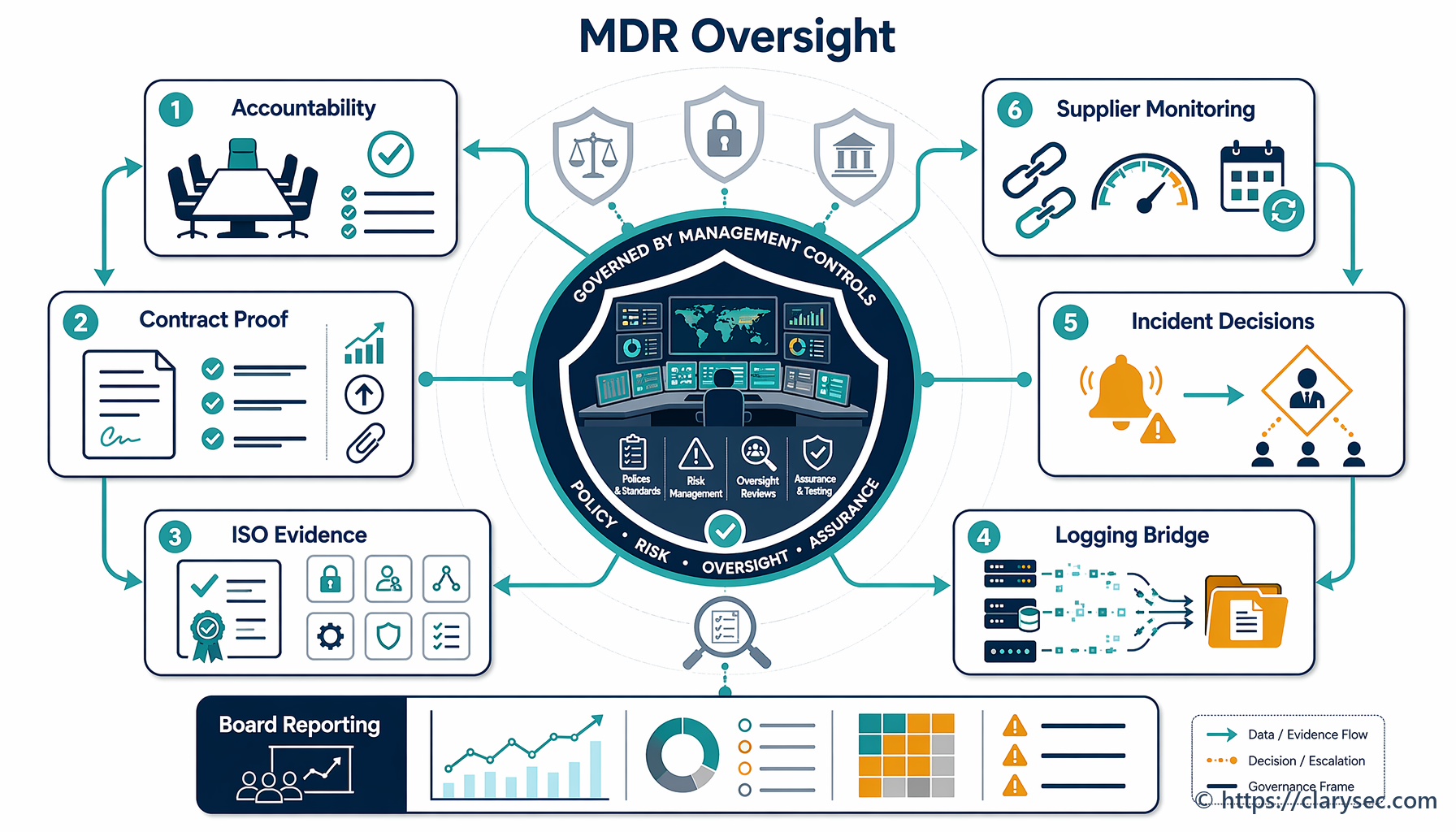
At 02:13 on a Monday morning, the MDR provider opens a high-severity alert: impossible travel, suspicious mailbox rules, and a privileged account used from an unmanaged endpoint. The SOC analyst escalates through the ticketing portal. Your IT manager is asleep. The CFO receives a phishing warning from a bank contact before the internal incident channel wakes up. By 07:30, the CISO is facing three uncomfortable questions.
Who had authority to declare an incident?
Can we prove the MDR provider had the right logs, retained them long enough, and preserved evidence?
If personal data was accessed, can Legal meet GDPR breach assessment timelines while Operations prepares NIS2 or DORA reporting?
A month later, the external auditor asks for the same evidence in a different tone. The MDR provider’s PDF report is useful, but it is not enough. The auditor wants raw alert data, complete log files, the escalation trail, the internal decision log, the supplier review record, and proof that the organization could independently verify what happened.
That is the 2026 MDR provider oversight problem. Organizations outsource detection and response because internal SOC capacity is expensive, hiring is difficult, and threat activity is relentless. But outsourced detection does not mean outsourced accountability. Under NIS2, management bodies remain responsible for approving and overseeing cybersecurity risk-management measures. Under DORA, financial entities remain fully responsible for ICT third-party risk, including critical ICT services, incident support, audit rights, subcontracting and exit. Under GDPR, controllers must demonstrate appropriate security of processing, especially where processors handle telemetry, endpoint data, user identifiers, IP addresses, email content, logs or forensic images.
The practical gap is rarely the MDR contract alone. It is the evidence chain between the contract and the live service: alert routing, privileged access, log retention, escalation thresholds, incident evidence, subcontractor transparency, processor clauses, service reviews, tabletop testing and management reporting.
A defensible MDR provider oversight program needs one operating model that satisfies multiple audit conversations. ISO/IEC 27001:2022 provides that backbone.
MDR oversight starts with accountability, not the SOC console
A common mistake is to treat MDR onboarding as a technical project: deploy EDR agents, forward identity logs, configure alerts, agree a Teams or Slack channel, and go live. That may improve detection, but it does not prove governance.
NIS2 makes the issue explicit. Essential and important entities must implement appropriate and proportionate technical, operational and organizational cybersecurity risk-management measures. Article 21 includes risk analysis, incident handling, business continuity, supply chain security, cyber hygiene, access control, asset management, cryptography and multi-factor authentication. Article 20 elevates this to management-body accountability, requiring approval and oversight of those measures.
MDR providers often sit across several NIS2 Article 21 areas at once:
- Incident handling, because the provider triages, escalates and may recommend containment.
- Supply chain security, because the provider is a direct service provider with operational security impact.
- Access control, because the provider may access consoles, logs, endpoint tools or cloud tenants.
- Logging and monitoring, because detection depends on log coverage, retention and correlation.
- Cyber hygiene, because MDR findings often expose patching, identity or configuration weaknesses.
- Business continuity, because delayed response can disrupt critical services.
For financial entities, DORA intensifies the operating model. DORA applies from 17 January 2025 and requires ICT risk management, incident reporting, resilience testing, information-sharing and ICT third-party risk management. It also clarifies that for financial entities also identified under NIS2, DORA operates as the sector-specific Union legal act for overlapping cybersecurity obligations. A regulated bank, payment institution, investment firm, insurer or crypto-asset service provider cannot simply say, “Our MDR provider handles that.” DORA expects the entity to classify ICT incidents, manage and monitor ICT third-party providers, maintain registers of ICT service arrangements, define contractual rights, test resilience, perform root-cause analysis, and report major ICT-related incidents in stages.
GDPR adds a different lens. If MDR telemetry includes user identifiers, IP addresses, email metadata, authentication records, endpoint artifacts or files containing personal data, then GDPR security and accountability principles apply. Article 5 includes integrity, confidentiality and accountability. Article 32 security of processing becomes a practical evidence question: were logs protected, was access limited, was encryption used where appropriate, were processors governed, and can the organization demonstrate what happened?
The message is consistent across all three regimes: you can delegate the work, but you cannot delegate the responsibility.
ISO/IEC 27001:2022 turns MDR into an auditable process
A well-implemented ISMS based on ISO/IEC 27001:2022 turns MDR provider oversight from a vendor-management promise into an evidence-based operating model. Clause 8.1 is especially important because it requires organizations to control externally provided processes, products and services relevant to the ISMS. MDR is exactly that: an externally provided process that can affect incident response, privacy, resilience, regulatory reporting and business continuity.
The most important ISO/IEC 27001:2022 Annex A areas for MDR oversight include supplier relationships, security requirements in supplier agreements, ICT supply chain risk management, supplier service monitoring, incident management, evidence handling, logging, monitoring, access control, privileged access, cryptography and business continuity readiness.
Clarysec’s Zenith Controls: The Cross-Compliance Guide Zenith Controls is the cross-compliance reference for this work. It maps ISO/IEC 27002:2022 controls to other requirements, related controls, audit expectations and implementation evidence. For MDR oversight, three ISO/IEC 27002:2022 controls are central: 5.19 for supplier relationships, 5.22 for supplier service monitoring and change management, and 8.15 for logging. These are supported by 5.20 supplier agreements, 5.21 ICT supply chain security, 5.24 to 5.28 incident management and evidence handling, 5.34 privacy and PII, 5.36 compliance, 8.16 monitoring activities, 8.17 clock synchronization, 8.18 use of privileged utility programs and 8.8 management of technical vulnerabilities.
This matters because an MDR audit failure rarely says “no MDR.” It usually says one of these:
- The MDR provider was not classified as critical.
- Contract clauses did not include incident notification, evidence access or audit rights.
- Logs were not retained long enough to investigate a reported event.
- Provider access was shared, persistent or not monitored.
- The customer did not review MDR performance against SLAs.
- Subcontractors or sub-processors were not approved.
- Personal data breach notification obligations were not aligned to incident workflows.
- Evidence was not preserved in a forensically useful way.
- Management had no metrics showing whether the MDR service reduced risk.
Zenith Controls states the relationship between supplier expectations and agreements clearly:
“5.19 sets the security expectations for how suppliers should handle organizational information. 5.20 formalizes those expectations by ensuring that contracts or agreements explicitly include security clauses, such as confidentiality requirements, compliance with security policies, and incident notification procedures. Without 5.20, the requirements identified in 5.19 may not be legally enforceable.”
For MDR, that sentence is the governance lesson. If the contract does not require the provider to retain logs, provide evidence, cooperate in incidents, restrict subcontracting, support audits and follow escalation timelines, the SOC service may be operationally useful but audit-weak.
What the MDR contract must prove before the first alert
A good MDR contract is not just a commercial order form. It is a control document. DORA Articles 28 to 30 require ICT third-party risk to be managed throughout the lifecycle, including registers of ICT contracts, criticality classification, pre-contract due diligence, audit and inspection approaches, termination rights, exit strategies, clear service descriptions, service levels, locations of service and data processing, data protection commitments, incident assistance and cooperation with authorities. NIS2 Article 21 requires supply chain security for direct suppliers and service providers. GDPR requires controller and processor roles, processor guarantees, data protection clauses and security of processing evidence.
Clarysec’s policy library translates those obligations into practical contract and operating requirements. In the Enterprise Incident Response Policy Incident Response Policy, MDR is explicitly treated as a governed third-party incident capability:
“Integration with third-party services, including Managed Detection and Response (MDR), Security Incident and Event Management (SIEM), and forensic analysis providers, must be governed by clearly defined service-level agreements (SLAs) and non-disclosure provisions.”
That clause matters because MDR providers often receive highly sensitive information before the organization knows whether an incident is reportable. Telemetry can include usernames, file paths, email subjects, internal hostnames, IP addresses, network diagrams and indicators of compromise. Non-disclosure provisions protect the organization during investigation and support GDPR accountability.
The Enterprise Third party and supplier security policy Third party and supplier security policy adds two clauses auditors expect to see when reviewing MDR oversight:
“Rights to audit, inspect, and request security evidence”
and:
“The use of subcontractors subject to prior written consent”
For SMEs, the same governance principle is scaled down but not removed. The Third-Party and Supplier Security Policy - SME Third-Party and Supplier Security Policy - SME requires least privilege:
“Suppliers must be granted access only to the minimum systems and data required to perform their function.”
It also requires:
“Restrictions on further subcontracting without approval”
Those clauses are particularly relevant for MDR. Many providers use tiered SOC teams, platform vendors, threat intelligence partners, cloud analytics services or regional support staff. If downstream parties can access customer logs or personal data, the customer needs visibility and approval mechanisms. In DORA terms, this is part of subcontracting and concentration-risk oversight. In GDPR terms, it is sub-processor governance. In NIS2 terms, it is supply chain risk management.
The essential MDR oversight checklist
A defensible MDR provider relationship should be testable. The following checklist combines contractual, operational and evidence requirements into one control view.
| Demand or requirement | ISO/IEC 27001:2022 control | Key regulation | Clarysec policy reference |
|---|---|---|---|
| Right to audit, inspect and request evidence | 5.19, 5.22 | DORA Articles 28 to 30, GDPR Article 28 | Third party and supplier security policy 5.3.4 |
| Prior written consent for subcontractors | 5.19, 5.21 | DORA Articles 28 to 30, GDPR Article 28 | Third-Party and Supplier Security Policy - SME 5.3.5 |
| Defined SLAs for incident response and notification | 5.20, 5.24, 5.26 | DORA Articles 17 and 30, NIS2 Article 23 | Incident Response Policy 5.6 |
| Right to access raw log data on demand | 8.15, 5.28 | DORA Articles 17 and 19, NIS2 Article 23, GDPR Article 32 | Logging and Monitoring Policy 4.6.2 |
| Defined log retention periods of at least 12 months where required | 8.15 | NIS2 Article 23, DORA Articles 17 and 19, GDPR Article 32 | Logging and Monitoring Policy - SME 5.5.1.3 |
| Defined escalation paths and decision criteria | 5.24, 5.25, 5.26 | DORA Article 17, NIS2 Article 23, GDPR Articles 33 and 34 | Incident Response Policy 5.2.2 |
| Privileged access managed with least privilege | 5.15, 8.2 | DORA Article 9, NIS2 Article 21, GDPR Article 32 | Third-Party and Supplier Security Policy - SME 6.2.1 |
| Segregated and monitored provider access | 5.15, 8.5, 8.16 | DORA Article 9, NIS2 Article 21, GDPR Article 32 | Third party and supplier security policy 6.3.2 |
This checklist should be embedded into procurement, onboarding, periodic review and incident testing. If any item is missing, the organization should treat it as a supplier risk, not a paperwork issue.
Seven evidence domains auditors expect
To make MDR oversight audit-ready, Clarysec recommends building an MDR evidence file organized into seven domains. This file should sit inside the ISMS, not in a procurement folder that nobody reviews.
| MDR evidence domain | What to collect | Why it matters |
|---|---|---|
| Supplier criticality and risk | Supplier classification, risk assessment, due diligence, security certifications, service owner | Supports ISO/IEC 27001:2022 supplier risk treatment, NIS2 supply chain security and DORA ICT third-party classification |
| Contract and DPA | SLA, incident clauses, audit rights, log access, confidentiality, subcontractor approval, data processing terms | Converts governance expectations into enforceable obligations |
| Access and privilege | Named accounts, MFA evidence, role assignments, access reviews, bastion or Zero Trust logs | Proves least privilege and monitored third-party access |
| Logging and retention | Log source list, retention settings, SIEM integration, time synchronization, integrity controls | Supports detection, investigation, NIS2 reporting, DORA root-cause analysis and GDPR accountability |
| Alert and escalation workflow | Severity matrix, on-call rota, ticket samples, incident declaration criteria, management notification path | Proves that MDR alerts become governed decisions |
| Incident evidence handling | Chain of custody, log snapshots, forensic images, evidence repository, legal hold process | Supports regulatory reporting and defensible investigations |
| Ongoing monitoring | Quarterly reviews, SLA metrics, false positive rates, missed escalations, remediation actions, subcontractor changes | Demonstrates continuous supplier service review and risk reassessment |
This table changes the conversation with the provider. Instead of asking, “Are you monitoring us?” the organization asks, “Can we prove, every quarter, that the MDR service remains effective, compliant and aligned to our risk appetite?”
Logging is the bridge between detection and compliance evidence
MDR without reliable logging is outsourced guesswork. The provider may detect some threats, but the organization cannot prove scope, timeline, root cause or impact.
ISO/IEC 27002:2022 control 8.15 covers logging. Zenith Controls classifies logging as a detective control supporting confidentiality, integrity and availability, aligned to the Detect cybersecurity concept and information security event management capability. It ties logging directly to monitoring activities, event assessment, incident response, lessons learned, privileged access, clock synchronization, access control, privacy, evidence collection, vulnerability management and physical security monitoring.
This is why logging is central to NIS2, DORA and GDPR Article 32 evidence. NIS2 Article 23 reporting for significant incidents requires early warning within 24 hours of awareness, notification within 72 hours, and a final report not later than one month after notification. DORA major ICT-related incident reporting requires classification, escalation, communication, root-cause analysis and final reporting. GDPR accountability requires organizations to demonstrate what occurred with personal data and whether security measures were appropriate.
Clarysec’s Logging and Monitoring Policy - SME Logging and Monitoring Policy - SME provides a simple contractual control for smaller organizations using external providers:
“Contracts must require providers to retain logs for at least 12 months and provide access upon request”
For enterprise environments, the Logging and Monitoring Policy Logging and Monitoring Policy adds the operational integration requirement:
“Must provide log data upon request or integrate with the organization’s SIEM/log aggregation platform.”
These clauses solve a recurring incident response problem: during an investigation, the MDR provider says the event is older than the searchable retention window, logs are available only through a paid forensic export, or the customer’s SIEM does not contain the provider’s enrichment and analyst actions. If log access is not defined in advance, the incident timeline becomes fragmented.
A strong MDR logging model should define mandatory log sources, event types, retention periods, integrity protection, access approvals, time synchronization, export formats and correlation rules between customer and provider platforms. It should also cover provider actions, including detection rule changes, endpoint isolation commands, administrative access, analyst notes and evidence exports.
ISO supporting standards reinforce this approach. ISO/IEC 27035-1:2023 and ISO/IEC 27035-2:2023 connect logging to incident detection, triage and centralized analysis. ISO/IEC 27701:2021 adds privacy-specific logging of PII processing activities. ISO/IEC 27017:2021 and ISO/IEC 27018:2020 add cloud and cloud PII logging expectations, especially where providers process customer data in public cloud environments. ISO/IEC 27005:2024 frames insufficient logging as a risk treatment issue, not merely a tooling gap.
Incident response: MDR can escalate, but management must decide
MDR providers detect and advise. The accountable organization declares incidents, assesses regulatory impact, communicates with authorities, and decides whether personal data breach notification is required.
This distinction matters because MDR severity does not automatically equal a NIS2 significant incident, a DORA major ICT-related incident or a GDPR personal data breach. The provider may label an alert “high severity,” but the organization must decide whether critical services were affected, whether personal data was compromised, whether customers must be notified, whether regulators must be informed, and whether management must approve a containment action with operational impact.
Clarysec’s Incident Response Policy - SME Incident Response Policy - SME is direct:
“Third parties must act in accordance with signed agreements, which must include personal data breach notification clauses and cooperative response obligations.”
This clause is where GDPR Article 32 evidence meets operational incident response. If the MDR provider observes suspected data exfiltration from an endpoint containing personal data, the provider must know how fast to notify, whom to notify, what evidence to preserve, and how to support the controller’s assessment.
Clarysec’s Zenith Blueprint: An Auditor’s 30-Step Roadmap Zenith Blueprint gives the test method. In the Controls in Action phase, Step 19, the Zenith Blueprint tells teams to validate logging and monitoring operationally:
“Pick a recent incident or event and demonstrate how you traced it using your logs. If log integrity features (e.g., hash verification) are used, document that too. Confirm that alerting is functional (e.g., failed logins or privilege escalations trigger alerts).”
The same step addresses identity and privileged access:
“For privileged accounts, verify that MFA is enforced, admin roles are segregated (admin_john-style accounts used only for admin tasks), and a current list of privileged users exists.”
In the MDR context, the privileged user list must include provider accounts, not only employees. If the MDR provider has console access, endpoint isolation rights, EDR administration rights or read access to sensitive logs, those accounts belong in the review.
Step 23 of the Zenith Blueprint then gives the incident and supplier test structure:
“Select a recent event or conduct a tabletop exercise to validate your plan. Capture and log all decisions, roles, and communications (5.26), and update the plan with lessons learned (5.27). Confirm that procedures are in place to preserve forensic evidence (5.28), including log snapshots, backups, and secure isolation of impacted systems.”
A realistic tabletop should include the MDR provider. Use a scenario such as compromised privileged account, endpoint isolation, suspected mailbox access, possible payroll data exposure, and alert escalation outside business hours. The test should verify whether the MDR provider’s clock starts at detection, customer notification or customer acknowledgement. That distinction matters when regulatory timeframes depend on awareness and decision points.
Build a one-alert MDR oversight pack in 90 minutes
A fast way to expose gaps is to choose one recent high-severity MDR alert and build a one-page evidence trace. This practical exercise works well before audits, board reviews and contract renewals.
- Start with the alert ticket. Capture timestamp, detection rule, affected asset, user, severity, MDR analyst notes and escalation path.
- Pull the contract clause or SLA showing expected response time for that severity.
- Retrieve the log source list proving which systems fed the alert, such as EDR, identity provider, firewall, email security gateway and cloud audit logs.
- Confirm logs are retained according to policy and that the historical event can still be retrieved.
- Verify whether the MDR analyst accessed any customer environment. If yes, capture the named account, MFA evidence, session logs and approval.
- Document the customer-side decision: event closed, incident declared, legal assessment triggered, containment performed or risk accepted.
- If personal data may be involved, record the GDPR role analysis, breach assessment owner and whether processor notification obligations were triggered.
- Close with lessons learned: tuning, new detection, access change, playbook update or supplier SLA issue.
This one-alert trace is powerful because it connects contract, logging, access, incident response, privacy and management oversight in one evidence chain. If you cannot build it for a recent alert, you likely cannot build it under regulatory pressure.
Supplier monitoring is where most MDR programs weaken
Many organizations perform due diligence before signing an MDR contract, then stop. That is not enough for ISO/IEC 27001:2022, NIS2, DORA or GDPR. MDR services change continuously: new detection rules, new analyst teams, new sub-processors, new data regions, new EDR capabilities, new integrations, new threat intelligence feeds and new support models.
ISO/IEC 27002:2022 control 5.22 addresses monitoring, review and change management of supplier services. Zenith Controls explains that 5.22 builds on supplier relationship and agreement controls by ensuring continuous monitoring and management after service initiation. It connects to security during disruption, vulnerability management, compliance, access control and secure engineering.
DORA Articles 28 to 30 make this especially important for financial entities. They require ongoing monitoring, registers of ICT third-party arrangements, criticality distinctions, due diligence, audit and inspection rights, termination rights, exit strategies, service levels, incident assistance, cooperation with authorities, and for critical or important functions, service targets, contingency testing and threat-led penetration testing cooperation where relevant.
The Zenith Blueprint, Controls in Action phase, Step 23, provides the supplier lifecycle structure:
“Compile a full list of current suppliers and service providers (5.19), and classify them based on access to systems, data, or operational control.”
It continues:
“For every critical supplier, identify if they use subcontractors (sub-processors) who may access your data or systems.”
A practical MDR service review should be held quarterly for critical environments and at least annually for lower-risk environments. The agenda should include SLA compliance by severity, escalated alerts, true positives, false positives, missed escalations, log source health, privileged access changes, new integrations, new regions, subcontractors, sub-processors, detection rule changes, incident support performance, evidence requests, open risks, corrective actions and exit readiness.
This is not micromanagement. It is the assurance loop that proves the organization is actively governing a critical security supplier.
Cross-compliance mapping: one MDR control set, five audit conversations
The value of ISO/IEC 27001:2022 is that it gives organizations one coherent ISMS cycle for multiple compliance conversations. The same MDR oversight evidence pack can be mapped across NIS2, DORA, GDPR, NIST CSF 2.0 and COBIT 2019.
| Requirement lens | MDR oversight expectation | Evidence from the ISO/IEC 27001:2022 control stack |
|---|---|---|
| NIS2 | Cybersecurity risk management, incident handling, supply chain security, cyber hygiene, access control and management oversight | Supplier risk assessment, MDR contract clauses, incident playbooks, escalation logs, training records, management review minutes |
| DORA | ICT third-party risk, incident classification and reporting, resilience testing, audit rights, exit and subcontracting governance | ICT service register, criticality assessment, SLA metrics, provider due diligence, audit rights, incident evidence, exit plan |
| GDPR Article 32 | Appropriate security of processing and accountability for personal data in logs, alerts and investigations | DPA, processor review, access controls, encryption, retention settings, breach assessment records, log access evidence |
| NIST CSF 2.0 | Governance, supply chain risk management, asset inventory, detection, response, recovery and continuous improvement | Current and Target Profiles, supplier monitoring, alert workflow, log coverage, response records, recovery lessons learned |
| COBIT 2019 | Supplier agreements, supplier risk, service monitoring, security monitoring and compliance evaluation | Procurement approvals, APO10 supplier reviews, DSS monitoring records, MEA compliance reports, corrective action tracking |
NIST CSF 2.0 is useful for communication. Its GOVERN function requires legal, regulatory, contractual and privacy obligations to be understood and managed, roles and authorities to be defined, cybersecurity risk to be integrated into enterprise risk management, and supplier risks to be communicated and monitored.
COBIT 2019 is useful for management and assurance. COBIT-oriented auditors often focus less on a single control and more on whether governance objectives, service management, risk ownership and performance monitoring work as a system.
How auditors will test MDR provider oversight
Different auditors use different lenses, but they all want evidence that the organization controls the relationship.
An ISO/IEC 27001:2022 auditor will start with scope, interested parties, risk assessment, Statement of Applicability, risk treatment plan and operational evidence. If MDR is in scope, the auditor will expect externally provided processes to be controlled under the ISMS. They may sample supplier relationships, supplier agreements, supplier service monitoring, logging, monitoring, incident response, evidence handling and access control.
A DORA supervisor will focus on operational resilience and systemic risk. They may scrutinize the criticality assessment, ICT service register, concentration-risk analysis, exit strategy, incident classification, audit rights and evidence that the MDR provider can support regulatory reporting.
A GDPR auditor or privacy reviewer will focus on controller-processor governance. They will ask for the DPA, processor due diligence, sub-processor controls, safeguards for logs containing personal data, retention controls, breach assessment records and evidence supporting Article 32.
A COBIT or ISACA auditor will inspect governance evidence: supplier risk ownership, procurement workflow, service review minutes, SLA issue tracking, corrective action, evidence quality and whether management receives meaningful metrics.
The most revealing audit request is simple: “Show me one MDR alert from detection to closure.” If you can show contract expectation, log source, alert, escalation, decision, evidence preservation, privacy assessment, remediation and management reporting, your MDR oversight is mature. If you can only show a vendor ticket, you have monitoring but weak governance.
Management reporting: the board does not need packet captures
NIS2 and DORA both place responsibility at management-body level. Boards and executives do not need raw telemetry. They need risk-relevant MDR oversight metrics.
A useful quarterly MDR dashboard includes:
- Critical log sources onboarded versus expected.
- Percentage of critical assets covered by MDR.
- High-severity alerts by category and business service.
- Mean time from detection to customer notification.
- Mean time from customer acknowledgement to decision.
- SLA breaches and unresolved provider actions.
- Privileged provider account review status.
- Subcontractor or sub-processor changes.
- Incidents requiring legal, regulatory or customer notification assessment.
- Lessons learned implemented.
This dashboard should feed ISMS management review, risk treatment updates and supplier review. Under ISO/IEC 27001:2022, leadership must ensure the ISMS aligns with strategic direction, resources are available, responsibilities are assigned, communication works and continual improvement occurs. MDR metrics are a practical way to show outsourced security operations are governed by management, not left to tool administrators.
Common MDR oversight pitfalls to fix before 2026 audits
The most common gaps are ordinary governance failures.
First, organizations forget that MDR providers may process personal data. Security logs are sometimes treated as “technical data,” but they can contain personal data and occasionally sensitive content. GDPR role analysis and processor clauses should be completed before onboarding, not during a breach.
Second, log retention is assumed rather than contracted. If regulatory, forensic or customer obligations require evidence for months, the MDR and SIEM retention model must support that. The SME policy requirement for 12-month provider log retention is a practical baseline for many environments.
Third, third-party access is over-permissive. Provider accounts should be named, MFA-protected, monitored, reviewed and time-bound where feasible. Shared accounts and unmanaged administrative sessions create audit and incident response risk.
Fourth, incident thresholds are ambiguous. MDR severity does not automatically equal legal incident, DORA major ICT-related incident, NIS2 significant incident or GDPR personal data breach. The playbook must define who makes each decision.
Fifth, subcontractors are invisible. If the MDR provider changes analysis platforms, support regions or downstream processors, the customer’s risk picture changes. Prior written consent and periodic review are essential.
Sixth, service reviews focus only on ticket volume. Mature reviews examine missed alerts, tuning changes, log source health, evidence retrieval, provider access, incident cooperation and contractual obligations.
Next steps: make your MDR provider audit-ready with Clarysec
If your MDR provider is already live, do not wait for a regulator, customer auditor or incident to discover that your evidence is incomplete. Start with one recent alert and build the trace. Then classify the provider, review the contract, validate logging, test escalation, confirm processor clauses, review access and schedule supplier monitoring.
Clarysec can help you operationalize this quickly using:
- Zenith Blueprint: An Auditor’s 30-Step Roadmap Zenith Blueprint for phased implementation, including Step 19 for logging, monitoring and access validation, and Step 23 for supplier and incident management controls.
- Zenith Controls: The Cross-Compliance Guide Zenith Controls to map ISO/IEC 27002:2022 controls 5.19, 5.22 and 8.15 into NIS2, DORA, GDPR, NIST and COBIT audit expectations.
- Clarysec policy templates, including Incident Response Policy, Third party and supplier security policy, Logging and Monitoring Policy, Incident Response Policy - SME, Third-Party and Supplier Security Policy - SME, Logging and Monitoring Policy - SME and Data Protection and Privacy Policy - SME.
MDR is one of the most valuable security investments an organization can make. In 2026, that value must be proven through governance, evidence and accountable oversight. If you want a practical MDR oversight pack mapped to ISO/IEC 27001:2022, NIS2, DORA and GDPR Article 32, Clarysec can help you build it before the next alert becomes the next audit finding.
About the Author

Igor Petreski
Compliance Systems Architect, Clarysec LLC
Igor Petreski is a cybersecurity leader with over 30 years of experience in information technology and a dedicated decade specializing in global Governance, Risk, and Compliance (GRC).Core Credentials & Qualifications:• MSc in Cyber Security from Royal Holloway, University of London• PECB-Certified ISO/IEC 27001 Lead Auditor & Trainer• Certified Information Systems Auditor (CISA) from ISACA• Certified Information Security Manager (CISM) from ISACA • Certified Ethical Hacker from EC-Council