NIS2 Board Liability: ISO 27001 Evidence
The email landed in Maria’s inbox at 08:15 on a Monday morning. As CISO of a fast-growing European cloud services provider, she was used to urgent messages, but this one felt different.
The CFO had forwarded a customer security questionnaire to the CEO, the board secretary, and Maria. The subject line was short: “NIS2 management body accountability evidence required before renewal.”
The customer was not asking for another penetration test report. They wanted to know whether the board had approved cybersecurity risk-management measures, how implementation was overseen, whether executives received cyber risk training, how significant incidents were escalated, and how supplier risks were reviewed at management level. The CEO added one line: “Maria, what is our exposure, and how do we prove due care? The board needs this next week.”
That is the moment NIS2 becomes real for many SaaS, cloud, MSP, MSSP, data centre, fintech, and digital infrastructure providers. Directive (EU) 2022/2555 does not treat cybersecurity as a technical department problem. It turns cyber risk into a management-body accountability issue.
NIS2 Article 20 requires management bodies of essential and important entities to approve cybersecurity risk-management measures, oversee their implementation, and undertake training. It also allows Member States to establish liability for infringements. Article 21 then defines the practical baseline: risk analysis, security policies, incident handling, business continuity, supply-chain security, secure acquisition and development, effectiveness assessment, cyber hygiene, training, cryptography, HR security, access control, asset management, and authentication.
For organizations already using ISO/IEC 27001:2022, the structure is familiar. The difference is the audience and the evidence burden. The question is no longer only, “Do we have security controls?” It is, “Can the board prove that it approved, understood, funded, reviewed, challenged, and improved those controls?”
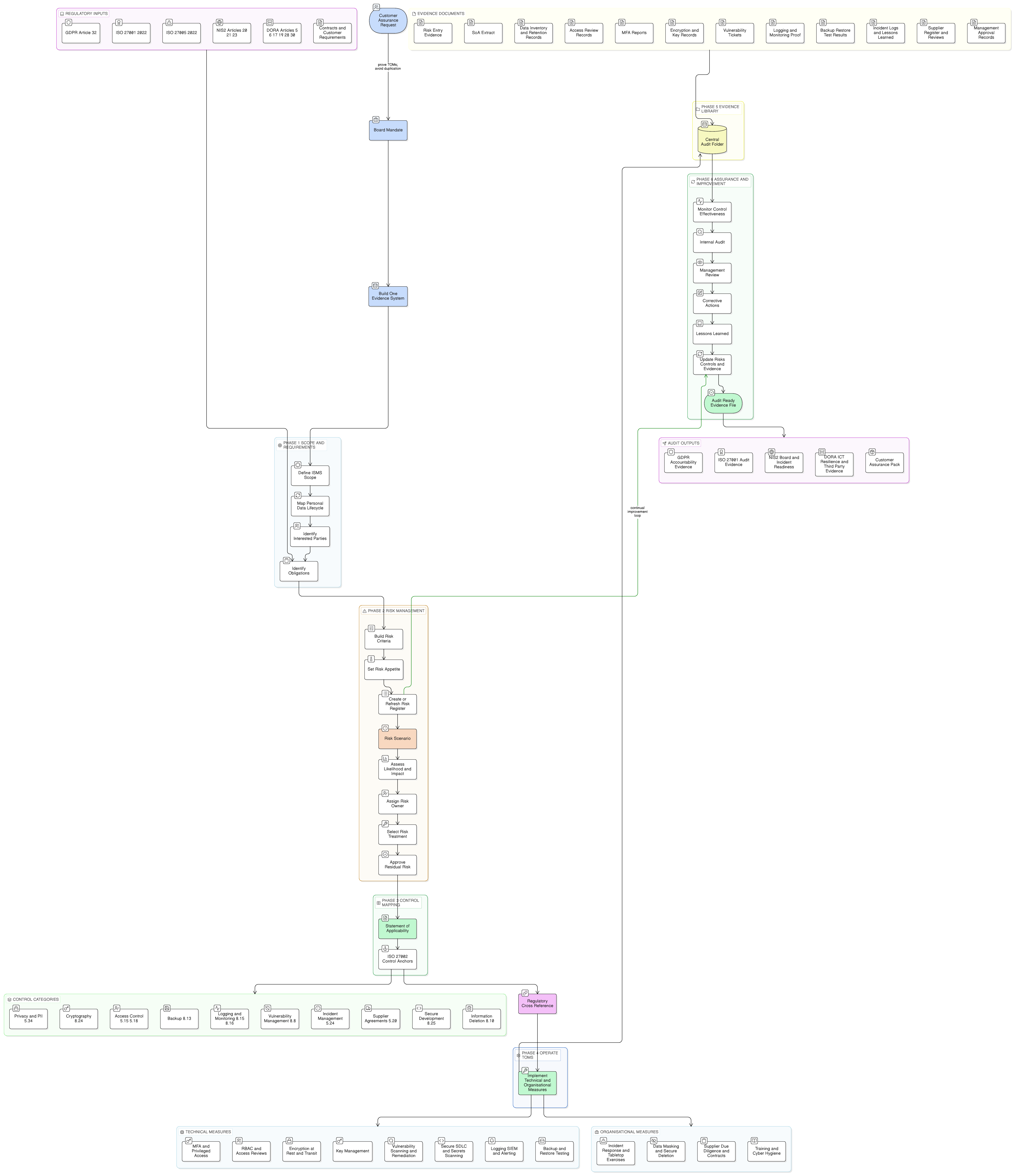
That is where ISO/IEC 27001:2022 becomes a defensible governance system. Clarysec’s approach is to use ISO/IEC 27001:2022 as the evidence backbone, Zenith Blueprint: An Auditor’s 30-Step Roadmap Zenith Blueprint as the implementation route, Clarysec policies as board-ready artefacts, and Zenith Controls: The Cross-Compliance Guide Zenith Controls as the cross-framework mapping guide for NIS2, DORA, GDPR, NIST CSF 2.0, COBIT 2019, and audit expectations.
Why NIS2 Board Liability Changes the Cybersecurity Conversation
NIS2 does not ask directors to become firewall engineers. It asks them to govern. That distinction matters.
A CISO can show vulnerability reports, MFA coverage, endpoint protection dashboards, and cloud posture scores. Those are useful operational signals, but they do not automatically prove management-body oversight. A regulator, enterprise customer, certification auditor, or financial-sector assessor will look for a chain of governance evidence:
- The organization assessed whether NIS2 applies and documented the basis.
- The board or top management approved the cybersecurity risk-management framework.
- Risk appetite and tolerance thresholds were defined.
- High cyber risks were escalated and reviewed.
- Risk treatment decisions were approved, including accepted residual risk.
- Incident reporting procedures reflect 24-hour, 72-hour, and final-report obligations where applicable.
- Supplier and cloud dependencies are mapped and governed.
- Management review includes audit findings, incident trends, metrics, and improvement actions.
- Executives received training appropriate to their accountability.
- Decisions, exceptions, and escalations are traceable.
This is where many old security playbooks fail. Buying a “NIS2-compliant” tool does not prove board oversight. Signing a policy and filing it away does not show implementation. Delegating cybersecurity entirely to the CISO does not satisfy a management body’s oversight duty.
ISO/IEC 27001:2022 solves this problem because it frames information security as a strategic, risk-based management system integrated into organizational processes. Its clauses on context, interested parties, legal obligations, scope, leadership, risk assessment, risk treatment, operational control, performance evaluation, internal audit, management review, and continual improvement create the structure a board needs for due care.
The Zenith Blueprint makes this practical in the ISMS Foundation & Leadership phase, Step 3:
“Clause 5.1 is all about Leadership and commitment. ISO 27001 mandates that top management demonstrate leadership by endorsing the ISMS, providing resources, promoting awareness, ensuring roles are assigned, integrating the ISMS into business processes, and supporting continual improvement.”
That is the operating model behind NIS2 Article 20. The board does not need to approve every technical ticket, but it must approve the governance model, understand material risks, ensure resources, and oversee implementation.
The Board Evidence Pack NIS2 Actually Demands
A common mistake is to treat NIS2 evidence as a legal memo plus a policy folder. That rarely satisfies a serious assessor. Board accountability needs proof of active governance, not passive documentation.
A strong NIS2 board evidence pack should connect legal obligations to board decisions, controls, and review cycles.
| Evidence artefact | Board accountability question answered | ISO/IEC 27001:2022 anchor | Clarysec source |
|---|---|---|---|
| NIS2 applicability assessment | Are we essential, important, indirectly exposed, or out of scope? | Clauses 4.1 to 4.4 | Zenith Blueprint, Step 1 and Step 2 |
| ISMS scope and dependency map | Which services, locations, suppliers, interfaces, and processes are governed? | Clauses 4.1 to 4.4 | Zenith Blueprint, ISMS Foundation phase |
| Cyber risk register | What are our highest cyber risks and who owns them? | Clauses 6.1.1 and 6.1.2 | Risk Management Policy |
| Risk treatment plan and SoA | Which controls are selected, why, and who approved residual risk? | Clause 6.1.3 | Zenith Blueprint, Step 13 |
| Board minutes and decision log | Did management approve, challenge, and oversee measures? | Clauses 5.1, 5.3, 9.3 | Governance Roles and Responsibilities Policy |
| Incident escalation and reporting procedure | Can we meet NIS2 staged reporting timelines? | Clauses 8.1, 9.1, Annex A incident controls | Incident response toolkit and management review |
| Supplier risk dashboard | Are critical suppliers and cloud dependencies governed? | Clause 8.1 and Annex A supplier controls | Zenith Controls cross-mapping |
| Executive training record | Did management-body members undertake appropriate training? | Clause 7.2 and awareness controls | Information Security Awareness and Training Policy |
| Internal audit and management review outputs | Is implementation independently checked and improved? | Clauses 9.2, 9.3, 10.1 | Audit and Compliance Monitoring Policy - SME |
The strength of this pack is traceability. Each artefact answers a governance question and points to an ISO/IEC 27001:2022 mechanism. That gives the CISO, CEO, and board a defensible narrative: cybersecurity is not a collection of tools, it is a governed system.
Turning Policies Into Board-Level Accountability
In the opening scenario, Maria’s CEO may be tempted to answer the customer with an ISO certificate and a few policies. That is not enough for NIS2 management-body accountability. The organization needs evidence that responsibility is assigned, decisions are recorded, and risks are escalated objectively.
Clarysec policies are designed to create that traceability.
For smaller organizations, Information Security Policy-sme Information Security Policy - SME, clause 4.1.1, states that top management:
“Retains overall accountability for information security.”
This sentence matters. It prevents a common anti-pattern where founders, CEOs, or executive teams informally delegate all security accountability to IT while retaining no meaningful oversight.
For larger organizations, Risk Management Policy Risk Management Policy, clause 4.1.1, states that leadership:
“Approves the risk management framework and defines acceptable risk appetite and tolerance thresholds.”
That is board-ready evidence for NIS2 Article 20. A risk appetite statement, tolerance thresholds, and a formal risk authority model show how approval and escalation work in practice.
The same policy’s clause 5.6 adds:
“The Risk Authority Matrix shall clearly define thresholds for escalation to Top Management or the Board.”
This is one of the most important artefacts for NIS2 governance. Without escalation thresholds, the board sees only what someone chooses to escalate. With thresholds, high residual risk, unresolved critical vulnerabilities, significant supplier concentration, major incidents, audit findings, and exceptions above tolerance automatically move into executive oversight.
The Governance Roles and Responsibilities Policy Governance Roles and Responsibilities Policy reinforces the evidence chain:
“Governance shall support integration with other disciplines (e.g., risk, legal, IT, HR), and ISMS decisions shall be traceable to their source (e.g., audit records, review logs, meeting minutes).”
For SMEs, Governance Roles and Responsibilities Policy-sme Governance Roles and Responsibilities Policy - SME states:
“All significant security decisions, exceptions, and escalations must be recorded and traceable.”
Those clauses convert board oversight from a conversation into an audit trail.
The ISO/IEC 27001:2022 Evidence Chain for NIS2 Article 20
A board can operationalize NIS2 Article 20 through a clear ISO/IEC 27001:2022 evidence chain.
First, establish context and scope. ISO/IEC 27001:2022 requires the organization to determine internal and external issues, interested parties, legal, regulatory and contractual requirements, ISMS boundaries, interfaces, dependencies, and interacting processes. For a SaaS or cloud provider, the ISMS scope should explicitly identify EU services, cloud environments, support operations, critical suppliers, regulated customer segments, and NIS2 exposure.
Second, demonstrate leadership. ISO/IEC 27001:2022 requires top management to align security objectives with strategic direction, integrate ISMS requirements into business processes, provide resources, communicate importance, assign responsibilities, and promote continual improvement. For NIS2, this becomes evidence that the management body approved and oversaw cybersecurity risk-management measures.
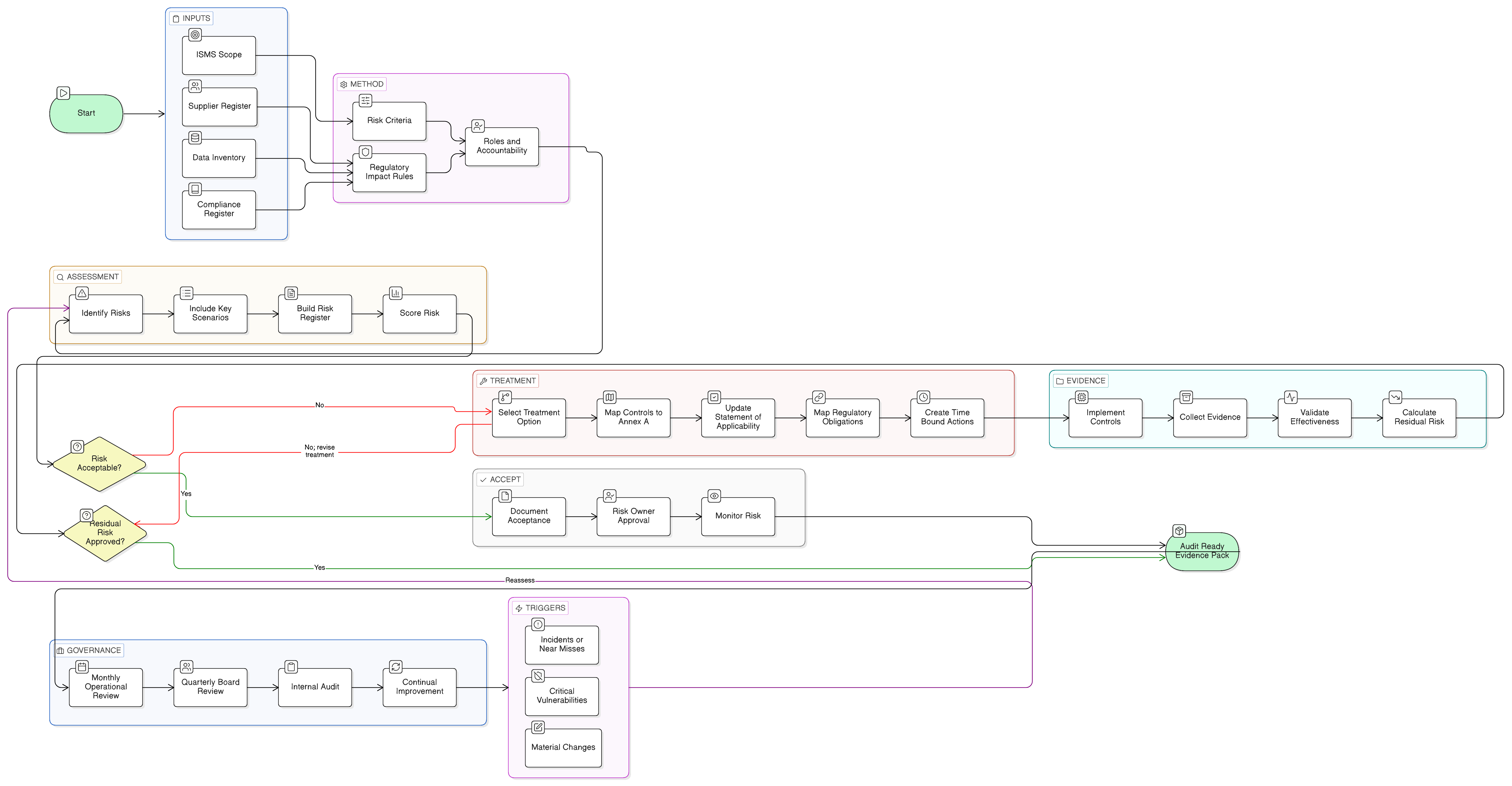
Third, run repeatable risk assessment and treatment. ISO/IEC 27001:2022 requires risk criteria, risk identification, risk owners, likelihood and consequence analysis, treatment options, control selection, Annex A comparison, a Statement of Applicability, a risk treatment plan, and approval of residual risk.
The Zenith Blueprint, Risk Management phase, Step 13, makes the approval point explicit:
“Management Approval: Risk treatment decisions and the SoA should be reviewed and approved by top management. Management should be briefed on key risks and proposed treatments, risks proposed for acceptance, and the controls planned for implementation.”
For NIS2, that briefing should not be a one-off. The board pack should show current top risks, trend, treatment progress, accepted residual risk, overdue actions, critical supplier exposure, incident themes, and key effectiveness metrics.
Fourth, operate and retain evidence. ISO/IEC 27001:2022 clause 8.1 requires operational planning and control. Annex A controls support supplier security, cloud governance, incident response, business continuity, vulnerability management, backups, logging, monitoring, secure development, application security, architecture, testing, outsourcing, segregation, and change management.
Fifth, evaluate and improve. Internal audit, measurement, management review, corrective action, and continual improvement turn a control catalogue into a governed system.
The enterprise Information Security Policy Information Security Policy embeds this management review expectation:
“Management review activities (per ISO/IEC 27001 Clause 9.3) shall be conducted at least annually and shall include:”
The value is not only that a meeting occurs. The value is that the review creates evidence: inputs, decisions, actions, owners, deadlines, and follow-up.
The Audit and Compliance Monitoring Policy-sme Audit and Compliance Monitoring Policy - SME, clause 5.4.3, closes the loop:
“Audit findings and status updates must be included in the ISMS management review process.”
That is the difference between “we had an audit” and “management reviewed audit results and directed remediation.”
Cross-Compliance Mapping: NIS2, DORA, GDPR, NIST CSF 2.0, and COBIT 2019
NIS2 rarely arrives alone. A cloud provider may process personal data under GDPR. A fintech customer may impose DORA-driven supplier requirements. A US enterprise customer may ask for NIST CSF 2.0 alignment. A board audit committee may speak COBIT 2019.
The answer is not to build separate compliance folders. The answer is to use ISO/IEC 27001:2022 as the central evidence system.
Zenith Controls helps teams consolidate by mapping ISO/IEC 27002:2022 control 5.4, Management responsibilities, across standards, regulations, and audit methods.
In Zenith Controls, the entry for ISO/IEC 27002:2022 control 5.4 “Management responsibilities” classifies the control type as “Preventive,” links it to confidentiality, integrity and availability, and places it under governance-focused operational capability.
That matters because NIS2 Article 20 is preventive governance. Leadership approval and oversight reduce the likelihood that cyber risk becomes invisible, underfunded, or unmanaged.
Zenith Controls also ties management responsibilities to related ISO/IEC 27002:2022 controls: 5.1 Policies for information security, 5.2 Information security roles and responsibilities, 5.35 Independent review of information security, 5.36 Compliance with policies, rules, and standards for information security, and 5.8 Security in project management. Board accountability cannot stand alone. It needs policies, roles, assurance, compliance monitoring, and project-level integration.
The broader crosswalk is especially useful for executive reporting.
| Requirement theme | NIS2 | DORA | GDPR | NIST CSF 2.0 | COBIT 2019 | Clarysec evidence focus |
|---|---|---|---|---|---|---|
| Management accountability | Article 20 approval, oversight, training, liability | Articles 5 and 6 management body responsibility and ICT risk management framework | Article 5(2) accountability and Article 24 responsibility | GOVERN, especially GV.RR, GV.RM, and GV.OV | EDM03 risk optimization | Board minutes, role charters, training records |
| Risk-management measures | Article 21 technical, operational and organizational measures | ICT risk management framework | Article 32 security of processing | GOVERN, IDENTIFY, PROTECT | APO13 managed security | Risk register, treatment plan, SoA |
| Incident reporting | Article 23 early warning, incident notification, final report | Articles 17 to 20 major ICT-related incident reporting | Articles 33 and 34 personal data breach notification where applicable | RESPOND and RECOVER | DSS02 managed service requests and incidents | Escalation matrix, playbooks, simulations |
| Supplier governance | Article 21(2)(d) supply-chain security | Articles 28 to 30 ICT third-party risk | Processor and security obligations | GV.SC cybersecurity supply chain risk management | APO10 managed vendors | Supplier register, due diligence, contract controls |
| Effectiveness and assurance | Article 21(2)(f) policies and procedures to assess effectiveness | Article 6 ICT risk management framework review and audit expectations | Article 32(1)(d) regular testing and evaluation | GV.OV oversight, ID.RA risk assessment, DE.CM continuous monitoring | MEA01 and MEA03 monitoring and compliance | Internal audit, management review, corrective actions |
DORA deserves special attention. NIS2 Article 4 recognizes that sector-specific EU legal acts can displace overlapping NIS2 provisions where equivalent cybersecurity risk-management or incident notification measures apply. DORA is the key example for financial entities. It applies from 17 January 2025 and creates a uniform ICT risk management, incident reporting, resilience testing, third-party risk management, and oversight framework for financial services.
A SaaS or cloud provider may not be directly regulated like a bank, but DORA can still arrive through customer contracts. Financial entities must manage ICT third-party risk, maintain registers of ICT service contracts, perform due diligence, assess concentration risk, include audit and inspection rights, define termination rights, and maintain exit strategies. That means providers serving financial customers should expect evidence requests that look very similar to NIS2 board governance questions.
GDPR adds accountability for personal data. Article 5(2) requires controllers to be responsible for and able to demonstrate compliance. Article 32 requires security of processing, including regular testing, assessing, and evaluating the effectiveness of technical and organizational measures. Where personal data is affected, incident workflows must integrate GDPR breach assessment with NIS2 significant incident escalation.
NIST CSF 2.0 adds an executive-friendly language through the GOVERN function. It emphasizes organizational context, risk management strategy, roles and responsibilities, policy, oversight, and supply chain risk management. COBIT 2019 adds a governance vocabulary familiar to audit committees, especially through EDM03 for risk optimization and MEA objectives for monitoring and assurance.
A 90-Day NIS2 Board Evidence Sprint
A practical evidence sprint can help organizations move quickly without creating a parallel bureaucracy.
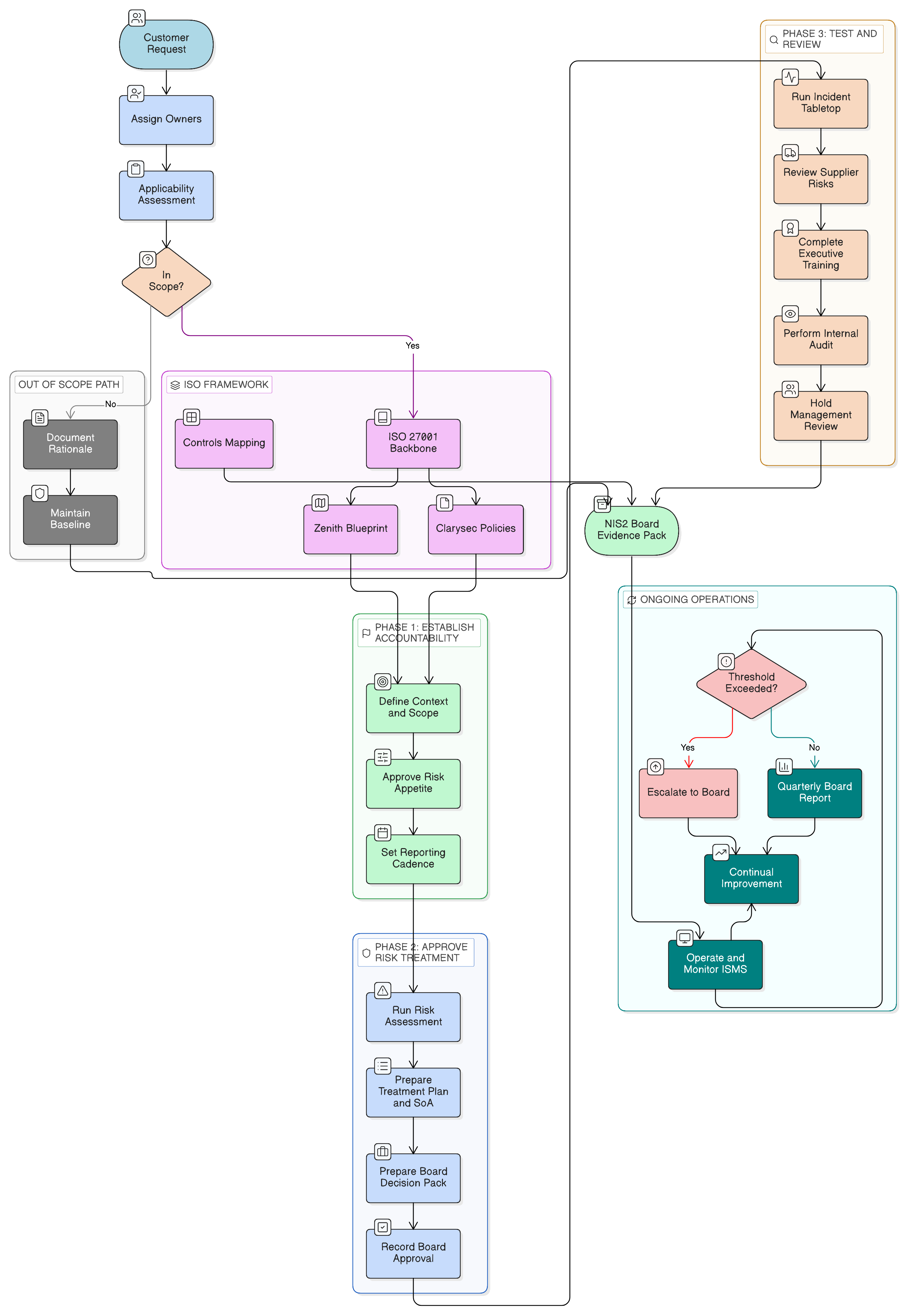
Days 1 to 30: Establish accountability
Start with an NIS2 accountability register that records:
- Entity classification analysis, including essential, important, indirect exposure, or out-of-scope rationale.
- Services in scope, such as SaaS, cloud, managed services, data centre, DNS, trust services, or communications-related services.
- EU Member States where services are provided.
- Customer sectors affected, especially financial services, healthcare, transport, energy, public administration, and digital infrastructure.
- Applicable obligations, including NIS2 Article 20, Article 21, and Article 23.
- Related obligations from DORA, GDPR, customer contracts, and cyber insurance.
- Management owner and board reporting frequency.
Attach this to the ISO/IEC 27001:2022 context, interested parties, obligations register, and ISMS scope. Then update the Risk Authority Matrix using the Risk Management Policy requirement that escalation thresholds be defined for top management or the board.
Useful escalation triggers include residual risk above appetite, unaccepted critical vulnerabilities past SLA, supplier concentration risk, unresolved high audit findings, incidents that may trigger NIS2 reporting, exceptions to MFA, backup, logging, encryption, or incident response requirements, and material cloud architecture changes.
Days 31 to 60: Approve risk treatment
Use Zenith Blueprint Step 13 to prepare a board decision pack for the risk treatment plan and Statement of Applicability. The pack should include:
- Top 10 cyber risks.
- Proposed treatment option for each risk.
- Selected control groups.
- Residual risk after treatment.
- Risks proposed for acceptance.
- Budget or resource decisions required.
- Dependencies on suppliers, legal, HR, product, and IT.
- Management decision requested.
The output should be a signed or minuted approval. A slide deck alone is not enough.
Also map NIS2 Article 21 measures to ISO/IEC 27001:2022 clauses and Annex A controls. This allows the organization to show that NIS2 is being handled through the ISMS rather than through a disconnected checklist.
Days 61 to 90: Test incident reporting and review evidence
NIS2 Article 23 requires staged reporting for significant incidents: early warning within 24 hours, incident notification within 72 hours, intermediate updates where required or requested, and a final report no later than one month after notification.
Run a tabletop with the board sponsor, CEO, CISO, legal, communications, customer success, and operations. Use a realistic scenario, such as a cloud misconfiguration exposing customer metadata, disrupting service availability, and affecting a regulated customer.
Test who decides whether the incident may be significant, who contacts legal counsel, who notifies competent authorities or the CSIRT where required, who approves customer communications, how evidence is preserved, how GDPR breach obligations are assessed in parallel, and how the board is updated during the first 24 hours.
Then hold a formal management review. The Zenith Blueprint, Audit, Review & Improvement phase, Step 28, explains why:
“Management review is not just a presentation; it is about making decisions.”
That review should include audit findings, risk treatment progress, incident readiness, supplier risks, metrics, decisions, assigned actions, and follow-up owners.
The Management Review Meeting That Actually Works
Many management reviews fail because they are structured as status updates. A NIS2-ready management review should be a decision meeting.
The agenda should include:
- Changes in NIS2, DORA, GDPR, contractual, and customer requirements.
- Changes in business context, services, acquisitions, suppliers, cloud architecture, and regulated customer segments.
- Status of top information security risks and residual risk against appetite.
- Risk treatment plan progress and overdue actions.
- Incident trends, significant events, near misses, and reporting readiness.
- Supplier and ICT dependency risks, including concentration and exit concerns.
- Results of internal audits, external audits, customer assessments, and penetration tests.
- Security awareness and executive training completion.
- Metrics for access control, vulnerability management, backups, logging, monitoring, secure development, and continuity tests.
- Decisions required, including risk acceptance, budget, staffing, policy exceptions, supplier remediation, and control improvements.
Executive training is especially important. NIS2 Article 20 requires management-body members to undertake training. Information Security Awareness and Training Policy Information Security Awareness and Training Policy, clause 5.1.2.4, explicitly includes executive training topics:
“Executives (e.g., governance, risk acceptance, legal obligations)”
Executive cyber training should focus on decision rights, liability, escalation, risk appetite, crisis governance, incident reporting, and regulatory obligations. It should not be limited to phishing awareness.
How Auditors and Customers Will Test Board Oversight
Different assessors will use different language, but they will test the same underlying question: is cybersecurity governed?
Zenith Controls is valuable because it includes audit methodology mappings. For management responsibilities, it references ISO/IEC 19011:2018 audit principles and conduct, ISO/IEC 27007:2020 ISMS audit practices, ISO/IEC 27001:2022 clause 5.1, COBIT 2019 EDM01 and EDM03, ISACA ITAF Section 1401, and NIST SP 800-53A PM-1 and PM-2. For independent review, it maps to ISO/IEC 27001:2022 clauses 9.2 and 9.3, ISO/IEC 27007 audit planning and evidence practices, ISACA ITAF Section 2400, and NIST assessment methods. For compliance with policies, it maps to ISO/IEC 27001:2022 clauses 9.1, 9.2 and 10.1, ISO/IEC 19011 evidence collection, COBIT 2019 MEA01, and NIST continuous monitoring assessment.
| Auditor lens | What they will ask | Evidence they expect | Common failure |
|---|---|---|---|
| ISO/IEC 27001:2022 auditor | How does top management demonstrate leadership, approve risk treatment, and review ISMS performance? | Policy approvals, risk register, SoA approval, management review minutes, internal audit outputs | Management review exists but has no decisions or action tracking |
| NIS2-focused assessor | Did the management body approve cybersecurity measures and oversee implementation? | Board minutes, escalation matrix, executive training records, Article 21 baseline mapping | Security measures approved by CISO only, with no board traceability |
| NIST CSF 2.0 assessor | Are governance outcomes, risk appetite, roles, resources, oversight, and supply chain risk integrated into enterprise risk management? | Current and target profiles, gap plan, leadership reporting, metrics | NIST used as a checklist without governance ownership |
| COBIT 2019 or ISACA auditor | Does governance evaluate, direct, and monitor cyber risk management? | Governance charters, risk appetite, management reporting, assurance results | Board receives technical metrics but no risk decision context |
| DORA customer or financial-sector assessor | Are ICT risks, incidents, resilience, and third-party dependencies governed and documented? | ICT dependency map, supplier register, due diligence, audit rights, incident lifecycle | Supplier risk is questionnaire-based only, without concentration or exit analysis |
| GDPR auditor or privacy assessor | Can the organization demonstrate security and accountability for personal data processing? | Data maps, lawful basis model, breach assessment process, security controls | Privacy and security evidence are separated and inconsistent |
The lesson is simple. Board accountability is not evidenced by attendance alone. It is evidenced by informed decisions, documented approvals, risk-based prioritization, resource allocation, and follow-up.
Common Pitfalls That Break the Evidence Chain
The organizations that struggle with NIS2 management-body accountability usually fall into predictable patterns.
First, they confuse technical control operation with governance. MFA coverage, SIEM alerts, EDR deployment, and backup success rates matter, but the board needs risk context, treatment decisions, and assurance that controls work.
Second, they approve policies but not risk treatment. A signed security policy does not prove the board approved proportionate cybersecurity measures. The risk treatment plan and SoA are stronger evidence because they connect risks, controls, residual risk, and management approval.
Third, they lack escalation thresholds. Without a Risk Authority Matrix, escalation depends on personalities. NIS2 governance needs objective triggers.
Fourth, they separate incident response from regulatory reporting. NIS2, DORA, and GDPR reporting workflows must be integrated before a crisis.
Fifth, they ignore supplier governance. NIS2 Article 21 includes supply-chain security and supplier vulnerability considerations. DORA-driven customers may expect deeper ICT third-party governance, including due diligence, audit rights, concentration risk, termination rights, and exit strategies.
Sixth, they do not train executives. Executive cyber training is not optional window dressing under NIS2. It is part of the governance evidence chain.
What Good Looks Like
After 90 days, a credible NIS2 board evidence folder should contain:
- Applicability assessment.
- ISMS scope and obligations register.
- Leadership commitment statement.
- Risk appetite and tolerance thresholds.
- Risk Authority Matrix.
- Cyber risk register.
- Risk treatment plan.
- Statement of Applicability.
- Board approval minutes.
- Executive training records.
- Incident tabletop report.
- Supplier risk dashboard.
- Internal audit report.
- Management review minutes and action tracker.
This folder answers the customer questionnaire Maria received on Monday morning. More importantly, it helps the board govern cyber risk before an incident, audit, or regulator tests the organization publicly.
Turn NIS2 Board Liability Into Audit-Ready Governance
NIS2 has changed the cybersecurity conversation. Management bodies must approve cybersecurity risk-management measures, oversee implementation, and undertake training. Article 21 requires an integrated set of technical, operational, and organizational measures. Article 23 compresses incident reporting into a staged timeline that demands preparation before the crisis.
ISO/IEC 27001:2022 gives you the management system. Clarysec gives you the implementation route, policy language, cross-compliance mappings, and audit evidence model.
If your board is asking, “What do we need to approve, and how do we prove oversight?”, start with three actions:
- Use Zenith Blueprint Step 3, Step 13, and Step 28 to structure leadership commitment, risk treatment approval, and management review.
- Use Clarysec policies such as Risk Management Policy, Governance Roles and Responsibilities Policy, Information Security Policy, and SME equivalents to formalize accountability and traceability.
- Use Zenith Controls to map NIS2 board oversight into ISO/IEC 27001:2022, ISO/IEC 27002:2022, DORA, GDPR, NIST CSF 2.0, COBIT 2019, and audit methodology expectations.
Clarysec can help you build the board pack, update the ISMS evidence chain, prepare management review, and turn NIS2 accountability into a repeatable cyber risk governance process that auditors, customers, and executives can understand. Download the relevant Clarysec toolkits or request an assessment to turn board liability into audit-ready evidence.
Frequently Asked Questions
About the Author

Igor Petreski
Compliance Systems Architect, Clarysec LLC
Igor Petreski is a cybersecurity leader with over 30 years of experience in information technology and a dedicated decade specializing in global Governance, Risk, and Compliance (GRC).Core Credentials & Qualifications:• MSc in Cyber Security from Royal Holloway, University of London• PECB-Certified ISO/IEC 27001 Lead Auditor & Trainer• Certified Information Systems Auditor (CISA) from ISACA• Certified Information Security Manager (CISM) from ISACA • Certified Ethical Hacker from EC-Council