NIST CSF 2.0 Govern for SMEs and ISO 27001
Sarah, the newly appointed CISO of a fast-growing FinTech SME, had a whiteboard full of frameworks and a deadline she could not move. NIST CSF 2.0. ISO 27001:2022. NIS2. DORA. GDPR. Supplier risk. Board accountability. Enterprise customer due diligence.
The trigger was familiar: a spreadsheet from a major financial services customer. Procurement wanted evidence of a cybersecurity governance model, risk appetite, supplier security program, legal and regulatory obligation mapping, incident escalation process, and ISO 27001:2022 alignment.
The CEO did not want a lecture on compliance. She wanted a simple answer to a hard question: “How do we prove to our board, our clients, and our regulators that we are in control of cyber risk?”
This is the governance problem facing many SMEs. A customer questionnaire is rarely just a customer questionnaire. It is often five compliance conversations compressed into one request. NIST CSF 2.0, ISO/IEC 27001:2022, GDPR, NIS2, DORA-driven supplier expectations, cloud resilience, board oversight, and contractual commitments are all hiding inside the same evidence request.
Many SMEs respond by creating separate artifacts: a NIST spreadsheet, an ISO certification folder, a GDPR tracker, a supplier risk register, and an incident response plan that do not connect. Six months later, nobody knows which document is authoritative.
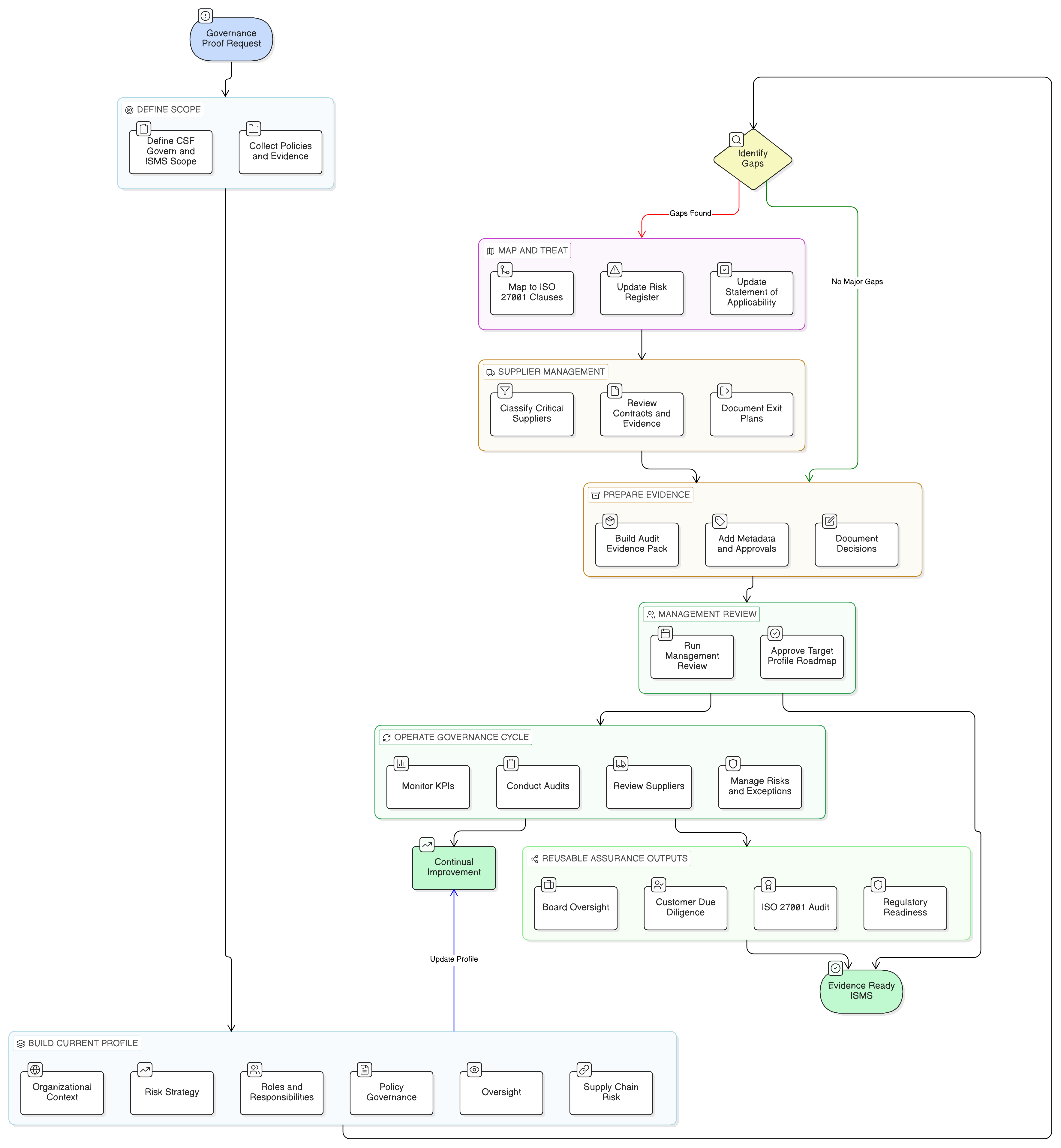
Clarysec’s approach is different. Use the NIST CSF 2.0 Govern Function as the executive governance layer, then map it into ISO 27001:2022 policies, risk treatment, the Statement of Applicability, supplier oversight, management review, and audit evidence. The result is not more compliance work. It is one operating model that can answer auditors, customers, regulators, and leadership with the same evidence set.
Why the NIST CSF 2.0 Govern Function matters for SMEs
NIST CSF 2.0 elevates governance into its own function, alongside Identify, Protect, Detect, Respond, and Recover. That change is important because most SME security failures are not caused by the absence of another tool. They are caused by unclear accountability, weak risk decisions, undocumented exceptions, inconsistent supplier oversight, and policies that were approved once but never operationalized.
The NIST CSF 2.0 Govern Function changes the question from “what controls do we have?” to “who is accountable, what obligations apply, how are risks prioritized, and how is performance reviewed?”
For SMEs, the Govern outcomes provide a practical mandate:
- Understand and manage legal, regulatory, contractual, privacy, and civil liberties obligations.
- Establish risk appetite, tolerance, risk scoring, prioritization, and risk response options.
- Define cybersecurity roles, responsibilities, authorities, escalation paths, and resourcing.
- Establish, communicate, enforce, review, and update cybersecurity policies.
- Review cybersecurity strategy, performance, and management accountability.
- Govern supplier and third-party cybersecurity risk from due diligence through offboarding.
This is why NIST CSF 2.0 Govern is such a strong front door for ISO 27001:2022. NIST gives executives the governance language. ISO 27001:2022 gives the auditable management system.
ISO 27001:2022 clauses 4 to 10 require organizations to understand context, define interested parties, establish ISMS scope, demonstrate leadership, plan risk assessment and treatment, support documented information, operate controls, evaluate performance, conduct internal audits and management reviews, and continually improve. Annex A then provides the control reference set, including policies, management responsibilities, legal obligations, privacy, supplier relationships, cloud services, incident management, and ICT readiness for business continuity.
Clarysec’s Enterprise Information Security Policy Information Security Policy states:
The organization shall maintain a formal governance model to oversee the ISMS, aligned with ISO/IEC 27001 Clauses 5.1 and 9.3.
That requirement, from clause 5.1 of the Information Security Policy, is the practical bridge between NIST GV accountability and ISO 27001:2022 leadership expectations. Governance is not an annual presentation. It is a formal model that connects decisions, policies, roles, risks, controls, evidence, and review.
The core mapping: NIST CSF 2.0 Govern to ISO 27001:2022 evidence
The fastest way to make NIST CSF 2.0 useful is to convert Govern outcomes into policy ownership and audit evidence. The table below is the structure Clarysec uses with SMEs preparing for ISO 27001:2022 certification, enterprise customer due diligence, NIS2 readiness, DORA customer assurance, and GDPR accountability.
| NIST CSF 2.0 Govern area | SME governance question | ISO 27001:2022 alignment | Clarysec policy anchor | Evidence auditors and customers expect |
|---|---|---|---|---|
| GV.OC, organizational context | Do we know our legal, regulatory, contractual, privacy, and business obligations? | Clauses 4.1 to 4.4, Annex A 5.31 and 5.34 | Legal and Regulatory Compliance Policy | Compliance register, ISMS scope, interested-party register, customer obligation map, privacy register |
| GV.RM, risk management strategy | How do we define, score, prioritize, accept, and treat cyber risks? | Clauses 6.1.1 to 6.1.3, 8.2 and 8.3 | Risk Management Policy | Risk methodology, risk register, risk treatment plan, risk owner approvals, SoA mapping |
| GV.RR, roles and responsibilities | Who owns cybersecurity decisions, exceptions, resources, and reporting? | Clauses 5.1 to 5.3, Annex A 5.2 and 5.4 | Governance Roles and Responsibilities Policy-sme | RACI, role descriptions, meeting minutes, exception approvals, training records |
| GV.PO, policy | Are policies approved, communicated, enforced, reviewed, and updated? | Clauses 5.2, 7.5 and 9.3, Annex A 5.1 | Information Security Policy | Policy register, approval records, version history, employee acknowledgements, policy review minutes |
| GV.OV, oversight | Are cybersecurity strategy and performance reviewed and adjusted? | Clauses 9.1, 9.2, 9.3, 10.1 and 10.2 | Audit and Compliance Monitoring Policy | KPI dashboard, internal audit plan, management review outputs, corrective actions |
| GV.SC, supply chain risk | Are suppliers known, prioritized, assessed, contracted, monitored, and offboarded? | Annex A 5.19 to 5.23 and 5.30 | Third-Party and Supplier Security Policy-sme | Supplier inventory, due diligence records, contract clauses, review logs, exit plans, incident contacts |
This mapping is intentionally evidence-first. It does not ask the SME to create 40 documents. It asks five operational questions:
- What decision is being made?
- Who owns it?
- Which policy governs it?
- Which ISO 27001:2022 clause or Annex A control supports it?
- What evidence proves it happened?
The Governance Roles and Responsibilities Policy-sme Governance Roles and Responsibilities Policy-sme - SME makes that traceability explicit:
All significant security decisions, exceptions, and escalations must be recorded and traceable.
This quote comes from clause 5.5 of the Governance Roles and Responsibilities Policy-sme. It turns NIST GV.RR from a governance principle into an auditable operating rule.
Start with a CSF Govern Profile, not a control spreadsheet
NIST CSF 2.0 Organizational Profiles help organizations describe current and target cybersecurity outcomes. For SMEs, the Profile is where governance becomes manageable.
A practical Govern Profile workshop should answer five questions:
- What is in scope: the whole company, a SaaS platform, a regulated product, or a customer environment?
- Which obligations drive the profile: customer contracts, GDPR, NIS2 exposure, DORA-driven customer expectations, ISO 27001:2022 certification, or investor due diligence?
- What does the current evidence prove, not what do people believe exists?
- What target state is realistic for the next 90 days and the next 12 months?
- Which risks, policies, suppliers, and SoA entries must change?
The Zenith Blueprint: An Auditor’s 30-Step Roadmap Zenith Blueprint supports this in the ISMS Foundation & Leadership phase, Step 6, “Documented Information and Building the ISMS Library.” It recommends preparing the SoA early and using it as a controls library:
✓ Additional Controls: Are there controls outside Annex A you might include? ISO 27001 allows adding other controls in the SoA. For example, maybe you want to include compliance with NIST CSF or specific privacy controls from ISO 27701. Generally, Annex A is comprehensive, but feel free to append any unique controls you plan
✓ Use a Spreadsheet (SoA Builder): A practical approach is to prepare the SoA spreadsheet now. We’ve prepared a SoA_Builder.xlsx template which lists all Annex A controls with columns for applicability, implementation status, and notes.
For an SME, this matters. You do not need to force NIST CSF 2.0 into ISO Annex A as if the two are identical. You can include CSF Govern outcomes as additional governance requirements in your SoA library, map them to ISO 27001:2022 clauses and Annex A controls, and use them to improve management review, supplier governance, risk reporting, and compliance monitoring.
Build a Govern evidence register
A Govern evidence register is the practical tool that converts frameworks into proof. It should connect each NIST outcome to an ISO reference, policy owner, evidence item, review cadence, gap, and action.
| Field | Example entry |
|---|---|
| CSF outcome | GV.OC-03 |
| Governance question | Are legal, regulatory, contractual, privacy, and civil liberties obligations understood and managed? |
| ISO 27001:2022 reference | Clauses 4.2, 4.3 and 6.1.3, Annex A 5.31 and 5.34 |
| Clarysec policy | Legal and Regulatory Compliance Policy |
| Evidence owner | Compliance Manager |
| Evidence | Compliance Register v1.4, customer obligations map, GDPR processing register |
| Review cadence | Quarterly and when new market, customer, or product changes occur |
| Gap | DORA customer flow-down clauses not mapped to supplier contracts |
| Action | Update supplier contract template and SoA notes |
| Due date | 30 days |
Clarysec’s Enterprise Legal and Regulatory Compliance Policy Legal and Regulatory Compliance Policy gives the governing requirement:
All legal and regulatory obligations must be mapped to specific policies, controls, and owners within the Information Security Management System (ISMS).
This is clause 6.2.1 of the Legal and Regulatory Compliance Policy. For SMEs, the Legal and Regulatory Compliance Policy-sme Legal and Regulatory Compliance Policy-sme - SME adds a practical cross-mapping requirement:
Where a regulation applies across multiple areas (e.g., GDPR applies to retention, security and privacy), this must be clearly mapped in the Compliance Register and training materials.
That quote comes from clause 5.2.2 of the Legal and Regulatory Compliance Policy-sme. Together, these clauses transform GV.OC-03 into a managed, reviewable, audit-ready process.
Connect risk scoring to risk treatment and the SoA
NIST GV.RM requires risk objectives, risk appetite, risk tolerance, standardized risk calculation, response options, and communication lines. ISO 27001:2022 operationalizes this through risk assessment, risk treatment, risk owner approval, residual risk acceptance, and the Statement of Applicability.
The Risk Management Policy-sme Risk Management Policy-sme - SME is deliberately concrete:
Each risk entry must include: description, likelihood, impact, score, owner, and treatment plan.
This comes from clause 5.1.2 of the Risk Management Policy-sme. The Enterprise Risk Management Policy Risk Management Policy reinforces the SoA connection:
A Statement of Applicability (SoA) shall reflect all treatment decisions and shall be updated whenever control coverage is modified.
That is clause 5.4 of the Risk Management Policy.
Consider a real SME risk: unauthorized access to production customer data due to inconsistent MFA enforcement across cloud administration accounts.
A strong Govern mapping would include:
- NIST GV.RM for standardized risk documentation and prioritization.
- NIST GV.RR for role ownership and authority to enforce access control.
- NIST GV.PO for policy enforcement and review.
- ISO 27001:2022 clauses 6.1.2, 6.1.3, 8.2 and 8.3.
- Annex A controls for access control, identity management, authentication information, logging, monitoring, configuration, and cloud services.
- Evidence such as a risk register entry, MFA configuration export, exception approval, cloud IAM review, management review decision, and updated SoA note.
The Zenith Blueprint, Risk Management phase, Step 13, “Risk Treatment Planning and Statement of Applicability,” explains the linkage:
✓ Ensure alignment with your risk register: every mitigating control you wrote in the Risk Treatment Plan should correspond to an Annex A control marked “Applicable.” Conversely, if a control is marked applicable, you should have either a risk or a requirement driving it.
This is the difference between saying “we use MFA” and proving “we have a governed, risk-based, ISO 27001:2022-aligned reason for MFA, with evidence, owner, and review cadence.”
Govern supplier risk without overbuilding the program
NIST GV.SC is one of the most useful parts of the Govern Function for SMEs because modern SMEs depend heavily on suppliers: cloud providers, payment processors, HR platforms, helpdesk systems, code repositories, CI/CD tooling, monitoring tools, and managed security services.
ISO 27001:2022 Annex A supports this through supplier and cloud controls, including 5.19 Information security in supplier relationships, 5.20 Addressing information security within supplier agreements, 5.21 Managing information security in the ICT supply chain, 5.22 Monitoring, review and change management of supplier services, 5.23 Information security for use of cloud services, and 5.30 ICT readiness for business continuity.
The Third-Party and Supplier Security Policy-sme Third-Party and Supplier Security Policy-sme - SME makes the evidence requirement clear:
These reviews must be documented and retained with the supplier’s record. Follow-up actions must be clearly tracked.
This is clause 6.3.2 of the Third-Party and Supplier Security Policy-sme.
A lean SME supplier model can use three tiers:
| Supplier tier | Criteria | Minimum evidence | Review cadence |
|---|---|---|---|
| Critical | Supports production, customer data, authentication, security monitoring, payment flow, or regulated service delivery | Due diligence questionnaire, contract security clauses, SLA, incident contact, exit plan, risk review | Annual and upon material change |
| Important | Supports business operations or internal sensitive information but not direct critical service delivery | Security summary, data processing terms, access review, risk acceptance if gaps exist | Every 18 months |
| Standard | Low-risk tools with no sensitive data or critical dependency | Business owner approval, basic data and access check | At onboarding and renewal |
This simple model supports NIST GV.SC, ISO 27001:2022 supplier controls, customer due diligence, and DORA-driven contractual expectations from financial customers.
Supplier offboarding deserves special attention. NIST GV.SC expects governance across the full supplier lifecycle, including the end of a relationship. Evidence should include data return or deletion, access removal, service transition planning, retained contract records, and residual risk review.
Use Zenith Controls for cross-compliance, not as a separate control set
Clarysec’s Zenith Controls: The Cross-Compliance Guide Zenith Controls is a cross-compliance guide for mapping ISO/IEC 27002:2022 control themes to multiple frameworks and audit lenses. These are not separate “Zenith controls.” They are ISO/IEC 27002:2022 controls analyzed inside Zenith Controls for cross-compliance use.
For NIST CSF 2.0 Govern, three ISO/IEC 27002:2022 control areas are especially important:
| ISO/IEC 27002:2022 control area in Zenith Controls | NIST CSF 2.0 Govern connection | Practical SME interpretation |
|---|---|---|
| 5.1 Policies for information security | GV.PO | Policies must be approved, communicated, enforced, reviewed, and updated when threats, technology, law, or business objectives change |
| 5.4 Management responsibilities | GV.RR and GV.OV | Security responsibilities must be assigned at leadership and operational levels, with resources, reporting, and review |
| 5.31 Legal, statutory, regulatory and contractual requirements | GV.OC-03 | Obligations must be identified, mapped to controls and owners, monitored for change, and evidenced |
The Zenith Blueprint, Controls in Action phase, Step 22, “Organizational controls,” gives the operating model:
Formalize Information Security Governance
Ensure your information security policies (5.1) are finalized, approved, and version-controlled. Assign named owners for each policy domain (e.g., access, encryption, backup) and document roles and responsibilities across the ISMS (5.2). Review segregation of duties (5.3) in high-risk areas like finance, system administration, and change control. Produce a simple governance map showing who approves, who implements, and who monitors security policy.
That governance map is one of the highest-value artifacts an SME can create. It answers NIST GV.RR, ISO 27001:2022 leadership requirements, NIS2 management accountability expectations, and customer questions about who owns cyber risk.
One governance model for NIS2, DORA, GDPR, NIST, and ISO
The Govern Function becomes most valuable when an SME faces overlapping requirements.
NIS2 requires in-scope essential and important entities to adopt appropriate and proportionate cybersecurity risk management measures. It also places responsibility on management bodies to approve cybersecurity risk management measures, oversee implementation, and follow training. NIST GV.RR supports management accountability. GV.RM supports risk-based measures. GV.SC supports supply chain security. GV.PO supports policies. GV.OV supports performance review.
NIS2 incident governance also introduces staged reporting expectations, including early warning within 24 hours, incident notification within 72 hours, and final reporting within one month for significant incidents. Those timelines should be reflected in incident response procedures, escalation paths, communications plans, and management reporting.
DORA applies from 17 January 2025 to EU financial entities, but many SMEs feel its impact through customer contracts. Financial customers may flow DORA requirements down to ICT providers, software vendors, managed service providers, and cloud-dependent suppliers. DORA focuses on ICT risk management, management body responsibility, incident reporting, resilience testing, third-party ICT risk, contractual requirements, and oversight.
GDPR adds accountability for personal data processing. SMEs must understand whether they are controllers, processors, or both, what personal data they process, which systems and suppliers are involved, what lawful bases apply, and which incident scenarios could become personal data breaches.
The Zenith Blueprint, Risk Management phase, Step 14, recommends cross-referencing DORA, NIS2, and GDPR requirements into the ISO 27001:2022 control set:
For each regulation, if applicable, you may create a simple mapping table (could be an appendix in a report) that lists the regulation’s key security requirements and the corresponding controls/policies in your ISMS. This isn’t mandatory in ISO 27001, but it’s a useful internal exercise to ensure nothing fell through the cracks.
A practical cross-compliance map can look like this:
| Governance requirement | NIST CSF 2.0 Govern | ISO 27001:2022 anchor | NIS2, DORA, GDPR relevance | Primary evidence |
|---|---|---|---|---|
| Management accountability | GV.RR and GV.OV | Clauses 5.1, 5.3 and 9.3, Annex A 5.4 | NIS2 management body oversight, DORA management body responsibility | Governance map, RACI, management review minutes |
| Legal and contractual obligations | GV.OC-03 | Clauses 4.2, 4.3 and 6.1.3, Annex A 5.31 and 5.34 | GDPR accountability, NIS2 legal scope, DORA contractual flow-downs | Compliance register, customer obligation map, privacy register |
| Risk-based security measures | GV.RM | Clauses 6.1.2, 6.1.3, 8.2 and 8.3 | NIS2 risk measures, DORA ICT risk framework, GDPR security of processing | Risk register, risk treatment plan, SoA |
| Supplier governance | GV.SC | Annex A 5.19 to 5.23 and 5.30 | NIS2 supply chain security, DORA ICT third-party risk, GDPR processors | Supplier inventory, due diligence, contracts, review logs |
| Policy governance | GV.PO | Clause 5.2 and Annex A 5.1 | All frameworks expect documented, approved, communicated rules | Policy register, version history, acknowledgements |
| Audit and improvement | GV.OV | Clauses 9.1, 9.2, 9.3, 10.1 and 10.2 | DORA testing and remediation, NIS2 effectiveness, GDPR accountability | Internal audit reports, KPIs, corrective actions |
The value is efficiency. One well-run ISO 27001:2022 ISMS, guided by NIST CSF 2.0 Govern, can generate reusable evidence for several frameworks at once.
The auditor’s view: proving governance is real
A policy on a shelf is not governance. Auditors and assessors look for a golden thread: high-level policy, defined process, operational record, management review, and improvement action.
Different reviewers will test that thread differently.
| Auditor lens | What they will focus on | Evidence that works well |
|---|---|---|
| ISO 27001:2022 auditor | Whether governance is embedded in the ISMS, risk treatment is traceable, SoA decisions are justified, and documented information is controlled | ISMS scope, policy register, risk register, SoA, management review minutes, internal audit reports, corrective actions |
| NIST CSF 2.0 assessor | Whether current and target profiles exist, gaps are prioritized, and Govern outcomes are tied to business risk and oversight | CSF profile, gap analysis, POA&M, risk appetite statement, leadership dashboard, supplier target profile |
| COBIT 2019 or ISACA-style auditor | Whether governance objectives, decision rights, performance measures, control ownership, and assurance activities are defined | Governance map, RACI, KPI and KRI dashboard, control owner attestations, audit plan, issue tracking |
| GDPR reviewer | Whether privacy obligations are identified, processing is mapped, security safeguards are appropriate, and accountability evidence exists | Processing register, lawful basis mapping, DPIA where needed, breach response process, supplier data processing terms |
| Customer security assessor | Whether the SME can prove operational security, supplier control, incident readiness, and executive accountability without excessive delay | Evidence pack, policies, supplier reviews, incident tabletop outputs, access reviews, backup tests, security roadmap |
Clarysec’s Enterprise Governance Roles and Responsibilities Policy Governance Roles and Responsibilities Policy states:
Governance shall support integration with other disciplines (e.g., risk, legal, IT, HR), and ISMS decisions shall be traceable to their source (e.g., audit records, review logs, meeting minutes).
This is clause 5.5 of the Governance Roles and Responsibilities Policy. It captures the essence of cross-compliance: governance decisions must be traceable.
The Audit and Compliance Monitoring Policy-sme Audit and Compliance Monitoring Policy-sme - SME adds a critical evidence discipline:
Metadata (e.g., who collected it, when, and from which system) must be documented.
This quote comes from clause 6.2.3 of the Audit and Compliance Monitoring Policy-sme. Evidence metadata is often what separates a screenshot folder from audit-grade evidence.
The Enterprise Audit and Compliance Monitoring Policy Audit and Compliance Monitoring Policy adds the program-level requirement:
The organization shall maintain a structured Audit and Compliance Monitoring Program integrated into the ISMS, covering:
This is clause 5.1 of the Audit and Compliance Monitoring Policy. The governance implication is direct: audit is not a yearly scramble. It is part of ISMS operations.
Common SME mistakes when mapping NIST Govern to ISO 27001:2022
The first mistake is over-documentation without ownership. An SME writes policies but does not assign owners for risk treatment, supplier reviews, exception approvals, or management reporting.
The second mistake is treating legal obligations as separate from the ISMS. NIST GV.OC-03 requires obligations to be understood and managed. ISO 27001:2022 requires relevant interested-party requirements and legal, regulatory, and contractual obligations to be considered in the ISMS.
The third mistake is weak SoA reasoning. The SoA is not only a list of applicable controls. It is the logic file for why controls are included, excluded, or implemented.
The fourth mistake is missing supplier lifecycle evidence. Supplier governance includes onboarding, contracts, monitoring, incidents, changes, and offboarding.
The fifth mistake is failing to update the Target Profile. A CSF Profile should change when the business enters a new geography, signs a major customer, adopts a critical supplier, launches a regulated product, changes cloud architecture, or suffers an incident.
A 30-day NIST CSF 2.0 Govern roadmap for SMEs
If an SME needs to move quickly, start with a focused 30-day implementation plan.
| Days | Activity | Output |
|---|---|---|
| 1 to 3 | Define CSF Govern scope and collect existing policies, contracts, risk records, supplier lists, and audit evidence | Scope note and evidence inventory |
| 4 to 7 | Build the Govern evidence register for GV.OC, GV.RM, GV.RR, GV.PO, GV.OV, and GV.SC | Current Profile and initial gaps |
| 8 to 12 | Map obligations to ISO 27001:2022 policies, Annex A control areas, and owners | Compliance register and policy ownership map |
| 13 to 17 | Update risk register and risk treatment plan, then align SoA entries | Risk register, treatment plan, SoA updates |
| 18 to 22 | Prioritize supplier governance, including critical supplier classification, contract gaps, and review evidence | Supplier risk register and action tracker |
| 23 to 26 | Prepare audit evidence pack with metadata, approvals, review logs, and management decisions | Evidence pack and audit index |
| 27 to 30 | Run management review and approve the Target Profile roadmap | Management review minutes, decisions, roadmap |
This plan creates enough governance evidence to answer serious customer and audit questions while building the foundation for ISO 27001:2022 certification, NIS2 readiness, DORA customer assurance, and GDPR accountability.
The practical result: one governance story, many compliance uses
When Sarah returns to the board, she no longer has five disconnected compliance workstreams. She has one governance story.
NIST CSF 2.0 Govern outcomes are mapped to ISO 27001:2022 policies, owners, risks, controls, and evidence. The ISMS scope includes customer, supplier, cloud, legal, regulatory, privacy, and contractual dependencies. The risk register drives treatment decisions and SoA applicability. Policies are approved, version-controlled, owned, communicated, and reviewed. Supplier risks are tiered, contracted, monitored, and tracked. GDPR processing obligations, NIS2 accountability expectations, and DORA customer flow-downs are cross-referenced where applicable. Audit evidence includes metadata, decision records, and management review outputs.
That is what governance looks like when it is operational.
Next step: build your SME Govern evidence pack with Clarysec
If you are preparing for ISO 27001:2022, responding to enterprise customer due diligence, mapping NIST CSF 2.0 Govern outcomes, or trying to align NIS2, DORA, and GDPR without building separate programs, start with the governance layer.
Clarysec can help you build:
- A NIST CSF 2.0 Govern Current and Target Profile.
- An ISO 27001:2022 policy and SoA mapping.
- A cross-compliance obligation register using Zenith Controls Zenith Controls.
- A 30-step ISMS implementation roadmap using Zenith Blueprint Zenith Blueprint.
- SME-ready policy evidence using the Clarysec policy toolkit, including Governance Roles and Responsibilities Policy-sme Governance Roles and Responsibilities Policy-sme - SME, Risk Management Policy-sme Risk Management Policy-sme - SME, Legal and Regulatory Compliance Policy-sme Legal and Regulatory Compliance Policy-sme - SME, Third-Party and Supplier Security Policy-sme Third-Party and Supplier Security Policy-sme - SME, and Audit and Compliance Monitoring Policy-sme Audit and Compliance Monitoring Policy-sme - SME.
The fastest path is not another spreadsheet. It is a governed, risk-based, evidence-ready ISMS that lets your SME answer one question confidently:
Can you prove cybersecurity is managed, owned, reviewed, and continuously improved?
With Clarysec, the answer becomes yes.
Frequently Asked Questions
About the Author

Igor Petreski
Compliance Systems Architect, Clarysec LLC
Igor Petreski is a cybersecurity leader with over 30 years of experience in information technology and a dedicated decade specializing in global Governance, Risk, and Compliance (GRC).Core Credentials & Qualifications:• MSc in Cyber Security from Royal Holloway, University of London• PECB-Certified ISO/IEC 27001 Lead Auditor & Trainer• Certified Information Systems Auditor (CISA) from ISACA• Certified Information Security Manager (CISM) from ISACA • Certified Ethical Hacker from EC-Council