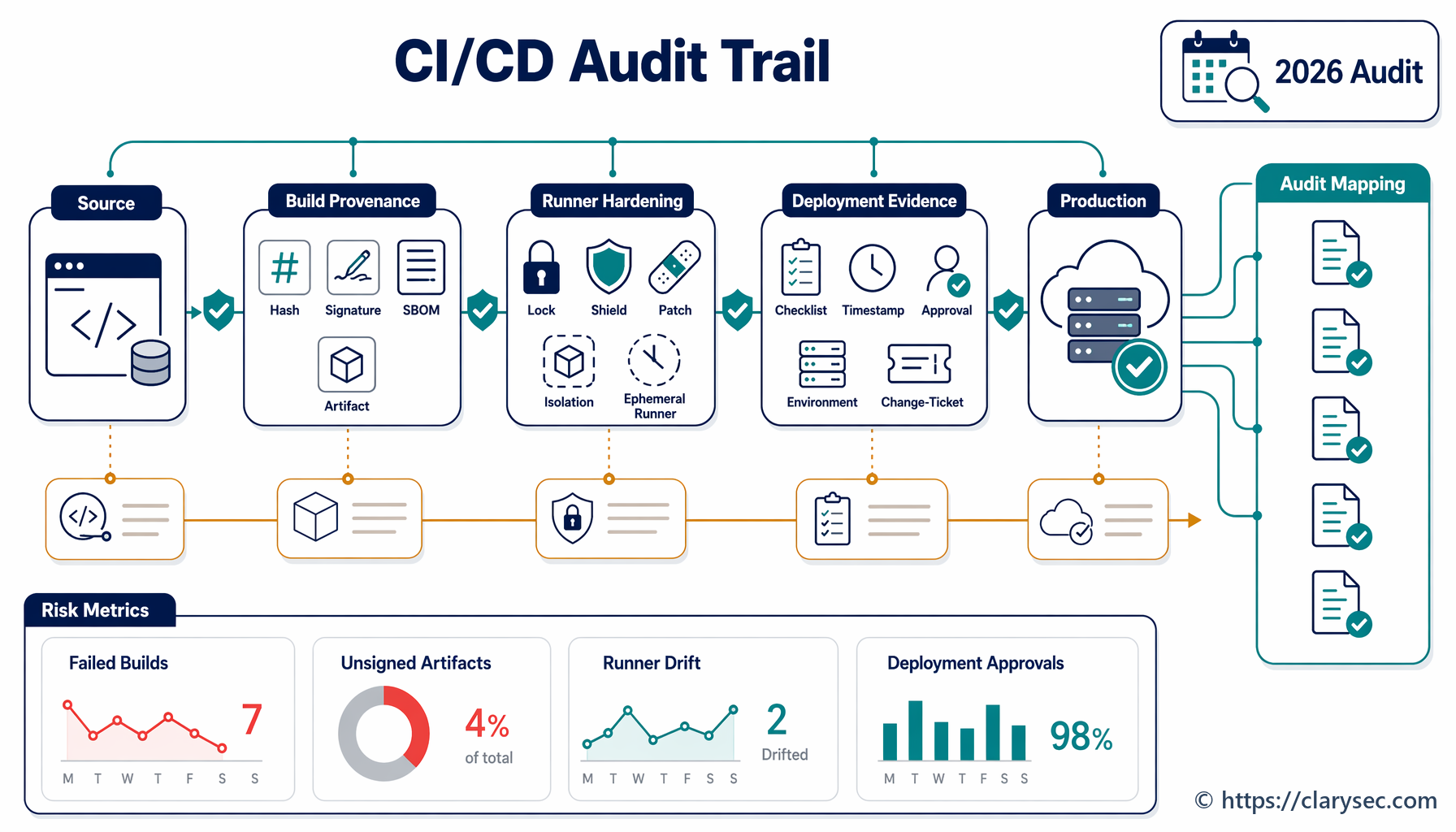
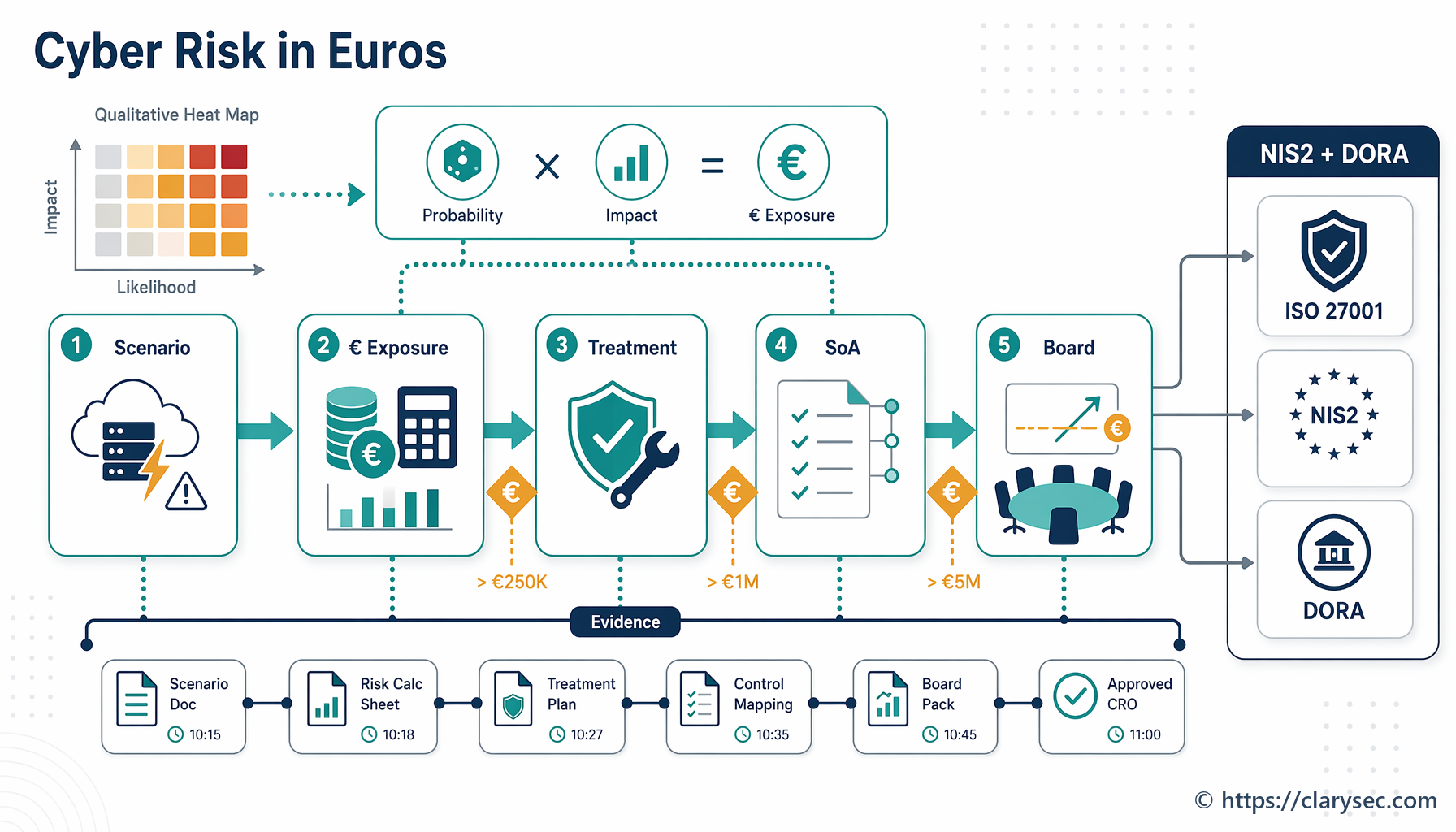
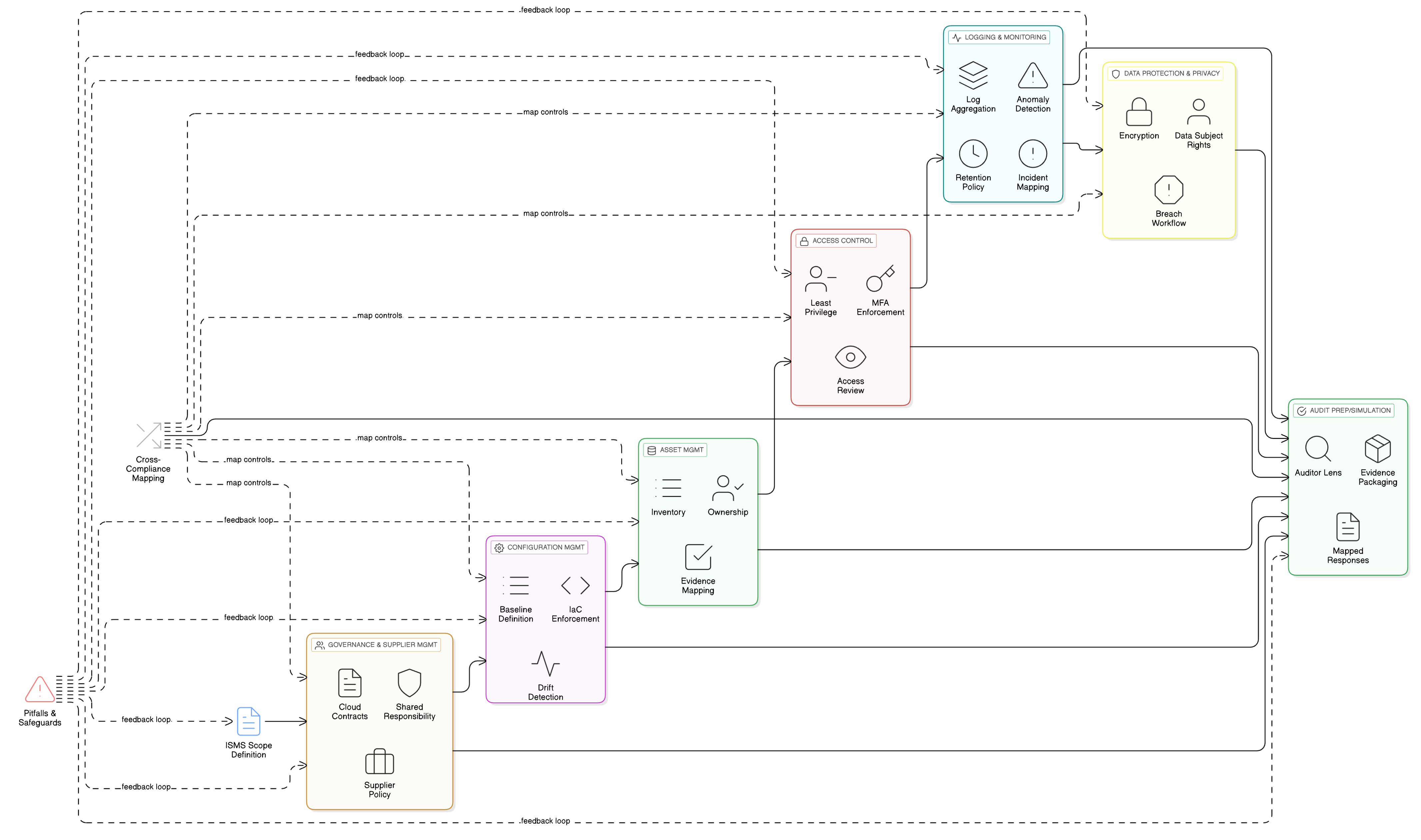
NIST Incident Response Mapping for 2026 Audits
It is 07:42 on a Tuesday. Anya, the CISO of a rapidly growing fintech platform, sees the first alert: impossible travel on an administrator account. A burst of failed logins follows, then a successful session from an unmanaged device. Five minutes later, customer support reports that users cannot access a core SaaS workflow. At 08:10, the cloud dashboard shows abnormal API calls against a storage bucket that may contain personal data.
The security team moves quickly. The SIEM fires, the cloud engineer revokes a session, and the service owner starts restoring access. But the real crisis is not only technical. It is governance.
Anya needs to answer three questions before the first hour is over.
First, is this an information security incident, a personal data breach, a NIS2 significant incident, or a DORA major ICT-related incident?
Second, who must be informed, by when, and with what evidence?
Third, can the organization prove that its incident response process actually ran as designed?
That moment is where many organizations discover the difference between having an incident response plan and having an incident response governance system. NIST SP 800-61 incident response and NIST CSF 2.0 are no longer only SOC playbook topics. In 2026, they connect directly to board accountability, ISO/IEC 27001:2022 audits, NIS2 staged reporting, DORA operational resilience, GDPR personal data breach decisions and supplier accountability.
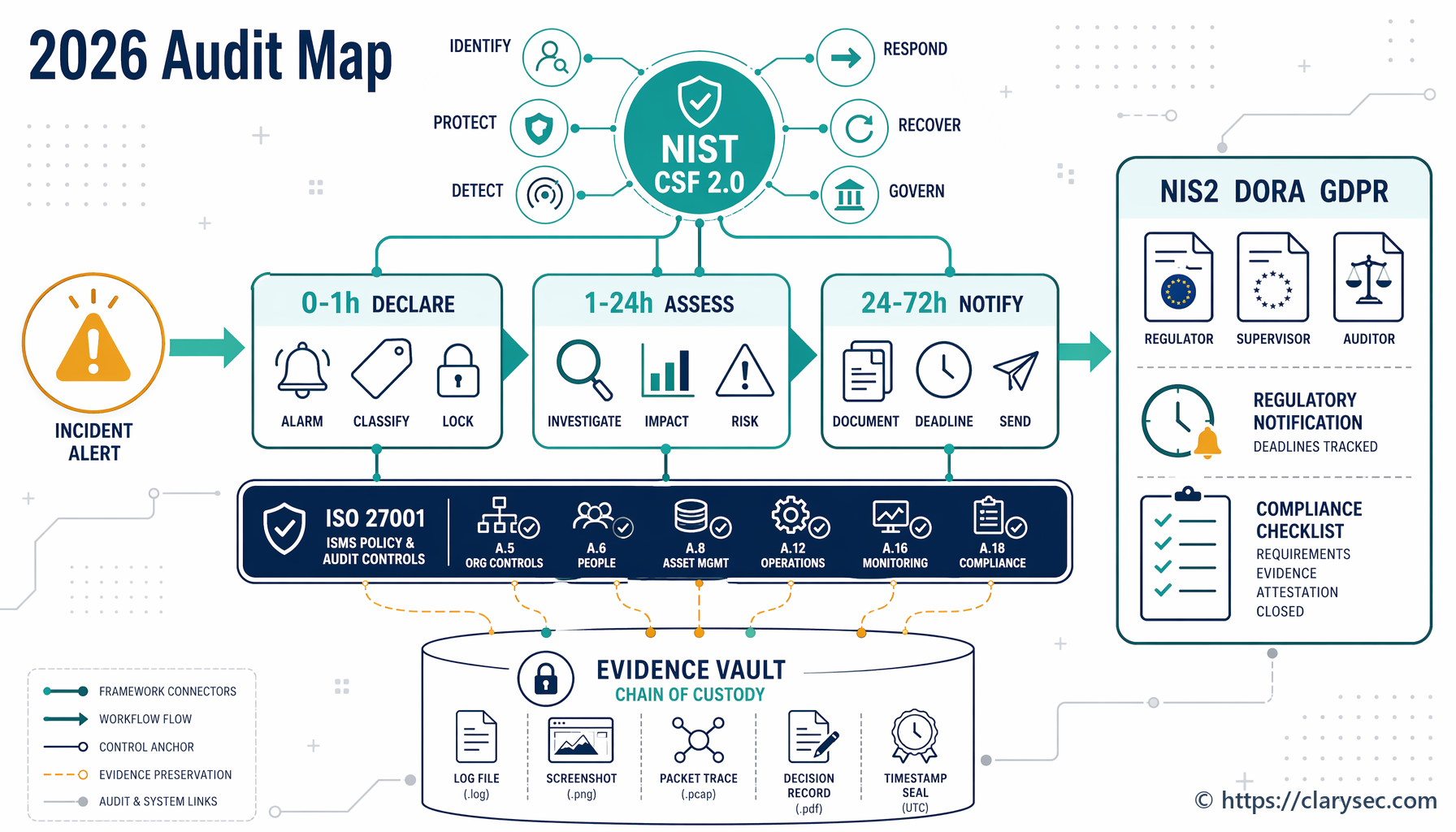
The strongest programs do not create separate response paths for every framework. They use NIST CSF 2.0 as the operating map, ISO/IEC 27001:2022 as the management system backbone, and a single evidence model that can support NIS2, DORA and GDPR at the same time. That is the Clarysec approach: policy-driven decisions, tabletop-tested workflows, regulator-ready evidence packs and cross-framework mapping through the Zenith Blueprint: An Auditor’s 30-Step Roadmap and Zenith Controls: The Cross-Compliance Guide.
The 2026 problem: one incident, many accountability regimes
The incident facing Anya is not one compliance problem. It is several overlapping decision paths.
If the organization provides cloud computing, SaaS, managed services, managed security services, DNS, data center, trust services or other digital infrastructure services, NIS2 may apply. Essential and important entity classification depends on sector, size and national implementation, but the direction is clear: incident handling is now a regulated management responsibility.
If the organization is a financial entity, DORA may be the primary operational resilience rulebook. DORA applies from 17 January 2025 and covers ICT risk management, major ICT-related incident reporting, operational resilience testing, information sharing, ICT third-party risk and oversight of critical ICT third-party service providers. For covered financial entities that also fall under NIS2, DORA acts as the sector-specific framework for overlapping ICT risk and incident reporting obligations.
If personal data was accessed, altered, lost, destroyed or disclosed, GDPR becomes part of the incident response decision tree. GDPR defines a personal data breach as a security breach causing accidental or unlawful destruction, loss, alteration, unauthorized disclosure of, or access to personal data. GDPR also requires accountability, meaning the controller must be able to demonstrate compliance with processing principles, including integrity and confidentiality.
If the company is certified to ISO/IEC 27001:2022, or preparing for certification, the incident becomes ISMS evidence. Auditors will examine scope, legal obligations, roles, risk treatment, control selection, operational execution, documented information, lessons learned and continual improvement. ISO/IEC 27001:2022 clauses 4.1 to 4.4 require the ISMS to reflect context, interested parties, obligations, scope and process interactions. Clauses 5.1 to 5.3 require leadership, accountability and assigned responsibilities. Clauses 6.1.1 to 6.1.3 require information security risk assessment, treatment and a Statement of Applicability. Clauses 8.1 to 8.3 require controlled operation, evidence that processes ran as planned, outsourced process control and treatment implementation.
The business problem is not a lack of frameworks. It is the lack of a single operating model that turns frameworks into timely decisions and reliable evidence.
Use NIST CSF 2.0 as the common language
NIST CSF 2.0 is useful because it gives leadership, security, legal, privacy, operations and suppliers a common language for cybersecurity outcomes. Its GOVERN function is especially important for incident response because it forces organizations to address oversight, policy, risk strategy, roles and supply chain risk before the crisis starts.
For incident response, CSF 2.0 connects governance to the operational lifecycle: IDENTIFY, PROTECT, DETECT, RESPOND and RECOVER. That structure helps translate a noisy incident into a controlled evidence flow.
| Incident response question | CSF 2.0 outcome area | Compliance evidence produced |
|---|---|---|
| Who owns the decision? | GOVERN, including GV.RR, GV.OV and GV.PO | RACI, incident commander record, management updates, board notifications |
| What assets and services are affected? | IDENTIFY, including asset and risk visibility | Asset inventory, service map, data inventory, critical supplier list |
| What controls failed or worked? | PROTECT, including access, data security, configuration and backups | MFA logs, privileged access records, backup records, configuration baselines |
| How was the event detected? | DETECT, including DE.CM and DE.AE | SIEM alerts, EDR alerts, cloud logs, correlation notes, declaration record |
| How was it handled? | RESPOND, including RS.MA, RS.AN, RS.CO and RS.MI | Incident ticket, severity classification, timeline, decision log, containment actions |
| How was service restored? | RECOVER, including RC.RP and RC.CO | Recovery execution, backup validation, restored service evidence, communications, closure report |
CSF 2.0 Organizational Profiles make this practical. A Current Profile shows the organization’s real incident response capability, including gaps, ambiguity and workarounds. A Target Profile defines the desired state, such as one-hour severity classification, documented notification decisions, evidence preservation, third-party coordination and regulator-ready reporting packs.
For Anya’s fintech, the Current Profile showed a familiar pattern: strong tools, weak decision governance. The Target Profile focused on concrete CSF 2.0 outcomes, including:
- RS.MA-01, the incident response plan is executed in coordination with relevant third parties once an incident is declared.
- RS.MA-02, incident reports are triaged and validated.
- RS.MA-03, incidents are categorized and prioritized.
- RS.MA-04, incidents are escalated or elevated as needed.
- RS.AN-03, analysis is performed to establish what has taken place during an incident and the root cause.
- RS.AN-06, actions performed during an investigation are recorded, and the records’ integrity and provenance are preserved.
- RS.AN-07, incident data and metadata are collected, and their integrity and provenance are preserved.
- RS.CO-02, internal and external stakeholders are notified of incidents.
- RS.MI-01, incidents are contained.
- RS.MI-02, incidents are eradicated.
- RC.RP-03, the integrity of backups and other restoration assets is verified before using them for restoration.
A framework alone is not an auditable program. The outcomes need to live inside a management system, and that is where ISO/IEC 27001:2022 provides the backbone.
Anchor incident response inside ISO/IEC 27001:2022
NIST gives a practical incident handling language. ISO/IEC 27001:2022 gives the operating discipline that auditors expect. The ISMS turns incident response from a set of playbooks into a governed process with scope, ownership, risk treatment, performance evaluation and improvement.
The most relevant Annex A control cluster is:
| ISO/IEC 27001:2022 Annex A control | Control name | Incident response purpose |
|---|---|---|
| A.5.24 | Information security incident management planning and preparation | Establishes the plan, roles, escalation and communication model |
| A.5.25 | Assessment and decision on information security events | Defines triage, classification and decision criteria |
| A.5.26 | Response to information security incidents | Drives containment, eradication, recovery and communications |
| A.5.27 | Learning from information security incidents | Converts lessons learned into corrective action and improvement |
| A.5.28 | Collection of evidence | Preserves evidence reliability, provenance and legal usability |
Clarysec’s Zenith Controls guide maps these ISO/IEC 27002:2022 control references to other standards, audit expectations and related compliance obligations. It is not a separate control framework. It is a cross-compliance guide that helps organizations understand how the same control activities support multiple assurance needs.
The Zenith Blueprint, Controls in Action phase, Step 23, makes the incident response spine operational:
Ensure you have an up-to-date incident response plan (5.24), covering preparation, escalation, response, and communication. Define what constitutes a reportable security event (5.25) and how the decision-making process is triggered and documented. Select a recent event or conduct a tabletop exercise to validate your plan. Capture and log all decisions, roles, and communications (5.26), and update the plan with lessons learned (5.27). Confirm that procedures are in place to preserve forensic evidence (5.28), including log snapshots, backups, and secure isolation of impacted systems.
That paragraph is the practical bridge from NIST incident handling to audit evidence. Prepare the capability, classify the event, respond in a controlled way, learn from the outcome and preserve evidence.
Build reportability into the first hour
Incident response programs often fail in the first hour, not because analysts lack skill, but because the organization has not defined who decides, when severity is assigned, what evidence is preserved and when legal triggers are checked.
For SMEs, Clarysec’s Incident Response Policy-sme sets a clear governance expectation:
The General Manager, with input from the IT provider, must classify all incidents by severity within one hour of notification.
This is a powerful requirement. It does not mean every fact is known within one hour. It means the organization must document an initial severity, record uncertainty and trigger escalation while facts are still developing.
The same policy also requires legal timelines to be designed into the process:
Response timelines, including data recovery and notification obligations, must be documented and aligned with legal requirements, such as the GDPR 72-hour personal data breach notification requirement.
For enterprise environments, Clarysec’s Incident Response Policy anchors a more formal response model:
The organization shall maintain a centralized, tiered Incident Response Framework aligned with ISO/IEC 27035, consisting of the following defined response phases:
The enterprise policy also embeds cross-regulatory timing references in clause 6.4.1:
GDPR Article 33 (72-hour notification to the supervisory authority)
NIS2 Article 23 (notification within 24 hours of becoming aware of the incident)
DORA Article 17 (reporting of severe ICT-related incidents)
That is the difference between a technical playbook and a governance-ready incident response framework. Legal and regulatory reporting pathways are not improvised during a crisis. They are triggered by predefined classification and decision points.
Map NIS2 reporting into the incident workflow
NIS2 requires essential and important entities to notify the CSIRT or competent authority without undue delay of significant incidents affecting service provision. A significant incident includes one that caused or is capable of causing severe operational disruption or financial loss, or one that affected or is capable of affecting others by causing considerable material or non-material damage.
The reporting model is staged.
| NIS2 stage | Timing | Evidence your process should produce |
|---|---|---|
| Early warning | Within 24 hours of awareness | Incident declaration, suspected malicious activity, cross-border impact check, initial affected service view |
| Incident notification | Within 72 hours | Severity assessment, impact analysis, indicators of compromise where available, uncertainty log |
| Intermediate reports | Upon request | Status updates, containment actions, recovery status, regulator communications |
| Final report | Within one month after incident notification | Severity and impact, likely threat or root cause, mitigation measures, cross-border impact |
| Ongoing incident progress report | If still ongoing at final-report time | Progress report, then final report within one month after handling |
NIS2 Article 21 also requires appropriate and proportionate technical, operational and organizational measures. The required baseline includes risk analysis, incident handling, business continuity, supply chain security, secure development, vulnerability handling, effectiveness assessment, cyber hygiene and training, cryptography, HR security, access control, asset management and, where appropriate, multi-factor authentication and secure communications.
NIS2 Article 20 brings management bodies into the accountability chain. They must approve cybersecurity risk-management measures and oversee implementation. For incident response, that means board minutes, management approvals, training records and escalation evidence are not optional administrative artifacts. They are part of regulatory defensibility.
Penalties add urgency. For Article 21 or Article 23 infringements, essential entities must face maximum fines of at least EUR 10 million or 2 percent of total worldwide annual turnover, whichever is higher. Important entities must face maximum fines of at least EUR 7 million or 1.4 percent of total worldwide annual turnover, whichever is higher.
The practical lesson is simple: if awareness time, severity criteria, escalation and reporting decisions are not recorded, the issue is no longer just incident response maturity. It becomes a regulatory evidence problem.
Treat DORA incident management as operational resilience
DORA changes the discussion for financial entities because incident management is part of digital operational resilience, not just security operations.
Article 5 requires the management body to define, approve, oversee and remain responsible for the ICT risk management framework. Article 6 expands that framework into a structured ICT risk management system. Article 17 requires financial entities to define, establish and implement an ICT-related incident management process to detect, manage and notify ICT-related incidents. The process must record ICT-related incidents and significant cyber threats, identify and address root causes, use early warning indicators, classify incidents by priority, severity and criticality of impacted services, assign roles and responsibilities, establish communication and escalation, notify clients and media where required, report at least major incidents to senior management, inform the management body and maintain response procedures to mitigate impact and restore secure operations.
Article 18 requires classification based on criteria such as affected clients or counterparties, transactions, reputational impact, duration and downtime, geographical spread, data losses affecting availability, authenticity, integrity or confidentiality, criticality of affected services and economic impact. Article 19 requires reporting of major ICT-related incidents to the competent authority, permits voluntary notification of significant cyber threats and requires client notification without undue delay when a major ICT-related incident affects clients’ financial interests.
For Anya’s fintech, this means the incident record needs more than a SOC timeline. It needs:
- Impacted service and criticality.
- Affected clients, counterparties or transactions.
- Downtime duration and geographical spread.
- Data loss or integrity impact.
- Economic impact.
- Management body visibility.
- Client notification decision.
- Root-cause closure.
- Restoration of secure operations.
- Supplier involvement and contractual evidence.
DORA also extends the incident story into supplier management. Articles 28 to 30 require financial entities to manage ICT third-party risk, maintain a register of ICT service contractual arrangements, assess concentration risk, conduct due diligence, ensure contractual safeguards, define audit and inspection rights, maintain termination rights and test exit strategies for critical or important functions. If the incident involves a cloud provider, managed service provider or SaaS integration, DORA evidence must show supplier roles, log preservation obligations, incident support, recovery duties and supervisory cooperation.
Integrate GDPR personal data breach accountability early
GDPR applies to automated processing of personal data and to non-automated processing that forms part of a filing system. It can apply to EU-established organizations and to non-EU controllers or processors that offer goods or services to individuals in the Union or monitor their behavior.
During incident response, GDPR analysis should begin as soon as personal data might be involved. Waiting for technical root cause is too late if the 72-hour clock is already running.
The response team should answer:
- What categories of personal data may be involved?
- Which systems, applications and processing activities are affected?
- Is the organization acting as controller, processor, or both?
- Was personal data accessed, altered, destroyed, lost or disclosed?
- Were encryption, tokenization or pseudonymisation safeguards effective?
- What is the likely risk to individuals?
- Who made the notification decision and when?
- What communications were sent to controllers, processors, supervisory authorities or data subjects?
- If notification was not made, what was the documented rationale?
GDPR Article 5 accountability is the key. The controller must be able to demonstrate compliance with principles such as lawfulness, fairness, transparency, purpose limitation, data minimization, storage limitation, integrity and confidentiality. That means the breach register, decision log, technical evidence and communications history are part of the privacy control system, not side notes after remediation.
Preserve evidence before recovery destroys it
A recurring incident response failure is restoration that destroys proof. Systems are rebooted. Malware is deleted. Logs roll over. Accounts are changed before snapshots are taken. From an availability perspective, the team may feel successful. From an audit, regulator, insurer or legal perspective, the organization may have lost the ability to prove what happened.
Clarysec’s Evidence Collection and Forensics Policy states:
A chain-of-custody log shall accompany all physical or digital evidence from the time of acquisition through archival or transfer and shall document:
For SMEs, the Evidence Collection and Forensics Policy-sme begins the evidence log requirement plainly:
Each item of digital evidence must be logged with:
The Zenith Blueprint, Controls in Action phase, Step 23, explains the principle behind ISO/IEC 27002:2022 control 5.28:
When an information security incident occurs, one of the most critical, yet often overlooked, elements of response is evidence. Not logs, not screenshots, not loose narratives, but properly preserved, chain-of-custody-respecting, tamper-resistant evidence. Control 5.28 recognizes that in the aftermath of an incident, what you can prove matters just as much as what actually happened.
A regulator-ready evidence pack for Anya’s incident should include:
| Evidence item | Why it matters | Owner |
|---|---|---|
| Incident declaration record | Shows awareness time and starts timing analysis | Incident commander |
| Severity classification | Supports escalation, prioritization and reporting decisions | Security lead or IT provider |
| Asset and data inventory extract | Identifies affected services, systems, data and criticality | IT owner and privacy lead |
| Log exports with timestamps | Supports detection, timeline and root-cause analysis | SOC or IT provider |
| Cloud audit trail snapshot | Shows API activity, identity activity and storage actions | Cloud administrator |
| Chain-of-custody log | Preserves reliability and traceability of evidence | Forensics lead |
| Management notification | Shows escalation and governance visibility | CISO or General Manager |
| Regulator decision log | Shows why notification was or was not required | Legal, DPO and CISO |
| Supplier communication record | Shows third-party cooperation and contractual response | Supplier manager |
| Customer communication record | Supports NIS2, DORA, GDPR and contractual duties | Communications lead |
| Lessons learned record | Supports ISO/IEC 27001:2022 continual improvement | ISMS manager |
Logging retention must be explicit. Clarysec’s Logging and Monitoring Policy-sme states:
Security logs relating to incidents must be preserved for at least 3 years from the date of the incident
The Zenith Blueprint, Controls in Action phase, Step 19, adds the operational truth:
Logging is the lifeblood of any secure IT environment. Without it, incidents remain invisible, accountability fades, and cause-and-effect relationships vanish into thin air.
Incident response, logging, evidence collection and reporting should therefore be designed as one connected control system.
Run the first 72 hours as an evidence sprint
A practical 72-hour evidence sprint helps teams respond without losing auditability.
Hour 0 to 1: declare, classify and preserve
Open the incident ticket using the Incident Response Policy. Assign an incident commander, technical lead, communications lead, legal or privacy lead, supplier coordinator and evidence owner.
Use the Incident Response Policy-sme one-hour classification requirement as a checkpoint, even in larger organizations. Apply the tiered framework for enterprise response and record uncertainty where facts are incomplete.
Preserve volatile evidence immediately: identity logs, EDR alerts, cloud audit trails, privileged access records, affected system logs, backup status, configuration changes and relevant ticket history. Start the chain-of-custody log using the Evidence Collection and Forensics Policy.
Decision outputs:
- Incident declaration time.
- Initial severity.
- Suspected affected services.
- Suspected affected data.
- Initial regulatory watchlist, including GDPR, NIS2, DORA and contractual duties.
- Evidence gaps and assigned owners.
Hour 1 to 24: impact and early warning analysis
Build the first impact view. Determine whether the event affected service provision, caused or could cause operational disruption or financial loss, affected others or created material or non-material harm. This supports NIS2 significant incident analysis.
For financial entities, classify against DORA criteria: affected clients, transactions, reputation, downtime, geographical spread, data loss, criticality and economic impact.
For GDPR, determine whether personal data was involved and whether there is likely risk to individuals.
Decision outputs:
- NIS2 early warning decision.
- DORA major incident watch status.
- GDPR personal data breach assessment status.
- Customer, client or controller notification watch.
- Management body update.
- Supplier evidence requests.
Hour 24 to 72: prepare regulator-grade notification evidence
If NIS2 applies, prepare the 72-hour incident notification update with preliminary severity, impact and indicators of compromise where available. If GDPR notification is required, ensure the supervisory authority package reflects what is known, what remains unknown, likely consequences and measures taken or proposed. If DORA applies, prepare the required initial or intermediate report using the competent authority process.
Decision outputs:
- Updated incident timeline.
- Root-cause hypothesis.
- Containment and eradication actions.
- Service restoration evidence.
- Regulator notification package.
- Customer or client communications.
- Updated evidence inventory.
This sprint is not paperwork for its own sake. It keeps the response team from sacrificing evidence while restoring operations.
Cross-framework mapping: one workflow, many evidence consumers
A mature incident response program produces evidence once and reuses it across frameworks.
| Incident workflow element | CSF 2.0 | ISO/IEC 27001:2022 and Annex A | NIS2 | DORA | GDPR |
|---|---|---|---|---|---|
| Governance and ownership | GV.RR, GV.OV, GV.PO | Clauses 5.1 to 5.3, A.5.24 | Article 20 management oversight | Articles 5 and 6 management body responsibility | Article 5 accountability |
| Scope and obligations | GV.OC | Clauses 4.1 to 4.4 | Essential and important entity scope | Financial entity scope and proportionality | Material and territorial scope |
| Risk and severity criteria | GV.RM, ID.RA, RS.MA-03 | Clauses 6.1.1 to 6.1.3, A.5.25 | Significant incident criteria | Article 18 classification | Risk to individuals |
| Detection and monitoring | DE.CM, DE.AE | A.8.15 logging, A.8.16 monitoring, A.5.25 | Incident handling and effectiveness assessment | Early warning indicators and incident records | Breach detection and assessment |
| Response execution | RS.MA, RS.AN, RS.MI | A.5.26, A.5.28 | Article 23 reporting pathway | Articles 17 and 19 incident process and reporting | Article 33 and Article 34 assessment |
| Recovery | RC.RP, RC.CO | A.5.29 ICT readiness for business continuity, A.8.13 information backup | Service impact minimization | Restore secure operations | Mitigation and communication |
| Lessons learned | GV.OV, RS.IM | A.5.27 and Clause 10 improvement | Corrective action without undue delay | Root-cause closure and corrective actions | Accountability records |
The ISO to NIST response mapping is especially useful for auditors.
| ISO/IEC 27002:2022 activity | NIST CSF 2.0 subcategory |
|---|---|
| Incident response plan execution with third parties | RS.MA-01 |
| Triage and validation of incident reports | RS.MA-02 |
| Categorization and prioritization | RS.MA-03 |
| Escalation as needed | RS.MA-04 |
| Analysis and root-cause determination | RS.AN-03 |
| Recording investigative actions and preserving provenance | RS.AN-06 |
| Collecting incident data and preserving integrity | RS.AN-07 |
| Estimating and validating incident magnitude | RS.AN-08 |
| Internal and external stakeholder notification | RS.CO-02 |
| Containment and eradication | RS.MI-01 and RS.MI-02 |
| Recovery plan execution and backup integrity verification | RC.RP-01 and RC.RP-03 |
Supply chain governance must also be included. NIST CSF 2.0 GV.SC addresses supply chain risk processes, supplier roles, criticality prioritization, contractual requirements, due diligence, ongoing monitoring, supplier inclusion in incident planning and end-of-relationship activities. That aligns directly with NIS2 supply chain security, DORA ICT third-party risk management and ISO/IEC 27001:2022 supplier controls.
How different auditors will test the same incident
An ISO/IEC 27001:2022 auditor will start with the ISMS. They will ask whether incident management is in scope, whether interested-party obligations are documented, whether incident risks are assessed, whether A.5.24 to A.5.28 are included in the Statement of Applicability, whether the process ran as planned and whether the incident produced lessons learned, corrective actions and continual improvement.
A NIST-oriented assessor will focus on CSF 2.0 outcomes. They will test governance, asset visibility, monitoring, incident declaration, triage, escalation, evidence integrity, stakeholder communications, containment, eradication, recovery and profile updates.
A NIS2 supervisory review will focus on management accountability, Article 21 risk-management measures and Article 23 reporting. Evidence of the 24-hour early warning decision, 72-hour notification content, intermediate reports and final report will be central. The reviewer may also examine business continuity, supply chain security, access control, training, cryptography and effectiveness assessment.
A DORA regulator will focus on operational resilience. They will expect incident classification criteria, records of ICT-related incidents and significant cyber threats, early warning indicators, senior management escalation, management body visibility, client notification where financial interests are affected, root-cause closure, restoration of secure operations and supplier evidence.
A GDPR supervisory authority will focus on personal data breach accountability. They will ask when the organization became aware, what personal data was affected, whether the organization was controller or processor, what risk existed to individuals, what measures were taken, why notification was or was not made and whether the internal breach register is complete.
A COBIT or ISACA-style auditor will test governance objectives, management practices, ownership, metrics and assurance evidence. They will care whether incident response is governed, measured, improved and aligned with enterprise objectives.
The same incident can satisfy all of these reviews if the workflow is designed around shared evidence rather than siloed compliance binders.
Test the mapping with a deadline-driven tabletop
The fastest way to learn whether the mapping works is a tabletop exercise built around reporting deadlines.
Use this scenario: a privileged engineer account is compromised. The attacker accesses a production database, exports an unknown volume of records, changes a configuration setting that causes partial outage for EU customers and uses an API token issued through a third-party integration.
Run the exercise in four rounds.
Round one, detection and declaration. Can the team identify the alert source, declare the incident, classify severity within one hour, preserve logs and assign roles?
Round two, impact. Can the team identify affected services, affected data, affected customers, supplier involvement, downtime, geographical spread and whether the incident affects financial interests or personal data?
Round three, reporting. Are NIS2 early warning, NIS2 72-hour notification, DORA reporting, GDPR notification and contractual customer notices triggered? Can the team document both notification and non-notification decisions?
Round four, recovery and closure. Are containment, eradication, restoration, backup validation, communications, lessons learned and corrective actions documented?
The output should not be a slide deck. It should be an evidence pack: completed incident ticket, timeline, decision log, communications log, preserved evidence list, regulator decision matrix, supplier communication record, recovery validation record and corrective action plan.
The exercise is not finished when people explain what they would do. It is finished when they produce the records an auditor would ask for.
Common failure patterns to remove before the next alert
The first failure pattern is undefined awareness time. If no one records when the organization became aware, NIS2, DORA and GDPR timing analysis becomes risky.
The second is severity without criteria. Labels such as medium or high are weak unless linked to service impact, data impact, financial impact, client impact or regulatory thresholds.
The third is privacy added too late. GDPR assessment must begin when personal data might be involved, not after root cause is complete.
The fourth is supplier ambiguity. If a cloud provider, managed service provider or SaaS integration is involved, contracts and playbooks must define who preserves logs, who communicates, who supports forensics and who assists with regulator requests.
The fifth is evidence destruction during recovery. Reboots, deletions and configuration changes may be necessary, but they should be coordinated with evidence preservation whenever feasible.
The sixth is lessons learned without risk treatment. ISO/IEC 27001:2022 expects improvement where appropriate. A lessons-learned meeting with no control change, owner, due date or risk reassessment is weak evidence.
Turn incident response into a cross-compliance evidence system
Preparing for NIST SP 800-61 incident response expectations and 2026 audits should not begin with another standalone playbook. It should begin with decision mapping.
Clarysec can help your team:
- Build a NIST CSF 2.0 incident response Current Profile and Target Profile.
- Align incident response with ISO/IEC 27001:2022 clauses, risk treatment and Annex A controls.
- Embed NIS2 24-hour, 72-hour and one-month evidence requirements into workflows.
- Map DORA incident classification, management body reporting, client notification and ICT supplier evidence.
- Integrate GDPR personal data breach analysis and accountability records.
- Deploy Clarysec’s Incident Response Policy, Incident Response Policy-sme, Evidence Collection and Forensics Policy, Evidence Collection and Forensics Policy-sme, Logging and Monitoring Policy-sme, Zenith Blueprint and Zenith Controls into a tabletop-tested operating model.
The question for 2026 is not whether your team can contain an attack. The question is whether your team can classify, escalate, report, recover and prove the response across NIST, ISO/IEC 27001:2022, NIS2, DORA and GDPR.
Clarysec’s 30-step implementation model and cross-compliance toolkit are built to make that possible before the next Tuesday morning alert. Download the relevant Clarysec policies, run a deadline-driven tabletop and request a Clarysec assessment to turn your incident response plan into an audit-ready evidence system.
Frequently Asked Questions
About the Author

Igor Petreski
Compliance Systems Architect, Clarysec LLC
Igor Petreski is a cybersecurity leader with over 30 years of experience in information technology and a dedicated decade specializing in global Governance, Risk, and Compliance (GRC).Core Credentials & Qualifications:• MSc in Cyber Security from Royal Holloway, University of London• PECB-Certified ISO/IEC 27001 Lead Auditor & Trainer• Certified Information Systems Auditor (CISA) from ISACA• Certified Information Security Manager (CISM) from ISACA • Certified Ethical Hacker from EC-Council