PII Deletion Certificates for Processor Exit Compliance
Maria, the CISO at a growing European fintech firm, stared at a short email from DataLeap, the marketing analytics SaaS provider her company had just terminated.
“We confirm that all data associated with your account has been deleted from our production systems.”
It was polite, fast and almost useless.
For three years, DataLeap had processed customer identifiers, campaign interaction data, lead scoring attributes, consent metadata and behavioural analytics for thousands of EU customers. FinSecure was preparing for a DORA audit, the Data Protection Officer was reviewing GDPR accountability evidence, and the procurement team wanted to close the supplier record before the next billing cycle. The email answered only one narrow question: production data. It said nothing about backups, logs, support tickets, analytics workspaces, subprocessor caches, test copies, API credentials or archived reports.
Maria asked the question every CISO, DPO and compliance manager eventually faces during a SaaS breakup:
Where is the deletion certificate?
That question turns an ordinary contract termination into a compliance event. Under GDPR, controllers must be able to demonstrate compliance with principles such as storage limitation, integrity, confidentiality and accountability. Under DORA, financial entities must manage ICT third-party risk across the full relationship lifecycle, including termination and exit strategies that prevent disruption, regulatory non-compliance and harm to clients. Under ISO/IEC 27701:2025, organizations need role-based PIMS evidence for controller, processor, subprocessor and cloud PII processing activities. Under ISO/IEC 27001:2022, supplier dependencies, external services, operational controls and retained evidence must be managed inside the information security management system.
The gap is rarely discovered during onboarding. It appears at exit. The contract says data will be deleted, but does not define evidence. The cloud provider can export a CSV, but cannot explain backup handling. Procurement can terminate the supplier, but compliance cannot prove final disposition. IT can disable accounts, but disabling access is not deletion. Legal can send a termination notice, but auditors want a chain of evidence.
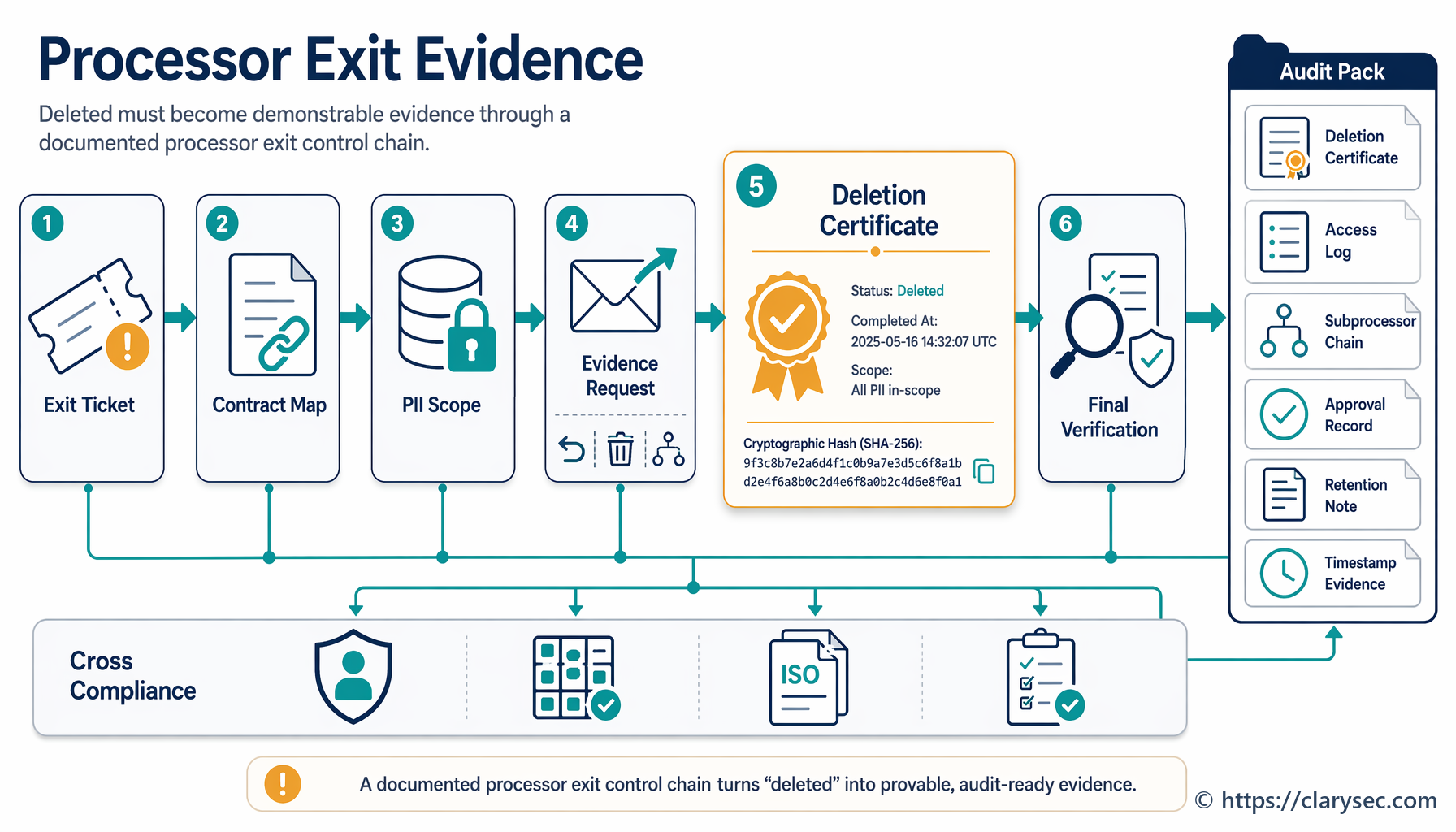
Clarysec treats processor exit as an auditable control chain, not an administrative afterthought.
Why Processor Exit Has Become a Compliance Hotspot
The end of a SaaS, payroll, HR, finance, CRM, cloud hosting, marketing analytics or managed ICT service relationship is one of the highest-risk moments in the personal data lifecycle. During normal operations, at least the organization knows which system is live, who owns it and which contract applies. At termination, ownership fragments quickly. Procurement closes the vendor record. IT disables users. Legal archives the contract. The business moves to the replacement platform. The old supplier continues to retain data under standard backup, archive or logging cycles.
That fragmentation is exactly what auditors and regulators test.
GDPR defines processing broadly, including storage, erasure and destruction. It distinguishes controllers, which determine purposes and means, from processors, which act on behalf of controllers. Article 5 establishes principles such as purpose limitation, data minimisation, storage limitation and integrity and confidentiality. Article 5(2) adds the accountability principle, meaning the controller must be able to demonstrate compliance. Article 28(3)(g) requires processor contracts to state that, at the controller’s choice, the processor must delete or return all personal data at the end of service and delete existing copies unless law requires storage.
A casual supplier email rarely satisfies that standard when the data involves payroll information, financial records, health-related data, customer identifiers, authentication logs or regulated client records.
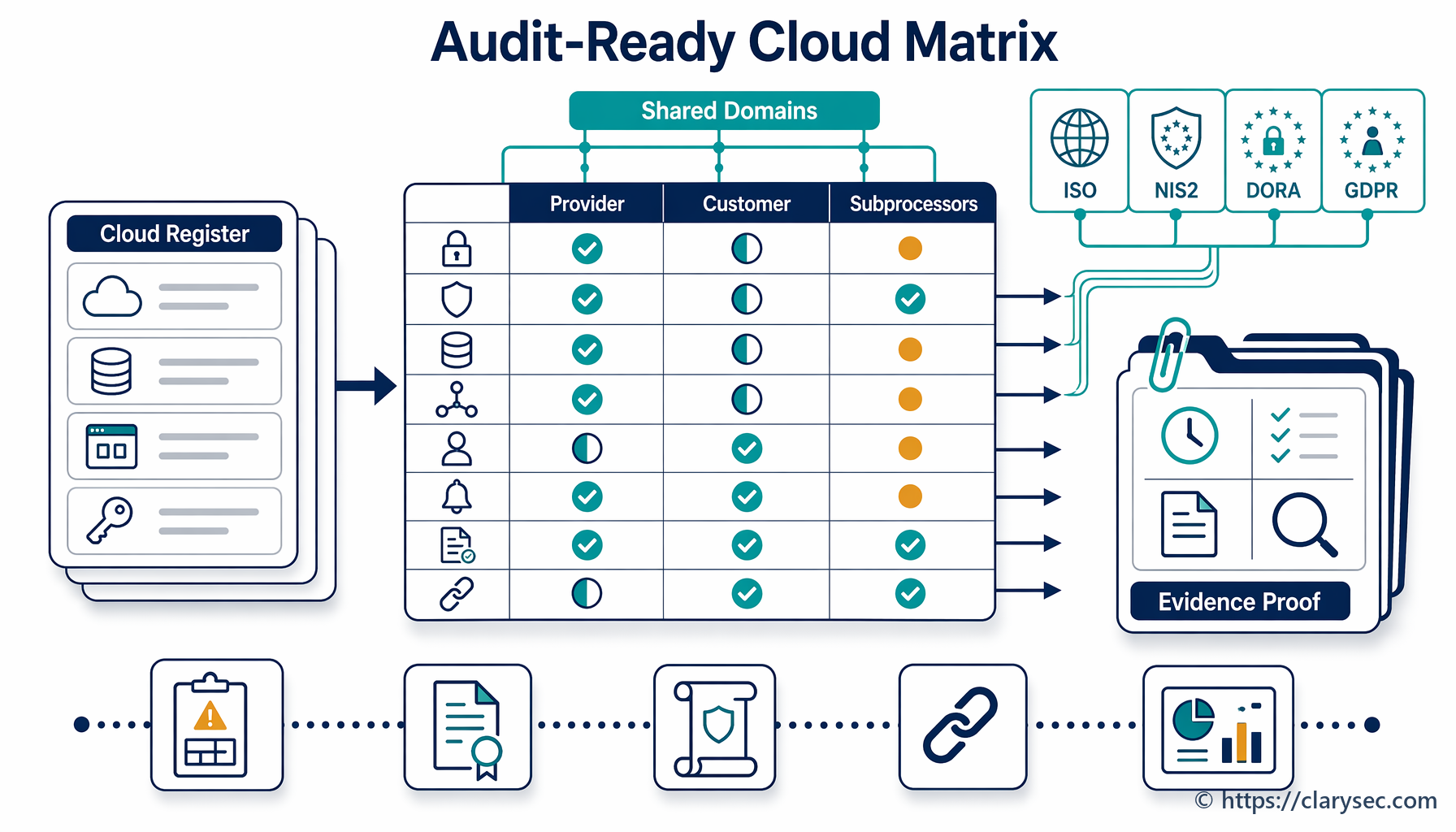
DORA raises the stakes for financial entities. From 17 January 2025, DORA applies as the EU financial sector’s digital operational resilience rulebook. It requires financial entities to manage ICT third-party risk as an integral part of their overall risk framework and to remain fully responsible for compliance when services are outsourced. DORA expects organizations to maintain information registers of ICT service contracts, identify services supporting critical or important functions, conduct due diligence, assess concentration risk, include contractual rights for access, recovery and return of data, and maintain termination and exit strategies.
For critical or important functions, DORA contracts must go further. They need provisions for audit rights, transition periods, service levels, contingency testing, cooperation obligations and exit support. A deletion certificate is not the entire DORA exit pack, but it is a critical evidence artifact inside it.
NIS2 also matters for many providers in the wider ICT chain, including cloud computing providers, data centre providers, managed service providers, managed security service providers and other digital infrastructure providers. NIS2 Article 21 requires appropriate and proportionate technical, operational and organizational measures, including supply-chain security, supplier relationship controls, access control, asset management, incident handling, continuity and cyber hygiene. For financial entities covered by DORA, DORA generally acts as the sector-specific Union legal act for comparable ICT risk, reporting, testing and third-party requirements, but NIS2 still frames the broader cybersecurity ecosystem.
The practical message is simple: if a supplier processed PII, supported regulated operations or formed part of your ICT service chain, exit evidence is risk control.
The Clarysec View: Processor Exit Is a Control Chain
A mature processor exit workflow answers three questions:
- What data, systems and subprocessors are in scope?
- What return, transfer, deletion or disposal action is legally and contractually required?
- What evidence proves that the action was completed before the exit was closed?
In Zenith Controls: The Cross-Compliance Guide, this scenario is mapped to ISO/IEC 27002:2022 control 5.20, “Addressing information security within supplier agreements”; control 8.10, “Information deletion”; and control 7.14, “Secure disposal or re-use of equipment.” These are not separate checklist items. Processor exit connects supplier agreements, data lifecycle management, cloud offboarding, access removal, asset ownership, evidence retention and audit readiness.
Clarysec’s Zenith Blueprint: An Auditor’s 30-Step Roadmap places this in the Controls in Action phase. In Step 23, Organizational controls, supplier agreements are expected to cover end-of-contract provisions, subcontractor controls, audit rights and incident protocols. The Blueprint describes typical supplier agreement areas as including:
“End-of-contract provisions , such as data return or destruction, asset recovery, and account deactivation.”
That sentence is where GDPR accountability, ISO/IEC 27701:2025 PIMS evidence, DORA exit expectations, NIS2 supply-chain security and ISO/IEC 27001:2022 operational control meet.
The same Zenith Blueprint, in Step 19, Technological Controls I, explains the deletion risk behind processor exit:
“This control ensures that data is not kept longer than necessary, and when it is no longer needed, it must be securely and reliably deleted.”
Step 18, Physical Controls II, brings the evidence expectation into practical terms:
“If using an external provider, request and retain certificates of destruction for audit evidence.”
For cloud-based systems, physical disposal is usually outside the customer’s direct control. That makes contractual deletion confirmation, compliance-grade erasure certificates and archived ISMS documentation even more important.
Clarysec’s operating model is direct: contract clause, exit trigger, data inventory, deletion action, subprocessor confirmation, evidence register, final verification.
Why “Deleted” Is Not the Same as Demonstrated
A common audit finding reads like this:
“The organization stated that the supplier deleted the data, but could not provide evidence of deletion, scope of deletion, date of deletion, responsible party, systems included, backup handling or subprocessor confirmation.”
This happens in large enterprises, but it is also common in SMEs that rely heavily on SaaS tools for payroll, support ticketing, CRM, HR onboarding, cloud storage, collaboration, analytics and software development. When a supplier changes, personal data often remains in dormant accounts, support attachments, temporary migration files, development exports, staging databases and backup cycles.
The Clarysec policy set turns “deleted” into an evidence requirement.
The Third party and supplier security policy [P26] requires in clause 6.5.1.2:
“Return or certified destruction of all organization-owned information”
Clause 6.5.1.3 then requires:
“Final compliance verification (e.g., log review, compliance attestations)”
This distinction matters. A deletion certificate is not the entire control. It is one artifact within a final compliance verification package. Auditors will want to see whether the certificate matches the supplier contract, data inventory, exit ticket, access logs, subprocessor list, retention schedule and risk assessment.
For SMEs, the Third-Party and Supplier Security Policy - SME [P26S] provides a practical baseline. Clause 5.3.6 under Governance Requirements requires:
“Termination terms, including secure data return or destruction”
Clause 6.4.2.3 under Policy Implementation Requirements requires suppliers to:
“Confirm in writing that data has been securely deleted”
The Data Retention and Disposal Policy [P14] adds the evidence requirement in clause 4.7.2:
“Shall provide documented evidence of compliance (e.g., deletion logs, certificates of destruction) upon request.”
For SMEs, the Data Retention Policy and Secure Disposal Policy - SME requires in clause 6.2.3:
“Disposal events must be logged with the date, record category, method, and responsible person.”
This is the difference between supplier trust and audit evidence.
ISO/IEC 27701:2025: Role-Based Exit Evidence
ISO/IEC 27701:2025 adds a privacy management layer to the ISMS. Processor exit must reflect the organization’s PIMS role. A controller leaving a processor relationship has different responsibilities than a processor leaving a subprocessor relationship. A processor acting on customer instructions must document that it followed those instructions. A cloud processor must show that return, transfer, deletion or disposal occurred within the customer-agreed timeframe.
Clarysec’s PIMS policy set uses role tags to make this operational. “Both” applies whether the organization is controller or processor. “Processor” applies when processing PII on documented controller instructions. “Subprocessor” applies when engaged by another processor.
The Processor, Subprocessor and Third-Party Privacy Management Policy requires in clause 4.5.6:
“[Both] The Vendor / Procurement Owner MUST obtain return, deletion, disposal, or transition evidence in REG08 within 30 days after contract termination, expiry, customer instruction, or approved exit event, unless a shorter contractual period applies.”
The PII Retention, Deletion and Disposal Policy separates processor and subprocessor obligations. Clause 4.3.3 states:
“[Processor] The Vendor / Procurement Owner MUST execute or confirm customer-directed return, transfer, deletion or disposal in REG08 by the contractual deadline or documented customer instruction date.”
Clause 4.3.4 states:
“[Subprocessor] The Vendor / Procurement Owner MUST obtain subprocessor return, deletion or disposal evidence in REG08 within the contractual evidence period after customer instruction, service exit or subprocessor termination.”
Clause 7.1.7 brings the requirement back to closure:
“[Both] The Vendor / Procurement Owner MUST obtain processor, subprocessor or external service evidence for required return, transfer or final disposition actions in REG08 before closing service exit.”
For cloud services, the Cloud PII Processor Policy requires in clause 4.6.3:
“[Processor] The System Owner / Application Owner MUST complete approved customer PII return, transfer, deletion or disposal within the customer-agreed timeframe and record completion evidence in REG08 or REG12.”
The operational improvement is immediate. Do not wait for an audit. Create the evidence requirement at the exit trigger, assign it to an owner, set a deadline and prevent closure until REG08 or REG12 is complete.
What a Good Processor Exit Evidence Pack Includes
A deletion certificate should not be a vague PDF with a logo and one sentence. It should support a structured evidence pack that can withstand a GDPR inquiry, ISO/IEC 27701:2025 PIMS audit, ISO/IEC 27001:2022 surveillance audit, DORA supervisory request, customer assurance review or internal audit.
| Evidence item | Purpose | Owner | Register or record |
|---|---|---|---|
| Exit trigger record | Shows termination, expiry, customer instruction or approved exit event | Vendor or Procurement Owner | Supplier exit ticket |
| Data scope statement | Identifies PII categories, systems, tenants, backups, logs, exports and support records | System Owner and DPO | REG08 or data inventory |
| Return or transfer confirmation | Proves export, migration or handover was completed | Supplier and Application Owner | Exit evidence folder |
| Deletion certificate | Confirms secure deletion or destruction and completion date | Supplier or processor | REG08 |
| Subprocessor evidence | Confirms downstream deletion, disposal or retention exception | Vendor Owner | REG08 |
| Backup and archive position | Explains backup lifecycle, cryptographic erasure or expiry schedule | Supplier technical owner | Technical attestation |
| Access closure evidence | Shows accounts, SSO, API tokens and privileged access were revoked | IT or IAM Owner | Access review log |
| Retention exception record | Documents lawful, contractual or dispute-based retention | Legal and DPO | Retention register |
| Final verification | Confirms evidence was reviewed before exit closure | Risk, Compliance or Security | Compliance attestation |
This is not bureaucracy. It is a practical chain of custody for PII at service exit.
The Contract Clause That Prevents the Crisis
Maria’s problem began years before DataLeap’s final email. It began when the contract was signed with a vague deletion clause and no evidence obligation. The strongest processor exit workflow starts at procurement, not termination.
For cloud services, the enterprise Cloud Usage Policy requires in clause 5.4.4:
“Termination clauses enabling secure and verifiable offboarding”
For SMEs, the Cloud Usage Policy - SME requires in clause 6.3.5:
“Confirmation of secure deletion procedures before account closure”
A practical supplier contract clause should require return or deletion, define timing, cover backups and subprocessors, require evidence and preserve audit rights.
Sample clause: Data return, deletion and evidence
Upon termination or expiration of the agreement, or upon the controller’s written instruction, the processor shall, at the controller’s choice, securely return all personal data in an agreed machine-readable format or securely delete all personal data from systems, media, backups and environments under the processor’s control, unless Union or Member State law requires storage.
Within thirty calendar days of completing the required action, or a shorter period where contractually agreed, the processor shall provide a signed Certificate of Deletion or equivalent compliance attestation. The certificate shall identify the service, data categories, systems covered, deletion date range, deletion method, backup and archive handling, subprocessor status, retained exceptions and authorized signatory.
The controller may request reasonable supporting evidence, including logs, disposal records, subprocessor attestations and process documentation, to verify the certificate and close the supplier exit record.
This language turns accountability into an operational deliverable.
Practical Example: Payroll SaaS Exit
Consider an SME moving from PayrollCloud A to PayrollCloud B. PayrollCloud A processed employee names, addresses, tax identifiers, bank details, salary history, sickness records and support tickets. It used a cloud hosting provider and support platform as subprocessors.
A Clarysec-aligned exit would work as follows.
1. Open a supplier exit ticket
Procurement creates an exit ticket linked to the supplier record. The ticket includes the contract termination date, final service date, business owner, system owner, DPO or privacy contact, and whether special-category data may be involved. Because payroll can include sensitive employment and health-related data, the risk rating is high.
2. Map the exit to the agreement
The Vendor Owner checks the contract for return, deletion, audit, transition and subprocessor clauses. If the contract is weak, the owner still sends a formal instruction requiring return, deletion and subprocessor confirmation. The evidence expectation is anchored in the Clarysec policies, including P26, P26S, P14, the Cloud Usage Policy and the Cloud Usage Policy - SME.
3. Define the PII scope
The System Owner completes a data scope statement covering production payroll records, employee self-service documents, attachments, exports, support tickets, audit logs containing user identifiers, API integration files, temporary migration extracts, backups, snapshots and subprocessor-held data.
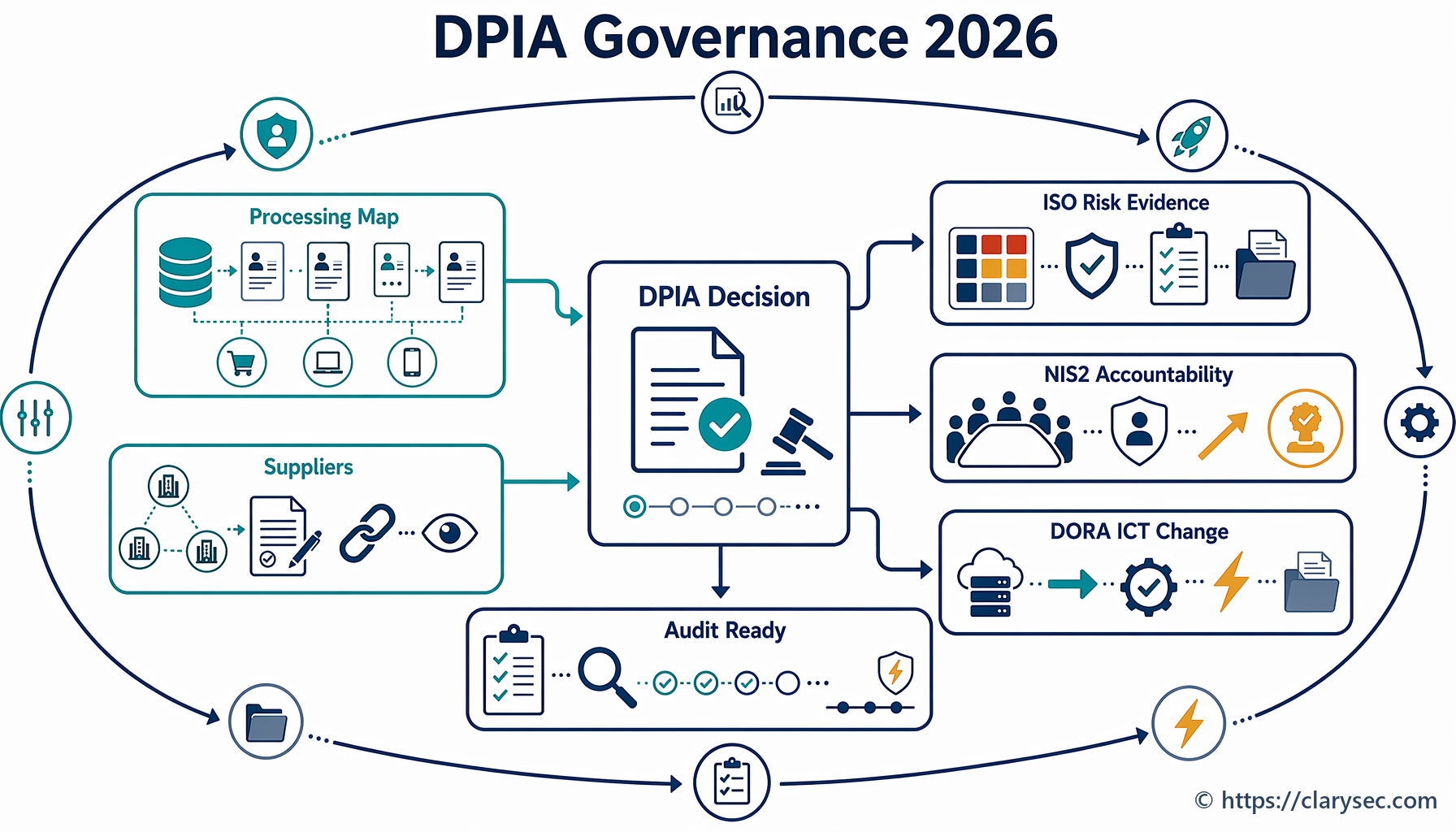
This supports GDPR accountability, ISO/IEC 27701:2025 PIMS evidence, ISO/IEC 27001:2022 operational control and, for financial entities, DORA ICT third-party information register expectations.
4. Request return, deletion and subprocessor evidence
The Vendor Owner sends a structured request to PayrollCloud A to confirm final export completion, deletion of production tenant data, handling of backups and immutable archives, deletion of support ticket attachments, revocation of customer-specific accounts and API credentials, subprocessor deletion or disposal evidence, and a signed deletion certificate.
5. Record completion in REG08 or REG12
The Vendor Owner records each evidence item in REG08. If the organization is acting as a processor and the cloud application contained customer PII, completion may also be recorded in REG12 under the Cloud PII Processor Policy.
6. Perform final verification before closure
Compliance compares the deletion certificate with the data scope statement. IT checks access logs and account closure evidence. The DPO checks whether any retention exception exists, such as a legal obligation or dispute hold. Security verifies that API tokens, service accounts and SSO configurations were removed.
Only then is the exit ticket closed.
If the supplier refuses to provide evidence, the issue becomes a risk treatment matter. It may trigger escalation, contractual remedies, customer notification analysis, regulatory assessment, enhanced monitoring during transition or supplier risk rating changes.
DORA, NIS2 and ICT Resilience: Exit Evidence Beyond Privacy
DORA treats supplier exit as part of resilience, not just privacy administration. A financial entity remains responsible for compliance even when ICT services are outsourced. It must maintain an information register of ICT service contracts, distinguish services supporting critical or important functions, perform due diligence, assess concentration risk and maintain exit strategies.
A processor deletion certificate can affect several DORA concerns:
- Client service continuity
- Regulatory reporting
- Data integrity
- Incident response
- Audit rights
- Operational resilience
- Recovery and transition planning
- Critical or important function management
For a payment institution, investment firm, credit institution, crypto-asset service provider or fintech platform, the deletion certificate needs to sit inside a broader exit pack. It is not enough to prove that PII was deleted if the organization cannot also prove that the service transition avoided disruption, regulatory obligations remained met and client impacts were managed.
NIS2 extends the supplier security discussion beyond financial services. Processor exit is a supply-chain security test. If an essential or important entity cannot prove that a supplier returned or deleted data at the end of service, it has a weakness in supplier relationship management, asset control, access governance, data protection and potentially incident readiness.
If a failed exit results in unauthorized access, loss, disclosure or service disruption, the organization may need to assess incident reporting obligations under applicable law and national transposition rules.
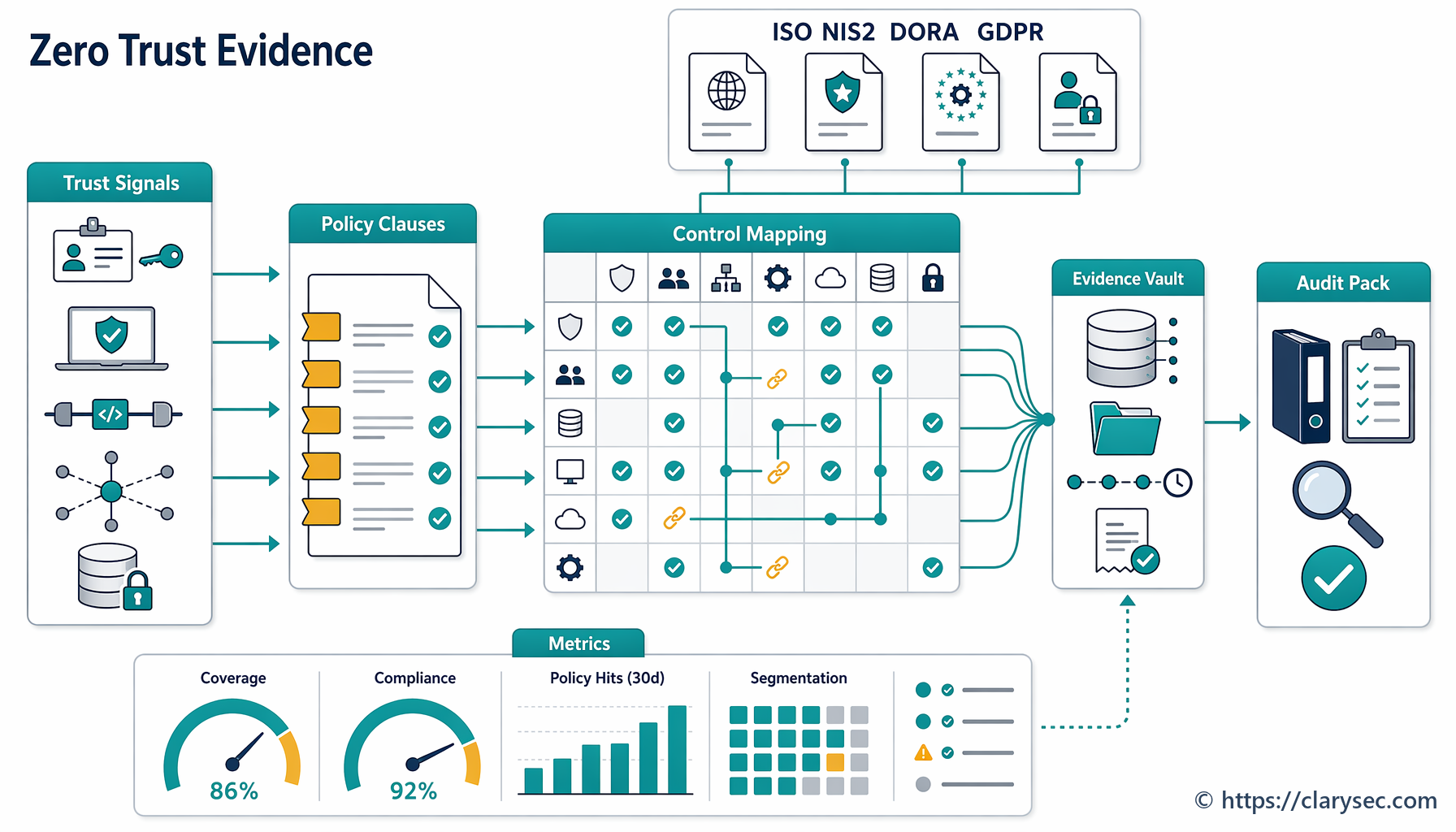
Cross-Compliance Mapping: One Workflow, Many Obligations
The value of a well-designed processor exit workflow is that it satisfies multiple frameworks at once.
| Framework or requirement | What it expects at processor exit | Clarysec control response |
|---|---|---|
| ISO/IEC 27701:2025 | Role-based PIMS evidence for controller, processor, subprocessor and cloud PII processing | REG08 and REG12 evidence, role-tagged policy duties, customer instruction tracking |
| ISO/IEC 27001:2022 | Scoped ISMS, supplier dependency control, risk treatment, operational evidence, monitoring and improvement | Supplier exit ticket, SoA mapping, risk treatment, internal audit and management review inputs |
| ISO/IEC 27002:2022 via Zenith Controls | Supplier agreement obligations, information deletion, secure disposal or reuse | Controls 5.20, 8.10 and 7.14 mapped in Zenith Controls |
| GDPR | Accountability, storage limitation, integrity and confidentiality, processor governance | Deletion certificate, disposal log, subprocessor evidence, documented retention exceptions |
| DORA | ICT third-party register, contractual data return, exit strategy, continuity and audit rights | Exit pack linked to ICT service register, criticality rating and transition plan |
| NIS2 | Supply-chain security, asset management, access control, incident handling and risk governance | Supplier assurance workflow and incident escalation path |
| NIST CSF 2.0 | Supplier lifecycle governance, supplier requirements in contracts, supplier risk monitoring, post-relationship activities | GV.SC-05, GV.SC-07 and GV.SC-10 aligned exit evidence |
| COBIT 2019 and ISACA audit lens | Governance, process ownership, control design, evidence reliability and management oversight | RACI, evidence register, closure approval and management reporting |
NIST CSF 2.0 is especially useful as a communications layer. Its GOVERN function requires organizations to understand legal, regulatory, contractual and privacy obligations, define risk strategy, assign roles and establish oversight. Its Cybersecurity Supply Chain Risk Management outcomes cover supplier requirements in contracts, supplier risk monitoring and activities after the end of a partnership or service agreement. GV.SC-10 is exactly where processor exit belongs.
What Auditors Will Ask
Different auditors approach processor exit through different lenses, but the evidence pack should be strong enough for all of them.
| Auditor lens | Main focus | Evidence expected |
|---|---|---|
| ISO/IEC 27001:2022 auditor | ISMS scope, supplier dependency, risk treatment, operational control and retained documented information | Supplier contract, SoA mapping, risk assessment, retention policy, disposal logs, deletion certificate and closure approval |
| ISO/IEC 27701:2025 PIMS auditor | Privacy role, documented instructions, processor and subprocessor obligations, evidence register and retention exceptions | REG08 or REG12 records, role-tagged policy evidence, customer instructions, subprocessor attestations and final disposition records |
| GDPR reviewer | Accountability, Article 28 processor obligations, storage limitation, security of processing and breach risk | DPA, ROPA link, deletion certificate, retention exception record, subprocessor evidence and verification notes |
| DORA supervisory reviewer | ICT third-party information register, critical or important function assessment, exit strategy, audit rights and transition continuity | ICT register entry, exit plan, transition evidence, provider cooperation records, data return or deletion proof and service continuity evidence |
| NIST CSF 2.0 or COBIT 2019 reviewer | Governance, supplier lifecycle controls, management oversight, evidence reliability and exception handling | RACI, contract close-out workflow, GV.SC-05, GV.SC-07 and GV.SC-10 mapping, evidence register and management reporting |
An ISO/IEC 27001:2022 auditor may not begin by asking for a “PII deletion certificate.” They may start with scope, interested-party requirements, supplier control, the Statement of Applicability, risk treatment and retained documented information. If the deletion certificate cannot be connected to those elements, it may look like a standalone artifact rather than proof of a functioning control.
A PIMS auditor will ask whether the organization understood its privacy role. Was it controller, processor, subprocessor or cloud PII processor? Was the exit based on documented customer instruction? Were subprocessor obligations flowed down? Was evidence stored in the correct register? Were exceptions justified?
A DORA reviewer will ask whether the service is in the ICT information register, whether it supports a critical or important function, whether the contract included data return and audit rights, and whether the transition avoided disruption and client harm.
The same evidence pack should answer all of them.
Common Failure Patterns
Clarysec repeatedly sees the same weaknesses during processor exit reviews:
- Contracts require deletion, but do not define evidence.
- Suppliers provide generic deletion statements with no system scope.
- Backups, snapshots and immutable archives are ignored.
- Subprocessor deletion is assumed, not evidenced.
- Access deactivation is treated as data deletion.
- Procurement closes the supplier before compliance reviews evidence.
- Retention exceptions are undocumented.
- Developers retain test exports after outsourced development ends.
- Cloud accounts are closed before deletion confirmation is obtained.
- Audit evidence is stored in email, not a controlled register.
The outsourced development scenario is particularly common. The Outsourced development policy - SME requires in clause 7.4.1.2:
“All developer-held data must be deleted and evidence may be requested”
For development teams, this includes local datasets, staging databases, debug logs, crash dumps, screenshots, support exports, AI testing prompts and temporary migration files. If the supplier exit workflow ignores developer-held data, it is incomplete.
Processor Exit Checklist
A strong processor exit process does not need to be complex, but it must be disciplined.
- Identify the exit trigger: termination, expiry, customer instruction, supplier replacement, breach response, approved transition or subprocessor termination.
- Confirm the PIMS role: controller, processor, subprocessor, joint controller or cloud PII processor.
- Link the supplier record: contract, service owner, business function, criticality and data categories.
- Identify the PII scope: production, backups, logs, exports, support tickets, analytics, test data and subprocessors.
- Issue written instructions: return, transfer, deletion, disposal or retention exception.
- Obtain evidence: deletion certificate, destruction certificate, logs, subprocessor attestation and access closure proof.
- Record evidence in REG08 or REG12: evidence location, date, method, responsible person and reviewer.
- Verify before closure: compare evidence against data scope, contract and customer instructions.
- Escalate exceptions: missing evidence, delayed backup expiry, disputed retention, uncooperative supplier or residual access.
- Feed improvement: update contract templates, supplier risk rating, retention schedule, audit plan and management reporting.
This is how the Zenith Blueprint, Zenith Controls and Clarysec policy set work together. The Blueprint shows where the control belongs in the implementation journey. The policies define required behavior. Zenith Controls maps the control relationship across ISO/IEC 27002:2022, GDPR, DORA, NIS2, NIST and audit expectations.
The Board-Level Message
Processor exit is not an administrative step at the end of a contract. It is a live test of privacy governance, supplier management, cloud security, ICT resilience and audit evidence discipline.
A deletion certificate is valuable only when it is tied to:
- A known supplier relationship
- A defined data scope
- A contractual or customer instruction
- A secure deletion or disposal method
- Subprocessor flow-down evidence
- Access closure
- Backup and archive handling
- A controlled evidence register
- Final compliance verification
Without that chain, the organization is relying on trust at the exact moment it should rely on evidence.
Next Steps with Clarysec
If your organization uses SaaS, cloud, payroll, HR, finance, support, development or managed ICT providers, review your processor exit workflow before the next termination notice is sent.
Clarysec can help you implement a practical, audit-ready processor exit model using:
- Zenith Blueprint: An Auditor’s 30-Step Roadmap to place supplier exit, deletion and disposal into the right implementation steps.
- Zenith Controls: The Cross-Compliance Guide to map supplier agreements, information deletion and secure disposal across ISO/IEC 27002:2022, GDPR, DORA, NIS2, NIST and audit expectations.
- Processor, Subprocessor and Third-Party Privacy Management Policy and PII Retention, Deletion and Disposal Policy to operationalize REG08 evidence.
- Third party and supplier security policy, Data Retention and Disposal Policy and Cloud PII Processor Policy to make exit evidence enforceable.
Your next action is simple: choose one recently terminated supplier and build a retrospective exit evidence pack. If you cannot prove return, deletion, subprocessor confirmation and final verification, that is your first remediation item.
Clarysec can help you turn that gap into a repeatable processor exit control before an auditor, regulator or customer asks for it.
Frequently Asked Questions
About the Author

Igor Petreski
Compliance Systems Architect, Clarysec LLC
Igor Petreski is a cybersecurity leader with over 30 years of experience in information technology and a dedicated decade specializing in global Governance, Risk, and Compliance (GRC).Core Credentials & Qualifications:• MSc in Cyber Security from Royal Holloway, University of London• PECB-Certified ISO/IEC 27001 Lead Auditor & Trainer• Certified Information Systems Auditor (CISA) from ISACA• Certified Information Security Manager (CISM) from ISACA • Certified Ethical Hacker from EC-Council