PII Disclosure Requests Under GDPR and ISO 27701
The request arrives at 16:47 on a Friday
A customer success manager forwards an email to Legal with the subject line: “URGENT POLICE REQUEST.” Attached is a scanned letter asking for account details, login history, IP addresses, payment records, and “any other relevant information” for a named individual. The sender claims to be from a cybercrime unit. The email asks for disclosure within 24 hours and requests that the organization “not notify the data subject.”
At the same time, the security operations team is investigating unusual activity in the same customer account. The DPO is in another time zone. The CISO asks whether this is an incident, a legal request, a GDPR disclosure, or all three. Sales wants to “cooperate fully.” Support wants to know if they can export the customer profile. Someone suggests sending the full CRM record because “the authorities asked for everything.”
This is the governance gap.
Most organizations have a privacy policy, an incident response plan, and a process for data subject access requests. Many can manage vendor due diligence, regulatory correspondence, and breach notification. Far fewer have a repeatable workflow for compelled or official PII disclosure requests from law enforcement, regulators, courts, tax authorities, financial supervisors, telecom regulators, cybercrime units, or foreign public authorities.
That gap is dangerous. Complying with a fraudulent request can become a personal data breach. Refusing a legitimate request can create legal exposure. Responding without a controlled process can lead to over-disclosure, broken chain of custody, missed deadlines, unlawful international transfers, and audit failure.
Under GDPR, ISO 27701:2025, and ISO/IEC 27001:2022, an official PII disclosure request is not just a Legal inbox issue. It touches lawful basis, accountability, purpose limitation, data minimization, confidentiality, role-based approval, international transfer governance, processor instructions, evidence preservation, secure transfer, and audit trails.
The practical test is simple: when the request arrives, can your organization prove that it validated the requester, assessed legal authority, minimized disclosure, obtained the right approvals, protected evidence, recorded the decision, and retained an audit-ready trail?
Clarysec’s position is clear. Treat law enforcement and regulator PII disclosure requests as a controlled privacy and information security workflow, not as an improvised email response.
Why official PII disclosure requests are different
A normal external data sharing arrangement usually starts with a business purpose. A vendor needs employee data for payroll. A SaaS provider processes customer identifiers. A partner receives transaction data under contract. The governance pattern is familiar: due diligence, data processing agreement, security requirements, transfer assessment, retention terms, and ongoing monitoring.
Law enforcement and regulator PII disclosure requests are different. They are event-driven, time-sensitive, often confidential, and sometimes legally binding. They may arrive outside procurement channels. They may ask for broad categories of PII. They may prohibit notification. They may involve foreign authorities. They may arrive during an incident, fraud investigation, litigation hold, regulatory examination, or cybercrime investigation.
That creates three immediate governance requirements.
First, the organization must know who can respond. A frontline employee should not decide whether a police request is valid, whether a regulator’s wording is binding, or whether customer notification is prohibited.
Second, cooperation must be separated from over-disclosure. GDPR does not prevent lawful cooperation with authorities, but it still requires a valid legal ground, fairness, transparency where applicable, purpose limitation, data minimization, integrity, confidentiality, and accountability.
Third, evidence must be preserved. If the request relates to an incident, fraud event, litigation matter, or supervisory inquiry, deleting logs, modifying records, or exporting data without traceability can damage both compliance and legal defensibility.
The strongest operating model connects privacy governance, legal approval, evidence handling, incident response, secure transmission, and authority contact into one workflow.
The Clarysec control cluster: authorities, privacy, and evidence
In Zenith Controls: The Cross-Compliance Guide, Clarysec treats law enforcement and regulator disclosure governance as a connected control cluster, not a standalone privacy task. The central ISO/IEC 27002:2022 controls are 5.5 Contact with authorities, 5.28 Collection of evidence, and 5.34 Privacy and protection of PII. Supporting control relationships include classification and labelling, access control, supplier relationships, incident management, logging, clock synchronization, cryptography, masking, deletion, and information transfer.
This matters because official disclosure requests can fail at multiple points. A privacy team may validate lawful basis but fail to preserve evidence. A SOC may preserve logs but disclose too much PII. Legal may approve a response but forget to update the disclosure register. A processor may respond directly to an authority when it should have routed the request to the controller.
The Zenith Blueprint: An Auditor’s 30-Step Roadmap reinforces this operational connection in the Controls in Action phase, Step 22, under Contact with Authorities:
Control 5.5 ensures that an organization is prepared to interact with external authorities when needed, not reactively or under panic, but through predefined, structured, and well-understood channels.
The same section frames the questions that must be answered before a real request arrives:
The principle here is simple: if your organization were targeted by a cyberattack, involved in a data breach, or under investigation , who would make the call to the authorities? How would they know what to say? Under what conditions would such contact be initiated? These questions must be answered in advance , not after the fact.
For PII protection, Zenith Blueprint, in the Controls in Action phase, Step 23, frames privacy as a lifecycle obligation:
Control 5.34 requires organizations to protect the privacy of individuals by implementing appropriate measures for the handling of PII throughout its entire lifecycle.
For evidence, the same phase and step explains why informal handling is risky:
Control 5.28 recognizes that in the aftermath of an incident, what you can prove matters just as much as what actually happened.
Together, these three principles define the governance model: know who speaks to authorities, protect PII throughout the disclosure lifecycle, and preserve evidence in a defensible way.
The GDPR and ISO 27701:2025 view of compelled disclosure
ISO 27701:2025 strengthens the need for Privacy Information Management System discipline. A PIMS should define how PII controllers and PII processors handle official disclosure requests, including intake, validation, legal review, authorization, recording, minimization, secure transmission, retention, and post-response review.
For a controller, the core question is whether the organization determines the purposes and means of processing and therefore must decide whether and how disclosure is lawful. For a processor, the question is whether it may disclose at all without controller instruction, unless legally required. For a subprocessor, routing and flow-down obligations become even more sensitive.
GDPR reinforces the same operating requirements. A disclosure to a public authority is still processing. The organization needs a lawful basis under Article 6, a documented purpose, appropriate security, data minimization under Article 5(1)(c), and accountability evidence under Article 5(2). In many cases, the lawful basis will be Article 6(1)(c), processing necessary for compliance with a legal obligation, but only after Legal validates the request and jurisdiction.
Where the request comes from a foreign public authority, transfer governance and DPO review become essential. Where the request involves a processor, contractual notification and instruction rules must be checked. Where the request relates to a cybersecurity incident, the response must align with incident handling and evidence collection requirements.
Clarysec’s policy set turns these requirements into operational rules.
The enterprise P17 Data Protection and Privacy Policy, clause 6.1.1, states:
All processing shall be based on a valid legal ground (e.g., consent, contract, legal obligation).
The same policy, clause 6.2.1, adds the minimization anchor:
Only data necessary for a specific, legitimate business purpose may be collected and processed.
For SMEs, P17S Data Protection and Privacy Policy - SME, clause 6.2.1, states:
Only the minimum personal data necessary must be collected and retained
These clauses matter when the request asks for “all information,” “complete history,” or “any related records.” The correct response is not to export every field. The correct response is to validate the request, identify the legally required scope, disclose only necessary PII, document the decision, and retain evidence.
From email panic to controlled disclosure
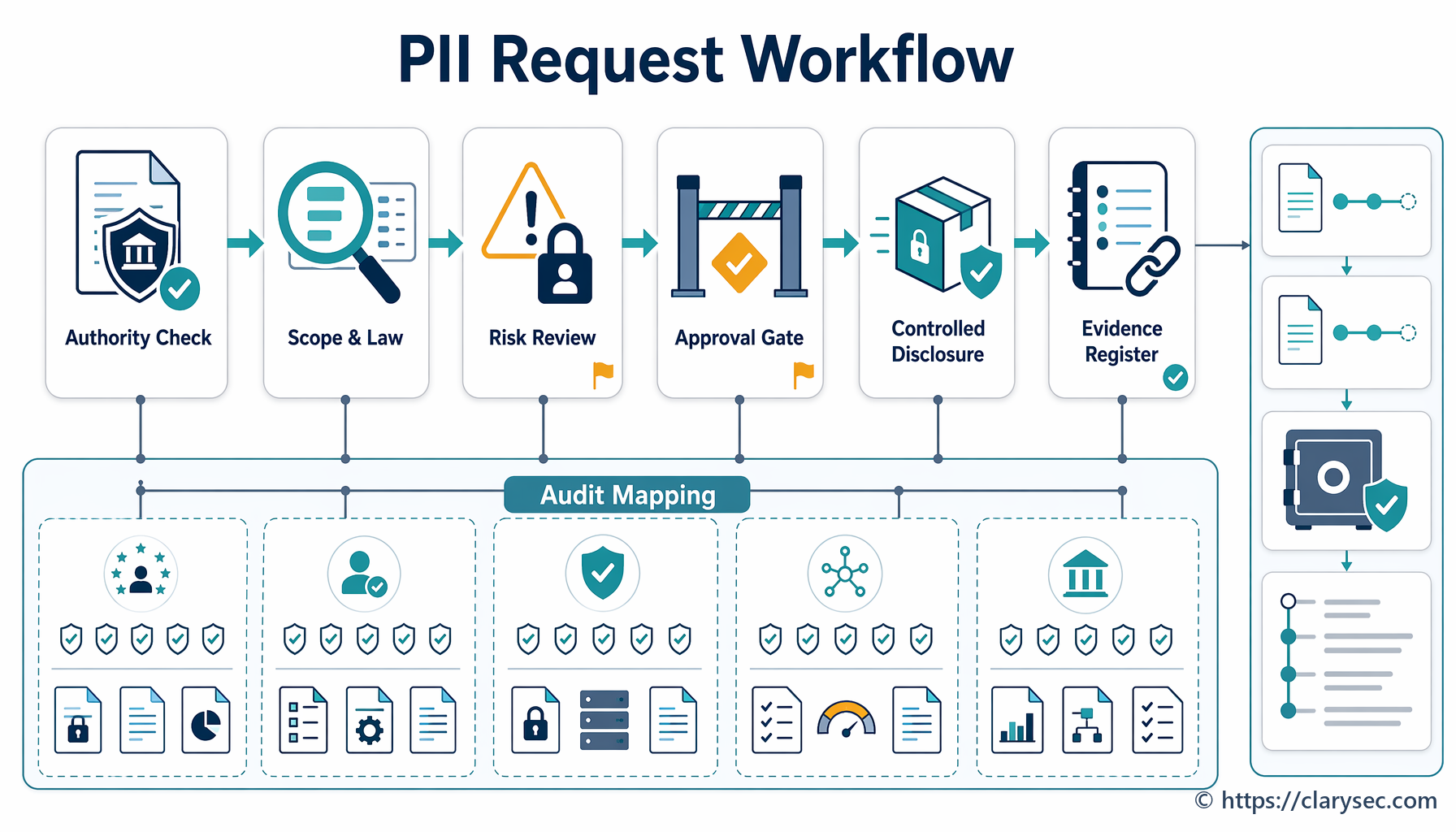
A mature workflow must be simple enough for frontline employees to follow and rigorous enough for auditors, regulators, and courts. Clarysec recommends a seven-stage model.
| Stage | Control objective | Primary owner | Evidence created |
|---|---|---|---|
| 1. Intake and quarantine | Prevent informal response or accidental disclosure | Service desk, Legal intake, Privacy Lead | Request ticket, original message, attachments, timestamp |
| 2. Authenticity validation | Confirm requester identity, authority, jurisdiction, and legal instrument | Legal, DPO, Compliance | Validation notes, authority contact verification, legal basis assessment |
| 3. Role determination | Decide whether the organization acts as controller, processor, joint controller, or subprocessor | Privacy Lead, Contract Owner | PIMS role assessment, customer instruction record if processor |
| 4. Scope minimization | Translate request into specific PII categories and date ranges | Process Owner, Security, Legal | Data mapping extract, minimization decision, redaction notes |
| 5. Approval | Ensure authorized decision before disclosure | DPO, Legal, CISO, Business Owner | Approval record, exception record if urgent |
| 6. Secure disclosure | Transmit only approved data through controlled channels | Security, Legal Operations | Transfer log, encryption evidence, recipient confirmation |
| 7. Register and review | Retain accountability evidence and lessons learned | PIMS Manager, Compliance | REG08, REG09 or REG12 entry, audit trail, closure review |
The first rule is routing. Every employee should know that official PII requests go to a defined intake path. No one should respond from a personal mailbox. No one should call the requester using a phone number printed in an unverified letter. No one should export customer data before Legal and Privacy have reviewed the request.
The enterprise P30 Incident Response Policy, clause 6.5.5, supports this routing discipline:
Any engagement with law enforcement or forensic service providers must be coordinated through the Legal Team and the CISO.
That clause is especially important where the disclosure request is linked to fraud, cybercrime, account compromise, ransomware, insider threat, or breach investigation. Legal and security must coordinate, not operate in parallel.
The enterprise P37 Legal and Regulatory Compliance Policy, clause 7.3.1.2, controls external statements:
Any verbal or written statements to regulators must be pre-approved
Clause 7.3.1.3 adds deadline and evidence discipline:
Response deadlines must be tracked, and evidence logs maintained
These rules are not bureaucratic friction. They prevent accidental admissions, uncontrolled disclosure, missed deadlines, and weak evidence.
Approval and register discipline: the audit evidence most teams miss
Many organizations can show the original request email. Fewer can show who approved the disclosure, what legal basis was used, why certain fields were included or excluded, how the requester was validated, whether the data subject was notified or lawfully not notified, and where the response was recorded.
This is where Clarysec’s PIMS registers become central.
For controllers, the enterprise PII09 PII Collection, Use, Disclosure and Sharing Policy, clause 4.4.1, requires:
[Controller] The Process Owner / Business Owner MUST record the Privacy Lead / PIMS Manager review outcome in REG08 before any new external disclosure or data-sharing arrangement begins.
Clause 4.4.2 specifies what must be captured for recurring sharing:
[Controller] The Vendor / Procurement Owner MUST record recipient identity, recipient role, disclosure purpose, PII categories, sharing frequency, processing location and authority source in REG08 before recurring external sharing begins.
For processors, the enterprise PII12 Processor, Subprocessor and Third-Party Privacy Management Policy, clause 4.5.3, provides a specific rule for legally binding and customer-authorized requests:
[Processor] The Vendor / Procurement Owner MUST record third-party disclosure requests, legally binding disclosure requests, or customer-authorized disclosure requests in REG08 before disclosure or within two business days when prior recording is not permitted or operationally possible.
For foreign public authority requests, the enterprise PII13 International PII Transfer Policy, clause 4.4.3, is more specific:
[Both] The Privacy Lead / PIMS Manager MUST record foreign public authority disclosure requests in REG09 or REG12 before disclosure where practicable, or within one business day where prior recording is not practicable.
Clause 4.4.4 adds review discipline:
[Both] The Data Protection Officer / Privacy Advisor MUST review privacy-significant foreign public authority disclosure requests in REG09 or REG12 before response where practicable.
A disclosure register is the organization’s single source of truth. It should not be replaced by scattered emails, private chat threads, or ad hoc spreadsheets.
| Register field | What it proves |
|---|---|
| Request ID | The request was uniquely tracked |
| Request source | The authority or requester was identified |
| Legal authority source | The legal instrument or authority was assessed |
| PIMS role | Controller, processor, joint controller, or subprocessor obligations were considered |
| PII categories requested | The original request scope was captured |
| PII categories approved | The final disclosure was controlled |
| PII excluded | Data minimization was actively applied |
| Approval chain | Legal, DPO, CISO, and business approvals were recorded |
| Transmission method | Secure transfer controls were used |
| Notification decision | Transparency restrictions or deferrals were considered |
| Retention and closure | Evidence was retained and the matter was closed |
Hands-on example: a regulator request in REG08
Imagine a regulated fintech receives a written request from a national financial regulator seeking PII related to suspicious transactions for one customer over a 90-day period. The request asks for identity verification records, transaction logs, device identifiers, support tickets, and internal risk notes.
Using Clarysec’s toolkit, the Privacy Lead opens a REG08 disclosure record.
| REG08 field | Example entry |
|---|---|
| Request ID | REG08-2026-041 |
| Request source | National financial regulator, verified through official supervisory contact directory |
| Request type | Regulator PII disclosure request |
| PIMS role | Controller |
| Legal authority source | Statutory supervisory information request, reference FIN-REQ-7781 |
| Purpose | Investigation of suspicious transactions for named customer |
| PII categories requested | Identity verification data, transaction logs, device identifiers, support communications, risk notes |
| PII categories approved | Transaction logs, device identifiers, relevant identity verification fields, two support tickets within date range |
| PII excluded | Unrelated support history, internal analyst opinions outside date range, third-party customer references |
| Minimization rationale | Scope limited to named customer, 90-day period, records relevant to transactions identified in request |
| DPO review | Approved with redaction instructions |
| Legal approval | Approved, response wording reviewed |
| CISO review | Approved secure export and transfer method |
| Transmission method | Encrypted archive through regulator secure portal |
| Data subject notification | Deferred due to legal restriction in request, review date set |
| Retention | Request record and disclosure package retained under legal hold schedule |
| Closure evidence | Portal submission receipt, hash of disclosure package, approval chain |
This is the difference between “we complied” and “we can prove we complied lawfully and proportionately.” If the customer later complains, if the authority asks follow-up questions, or if an auditor samples the disclosure, the record shows the governance logic.
Evidence preservation: do not damage the facts while trying to help
When a law enforcement or regulator request is linked to an investigation, privacy governance intersects with forensics and legal hold. The data disclosed is often evidence, and the act of collecting it must preserve integrity.
The Legal and Regulatory Compliance Policy - SME, clause 6.4.1, sets the context:
In the event of a dispute, investigation or legal request:
Clause 6.4.1.2 gives a clear instruction:
Employees must not delete or alter materials that may form part of an investigation.
The P31S Evidence Collection and Forensics Policy - SME, clause 2.2.5, explicitly includes:
Regulatory or law enforcement inquiries
Clause 5.2.1 establishes logging discipline:
Each item of digital evidence must be logged with:
In operational terms, the evidence log should capture a unique identifier, date and time of collection, collector name, source location, and cryptographic hash where appropriate. The point is traceability. If logs are exported manually, filenames are changed, timestamps are unclear, or no hash is retained, the organization may struggle to prove integrity later.
A strong evidence workflow also limits access. Disclosure packages should be stored in restricted locations, encrypted in transit, tracked through transfer logs, and retained according to legal hold and retention requirements. If a disclosure request overlaps with an incident response, the team must know when to shift from remediation mode to investigative posture.
Cross-compliance mapping: one workflow, many obligations
A well-designed PII disclosure request workflow can satisfy multiple frameworks without duplicating work. Zenith Controls helps organizations map the same operational evidence across privacy, cybersecurity, operational resilience, and governance expectations.
| Framework | What the auditor or regulator expects | How the Clarysec workflow supports it |
|---|---|---|
| ISO 27701:2025 | PIMS roles, lawful disclosure governance, processor instructions, records of PII disclosure, privacy risk treatment | Role determination, REG08, REG09, REG12, DPO review, minimization rationale |
| GDPR | Lawful basis, accountability, data minimization, security, transparency decisions, processor and transfer governance | Legal authority assessment, approval chain, limited disclosure package, secure transfer evidence |
| ISO/IEC 27001:2022 and ISO/IEC 27002:2022 | Contact with authorities, evidence collection, PII protection, access control, logging, cryptography, deletion | Authority contact matrix, evidence log, secure export, hash record, retention decision |
| NIS2 | Incident reporting discipline, cooperation with competent authorities, governance accountability, supply chain awareness | Legal and CISO coordination, response deadlines, authority contact register, incident linkage |
| DORA | Financial entity ICT incident governance, regulator interaction, evidence readiness, third-party ICT risk | Regulator request routing, secure disclosure records, incident evidence preservation, vendor interface |
| NIST Cybersecurity Framework | Govern, identify, protect, detect, respond, and recover outcomes for cybersecurity events | Policy ownership, data inventory, access controls, logging, response workflow, post-response review |
| COBIT 2019 | Governance objectives for compliance, risk, security, information management, and assurance | Decision rights, process ownership, audit records, management oversight, continuous improvement |
The supporting ISO standards are also relevant. ISO/IEC 27035 helps structure incident management when the request is incident-related. ISO/IEC 27037 supports identification, collection, acquisition, and preservation of digital evidence. ISO/IEC 27018 is useful where public cloud processors handle PII. ISO/IEC 27017 supports cloud security responsibilities. ISO 22301 becomes relevant if authority contact and disclosure obligations must continue during crisis conditions. ISO/IEC 27006-1:2024 matters indirectly because certification auditors expect consistent, auditable implementation of management system controls within scope.
The point is not to build a separate compliance process for every framework. The point is to design one defensible workflow that produces reusable evidence.
How different auditors will test the workflow
An ISO/IEC 27001:2022 auditor will typically start with management system integration. They will ask whether the organization has determined interested parties, legal and regulatory requirements, risks, control objectives, documented procedures, assigned responsibilities, and retained evidence. For disclosure requests, they may sample incidents, regulator correspondence, authority contact lists, evidence logs, and privacy records. They will likely test Annex A controls A.5.5 Contact with authorities, A.5.28 Collection of evidence, and A.5.34 Privacy and protection of PII.
An ISO 27701:2025 assessor will focus on PIMS role clarity. Were you a controller, processor, joint controller, or subprocessor? If controller, where is the lawful basis and disclosure record? If processor, did you act on controller instructions unless legally compelled otherwise? Was the customer notified where required or where contractually expected? Were foreign public authority requests recorded and reviewed?
A GDPR regulator will focus on accountability. The question will not be merely “did you have a legal obligation?” It will be “why was this amount of data disclosed, who approved it, how was the requester validated, what security protected the transfer, how did you assess transparency, and where is the record?”
A NIST-oriented assessor will examine governance and response outcomes. They will ask whether roles were defined, whether logs were preserved, whether access to disclosure packages was restricted, whether response activities were documented, and whether lessons learned improved the program.
A COBIT 2019 or ISACA auditor will test governance over decision rights. They may ask whether management defined the process owner, whether Legal, Privacy, Security, and Business responsibilities are separated, whether exceptions are approved, whether metrics are reported, and whether assurance can rely on the evidence.
A regulator, auditor, CISO, and DPO may all view the same record differently. A privacy professional sees a lawful disclosure record. A security auditor sees evidence preservation and secure transfer. A governance auditor sees accountability and decision rights. The organization should be able to answer all of them from the same control evidence.
Common failure patterns
Clarysec sees the same preventable failures repeatedly.
The first is informal authority contact. A police officer calls support, support wants to be helpful, and the employee confirms account details verbally. No validation, no approval, no record.
The second is excessive disclosure. The organization sends an entire customer file instead of the specific records and date range required. This creates avoidable GDPR risk and weakens trust.
The third is processor overreach. A SaaS provider receives a law enforcement request for customer-controlled PII and responds without notifying or involving the customer, even though the contract and PIMS role require routing unless legally prohibited.
The fourth is missing foreign authority review. A request from a non-domestic public authority is treated like an ordinary disclosure, with no transfer assessment, DPO review, or REG09 or REG12 entry.
The fifth is weak evidence handling. Logs are exported manually, timestamps are unclear, filenames are changed, and no hash or chain-of-custody record exists.
The sixth is unmanaged confidentiality. Too many employees are copied into the request, including people with no need to know. Sensitive investigation details spread through chat channels.
The seventh is deadline confusion. The organization misses a legally significant response date because the request lives in a mailbox instead of a tracked workflow.
Each failure is preventable with predefined channels, registers, approvals, and evidence standards.
Roles and decision rights
A practical governance model defines decision rights before the first request arrives.
| Role | Responsibility in disclosure workflow |
|---|---|
| Frontline employee | Forward request to approved intake channel, do not respond substantively, do not disclose PII |
| Legal Team | Validate legal instrument, jurisdiction, authority, confidentiality restriction, response wording |
| DPO or Privacy Advisor | Assess GDPR and ISO 27701:2025 implications, minimization, transparency, PIMS role, transfer issues |
| CISO | Approve secure evidence collection, secure export, transfer method, incident linkage |
| Process Owner | Identify relevant systems and data categories, confirm business context |
| PIMS Manager | Maintain REG08, REG09 or REG12, track review outcome, retain audit evidence |
| Executive approver | Approve high-risk, foreign, strategic, or reputationally sensitive disclosures |
| Vendor or Procurement Owner | Coordinate third-party or processor-related request records and contractual obligations |
This model should be embedded into awareness training. Employees do not need to know every legal nuance, but they must know the rule: official requests go to the defined channel, and PII is not disclosed without authorization.
Readiness checklist for your next tabletop exercise
Use this checklist in a privacy governance workshop, internal audit, or tabletop exercise.
- Do we have a single intake channel for law enforcement and regulator PII disclosure requests?
- Do employees know they must not respond informally?
- Do we validate requester identity using independent contact sources?
- Do we distinguish regulator requests, court orders, law enforcement requests, customer-authorized requests, and foreign public authority requests?
- Do we determine whether we are controller, processor, joint controller, or subprocessor before responding?
- Do we document lawful basis, legal authority, jurisdiction, and confidentiality restrictions?
- Do we apply data minimization and redact unrelated PII?
- Do we require DPO or Privacy Advisor review for privacy-significant requests?
- Do we require Legal and CISO coordination where law enforcement or forensic issues are involved?
- Do we record controller disclosures in REG08?
- Do we record foreign public authority requests in REG09 or REG12?
- Do we track response deadlines and maintain evidence logs?
- Do we preserve potentially relevant materials and prevent deletion or alteration?
- Do we secure disclosure packages with encryption, access control, and transfer logging?
- Do we perform post-response review for high-risk requests?
- Do we report metrics and lessons learned to management?
If the answer to any of these is “we usually handle that by email,” the process is not yet audit-ready.
Bring the workflow into the ISMS and PIMS
The best governance model does not live only in Legal. It is part of the ISMS and PIMS.
In Zenith Blueprint, the ISMS Foundation & Leadership phase, Step 5, recommends planning external communication and identifying who communicates with regulators, customers, partners, and the public. It notes that legal counsel may be involved in wording communications to regulators. That principle applies directly to official PII disclosure requests.
The Controls in Action phase then operationalizes the workflow through authority contact, PII protection, and evidence collection. This is why Clarysec’s 30-Step Guide does not treat privacy, security, and compliance as disconnected workstreams. A real request crosses all three.
For business owners, the benefit is reduced chaos. For CISOs, it clarifies when security evidence can be collected, disclosed, or preserved. For DPOs, it creates demonstrable GDPR and ISO 27701:2025 accountability. For compliance managers, it produces registers and audit trails. For auditors, it creates a clear path from policy requirement to operational evidence.
Next steps with Clarysec
A regulator or law enforcement request is not the moment to invent your privacy governance process. It is the moment your process is tested.
Start with a tabletop exercise. Use a realistic cybercrime, regulator, or foreign public authority request. Ask Legal, the DPO, the CISO, support, and the relevant process owner to walk through intake, validation, role determination, minimization, approval, secure transfer, register recording, evidence preservation, and closure review.
Then compare your answers against Clarysec’s operating model:
- Use Zenith Blueprint: An Auditor’s 30-Step Roadmap to place authority contact, external communication, PII protection, and evidence collection into your ISMS and PIMS implementation plan.
- Use Zenith Controls: The Cross-Compliance Guide to map ISO 27701:2025, GDPR, ISO/IEC 27001:2022, ISO/IEC 27002:2022, NIS2, DORA, NIST, and COBIT 2019 expectations into one audit-ready control narrative.
- Use Clarysec’s Data Protection and Privacy, Incident Response, Legal and Regulatory Compliance, Evidence Collection and Forensics, PII Disclosure, Processor Management, and International Transfer policies to define workflow rules, registers, approvals, and evidence requirements.
Clarysec helps teams move from reactive panic to controlled execution. Download the relevant Clarysec toolkits, run the tabletop, and book a disclosure governance assessment to make sure your next response is lawful, minimal, approved, recorded, secure, and auditable.
About the Author

Igor Petreski
Compliance Systems Architect, Clarysec LLC
Igor Petreski is a cybersecurity leader with over 30 years of experience in information technology and a dedicated decade specializing in global Governance, Risk, and Compliance (GRC).Core Credentials & Qualifications:• MSc in Cyber Security from Royal Holloway, University of London• PECB-Certified ISO/IEC 27001 Lead Auditor & Trainer• Certified Information Systems Auditor (CISA) from ISACA• Certified Information Security Manager (CISM) from ISACA • Certified Ethical Hacker from EC-Council