PII Governance for ISO 27701:2025 and GDPR
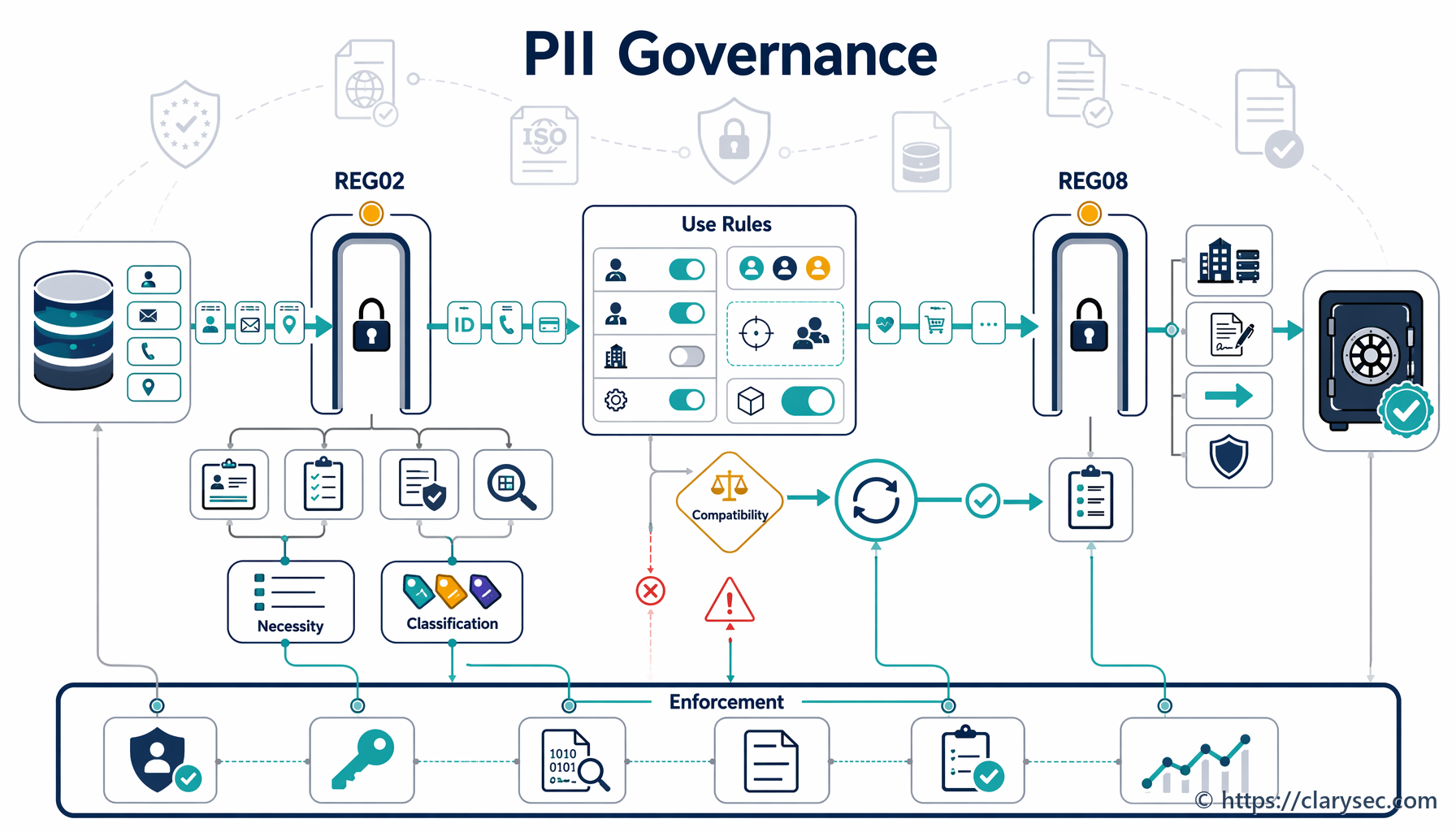
The request landed in the CISO’s inbox with deceptive simplicity: “Project Wellness.” A fast-growing fintech wanted to analyze existing customer transaction data to provide personalized savings tips, product recommendations and churn-risk insights. Marketing saw customer engagement. Product saw innovation. Leadership saw a competitive advantage.
The CISO saw a governance landmine.
The transaction data had been collected for payment processing under a defined purpose and lawful basis. Now the business wanted to reuse it for financial wellness analytics, campaign personalization and predictive scoring. To accelerate delivery, the team also wanted to send a pseudonymised dataset to a third-party AI analytics vendor.
No attacker was in the network. No database had leaked. No incident ticket was flashing red.
Yet this is exactly where many GDPR accountability failures begin.
The issue is not whether the organization has a privacy notice, a Data Protection Officer, a lawful basis register or a retention schedule. The deeper question is operational: who approves new PII collection, who confirms necessity, who defines permitted internal use, who decides whether secondary use is compatible, who authorizes disclosure to a vendor, and who can prove the decision later?
That is the control gap ISO/IEC 27701:2025 privacy information management system, or PIMS, implementations must close. GDPR Article 5 requires personal data to be processed lawfully, fairly and transparently, collected for specified, explicit and legitimate purposes, limited to what is necessary, accurate, retained only as needed, protected appropriately and handled under controller accountability. GDPR Article 6 adds lawful basis and compatibility logic for further processing. But those principles only become defensible when they are translated into workflows, registers, approvals, access rules, supplier controls, monitoring and evidence.
Clarysec’s approach is simple: treat PII collection, use and disclosure governance as a controlled operating model, not as a legal memo. The model sits inside the ISO/IEC 27001:2022 ISMS backbone, extends into ISO/IEC 27701:2025 PIMS roles, and is evidenced through Clarysec policies, registers, Zenith Blueprint: An Auditor’s 30-Step Roadmap and Zenith Controls: The Cross-Compliance Guide.
Why PII governance fails even when privacy documents exist
Most privacy programs do not fail because nobody knows GDPR exists. They fail because privacy decisions are made inside product tickets, supplier onboarding emails, spreadsheet exports, dashboard experiments and AI pilots without a repeatable control gate.
A typical pattern looks familiar:
- A team adds a new field to a sign-up form because it improves segmentation.
- Nobody records why that specific field is necessary.
- Another team later reuses the data for a different purpose.
- A vendor receives an export under a broad services agreement.
- The processing register is updated after launch, if it is updated at all.
- During audit, the organization can show a privacy notice but cannot show decision evidence.
GDPR Articles 4 and 5 define processing broadly. Collection, recording, storage, use, disclosure, erasure and destruction all count. Article 5 also makes accountability explicit. Controllers must be able to demonstrate compliance with the principles.
That means the audit question is not only, “Do you have a policy?” It is, “Show me how this specific data element was approved, why it was needed, how it was used, who received it, and what controls prevented misuse.”
Clarysec P17 Data Protection and Privacy Policy sets the lifecycle expectation clearly:
It formalizes the enterprise’s responsibilities under international standards and regulatory frameworks, ensuring that personal information (PII) is collected, processed, retained, shared, and disposed of lawfully, securely, and transparently.
For SMEs, Clarysec Data Protection and Privacy Policy - SME turns the same principle into a pragmatic operating rule:
Personal data may only be collected where necessary for a legitimate, lawful, or contractual purpose
And for minimisation:
Only the minimum personal data necessary must be collected and retained
These statements are powerful only when enforced before processing starts. Otherwise, they remain privacy language without operational proof.
The control objective: stop uncontrolled processing at three gates
A strong PIMS should control PII decisions at three points: before collection, before use and before disclosure.
Before collection, the organization must know what it wants to collect, from whom, through which channel, for what purpose, under which lawful basis, and why each field is necessary.
Before use, the organization must define permitted internal use rules. Support, customer success, marketing, fraud, finance and engineering rarely need the same visibility or the same permission to act on PII.
Before disclosure, the organization must know who the recipient is, what role they play, why disclosure is necessary, where processing occurs, what PII categories are shared, how often sharing happens, and which authority permits the sharing.
Clarysec PII09 PII Collection, Use, Disclosure and Sharing Policy is designed for this governance layer. It uses PIMS role tagging, especially the Controller role, because collection, use and disclosure decisions usually sit with the organization determining purposes and means.
For collection limitation, PII09 PII Collection, Use, Disclosure and Sharing Policy requires:
[Controller] The Process Owner / Business Owner MUST record the collection purpose, source or channel, PII categories, PII principal categories and minimum data elements in REG02 before any new collection activity or material collection change begins.
It then makes minimisation testable:
[Controller] The Process Owner / Business Owner MUST record a necessity justification in REG02 for each PII data element before that element is collected.
That “each PII data element” requirement is the difference between a generic processing inventory and field-level accountability evidence.
For internal use, the same policy requires:
[Controller] The Process Owner / Business Owner MUST record approved internal use rules for each processing activity in REG02 before the use begins.
For secondary use:
[Controller] The Process Owner / Business Owner MUST record a secondary-use compatibility check in REG02 before PII is used for a purpose not already approved for the processing activity.
And for external disclosure:
[Controller] The Vendor / Procurement Owner MUST record recipient identity, recipient role, disclosure purpose, PII categories, sharing frequency, processing location and authority source in REG08 before recurring external sharing begins.
These clauses create a clear answer when leadership asks whether the business can innovate quickly: yes, if the decision passes a documented governance workflow and the controls match the approval.
REG02 and REG08: the Clarysec policy-to-control chain
In Clarysec implementations, REG02 is not a passive processing inventory. It is the decision record for collection purpose, lawful basis, PII categories, necessity, internal use rules, retention alignment and secondary-use compatibility.
REG08 is the disclosure and sharing control register. It is especially important for vendors, partners, group companies, authorities, subprocessors, integrations and recurring exports.
Together, they create a policy-to-control chain that can be tested by privacy, security, procurement and audit teams.
| Governance question | Evidence artifact | Clarysec policy trigger | Practical control outcome |
|---|---|---|---|
| What PII are we collecting? | REG02 processing record | PII09 clause 4.1.1 | Collection is defined before launch |
| Why is each field needed? | REG02 data-element necessity justification | PII09 clause 4.1.3 | Data minimisation is evidenced |
| How may teams use the PII? | REG02 internal use rules | PII09 clause 4.2.1 | Access and use are purpose-bound |
| Can we reuse PII for a new purpose? | REG02 compatibility check | PII09 clause 4.3.1 | Secondary use is approved, conditioned or blocked |
| Who receives PII externally? | REG08 disclosure record | PII09 clause 4.4.2 | Disclosure is traceable and authorized |
| Are vendors limited to need-to-know? | Supplier access review | Third-party policy clause 6.2.1 | Supplier access is minimised |
This model aligns naturally with ISO/IEC 27001:2022. Clauses 4 to 10 require the organization to understand context, interested-party requirements, scope, leadership responsibilities, risk assessment, risk treatment, operational control, performance evaluation and improvement. Privacy obligations under GDPR and ISO/IEC 27701:2025 become part of the management system instead of a separate privacy island.
ISO/IEC 27002:2022 also supports the operating model. Control 5.31, Legal, statutory, regulatory and contractual requirements, anchors GDPR and sector obligations. Control 5.34, Privacy and protection of PII, addresses privacy-specific protection. Control 5.9, Inventory of information and other associated assets, supports data awareness. Controls 5.12 and 5.13 support classification and labelling. Control 5.14 governs information transfer. Controls 5.19 to 5.23 cover supplier relationships, supplier agreements, ICT supply chain, supplier service monitoring and cloud services. Control 8.11 supports data masking, 8.12 supports data leakage prevention, 8.15 logging, 8.16 monitoring activities and 8.24 use of cryptography.
Zenith Blueprint places these controls into an implementation path. In the Controls in Action phase, Step 23 covers organizational controls 5.19 to 5.37, including control 5.34 for Privacy and protection of PII. The Blueprint explains:
In today’s data-driven world, personally identifiable information isn’t just another data type, it’s a deeply sensitive representation of trust. Names, addresses, IDs, health records, financial details, this data tells a story about real people.
It then gives the operational baseline:
The foundation of this control is data awareness. The organization must know what PII it collects, where it resides, why it is being processed, and who can access it.
That is what REG02 and REG08 provide when they are treated as living governance records.
Hands-on example: approving Project Wellness without losing control
Return to the fintech scenario. The business wants to analyze customer transaction data for personalized financial wellness recommendations. Marketing wants to use the outputs for campaigns. Product wants to build churn and engagement scores. A third-party AI analytics platform will process part of the dataset.
Here is how Clarysec would govern the request.
Step 1: Create or update the REG02 processing activity
The Process Owner opens REG02 and records the processing activity before work begins.
| REG02 field | Project Wellness example |
|---|---|
| Processing activity | Financial wellness analytics and recommendation feature |
| Primary purpose | Provide tailored savings insights and product guidance to customers |
| PII principal categories | Retail customers, account holders, authorized users |
| PII categories | Transaction category, transaction amount, transaction date, account status, product holdings |
| Source or channel | Payment platform, customer account records, product usage systems |
| Lawful basis | Determined by privacy counsel or privacy owner based on controller context |
| Retention | Linked to the approved retention schedule |
| Internal use rules | Product may use aggregated insights; Marketing requires secondary-use approval; Engineering must use masked datasets |
The important point is timing. REG02 is updated before new processing begins, not after the feature is already live.
Step 2: Record field-level necessity justifications
Marketing initially asks for five years of full transaction history, including merchant names, exact timestamps, card metadata and customer profile attributes. The governance team challenges each field.
| PII element | Necessity justification | Decision |
|---|---|---|
| Transaction category | Needed to identify spending patterns for savings tips | Approved |
| Transaction amount | Needed to calculate trend ranges and recommendation relevance | Approved with aggregation thresholds |
| Transaction date | Needed for trend analysis | Approved at month level where possible |
| Merchant name | Not required for the first release and increases re-identification risk | Rejected |
| Exact timestamp | Not necessary for wellness recommendations | Rejected |
| Customer email | Needed only for account association, not for model training | Restricted |
| Product holdings | Needed to avoid irrelevant recommendations | Approved with access limits |
This is data minimisation as evidence, not aspiration. The business still receives useful analytics, but the dataset is narrowed to what is necessary for the approved purpose.
Step 3: Classify and label the dataset
The dataset is classified under Clarysec Data Classification and Labeling Policy. The SME version requires:
External sharing must be explicitly authorized and logged.
The enterprise Data Classification and Labeling Policy adds a safeguard for sensitive information:
May only be shared externally under an NDA or equivalent contractual safeguards
In practice, the Project Wellness dataset cannot be casually exported to an AI platform. It needs an approved disclosure record, contractual safeguards, technical transfer controls and logs.
Zenith Blueprint, in Step 22 for control 5.12 Classification of information, explains why this matters:
Every information security control ever written, access restriction, encryption, backup, monitoring, or disposal, assumes one thing: that the organization knows what it is protecting.
Without classification, access restrictions, encryption, DLP and retention rules become guesswork.
Step 4: Define internal use rules before production release
The Process Owner records approved internal use rules in REG02. This is where purpose creep is often stopped.
A defensible rule set might state:
- Product may use aggregated recommendation performance metrics.
- Customer support may see whether a recommendation was shown to a customer when handling a support request.
- Marketing may not use individual-level wellness scores for campaign segmentation unless a secondary-use compatibility check is completed.
- Finance may not access detailed wellness analytics unless a separate approved purpose exists.
- Developers must not use production PII in test environments.
- AI model evaluation must use masked, pseudonymised or aggregated datasets where feasible.
The last two rules connect to ISO/IEC 27002:2022 control 8.11, Data masking. Zenith Blueprint, Step 19, describes data masking as a practical method for preventing unnecessary exposure in testing environments, training datasets, analytics platforms, third-party integrations and CI/CD testing pipelines.
Step 5: Run the secondary-use compatibility check
Marketing later asks to use wellness scores for targeted campaigns. That is a new purpose. Under PII09 PII Collection, Use, Disclosure and Sharing Policy clause 4.3.1, the Business Owner must record a compatibility check in REG02 before the new use begins.
The check should assess:
- Whether financial wellness marketing is compatible with the original processing purpose.
- What customers were told at collection and in the privacy notice.
- Whether transaction-derived inferences could be sensitive or unexpected.
- Whether the new use could create pressure, exclusion or unfair profiling.
- Whether safeguards such as aggregation, opt-out, pseudonymisation or account-level segmentation reduce risk.
- Whether the lawful basis remains valid.
- Whether transparency updates or consent mechanisms are required.
The outcome may be approval, approval with safeguards or rejection. The value is that the decision is documented before the use begins.
Step 6: Approve external disclosure through REG08
If the AI analytics vendor will receive data, the Vendor or Procurement Owner records in REG08:
| REG08 field | Required decision evidence |
|---|---|
| Recipient identity | Legal entity name, service owner and vendor contact |
| Recipient role | Processor, subprocessor, independent controller or joint controller |
| Disclosure purpose | Defined analytics purpose linked to Project Wellness |
| PII categories | Approved fields only, excluding rejected data elements |
| Sharing frequency | One-time transfer, batch frequency or API flow |
| Processing location | Countries and hosting regions |
| Authority source | Contract, DPA, documented instruction or other approved basis |
| Security requirements | Encryption, access restriction, logging, deletion and incident notification |
| Exit requirements | Return, deletion, transition support and audit evidence |
Clarysec Third-Party and Supplier Security Policy - SME reinforces minimised supplier access:
Suppliers must be granted access only to the minimum systems and data required to perform their function.
This is privacy minimisation applied to supplier access and disclosure.
Step 7: Add technical enforcement
Governance records must be backed by technical controls. For Project Wellness, Clarysec would typically recommend DLP rules for exports, role-based access restrictions, logging for access and transfer events, masked datasets for development, encryption for transfer and storage, vendor access reviews, cloud security due diligence and periodic sampling of REG02 and REG08 against actual system behavior.
That is how ISO/IEC 27701:2025 and GDPR accountability become operational evidence.
Control mapping: from privacy decision to security enforcement
PII governance is not one isolated control. It is a relationship between privacy requirements, security controls, supplier governance and audit evidence.
Zenith Controls treats ISO/IEC 27002:2022 control 5.34, Privacy and protection of PII, as a preventive control supporting confidentiality, integrity and availability, with Identify and Protect cybersecurity concepts and operational capabilities in information protection plus legal and compliance.
For 5.34, Zenith Controls maps the surrounding control ecosystem, including inventory, classification, transfer, access, identity, cloud, supplier security, masking, leakage prevention, logging, monitoring and cryptography.
| ISO/IEC 27002:2022 control | Control name | Why it matters for PII governance |
|---|---|---|
| 5.9 | Inventory of information and other associated assets | PII holdings must be known before they can be protected |
| 5.12 | Classification of information | PII must be classified by sensitivity and handling requirements |
| 5.13 | Labelling of information | Labels help enforce handling, sharing and retention rules |
| 5.14 | Information transfer | PII movement must be authorized, protected and traceable |
| 5.15 | Access control | PII access must be limited to approved roles and purposes |
| 5.16 | Identity management | Users and service identities accessing PII must be governed |
| 5.19 | Information security in supplier relationships | Supplier PII risk must be identified and controlled |
| 5.20 | Addressing information security within supplier agreements | Contracts must include security and privacy requirements |
| 5.21 | Managing information security in the ICT supply chain | Downstream ICT and subprocessor risks must be managed |
| 5.22 | Monitoring, review and change management of supplier services | Supplier services must be reviewed and changes assessed |
| 5.23 | Information security for use of cloud services | SaaS and cloud PII processing must be governed |
| 5.31 | Legal, statutory, regulatory and contractual requirements | GDPR, DORA, NIS2 and customer obligations must be identified |
| 5.34 | Privacy and protection of PII | PII protection must be implemented according to privacy requirements |
| 8.11 | Data masking | Real PII should be hidden where full data is unnecessary |
| 8.12 | Data leakage prevention | Unauthorized PII movement should be detected and prevented |
| 8.15 | Logging | Access, changes and transfers should be evidenced |
| 8.16 | Monitoring activities | Suspicious or unauthorized activity should be detected |
| 8.24 | Use of cryptography | PII should be protected in storage and transfer where required |
For masking, Zenith Controls states:
Data masking (8.11) is a technique often used to protect PII in non-production environments or when sharing data. It directly supports 5.34 by reducing the exposure of real personal data, thus lowering privacy risk.
For data leakage prevention, the guide explains the practical boundary:
DLP plays a direct role in protecting personal data. Control 8.12 enforces boundaries on how PII can be accessed, shared, or moved, ensuring that personal data cannot be leaked via unauthorized channels.
An auditor testing disclosure governance may therefore ask not only for REG08, but also for DLP policies, blocked transfer logs, outbound email controls, cloud-sharing restrictions, encryption requirements, vendor access records and evidence of approved exceptions.
Cross-compliance value: GDPR, ISO 27701, NIS2, DORA, NIST and COBIT
PII collection, use and disclosure governance is privacy-led, but its evidence supports broader cybersecurity, resilience and governance obligations.
GDPR Articles 2 and 3 define broad material and territorial scope, which can include SaaS, fintech and digital service providers outside the EU when they serve or monitor EU individuals. Article 5 requires purpose limitation, data minimisation, accuracy, storage limitation, integrity, confidentiality and accountability. Article 6 requires lawful basis and compatibility assessment for further processing. Article 9 adds stricter conditions for special category data, relevant where profiling, health-adjacent data, biometric onboarding or sensitive attributes are involved.
NIS2 Article 21 requires essential and important entities to implement proportionate technical, operational and organisational risk-management measures. Its minimum areas include risk analysis, information system security policies, incident handling, business continuity, supply-chain security, secure development, control effectiveness, training, cryptography, human resources security, access control, asset management and authentication.
DORA requires financial entities to maintain an ICT risk management framework, management-body accountability, identification of ICT assets and dependencies, protection and prevention controls, detection, response, recovery, backup, learning, incident management, testing and ICT third-party risk management. It also requires registers of information for ICT service contracts, due diligence, audit rights, security requirements and exit strategies.
NIST Cybersecurity Framework 2.0 gives an integrating governance language. Its GOVERN function expects legal, regulatory and contractual requirements, including privacy obligations, to be understood and managed. It also covers risk strategy, roles, policies, oversight and supplier risk management.
COBIT 2019 auditors look for governance objectives, decision rights, accountability, process ownership, performance indicators and assurance evidence. For PII governance, that means privacy requirements must be embedded into enterprise governance, not managed as a side process.
| Framework or regime | What it expects | Clarysec evidence that helps |
|---|---|---|
| ISO/IEC 27701:2025 PIMS | Role-based privacy governance for controller and processor obligations | PII09 clauses, REG02, REG08, privacy roles, compatibility checks |
| GDPR | Purpose limitation, minimisation, lawful basis, accountability and secure processing | Necessity justifications, internal use rules, disclosure approvals, DLP, access logs |
| ISO/IEC 27001:2022 and ISO/IEC 27002:2022 | Risk-based ISMS controls for PII, suppliers, transfers, access, masking and monitoring | Statement of Applicability, risk treatment plan, 5.34, 5.12, 5.14, 8.11, 8.12 |
| NIS2 | Operational and organisational cybersecurity risk measures, supplier security and management accountability | Asset inventory, supplier controls, incident and monitoring controls, board reporting |
| DORA | ICT risk management, data protection, third-party risk, resilience testing and audit rights | Vendor registers, contract clauses, access controls, testing evidence, disclosure logs |
| NIST CSF 2.0 | Governance, legal requirements, risk management and data protection outcomes | Current Profile, Target Profile, policy mapping, risk register, control action plan |
| COBIT 2019 | Governance accountability, process ownership, assurance and performance monitoring | RACI, control KPIs, audit samples, management review minutes, exception tracking |
How auditors test the same governance layer
A strong PIMS implementation should survive different audit styles.
An ISO/IEC 27001:2022 and ISO/IEC 27701:2025 auditor will start with scope, interested parties, legal and contractual requirements, risk assessment, Statement of Applicability, operational planning and documented evidence. They may sample processing activities from REG02 and test whether controls such as 5.34, 5.12, 5.14, 5.19 to 5.23, 8.11, 8.12, 8.15, 8.16 and 8.24 are implemented and monitored.
A GDPR-focused auditor or regulator will test accountability. They may begin with a privacy notice, complaint, data subject request or vendor disclosure, then trace backward. Why was this data collected? What lawful basis applied? Was the purpose specified? Was the later use compatible? Was the recipient authorized? Were individuals informed? Were records updated before processing began?
A DORA supervisor, where applicable, will focus on ICT-supported business functions, third-party ICT providers, contractual clauses, audit rights, data protection, incident communication, resilience testing and exit planning. If customer PII is shared with a critical analytics or cloud provider, REG08, supplier due diligence and contract controls become central evidence.
A NIST CSF assessor will frame the issue through governance outcomes. Are legal and regulatory requirements managed? Are roles and responsibilities clear? Are policies maintained and enforced? Are supplier risks governed? Are data protection, monitoring and response outcomes operating?
A COBIT or ISACA-style auditor will ask whether decision rights are defined, whether business owners accept privacy risk, whether control performance is measured, whether exceptions are tracked and whether management receives meaningful reporting.
| Auditor persona | Key focus areas | Evidence they will demand |
|---|---|---|
| ISO 27001 and ISO 27701 auditor | ISMS and PIMS integration, control effectiveness, documented evidence | REG02, REG08, Statement of Applicability, risk treatment, 5.34 evidence, masking records |
| GDPR regulator | Lawful basis, purpose limitation, minimisation, transparency, accountability | Compatibility checks, necessity justifications, privacy notices, disclosure approvals |
| DORA supervisor | ICT risk, third-party resilience, board oversight, contract controls | Vendor due diligence, ICT contract register, audit rights, exit plan, incident procedures |
| NIS2 assessor | Cybersecurity risk measures, supply chain, incident readiness, management accountability | Supplier reviews, monitoring evidence, access controls, asset inventory, incident playbooks |
| COBIT or ISACA auditor | Governance maturity, roles, process ownership, metrics, assurance | RACI, governance minutes, KPIs, exception tracking, management review records |
Common pitfalls Clarysec finds in implementations
The first pitfall is treating the processing inventory as a documentation exercise rather than an approval gate. If REG02 is updated after launch, it cannot prove prior governance.
The second is vague purpose language. “Analytics,” “service improvement” or “customer insight” is rarely specific enough to control internal use or secondary use.
The third is missing field-level necessity. Data minimisation cannot be proven by saying every field is useful. The business must explain why each field is necessary for the approved purpose.
The fourth is uncontrolled secondary use. Data collected for account administration quietly becomes sales intelligence, then marketing segmentation, then AI training. Each purpose change requires compatibility analysis and, in some cases, a new lawful basis or transparency update.
The fifth is weak disclosure governance. Supplier lists are not the same as disclosure records. REG08 ties recipient, role, purpose, PII categories, location, frequency and authority source into one approval trail.
The sixth is missing technical enforcement. Policies may say PII should not leave approved channels, but email, exports, shared drives and analytics tools often allow it. This is where ISO/IEC 27002:2022 controls 5.14, 8.12, 8.15, 8.16 and 8.24 become essential.
A practical 30-day starting plan
Organizations do not need to boil the ocean. Start with one high-risk processing activity, preferably one involving customer profiling, AI analytics, sensitive attributes, cross-border transfer or a third-party platform.
In the first week, identify the processing activity, owner, PII categories, systems, vendors and current purpose. Confirm whether the activity is already represented in REG02 and whether disclosure is represented in REG08.
In the second week, complete field-level necessity justifications. Challenge excessive data elements. Confirm classification and labelling. Identify whether masking, aggregation or pseudonymisation can reduce risk.
In the third week, define internal use rules and run any secondary-use compatibility checks. Decide whether privacy notices, lawful basis assessments or data subject controls need updates.
In the fourth week, validate external disclosure records, supplier access, contract safeguards, DPA terms, transfer controls, logging, DLP and deletion obligations. Then sample actual system behavior against the approvals.
At the end of 30 days, management should have a concrete evidence pack: REG02, REG08, classification records, access matrices, DLP and logging evidence, supplier due diligence, contract safeguards, compatibility checks and open remediation actions.
From policy to proof
PII collection, use and disclosure governance is where privacy becomes real. It is the difference between saying “we comply with GDPR” and proving that every collection, use, reuse and disclosure decision was controlled before processing happened.
Clarysec’s toolkit gives privacy, security and compliance teams a practical route:
- Use PII09 PII Collection, Use, Disclosure and Sharing Policy to define mandatory approval gates.
- Use P17 Data Protection and Privacy Policy or Data Protection and Privacy Policy - SME to anchor lawful, fair, transparent and minimised processing.
- Use Data Classification and Labeling Policy and Third-Party and Supplier Security Policy - SME to govern classification, sharing and supplier access.
- Follow Zenith Blueprint: An Auditor’s 30-Step Roadmap to implement the control environment in the right sequence.
- Use Zenith Controls: The Cross-Compliance Guide to understand how ISO/IEC 27002:2022 controls such as 5.34, 5.12, 5.14, 8.11 and 8.12 support GDPR, NIS2, DORA, NIST and audit expectations.
If your next audit, customer due diligence request or board review asks how you control what PII is collected, how it is used and when it is disclosed, do not rely on policy statements alone.
Start with one high-risk activity. Build the REG02 record. Justify each data element. Define internal use rules. Run the secondary-use compatibility check. Create the REG08 disclosure record. Then test whether access, DLP, masking, logging, encryption and supplier controls match the decision.
That is how ISO/IEC 27701:2025 and GDPR accountability become evidence.
Explore the Clarysec PIMS toolkit, start with the PII09 PII Collection, Use, Disclosure and Sharing Policy, and use Zenith Blueprint to turn privacy governance from policy intent into audit-ready proof.
About the Author

Igor Petreski
Compliance Systems Architect, Clarysec LLC
Igor Petreski is a cybersecurity leader with over 30 years of experience in information technology and a dedicated decade specializing in global Governance, Risk, and Compliance (GRC).Core Credentials & Qualifications:• MSc in Cyber Security from Royal Holloway, University of London• PECB-Certified ISO/IEC 27001 Lead Auditor & Trainer• Certified Information Systems Auditor (CISA) from ISACA• Certified Information Security Manager (CISM) from ISACA • Certified Ethical Hacker from EC-Council