Policy Lifecycle Governance for ISO 27001, NIS2, DORA
The email landed in CISO Maria Petrova’s inbox with a quiet thud that felt like a siren. It was from the external auditor, a preliminary request list for a combined ISO/IEC 27001:2022 surveillance audit and DORA readiness assessment. The first item looked simple:
“Please provide the current Information Security Policy, its complete version history, evidence of management approval for each version, and records of its communication to relevant personnel over the last 24 months.”
Maria’s company, a mid-sized fintech platform, had policies. Dozens of them. They had an information security policy, incident response plan, supplier security questionnaire, risk register, access control procedure, business continuity plan, and a folder full of audit evidence. But the files were scattered across SharePoint sites, legacy Confluence spaces, email threads, ticket attachments, and shared drives owned by people who had already left the company.
The real problem became clear when the auditor’s follow-up questions arrived.
Who approved the current incident procedure? Why does the supplier security policy in SharePoint say version 2.1 while procurement uses version 1.8? Which policy maps to NIS2 Article 21 risk management measures? Where is the record showing staff were informed of the last policy update? Why was a privileged access exception granted, who accepted the residual risk, and when does it expire? Are obsolete documents removed from operational use? How long are audit reports retained? Can the company prove the policy library was reviewed after the last major system change?
Maria had controls, but not control over the controls.
That is the policy lifecycle governance problem in 2026. Organizations no longer fail audits only because a firewall rule is wrong or a backup test is missing. They fail because documented information is fragmented, unauditable, duplicated, stale, uncontrolled, or disconnected from legal obligations. Under ISO/IEC 27001:2022 clause 7.5, documented information is not administrative housekeeping. It is the operating memory of the ISMS. Under NIS2, it supports management-body approval and oversight. Under DORA, it becomes part of the ICT risk management framework and resilience evidence trail. Under GDPR, it proves accountability.
Clarysec’s view is straightforward: a policy library is not a document dump. It is a governed evidence system.
Why policy lifecycle governance is now a board-level issue
Policy lifecycle governance is the discipline of creating, approving, publishing, communicating, reviewing, changing, retiring, retaining and evidencing policies and related records. It answers the questions auditors, regulators, customers and boards now ask as a matter of routine:
- Who owns each policy?
- Who approves it?
- Which legal, contractual and risk requirements does it satisfy?
- Which controls and procedures implement it?
- Which version is current?
- Who was informed, trained or required to acknowledge it?
- Which exceptions are linked to it?
- Which records prove it is operating?
- What happens when it becomes obsolete?
ISO/IEC 27001:2022 supports this discipline through clause 7.5 on documented information, clause 5 on leadership, clause 6 on planning and risk treatment, clause 8 on operational control, and Annex A controls covering policies, records, legal requirements, suppliers, incidents, continuity, privacy, logging, monitoring and change management.
The regulatory pressure is equally direct.
NIS2 Article 20 requires management bodies to approve cybersecurity risk management measures, oversee implementation and receive appropriate training. Article 21 requires risk-based technical, operational and organizational measures, including security policies, incident handling, business continuity, supply chain security, secure development, effectiveness assessment, cyber hygiene, cryptography, human resources security, access control, asset management and authentication. A policy corpus without ownership, approval and review evidence weakens the management accountability story.
DORA applies from 17 January 2025 and establishes a uniform EU framework for ICT risk management, incident reporting, digital operational resilience testing, ICT third-party risk and contractual requirements. For financial entities that are also essential or important entities under NIS2, DORA is treated as the sector-specific Union legal act for corresponding cybersecurity obligations. Article 5 requires management-body responsibility for the ICT risk management framework, policies, responsibilities, continuity plans, audits, ICT third-party policies, reporting channels and training. Article 6 requires a well-documented ICT risk management framework, reviewed at least annually for non-micro financial entities and improved from lessons learned.
GDPR adds the accountability requirement. Article 5 requires personal data to be processed lawfully, fairly, transparently, for specified purposes, with minimization, accuracy, retention limitation and security. Article 5(2) makes the controller responsible for demonstrating compliance. That demonstration depends on controlled records: lawful basis decisions, retention schedules, DPIAs where applicable, processor due diligence, breach records, access reviews, training logs and policy approvals.
The common thread is evidence. An auditor will not just ask if a policy exists. They will ask for its birth certificate, its version history, its approval trail, its communication record, its related procedures and the operational records proving it works.
The ISO/IEC 27001:2022 documented information spine
The backbone of defensible documentation is ISO/IEC 27001:2022 clause 7.5, Documented Information. It requires organizations to create, update and control the documented information needed by the ISMS and required by the standard.
A practical way to understand this is to separate documented information into three layers:
| Layer | Examples | Governance purpose |
|---|---|---|
| Governing documents | ISMS scope, information security policy, risk methodology, Statement of Applicability, risk treatment plan, objectives | Set direction, authority, requirements and accountability |
| Operating documents | Procedures, standards, playbooks, runbooks, checklists, templates | Convert policy into repeatable action |
| Records | Risk assessments, training logs, incident reports, audit reports, approvals, management review minutes, access reviews, supplier records, exception decisions | Prove that decisions were made and controls operated |
Clarysec’s Zenith Blueprint: An Auditor’s 30-Step Roadmap treats this explicitly in the ISMS Foundation and Leadership phase, Step 6: Documented Information and Building the ISMS Library. It explains that clause 7.5 covers documentation in general, creation and updating, and control of documented information.
The Zenith Blueprint turns that into practical implementation guidance:
“Documents should have proper identification (a title, perhaps a document number or unique identifier, an author), an appropriate format … and review & approval for adequacy prior to use.”
It also gives the operational rule many organizations miss:
“Ensure only the current version is readily found (archive obsolete versions or mark them clearly as superseded).”
That is where many ISMS implementations quietly break. A policy may have been approved once, but if old versions remain available, staff use outdated procedures, or auditors cannot trace changes, the document is no longer controlled in a meaningful way.
The Zenith Blueprint recommends establishing an “ISMS documentation library” with folders for policies and procedures, risk assessment and SoA, training records, audit and review, incident records, assets and inventory, and an Annex A controls library. It also states that the repository must be “accessible but secure,” with policies readable by employees while confidential folders such as risk assessment and incident records are restricted.
This is not just a filing model. It is a governance architecture.
The Clarysec policy lifecycle model
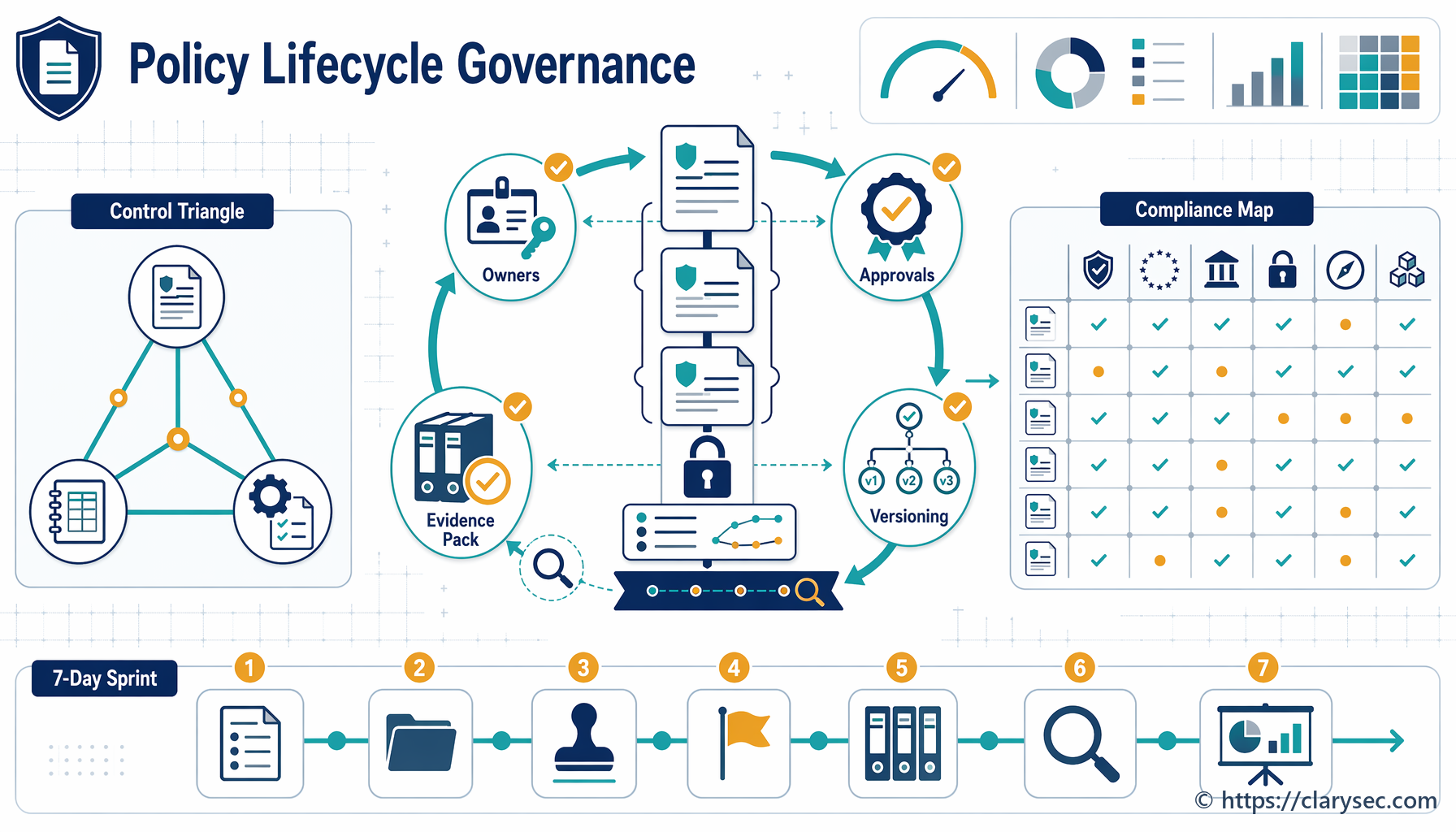
Clarysec structures ISO 27001 policy lifecycle governance around a closed loop: requirement, owner, document, approval, publication, communication, evidence, review, change, retention and retirement. That loop prevents the classic audit failure where a company has documents, but cannot prove authority, currency or control.
| Lifecycle stage | Governance question | Evidence expected by auditors | Clarysec implementation anchor |
|---|---|---|---|
| Requirement intake | Which obligation or risk requires this policy? | Legal register, customer requirement, risk register entry, control mapping | Legal and regulatory mapping plus ISMS scope |
| Ownership | Who maintains the policy? | Policy owner field, RACI, role assignment | Governance Roles and Responsibilities Policy |
| Approval | Who approved it before use? | Approval record, meeting minutes, electronic approval | Management review or delegated authority |
| Version control | Which version is current? | Version history, change log, document metadata | Controlled ISMS repository |
| Communication | Who was informed? | Announcement, acknowledgement, training log | Awareness and communication records |
| Operation | Which procedures implement it? | SOPs, checklists, tickets, control records | Documented operating procedures |
| Exceptions | What deviations are allowed? | Exception register, risk acceptance, expiry date | Risk treatment and governance escalation |
| Review | When was it reviewed and why? | Annual review record, trigger-based review | Review calendar and policy owner attestation |
| Retention | How long are records kept? | Retention schedule, archive records | Audit and compliance monitoring |
| Retirement | How are obsolete documents controlled? | Superseded archive, removal from live library | Document control workflow |
This lifecycle is stronger than a one-time approval because it links documents to controls, owners and evidence. It also supports cross-compliance. A single incident response policy can map to ISO/IEC 27001:2022 Annex A incident controls, NIS2 Article 23 notification readiness, DORA incident classification and reporting processes, GDPR personal data breach handling, NIST CSF 2.0 Respond outcomes and COBIT 2019 governance expectations.
What Clarysec policies require for review, versioning and evidence
Clarysec’s policy library is designed so policy lifecycle requirements are not left to interpretation.
For SMEs, the Information Security Policy-sme - SME sets a clear review trigger:
“This policy must be reviewed by the General Manager (GM) at least annually to ensure continued compliance with ISO/IEC 27001 certification requirements, regulatory changes (such as GDPR, NIS2, and DORA), and evolving business needs.”
It also requires documented change records:
“All policy reviews and changes must be formally documented, clearly stating the date, nature of the revisions, and the GM’s approval.”
And it preserves historical traceability:
“A historical record of policy versions must be securely maintained to demonstrate policy evolution and compliance during audits.”
Those three clauses solve a common SME problem. The organization may not have a large governance office, but it still needs proof of review, approval and version history.
The SME Governance Roles and Responsibilities Policy-sme - SME adds the traceability requirement for governance decisions:
“All significant security decisions, exceptions, and escalations must be recorded and traceable.”
That clause is critical for policy exceptions. A temporary deviation from MFA, a delayed supplier review, or an emergency change to logging retention should not live only in email threads. It should be linked to the relevant policy, control, risk owner, residual risk decision and expiry date.
For evidence centralization, the SME Audit and Compliance Monitoring Policy-sme - SME states:
“All evidence must be stored in a centralized audit folder.”
In enterprise environments, Clarysec’s Information Security Policy requires policies to:
“Be version-controlled and documented”
and:
“Be communicated to all affected parties through official communication channels”
The enterprise Governance Roles and Responsibilities Policy embeds the concept of:
“Policy owner and approver”
The enterprise Audit and Compliance Monitoring Policy adds retention expectations:
“Reports shall be retained for no less than six years (or longer where legally required), stored securely, and subject to version control under the Document and Records Management Policy (P6).”
Finally, the enterprise Legal and Regulatory Compliance Policy connects legal obligations to the ISMS:
“All legal and regulatory obligations must be mapped to specific policies, controls, and owners within the Information Security Management System (ISMS).”
That requirement is the bridge between policy lifecycle governance and NIS2, DORA and GDPR evidence. Without obligation mapping, a company may have documents, but it cannot show that those documents satisfy specific legal, contractual or risk requirements.
The control triangle: policies, records and operating procedures
Clarysec’s Zenith Controls: The Cross-Compliance Guide provides the cross-compliance compass for this topic. For ISO/IEC 27002:2022 control 5.1, Policies for Information Security, Zenith Controls identifies it as a preventive control supporting confidentiality, integrity and availability, aligned with governance and identify cybersecurity concepts, and tied to governance and policy management operational capabilities.
That matters because policy governance is not just a compliance artifact. It is preventive. A clearly owned and communicated access control policy reduces unauthorized access risk before incidents occur. A properly approved supplier policy prevents unmanaged outsourcing risk. A controlled incident procedure improves response consistency before the first regulatory notification clock starts.
Zenith Controls also highlights ISO/IEC 27002:2022 control 5.33, Protection of Records, as preventive and aligned with legal and compliance, asset management and information protection. This is central to audit evidence. The Zenith Blueprint expands the same concept in the Controls in Action phase, Step 23:
“Records are not just relics of past decisions. They are evidence, of compliance, of action, of accountability.”
It continues:
“Records are appropriately protected from loss, unauthorized access, tampering, and premature destruction”
ISO/IEC 27002:2022 control 5.37, Documented Operating Procedures, is also relevant. Zenith Controls classifies it as preventive and corrective, supporting protection and recovery. For DORA and NIS2, documented operating procedures are how policy becomes repeatable action: incident triage, backup restoration, supplier onboarding, vulnerability handling, secure development, change management, evidence collection and crisis communication.
Together, 5.1, 5.33 and 5.37 create the policy lifecycle control triangle:
| ISO/IEC 27002:2022 control | Lifecycle role | What it proves |
|---|---|---|
| 5.1 Policies for Information Security | Direction, approval, ownership and communication | Management has set expectations and assigned accountability |
| 5.33 Protection of Records | Evidence integrity, retention and secure access | Compliance records can be trusted |
| 5.37 Documented Operating Procedures | Repeatable execution of policy requirements | Staff know how to perform controlled activities |
A mature ISMS needs all three. Policies without records are declarations. Records without procedures are inconsistent. Procedures without policy direction become local habits rather than governed controls.
Cross-compliance mapping for ISO 27001, NIS2, DORA, GDPR, NIST and COBIT
Managing policies separately for ISO 27001, NIS2, DORA and GDPR creates duplication, contradiction and evidence fatigue. A better model is to maintain one controlled ISMS library with mapping metadata. This lets one evidence corpus satisfy multiple assurance audiences.
| Requirement family | What regulators or auditors expect | Policy lifecycle evidence |
|---|---|---|
| ISO/IEC 27001:2022 clause 7.5 | Documents are identified, reviewed, approved, available, protected and controlled | Document register, approval records, version history, access permissions, obsolete archive |
| ISO/IEC 27002:2022 5.1 | Information security policies are defined, approved, published, communicated and reviewed | Policy suite, approval workflow, communication records, review log |
| ISO/IEC 27002:2022 5.33 | Records are protected from loss, destruction, falsification, unauthorized access and release | Retention schedule, secure repository, access controls, integrity evidence |
| ISO/IEC 27002:2022 5.37 | Operating procedures are documented and available to personnel who need them | SOPs, runbooks, playbooks, procedure review evidence |
| NIS2 Articles 20 and 21 | Management approval and oversight of cybersecurity risk management measures | Board approvals, policy mappings, training records, review minutes, control effectiveness evidence |
| NIS2 Article 23 | Significant incident notification readiness and reporting evidence | Incident policy, classification procedure, escalation log, 24-hour and 72-hour workflow evidence, final report template |
| DORA Articles 5 and 6 | Well-documented ICT risk framework approved and overseen by management | ICT policy suite, strategy, risk framework, annual review evidence, audit results, lessons learned |
| DORA Articles 17 to 19 | Incident process to detect, classify, escalate, communicate and report | Incident register, severity criteria, escalation records, client notification templates, root cause records |
| DORA Articles 28 to 30 | ICT third-party risk policy, register, contracts, due diligence and exit planning | Supplier policy, contract register, risk assessments, audit rights, exit strategy evidence |
| GDPR Article 5(2) | Ability to demonstrate compliance with privacy principles | Data protection policy, processing records, retention schedule, breach records, access logs, DPIA records where applicable |
| GDPR Article 32 | Appropriate technical and organisational security measures | Security policies, access control procedures, encryption standards, backup records, testing evidence |
| NIST CSF 2.0 GOVERN | Policies, roles, risk appetite, legal obligations and oversight are established and updated | Governance profile, policy review records, risk register, roles and responsibilities |
| COBIT 2019 assurance lens | Governance objectives, ownership, performance monitoring and control evidence | RACI, management approvals, control operation evidence, issue remediation tracking |
NIST CSF 2.0 is especially useful as a communication layer. Its GOVERN Function expects legal, regulatory and contractual obligations to be understood, risk management objectives and responsibilities to be defined, policies to be established and updated, and outcomes to be evaluated. Its Organizational Profile method also provides a practical process: scope the profile, gather inputs such as policies, risk priorities and requirements, create current and target profiles, analyze gaps and implement a prioritized action plan.
That aligns closely with Clarysec’s approach: build one evidence-backed operating model, then map it outward to NIS2, DORA, GDPR, NIST and COBIT rather than maintaining separate compliance silos.
A one-week sprint to build a policy evidence control pack
A complete policy governance transformation takes time, but a focused one-week sprint can expose the gaps and create a defensible foundation.
Day 1: Create the document register
Start with a spreadsheet, GRC system or structured SharePoint list. The document register is the index that lets auditors navigate the evidence corpus.
| Field | Example |
|---|---|
| Document ID | P01 |
| Document name | Information Security Policy |
| Type | Policy |
| Owner | CISO |
| Approver | CEO |
| Current version | 3.0 |
| Effective date | 2026-02-01 |
| Next review date | 2027-02-01 |
| Trigger-based review | Major incident, regulatory change, merger, new critical supplier |
| Confidentiality classification | Internal |
| Primary controls | ISO/IEC 27002:2022 5.1, 5.33, 5.37 |
| Legal mapping | NIS2 Article 21, DORA Article 6, GDPR Article 5 |
| Evidence location | ISMS Documentation/Policies/P01 |
| Obsolete location | ISMS Documentation/Archive/P01 |
| Exceptions linked | EX-2026-004 |
| Communication record | Awareness campaign AC-2026-02 |
Do not overcomplicate it. If the register reliably shows owner, approver, version, review date, mapping and evidence location, it already solves many audit retrieval problems.
Day 2: Establish the repository
Follow the Zenith Blueprint Step 6 structure: Policies and Procedures, Risk Assessment and SoA, Training and Awareness Records, Audit and Review, Incident Records, Assets and Inventory, and Controls Library.
Apply access rules. Policies may be read by all employees. Risk assessment records should be restricted to the ISMS team and management. Incident records should be need-to-know. Supplier contracts should be limited to procurement, legal, finance and security. Obsolete documents should be inaccessible for day-to-day use but retained for audit traceability.
Day 3: Standardize headers and change logs
Every policy should include document name, owner, approver, version, effective date, next review date, classification, related controls, related legal obligations and change history.
| Version | Date | Change summary | Reviewer | Approver |
|---|---|---|---|---|
| 2.0 | 2025-09-15 | Added DORA third-party risk references | Head of Security | COO |
| 2.1 | 2025-11-20 | Updated incident escalation roles | CISO | CEO |
| 3.0 | 2026-02-01 | Annual review and NIS2 mapping refresh | CISO | CEO |
This supports ISO/IEC 27001:2022 documented information control, NIS2 management oversight, DORA review expectations and GDPR accountability.
Day 4: Link exceptions to policies
Create an exception register with exception ID, policy affected, control affected, business justification, compensating controls, risk owner, approval, expiry date and review status.
For example, a legacy system cannot support MFA for 60 days. The exception links to the Access Control Policy, asset inventory, risk register and remediation plan. The risk owner approves residual risk, and the exception expires automatically unless renewed. This implements the Clarysec SME governance requirement that significant decisions, exceptions and escalations be recorded and traceable.
Day 5: Build the audit evidence pack
For each top-level policy, create an evidence subfolder containing the approved current version, prior version and change log, approval evidence, communication evidence, training or acknowledgement record, related procedure, related operational record, exceptions, last review record, next review date, and mapping to legal obligations and controls.
For incident response, include tabletop exercise records, incident classification criteria, contact lists, post-incident review templates and notification decision records. This supports NIS2 Article 23 staged reporting readiness, DORA incident classification and GDPR breach accountability.
Day 6: Test retrieval
Ask an internal auditor or compliance manager to retrieve evidence for three questions:
- Prove the Information Security Policy was approved, communicated and reviewed.
- Prove supplier security obligations map to DORA and NIS2 requirements.
- Prove GDPR accountability evidence is retained and protected.
If retrieval takes more than 30 minutes per question, the repository needs improvement.
Day 7: Present to management
Summarize policy lifecycle status in management review:
- Policies current, overdue or due within 90 days
- Exceptions open and expired
- Evidence gaps
- Regulatory mapping updates
- Audit findings
- Corrective actions
- Resource needs
This closes the loop with ISO/IEC 27001:2022 leadership expectations, NIS2 board accountability and DORA management-body oversight.
How auditors will examine your policy lifecycle
Different auditors look at the same evidence through different lenses.
An ISO/IEC 27001:2022 auditor starts with documented information control. They will check whether required documents exist, whether they are approved before use, whether versions are controlled, whether documents are available where needed, whether confidential records are protected, and whether obsolete documents are prevented from unintended use. They will connect the policy lifecycle to leadership, risk treatment, operational control, internal audit and management review.
A DORA-focused reviewer will be resilience-oriented. They will examine whether the ICT risk management framework is well documented, approved by management, reviewed at least annually where applicable, audited regularly, improved from lessons learned, and connected to incident reporting, testing, third-party risk, continuity and recovery.
A NIS2 regulator will want to see an unbroken chain of evidence from risk identification, to cybersecurity risk management measures, to management-body approval, to implementation and monitoring. Any break in that chain can look like a failure of due care.
A GDPR auditor or privacy reviewer will ask whether personal data governance records demonstrate accountability: processing purposes, lawful basis, retention, technical and organisational measures, processor controls, breach records and evidence of policy enforcement.
A COBIT 2019 or ISACA-style auditor will focus on governance system components: processes, organizational structures, information flows, policies, roles, culture, skills and services. They will ask whether ownership is defined, whether management monitors performance, whether exceptions are escalated, and whether evidence supports control operation and management oversight.
The same controlled evidence repository can satisfy all of them, but only if documents are mapped, current, protected and traceable.
Common policy lifecycle failures to fix before the auditor arrives
Most policy lifecycle failures are basic governance weaknesses repeated across environments:
- Policies exist but have no named owner.
- Approvers are unclear, outdated or too junior for the risk.
- Policies are approved but not communicated.
- Review dates are missed without escalation.
- Obsolete versions remain available in shared folders.
- Procedures conflict with policies.
- Exceptions are approved informally by email.
- Legal obligations are mapped to frameworks but not to actual controls or owners.
- Audit evidence is spread across personal drives, ticketing tools and chat messages.
- Retention periods are undefined or inconsistently applied.
- Records are retained but not protected from unauthorized alteration.
- Supplier policies do not link to contract registers, due diligence or exit plans.
- Incident procedures do not align with NIS2, DORA or GDPR notification decision points.
These issues create audit friction because they undermine trust. If an auditor cannot trust the policy corpus, they will dig deeper into control operation.
Maria’s remediation plan was not to write another policy. It was to create a single source of truth. She designated one official ISMS Documentation Library, migrated current policies into it, archived uncontrolled locations, standardized owner and approver fields, built approval workflows, mapped policies to NIS2 and DORA obligations, and gave auditors read-only access to structured evidence. What had been a source of anxiety became a demonstration of control.
The Clarysec way forward
Policy lifecycle governance is not bureaucratic overhead. It is the operating discipline that makes ISO 27001 documented information, NIS2 management accountability, DORA ICT risk governance and GDPR accountability defensible.
Use the Zenith Blueprint: An Auditor’s 30-Step Roadmap to build the ISMS library in the correct phase and sequence, especially Step 6 for documented information and Step 22 for policy governance. Use Clarysec SME and enterprise policies to define review, approval, version control, communication, traceability, evidence centralization and retention requirements. Use Zenith Controls: The Cross-Compliance Guide to map ISO/IEC 27002:2022 controls such as 5.1, 5.33 and 5.37 to cross-compliance expectations, control attributes and audit perspectives.
Before buying another tool or writing another policy, answer one question:
Can you prove that every important policy is owned, approved, current, communicated, mapped, evidenced, reviewed, protected and retired correctly?
If the answer is not yet, Clarysec can help you build the evidence-ready ISMS library, policy lifecycle workflow and cross-compliance mapping that auditors, boards and customers expect in 2026. Download the Zenith Blueprint, explore Clarysec’s SME and enterprise policy packs, or book a readiness assessment to turn your policy library into a defensible compliance asset.
About the Author

Igor Petreski
Compliance Systems Architect, Clarysec LLC
Igor Petreski is a cybersecurity leader with over 30 years of experience in information technology and a dedicated decade specializing in global Governance, Risk, and Compliance (GRC).Core Credentials & Qualifications:• MSc in Cyber Security from Royal Holloway, University of London• PECB-Certified ISO/IEC 27001 Lead Auditor & Trainer• Certified Information Systems Auditor (CISA) from ISACA• Certified Information Security Manager (CISM) from ISACA • Certified Ethical Hacker from EC-Council