Privacy Complaint Governance for GDPR and ISO 27701
It is 4:45 PM on a Friday when the CISO of a fast-growing FinTech SaaS platform sees the email arrive. The subject line is short, formal, and immediately uncomfortable: “Formal Inquiry Regarding Complaint Ref: [Case Number].”
The sender is a national Data Protection Authority.
The email references a customer complaint from six months earlier. The customer says their access request was ignored, their data remained visible in analytics exports, and the company failed to explain the legal basis for continued processing. The authority now wants the original request, all correspondence, internal decision logs, processing records, privacy notices, evidence of controls protecting the account, processor contracts, and an explanation of the delay.
They have 10 business days to respond.
At that moment, privacy governance stops being theoretical. The privacy notice may exist. The data protection policy may have been approved last year. The DSAR workflow may be saved somewhere in a shared drive. But the regulator is not asking whether the organization has good intentions. The regulator is asking for evidence.
Who owns the response? Can the DPO or Privacy Lead engage the authority directly? Can support send a quick explanatory email? Is this only a GDPR complaint, or is it also a personal data breach, a DORA major ICT-related incident, or a NIS2 significant incident? Which records can be disclosed externally, and who approves them?
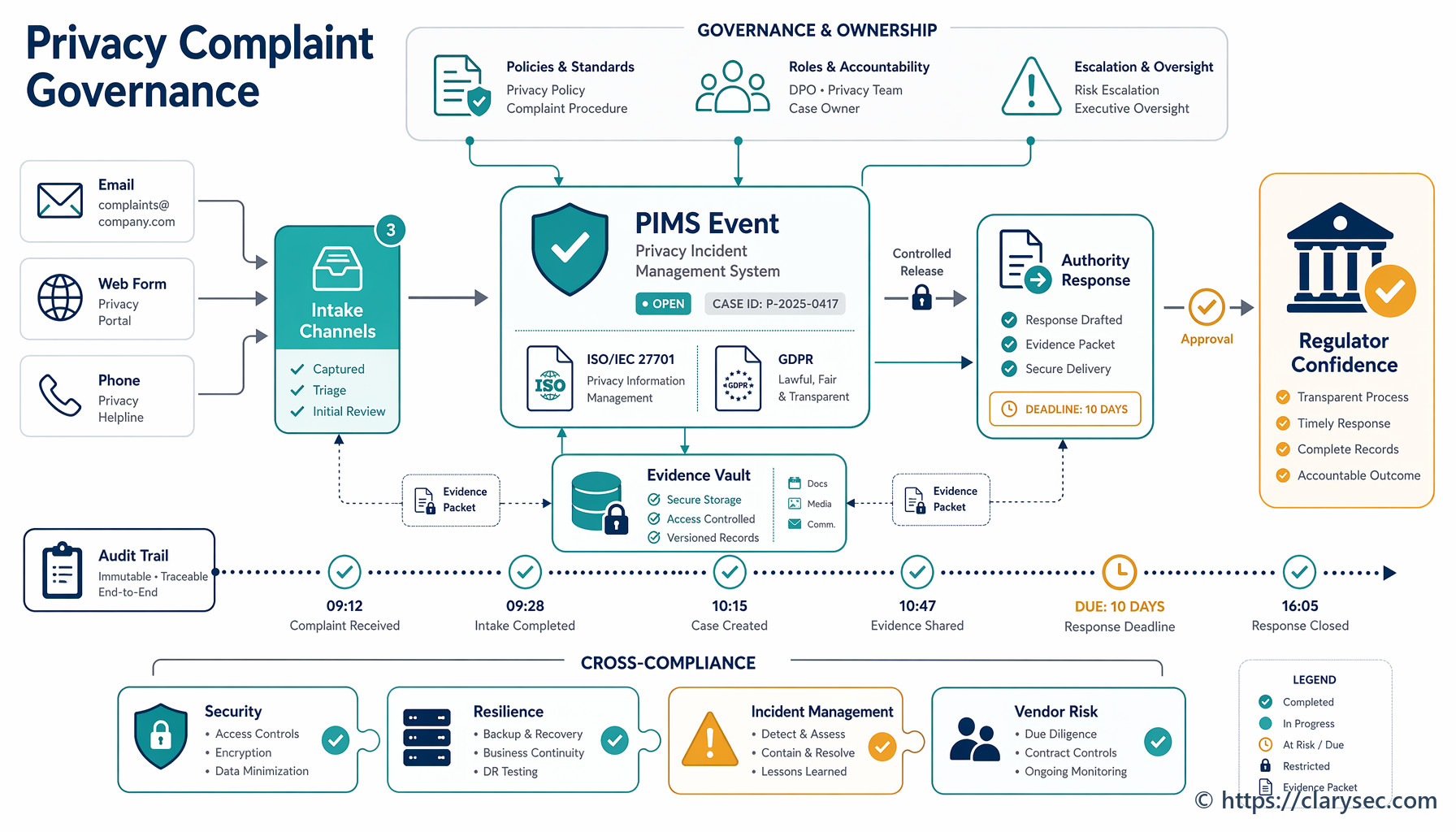
This is exactly where ISO/IEC 27701:2025 privacy information management system governance must become operational. A PIMS is not a folder of privacy documents. It is the management system that turns complaints, data subject request escalations, supervisory authority correspondence, breach indicators, evidence disclosure, corrective actions, and management review into a defensible accountability trail.
Clarysec’s approach is simple: treat privacy complaints and supervisory authority requests as governed workflows, not ad hoc legal events. That means predefined intake channels, role-based escalation, evidence registers, regulator communication rules, corrective actions, and cross-compliance mapping to GDPR, ISO/IEC 27001:2022, ISO/IEC 27002:2022, NIST CSF 2.0, NIS2, DORA, and COBIT 19 assurance expectations.
Why privacy complaint governance fails under pressure
Most privacy programs are designed around predictable requests: access, deletion, rectification, objection, portability, and consent withdrawal. The operating model often assumes the requester is cooperative, the request is clear, and the privacy team has time to investigate.
Complaints are different.
A complaint usually arrives with emotion, accusation, incomplete facts, and potential external escalation. A supervisory authority request adds legal sensitivity, deadlines, reputational risk, and a higher evidentiary standard. A DSAR escalation may expose deeper weaknesses, such as poor identity validation, unclear processor responsibilities, missing retention rules, inconsistent privacy notice content, or lack of proof that the original request was handled within statutory timeframes.
GDPR makes this evidence problem unavoidable. Article 5 requires controllers to process personal data lawfully, fairly, transparently, for specified purposes, with data minimisation, accuracy, storage limitation, and appropriate security. Article 5(2) adds the accountability obligation: the controller must be able to demonstrate compliance. Article 6 requires a lawful basis, Article 9 adds heightened conditions for special categories of personal data, and Article 4 defines roles, processing activities, and the personal data breach concept that often become central to complaint investigations.
The problem is not only that the complaint may be valid. The greater risk is that the organization cannot reconstruct what happened.
A regulator may ask for:
- The original privacy request and acknowledgement.
- Identity validation records.
- Internal routing and decision logs.
- Copies of communications to the complainant.
- The applicable privacy notice version.
- Records of processing and lawful basis.
- Processor and subprocessor involvement.
- DPIA evidence, where relevant.
- Security controls protecting the personal data.
- Breach assessment and notification rationale.
- Corrective actions and management review outputs.
If those artifacts are scattered across email, ticketing systems, legal folders, CRM notes, chat messages, and vendor portals, the organization is already behind.
The Clarysec operating model: complaints are PIMS-controlled events
In Clarysec’s ISO/IEC 27701:2025 PIMS policy set, complaint handling is not treated as a side process. It connects intake, privacy notices, rights management, regulatory engagement, evidence disclosure, security incident triage, and continual improvement.
The SME version of Clarysec’s Data Protection and Privacy Policy-sme Data Protection and Privacy Policy-sme assigns responsibility clearly:
“Responds to individual privacy requests and regulatory inquiries”
From section “Roles and Responsibilities”, policy clause 4.2.2.
That single responsibility is important because many smaller organizations lack a dedicated DPO. The policy makes regulatory inquiry response an assigned function, not a best-effort activity.
The same Data Protection and Privacy Policy-sme requires immediate escalation:
“All privacy concerns, incidents, or risks must be escalated immediately to the GM or Privacy Coordinator”
From section “Governance Requirements”, policy clause 5.4.1.
It also closes the evidence loop:
“Escalation logs must be maintained, including final outcomes and corrective actions”
From section “Governance Requirements”, policy clause 5.4.2.
For enterprise environments, Clarysec’s Data Protection and Privacy Policy Data Protection and Privacy Policy assigns the DPO a broader regulatory and breach role:
“Leads regulatory engagement, conducts Data Protection Impact Assessments (DPIAs), and manages breach notification processes.”
From section “Roles and Responsibilities”, policy clause 4.2.3.
That matters because one privacy complaint can quickly split into three connected workstreams: complaint response, supervisory authority correspondence, and breach assessment. The same Data Protection and Privacy Policy formalizes data subject request governance:
“The Data Protection Officer (DPO) shall maintain documented processes for Data Subject Request (DSR) intake, validation, tracking, and response.”
From section “Policy Implementation Requirements”, policy clause 6.4.1.
“Requests shall be acknowledged within 72 hours and resolved within statutory timeframes.”
From section “Policy Implementation Requirements”, policy clause 6.4.2.
This is how a PIMS becomes operational. The organization does not wait for Legal, Support, Security, and the DPO to improvise. It already has an intake process, a response clock, an accountable owner, and a recordkeeping obligation.
From privacy inbox to authority response: the governed workflow
A good privacy complaint and supervisory authority request governance workflow answers five questions within the first hour:
- What type of event is this?
- Who owns it?
- What deadline applies?
- What evidence is needed?
- What external communication is permitted?
Clarysec maps those questions into a structured PIMS workflow.
| Stage | Practical question | Clarysec artifact | Governance outcome |
|---|---|---|---|
| Intake | Was this a complaint, DSAR, regulator request, breach allegation, or all of these? | REG06, privacy inbox, complaint channel | Single record of receipt and classification |
| Validation | Is the requester identifiable, authorized, and within scope? | DSR procedure, identity validation log | Prevents unlawful disclosure and confirms role |
| Escalation | Does the event require DPO, Legal, GM, CISO, or processor involvement? | Escalation log, incident ticket, REG12 | Clear ownership and auditable routing |
| Evidence collection | Which records prove compliance or explain nonconformity? | Compliance Register, policies, DPIA, RoPA, processor records | Controlled evidence pack |
| Communication | Who can respond to the complainant or authority? | Legal and Regulatory Compliance Policy | Approved and consistent regulator communications |
| Closure | What was decided, sent, refused, extended, corrected, or escalated? | REG06, REG12, corrective action plan | Accountability and continual improvement |
The enterprise Legal and Regulatory Compliance Policy Legal and Regulatory Compliance Policy is direct about regulator communication risk:
“Any verbal or written statements to regulators must be pre-approved”
From section “Risk Treatment and Exceptions”, policy clause 7.3.1.2.
It also requires deadline and evidence control:
“Response deadlines must be tracked, and evidence logs maintained”
From section “Risk Treatment and Exceptions”, policy clause 7.3.1.3.
For SMEs, the Legal and Regulatory Compliance Policy-sme Legal and Regulatory Compliance Policy-sme gives a practical response model:
“If regulators request evidence of compliance:”
From section “Enforcement and Compliance”, policy clause 8.4.1.
“The GM must provide the Compliance Register, records and policies.”
From section “Enforcement and Compliance”, policy clause 8.4.1.1.
This difference is intentional. Enterprises may have legal counsel, DPOs, privacy operations teams, and regulatory affairs functions. SMEs may need a simpler accountability line. Both models require the same outcome: approved evidence, controlled disclosure, traceable response, and clear ownership.
Intake channels must be visible, current, and auditable
One common audit finding is surprisingly basic: the privacy notice tells individuals they have rights, but does not provide a reliable intake channel for rights requests or complaints.
Under GDPR transparency expectations, individuals should know where to send requests and concerns. Under ISO/IEC 27701:2025 PIMS governance, that channel should feed a controlled register.
Clarysec’s Privacy Notice and Transparency Policy Privacy Notice and Transparency Policy addresses this at the point of notice approval:
“[Controller] The Process Owner / Business Owner MUST include the current REG06 rights-request intake channel and complaint or privacy contact channel in REG07 before submitting a privacy notice for approval.”
From section “Notice content and transparency information”, policy clause 4.2.4.
This clause is operationally important. It prevents business teams from publishing privacy notices with outdated DPO mailboxes, broken webforms, or generic “contact us” links that customer support does not recognize as privacy channels.
The result is a closed loop:
- Privacy notices list the correct complaint and rights intake channel.
- Requests and complaints enter REG06.
- The Privacy Lead or PIMS Manager classifies and routes them.
- Outcomes and communications are recorded.
- Trends and corrective actions are reviewed in REG12.
The PII Principal Rights Management Policy PII Principal Rights Management Policy gives the register requirement:
“[All] The Privacy Lead / PIMS Manager MUST record each PII principal rights request in REG06 within two business days of receipt.”
From section “Intake, Logging and Classification”, policy clause 4.1.1.
For controller scenarios, it also requires the closure communication to be recorded:
“[Controller] The Privacy Lead / PIMS Manager MUST communicate the outcome, fulfilment status, refusal rationale, extension status or available escalation route to the requestor and record the communication in REG06.”
From section “Refusal, Extension, Restriction and Closure”, policy clause 4.4.4.
And for continual improvement:
“[All] The Privacy Lead / PIMS Manager MUST review recurring rights request themes, complaints, disputes and corrective actions in REG12 at least quarterly.”
From section “Metrics and Measurement”, policy clause 8.1.6.
Privacy complaint governance is not complete when the complainant receives an answer. It is complete when the organization can show how patterns were reviewed, root causes were addressed, and the PIMS improved.
Supervisory authority evidence release is a controlled activity
When an authority requests records, the organization faces a second privacy risk: over-disclosure.
A rushed response can expose unrelated customer data, employee PII, privileged legal analysis, security-sensitive diagrams, confidential processor information, or internal incident indicators that should have been scoped and approved. Regulator cooperation matters, but uncontrolled evidence release creates its own compliance, contractual, and security risks.
That is why Clarysec’s PIMS Documented Information and Evidence Management Policy PIMS Documented Information and Evidence Management Policy requires approval and disclosure scoping:
“[All] The Privacy Lead / PIMS Manager MUST record approval and disclosure scope in REG12 before releasing PIMS evidence to an external auditor, customer, processor, controller, supervisory authority, or other external party.”
From section “Access, protection, retrieval, and disclosure”, policy clause 4.4.5.
This is the governance control many organizations miss. The issue is not only “can we find evidence?” The issue is “can we prove the evidence was authorized, relevant, complete enough, and not excessive?”
For supervisory authority requests, Clarysec recommends an authority response pack containing:
- The authority request reference, receipt date, and deadline.
- The assigned response owner and approver.
- The legal basis for disclosure, if needed.
- The evidence scope and exclusions.
- The record sources used.
- A log of all communications.
- The final response copy.
- Corrective actions opened as a result.
This pack should be linked to REG12 and, where the matter started as a rights request or complaint, cross-referenced to REG06.
Where ISO/IEC 27002:2022 makes privacy governance auditable
Privacy complaints often expose weaknesses in information security governance. A complainant may allege unauthorized access, inaccurate records, excessive retention, insecure transfer, or uncontrolled processor access. That means PIMS evidence must connect to ISMS controls.
Clarysec’s Zenith Controls: The Cross-Compliance Guide Zenith Controls places ISO/IEC 27002:2022 control 5.5, Contact with authorities, at the center of regulator interaction governance. It describes control 5.5 as preventive and corrective, supporting confidentiality, integrity, and availability, and connecting to Identify, Protect, Respond, and Recover concepts.
Zenith Controls explains the operational connection between authority contact and incident management:
“Control 5.5 supports the effectiveness of incident management by ensuring that organizations have pre- established contacts with relevant authorities, such as law enforcement, regulators, national CERTs, or data protection agencies.”
From Zenith Controls, control 5.5, Contact with authorities.
The guide maps control 5.5 to supporting ISO/IEC 27002:2022 controls that matter directly when a complaint becomes a regulator-facing case.
| ISO/IEC 27002:2022 control | Why it matters for privacy complaints and authority requests |
|---|---|
| 5.24 Information security incident management planning and preparation | Complaints alleging unauthorized disclosure may need breach triage and regulator notification planning |
| 6.8 Information security event reporting | Employees must know how to report privacy concerns, lost records, suspicious access, or complaint escalations |
| 5.7 Threat intelligence | Authority advisories may inform risk assessment and incident investigation |
| 5.6 Contact with special interest groups | Industry groups and ISACs can support situational awareness during sector-wide privacy or security events |
| 5.26 Response to information security incidents | If the complaint indicates a breach, response coordination depends on prepared authority contacts |
Zenith Controls also highlights control 5.31, Legal, statutory, regulatory and contractual requirements. This control ties directly to privacy complaint governance because the organization must know which legal obligations apply before it can respond correctly. Control 5.31 connects with retention, privacy and protection of PII, independent review, and internal compliance with policies and standards.
Control 5.34, Privacy and protection of PII, is equally central. Zenith Controls links it to asset inventories, cloud service governance, information classification, information transfer, access control, identity management, and security review of projects and changes. In complaint terms, those connections answer key regulator questions: What PII exists? Where is it stored? Who can access it? Which processors are involved? Was the transfer controlled? Was the project reviewed for privacy impact?
Do not meet the regulator for the first time during a crisis
Clarysec’s Zenith Blueprint: An Auditor’s 30-Step Roadmap Zenith Blueprint treats contact with authorities as a planned capability, not a panic response. In the Controls in Action phase, Step 22, Organizational controls, control 5.5 is described with a direct challenge:
“The principle here is simple: if your organization were targeted by a cyberattack, involved in a data breach, or under investigation , who would make the call to the authorities? How would they know what to say? Under what conditions would such contact be initiated? These questions must be answered in advance , not after the fact.”
From Zenith Blueprint, Controls in Action phase, Step 22, Organizational controls, control 5.5, Contact with Authorities.
For privacy complaint governance, the playbook should identify:
- Data protection supervisory authorities by jurisdiction.
- Cybersecurity authorities, CSIRTs, and sector regulators where relevant.
- Internal authority contact owners, such as DPO, CISO, Legal, GM, or Privacy Lead.
- Approved communication channels.
- Legal review and executive approval rules.
- Evidence retention and disclosure control requirements.
- Triggers for breach, NIS2, DORA, customer, or processor escalation.
The Zenith Blueprint also addresses external communication in the ISMS Foundation and Leadership phase, Step 5, Communication, Awareness, and Competence:
“Determine who communicates: Likely your CISO/ISMS Manager handles operational security communications with partners/clients (like answering security audits questionnaires), whereas top management or a PR person handles public statements about incidents. Legal counsel might be involved in wording communications to regulators.”
From Zenith Blueprint, ISMS Foundation and Leadership phase, Step 5, Clause 7.4, External Communication.
The DPO or Privacy Lead may own the substance, Legal may approve wording, the CISO may provide security evidence, and top management may approve sensitive positions. The failure mode is when these roles are discovered during the incident.
Cross-compliance: when a privacy complaint becomes more than GDPR
A privacy complaint may remain a pure GDPR matter. But the moment it alleges unauthorized access, service disruption, compromised credentials, ransomware, cloud misconfiguration, or processor failure, other frameworks may become relevant.
GDPR applies broadly to EU-established controllers and processors, and also to non-EU organizations offering goods or services to individuals in the EU or monitoring their behaviour. A SaaS company outside the EU can therefore face GDPR complaint and authority engagement obligations if it serves EU users.
NIS2 may apply where the organization is an essential or important entity, including certain digital infrastructure, cloud computing service providers, data centres, MSPs, MSSPs, financial market infrastructures, digital providers, and other sectors. NIS2 Article 21 requires technical, operational, and organizational risk-management measures covering incident handling, business continuity, supply chain security, secure development, vulnerability handling, effectiveness assessment, training, cryptography, access control, asset management, and authentication. Article 23 introduces staged reporting for significant incidents, including early warning, incident notification, and follow-up reporting. If a privacy complaint reveals an incident affecting service provision, NIS2 analysis may be needed.
DORA applies to many financial entities and creates a specific digital operational resilience framework from 17 January 2025. It covers ICT risk management, incident reporting, resilience testing, threat information sharing, ICT third-party risk, and oversight. Articles 17 to 20 require an ICT-related incident management process, classification, management escalation, client communication, and regulatory reporting. If a FinTech privacy complaint alleges data loss, access compromise, or third-party ICT provider failure, the DORA incident process may run in parallel with GDPR assessment.
NIST CSF 2.0 provides a practical governance overlay. Its GOVERN function expects legal, regulatory, contractual, privacy, and civil liberties obligations to be understood and managed. Its RESPOND and RECOVER functions support triage, escalation, stakeholder communication, evidence preservation, containment, eradication, recovery, and documentation.
COBIT 19, from an audit and governance perspective, focuses on whether privacy complaint and authority request handling is embedded into governance objectives, management practices, risk ownership, performance measurement, and assurance. A COBIT-oriented assessor will ask whether the process is defined, measured, controlled, and improved.
| Framework | Complaint governance relevance | Evidence auditors or regulators expect |
|---|---|---|
| GDPR | Rights, transparency, lawful basis, accountability, breach assessment, supervisory authority engagement | Request logs, notices, lawful basis records, communications, breach rationale, processor evidence |
| ISO/IEC 27701:2025 | PIMS roles, PII controller and processor obligations, evidence, monitoring, improvement | PIMS scope, procedures, REG06, REG12, role assignments, corrective actions |
| ISO/IEC 27001:2022 | Management system, risk treatment, documented information, operational control | ISMS scope, risk assessment, Statement of Applicability, incident and evidence records |
| ISO/IEC 27002:2022 | Authority contact, legal requirements, privacy protection, event reporting, incident response | Contact matrix, legal register, event reports, incident plans, PII controls |
| NIS2 | Significant incident governance for in-scope essential and important entities | Incident classification, staged reports, management approval, service recipient communications |
| DORA | ICT incident, resilience, third-party, and client communication governance for financial entities | Incident register, classification, authority reports, third-party register, testing and remediation evidence |
| NIST CSF 2.0 | Governance, response, recovery, supplier risk, legal obligation management | Current and target profiles, action plans, roles, response evidence, improvement tracking |
| COBIT 19 | Governance system, process capability, assurance and performance | RACI, process metrics, control evidence, assurance results, management reporting |
Hands-on example: a SaaS authority request in practice
Consider a SaaS provider acting as both processor for enterprise customers and controller for its own account management data. A user complains that their deletion request was ignored and that their personal data remains visible in analytics exports. The supervisory authority asks for evidence within a defined deadline.
A Clarysec-aligned response would work as follows.
First, the Privacy Lead opens or updates the REG06 record within two business days. The event is classified as a rights request escalation, privacy complaint, supervisory authority case, and potential processor-related issue. The record includes receipt date, requester identity status, affected systems, controller or processor role, and initial deadline.
Second, the Privacy Lead checks whether the privacy notice contained the correct rights-request and complaint channel. If the channel was outdated, that issue is logged as a potential corrective action and linked to REG07.
Third, the DPO or Privacy Lead determines role context. For account data where the SaaS provider decides purposes and means, it acts as controller. For customer-uploaded user records, it may act as processor and must follow documented controller instructions. If a subprocessor or analytics vendor is involved, the supplier and processor evidence path is opened.
Fourth, Legal and the DPO prepare the authority response plan. Under the Legal and Regulatory Compliance Policy, regulator statements are pre-approved and response deadlines are tracked. Under the PIMS Documented Information and Evidence Management Policy, REG12 records the approval and disclosure scope before any evidence is released.
Fifth, the CISO or security owner checks whether the complaint indicates unauthorized disclosure, accidental loss, or access to personal data. If yes, the incident process is triggered. This connects the matter to ISO/IEC 27002:2022 controls for event reporting, incident planning, response, evidence handling, logging, monitoring, and legal requirements.
Sixth, the evidence pack is assembled. It may include the REG06 record, privacy notice version, DSR acknowledgement, validation steps, fulfilment or refusal rationale, deletion job logs, retention rule, processor instruction record, analytics export configuration, access logs, DPIA, vendor contract clauses, and corrective actions.
Seventh, closure is not limited to sending the response. The Privacy Lead records the final authority communication, updates REG06 with the outcome, logs approved disclosure in REG12, and opens corrective actions for any root cause: outdated notice channel, deletion workflow defect, analytics retention mismatch, processor instruction ambiguity, or support team training gap.
This turns a stressful authority request into an auditable, repeatable PIMS workflow.
The auditor’s lens: how the same complaint is tested
A privacy complaint file is one of the most revealing audit samples because it crosses policy, operations, evidence, legal compliance, security, and management review.
An ISO/IEC 27701:2025 PIMS auditor will follow the PII lifecycle. They will ask how the request was received, whether the organization correctly identified its PIMS role, whether the rights process was followed, whether complaint and escalation routes were available, whether communications were recorded, and whether recurring themes entered continual improvement.
An ISO/IEC 27001:2022 auditor will look at management system discipline. They will test whether the organization identified legal and contractual requirements, assigned roles, controlled documented information, assessed risks, selected controls, operated incident and evidence processes, and reviewed performance. The auditor may trace the complaint into the risk register, Statement of Applicability, incident records, and corrective action plan.
A GDPR supervisory authority will be more direct: show the record, show the decision, show the deadline, show the communication, show the evidence, show the corrective action.
A NIS2 or DORA assessor will focus on whether the event was classified correctly, whether reporting timelines were evaluated, whether management was informed, whether third-party ICT providers were involved, and whether customer or service recipient communications were handled appropriately.
A COBIT 19 or ISACA-style auditor will focus on governance and assurance. They will ask whether process ownership is defined, whether roles are segregated, whether performance metrics exist, whether management receives reporting, whether exceptions are approved, and whether the complaint process is monitored for maturity and effectiveness.
| Auditor or regulator | Primary focus | Key evidence demanded |
|---|---|---|
| ISO/IEC 27001:2022 and ISO/IEC 27701:2025 auditor | Process conformity and management system discipline | Policies, REG06, REG12, escalation logs, management review minutes, corrective actions |
| GDPR supervisory authority | Accountability and data subject rights | RoPA, DPIAs, complaint record, correspondence, lawful basis, decision rationale |
| NIS2 or DORA assessor | Resilience, classification, reporting, and management oversight | Incident classification, notification timestamps, final reports, root cause analysis, management evidence |
| COBIT 19 assessor | Governance, process capability, performance, and assurance | RACI, process metrics, exception approvals, assurance results, management reporting |
The Zenith Blueprint addresses corrective actions in the Audit, Review and Improvement phase, Step 29, Continual Improvement:
“Make sure each corrective action is specific, assignable, and time-bound. Essentially, you are creating a mini project for each issue.”
From Zenith Blueprint, Audit, Review and Improvement phase, Step 29, Continual Improvement, Corrective Actions and Lessons Learned.
That is exactly the standard expected after a complaint reveals a systemic weakness. “We reminded the team” is rarely enough. A corrective action should have an owner, due date, root cause, evidence of completion, and effectiveness check.
Practical checklist for CISOs, DPOs, compliance managers, and business owners
Use this checklist to test whether your organization can survive a complaint-driven investigation.
- Confirm that privacy notices include current rights request and complaint contact channels.
- Ensure REG06 or an equivalent register records all rights requests, complaints, escalations, outcomes, and communications.
- Define when complaints become incidents, breach assessments, legal matters, or supervisory authority cases.
- Assign authority contact roles for DPO, Privacy Lead, Legal, CISO, GM, and executive approver.
- Maintain a supervisory authority contact matrix by jurisdiction and sector.
- Require approval before verbal or written regulator statements.
- Track response deadlines in a controlled evidence register.
- Define evidence disclosure scope before releasing records externally.
- Link complaint files to DPIAs, RoPA records, processor agreements, retention rules, and security logs.
- Review recurring complaint themes quarterly and record corrective actions.
- Test the process using a tabletop exercise involving Privacy, Legal, Security, Support, and management.
- Include supplier and processor escalation paths, especially for cloud, analytics, support, and managed service providers.
- Map complaint governance to GDPR accountability, ISO/IEC 27701:2025 PIMS controls, ISO/IEC 27001:2022 ISMS requirements, and ISO/IEC 27002:2022 authority and privacy controls.
- For in-scope sectors, add NIS2 or DORA incident reporting decision points.
The business case: regulator confidence is built early
Supervisory authorities do not expect perfection. They do expect control, accountability, and evidence.
A well-governed organization can say: here is when we received the complaint, here is how we classified it, here is the role we performed, here is the notice the individual saw, here is the request log, here is the processor evidence, here is the breach assessment, here is the approved authority response, and here are the corrective actions we opened.
That posture changes the conversation. Instead of appearing disorganized or evasive, the organization demonstrates that privacy governance is embedded into the PIMS and ISMS.
For CISOs, this reduces the risk that a privacy complaint becomes an uncontrolled security investigation. For DPOs and Privacy Leads, it creates defensible accountability. For compliance managers, it creates audit-ready records. For business owners, it protects trust, reduces regulator friction, and makes privacy operations scalable.
Next steps with Clarysec
If your privacy complaint process still depends on inbox memory, informal legal review, or manual evidence hunting, now is the time to operationalize it.
Clarysec can help you build a regulator-ready privacy complaint and supervisory authority request workflow using:
- ISO/IEC 27701:2025 PIMS policies and role-based operating procedures.
- REG06 and REG12 evidence models for rights requests, complaints, disclosures, and corrective actions.
- DPO, Privacy Lead, GM, Legal, and CISO responsibility matrices.
- Authority contact playbooks based on Zenith Blueprint Zenith Blueprint.
- Cross-compliance mappings using Zenith Controls Zenith Controls.
- Enterprise and SME policy packs, including Data Protection and Privacy Policy Data Protection and Privacy Policy, Data Protection and Privacy Policy-sme Data Protection and Privacy Policy-sme, Legal and Regulatory Compliance Policy Legal and Regulatory Compliance Policy, Legal and Regulatory Compliance Policy-sme Legal and Regulatory Compliance Policy-sme, PII Principal Rights Management Policy PII Principal Rights Management Policy, Privacy Notice and Transparency Policy Privacy Notice and Transparency Policy, and PIMS Documented Information and Evidence Management Policy PIMS Documented Information and Evidence Management Policy.
Start with one scenario: a complaint copied to the supervisory authority. Run it through your current process. If you cannot produce a complete evidence pack within 48 hours, Clarysec’s toolkit gives you the structure to close that gap before the regulator asks.
About the Author

Igor Petreski
Compliance Systems Architect, Clarysec LLC
Igor Petreski is a cybersecurity leader with over 30 years of experience in information technology and a dedicated decade specializing in global Governance, Risk, and Compliance (GRC).Core Credentials & Qualifications:• MSc in Cyber Security from Royal Holloway, University of London• PECB-Certified ISO/IEC 27001 Lead Auditor & Trainer• Certified Information Systems Auditor (CISA) from ISACA• Certified Information Security Manager (CISM) from ISACA • Certified Ethical Hacker from EC-Council