Privacy Enhancing Technologies for ISO 27701 and GDPR
Sarah, the CISO of a fast-growing fintech company, knew the request was coming before the meeting started.
The product team wanted to launch an AI-driven financial advisory feature. The model needed realistic customer behavior, transaction patterns, support events and subscription history. The data science team argued that the model would perform better with production data. The QA team wanted production-like payment records to reproduce edge cases. A cloud analytics vendor needed a sample dataset to validate ingestion. Nobody was trying to violate privacy law. Nobody wanted to expose customers. Everyone wanted to move fast.
Then Sarah asked the question that changed the meeting.
“Why do you need identifiable PII?”
The room went quiet.
This is where many privacy management systems fail in practice. The organization may have a privacy notice, a data protection policy, a DPIA template and a legal review process, but the real decision is happening in a Slack thread, Jira ticket, analytics export or database clone. If the only privacy control is “ask Legal,” the business either stalls or takes shortcuts.
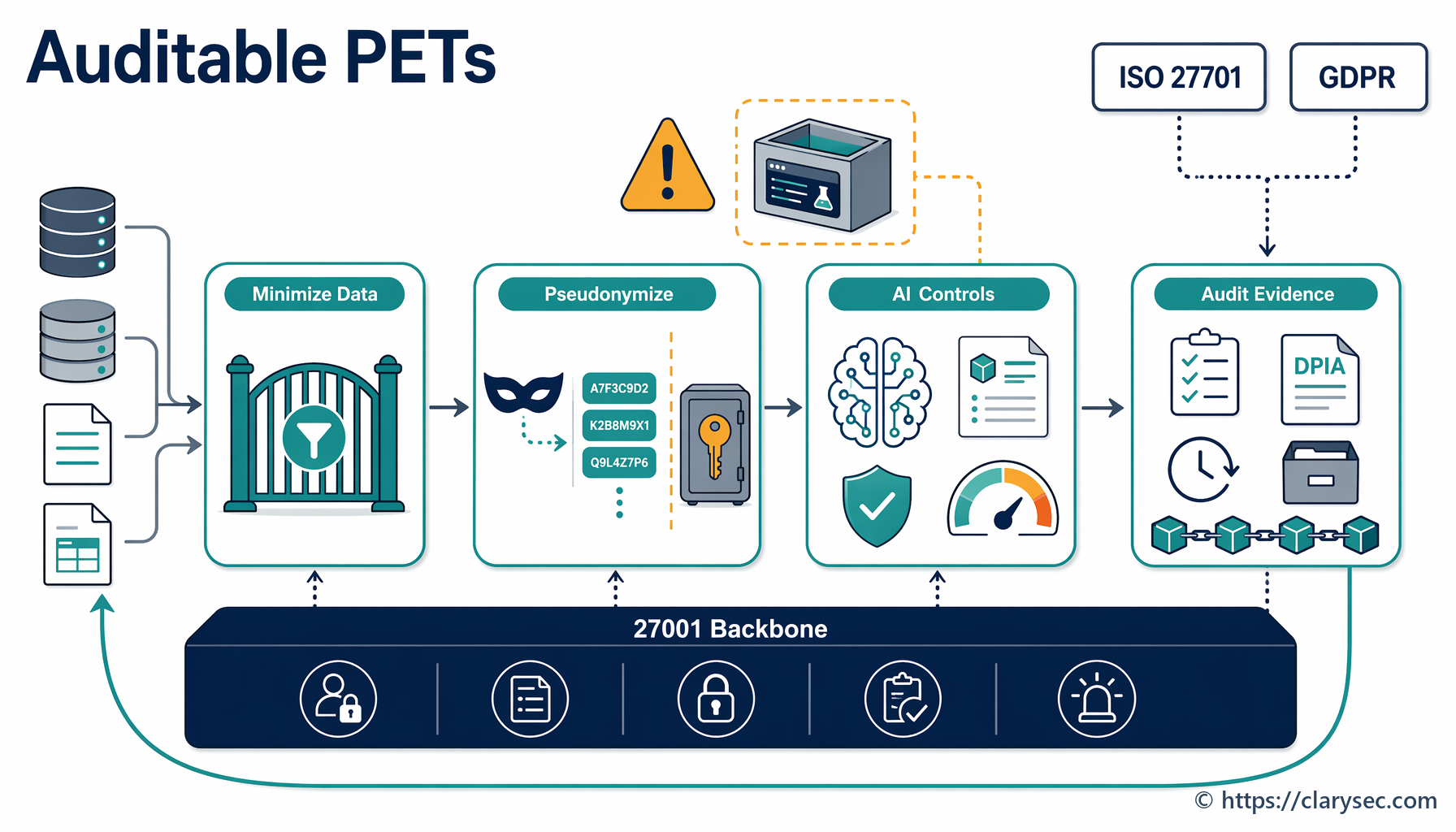
Privacy enhancing technologies, usually called PETs, solve this gap when they are treated as an operational control set, not a research topic. Under ISO/IEC 27701:2025 PIMS expectations and GDPR obligations, PETs such as data masking, pseudonymization, anonymization, aggregation, tokenization, encryption and synthetic data reduce identifiability while preserving business value. They turn “no, you cannot use the data” into “yes, if you use the safe version, with documented evidence.”
Clarysec’s approach is built for exactly this moment. The Zenith Blueprint: An Auditor’s 30-Step Roadmap places data masking in the Controls in Action phase, Step 19: Technological Controls I, and test information in Step 21: Controls 8.27 to 8.34. PETs are not cosmetic privacy features. They are controls that auditors can inspect, engineers can implement and management can govern.
As the Zenith Blueprint puts it:
Data masking is not hiding information from attackers, it’s about preventing unnecessary exposure within your organization. In scenarios like development, testing, training, or analytics, real production data is often copied into environments that lack the full security controls of production.
That single sentence captures the operating reality of modern privacy risk. The most dangerous PII exposure is often not a dramatic external breach. It is the internal copy, the test database, the AI training extract, the vendor sample, the forgotten debug log and the analytics dashboard that exposes more than anyone intended.
PETs turn privacy by design into operational evidence
GDPR Article 25 requires data protection by design and by default. GDPR Article 32 requires appropriate technical and organizational measures, including pseudonymization and encryption where appropriate. GDPR Article 5 requires lawfulness, fairness, transparency, purpose limitation, data minimization, accuracy, storage limitation, integrity, confidentiality and accountability.
PETs are where those legal principles become engineering decisions.
A privacy enhancing technology is any technical or procedural mechanism that reduces privacy risk by limiting exposure, identifiability, linkability or misuse of personal data. In a PIMS aligned with ISO/IEC 27701:2025, PETs should connect to role clarity, privacy risk treatment, processing records, supplier controls, access restrictions, retention decisions and evidence.
For controllers, PETs help prove that the organization considered minimization, default privacy settings and safeguards for further processing. For processors, PETs help demonstrate that customer instructions are implemented safely, subprocessor exposure is reduced and cloud PII processing is protected. For joint controllers and subprocessors, PETs help clarify who controls re-identification keys, who approves de-identification assumptions and who may receive usable datasets.
Clarysec’s Privacy by Design and Default Policy makes this operational for both controller and processor contexts:
[Both] The Process Owner / Business Owner MUST document de-identification, pseudonymization, aggregation or non-identifiable processing feasibility in REG04 before approving identifiable PII for testing, analytics, reporting or secondary operational use.
This clause changes the conversation. The business owner does not begin by asking for a database copy. They begin by documenting the business purpose, the minimum data needed and why a lower-risk form will or will not work.
That is the management move that makes PETs defensible. Before identifiable PII is approved, the organization must show why aggregation, synthetic data, masking, pseudonymization or anonymization is insufficient.
The PETs that matter most in audits
Not every PET fits every scenario. A useful privacy engineering program needs a practical taxonomy that business, engineering, privacy, security and audit teams can all understand.
| PET | Best use case | Privacy risk reduced | Key audit evidence |
|---|---|---|---|
| Static data masking | Test, development, training and support datasets | Direct exposure of real values | Masking rules, transformation logs, sample before and after evidence |
| Dynamic masking | Role-based field visibility in applications and reports | Excessive access and casual browsing | Access rules, role mappings, application screenshots, access logs |
| Pseudonymization | Analytics or AI requiring linkage over time | Identifiability while preserving joins and trend analysis | Token design, key custody, access logs, re-identification risk review |
| Anonymization | Long-term reporting or external sharing where identity is not needed | Personal data exposure, if re-identification risk is sufficiently low | Methodology, risk assessment, approval record, residual risk sign-off |
| Aggregation | Dashboards, KPIs, benchmarking and trend reports | Individual-level disclosure | Aggregation thresholds, suppression rules, report configuration |
| Encryption | Storage, transmission, cloud processing and key-protected tokens | Unauthorized access and breach impact | Key management records, crypto policy, certificate and vault evidence |
| Synthetic data | AI testing, QA, demos and sandbox environments | Use of real personal data in non-production | Synthetic generation rules, validation results, approval records |
The P16 Data Masking and Pseudonymization Policy defines PETs directly in privacy risk terms:
This policy defines the organization’s approach to implementing data masking and pseudonymization as privacy-enhancing technologies (PETs) to reduce the identifiability and exposure of personal or sensitive data.
For smaller organizations, Clarysec mirrors the same control intent in a lighter operating model. The P16S Data Masking and Pseudonymization Policy - SME states:
This policy establishes mandatory requirements for the use of data masking and pseudonymization to protect sensitive, personal, and confidential data within small and medium-sized enterprises (SMEs).
The principle is proportionality. A multinational may use enterprise tokenization, data loss prevention, segregated key vaults and privacy engineering review boards. An SME may start with approved masking scripts, restricted token tables and documented approvals. Both must be able to prove that privacy risk was considered, treated and evidenced.
Why ISO/IEC 27701:2025 needs an ISO/IEC 27001:2022 backbone
ISO/IEC 27701:2025 extends privacy governance into a privacy information management system, but privacy controls do not operate in a vacuum. They depend on the information security management system beneath them.
ISO/IEC 27001:2022 requires organizations to understand context, interested-party requirements, scope, interfaces and dependencies, then establish and continually improve the ISMS. Its planning requirements drive repeatable risk assessment, risk treatment, a Statement of Applicability and residual risk acceptance. For PETs, that means controls should not be selected because “privacy wants them.” They should be selected because risk assessment shows they reduce confidentiality, privacy, testing, analytics, supplier or cloud exposure.
The Zenith Blueprint makes this practical in Step 23, where it explains privacy and protection of PII as a lifecycle control:
The foundation of this control is data awareness. The organization must know what PII it collects, where it resides, why it is being processed, and who can access it. Without this baseline, any privacy promises are hollow.
That is the bridge between ISO/IEC 27701:2025 and GDPR. PETs require data awareness. You cannot mask what you have not classified. You cannot pseudonymize responsibly if you do not know who holds the key. You cannot anonymize safely if you have not assessed re-identification risk. You cannot defend an analytics or AI use case if you cannot connect it to a lawful basis, purpose, retention rule and approval record.
Mapping PETs to ISO/IEC 27002:2022 and Clarysec guidance
Mature PET governance depends on integrated controls. Zenith Controls: The Cross-Compliance Guide treats privacy and protection of PII, data masking, cryptography and test information as a connected control family. This matters because auditors rarely inspect PETs in isolation. If a dataset is masked, they will ask how it was classified, who can access it, whether cryptographic tokenization is involved and whether the same rule applies in test environments.
| ISO/IEC 27002:2022 control | Control name | How it supports PET governance |
|---|---|---|
| 5.34 | Privacy and protection of PII | Establishes the overarching objective for protecting PII and supports privacy by design, minimization and lawful processing evidence |
| 8.11 | Data masking | Provides the core technical control for masking, pseudonymization and other de-identification patterns |
| 8.24 | Use of cryptography | Supports tokenization, encryption, key protection, secure transfer and protection of pseudonymization keys |
| 8.33 | Test information | Requires protection of information used in testing and makes masking or synthetic data essential for safe non-production use |
Zenith Controls maps ISO/IEC 27002:2022 control 5.34, Privacy and protection of PII, as a preventive control supporting confidentiality, integrity and availability, with operational capabilities in information protection and legal compliance. It also ties 5.34 to inventory of assets, data masking and cryptography. PETs depend on knowing where PII resides, restricting how it is exposed and protecting it cryptographically where needed.
For control 8.11, Data masking, Zenith Controls identifies masking as preventive, confidentiality-focused and part of information protection. It ties masking to classification of information, privacy and protection of PII, information access restriction, cryptography and test information.
For control 8.24, Use of cryptography, Zenith Controls links cryptography to classification, PII protection, information transfer, vulnerability management and secure development lifecycle. It also links the control to ISO/IEC 27018:2020 for cloud PII protection and to NIST SP 800-53 Rev. 5 controls for cryptographic protection, data-at-rest protection and transmission confidentiality.
This integrated view is the reason PETs create a cross-compliance dividend. A masked test dataset can support GDPR minimization, ISO/IEC 27002:2022 test information protection, DORA ICT risk reduction, NIS2 cyber hygiene and NIST CSF 2.0 data security outcomes at the same time.
The test environment is where privacy promises often fail
In many audits, the fastest path to a major finding is the non-production environment.
Production may have MFA, privileged access management, encryption, monitoring and strict change control. Test, development and staging environments may have shared accounts, broader developer access, copied production data, weaker logging and forgotten backups. Clarysec treats test data as a PET priority for exactly this reason.
The P16 Data Masking and Pseudonymization Policy is explicit:
Real personal data must not be used in development, test, or staging environments. Masked or pseudonymized data must be used instead and must be generated from pre-approved transformation templates.
The Test Data and Test Environment Policy - SME sets the same expectation in practical language:
The data must be anonymized or pseudonymized using appropriate tools
The Zenith Blueprint, in Step 21, explains why this matters:
Ultimately, Control 8.33 reminds us that information doesn’t lose its value just because it’s in a sandbox. When test data is handled with the same care as production data, organizations reduce the chance of accidental exposure, insider misuse, or compliance failure.
A strong PET program therefore starts with a simple rule: production PII does not move into lower environments unless a documented exception proves technical necessity, applies equivalent safeguards and records approval.
The Test Data and Test Environment Policy supports this through controlled test data requirements, while the SME version gives smaller teams a practical baseline. Together, they should drive:
- A default requirement for synthetic, anonymized or masked data
- A formal exception path for production PII
- Pre-approved transformation templates
- Access control and logging for test datasets
- Time-limited retention and cleanup
- Evidence that masking was applied before the dataset was released
- Periodic review of re-identification risk for pseudonymized data
Pseudonymization is not anonymization
One common failure is treating pseudonymized data as if it were anonymous. It is not.
Pseudonymization reduces identifiability by replacing direct identifiers with tokens, hashes or alternate values. If a key, lookup table, salt or additional dataset can restore identity, the data still requires governance. This is why GDPR treats pseudonymization as a safeguard, not as an automatic exit from privacy obligations.
The P16S Data Masking and Pseudonymization Policy - SME states:
Pseudonymization must be used where data linkage is required without revealing identities:
That phrase defines the use case: linkage without direct identity. Pseudonymization is ideal for churn analytics, fraud pattern analysis, support case correlation, longitudinal reporting and AI model training where the same person must be recognized across events, but their real identity is not needed by the model user.
But the control is only as strong as key management. The P16S Data Masking and Pseudonymization Policy - SME also states:
Access to keys must be encrypted, access-controlled, and logged.
This aligns directly with ISO/IEC 27002:2022 control 8.24. In Step 20 on use of cryptography, the Zenith Blueprint warns:
Strong encryption means nothing if the keys are exposed, mishandled, or forgotten. Keys should be generated securely, stored in encrypted key vaults or hardware security modules, rotated on a schedule, and revoked when compromised or no longer needed.
For a CISO or privacy manager, the practical rule is clear: if pseudonymization is reversible, key access is the crown jewel. The token table, salt, key vault permissions, re-identification workflow and logs must be treated as high-risk assets.
The P16 Data Masking and Pseudonymization Policy adds another audit-critical requirement:
Periodic re-identification risk assessments must be performed on pseudonymized datasets.
This prevents pseudonymization from becoming stale. A dataset that was low risk last year may become higher risk after new attributes are added, a vendor receives more data or external datasets become easier to link.
A practical PET workflow for AI and analytics
Return to Sarah’s fintech AI feature. The business wants customer data for model training, but Sarah needs a defensible path that protects customers, satisfies Legal and does not block innovation.
Step 1: Create the privacy by design decision record
The business owner opens REG04, the decision record referenced by the Privacy by Design and Default Policy. The request documents:
- Business purpose: AI-driven advisory feature and churn or engagement modeling
- Dataset requested: customer profile, subscription events, transaction categories, usage logs and support events
- Controller or processor role and legal basis or processing instruction
- Whether identifiable PII is necessary
- PET feasibility: aggregation, pseudonymization, anonymization, synthetic data or masking
- Recipients: internal analytics team, application team and cloud analytics platform
- Retention period and deletion trigger
- Approval owner and residual risk
The policy requires PET feasibility to be documented before identifiable PII is approved. That makes de-identification the default path, not an afterthought.
Step 2: Classify and minimize fields
The data owner removes direct identifiers such as name, email address, phone number, government ID and full account number from the training extract. Customer ID is replaced with a pseudonymous token. Location is generalized. Free-text support notes are excluded or passed through redaction. Payment details are removed unless a specific approved feature requires them.
The Data Protection and Privacy Policy - SME reinforces this design principle:
Default system settings must minimize the exposure of personal data (e.g., masked views, restricted reports)
The Data Protection and Privacy Policy states the broader system requirement:
Systems shall support anonymization or pseudonymization where appropriate.
Step 3: Apply pseudonymization and protect keys
Engineering uses an approved transformation template from the masking policy. Tokens are generated using an approved method. The key or lookup table is stored separately in a restricted vault. Only a small re-identification role can access it, and every access is logged.
If the dataset is transferred to a cloud analytics provider, encryption in transit and at rest is verified. The PII Security and Access Control Policy requires:
[Both] The Information Security Lead MUST define encryption or approved compensating protection requirements in REG12 before high-impact, sensitive or externally transmitted PII is stored, transmitted or made accessible.
Step 4: Review re-identification risk
The DPO or Privacy Advisor reviews whether the remaining attributes could identify individuals through uniqueness, rare behavior patterns or linkage with external data.
The PII Retention, Deletion and Disposal Policy states:
[Both] The Data Protection Officer / Privacy Advisor MUST review re-identification risk assumptions in REG12 before approval of anonymization or de-identification for high-risk or externally shared data sets.
This review is especially important when data leaves the organization, enters a processor environment or is used in AI training.
Step 5: Control AI-specific data risk
AI creates unique PET challenges because model teams often want large, realistic and reusable datasets. The AI and Automated Decision-Making Privacy Policy makes the operational expectation clear:
[Both] Before production PII is used for AI testing, training, tuning, validation or monitoring, the System Owner / Application Owner must implement approved minimization, segregation, access control or de-identification measures and record implementation evidence in REG04 or REG12.
For AI projects, practical PET options include synthetic data for early testing, feature minimization, pseudonymized identifiers, free-text redaction, aggregation, differential access to sensitive attributes and segregation between training, validation and production monitoring data.
The review should ask:
- Can the model objective be met without direct identifiers?
- Are free-text fields necessary, and have they been redacted?
- Is sensitive data used as an input, label or proxy?
- Can synthetic data support testing before real data is approved?
- Are model outputs checked for memorization or re-identification risk?
- Is there a deletion plan for training extracts?
- Is evidence recorded in REG04 or REG12?
Step 6: Record retention and disposal
If the AI output no longer needs row-level data after training or validation, the raw pseudonymized dataset should be deleted after a defined period. If the final output is aggregated, it may have a different retention rule.
The PII Retention, Deletion and Disposal Policy requires:
[Both] The Process Owner / Business Owner MUST document anonymization, de-identification or pseudonymization as a retention risk-reduction measure or final disposition outcome in REG02 before identifiable PII is transformed.
Step 7: Preserve the audit trail
The evidence pack should include REG04, REG12, REG02, DPIA or PIA where required, masking configuration, token design, key access logs, cloud security settings, supplier approvals, deletion logs and screenshots of restricted reports.
This is how PETs become auditable. Sarah can show not only that pseudonymization was used, but why it was selected, who approved it, how it was implemented, how keys were protected and how residual risk was reviewed.
Cross-compliance mapping: GDPR, ISO 27701, NIS2, DORA, NIST and COBIT
PETs reduce pressure across the broader regulatory landscape because they support the same core objective: reduce unnecessary exposure of sensitive data while preserving accountability and operational resilience.
| Framework or regulation | PET relevance |
|---|---|
| GDPR | Articles 5, 25 and 32 connect minimization, privacy by design, security of processing, pseudonymization and encryption |
| ISO/IEC 27701:2025 | PETs support PIMS implementation, controller and processor obligations, privacy risk treatment and evidence |
| ISO/IEC 27001:2022 | Clauses 6.1.2 and 6.1.3 anchor PETs in risk assessment, risk treatment and the Statement of Applicability |
| ISO/IEC 27002:2022 | Controls 5.34, 8.11, 8.24 and 8.33 provide practical guidance for PII, masking, cryptography and test information |
| ISO/IEC 27005:2024 | PETs can be selected as risk treatment options to reduce breach impact and likelihood |
| ISO/IEC 27018:2020 | Cloud PII processing benefits from masking, pseudonymization, encryption and processor safeguards |
| NIS2 | Article 21 supports risk analysis, incident handling, business continuity, supply chain security, cyber hygiene, access control and cryptography |
| DORA | Articles 6, 9 and 28 to 30 support ICT risk management, protection and prevention, third-party risk, contract controls and data safeguards |
| NIST CSF 2.0 | GOVERN, PROTECT, DETECT, RESPOND and RECOVER outcomes help integrate PETs into enterprise risk and resilience |
| COBIT 19 | Governance assurance focuses on ownership, decision rights, control performance, metrics and accountability over data use |
Under GDPR, PETs support accountability, minimization, privacy by design and security of processing. GDPR may apply extraterritorially to non-EU controllers or processors offering services to, or monitoring, individuals in the Union. SaaS, fintech and cloud analytics providers often need GDPR-aligned PETs even if they are headquartered elsewhere.
Under NIS2, essential and important entities must implement appropriate and proportionate technical, operational and organizational measures. Article 21 includes risk analysis, incident handling, business continuity, supply chain security, secure development, effectiveness assessment, cyber hygiene, cryptography, access control and asset management.
Under DORA, financial entities need a documented ICT risk management framework and strong protection of data confidentiality, integrity and availability. Third-party requirements in Articles 28 to 30 make PETs especially valuable when data moves through ICT providers, cloud platforms, outsourced developers or testing partners.
NIST CSF 2.0 adds an operating lens. GOVERN outcomes require legal, regulatory and contractual requirements, privacy obligations, risk appetite and policy oversight. PROTECT includes data security for data at rest, in transit and in use. DETECT, RESPOND and RECOVER add monitoring, incident declaration, stakeholder notification, investigation integrity and recovery verification.
How auditors will test your PET program
A policy is just paper and a tool is just code until an auditor asks for evidence. Different assessors approach PETs from different angles, but the evidence overlaps.
| Audit lens | What the auditor will ask | Evidence that helps |
|---|---|---|
| ISO/IEC 27001:2022 and ISO/IEC 27002:2022 | Are PETs selected through risk assessment and reflected in the Statement of Applicability? | Risk register, treatment plan, SoA, control procedures, masking samples and key access records |
| ISO/IEC 27701:2025 PIMS | Are controller or processor privacy obligations implemented through documented controls? | PIMS scope, role mapping, processing records, DPIA or PIA, privacy by design records |
| GDPR | Can you demonstrate Article 5, 25 and 32 accountability? | Lawful basis, minimization rationale, DPIA, pseudonymization evidence, encryption evidence |
| NIST CSF 2.0 | Are PETs part of governance, data protection and monitoring outcomes? | Current and target profiles, POA&M, data security controls, monitoring logs |
| DORA | Are data and ICT third-party risks managed, tested and governed? | ICT risk register, supplier register, contracts, audit rights, incident procedures |
| NIS2 | Are risk-based measures, cryptography, access control and supplier controls implemented? | Policies, training, supplier assessments, incident classification, management approvals |
| COBIT 19 or ISACA assurance | Is there governance over data ownership, control performance and accountability? | RACI, KPIs, control testing, management reporting, issue remediation |
Zenith Controls includes an audit methodology view that is especially useful here. For privacy and protection of PII, it points auditors toward privacy policies, data inventories, DPIAs or PIAs, training logs, encryption evidence, access controls and logical safeguards. For data masking, it highlights masking policies, classification schemes, system samples, dashboards, logs, non-production datasets and evidence that masking is correctly applied. For cryptography, it highlights approved algorithms, key lengths, key management procedures, custodial roles and evidence that weak ciphers are avoided.
The lesson is simple: PET evidence must be both technical and managerial. Screenshots alone are not enough. Policies alone are not enough. You need the complete chain from requirement to risk, implementation, monitoring, review and improvement.
Common PET failures to fix before the audit
Most organizations do not fail because they lack tools. They fail because PETs are inconsistently governed.
Common findings include:
- Masking is applied to databases but not exports, logs or BI dashboards
- Pseudonymization keys are accessible to too many administrators
- Test environments contain old production copies with no retention owner
- Analytics teams use email addresses as convenient join keys
- Vendors receive sample data before privacy review
- Anonymization is claimed without re-identification assessment
- Data minimization is documented in a DPIA but not implemented in queries
- Encryption is enabled, but key ownership and rotation are unclear
- AI teams store training extracts outside approved repositories
- Exceptions are approved verbally and never expire
The fix is not a larger policy document. The fix is a workflow that makes the safe path the easiest path.
Build your PET operating model in 30 days
A practical PET program can begin quickly if you focus on the highest-risk data movements first.
| Timeline | Focus | Outcome |
|---|---|---|
| Week 1 | Identify top PII use cases outside production, including test data, analytics exports, AI training data, vendor samples, support access and cloud reports | A prioritized list of high-risk datasets, owners and systems |
| Week 2 | Define mandatory PET patterns for test, analytics, dashboards, external sharing and AI | Standard rules for masking, pseudonymization, aggregation, synthetic data and re-identification review |
| Week 3 | Connect policies to evidence using REG04, REG12 and REG02 | A repeatable evidence workflow tied to Clarysec policy requirements |
| Week 4 | Run an audit simulation on one dataset from request to deletion | A remediation backlog and proof that PET controls can be demonstrated end to end |
This is also the right point to connect PETs to the broader Clarysec roadmap. In the Zenith Blueprint, Step 19 addresses masking, Step 20 addresses cryptography, Step 21 addresses test information and Step 23 addresses privacy and protection of PII. Together, those steps create an actionable implementation sequence for ISO/IEC 27701:2025 and GDPR-aligned privacy engineering.
Make PETs auditable before the auditor asks
Sarah’s story does not end with a simple yes or no. It ends with a better question: how can the organization use data safely?
By using a governance-led approach to privacy enhancing technologies, she can satisfy Legal, enable the product team, protect customers and strengthen compliance at the same time. The AI feature can proceed on pseudonymized, minimized and access-controlled data. The cloud analytics provider can receive only the safe dataset. The key can remain restricted. The retention rule can be documented. The evidence can stand up to ISO, GDPR, DORA, NIS2 and customer assurance review.
PETs are more than a technical fix for a compliance problem. When integrated into a management system guided by clear policies, the Zenith Blueprint and cross-framework mapping from Zenith Controls, they become a strategic enabler. They allow organizations to extract value from data while reducing exposure, building trust and proving accountability.
Clarysec can help you turn this into an operating model.
Start with the Zenith Blueprint to sequence your implementation. Use Zenith Controls to map PETs across ISO/IEC 27002:2022, GDPR, NIS2, DORA, NIST and supporting ISO standards. Then adopt the relevant Clarysec policies, including P16 Data Masking and Pseudonymization Policy, Privacy by Design and Default Policy, PII Retention, Deletion and Disposal Policy, PII Security and Access Control Policy, Test Data and Test Environment Policy, and AI and Automated Decision-Making Privacy Policy.
Your immediate action is simple: pick one high-risk dataset this week and ask, “Can the business outcome be achieved without identifiable PII?” If the answer is yes, implement the PET. If the answer is no, document why, protect it properly and preserve the evidence.
That is privacy by design in the real world.
Get PECB ISO/IEC 27701 certified and stand up your PIMS
- ✓ Official PECB courseware and two exam attempts
- ✓ Certification fee and first-year AMF included, where applicable
- ✓ Self-study or live online · course assigned within 1 business day
About the Author

Igor Petreski
Compliance Systems Architect, Clarysec LLC
Igor Petreski is a cybersecurity leader with over 30 years of experience in information technology and a dedicated decade specializing in global Governance, Risk, and Compliance (GRC).Core Credentials & Qualifications:• MSc in Cyber Security from Royal Holloway, University of London• PECB-Certified ISO/IEC 27001 Lead Auditor & Trainer• Certified Information Systems Auditor (CISA) from ISACA• Certified Information Security Manager (CISM) from ISACA • Certified Ethical Hacker from EC-Council