NIS2 and DORA Contact Registers for ISO 27001
The 02:17 Incident: When the Contact List Becomes the Control
At 02:17 on a Tuesday, the SOC analyst sees the pattern nobody wants to see. A privileged service account has authenticated from an unusual geography, customer records have been queried in sequence, and a managed detection provider has opened a high-severity ticket. Within minutes, the incident commander confirms the concern: ransomware indicators are spreading laterally, a critical production service is degraded, and customer data may be involved.
The technical response starts quickly. Endpoints are isolated, identity logs are pulled, cloud snapshots are preserved, and the managed security provider joins the bridge. Then the colder panic begins.
The CISO asks, “Who do we notify?”
Legal says the data protection authority may need to be involved. The DPO asks whether this is a personal data breach. The COO says the cloud provider must be escalated under the enterprise support clause. The compliance manager asks whether the entity is an important entity under NIS2, or whether DORA applies because the service supports a regulated financial entity. The board wants to know what must happen in the first 24 hours.
Nobody disputes the need to communicate. The problem is that the contact details, approval path, legal triggers and evidence requirements are scattered across an old business continuity spreadsheet, supplier contracts, email threads, an outdated compliance wiki and one person’s phone.
That is not just an operational inconvenience. In 2026, it is a compliance gap.
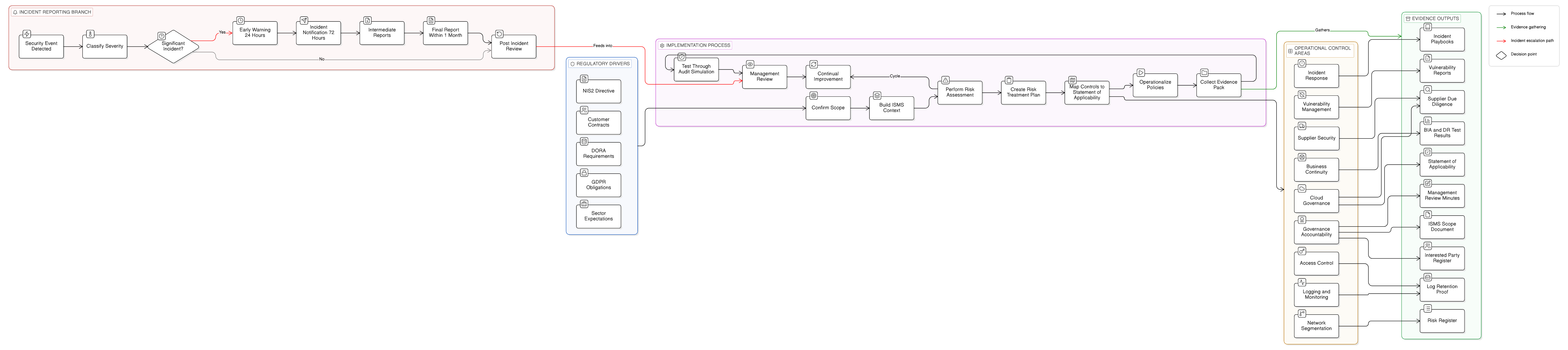
NIS2 has made staged incident notification a governance obligation, including early warning within 24 hours, a 72-hour notification and a final report within one month for significant incidents. DORA has created a dedicated digital operational resilience regime for financial entities, including ICT incident management, classification, supervisory reporting, ICT third-party risk and crisis communication. GDPR remains relevant whenever personal data is involved. ISO/IEC 27001:2022 turns these obligations into auditable management system evidence.
A regulatory contact register sounds administrative. It is not. It is the connective tissue between incident response, legal notification, business continuity, supplier coordination, executive accountability and audit evidence.
Clarysec treats this as an evidence problem, not a paperwork exercise. In Zenith Blueprint: An Auditor’s 30-Step Roadmap Zenith Blueprint, Step 22 in the Controls in Action phase explains why contact with authorities must be predefined:
Control 5.5 ensures that an organization is prepared to interact with external authorities when needed, not reactively or under panic, but through predefined, structured, and well-understood channels.
That is the real lesson from the 02:17 incident. The time to find the regulator’s notification portal, the CSIRT duty phone, the DPO backup contact, the financial supervisor’s reporting channel and the supplier escalation route is before the incident, not while the reporting clock is already running.
Why Regulatory Contact Registers Became a 2026 Compliance Priority
Many organizations already have emergency contact lists. The problem is that NIS2 and DORA require something more disciplined than a list of names and phone numbers. They require accurate, role-based, evidence-ready contact governance tied to legal triggers, escalation authority, reporting deadlines and supplier dependencies.
NIS2 applies to a broad set of essential and important entities across sectors such as energy, transport, banking, financial market infrastructure, healthcare, drinking water, wastewater, digital infrastructure, ICT service management, public administration and space. It also captures many digital providers, including cloud computing services, data centre services, content delivery networks, managed service providers, managed security service providers, online marketplaces, online search engines and social networking platforms. Member States were required to establish lists of essential and important entities by 17 April 2025 and update them at least every two years. For many cloud, SaaS, managed service and digital platform providers, regulatory exposure has moved from theoretical to operational.
DORA applies from 17 January 2025 to financial entities such as credit institutions, payment institutions, electronic money institutions, investment firms, crypto-asset service providers, trading venues, central securities depositories, central counterparties, insurance and reinsurance undertakings and other covered financial-sector organizations. DORA is also deeply relevant to the ICT third-party ecosystem because financial entities must manage providers supporting critical or important functions. DORA Article 17 requires an ICT-related incident management process, Article 18 sets classification expectations, and Article 19 governs reporting of major ICT-related incidents to the competent authority.
GDPR adds the privacy dimension. A cybersecurity incident may become a personal data breach if it involves accidental or unlawful destruction, loss, alteration, unauthorized disclosure of or access to personal data. The controller must be able to demonstrate accountability, assess risk to individuals and, where required, notify the supervisory authority and possibly affected data subjects.
A mature regulatory contact register must therefore answer five questions under pressure:
- Which CSIRT, competent authority, financial supervisor, data protection authority and law enforcement contact applies to this legal entity, jurisdiction and service?
- Which internal role is authorized to initiate contact, approve wording and submit notifications?
- Which suppliers must be contacted for containment, logs, restoration, evidence preservation or contractual reporting?
- Which customer, counterparty or public communication route is triggered at each severity level?
- How do we prove that the register was reviewed, tested and used correctly?
The answer cannot live only in legal’s inbox or the CISO’s memory. It must be a controlled ISMS record.
What an Evidence-Ready NIS2 and DORA Contact Register Contains
A regulatory contact register should be designed for use during a real incident. If the incident commander needs to make the first escalation decision within minutes, the register cannot be a vague list of websites. It must be structured, verified and linked to the response playbook.
| Register field | Why it matters in an incident | Evidence value |
|---|---|---|
| Authority or stakeholder type | Distinguishes CSIRT, competent authority, financial supervisor, DPA, law enforcement, supplier, customer group and internal role | Shows that interested parties and notification channels were identified |
| Specific body or entity name | Identifies the exact regulator, supervisor, provider, customer group or internal function | Reduces wrong-recipient and wrong-jurisdiction risk |
| Jurisdiction and legal entity | Prevents wrong-country or wrong-entity notifications in cross-border groups | Supports scope, applicability and regulatory mapping |
| Trigger condition | Links contact to NIS2 significant incident, DORA major ICT-related incident, GDPR personal data breach or contractual notice | Shows documented decision logic |
| Primary contact channel | Provides portal, email, phone, secure message route or high-priority support channel | Supports timely reporting and escalation |
| Backup contact channel | Provides resilience when the main channel is unavailable | Demonstrates continuity of communication |
| Authorized internal owner | Defines who may contact, approve or submit information | Supports accountability and segregation of duties |
| Evidence required before contact | Lists facts, severity assessment, affected services, IOCs, customer impact and legal review status | Supports timely but controlled notification |
| Last validation date and validator | Confirms periodic review and reduces stale contact risk | Provides audit evidence of maintenance |
| Test or exercise reference | Links the contact to tabletop exercises, simulations or real incident use | Shows operational effectiveness |
| Retention location | Points to SIMS, GRC platform, ticketing system or evidence repository | Supports repeatability and audit retrieval |
A complete register should include at least six contact families.
First, official cybersecurity authorities: national CSIRTs, competent authorities, single points of contact where applicable and sectoral cybersecurity agencies.
Second, financial supervisors for DORA: competent authorities and reporting channels used for initial, intermediate and final major ICT-related incident reporting.
Third, privacy authorities: data protection authorities, lead supervisory authority logic for cross-border processing and DPO escalation paths.
Fourth, law enforcement: cybercrime units, fraud units and emergency contacts for extortion, ransomware, unauthorized access and evidence preservation.
Fifth, suppliers and ICT third parties: cloud providers, managed security providers, managed service providers, identity platforms, payment processors, digital forensics providers and legal counsel.
Sixth, internal escalation roles: incident commander, CISO, DPO, general counsel, communications lead, business continuity lead, executive approver, board liaison and service owner.
The register should also include special-interest groups where relevant, such as ISACs or sector information-sharing communities. These are not regulators, but they can become important channels for threat intelligence and coordinated response.
The Zenith Blueprint makes this practical in Step 22:
Create or update procedures for engaging authorities during security events (5.5), including contact details for local CERTs, regulators, and law enforcement. Maintain a similar contact list for participation in security forums or sector-specific groups (5.6). Store this information in an accessible yet access-controlled location, and include it in your incident response runbook.
That last sentence matters. If the register is not in the incident response runbook, it is unlikely to be used when the pressure is real.
Example Contact Register Structure for a FinTech or SaaS Provider
Imagine a fintech SaaS provider that supports payment analytics for EU clients. It uses a cloud provider, a managed detection provider, an identity platform, a customer support platform and external legal counsel. Depending on its role, it may be a financial entity, an ICT third-party service provider, a NIS2 in-scope digital provider, or a processor of personal data under GDPR.
A practical register could begin like this:
| Authority or entity type | Specific body or name | Contact point | Primary method | Backup method | Trigger for contact | Owner |
|---|---|---|---|---|---|---|
| NIS2 CSIRT | National CSIRT | Incident response intake | Secure portal | Emergency email | Significant cyber incident affecting services | CISO |
| DORA supervisor | National financial authority | ICT incident reporting desk | Supervisor portal | Designated phone | Major ICT-related incident | Head of Compliance |
| GDPR DPA | Data protection authority | Breach notification unit | Web form | DPO authority liaison | Personal data breach risk assessment indicates notification may be required | DPO |
| Law enforcement | National cybercrime unit | Duty officer | Official reporting line | Local liaison officer | Suspected criminal activity, extortion or evidence preservation need | Head of Legal |
| Critical cloud provider | Cloud provider name | Enterprise security support | High-priority ticket portal | Technical account manager | Incident impacting tenancy, logs, containment or restoration | Head of Cloud Ops |
| Managed detection provider | MDR provider name | SOC escalation lead | 24x7 escalation line | Account escalation contact | Confirmed high-severity detection or forensic support requirement | Incident Commander |
| Internal executive | CEO or delegated executive | Executive escalation | Direct mobile | Executive assistant | Any incident requiring external notification or public impact decision | CISO |
| Internal communications | Head of PR or communications | Crisis communications lead | Direct mobile | Collaboration channel | Customer, media or market communication may be required | General Counsel |
The entries should not contain unnecessary personal data. Use role-based contacts wherever possible, protect sensitive contact details, and ensure offline availability during a major outage. A register that is accessible only from the same systems affected by a ransomware incident is not resilient.
Mapping the Register to ISO/IEC 27001:2022 Evidence
Auditors rarely fail an organization because it lacks a spreadsheet. They fail it because the organization cannot prove that the spreadsheet is complete, current, approved, protected, tested and connected to actual processes.
ISO/IEC 27001:2022 starts with organizational context. Clauses 4.1 to 4.4 require the organization to understand internal and external issues, identify interested parties and their requirements, define the ISMS scope and understand interfaces and dependencies. A regulatory contact register is strong evidence that legal, regulatory, contractual and stakeholder requirements have been translated into operational relationships.
Leadership follows. Clauses 5.1 to 5.3 require top management to demonstrate leadership, assign responsibilities, ensure communication and support the ISMS. If the register identifies who is authorized to notify a CSIRT, supervisor or DPA, who approves external communications and who reports incident status to top management, it supports leadership evidence.
Risk planning then turns obligations into action. Clauses 6.1.1 to 6.1.3 require a risk assessment and treatment process, comparison against Annex A, a Statement of Applicability, a risk treatment plan and residual risk acceptance. The register should appear in the treatment plan for risks such as legal notification failure, delayed incident escalation, supplier response failure, cross-border notification error and business continuity communication breakdown.
The Annex A control anchors are clear:
| ISO/IEC 27001:2022 control | Control name | Register relevance |
|---|---|---|
| A.5.5 | Contact with authorities | Establishes predefined authority contacts for incidents and regulatory events |
| A.5.6 | Contact with special interest groups | Supports sector information sharing and threat intelligence coordination |
| A.5.19 | Information security in supplier relationships | Links supplier contacts to security obligations and escalation routes |
| A.5.20 | Addressing information security within supplier agreements | Ensures notification and support channels are contractually supported |
| A.5.21 | Managing information security in the ICT supply chain | Connects critical ICT providers to response and recovery workflows |
| A.5.22 | Monitoring, review and change management of supplier services | Keeps supplier contacts current when services or providers change |
| A.5.23 | Information security for use of cloud services | Supports cloud incident escalation, evidence access and restoration |
| A.5.24 | Information security incident management planning and preparation | Embeds the register into incident response planning |
| A.5.25 | Assessment and decision on information security events | Links triggers to reportability assessment and decision logs |
| A.5.26 | Response to information security incidents | Supports external coordination during response |
| A.5.27 | Learning from information security incidents | Drives register updates after incidents and exercises |
| A.5.28 | Collection of evidence | Supports retained notifications, receipts, call notes and regulator feedback |
| A.5.29 | Information security during disruption | Ensures communication channels remain available during disruption |
| A.5.30 | ICT readiness for business continuity | Links contact governance to continuity and recovery plans |
| A.5.31 | Legal, statutory, regulatory and contractual requirements | Maps contacts to legal and contractual notification duties |
| A.5.34 | Privacy and protection of PII | Ensures DPO and DPA paths are integrated for personal data breaches |
| A.8.15 | Logging | Provides facts and evidence required for notification |
| A.8.16 | Monitoring activities | Enables early detection and timely escalation into notification workflows |
In Zenith Controls: The Cross-Compliance Guide Zenith Controls, contact with authorities is treated as control 5.5 with preventive and corrective characteristics. It supports confidentiality, integrity and availability, and connects to Identify, Protect, Respond and Recover cybersecurity concepts. Zenith Controls ties it to incident planning, event reporting, threat intelligence, special interest groups and incident response. It also explains why pre-established contacts with regulators, law enforcement, national CERTs or data protection agencies enable faster escalation and guidance during events such as significant breaches or ransomware attacks.
The control is not isolated. Zenith Controls also maps control 6.8, Information security event reporting, as a detective control tied to incident planning, event assessment, response, lessons learned, awareness, monitoring and disciplinary process. Control 5.24, Information security incident management planning and preparation, connects to event assessment, lessons learned, logging, monitoring, security during disruption, continuity and contact with authorities. The audit story becomes stronger when events are reported, assessed, escalated, communicated, evidenced and improved.
NIS2, DORA and GDPR: One Register, Different Legal Clocks
A single incident may trigger several legal workflows. Unauthorized access at a SaaS provider might be a NIS2 significant incident, a GDPR personal data breach and a contractual customer notice event. An outage at a financial entity might be a DORA major ICT-related incident while also requiring GDPR analysis and supplier coordination.
NIS2 requires essential and important entities to notify their CSIRT or competent authority without undue delay of significant incidents affecting service provision. The staged reporting model includes an early warning without undue delay and within 24 hours of becoming aware, an incident notification without undue delay and within 72 hours, intermediate status reports upon request and a final report within one month after the incident notification. If the incident is still ongoing, progress reporting may also be required.
DORA requires financial entities to maintain an ICT-related incident management process that detects, manages and notifies incidents, records incidents and significant cyber threats, classifies severity and criticality, assigns roles, defines escalation and communication, reports major incidents to senior management and supports timely recovery. Major ICT-related incident reporting follows initial, intermediate and final reporting logic, with classification based on factors such as affected clients, duration, geographic spread, data loss, criticality of services and economic impact.
GDPR adds the personal data breach assessment. A contact register does not decide legal reportability by itself. It ensures the right people can decide quickly, using current channels and documented criteria.
Clarysec’s policy library makes this operational. In the SME Incident Response Policy Incident Response Policy - SME, clause 5.1.1 states:
The General Manager (GM) is accountable for authorizing all incident escalation decisions, regulatory notifications, and external communications.
The same SME policy, clause 7.4.1, adds:
Where customer data is involved, the General Manager must assess legal notification obligations based on the applicability of GDPR, NIS2, or DORA.
For enterprise environments, the Incident Response Policy Incident Response Policy clause 5.5 establishes the communication framework:
All incident-related communications must follow the Communications and Escalation Matrix, ensuring:
Clause 6.4.2 adds the evidence requirement:
All breach notifications must be documented and approved before submission, and copies must be retained in the SIMS.
This is where the register becomes ISO evidence. It is not only about knowing whom to call. It is about showing who was authorized, what was assessed, what was approved, what was submitted and where the retained copy lives.
The Clarysec Evidence Model: Four Artifacts That Work Together
A strong regulatory contact capability needs four artifacts working as one evidence chain.
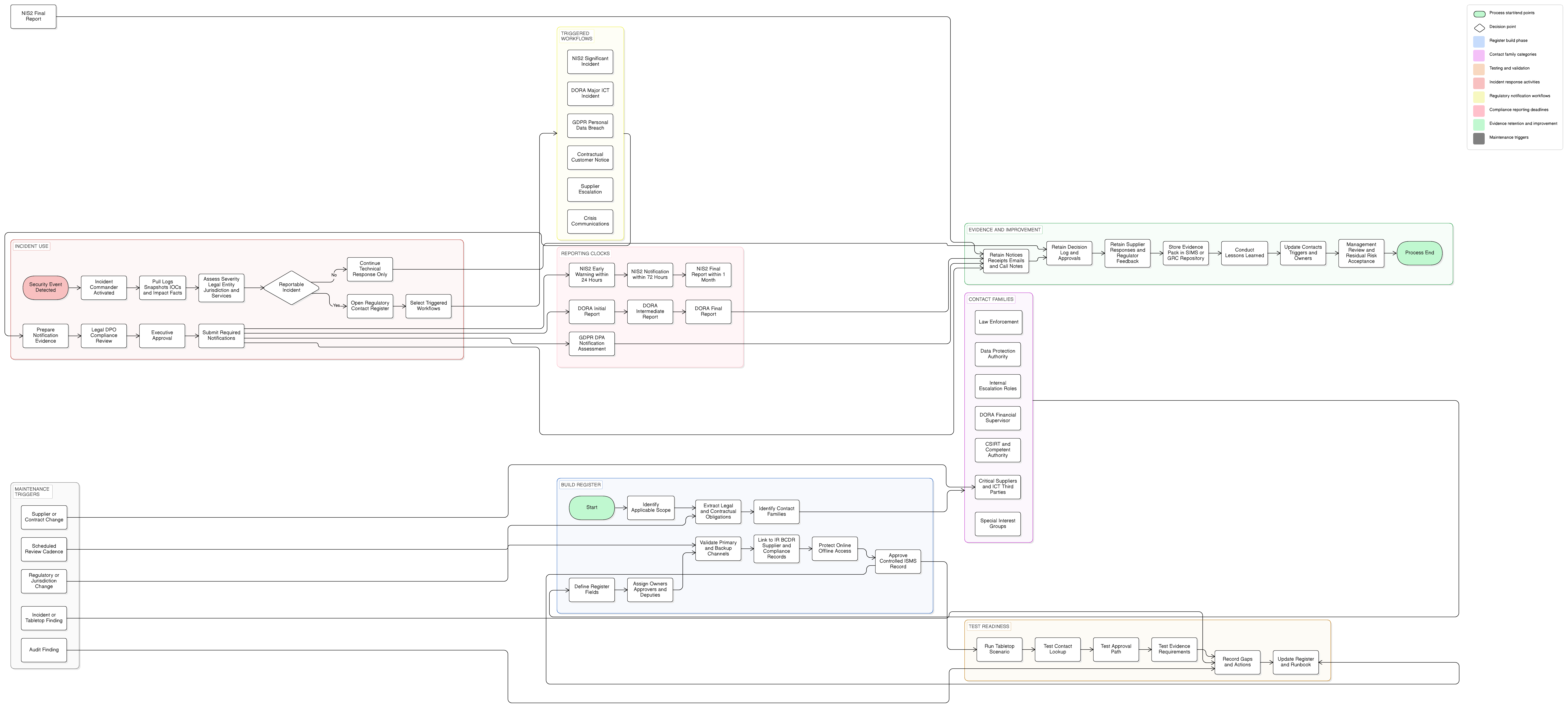
The regulatory contact register identifies contacts, channels, triggers and owners. The communications and escalation matrix defines who does what. The decision log records classification, reportability assessment, legal review and approval. The notification evidence pack retains submitted notices, portal receipts, emails, call notes, regulator feedback, supplier responses and final reports.
Clarysec’s Legal and Regulatory Compliance Policy Legal and Regulatory Compliance Policy - SME makes the register concept explicit. Clause 5.5.2 states:
Key compliance terms (e.g., breach notification timelines and data handling clauses) must be extracted and tracked in the Compliance Register.
The Compliance Register should feed the regulatory contact register. The legal requirement might say “NIS2 early warning within 24 hours,” while the contact register identifies the national CSIRT portal, backup duty number, authorized submitter, legal reviewer, evidence required and retention path.
Business continuity policies reinforce the same expectation. The SME Business Continuity Policy and Disaster Recovery Policy Business Continuity Policy and Disaster Recovery Policy - SME clause 5.2.1.1 refers to:
contact lists and alternate communication plans
The enterprise Business Continuity Policy and Disaster Recovery Policy Business Continuity Policy and Disaster Recovery Policy clause 5.3.3 requires continuity arrangements to be:
Supported by up-to-date contact lists and escalation flows
Supplier governance also belongs in the model. In the SME Third-Party and Supplier Security Policy Third-Party and Supplier Security Policy - SME, clause 5.4.3 requires an:
Assigned contact person
For NIS2 and DORA, that contact cannot be generic. If a critical cloud provider, managed security service provider, identity provider or payment processor supports a regulated service, the register should identify the operational contact, security incident contact, contractual notice channel and escalation route for evidence requests.
Build the Register in One Working Session
A useful register can be built quickly if the right people are in the room. Schedule a two-hour session with the CISO, DPO, legal counsel, supplier manager, business continuity lead, incident commander and compliance owner.
Start with the Compliance Register. Extract NIS2, DORA, GDPR, contractual and sector reporting obligations. Record timelines, reportability criteria and evidence requirements.
Open the incident response runbook. For each incident category, such as ransomware, unauthorized access, service outage, data exfiltration, supplier incident and cloud region failure, identify the external contacts needed.
Populate the regulatory contact register with authority, jurisdiction, trigger, primary channel, backup channel, owner, approver, evidence needed, last validation date and retention location.
Link supplier contacts. For each critical or important function, identify the provider’s security incident contact, contractual notice channel, audit contact and emergency escalation path.
Review against policies. Confirm that escalation authority matches the Incident Response Policy, notification evidence is retained in SIMS, business continuity contact lists are aligned and supplier contacts have assigned owners.
Test one scenario. Use a focused tabletop: “Customer data exposure detected at 02:17 affecting EU clients and possibly caused by compromised identity provider credentials.” Ask the team to identify whether CSIRT, DPA, financial supervisor, supplier and customer notices may be required. The goal is not to force a final legal conclusion during the drill. The goal is to prove where contacts are found, who approves contact, what evidence is needed and where decisions are logged.
Create the evidence pack. Save the register version, meeting attendees, approvals, scenario notes, decision log, action items and updated runbook reference.
This is where Zenith Blueprint Step 23 becomes practical:
Ensure you have an up-to-date incident response plan (5.24), covering preparation, escalation, response, and communication. Define what constitutes a reportable security event (5.25) and how the decision-making process is triggered and documented. Select a recent event or conduct a tabletop exercise to validate your plan.
The exercise does not need to be elaborate. It needs to prove readiness.
Cross-Compliance Mapping: One Register, Many Frameworks
The value of a regulatory contact register is that it reduces duplicated compliance effort. One evidence-ready artifact can support ISO/IEC 27001:2022, NIS2, DORA, GDPR, NIST CSF 2.0 and COBIT 2019 governance expectations.
| Framework | What the register supports | Evidence auditors or assessors expect |
|---|---|---|
| ISO/IEC 27001:2022 | Interested parties, legal requirements, contact with authorities, incident management, supplier governance, continuity and evidence collection | Scope, Statement of Applicability, register, approvals, review history, tabletop records and incident logs |
| NIS2 | Contact with CSIRT or competent authority, staged significant incident notification, management accountability and supply chain coordination | Reportability decision, 24-hour early warning evidence, 72-hour notification evidence, final report and board oversight |
| DORA | Competent authority reporting, incident classification, major ICT incident communication, ICT third-party coordination and crisis communication | Initial, intermediate and final reporting records, severity classification, supplier register and continuity test records |
| GDPR | DPA notification workflow, DPO escalation, personal data breach assessment and accountability | Breach assessment, controller or processor role analysis, DPA contact, submitted notices and data subject communication decisions |
| NIST CSF 2.0 | GOVERN outcomes for stakeholders, obligations, roles, policy, oversight and supply chain risk management | Current Profile, Target Profile, gap analysis, POA&M, stakeholder map and supplier coordination evidence |
| COBIT 2019 | Governance of stakeholder needs, risk, compliance, incident handling and third-party arrangements | RACI, process performance evidence, control monitoring, assurance records and management review evidence |
NIST CSF 2.0 is especially useful as an integration layer. Its GOVERN function expects organizations to understand stakeholders, legal and regulatory obligations, critical services, dependencies, risk appetite, roles, policies, oversight and supplier risk. Its CSF Profiles help organizations document a Current Profile, define a Target Profile, analyze gaps and create a prioritized action plan. A regulatory contact register can be concrete evidence that closes the gap between current and target incident governance.
For supply chain, NIST CSF 2.0 expects suppliers, customers and partners to have defined cybersecurity roles and responsibilities, supplier criticality to be known, cybersecurity requirements to be embedded into agreements, supplier risks to be assessed and relevant suppliers to be included in incident planning, response and recovery. That maps directly to DORA ICT third-party risk and NIS2 supply chain expectations.
How Auditors and Supervisors Will Test the Same Register
A well-maintained register will be examined differently depending on the reviewer’s lens.
An ISO/IEC 27001:2022 auditor will start with scope and interested parties. They will ask how the organization identified applicable authorities, legal obligations, contractual notification duties and outsourced dependencies. Then they will trace the register to the Statement of Applicability, incident response plan, business continuity plan and evidence retention. They may sample one contact and ask for proof of last validation.
A NIS2 assessor will focus on whether the entity has identified the correct CSIRT or competent authority and whether significant incident thresholds are operationalized. They will look for a process capable of supporting 24-hour early warning, 72-hour notification and final reporting. They will also look at management body oversight because NIS2 Article 20 makes cybersecurity governance a leadership responsibility.
A DORA supervisor or internal audit team will test whether the register supports incident management, classification, major ICT-related incident reporting, crisis communication, senior management reporting, supplier coordination and operational recovery. They may ask whether contacts exist for ICT third-party service providers supporting critical or important functions and whether communication obligations are reflected in contracts.
A GDPR auditor or DPO review will focus on personal data breach assessment. They will ask whether the DPO and privacy legal contacts are involved early, whether controller and processor roles are clear, whether the correct supervisory authority is identified and whether data subject communication decisions are recorded.
A NIST CSF assessor will treat the register as evidence for GOVERN outcomes: stakeholder expectations, legal obligations, roles, policies, oversight and supply chain risk. A COBIT 2019 or ISACA-style auditor will examine whether stakeholder needs are translated into governance and management practices, whether responsibilities are assigned and whether process performance is monitored.
The same artifact must survive all of these questions. That is why the register should be controlled, owned, reviewed, access-controlled and tested.
Common Failure Patterns in Contact Governance
Organizations rarely fail because they have no contacts at all. They fail because the contacts cannot be trusted during a real incident.
| Failure pattern | Why it creates risk | Practical fix |
|---|---|---|
| Regulator contact is only a public homepage | Teams lose time finding the actual reporting route | Validate portal, email, phone and backup channels |
| DPO has no deputy | Out-of-hours privacy decisions stall | Assign and train backup privacy contacts |
| Supplier contacts are hidden in contracts | Incident teams cannot escalate quickly | Extract security, contractual and support contacts into the register |
| BCDR list and IR matrix disagree | Teams follow conflicting escalation paths | Reconcile both records through one owner and review cycle |
| No last-reviewed date exists | Auditors cannot verify maintenance | Add validation dates, validators and approval evidence |
| Law enforcement is omitted | Ransomware or extortion response lacks evidence support | Add cybercrime and evidence preservation contacts |
| NIS2 and DORA timelines are not integrated | GDPR-only workflows miss sector obligations | Map triggers to NIS2, DORA, GDPR and contracts |
| Register is online-only in affected systems | Outage or ransomware blocks access | Maintain protected offline and alternate access routes |
| Notifications are not retained | Compliance cannot prove what was submitted | Retain notices, receipts, approvals and correspondence in SIMS |
| Tabletop exercises skip notification | Process remains theoretical | Test contact lookup, approval, submission and evidence retention |
Each issue creates a predictable audit finding. The remediation is equally predictable: align the register to policy, integrate it into incident response, validate contacts, test the workflow and retain evidence.
Board and Management Accountability
NIS2 requires management bodies to approve cybersecurity risk-management measures, oversee implementation and follow training. DORA Article 5 makes the management body responsible for defining, approving, overseeing and being accountable for ICT risk arrangements, including policies, roles, ICT business continuity, response and recovery plans, ICT third-party policy, awareness and training. ISO/IEC 27001:2022 requires leadership to align the ISMS with strategic direction, provide resources, assign responsibilities and support continual improvement.
The board does not need to memorize the CSIRT phone number. It does need assurance that notification readiness exists, is owned, is tested and is reviewed.
A quarterly management pack should include:
- Regulatory contact register review status
- Changes in applicable authorities, supervisors or jurisdictions
- Open gaps in supplier incident contacts
- Tabletop exercise outcomes and lessons learned
- Evidence of notification approval workflow testing
- Metrics on time from detection to escalation decision
- Updates to NIS2, DORA, GDPR and contractual reporting obligations
- Residual risks requiring management acceptance
This shifts the register from an operational spreadsheet to a governance control.
How Clarysec Helps You Build Audit-Ready Contact Governance
Clarysec connects policy text, implementation sequencing and cross-framework control mapping into one evidence pathway.
The policy library defines accountability and required records. The Incident Response Policy sets escalation, notification approval and retention expectations. The Legal and Regulatory Compliance Policy requires compliance terms such as breach notification timelines to be tracked. The Business Continuity Policy and Disaster Recovery Policy requires up-to-date contact lists and alternate communication plans. The Third-Party and Supplier Security Policy requires assigned supplier contacts.
The Zenith Blueprint gives implementation sequencing. Step 5 in the ISMS Foundation & Leadership phase addresses communication, awareness and competence, including external stakeholders, timing, communicator roles and communication plans. Step 22 builds authority and special-interest contacts into organizational controls. Step 23 validates incident management, reportable event decisions, forensic evidence preservation and lessons learned.
The Zenith Controls guide gives the cross-compliance compass. It shows how contact with authorities connects to incident planning, event reporting, threat intelligence, special interest groups and incident response. It also shows why information security event reporting and incident preparation are necessary companions. A contact register is only effective if events are reported and assessed early enough to trigger it.
For SMEs, this means a lean but defensible register, clear accountability and evidence that fits proportionality. For enterprises, it means integration across jurisdictions, legal entities, business units, suppliers, regulators, supervisors, CSIRTs and board reporting.
Next Steps: Build the Register Before the Clock Starts
If your organization is preparing for NIS2, DORA, GDPR breach notification readiness or ISO/IEC 27001:2022 certification, do not wait for a live incident to discover whether your contact governance works.
Start with four actions this week:
- Create or refresh your regulatory contact register for CSIRTs, competent authorities, financial supervisors, data protection authorities, law enforcement, critical suppliers and internal escalation roles.
- Map each contact to a trigger, owner, approval path, evidence requirement and retention location.
- Run one tabletop exercise focused on notification decisions, authority contact, supplier coordination and evidence retention.
- Update ISMS records, including the Compliance Register, incident response runbook, business continuity contact lists and supplier contact records.
Clarysec can help you implement this quickly using the Zenith Blueprint Zenith Blueprint, Zenith Controls Zenith Controls and our SME and enterprise policy libraries, including the Incident Response Policy Incident Response Policy, Legal and Regulatory Compliance Policy Legal and Regulatory Compliance Policy - SME, Business Continuity Policy and Disaster Recovery Policy Business Continuity Policy and Disaster Recovery Policy and Third-Party and Supplier Security Policy Third-Party and Supplier Security Policy - SME.
The 24-hour clock does not pause while your team searches for the right contact. Build the register now, test it, and make it part of your ISO evidence before the next incident decides the timeline for you.
Frequently Asked Questions
About the Author

Igor Petreski
Compliance Systems Architect, Clarysec LLC
Igor Petreski is a cybersecurity leader with over 30 years of experience in information technology and a dedicated decade specializing in global Governance, Risk, and Compliance (GRC).Core Credentials & Qualifications:• MSc in Cyber Security from Royal Holloway, University of London• PECB-Certified ISO/IEC 27001 Lead Auditor & Trainer• Certified Information Systems Auditor (CISA) from ISACA• Certified Information Security Manager (CISM) from ISACA • Certified Ethical Hacker from EC-Council