Risk-Based Vulnerability Prioritization for 2026
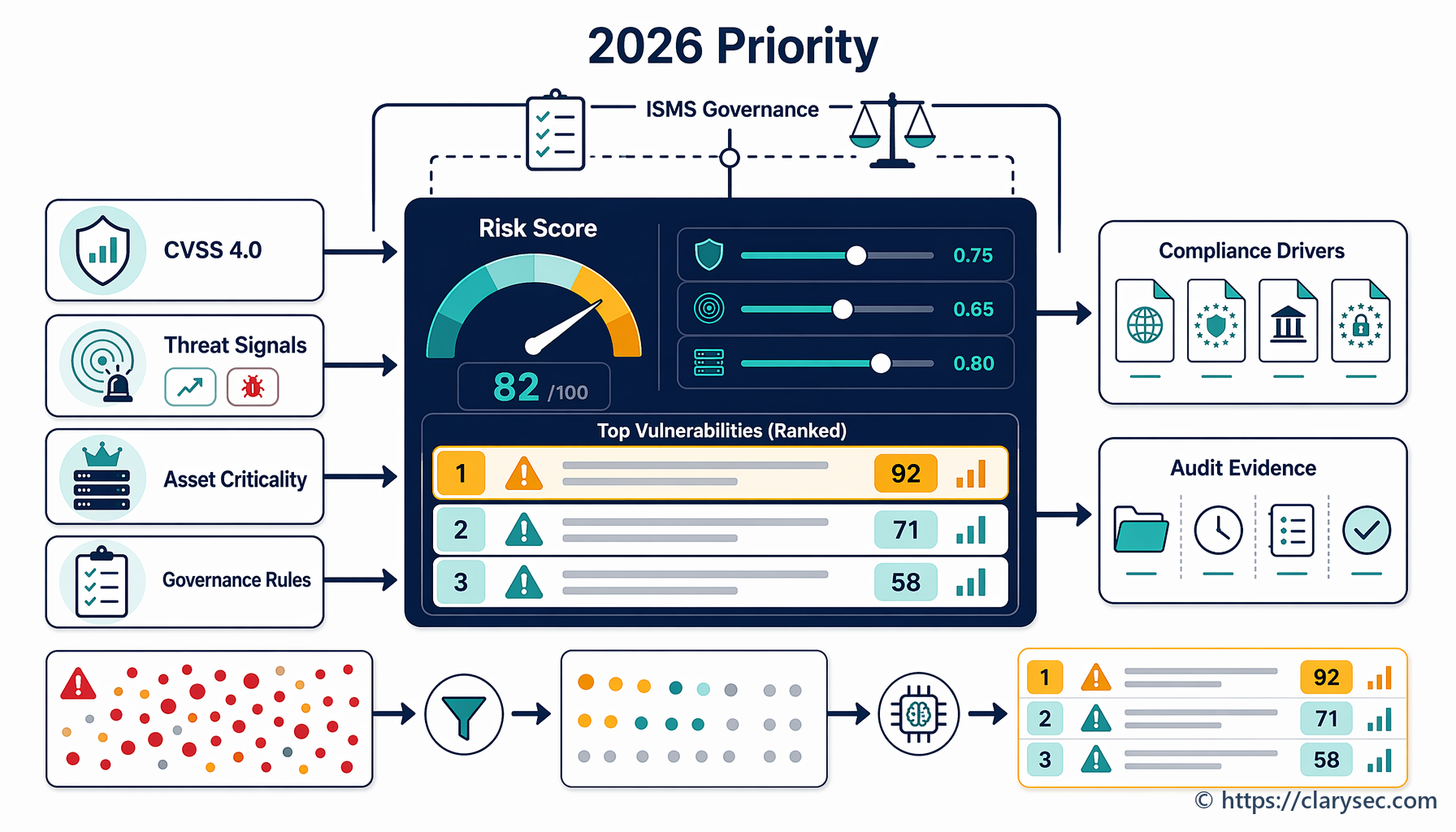
It is 08:17 on a Tuesday in early 2026. The vulnerability scanner has finished its overnight run, and the dashboard is glowing red. The infrastructure team sees 1,842 findings. The cloud platform owner says only 73 are reachable from the internet. The compliance manager is preparing for NIS2 and DORA assessments. The privacy lead asks whether any affected system processes personal data. The SOC wants to know whether any are being exploited in the wild. The CISO needs one answer for engineering, another for the board, and a third for the next ISO 27001 audit.
Then the board asks the most dangerous question in vulnerability management:
“Why did we fix that one first?”
In 2026, vulnerability prioritization is no longer a scanner sorting exercise. It is a governance decision. CVSS 4.0 severity matters, but it does not tell you whether a vulnerable system supports customer authentication, stores payment metadata, enables remote access, processes EU customer records, depends on an ICT third-party provider, or appears in known exploitation sources such as KEV or EUVD-related intelligence.
EPSS adds exploit probability, but probability is not business impact. Asset criticality adds context, but only if the asset inventory is reliable. GDPR changes the calculation when vulnerable systems process personal data. NIS2 and DORA change it again when disruption could affect essential services, important entities, financial services, critical or important functions, ICT third-party dependencies, or regulated operational resilience.
This is the gap Clarysec sees in real audits. Many organizations can show a scan report and a patch ticket. Fewer can show a defensible decision model. They cannot prove why one vulnerability was treated as urgent, why another was accepted temporarily, or why a delayed patch did not create unmanaged exposure.
The Clarysec answer is to turn vulnerability prioritization into audit-ready risk evidence, using the Zenith Blueprint: An Auditor’s 30-Step Roadmap Zenith Blueprint, Clarysec policies, and Zenith Controls: The Cross-Compliance Guide Zenith Controls as the operating model.
Why CVSS-first vulnerability management fails in 2026
Most vulnerability programs still start with scanner severity. That is understandable. CVSS 4.0 provides a structured technical severity baseline, including exploitability and impact dimensions. It is useful, repeatable and widely supported.
But severity alone is incomplete.
A critical vulnerability on an isolated lab host might be less urgent than a high vulnerability on an internet-facing identity provider. A medium vulnerability in a public API that processes EU customer records may carry more regulatory exposure than a high vulnerability in a non-production analytics system. A vulnerability listed in known exploited sources deserves different treatment from one that is theoretically severe but not observed in active exploitation.
The Clarysec Enterprise Vulnerability and Patch Management Policy Vulnerability and Patch Management Policy makes this shift explicit. Clause 4.5.2 states:
“Map vulnerabilities to business risk context using CVSS, exploitability, and exposure metrics.”
That line is the dividing point between basic patching and risk-based vulnerability management. The SME version, Vulnerability and Patch Management Policy-sme Vulnerability and Patch Management Policy - SME, makes the operational trigger even clearer. Clause 6.5.1 states:
“Systems that process personal data, provide remote access, or are externally facing must be prioritized for scanning and updates”
This is where many programs break down. They scan everything, but prioritize as if all assets are equal. They document remediation dates, but not the reasoning. They know the CVSS score, but not whether the asset supports a regulated service, a critical supplier dependency, or a personal-data processing environment.
A defensible 2026 model combines five lenses:
- Technical severity, such as CVSS 4.0.
- Exploit likelihood, such as EPSS or comparable exploit probability intelligence.
- Known exploitation, including KEV, EUVD-related intelligence, CERT and ENISA alerts.
- Asset and service criticality.
- Regulatory and data impact, including ISO 27001, NIS2, DORA and GDPR evidence.
The result is not a perfect mathematical truth. It is a documented, repeatable, management-approved risk decision process.
Start with the ISMS: prioritization is a governance decision
ISO/IEC 27001:2022 is not just a certification standard. Used properly, it becomes the management-system backbone for vulnerability prioritization. Its clauses require the organization to understand context, interested parties, legal and contractual requirements, scope, leadership, roles, risk assessment, risk treatment, documented information and continual improvement.
That matters because vulnerability prioritization is full of assumptions. What does “critical” mean? What risk level is unacceptable? Who can accept residual risk? When must management be notified? What evidence must be retained? These are not scanner settings. They are ISMS decisions.
The Zenith Blueprint addresses this in the Risk Management phase, Step 10, Establishing Risk Criteria and Impact Matrix:
“Risk criteria are the rules and benchmarks your organization uses to evaluate the significance of each risk. Establishing these criteria upfront ensures everyone speaks the same risk language.”
Step 10 also guides organizations to define likelihood and impact using business-specific criteria, including regulatory impact. A personal data breach may automatically be Major or Severe because of GDPR obligations. A disruption affecting an essential or important service under NIS2 may elevate operational and legal impact. A vulnerability affecting a financial entity’s critical or important function may trigger DORA resilience concerns.
Before you rank vulnerabilities, define the rules.
Clarysec typically helps clients establish a vulnerability decision record with these fields:
| Field | Purpose | Example evidence |
|---|---|---|
| CVSS 4.0 severity | Establish technical baseline for exploitability and impact | Scanner output, CVE record, vendor advisory |
| EPSS score | Add probability signal for likely exploitation | Threat intelligence enrichment record |
| Known exploitation | Identify confirmed or credible exploitation | KEV listing, EUVD-related advisory, CERT alert, ENISA alert |
| Exposure | Determine whether the asset is reachable or accessible | Attack surface inventory, firewall rule, EDR telemetry |
| Asset criticality | Connect the finding to business importance | CMDB, service catalogue, asset classification |
| Data impact | Identify personal data, credentials, payment data or regulated records | Data inventory, DPIA, records of processing |
| Compensating controls | Reduce likelihood or impact where controls are effective | WAF rule, isolation, EDR, MFA, virtual patching |
| Treatment decision | Record patch, mitigation, isolation, monitoring, acceptance or deferral | Change record, risk acceptance, treatment plan |
| Regulatory mapping | Explain relevance to ISO 27001, NIS2, DORA, GDPR or contracts | SoA notes, risk register, control mapping |
This table is not bureaucracy. It is the difference between “the scanner said so” and “management made a documented risk decision using approved criteria.”
Asset criticality is the missing multiplier
The most accurate exploit data in the world cannot help if you do not know what the asset does.
Clarysec frequently sees organizations with mature scanners and immature asset inventories. They know hostnames, IP addresses and CVEs, but not business owners, data classification, service dependencies, customer impact, supplier relationship, recovery priority or regulatory scope. That makes risk-based vulnerability prioritization impossible.
The Asset Management Policy-sme Asset Management Policy - SME captures the basic requirement in clause 5.3:
“Assets must be classified according to their sensitivity or criticality. For example:”
That classification is the engine of business-aware vulnerability management. Is the affected asset part of customer authentication? Does it support payment processing? Is it a backup server? Is it an API gateway used by external partners? Does it store logs containing personal data? Is it hosted by a cloud provider or operated by an ICT third-party service provider?
Zenith Controls treats this as a cross-compliance anchor. For ISO/IEC 27002:2022 control 5.9, Inventory of information and other associated assets, it maps asset inventory to GDPR Article 30 and Article 32, NIS2 Article 21, DORA Articles 5, 9 and 18, and NIST CSF ID.AM. It also connects asset inventory to configuration management, monitoring activities and information classification.
A practical Clarysec rule is simple: no vulnerability can be correctly prioritized until the affected asset has an owner, criticality, data classification and exposure state.
If those fields are missing, the vulnerability itself may still need remediation, but the asset governance gap becomes a separate risk.
Build a multi-factor vulnerability priority model
A practical priority model should not simply add unrelated numbers and pretend the result is science. CVSS 4.0 and EPSS measure different things. CVSS is a severity framework. EPSS is an exploit probability signal. KEV or EUVD-related intelligence indicates known or emerging exploitation relevance. Asset criticality and data impact determine business consequence.
A simple Clarysec model uses these factors:
| Factor | Suggested rating | What increases priority |
|---|---|---|
| CVSS 4.0 severity | 1 to 5 | Critical or high technical severity, high impact, low attack complexity |
| EPSS exploit probability | 1 to 5 | High probability compared with the organizational threshold |
| Known exploitation | 0 or 5 | KEV listing, credible exploitation reports, national CERT or ENISA advisory |
| Exposure | 1 to 5 | Internet-facing, remote-access path, third-party accessible, weak segmentation |
| Asset criticality | 1 to 5 | Supports critical service, identity, payment, production, safety or core revenue |
| Data and regulatory impact | 1 to 5 | Personal data, special category data, regulated financial service, NIS2 or DORA function |
| Compensating control reduction | 0 to minus 3 | Effective WAF, isolation, hardening, detection or temporary mitigation |
A sample formula could be:
Priority score = CVSS rating + EPSS rating + known exploitation + exposure + asset criticality + data impact - compensating control reduction
The organization then defines thresholds:
| Priority | Score range | Typical action |
|---|---|---|
| P1 emergency | 24 or above | Patch or mitigate immediately, notify management, initiate incident review if exploitation is suspected |
| P2 urgent | 18 to 23 | Remediate within accelerated SLA, track daily, require risk owner visibility |
| P3 scheduled | 12 to 17 | Remediate in normal patch cycle, monitor threat changes |
| P4 monitored | Below 12 | Accept temporarily, monitor intelligence and asset exposure changes |
This only works when the model is approved and consistently applied. ISO/IEC 27001:2022 clauses 6.1.1 to 6.1.3 require defined information security risk assessment, risk treatment, control selection, residual-risk approval and documented information.
The Clarysec Enterprise Risk Management Policy Risk Management Policy reinforces this in clause 6.2.2:
“The analysis shall consider the effectiveness of existing controls, relevant threat intelligence, asset criticality, and vulnerability severity.”
The SME Risk Management Policy-sme Risk Management Policy - SME gives a simple evidence rule in clause 5.1.2:
“Each risk entry must include: description, likelihood, impact, score, owner, and treatment plan.”
For vulnerability prioritization, this means every major delayed remediation should create or link to a risk entry. If a high-severity vulnerability is deferred because the asset is isolated and compensating controls exist, the risk register must show the owner, rationale, evidence and review date.
Threat intelligence: EPSS, KEV, EUVD, ENISA and CERT alerts
Known exploitation changes everything.
The Enterprise Vulnerability and Patch Management Policy states that governance should consider:
“Known exploits (e.g., CISA KEV listing)”
The SME policy expands the intelligence sources in clause 6.2.1.3:
“Trusted threat intelligence advisories (e.g., CISA, ENISA, national CERT alerts)”
A mature 2026 vulnerability program should ingest multiple sources: scanner vendor advisories, vendor security bulletins, KEV, EUVD-related vulnerability information, national CERT alerts, ENISA advisories, sector ISACs, EPSS probability, EDR signals and incident telemetry.
These sources do not all mean the same thing. KEV-style sources indicate known exploitation. EPSS estimates probability. EUVD and ENISA sources support European vulnerability awareness and coordination. Vendor advisories clarify affected versions, mitigations, exploit conditions and patch availability.
Zenith Controls describes ISO/IEC 27002:2022 control 5.7, Threat intelligence, as a preventive, detective and corrective control supporting confidentiality, integrity and availability. It ties threat intelligence directly to control 8.8, Management of technical vulnerabilities:
“Threat intelligence often includes data on emerging vulnerabilities and exploits in the wild, enabling prioritized patching and vulnerability mitigation under 8.8.”
That relationship is critical. Threat intelligence is not a separate SOC hobby. It is an input into prioritization, emergency change decisions, supplier notifications, incident triage and management reporting.
GDPR, NIS2 and DORA change what urgency means
A vulnerability on a system processing personal data is not just an IT weakness. It may become a failure of security of processing if appropriate technical and organizational measures are not in place.
GDPR Article 5 requires integrity, confidentiality and accountability. Article 32 requires appropriate security measures considering risk. Article 4 defines personal data broadly and defines personal data breach as an incident leading to accidental or unlawful destruction, loss, alteration, unauthorized disclosure of, or access to personal data. Article 9 raises the stakes for special category data such as biometric or health data.
The Clarysec Enterprise Data Protection and Privacy Policy Data Protection and Privacy Policy states in clause 3.3:
“Implement technical and organizational measures (TOMs) that protect the Confidentiality, Integrity, and Availability of personal information (PII) throughout its lifecycle.”
This is why the prioritization model needs a data-impact factor. If a vulnerability affects customer records, identity verification files, payment metadata, support tickets, HR data or telemetry that identifies users, the impact rating should rise. If exploitation could lead to unauthorized access, alteration or disclosure, the event may also need breach assessment and potential notification analysis.
Zenith Controls maps ISO/IEC 27002:2022 control 8.8 to GDPR Articles 32(1), 5(1)(f) and Recital 83, describing how technical vulnerability management supports appropriate technical and organizational measures and up-to-date risk mitigation for systems processing personal data.
NIS2 adds another layer. Article 21 requires essential and important entities to take appropriate and proportionate technical, operational and organizational measures to manage cybersecurity risks and minimize incident impact. Its baseline includes risk analysis, incident handling, business continuity, supply-chain security, secure acquisition and development, vulnerability handling and disclosure, effectiveness assessment, cyber hygiene, training, cryptography, HR security, access control, asset management and authentication where appropriate. Article 20 places governance duties on management bodies, including approval and oversight of cybersecurity risk-management measures.
DORA is especially important for financial entities. It creates a digital operational resilience framework covering ICT risk management, major ICT-related incident reporting, resilience testing, information sharing and ICT third-party risk management. Articles 5 and 6 require internal governance, documented ICT risk management, policies, procedures, tools, review, audit, remediation and a digital operational resilience strategy. Articles 9, 10 and 11 address protection, prevention, detection, response and recovery. Articles 17 to 19 require incident detection, classification, escalation, notification and reporting. Article 28 requires ICT third-party risk management, registers of contractual arrangements, pre-contract assessments, audit and inspection rights, termination rights and exit strategies.
For vulnerabilities, this means financial entities must know whether a weakness affects a critical or important function, a third-party ICT service, a cloud workload, a payment process, or a resilience objective.
Practical example: from red dashboard to defensible top priority
Imagine a SaaS provider discovers CVE-2026-XXXX in a web framework. The scanner marks it High. EPSS is elevated. It appears in an ENISA-related advisory and later in a known exploitation feed. The affected application is internet-facing, supports customer login and processes EU customer profile data. Engineering wants to defer the patch to the weekend because of downtime risk.
Here is how Clarysec would document the decision.
First, confirm asset context. The inventory shows the application is production, externally facing, owned by the Platform team, supports authentication, processes personal data and has a high business criticality rating. This aligns with Asset Management Policy-sme clause 5.3 and Zenith Controls control 5.9 mapping to asset inventory, GDPR and DORA evidence.
Second, score the vulnerability:
| Factor | Rating | Evidence |
|---|---|---|
| CVSS 4.0 severity | 4 | Scanner and vendor advisory show High severity |
| EPSS exploit probability | 4 | Threat enrichment indicates elevated likelihood |
| Known exploitation | 5 | Known exploitation source or credible advisory observed |
| Exposure | 5 | Internet-facing customer login application |
| Asset criticality | 5 | Production authentication service |
| Data and regulatory impact | 4 | EU customer profile data processed |
| Compensating control reduction | -1 | WAF rule available but bypass uncertainty remains |
| Total | 26 | P1 emergency threshold exceeded |
Third, select treatment. The decision is immediate mitigation plus accelerated patch. The WAF rule is deployed within hours, monitoring rules are tuned, and the patch is applied under emergency change. If downtime risk is significant, the service owner and risk owner approve the emergency change.
Fourth, record evidence. The SME Vulnerability and Patch Management Policy-sme requires patch logs to include:
“Logs must include the device name, update applied, patching date, and reason for any delay”
The Enterprise policy also requires:
“Evidence of risk-based prioritization”
The ticket should include the score, threat intelligence source, asset criticality, personal-data impact, treatment decision, change approval, test evidence, deployment timestamp, detection queries and residual-risk statement.
Finally, update the risk register and Statement of Applicability. The Zenith Blueprint, Risk Management phase, Step 11, Building and Documenting the Risk Register, explains:
“The Risk Register is a living document. Throughout the ISMS lifecycle, update it after risk treatment decisions, whenever new risks emerge, when new threat intelligence appears, or when an incident reveals a vulnerability.”
If this vulnerability creates unacceptable risk, it belongs in the risk register until remediated. In Step 13, Risk Treatment Planning and Statement of Applicability, Zenith Blueprint recommends adding Annex A control references to the treatment plan and noting where controls support GDPR, NIS2 or DORA compliance. Step 19 then connects that governance model to technical vulnerability management execution.
Cross-compliance mapping: one decision, many obligations
The power of risk-based vulnerability management is that the same evidence can serve multiple frameworks. Zenith Controls acts as the cross-compliance compass, showing how ISO/IEC 27002:2022 controls relate to regulations, frameworks and audit expectations.
| Evidence item | ISO 27001 and ISO 27002 relationship | NIS2 relationship | DORA relationship | GDPR relationship | NIST and COBIT relationship |
|---|---|---|---|---|---|
| Risk criteria and impact matrix | Supports ISO/IEC 27001:2022 clauses 6.1.1 to 6.1.3 | Supports proportionate cybersecurity risk-management measures | Supports ICT risk framework and proportionality | Supports risk-based TOMs | Aligns with NIST CSF GOVERN and COBIT risk governance |
| Asset inventory with criticality | Supports ISO/IEC 27002:2022 control 5.9 | Supports asset management and critical system awareness | Supports ICT asset and dependency knowledge | Supports records, systems and security of processing | Maps to NIST CSF ID.AM and COBIT asset governance |
| Threat intelligence enrichment | Supports ISO/IEC 27002:2022 control 5.7 | Supports cyber hygiene, information sharing and vulnerability handling | Supports evolving threat monitoring and resilience testing | Supports appropriate security measures | Maps to detection, response and vulnerability outcomes |
| Vulnerability score and treatment | Supports ISO/IEC 27002:2022 control 8.8 | Supports secure maintenance and vulnerability handling | Supports vulnerability identification, mitigation and remediation | Supports confidentiality, integrity and availability of personal data | Maps to NIST SP 800-53 RA-5, SI-2, CA-7 and COBIT APO12.06, DSS05.03, BAI09.02 |
| Patch or mitigation evidence | Supports documented information and control effectiveness | Supports prevention and impact minimization | Supports remediation and operational resilience | Supports accountability under Article 5 and Article 32 | Supports audit trails and continuous monitoring |
| Supplier vulnerability evidence | Supports supplier and ICT supply-chain controls | Supports supply-chain security | Supports ICT third-party risk management | Supports processor security due diligence | Maps to NIST CSF GV.SC |
ISO/IEC 27005:2024 supports this approach by recognizing unpatched vulnerabilities as contributors to information security risk and supporting risk-based remediation. ISO/IEC TS 27008:2019 adds an auditor perspective, where auditors assess whether scanning tools exist, scan results are reviewed, patch timelines are reasonable, and audit trails show detection, risk rating and remediation.
What auditors will ask
An ISO/IEC 27001:2022 auditor will start with the ISMS. They will ask whether vulnerability management is in scope, whether risk criteria are defined, whether risk assessments consider confidentiality, integrity and availability, whether control 8.8 is included in the Statement of Applicability, whether risk owners approve treatment, and whether residual risk is accepted appropriately.
A NIS2 auditor will ask whether the process supports Article 21 measures, whether vulnerability handling is proportionate, whether essential or important services are protected, whether supply-chain exposure is considered, and whether management bodies oversee cybersecurity risk.
A DORA supervisor or internal audit team will ask whether vulnerability prioritization is part of the ICT risk management framework, whether it supports digital operational resilience, whether it covers ICT third-party services, whether it feeds incident classification, and whether vulnerabilities affecting critical or important functions are tracked through governance.
A GDPR reviewer will ask whether systems processing personal data were identified, whether vulnerabilities affecting them were treated according to risk, whether TOMs were appropriate, whether suspected exploitation triggered breach assessment, and whether accountability evidence exists.
A NIST or COBIT-oriented assessor will focus on outcomes, governance, process ownership, risk response, continuous monitoring, exception handling and measurable improvement.
The best answer to all of them is a single coherent evidence trail: asset context, threat intelligence, priority score, treatment decision, risk owner approval, remediation proof and control mapping.
Common failure patterns
The first failure is treating CVSS as the only prioritization variable. This creates false urgency for isolated systems and false comfort for exposed, business-critical systems.
The second failure is missing asset criticality. Without ownership and data classification, the vulnerability team cannot make regulatory or operational decisions.
The third failure is weak exception handling. A delayed patch without a documented reason, compensating control and risk owner approval is not risk-based management. It is unmanaged backlog.
The fourth failure is separating vulnerability management from incident response. If a vulnerability is known exploited and the affected asset shows suspicious activity, the issue may no longer be only patch management. It may be an incident classification and reporting question under NIS2, DORA or GDPR.
The fifth failure is supplier blindness. DORA Article 28 and NIS2 supply-chain expectations make third-party vulnerability evidence essential. If a cloud provider, SaaS vendor or managed service provider hosts a vulnerable component affecting your service, you still need inventory, contractual rights, communication, risk assessment and evidence.
Audit-ready vulnerability prioritization checklist
Use this checklist to test whether your vulnerability prioritization process is defensible:
- Have management-approved risk criteria for likelihood, impact, regulatory impact and risk appetite.
- Enrich vulnerabilities with CVSS 4.0, EPSS, known exploitation, exposure, asset criticality and data impact.
- Maintain an asset inventory with owner, business service, criticality, data classification and supplier dependency.
- Define emergency, urgent, scheduled and monitored treatment thresholds.
- Require risk owner approval for SLA breaches, deferrals and acceptance.
- Link significant vulnerabilities to the risk register and treatment plan.
- Map controls in the Statement of Applicability, especially ISO/IEC 27002:2022 controls 5.7, 5.9 and 8.8.
- Retain patch logs, change records, test evidence, mitigation evidence and delay reasons.
- Escalate suspected exploitation to incident response and breach assessment.
- Track supplier vulnerabilities and contractual remediation obligations.
- Review metrics in management review, including overdue P1 and P2 items, exception trends and repeated root causes.
- Update prioritization rules when threat intelligence, business services or regulatory scope changes.
This checklist mirrors the Zenith Blueprint logic: define criteria, build the register, treat risks, map controls, retain evidence and continually improve.
The Clarysec way: make prioritization explainable before the audit
Risk-based vulnerability prioritization in 2026 is not about creating a perfect score. It is about creating a decision model that a CISO can defend, an engineer can operate, a risk owner can approve, and an auditor can test.
Clarysec helps organizations implement that model through:
- The Zenith Blueprint Zenith Blueprint, especially Risk Management Step 10 for risk criteria, Step 11 for the living risk register, Step 13 for risk treatment and SoA traceability, and Step 19 for technical vulnerability management.
- Clarysec Enterprise and SME policies, including Vulnerability and Patch Management Policy Vulnerability and Patch Management Policy, Vulnerability and Patch Management Policy-sme, Risk Management Policy Risk Management Policy, Risk Management Policy-sme Risk Management Policy - SME, Asset Management Policy-sme Asset Management Policy - SME and Data Protection and Privacy Policy Data Protection and Privacy Policy.
- Zenith Controls Zenith Controls, which maps threat intelligence, asset inventory and technical vulnerability management across ISO/IEC 27002:2022, GDPR, NIS2, DORA, NIST SP 800-53, NIST CSF and COBIT 2019.
If your current process still says “patch critical CVSS first,” 2026 is the year to upgrade. Build the evidence model now: severity, exploit probability, known exploitation, exposure, asset criticality, data impact, compensating controls, risk owner decision and regulatory mapping.
Your next audit, regulator question, customer security review or board meeting will not ask whether your scanner found vulnerabilities. It will ask whether your organization made the right decisions, fast enough, with evidence.
Download the Clarysec templates, map your current vulnerability process against Zenith Controls, or book a Clarysec assessment to turn vulnerability prioritization into audit-ready proof.
About the Author

Igor Petreski
Compliance Systems Architect, Clarysec LLC
Igor Petreski is a cybersecurity leader with over 30 years of experience in information technology and a dedicated decade specializing in global Governance, Risk, and Compliance (GRC).Core Credentials & Qualifications:• MSc in Cyber Security from Royal Holloway, University of London• PECB-Certified ISO/IEC 27001 Lead Auditor & Trainer• Certified Information Systems Auditor (CISA) from ISACA• Certified Information Security Manager (CISM) from ISACA • Certified Ethical Hacker from EC-Council