Role-Based Privacy Training for ISO 27701 and GDPR
Role-Based Privacy Training for ISO 27701 and GDPR
Sarah, the CISO of a fast-growing FinTech, expected the ISO/IEC 27701:2025 PIMS audit to test policies, records, and risk assessments. By day two, the auditor had moved past the comfort zone.
He did not ask whether employees completed the annual “Privacy 101” module. The dashboard showed 98 percent completion, which looked impressive until the questions became surgical.
“Your developers handle sensitive financial PII and are implementing biometric authentication. What specific training have they received on privacy by design, data minimization in API design, secure logging, test data restrictions, and special category data under GDPR?”
Then came customer support.
“They can view transaction histories. How are they trained to recognize a data subject access request, verify identity, avoid excessive ticket notes, and escalate accidental disclosure?”
Then HR.
“They just onboarded a new cloud payroll system hosted outside the EU. What privacy training did they receive on processor due diligence, cross-border transfers, employee records, and retention?”
Sarah had policies, a Record of Processing Activities, supplier clauses, breach procedures, and a defined PIMS scope. What she did not have was defensible evidence that the right people had been trained for the right privacy responsibilities.
That is the gap that breaks many privacy programs. ISO/IEC 27701:2025 and GDPR do not reward organizations for generic awareness. They require accountability, competence, and operational proof. If people collect, use, view, store, share, delete, monitor, or support systems containing PII, they need to know what applies to their role, when to escalate, and where evidence is recorded.
Role-based privacy awareness training is how a PIMS becomes real.
Why one-size-fits-all privacy training fails
Most organizations already run some form of security awareness training. The problem is that privacy obligations are unevenly distributed across the business.
A developer needs privacy by design, masking, pseudonymisation, secure coding, logging minimization, and change impact awareness. A support agent needs identity verification, ticket minimization, DSAR recognition, and accidental disclosure escalation. HR needs employee privacy, special category handling, confidentiality, retention, and access restrictions. Procurement needs to know when a supplier is a processor or subprocessor. Incident responders need to distinguish a security incident from a personal data breach.
A single annual GDPR quiz cannot create operational competence across all of those roles.
GDPR makes this visible through Article 5, which defines principles such as lawfulness, fairness, transparency, purpose limitation, data minimization, accuracy, storage limitation, integrity, and confidentiality. Article 5(2) adds the accountability principle, requiring controllers to demonstrate compliance. Article 32 requires appropriate technical and organizational measures for security of processing. Articles 4, 6, and 9 make role clarity even more important by defining processing, controller and processor relationships, lawful basis, and special category data.
The practical audit question is simple: can you prove that personnel understand the PII responsibilities attached to their role?
Clarysec’s SME policy position is direct. In the Information Security Awareness and Training Policy - SME, clause 1.3 states:
“This policy supports compliance with ISO/IEC 27001, NIS2, GDPR, and DORA by embedding Security Awareness into day-to-day working practices and role-based expectations.”
The phrase “day-to-day working practices” is the point. Privacy awareness is not a poster. It must be visible in collection, access, sharing, retention, deletion, supplier onboarding, incident reporting, and management review.
From awareness to PIMS competence
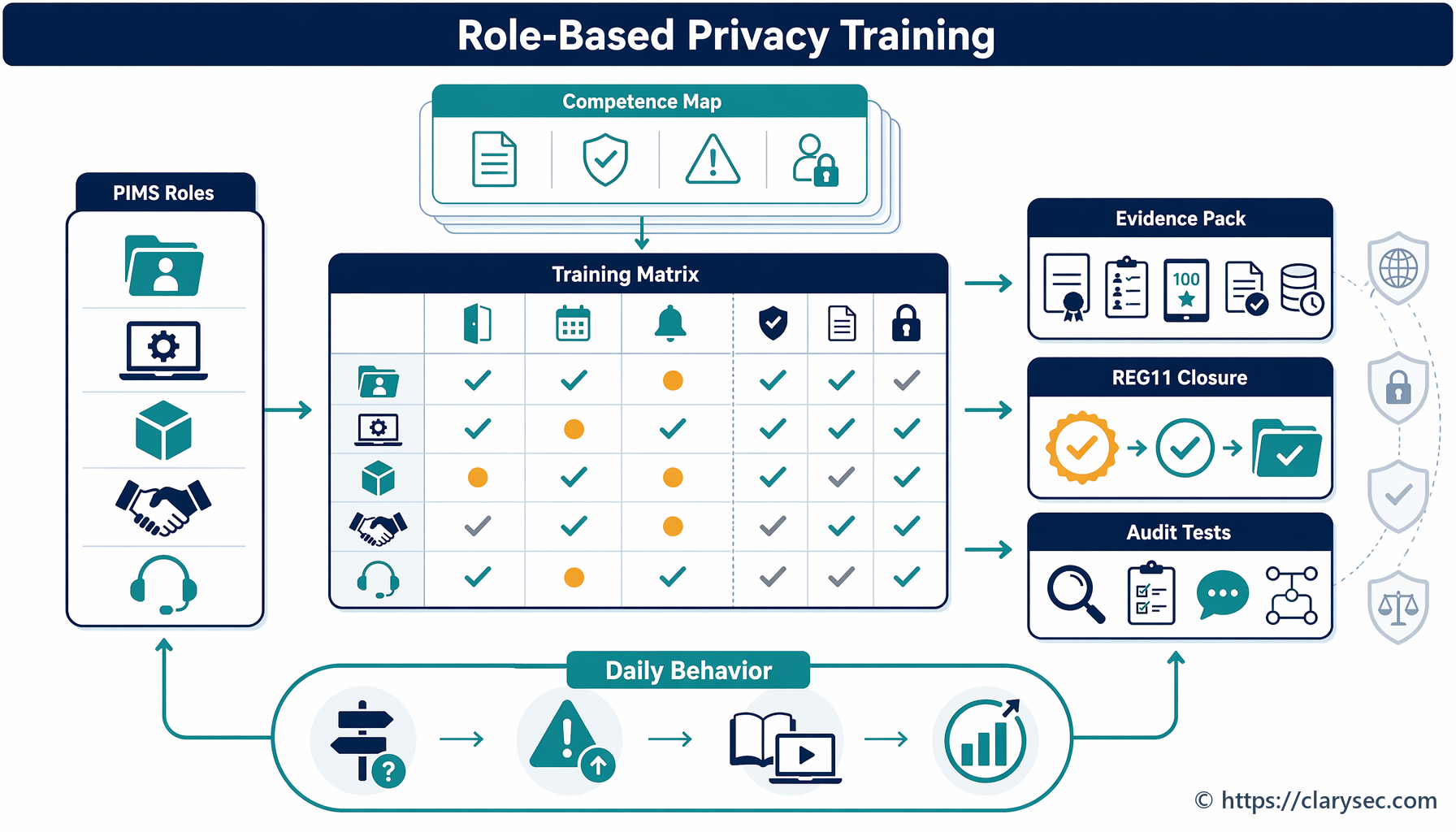
Clarysec treats privacy training as a governance control, not a learning and development side project. A defensible PIMS training program has four layers:
- Baseline privacy awareness for all personnel with PII access or PIMS responsibilities.
- Role-based training for teams whose decisions affect privacy outcomes.
- Trigger-based training after role changes, new systems, incidents, audit findings, or regulatory changes.
- Evidence capture in REG11, linked to audience, role, training type, required completion date, acknowledgements, overdue records, refresher evidence, and evidence owners.
This follows the structure of the Zenith Blueprint, Clarysec’s 30-step roadmap for implementing an audit-ready management system. In Step 4, “Roles and Responsibilities in the ISMS,” the Blueprint emphasizes communicating roles so personnel know who owns what, who to contact, and how to report incidents.
Step 5, “Communication, Awareness, and Competence,” is even more explicit:
“Identify Required Competencies: Determine what knowledge and skills are necessary for different roles in your ISMS… your developers need to know secure coding principles, your HR team should know how to handle personal data securely, etc.”
That same logic applies directly to ISO/IEC 27701:2025. You cannot assign PII responsibilities and hope generic awareness covers them. Competence must be identified, trained, measured, and evidenced.
The Privacy Training, Awareness and Competence Policy turns this into a PIMS workflow. Clause 4.1.6 requires:
“[All] The Privacy Lead / PIMS Manager MUST record the assigned training audience, training type, required completion date and evidence owner in REG11 before each annual training cycle begins.”
This creates a bridge between privacy roles and audit evidence. The auditor no longer has to infer who should have been trained. REG11 shows the assignment, deadline, completion, overdue status, acknowledgement, refresher cycle, and owner.
The ISO/IEC 27002:2022 controls behind privacy training
Privacy training becomes auditable when it is tied to controls, not just course completions. In Zenith Controls, Clarysec maps role-based privacy training through three central ISO/IEC 27002:2022 controls: 6.3, 5.2, and 5.34.
| ISO/IEC 27002:2022 control | PIMS meaning | Why it matters for ISO 27701:2025 and GDPR |
|---|---|---|
| 6.3 Information Security Awareness, Education and Training | Personnel receive general and role-specific awareness, education, and training | Converts privacy obligations into daily behavior and provides evidence of competence |
| 5.2 Information Security Roles and Responsibilities | Privacy, security, risk, incident, supplier, and system ownership are assigned and communicated | Ensures training is tied to accountable PIMS roles, not generic audiences |
| 5.34 Privacy and Protection of PII | PII protection is embedded into policies, procedures, systems, and operations | Ensures privacy training covers real PII risks, GDPR principles, breach reporting, and lawful handling |
Zenith Controls classifies control 6.3 as preventive, supporting confidentiality, integrity, and availability, with the cybersecurity concept “Protect,” operational capability “Human Resource Security,” and governance and ecosystem domains. Its purpose is to prevent privacy and security failures caused by human error, unclear expectations, and role confusion.
Control 6.3 also depends on related controls:
| Related ISO/IEC 27002:2022 control | Relationship to privacy training |
|---|---|
| 5.1 Policies for Information Security | Training communicates policies so they are understood and followed |
| 5.2 Information Security Roles and Responsibilities | Role definitions drive role-specific privacy training |
| 5.36 Compliance with Policies, Rules and Standards for Information Security | Training helps personnel comply with internal and external requirements |
| 6.4 Disciplinary Process | Personnel understand consequences of non-compliance |
| 6.8 Information Security Event Reporting | Staff learn to recognize and report security and privacy events |
| 8.16 Monitoring Activities | Monitoring personnel understand anomalies, tools, and escalation protocols |
For privacy, control 5.34 is the anchor. Zenith Blueprint, Step 23, explains the behavioral requirement behind privacy and PII protection:
“Staff must understand what PII is, how to report misuse, and what practices are prohibited, not in legal terms, but in day-to-day behavior.”
That sentence captures what many PIMS implementations miss. Privacy policies may be legal artifacts, but privacy training must be operational.
Build the role-based PIMS training matrix
The most useful artifact for privacy training governance is a role-based training matrix. It connects role, PII exposure, key risks, required training, timing, and evidence.
The Privacy Training, Awareness and Competence Policy requires this before PIMS responsibilities are assigned. Clause 4.3.1 states:
“[All] The Privacy Lead / PIMS Manager MUST define role-based privacy training topics in REG11 before assigning PIMS responsibilities to a role.”
A practical matrix should look like this:
| Role or audience | PII exposure | Required privacy training topics | Evidence in REG11 |
|---|---|---|---|
| All personnel with PII access | May view, store, transmit, or discuss PII | PII definition, confidentiality, data minimization, secure sharing, incident reporting, phishing, acceptable use | Baseline assignment, completion date, quiz score, acknowledgement |
| HR team | Employee and candidate records, payroll, health or absence data | Employee privacy, special category handling, retention, access restrictions, confidentiality, secure transfer | HR role module, confidentiality acknowledgement, refresher evidence |
| Customer support | Customer identifiers, tickets, screenshots, account issues | Identity verification, ticket minimization, DSAR recognition, accidental disclosure, escalation | Support module, scenario quiz, escalation drill evidence |
| Developers and testers | Production or test datasets, logs, analytics, telemetry | Privacy by design, masking, pseudonymisation, secure logging, test data restrictions, change review | Developer module, secure SDLC evidence, project privacy checklist |
| System administrators | Privileged access to systems containing PII | Least privilege, monitoring, access approvals, logging, encryption, privileged activity handling | Admin module, privileged access acknowledgement, access review evidence |
| Procurement and vendor owners | Supplier contracts and processor relationships | Processor due diligence, subprocessor awareness, contract clauses, transfer considerations, supplier incident duties | Supplier module, vendor checklist training, procurement workflow acknowledgement |
| Incident response team | Security events and potential personal data breaches | Breach triage, evidence preservation, notification escalation, communications, root cause, lessons learned | Incident module, tabletop attendance, scenario results |
| Executives and management body | Governance, resources, accountability, risk acceptance | GDPR accountability, PIMS objectives, risk appetite, regulatory exposure, metrics, management review | Executive briefing, attendance, management review minutes |
This matrix also supports controller and processor role clarity. A SaaS provider acting as a processor needs training on documented customer instructions, subprocessor engagement, breach support, return and deletion, and contractual flow-down. The same organization, acting as a controller for HR and marketing, needs lawful basis, privacy notices, consent where applicable, data subject rights, and retention training.
This distinction matters because GDPR Article 4 differentiates controllers and processors, and ISO/IEC 27701:2025 expects those privacy roles to be operationally understood.
Use onboarding, annual, and trigger-based training
A PIMS training program must answer three timing questions: what happens when someone joins, what happens every year, and what happens when risk changes.
The Privacy Training, Awareness and Competence Policy sets the baseline. Clause 4.2.1 requires:
“[All] The Privacy Lead / PIMS Manager MUST assign baseline privacy awareness training in REG11 within 10 business days of onboarding for personnel with access to PII or PIMS responsibilities.”
Clause 4.2.3 adds:
“[All] The Privacy Lead / PIMS Manager MUST assign annual privacy refresher training in REG11 at least once every 12 months.”
The SME Information Security Awareness and Training Policy reinforces freshness and practicality. Clause 6.1.1 states:
“Materials must be practical, role-appropriate, and updated annually.”
The mature step is trigger-based training. Clause 6.5.1 of the same SME policy states:
“When job roles change or systems are introduced, targeted awareness training may be required (e.g., secure file sharing, new data protection, and data minimization requirements).”
This is where privacy training becomes risk-informed. A support agent promoted to team lead may gain access approval duties. A new CRM may introduce exports, integrations, retention fields, and data subject request impacts. A new analytics tool may introduce tracking, profiling, or consent implications. A new payroll vendor may introduce processor due diligence and cross-border transfer requirements.
Training should be triggered by these changes, not delayed until the annual refresher.
The enterprise Information Security Awareness and Training Policy adds a clear completion window. Clause 6.1.3 states:
“Role-based training (e.g., administrators, developers, executives) must be assigned and completed within 60 days of role assignment or elevation of system privileges.”
For high-risk PII roles, many organizations choose shorter deadlines, but the principle is the same: role-based training follows responsibility.
How REG11 closes an audit finding
Consider a realistic internal audit finding:
“Customer support personnel can access customer PII and may receive data subject access requests, but there is no evidence of role-based privacy training for support agents or team leads.”
A Clarysec implementation team would close the finding in five steps.
First, the Privacy Lead creates a REG11 training audience called “Customer Support PII Handlers.” The evidence owner is the Support Operations Manager. The training type is “Role-based privacy training.” The completion deadline is 30 days. The linked responsibilities include identity verification, ticket minimization, secure attachments, DSAR recognition, and suspected breach escalation.
Second, the Privacy Lead maps the content to policy requirements, including clause 4.3.1 of the Privacy Training, Awareness and Competence Policy and clause 6.1.3 of the enterprise Information Security Awareness and Training Policy.
Third, the training uses scenario-based testing:
| Scenario | Expected competence |
|---|---|
| A customer asks for “all data you hold about me” in a ticket | Recognize a potential DSAR and escalate through the approved workflow |
| A support agent wants to paste a payment screenshot into chat | Minimize PII and use approved secure channels |
| A customer sends another person’s ID document by mistake | Stop unnecessary processing and escalate accidental disclosure |
| A permission change exposes unexpected customer records | Report a potential access control and privacy incident |
| A deletion request conflicts with a legal retention hold | Escalate for privacy and legal review before action |
Fourth, completion is recorded in REG11: learner, role, module, completion timestamp, quiz or scenario score, acknowledgement, overdue status, refresher date, and evidence owner.
Clause 4.4.1 of the Privacy Training, Awareness and Competence Policy requires:
“[All] The Privacy Lead / PIMS Manager MUST maintain training assignment, completion, overdue, acknowledgement and refresher evidence in REG11 for each required privacy training activity.”
Fifth, the audit finding is closed with evidence: REG11 export, training material, attendance records, quiz results, support procedure update, and the internal escalation path.
The key is not that support received a slide deck. The key is that role-specific competence was assigned, tested, evidenced, and linked to PIMS duties.
Cross-compliance value: GDPR, NIS2, DORA, NIST, and COBIT
Role-based privacy training is not only an ISO/IEC 27701:2025 issue. It is a cross-compliance control.
GDPR supplies the privacy substance. Article 5(2) requires accountability. Article 32 requires appropriate technical and organizational measures for security of processing. Article 39(1)(b) also makes awareness-raising and staff training part of the DPO monitoring role where a DPO is appointed.
The enterprise Information Security Awareness and Training Policy recognizes this in clause 11.4.1:
“Article 32 – Security of Processing: Mandates that personnel handling personal data be trained to recognize, prevent, and report risks to personal information. This policy ensures that data handlers and all relevant roles are trained accordingly.”
NIS2 adds cyber resilience. Article 20 requires management body members of essential and important entities to follow cybersecurity training and encourages regular training for employees. Article 21(2)(i) includes basic cyber hygiene practices and cybersecurity training among risk-management measures.
DORA adds financial-sector specificity. Article 13 requires financial entities to maintain digital operational resilience training programmes as part of human resources policy. Article 5 also places ICT risk governance duties on the management body. For financial entities, DORA applies directly from 17 January 2025 and operates as the sector-specific Union legal act where it overlaps with NIS2 ICT risk and incident reporting obligations.
NIST CSF 2.0 provides an organizing layer. The GOVERN function expects legal, regulatory, contractual, privacy, and civil liberties obligations to be understood and managed. The PROTECT function includes awareness and training through PR.AT-01 for personnel awareness and PR.AT-02 for specialized role training.
COBIT 2019 focuses on governance and capability. APO07 supports human resources management, BAI05.07 supports skills development, APO13.01 supports security management, and DSS06.08 supports data privacy management. From a COBIT perspective, privacy training must connect to workforce capability, governance objectives, management review, and corrective action.
Zenith Controls brings these threads together. It maps control 6.3 to GDPR training and awareness expectations, NIS2 Article 21(2)(i), DORA Article 13, NIST SP 800-53 awareness and training controls, and COBIT skills and labor policy objectives. It maps control 5.2 to GDPR accountability and DPO tasks, NIS2 organizational measures, DORA governance responsibilities, NIST role assignment, and COBIT governance structures. It maps control 5.34 to GDPR security and privacy by design, NIS2 security policies, DORA data confidentiality, NIST privacy controls, and COBIT privacy management.
The business benefit is efficiency. One governed training system can produce evidence for several frameworks instead of forcing teams to maintain disconnected compliance programs.
Supporting ISO guidance that strengthens the program
Role-based PIMS training becomes stronger when connected to related ISO guidance.
ISO/IEC 27005:2024 treats human-factor risks, including phishing, social engineering, and negligent behavior, as risk sources requiring treatment. Training is therefore a risk treatment, not an administrative exercise.
ISO/IEC 27035-1:2023 emphasizes awareness for incident management. Personnel must recognize and report incidents, including suspected PII misuse or accidental disclosure. For privacy, this is critical because breach assessment timelines often begin when the organization becomes aware of an issue.
ISO/IEC 27017 supports cloud-specific role clarity. Cloud teams need training on shared responsibility, configuration, access management, backup responsibilities, logging, monitoring, and escalation.
ISO/IEC 27018 supports PII protection in public cloud environments. Cloud providers and customers should train personnel on customer instructions, unauthorized use, PII return and deletion, and breach support.
ISO/IEC 29100 provides privacy principles such as consent, limitation, transparency, minimization, and accountability. These principles help convert legal language into practical behavior.
ISO/IEC 27014 supports governance delegation and decision-making, which matters when executives, privacy leads, risk owners, and system owners need different training depth.
ISO/IEC 27036-2 supports supplier relationship responsibilities. Procurement and vendor owners need privacy training because processor contracts, subprocessor chains, audit rights, and incident clauses affect live risk.
What auditors actually test
A privacy training program is only defensible if it survives testing.
An ISO-oriented auditor will start with scope, roles, competence, awareness, and records. They may sample new hires, developers, privileged users, HR personnel, support agents, procurement owners, contractors, and incident responders.
A PIMS auditor will test privacy substance. They may ask whether personnel understand PII, DSAR recognition, controller and processor duties, processing instructions, breach escalation, and prohibited practices.
A NIST-oriented assessor will look for general awareness, specialized role training, training records, and tracked gaps. They may compare current and target profiles and review plans of action.
A COBIT auditor will evaluate whether training supports governance objectives and workforce capability. They may ask whether management reviews completion rates, overdue training, phishing simulation trends, incident reporting behavior, and corrective actions.
An ISACA ITAF-style auditor may focus on performance evidence: completion rates, quiz scores, interviews, simulation results, incident trends, and management action.
Zenith Controls captures this audit lens for control 6.3. Auditors may review curricula, schedules, materials, attendance records, completion certificates, employee interviews, phishing simulation results, and metrics such as completion rates and quiz scores. A practical interview test is often decisive: can employees explain what they would do if they receive a suspicious message, suspect unauthorized PII access, or receive a privacy request?
Evidence is not only a spreadsheet. It is whether people know what to do.
Common PIMS training nonconformities
Clarysec implementations reveal recurring privacy training gaps:
- Training exists, but it is generic and not role-based.
- PII handlers are not clearly identified.
- Contractors and third parties with PII or system access are omitted.
- Developers receive secure coding training but not privacy by design or test data restrictions.
- Support teams are trained on service quality but not DSAR recognition or accidental disclosure.
- HR handles sensitive employee data without role-specific privacy training evidence.
- Procurement negotiates supplier contracts without processor or subprocessor training.
- Incident responders know cyber escalation but not personal data breach triage.
- New hires complete security training, but privacy training is delayed.
- Role changes and new systems do not trigger targeted training.
- Completion is tracked, but overdue, acknowledgement, and refresher evidence are missing.
- Management receives dashboards but does not act on gaps.
The Data Protection and Privacy Policy makes the expected management discipline clear. Clause 4.7.3 requires organizations to:
“Maintain staff confidentiality agreements and privacy awareness training.”
For SMEs, the Data Protection and Privacy Policy - SME is more direct. Clause 4.5.2 states:
“Must complete privacy training”
Clause 7.2.2 connects training to risk treatment:
“Training and awareness must be used as controls to reduce human error in data handling”
That is the heart of the issue. Privacy training is a control designed to reduce risk.
A practical implementation checklist
A defensible privacy training program does not need to become bureaucratic. It needs a clear operating model, good evidence, and regular management attention.
Use this checklist to build or improve your program:
| Step | Action | Evidence |
|---|---|---|
| 1 | Define PIMS roles and PII access groups | Role register, access groups, responsibility matrix |
| 2 | Map each role to privacy obligations and key PII risks | PIMS responsibility matrix, risk assessment, ROPA links |
| 3 | Define baseline and role-based training topics | REG11 assignments, training catalogue, policy mapping |
| 4 | Assign onboarding training within required timelines | REG11 onboarding records, completion dates |
| 5 | Assign annual privacy refresher training | Annual training plan, refresher records |
| 6 | Trigger training after role changes, new systems, incidents, and audit findings | Change records, incident lessons learned, updated REG11 entries |
| 7 | Test competence through scenarios, quizzes, interviews, and tabletop exercises | Scores, attendance, interview notes, tabletop reports |
| 8 | Escalate overdue training and report metrics to management | Overdue log, management review minutes, corrective actions |
| 9 | Update materials annually and after material changes | Version history, approvals, communications |
| 10 | Link evidence to controls and compliance obligations | Crosswalks, audit package, REG11 export |
The Zenith Blueprint supports this lifecycle through leadership, scope, role assignment, competence, communication, and control implementation. In the Controls in Action phase, Step 15, “People Controls I,” it recommends annual training, role-specific modules, new hire onboarding, simulated phishing, bulletins, team briefings, evidence of participation, and extending training to contractors or third parties with system or data access.
The policy pack gives you the governance baseline. The privacy-specific training policy gives you the REG11 evidence workflow. The data protection policies define responsibilities and awareness expectations. Zenith Controls provides the audit and cross-compliance mapping layer.
Together, these tools help a CISO, Privacy Lead, DPO, compliance manager, or HR owner explain why one training program supports ISO/IEC 27701:2025, GDPR, NIS2, DORA, NIST, and COBIT expectations.
Turn privacy accountability into daily behavior
If your ISO/IEC 27701:2025 or GDPR program relies on generic annual awareness, start with a simple test. Choose five roles that touch PII: HR, customer support, developers, administrators, and procurement.
For each role, ask:
- What PII do they handle?
- What privacy decisions do they make?
- What mistakes could create GDPR or PIMS risk?
- What training have they completed?
- Where is the evidence?
- Would they know how to escalate a suspected PII incident today?
- Has training been updated after system changes, incidents, or audit findings?
If you cannot answer those questions from documented evidence, the training program is not yet defensible.
Clarysec helps organizations move from completion percentages to measurable competence. Use the Privacy Training, Awareness and Competence Policy, Information Security Awareness and Training Policy, Information Security Awareness and Training Policy - SME, Data Protection and Privacy Policy, Data Protection and Privacy Policy - SME, Zenith Blueprint, and Zenith Controls to build an audit-ready PIMS training program that turns privacy accountability into daily behavior.
Download the policy pack, map your roles to REG11, and schedule a Clarysec assessment to prove that your people are not just aware of privacy. They are competent, accountable, and ready for audit.
About the Author

Igor Petreski
Compliance Systems Architect, Clarysec LLC
Igor Petreski is a cybersecurity leader with over 30 years of experience in information technology and a dedicated decade specializing in global Governance, Risk, and Compliance (GRC).Core Credentials & Qualifications:• MSc in Cyber Security from Royal Holloway, University of London• PECB-Certified ISO/IEC 27001 Lead Auditor & Trainer• Certified Information Systems Auditor (CISA) from ISACA• Certified Information Security Manager (CISM) from ISACA • Certified Ethical Hacker from EC-Council