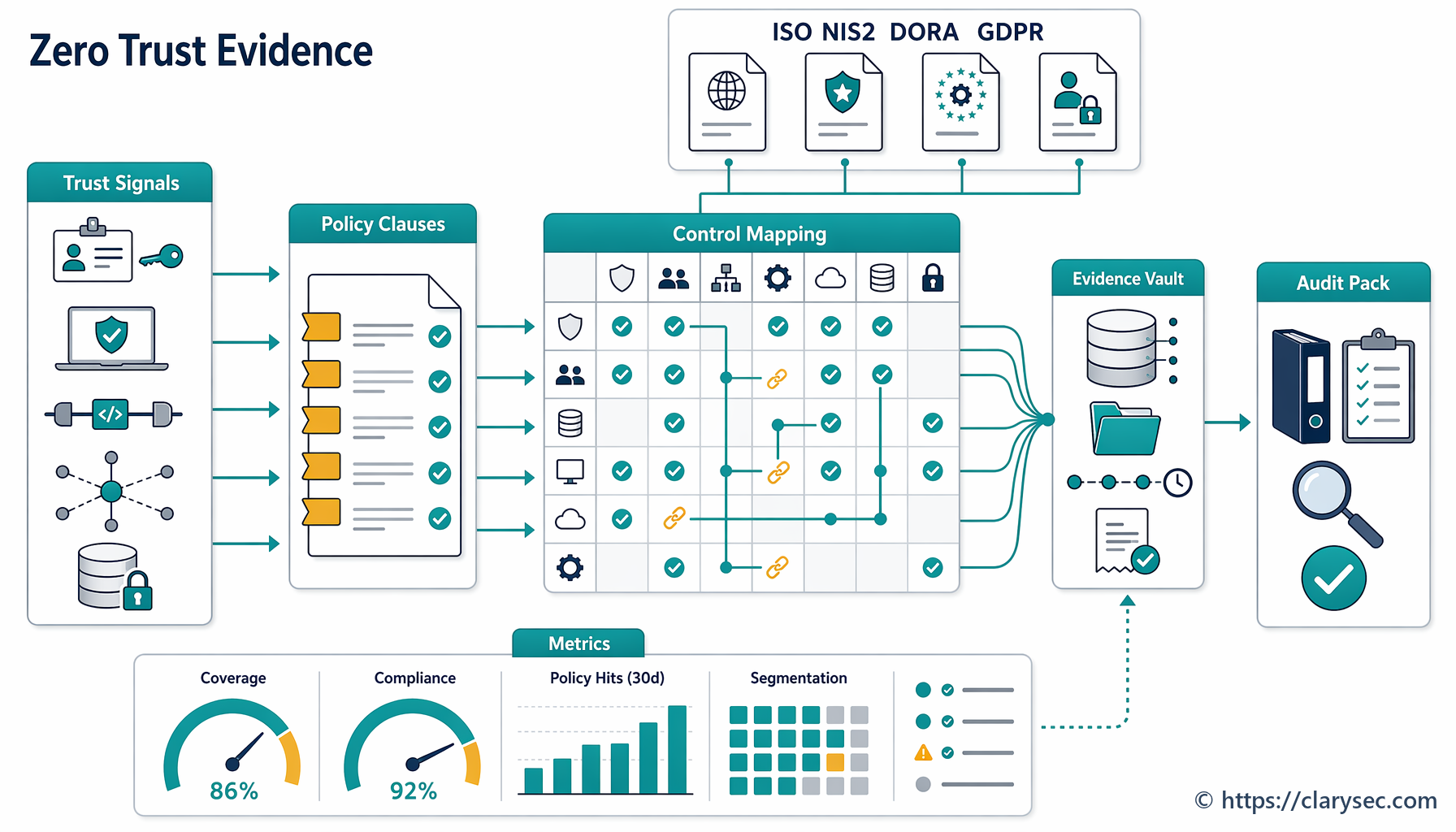
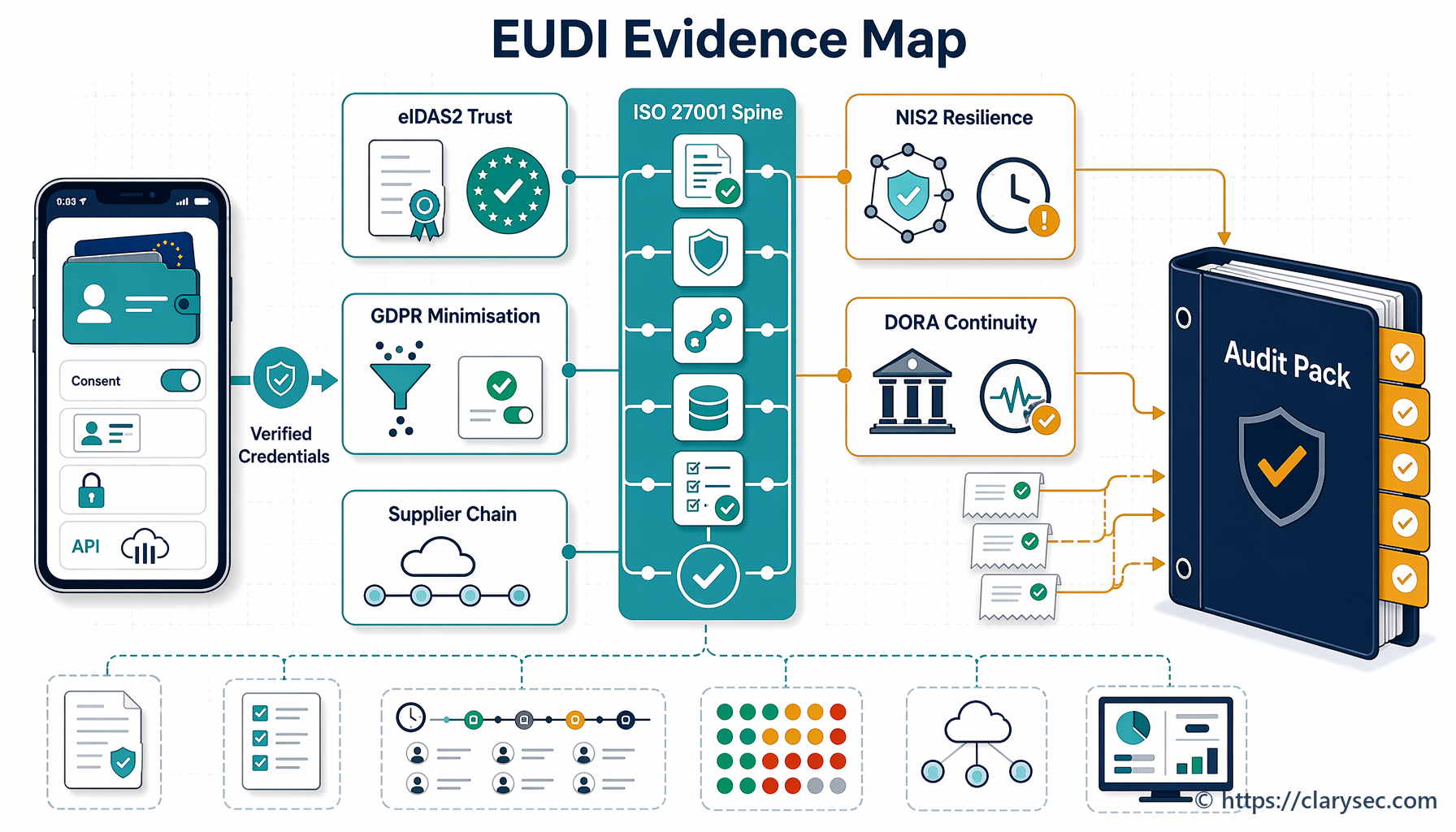
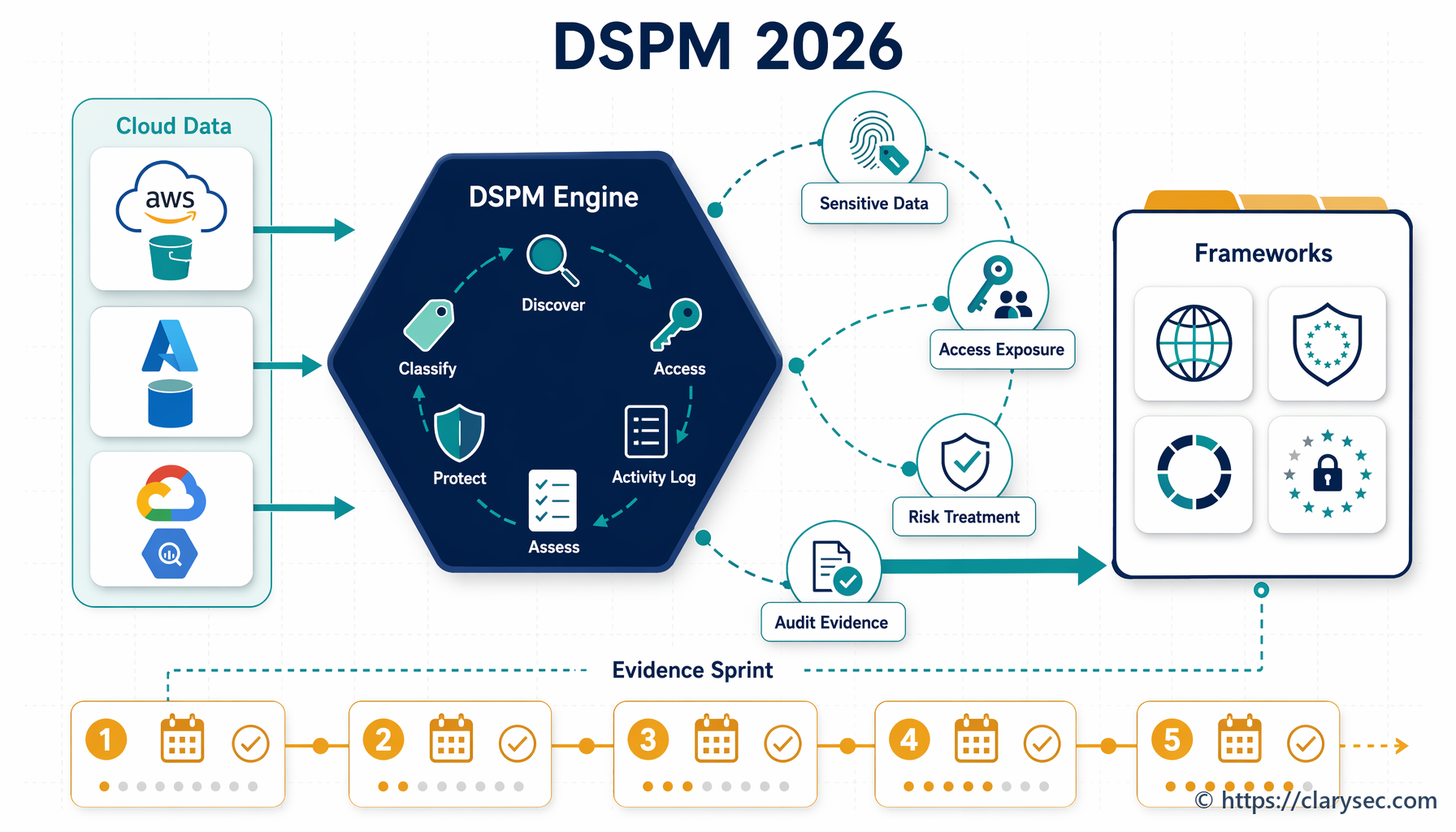
SaaS Security Posture Management for 2026 Audits
The SaaS audit finding that nobody owned
At 08:15 on a Tuesday, the CISO of a fast-growing fintech receives a message from the Data Protection Officer: “Why is a customer export publicly shareable from a collaboration tool, and who approved the OAuth app that can read it?”
By 09:00, finance confirms that the tool is paid through a departmental card, not central procurement. By 10:30, IT discovers that the user who created the public link left the company three months ago. By noon, Legal asks whether this is a GDPR personal data breach. By 14:00, the Risk Committee asks whether the issue affects NIS2 cyber hygiene and DORA ICT third-party risk. By 16:00, the internal auditor asks for configuration baselines, administrator access reviews, cloud service ownership, logs and supplier due diligence.
The painful truth is that the organization did not suffer a classic SaaS outage or vendor failure. It suffered a governance failure.
That scenario is no longer exceptional. A marketing team connects an AI platform to a CRM with broad OAuth permissions. HR buys a niche analytics tool outside procurement. A customer support team enables public ticket exports for convenience. Engineering integrates a browser extension into a development workflow. Each decision may feel small, but together they create a distributed control surface filled with regulated data, privileged workflows and operational dependencies.
SaaS Security Posture Management, or SSPM, is the discipline that turns that scattered SaaS reality into governed, tested and auditable control. Done well, it gives CISOs, compliance managers, auditors and business owners a single evidence trail for ISO/IEC 27001:2022, NIS2 cyber hygiene, DORA ICT risk and GDPR security accountability.
Clarysec’s position is direct: SSPM should not be treated as another dashboard. It should be embedded into the ISMS, linked to risk ownership, mapped to legal obligations, supported by policy and tested through recurring evidence.
That is where Zenith Blueprint: An Auditor’s 30-Step Roadmap Zenith Blueprint, Zenith Controls: The Cross-Compliance Guide Zenith Controls and Clarysec policy templates become practical. They help convert SaaS sprawl into a control model an auditor can understand and a management body can oversee.
Why SaaS Security Posture Management became a compliance issue
SaaS used to be treated as “software someone else runs.” That framing is no longer defensible.
Under NIS2, many cloud, SaaS, digital infrastructure, managed service and managed security providers can fall within regulated cybersecurity expectations depending on sector, size, role and criticality. More importantly, organizations that rely on SaaS must govern it as part of their own risk-management measures. NIS2 Article 20 makes management bodies responsible for approving cybersecurity risk-management measures, overseeing implementation and receiving training. Article 21 requires practical technical, operational and organizational measures, including risk analysis, policies, incident handling, business continuity, supply-chain security, secure acquisition and maintenance, effectiveness testing, cyber hygiene, cryptography, HR security, access control, asset management and multi-factor authentication where appropriate.
DORA raises the bar further for financial entities. Since 17 January 2025, DORA has applied to many financial-sector organizations as the operational resilience regime for in-scope entities. It requires ICT governance, identification and classification of ICT assets and supported functions, protection and prevention controls, incident management, continuity, testing and ICT third-party risk management. SaaS providers supporting critical or important functions become part of the DORA evidence perimeter, while the regulated financial entity remains accountable.
GDPR adds a privacy evidence layer. Article 5 requires integrity, confidentiality and accountability. Article 32 requires appropriate security of processing. In practice, an organization must know what personal data exists, where it is processed, who can access it, what suppliers process it and what safeguards protect it. A SaaS misconfiguration turns those questions into urgent breach assessment questions.
ISO/IEC 27001:2022 is the bridge. Clauses 4.1 to 4.4 require the organization to define context, interested-party requirements, scope, interfaces and dependencies. Clause 5 requires leadership, policy, roles and accountability. Clauses 6.1.1 to 6.1.3 require risk assessment, risk treatment, the Statement of Applicability and residual-risk decisions. Clauses 8.1, 8.2 and 8.3 require operational planning, risk assessment and risk treatment. Clauses 9 and 10 require monitoring, internal audit, management review and improvement.
If you cannot answer which SaaS tools process regulated data, who owns them, how they are configured, who has administrator access, which integrations are active and what evidence proves the control works, your compliance position is fragile.
The Clarysec SSPM model: inventory, ownership, baseline, evidence
Clarysec treats SaaS Security Posture Management as a repeatable control loop, not a one-time clean-up project.
- Discover every SaaS service, including shadow SaaS.
- Assign a business owner and technical owner.
- Classify data, users, integrations and operational criticality.
- Apply secure configuration baselines.
- Review users, administrators, guests, service accounts and OAuth scopes.
- Enable logging, alerting and retention.
- Monitor public sharing and data exposure.
- Link suppliers, contracts, data processing agreements and exit planning.
- Collect evidence on a defined cadence.
- Feed findings into risk treatment, management review and improvement.
This model aligns tightly with ISO/IEC 27002:2022 ISO/IEC 27002:2022 controls, especially 5.9 inventory of information and other associated assets, 5.15 access control, 5.18 access rights, 5.19 information security in supplier relationships, 5.20 addressing information security within supplier agreements, 5.21 managing information security in the ICT supply chain, 5.23 information security for use of cloud services, 8.2 privileged access rights, 8.3 information access restriction, 8.9 configuration management, 8.15 logging, 8.16 monitoring activities and 8.32 change management.
The Zenith Blueprint, in the Controls in Action phase, Step 23 for organizational controls, states:
The cloud is no longer a destination, it’s the default. From storage to collaboration, from infrastructure to machine learning, organizations are increasingly built on layers of third-party, abstracted, remotely managed environments. Control 5.23 recognizes this reality and requires that information security be explicitly addressed in the selection, use, and management of cloud services , not as an afterthought, but as a design principle from the very beginning.
That is the heart of SSPM. It is not just detecting misconfiguration after the fact. It is making SaaS selection, onboarding, operation, monitoring and exit part of the management system.
The same Zenith Blueprint section explains the shared-responsibility reality in language every board member should hear:
Cloud providers secure the infrastructure, but you are still accountable for your data, your configurations, your access policies, and your incident response readiness. A misconfigured storage bucket, a publicly exposed dashboard, or excessive permissions in a cloud IAM setup, these aren’t cloud failures. They are failures of governance.
Your provider may operate the platform, but you still own tenant configuration, identities, access approvals, exposed data, integrations, incident workflows and compliance evidence.
Control 5.23 is the anchor, but SSPM needs a control family
In Zenith Controls, ISO/IEC 27002:2022 control 5.23, information security for use of cloud services, is categorized as a preventive control supporting confidentiality, integrity and availability. Its cybersecurity concept is Protect, with operational capability in supplier relationships security and domains across governance, ecosystem and protection.
That matters because SSPM is not a single control. It is a cross-control discipline.
Zenith Controls links 5.23 to supplier relationships under 5.19 because SaaS providers are critical suppliers, but 5.23 adds SaaS-specific concerns such as multi-tenancy, data location transparency and shared responsibility. It links 5.23 to information transfer because APIs, integrations and inter-SaaS workflows move data constantly. It links 5.23 to asset inventory because organizations need current visibility into cloud-stored data and SaaS resources. It also links cloud governance to monitoring, access restriction, configuration management and supplier oversight.
| SSPM capability | Primary ISO/IEC 27002:2022 control | Why it matters in SaaS |
|---|---|---|
| SaaS inventory and ownership | 5.9 and 5.23 | You cannot protect, audit or exit a SaaS service you do not know exists |
| Administrator role review | 5.18 and 8.2 | Excessive admin rights create account takeover and data exposure risk |
| User and group permissions | 5.15, 5.18 and 8.3 | SaaS permissions often outlive role changes, projects and employment |
| Configuration baseline | 8.9 and 5.23 | Public sharing, weak MFA, guest access and risky defaults are tenant-side responsibilities |
| OAuth and app integrations | 5.14, 8.3 and 8.25 | Integrations can silently expand data access and bypass user reviews |
| Logging and alerting | 8.15 and 8.16 | SaaS incidents require logs for detection, investigation and reporting |
| Supplier review and contracts | 5.19, 5.20, 5.21 and 5.23 | SaaS providers are part of the operational and regulatory dependency chain |
| Change and release governance | 8.32 and 8.9 | SaaS feature releases and tenant changes can alter exposure without formal review |
| Evidence cadence | ISO/IEC 27001:2022 clauses 9.1, 9.2 and 9.3 | Auditors need proof that controls operate repeatedly, not once |
For access rights, Zenith Controls maps 5.18 to 5.15 access control, 5.16 identity management, 5.3 segregation of duties, 5.36 compliance with policies, rules and standards for information security and 8.2 privileged access rights. For SSPM, this means access review is not just a spreadsheet exercise. It is operational proof that identity lifecycle, least privilege, segregation and privileged access governance work inside SaaS applications.
Policy foundation: define good before buying tools
Many SaaS failures begin because policy language is vague. “Use approved tools securely” is not enough. Clarysec policies define specific register, access, logging, configuration and supplier review expectations.
For SMEs, the Cloud Usage Policy-sme Cloud Usage Policy - SME gives a practical starting point. From section “Governance Requirements,” policy clause 5.3:
A Cloud Service Register must be maintained by the IT provider or GM. It must record: 5.3.1 The name and purpose of each approved cloud service 5.3.2 The responsible person or team (Application Owner) 5.3.3 The types of data stored or processed 5.3.4 The country or region where data is stored 5.3.5 User access permissions and administrative accounts 5.3.6 Contract details, renewal dates, and support contacts
This clause is the operating core of SSPM. It gives auditors the first evidence object: a register that connects SaaS usage to owners, data, geography, access and contracts.
The same Cloud Usage Policy-sme, from section “Policy Implementation Requirements,” policy clause 6.2, defines baseline settings:
Security Configuration Requirements 6.2.1 The following must be enabled on all cloud platforms: 6.2.2 Multi-factor authentication (MFA) for administrative and user accounts 6.2.3 Password complexity settings (minimum 10 characters, no reuse) 6.2.4 Activity logging for login attempts and data access 6.2.5 Access restrictions (e.g., IP allow-listing, where supported) 6.2.6 Administrative access must be limited to named individuals or authorized support providers. 6.2.7 Publicly shared content must be monitored regularly to prevent data leakage. 6.2.8 When user accounts are no longer required, access must be revoked immediately and any residual data must be reviewed and archived or deleted.
For enterprise environments, the Cloud Usage Policy Cloud Usage Policy assigns stronger centralized governance. From section “Governance Requirements,” policy clause 5.3:
Each cloud service must have an assigned service owner accountable for information asset lifecycle management, usage governance, budget tracking, and ongoing compliance monitoring.
That sentence closes a common audit gap. If nobody owns a SaaS service, nobody owns configuration drift, access recertification, data exposure, renewal decisions, incident contact or exit planning.
Privilege governance must also be explicit. The User Account and Privilege Management Policy-sme User Account and Privilege Management Policy - SME, from section “Policy Implementation Requirements,” policy clause 6.4, states:
Access Reviews and Logging 6.4.1 A review of all user accounts and privileges must be performed every six months. 6.4.2 During reviews, the IT Lead must validate whether each account remains active, necessary, and assigned the correct permissions. 6.4.3 Logs of account creation, account deactivation, and privilege changes must be securely retained for at least 12 months.
For SaaS, every critical platform needs a defined access review cycle, even if the platform is administered by a business team rather than central IT.
Logging must be explicit too. The Logging and Monitoring Policy-sme Logging and Monitoring Policy - SME, from section “Governance Requirements,” policy clause 5.5, states:
Cloud Services and Third-Party Logging 5.5.1 For platforms where logging is not under direct IT control (e.g., SaaS email), the following requirements apply: 5.5.1.1 Logging must be enabled and configured where available 5.5.1.2 Alerts must be routed to the IT Support Provider 5.5.1.3 Contracts must require providers to retain logs for at least 12 months and provide access upon request
Finally, SaaS supplier governance must be documented. The Third-Party and Supplier Security Policy-sme Third-Party and Supplier Security Policy - SME, from section “Policy Implementation Requirements,” policy clause 6.3, states:
Ongoing monitoring of supplier security 6.3.1 Critical or high-risk suppliers must be reviewed at least annually. The review must verify: 6.3.1.1 Continued use of secure access methods 6.3.1.2 Valid security certifications or updated control evidence 6.3.1.3 Incident history or reported issues 6.3.1.4 Contractual compliance with security clauses 6.3.2 These reviews must be documented and retained with the supplier’s record. Follow-up actions must be clearly tracked. 6.3.3 Where suppliers manage IT infrastructure or applications, monitoring may include: 6.3.3.1 Requesting audit logs 6.3.3.2 Reviewing account activity 6.3.3.3 Confirming that no unauthorized access has occurred
Together, these policies turn SSPM from a security aspiration into an enforceable operating model.
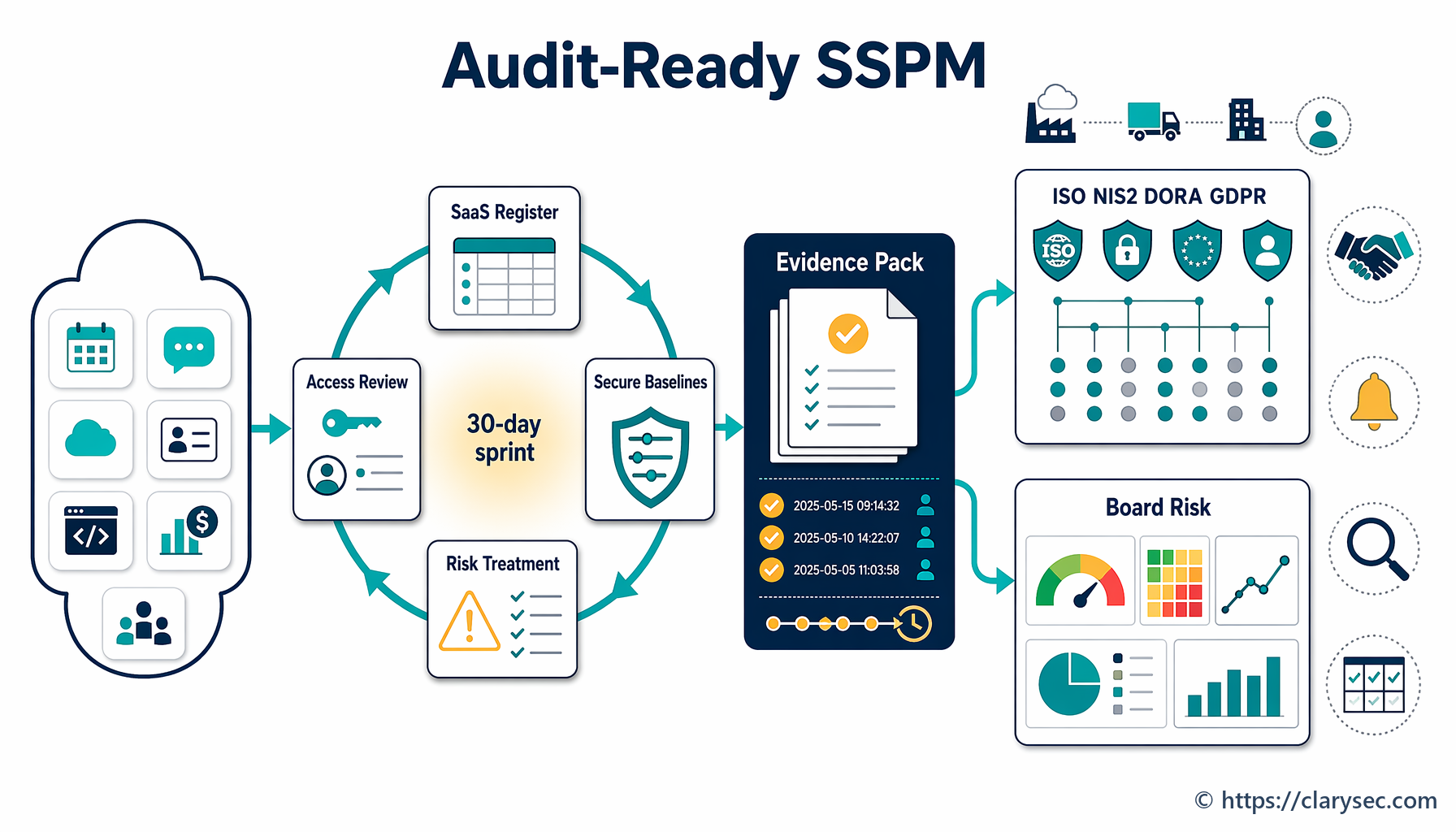
A 30-day SSPM evidence sprint
A practical CISO or compliance manager can start with a 30-day evidence sprint. Select the five SaaS platforms that matter most to regulated data or critical operations. Typical candidates include Microsoft 365 or Google Workspace, CRM, ticketing, HRIS, finance automation, customer support and analytics.
Week 1: Create the SaaS register
Use the Cloud Usage Policy-sme clause 5.3 fields as the minimum register. For each SaaS service, capture:
- Service name and business purpose
- Application owner and technical owner
- Data types, including personal data and special-category data where applicable
- Data storage country or region
- User groups and administrator accounts
- OAuth apps and third-party integrations
- Contract owner, renewal date and support contact
- Criticality for operations
- Applicable obligations, such as NIS2, DORA, GDPR or customer contracts
This supports ISO/IEC 27001:2022 clauses 4.2 and 4.3 because regulatory, contractual and third-party dependencies must shape the ISMS scope. It also supports DORA Article 8 style identification and classification of ICT-supported business functions, information assets, ICT assets and dependencies.
Week 2: Define secure configuration baselines
For each selected SaaS platform, define 10 to 15 baseline controls.
- MFA enforced for all users, with phishing-resistant MFA for administrators where possible
- External sharing disabled by default or limited to approved domains
- Public links disabled or time-limited
- Guest accounts reviewed monthly
- Admin roles assigned to named individuals
- Legacy authentication disabled
- OAuth app approval workflow enabled
- High-risk OAuth scopes blocked or requiring security approval
- Audit logging enabled
- Data export permissions restricted
- Retention settings aligned to legal and business requirements
- API tokens reviewed and rotated
- Security alerts routed to IT or SOC
- Data loss prevention settings enabled where supported
- Break-glass accounts documented and monitored
The Zenith Blueprint, Controls in Action phase, Step 19, control 8.9 configuration management, explains why this matters:
Many breaches don’t result from software flaws, they come from poor configuration choices. Default passwords left unchanged, insecure services enabled, unnecessary ports open, or systems exposed to the internet without justification. Control 8.9 ensures that every system is built to a secure configuration baseline and regularly reviewed to prevent drift over time.
For SaaS, configuration drift includes a business owner enabling public sharing, an administrator approving broad third-party access or a vendor changing default settings after a feature release.
Week 3: Review access and integrations
Export users, groups, administrators and connected applications. For each administrator account, confirm the named individual, business justification, MFA status, last login, privilege level, backup coverage, segregation of duties concerns and approval evidence.
For OAuth apps and integrations, confirm the app owner, data accessed, permissions requested, vendor risk status, last used date, ongoing need and whether consent was user-granted or administrator-approved.
The Zenith Blueprint, Controls in Action phase, Step 19, control 8.3 information access restriction, gives the operating principle:
Access to information should be as open as necessary, but as restricted as possible.
This applies not only to people, but also to applications, services and APIs. An inactive OAuth integration can retain access long after the employee or project that created it has disappeared.
Week 4: Produce audit-ready evidence and risk treatment
For each SaaS platform, store the register entry, configuration baseline, screenshots or exports proving key settings, access review sign-off, administrator review evidence, OAuth review evidence, logging and alerting evidence, supplier security review record, open findings and risk treatment actions.
Then create a one-page management summary showing critical findings, overdue owners, unresolved high-risk configuration gaps, unapproved integrations, logging gaps, exceptions and decisions required. This supports ISO/IEC 27001:2022 clause 9.1 monitoring, clause 9.2 internal audit and clause 9.3 management review. It also creates a practical bridge to NIS2 Article 20 management accountability and DORA management body oversight.
Cross-compliance mapping: one SSPM evidence pack, many obligations
The business value of SSPM is not only better security. It is reduced compliance duplication.
NIS2 Article 21 requires appropriate and proportionate technical, operational and organizational measures. SaaS inventory supports asset management. Configuration baselines support cyber hygiene. MFA and access reviews support access control. Logging supports incident handling. Supplier review supports supply-chain security. Evidence cadence supports policies and procedures to assess effectiveness.
DORA requires financial entities to identify and classify ICT-supported functions, information assets, ICT assets and third-party dependencies. It also requires protection and prevention measures, access controls, strong authentication, encryption, continuity, testing, incident management and ICT third-party risk governance. A SaaS SSPM evidence pack can support DORA registers, dependency mapping, contract oversight, audit rights and exit planning.
GDPR requires controllers to demonstrate compliance with integrity, confidentiality and accountability. SaaS registers identify where personal data is processed. Configuration baselines reduce unauthorized disclosure. Access reviews support least privilege. Logging supports breach investigation. Supplier records support processor governance and accountability.
NIST CSF 2.0 adds a useful communication layer. Its GOVERN function requires legal, regulatory and contractual cybersecurity requirements to be understood and managed. Its supply chain outcomes require supplier roles, contracts, due diligence, monitoring and post-relationship activities. Its IDENTIFY, PROTECT, DETECT, RESPOND and RECOVER functions map naturally to SaaS inventory, access control, data protection, logging, incident response and recovery.
| Compliance driver | What the auditor or regulator wants to see | SSPM evidence that helps |
|---|---|---|
| ISO/IEC 27001:2022 | Risk-based control selection, operation, monitoring, audit and improvement | SaaS risk assessment, Statement of Applicability linkage, register, reviews and management reporting |
| NIS2 | Cyber hygiene, asset management, access control, supply-chain security and incident readiness | SaaS inventory, MFA evidence, supplier review, logging, incident escalation paths |
| DORA | ICT dependency mapping, third-party risk, resilience testing and operational control | SaaS criticality map, contracts, exit plans, control tests, incident records |
| GDPR | Accountability, integrity, confidentiality and breach assessment evidence | Data classification, access review, exposure checks, logs and processor records |
| NIST CSF 2.0 | Current profile, target profile and prioritized action plan | SSPM gap assessment, remediation backlog, risk register and POA&M style tracking |
| COBIT 2019 | Governance objectives, ownership, performance and assurance | RACI, management reporting, KPIs, audit findings and corrective action tracking |
COBIT 2019 and ISACA-oriented auditors will usually approach SSPM through governance, management objectives, risk ownership, control operation and assurance. They will ask whether SaaS decisions are aligned with enterprise objectives, whether risk responses are documented, whether responsibilities are assigned and whether assurance activities prove that controls operate.
The audit lens: how different auditors test SaaS posture
A strong SSPM program survives different audit styles because it produces evidence at the right level.
| Audit perspective | Typical SSPM audit question | Evidence to prepare |
|---|---|---|
| ISO/IEC 27001:2022 | Is SaaS included in ISMS scope, risk assessment and control operation? | ISMS scope, SaaS register, risk treatment plan, SoA mapping, access and configuration reviews |
| NIST CSF 2.0 | What is the current SaaS posture, target posture and remediation plan? | CSF profile, gap assessment, prioritized action plan, risk register |
| DORA | Which SaaS supports critical or important functions and how is ICT third-party risk managed? | Dependency map, supplier register, contracts, exit plans, test results, incident records |
| NIS2 | Are cyber hygiene, supplier security and incident handling measures operating for SaaS? | Policies, MFA evidence, supplier reviews, incident plans, logging records |
| GDPR | Can the organization demonstrate appropriate security for personal data in SaaS? | Data inventory, access evidence, sharing review, logs, processor due diligence |
| COBIT 2019 or ISACA | Are SaaS risk decisions governed, owned, measured and improved? | RACI, management reporting, KPIs, audit findings, corrective action tracking |
An ISO/IEC 27001:2022 auditor will start with scope, interested parties, risk assessment, Statement of Applicability and operational evidence. If control 5.23 is included, they will expect evidence for selection, use, management and exit of cloud services. If access rights controls are included, they will sample users and ask whether joiner, mover and leaver changes are reflected in SaaS permissions.
A DORA reviewer will focus on critical or important functions, ICT third-party dependency, register completeness, contracts, incident classification, testing and exit planning. If a SaaS platform supports payment operations, customer onboarding, trading, risk analytics or client communications, the evidence standard rises.
A GDPR auditor or privacy reviewer will ask where personal data is stored, who can access it, what exports and sharing settings exist, whether processors are governed, whether logs support breach assessment and whether controls are proportionate to risk.
Supplier risk, shared responsibility and incident readiness
SSPM often starts with configuration, but it cannot stop there. SaaS is also a supplier risk and incident-readiness issue.
DORA requires financial entities to maintain registers of ICT service contracts, distinguish arrangements supporting critical or important functions, assess concentration risk, evaluate provider suitability and maintain exit strategies. Contracts should address service descriptions, data location, protection of availability, authenticity, integrity and confidentiality, data access, recovery and return, incident assistance, cooperation with authorities, termination rights, security requirements, audit rights and transition support.
NIS2 Article 21 also includes supply-chain security and requires entities to consider vulnerabilities specific to direct suppliers and service providers, the quality of products and supplier cybersecurity practices.
In practice, a critical SaaS review should combine security questionnaire evidence, contract review, data processing agreement status, incident history, service-level commitments, log access, audit reports, configuration evidence and exit feasibility.
The shared-responsibility gap appears when teams assume the supplier’s certification covers tenant configuration. It does not. A supplier may operate a secure platform while the customer enables public sharing, leaves dormant admin accounts active or grants excessive API scopes. SSPM closes that gap.
Incident readiness is equally important. NIS2 significant-incident reporting includes a 24-hour early warning, a 72-hour notification and a final report no later than one month after the 72-hour notification. DORA requires ICT-related incident management with detection, recording, classification, escalation, communication and notification. GDPR personal data breach assessment also depends on timely understanding of what happened, what data was affected and who was impacted.
If a suspicious OAuth app accessed customer files, you need to know when the app was authorized, which user authorized it, what scopes were granted, which data was accessed, whether data was downloaded or shared, which users or customers were affected, whether the access remains active and what containment actions were taken.
Without logging and retention, the organization may be forced to make worst-case assumptions. That increases legal exposure, customer communication pressure and regulatory uncertainty. Where a SaaS provider charges extra for audit logs, the risk owner should explicitly accept the residual risk or approve the required license tier. That decision belongs in the risk treatment record and management review.
Common SSPM failure patterns
The same failure patterns appear across sectors.
First, shadow SaaS is discovered through invoices, browser history or SSO logs rather than procurement. The fix is not only blocking tools. It is a lightweight intake process that business teams can use.
Second, SaaS ownership is unclear. The CRM is “owned by Sales,” but nobody in Sales can explain administrator roles, API tokens, data exports or retention settings. Assign application owners and technical owners separately.
Third, access reviews are too generic. A reviewer signs off “all users approved” without checking high-risk roles, inactive users, guests, external collaborators or service accounts. SSPM access review must be risk-ranked.
Fourth, OAuth apps are ignored. Many organizations review human users but not app-to-app permissions. In modern SaaS, integrations can be more powerful than users.
Fifth, configuration baselines exist only as screenshots from the certification project. They are not monitored for drift. Align SSPM with configuration management so baseline checks become recurring evidence.
Sixth, supplier review and SaaS posture review are separated. Procurement has the contract, IT has the admin console, Privacy has the data processing agreement and Security has the risk register. The auditor sees fragments. SSPM brings them together.
Management reporting: make SaaS risk visible to the board
NIS2 and DORA both make ICT and cybersecurity governance a management issue. ISO/IEC 27001:2022 also requires leadership, resources, role assignment, monitoring and management review.
An effective SSPM management report should answer:
- Which critical SaaS services are in scope?
- Which regulated processes depend on them?
- Which contain personal data or sensitive business data?
- Which have overdue access reviews?
- Which have unresolved high-risk configuration gaps?
- Which have unapproved OAuth apps or integrations?
- Which suppliers lack current security evidence?
- Which logging gaps affect incident reporting?
- Which exceptions require risk acceptance?
- Which investments or decisions are needed?
This transforms SSPM from a technical clean-up project into a governance input. It also makes the CISO more effective because risk acceptance moves to the right level.
Turn SaaS posture into audit-ready evidence
If your organization relies on SaaS for regulated data, financial operations, customer support, HR, collaboration, engineering or analytics, SSPM is no longer optional. It is part of cyber hygiene, ICT risk management, privacy accountability and audit readiness.
Clarysec can help you move from scattered SaaS findings to a structured, evidence-driven program by using:
- Zenith Blueprint: An Auditor’s 30-Step Roadmap Zenith Blueprint to structure implementation across cloud use, access restriction and configuration management.
- Zenith Controls: The Cross-Compliance Guide Zenith Controls to map ISO/IEC 27002:2022 controls to NIS2, DORA, GDPR, NIST CSF 2.0 and audit expectations.
- Clarysec policy templates such as Cloud Usage Policy Cloud Usage Policy, Cloud Usage Policy-sme Cloud Usage Policy - SME, User Account and Privilege Management Policy-sme User Account and Privilege Management Policy - SME, Logging and Monitoring Policy-sme Logging and Monitoring Policy - SME and Third-Party and Supplier Security Policy-sme Third-Party and Supplier Security Policy - SME to create enforceable operating rules.
Start with your five highest-risk SaaS platforms. Assign owners. Capture data, access, configuration, integrations, logs and supplier evidence. Turn findings into risk treatment actions and management decisions.
That is how SaaS Security Posture Management becomes more than a tool category. It becomes a defensible compliance discipline for 2026.
Download the Clarysec policy templates, use Zenith Blueprint to plan your 30-day SSPM evidence sprint, and map your SaaS controls with Zenith Controls before your next audit finds the gaps for you.
Frequently Asked Questions
About the Author

Igor Petreski
Compliance Systems Architect, Clarysec LLC
Igor Petreski is a cybersecurity leader with over 30 years of experience in information technology and a dedicated decade specializing in global Governance, Risk, and Compliance (GRC).Core Credentials & Qualifications:• MSc in Cyber Security from Royal Holloway, University of London• PECB-Certified ISO/IEC 27001 Lead Auditor & Trainer• Certified Information Systems Auditor (CISA) from ISACA• Certified Information Security Manager (CISM) from ISACA • Certified Ethical Hacker from EC-Council