Secure File Transfer Governance for ISO 27001 Audits
It was 4:47 PM on a Tuesday when Anya, the CISO of a rapidly growing FinTech, received the kind of call that changes a security program.
It was not ransomware. It was not a production outage. It was the General Counsel, speaking with controlled urgency. A junior analyst had attached the wrong file to an email during an M&A due diligence sprint. The file was not a harmless presentation. It contained financial projections, customer personal data and strategic intellectual property. The intended recipient was an external lawyer, but the analyst had typed a personal email address instead of the approved law firm mailbox.
The only reason the company avoided a major incident was a recently deployed data loss prevention rule. The email was blocked, an alert fired and the security team contained the event before the file left the environment.
The next morning, the pressure multiplied. A financial-services prospect sent a DORA due diligence questionnaire asking for evidence of secure ICT data exchanges. A customer asked the legal team to prove that all exports of personal data to support vendors were encrypted, approved and logged. The service desk then reported that a project manager had used a public file-sharing link because the managed file transfer portal was “too slow.”
That sequence is the reality of secure file transfer governance in 2026. The issue is no longer whether an organization owns SFTP, a managed file transfer platform, cloud collaboration tools or email encryption. The harder question is whether the organization can prove that sensitive information moved through approved channels, with the right classification, authorization, encryption, supplier commitments, logging, monitoring, retention and incident response triggers.
For CISOs, compliance managers, auditors and business leaders, information transfer is now a board-level evidence problem. GDPR expects accountability and appropriate technical and organisational measures for personal data. NIS2 expects risk-based cybersecurity controls, management oversight, secure communications, cryptography, access control, incident handling and supply-chain security. DORA expects financial entities and ICT providers to demonstrate operational resilience, ICT third-party governance, incident management and contractual control over critical ICT services.
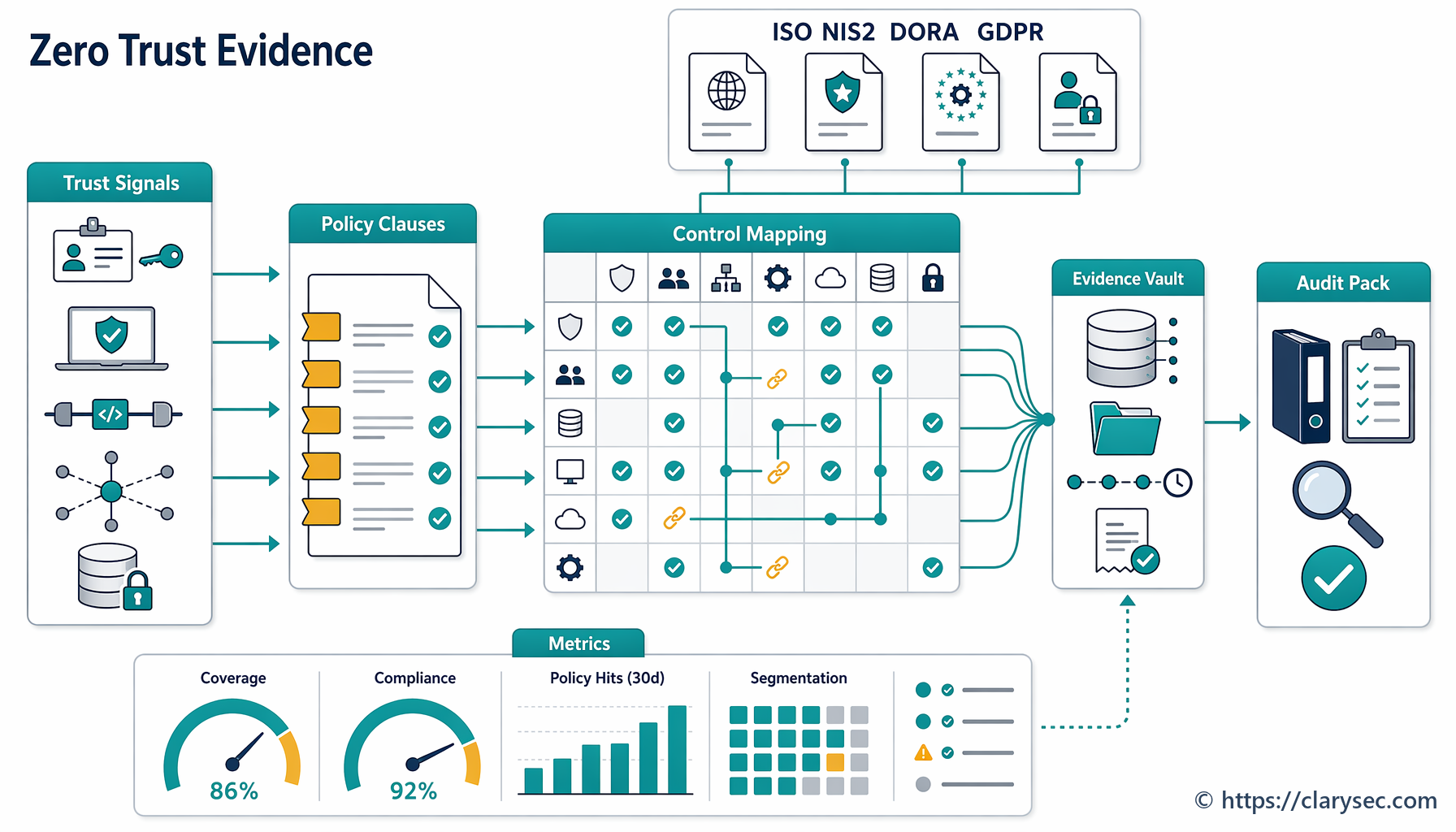
ISO/IEC 27001:2022 gives you the management system backbone. ISO/IEC 27002:2022 gives you the control language. Clarysec turns that language into operating evidence through Zenith Blueprint: An Auditor’s 30-Step Roadmap Zenith Blueprint, the Clarysec policy library and Zenith Controls: The Cross-Compliance Guide Zenith Controls.
Why file transfer governance breaks before the audit starts
Most organizations do not fail because they lack a secure transfer tool. They fail because they have too many transfer paths and no unified governance model.
A typical environment includes managed file transfer portals, SFTP servers, email attachments, Microsoft 365 or Google Workspace shared links, API exports, customer portals, supplier upload sites, removable media and messaging apps used when someone is under pressure. From an audit perspective, each channel raises the same questions:
- What information moved?
- Which classification applied?
- Who approved the transfer?
- Was the recipient authorized?
- Was encryption enforced?
- Was access logged and monitored?
- Did supplier contracts require equivalent protection?
- Were retention and deletion rules applied?
- Would an incident be detected and escalated?
The Zenith Blueprint, in the Controls in Action phase, Step 22, Organizational controls, Control 5.14, captures the operational reality:
In a connected organization, information doesn’t stay still. It moves, between people, departments, systems, devices, partners, and external entities. Sometimes it moves across secure tunnels with full traceability. Other times it moves via WhatsApp, personal email, or a quick copy-paste into a shared Google Doc. Control 5.14 exists to govern that flow , ensuring that information transfer is secure, intentional, and consistent with its classification and business purpose.
That is the core of secure information exchange governance. Auditors are not only asking, “Do you use encryption?” They are asking whether information movement is intentional, controlled, consistent with classification and supported by evidence.
Start with ISMS scope, risk and accountability
A secure file transfer program should not begin with a tool selection exercise. It should begin with ISO/IEC 27001:2022 scope, interested-party requirements, risk assessment and management accountability.
For a SaaS provider, FinTech or regulated supplier, the ISMS scope should include the systems, suppliers, locations and processes through which sensitive information moves. That commonly means customer data exports, support case attachments, analytics extracts, vendor troubleshooting packages, backups transferred to cloud storage, HR and finance exchanges, M&A data rooms, customer evidence portals and API-to-API transfers with processors or subprocessors.
ISO/IEC 27001:2022 requires a repeatable information security risk assessment process, risk treatment, a Statement of Applicability and risk-owner acceptance of residual risk. In practice, this becomes a transfer-risk register rather than a theoretical spreadsheet.
| Transfer scenario | Risk | Control expectation | Evidence |
|---|---|---|---|
| Customer PII exported to support vendor through SFTP | Unauthorized disclosure, weak vendor access, incomplete logs | Approved supplier, encrypted protocol, named accounts, MFA where applicable, retention limit, logs reviewed | Supplier contract, SFTP configuration, access list, transfer log, ticket approval, retention record |
| Finance sends payroll file by email | Personal data breach, misdelivery, unencrypted attachment | Approved secure email or portal, encryption, recipient verification, DLP alerting | Mail encryption rule, DLP policy, approval workflow, mail audit log |
| M&A team shares due diligence dataset through cloud link | Public link exposure, excessive retention, uncontrolled onward sharing | Approved data room, classification label, expiry date, external sharing approval, access log | Sharing settings, link expiry, access events, owner approval, classification label |
| Backup archive transported on removable media | Loss in transit, weak chain of custody, missing encryption proof | Encryption before transfer, tamper-evident packaging, reputable courier, receipt confirmation | Media inventory, encryption record, courier tracking, chain-of-custody log |
This is also where executive accountability becomes practical. ISO/IEC 27001:2022 requires top management to align information security with strategic direction, assign roles, provide resources and review performance. NIS2 reinforces management-body accountability for cybersecurity risk-management measures. DORA does the same for financial entities, making ICT risk management and protection of confidentiality, integrity, authenticity and availability a management responsibility.
Secure file transfer is not just a systems administration task. It is controlled data movement across the business ecosystem.
ISO/IEC 27002:2022 control mapping for secure transfer
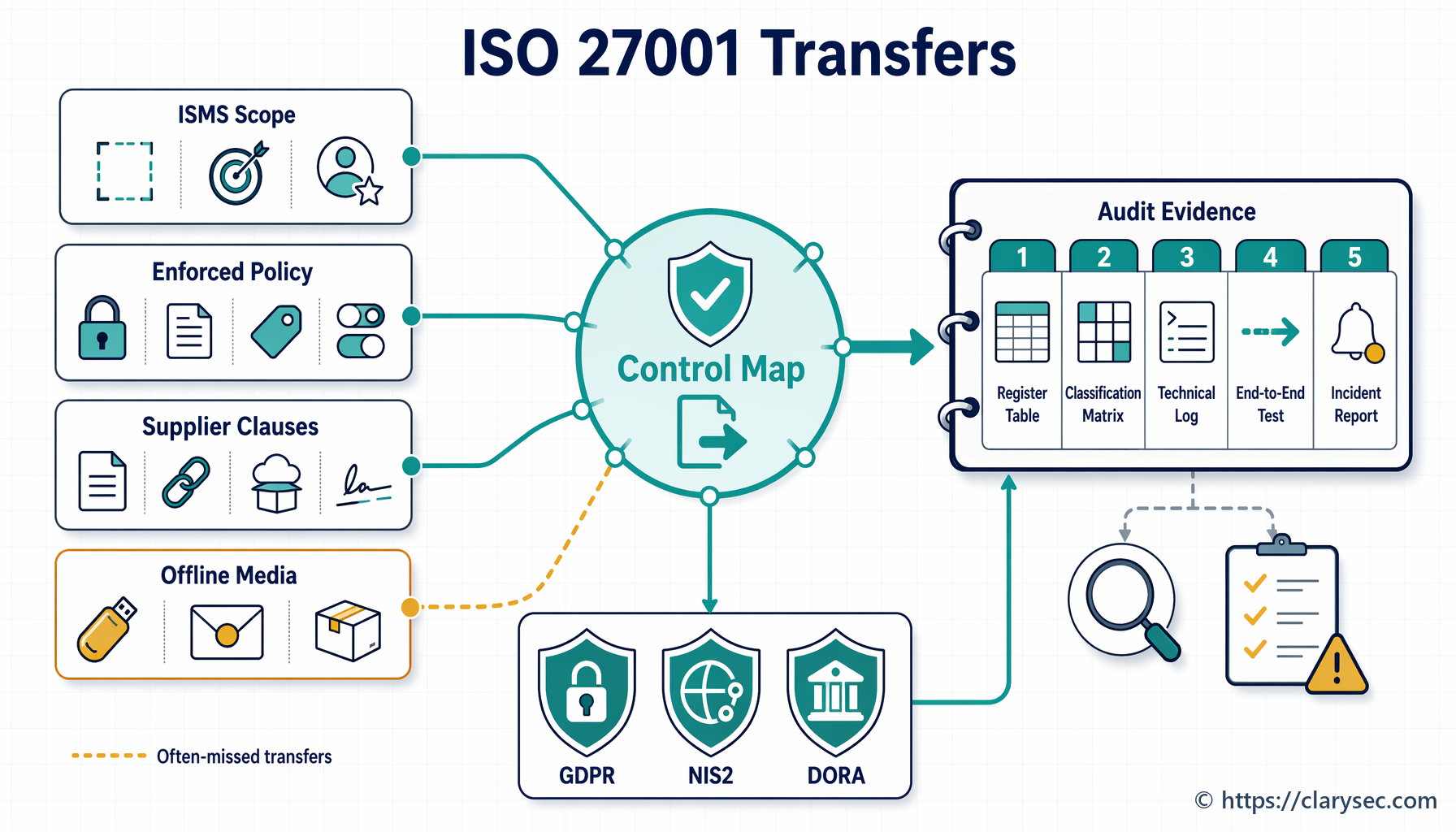
ISO/IEC 27002:2022 control 5.14, Information transfer, is the anchor, but it cannot work alone. Through Zenith Controls, Clarysec maps secure information transfer primarily to control 5.14, supported strongly by control 8.12, Data leakage prevention, and control 8.24, Use of cryptography.
Control 5.14 answers the governance question: how may information be transferred internally and externally? Control 8.12 answers the leakage question: how do we prevent sensitive data from leaving through unauthorized channels? Control 8.24 answers the protection question: how is cryptography selected, applied and managed for data in transit, at rest and, where relevant, in use?
The surrounding controls create the audit-ready environment:
| ISO/IEC 27002:2022 control | Role in secure file transfer governance | Evidence examples |
|---|---|---|
| 5.12 Classification of information | Defines sensitivity and handling expectations | Classification policy, data inventory, labels |
| 5.13 Labelling of information | Makes classification visible and enforceable | Label configuration, labeling records, user guidance |
| 5.14 Information transfer | Defines approved transfer methods and rules | Transfer standard, approved channel matrix, exception records |
| 5.20 Addressing information security within supplier agreements | Extends transfer obligations into contracts | Supplier security schedule, secure transfer clause, audit rights |
| 5.23 Information security for use of cloud services | Governs cloud portals and collaboration platforms | Cloud sharing settings, supplier due diligence, configuration review |
| 7.10 Storage media | Controls removable media, transport and disposal | Media register, encryption proof, chain-of-custody logs |
| 8.12 Data leakage prevention | Blocks or alerts on unauthorized sharing | DLP rules, alert history, exception approvals |
| 8.16 Monitoring activities | Detects suspicious transfer and access behavior | SIEM events, MFT logs, review evidence |
| 8.24 Use of cryptography | Protects data in transit and at rest | TLS settings, SFTP configuration, key management records |
The Zenith Blueprint, Controls in Action phase, Step 22, explains the enforcement expectation clearly:
In practice, this means not just defining “what’s allowed,” but also building technical and behavioral mechanisms to enforce those expectations. For instance:
✓ If “Confidential” information is not permitted to leave the company without encryption, then email systems must enforce encryption policies or block external transmission. ✓ If file transfers to external vendors are permitted only via secure portals, then links to open cloud drives (like public Dropbox folders) must be actively prevented. ✓ If personal data is being transferred across borders, the method must comply with privacy and legal obligations, not just internal preferences.
This is why policy statements such as “use secure methods” are not enough. Auditors test whether approved methods are defined, implemented, monitored and evidenced.
The policy layer: turning rules into enforceable controls
Policies are where auditors look for commitment. Strong evidence appears when policy clauses are traceable to technical settings, workflow approvals and operating records.
Clarysec’s SME Third-Party and Supplier Security Policy Third-Party and Supplier Security Policy - SME states in clause 6.2.3:
All data shared with suppliers must be protected through encryption and transmitted using secure protocols (e.g., HTTPS, SFTP).
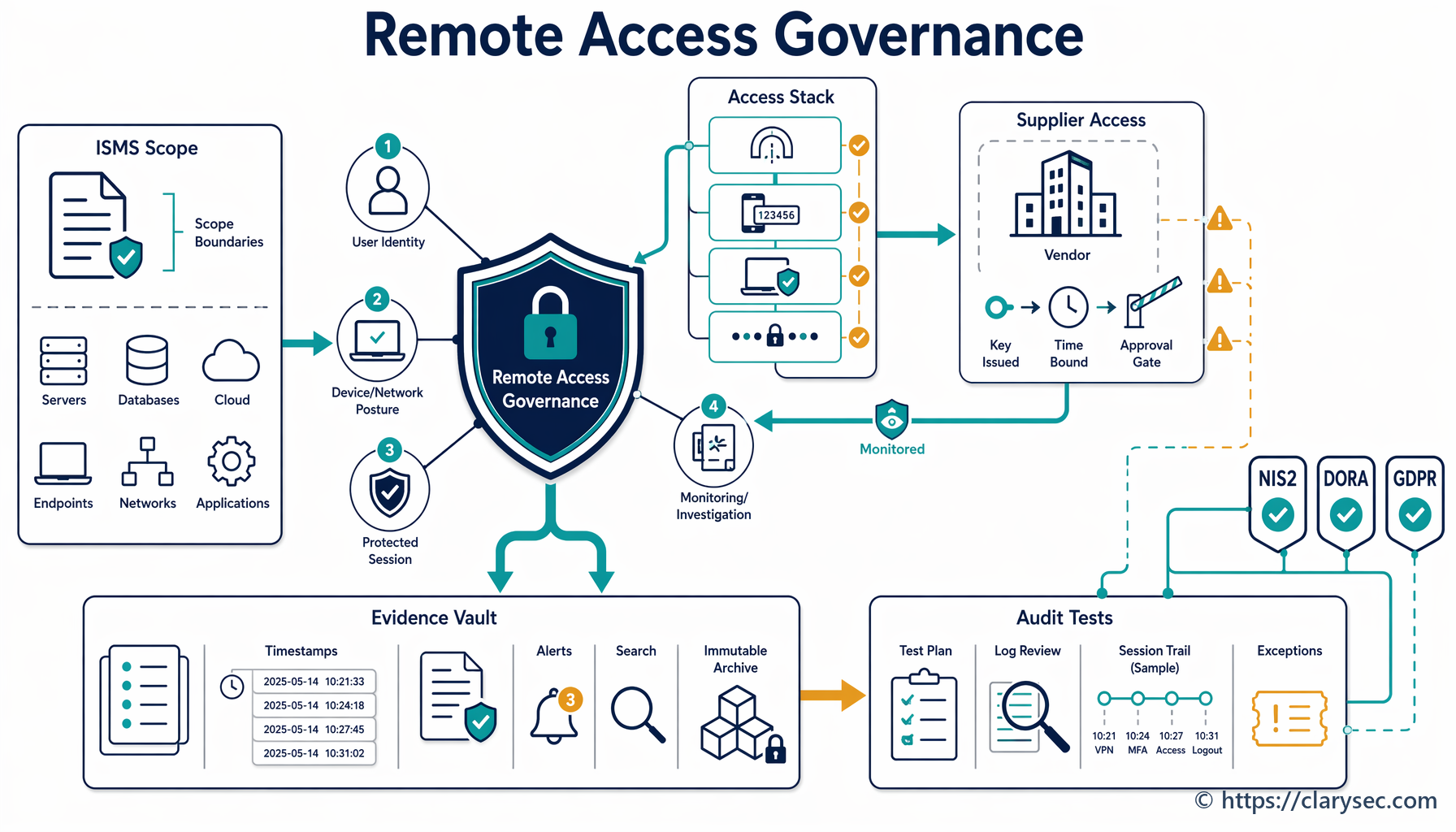
That clause can drive a complete audit trail. If a supplier receives customer data, the team should be able to show supplier approval, permitted data categories, secure protocol configuration, access limitations, logs and equivalent contractual obligations.
The SME Data Classification and Labeling Policy Data Classification and Labeling Policy - SME, section Governance Requirements, 5.2.3, adds:
External sharing must be explicitly authorized and logged.
For enterprise environments, the Data Classification and Labeling Policy Data Classification and Labeling Policy, clause 6.3.1, expands the rule:
All data handling, transmission, access, storage, and disposal of information must align with its classification level. At a minimum:
For more sensitive classifications, clause 6.3.1.3.2 states:
Must be encrypted in transit and at rest
The enterprise Remote Work Policy Remote Work Policy connects this to everyday behavior, requiring employees to:
Use only approved file-sharing solutions (e.g., M365, Google Workspace with data loss prevention (DLP) controls)
This matters because many transfer incidents happen during remote work, legal negotiations, sales due diligence, urgent support and project delivery.
Clarysec’s SME Cryptographic Controls Policy Cryptographic Controls Policy - SME, section Scope, clause 2.2, confirms that encryption governance covers more than databases:
This policy covers data at rest, data in transit, and data in use. It also governs encryption used for backups, email, external data transfers, and public-facing websites.
The SME Logging and Monitoring Policy Logging and Monitoring Policy - SME, Governance Requirements, clause 5.4.3, identifies:
Access logs: File access (especially for sensitive or personal data), permission changes, shared resource usage
For enterprise environments, the Third party and supplier security policy Third party and supplier security policy, clause 6.3.2, requires:
All third-party access must be logged and monitored and, where feasible, segmented through bastion hosts, VPNs, or Zero Trust gateways.
The enterprise Logging and Monitoring Policy Logging and Monitoring Policy also includes monitoring for:
External communications and firewall rule triggers
Finally, the SME Legal and Regulatory Compliance Policy-sme Legal and Regulatory Compliance Policy-sme gives a privacy-specific safeguard:
Personal data must not be sent by email or otherwise transferred without encryption or appropriate safeguards.
Together, these clauses create a defensible control narrative: classify the data, authorize the transfer, use an approved channel, encrypt the movement, monitor access, log activity, review anomalies and preserve evidence.
One control model for GDPR, NIS2 and DORA
Secure file transfer governance is a strong example of why compliance should be integrated, not duplicated.
GDPR defines processing broadly, including disclosure, transmission, storage, erasure and destruction. It also defines a personal data breach as a security breach leading to accidental or unlawful destruction, loss, alteration, unauthorized disclosure of or access to personal data. Article 5 introduces accountability. Article 32 expects appropriate technical and organisational measures, including confidentiality, integrity, availability, resilience, restoration capability and testing.
NIS2 requires risk-management measures such as incident handling, business continuity, supply-chain security, secure acquisition and maintenance, effectiveness assessment, cyber hygiene, training, cryptography, access control, asset management, MFA where appropriate and secure communications. It also sets significant incident reporting expectations, including early warning within 24 hours, notification within 72 hours and a final report within one month.
DORA applies from 17 January 2025 across financial entities and relevant ICT third-party service providers. It formalizes ICT risk management, incident classification, digital operational resilience testing and ICT third-party risk. File transfer platforms, cloud data rooms, SFTP hosting, document exchange portals and support platforms may all become relevant when they support critical or important functions.
| Requirement theme | GDPR lens | NIS2 lens | DORA lens | ISO/IEC 27001:2022 evidence |
|---|---|---|---|---|
| Personal or sensitive data movement | Demonstrate lawful, limited and protected processing | Manage risk to network and information systems | Protect data supporting financial business processes | Data inventory, classification, processing records, transfer register |
| Encryption and secure transfer | Appropriate safeguards for confidentiality and integrity | Cryptography and secure communications | Data availability, authenticity, integrity and confidentiality | Cryptography policy, TLS or SFTP settings, key management evidence |
| Supplier exchanges | Processor and subprocessor accountability | Supply-chain security and supplier vulnerabilities | ICT third-party risk strategy, contracts, audit rights | Supplier due diligence, agreements, access logs, review records |
| Incident response | Personal data breach assessment and notification where required | 24-hour early warning, 72-hour notification, final report cadence | Major ICT incident lifecycle and client notification where relevant | Incident playbooks, classification records, evidence preservation |
| Logging and proof | Accountability and breach investigation support | Control effectiveness and incident detection | Incident classification, root cause and reporting | SIEM logs, MFT logs, review records, audit trails |
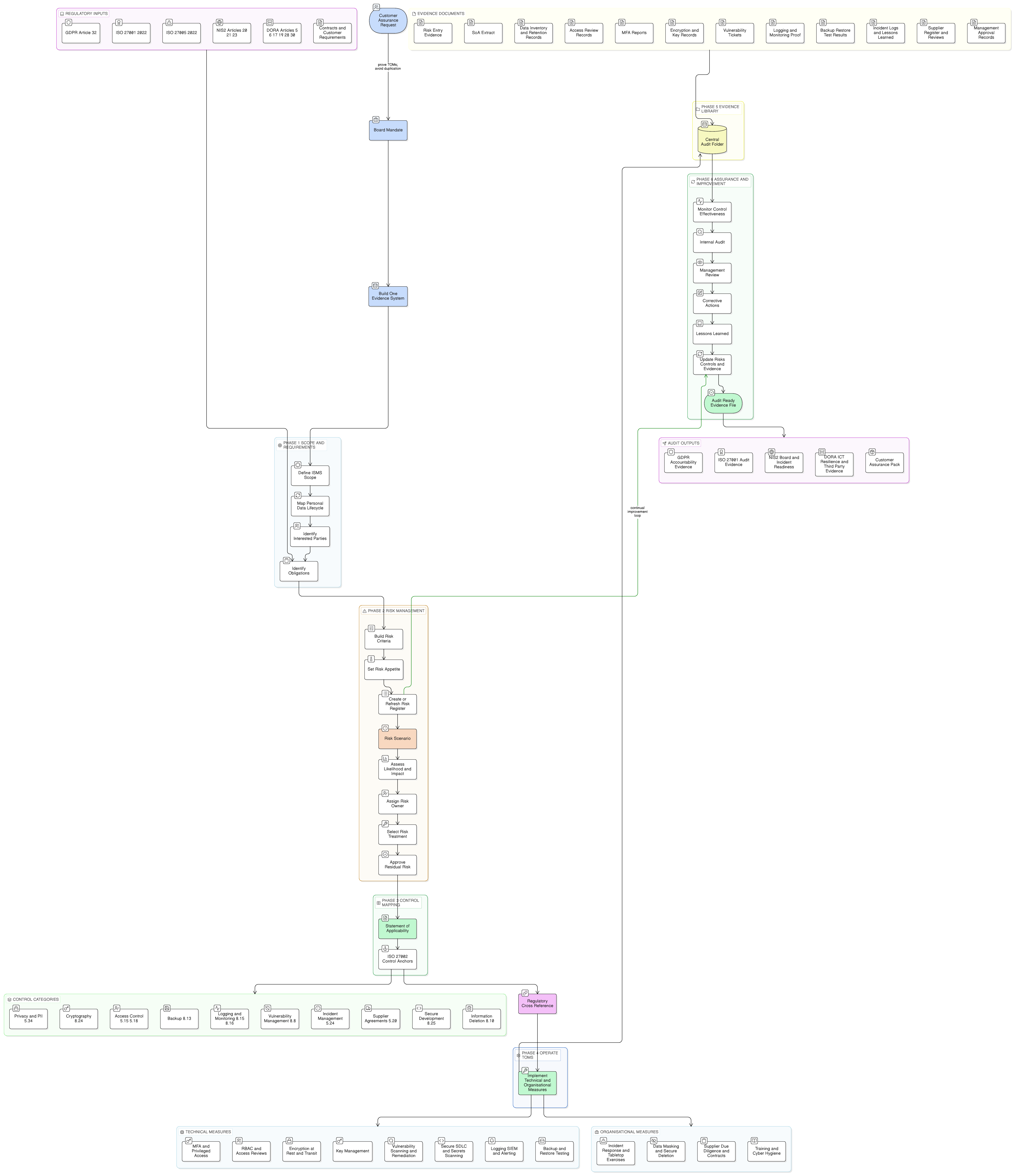
The value of Zenith Controls is that the same evidence can be indexed once and mapped across ISO/IEC 27001:2022, GDPR, NIS2, DORA, NIST CSF 2.0 and COBIT 2019. The guide does not create separate “Zenith controls.” It helps map recognized controls and evidence across frameworks.
Build a secure transfer evidence pack in five days
When a customer audit, certification audit or regulator-facing review is approaching, the fastest path is to build a focused evidence pack around actual transfer activity.
Day 1: Create the transfer register
List recurring and high-risk transfers, including system exports, supplier feeds, customer portals, email workflows, cloud-sharing patterns, APIs and removable media. Minimum fields should include transfer name, business owner, data classification, personal data indicator, source system, destination party, transfer method, encryption method, frequency, approval requirement, logging source, retention rule, supplier contract reference and incident owner.
Day 2: Map approved methods to classification
Use the Clarysec classification policies as the rule source. Define allowed methods by classification level.
| Data class | Allowed internal transfer | Allowed external transfer | Required controls |
|---|---|---|---|
| Public | Approved collaboration tools | Approved public channels | Integrity protection where needed |
| Internal | Corporate email, approved workspace | Approved external workspace with owner approval | Access control, logging |
| Confidential | Approved encrypted workspace, MFT | MFT, SFTP, encrypted portal, approved API | Encryption, approval, access review, logs |
| Restricted | Case-by-case secure workflow | Exceptional approval only | Encryption, named recipients, MFA, DLP, legal review, retention limit |
Day 3: Capture technical enforcement
For each channel, collect screenshots or exports showing external sharing restrictions, DLP rules, link expiry, download restrictions, encryption configuration, MFA or conditional access settings, SFTP cipher and protocol configuration, account permissions, logging configuration and alert rules for unusual downloads, permission changes or public links.
Day 4: Test one transfer end to end
Select a real sample, such as a monthly customer export to a payroll provider, a due diligence data room upload or a support package sent to a vendor. Evidence should show the business approval, classification, supplier contract check, export source, secure channel, recipient verification, transfer log, access or download review, deletion or retention action and register update.
Day 5: Add incident triggers and reporting links
Define when a transfer anomaly becomes a security event or incident. Triggers may include transfer to an unauthorized domain, creation of a public link for confidential data, failed login bursts against an SFTP portal, large supplier downloads, wrong-recipient email, encryption downgrade, access from unexpected geography or vendor compromise of a file transfer platform.
Then map each trigger to GDPR, NIS2 and DORA decision criteria. Under GDPR, assess whether personal data was unlawfully disclosed, accessed, altered, lost or destroyed. Under NIS2, assess operational disruption, financial loss and damage to others. Under DORA, consider affected clients, transactions, duration, geographic spread, data loss, service criticality and economic impact.
Supplier agreements are half the control
A secure SFTP server does not protect you if the receiving supplier stores the file unencrypted, forwards it to a subcontractor or keeps it indefinitely.
The Zenith Blueprint, Controls in Action phase, Step 23, Organizational controls, Control 5.20, describes the supplier agreement topics that matter:
Key areas typically addressed in supplier agreements include:
✓ Confidentiality obligations , including scope, duration, and third-party disclosure restrictions; ✓ Access control responsibilities , such as who can access your data, how credentials are managed, and what monitoring is in place; ✓ Technical and organizational measures for data protection, encryption, secure transmission, backup, and availability commitments; ✓ Incident reporting timelines and protocols , often with defined timeframes (e.g., “notify within 24 hours”); ✓ Right to audit , including frequency, scope, and access to relevant evidence (e.g., pen test reports, SoA, certifications); ✓ Subcontractor controls , requiring your supplier to pass on equivalent security obligations to their downstream partners; ✓ End-of-contract provisions , such as data return or destruction, asset recovery, and account deactivation.
This aligns with ISO/IEC 27002:2022 supplier controls, including 5.19 Information security in supplier relationships, 5.20 Addressing information security within supplier agreements, 5.21 Managing information security in the ICT supply chain, 5.22 Monitoring, review and change management of supplier services and 5.23 Information security for use of cloud services.
For DORA, supplier exchanges also connect to ICT third-party risk management, registers of ICT service arrangements, contractual clauses, audit and inspection rights, incident assistance and exit strategies. For NIS2, they connect to supply-chain security and supplier-specific vulnerabilities.
A practical supplier data exchange schedule should specify data categories exchanged, transfer channel, encryption requirements, authentication requirements, named supplier roles, subprocessor restrictions, logging obligations, incident notification timeframe, data return and destruction requirements and evidence available on request.
Do not ignore physical media and offline transfers
Most file transfer governance discussions focus on cloud links and MFT platforms, but auditors still ask about USB drives, removable disks, backup tapes and couriered media. These are often used during migrations, litigation, forensic analysis, OT maintenance or offsite backups.
The Zenith Blueprint, Controls in Action phase, Step 18, Physical Controls II, Media Management, Control 7.10, states:
For any transport of media , especially between office locations or to third parties (like a data migration to a cloud provider), implement specific steps. Media must be encrypted prior to transfer, packaged in tamper-evident containers , and sent via reputable couriers with tracking. Maintain a transport log stating what was sent, when, to whom, and confirmation of receipt.
For audit readiness, treat physical media like every other transfer channel. The evidence pack should include a media inventory, encryption record, chain-of-custody log, courier tracking, recipient confirmation, return record or destruction certificate.
How auditors test secure file transfer governance
A mature secure transfer program should survive multiple audit perspectives. The same evidence may be interpreted differently by an ISO/IEC 27001:2022 auditor, a NIST CSF assessor, a COBIT 2019 reviewer, a DORA reviewer or a GDPR-focused privacy auditor.
| Auditor perspective | What they will test | Evidence they expect |
|---|---|---|
| ISO/IEC 27001:2022 auditor | Whether information transfer risks are identified, treated, controlled and reviewed within the ISMS | Scope, risk assessment, Statement of Applicability, policies, transfer register, sample evidence, internal audit results |
| ISO/IEC 27002:2022 control reviewer | Whether 5.14, 8.12 and 8.24 work with classification, access, logging, supplier and incident controls | Approved methods, DLP rules, cryptography settings, access reviews, logs, supplier clauses |
| NIST CSF 2.0 assessor | Whether outcomes across GOVERN, IDENTIFY, PROTECT, DETECT, RESPOND and RECOVER are achieved | Current and Target Profile, supplier risk records, data flow inventory, monitoring events, response records |
| COBIT 2019 or ISACA auditor | Whether governance objectives, ownership, process performance and monitoring are defined | RACI, process metrics, management reporting, issue tracking, control testing results |
| GDPR auditor or DPO review | Whether personal data transfers are lawful, minimized, protected and demonstrable | RoPA, DPIA where applicable, transfer safeguards, breach assessment, processor clauses |
| DORA reviewer | Whether ICT third-party data exchanges supporting important functions are resilient, contractual and auditable | ICT third-party register, contract clauses, incident assistance, exit plan, resilience testing records |
| NIS2 reviewer | Whether secure communications, cryptography, supplier security, incident handling and board oversight are effective | Management approval, policies, supplier assessments, incident procedures, reporting decision records |
The lesson is simple: do not create duplicate evidence folders for each regulation. Create one secure transfer evidence model, then map it to the relevant obligations.
Common findings in secure transfer audits
Across SaaS, FinTech, professional services and regulated suppliers, Clarysec repeatedly sees the same weaknesses:
- SFTP accounts are shared between supplier staff
- Service accounts never expire
- External sharing is enabled globally in cloud collaboration tools
- Public links are allowed for confidential files
- DLP exists but is not tuned to data classifications
- Email encryption is optional and user-driven
- Supplier contracts mention confidentiality but not secure transfer evidence
- Logs are collected but not reviewed
- Transfer approvals sit in chat messages rather than ticketing systems
- Retention for customer portal uploads is unclear
- Physical media is treated as an exception outside the ISMS
- Incident playbooks do not include misdirected file transfer or compromised MFT platform scenarios
Each weakness creates regulatory friction. Under GDPR, it weakens accountability and breach defensibility. Under NIS2, it undermines risk management and incident handling. Under DORA, it threatens ICT third-party risk governance and operational resilience evidence.
Secure file transfer governance checklist for 2026
Use this checklist before your next ISO/IEC 27001:2022 audit, customer security review, DORA readiness assessment, NIS2 board briefing or GDPR evidence request.
- Do we have a complete register of recurring sensitive information transfers?
- Are transfer methods mapped to classification levels?
- Are external transfers explicitly authorized and logged?
- Are MFT, SFTP, secure portals, APIs, email and cloud links governed consistently?
- Is encryption enforced for confidential, restricted and personal data transfers?
- Are email attachments controlled through encryption, DLP or approved alternatives?
- Are supplier transfer obligations written into contracts?
- Are third-party accesses logged, monitored and periodically reviewed?
- Are file access, permission changes and shared resource usage logged?
- Are transfer logs retained long enough for investigations and audits?
- Are anomalous transfers integrated into incident response?
- Can we classify whether a transfer incident triggers GDPR, NIS2 or DORA reporting?
- Do we test transfer controls through internal audit or control self-assessment?
- Do we have evidence of management review and risk-owner acceptance?
If the answer to any of these is unclear, the issue is probably not technology. It is governance.
From reaction to audit-ready resilience
Anya’s near miss was not just a blocked email. It was proof that uncontrolled information flow can become a regulatory, contractual and operational resilience problem in seconds.
Secure file transfer governance in 2026 is about more than encrypting a connection. It is about proving that sensitive information moves only through approved, monitored and legally defensible paths.
Clarysec helps organizations build this evidence model using the Zenith Blueprint Zenith Blueprint, Zenith Controls Zenith Controls and ISO/IEC 27001:2022-aligned policy templates such as the Data Classification and Labeling Policy, Third-Party and Supplier Security Policy, Cryptographic Controls Policy - SME, Logging and Monitoring Policy - SME and Remote Work Policy.
If you are preparing for ISO/IEC 27001:2022 certification, DORA readiness, NIS2 governance reporting or a GDPR evidence request, start with one question: can you prove where your sensitive information went last month?
Clarysec can help you create the transfer register, map controls, harden file-sharing channels, align supplier clauses and build the audit evidence needed to answer with confidence.
Frequently Asked Questions
About the Author

Igor Petreski
Compliance Systems Architect, Clarysec LLC
Igor Petreski is a cybersecurity leader with over 30 years of experience in information technology and a dedicated decade specializing in global Governance, Risk, and Compliance (GRC).Core Credentials & Qualifications:• MSc in Cyber Security from Royal Holloway, University of London• PECB-Certified ISO/IEC 27001 Lead Auditor & Trainer• Certified Information Systems Auditor (CISA) from ISACA• Certified Information Security Manager (CISM) from ISACA • Certified Ethical Hacker from EC-Council