Subprocessor Change Governance for SaaS and MSPs
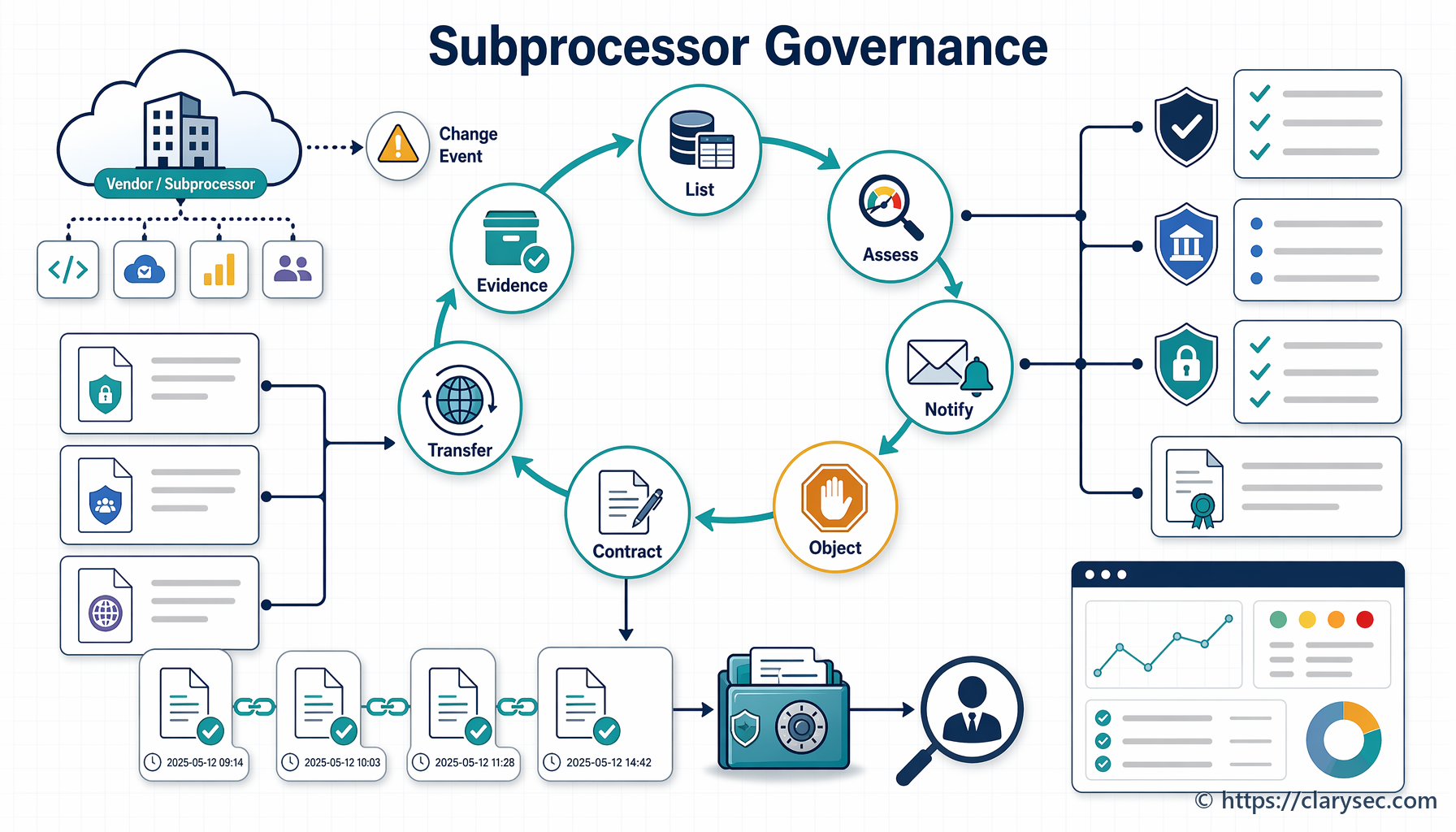
Sarah, the CISO of a fast-growing FinTech SaaS provider, opened what looked like a routine service update from a critical infrastructure vendor. Buried under “service optimizations” was one sentence that changed her week:
“To enhance analytics performance, data processing workloads will be migrated to our new partner, DataCrunch Analytics, effective in 30 days.”
Thirty days. A new analytics partner. A quick check showed the provider was based outside the EU.
The engineering team saw a routine vendor improvement. Procurement assumed the existing agreement covered it. Customer Success had not planned any notice campaign. Legal had not reviewed the transfer implications. Sarah immediately saw the real problem: her company acted as a processor for hundreds of financial institutions across Europe. Those customers were controllers under GDPR. Some had negotiated prior notice of new subprocessors. Some had objection rights. Several had DORA-driven outsourcing and ICT third-party risk obligations. A few had strict location declarations that could not be silently changed.
This is the moment many SaaS providers, MSPs, MSSPs, and cloud service providers discover that subprocessor governance is not an administrative privacy task. It is supplier risk management, contractual compliance, operational resilience, customer communication, and audit evidence in one workflow.
A public subprocessor page is not enough. A vendor footnote is not enough. A security questionnaire is not enough. A defensible process must show who assessed the subprocessor, what data is processed, which customers are affected, what agreements require notice, whether objections were handled before use, how international transfer evidence was linked, and where the final evidence is retained.
Clarysec treats this as a governed control pattern, not an ad hoc email chain. The workflow connects privacy management, supplier assurance, legal review, ICT supply chain risk, customer notice, and audit evidence through Clarysec policies, Zenith Blueprint: An Auditor’s 30-Step Roadmap, and Zenith Controls: The Cross-Compliance Guide.
Why subprocessor changes are high-risk supplier events
A subprocessor change can alter the risk profile of a service overnight. It can change where customer personal data is hosted, where it is accessed from, who has privileged support access, how long logs are retained, how incidents are escalated, which encryption responsibilities apply, and whether a new international transfer mechanism is required.
For SaaS and managed service providers, subprocessors often sit inside the product delivery chain. They may include cloud hosting providers, ticketing platforms, email delivery services, AI analytics tools, background job platforms, observability vendors, support tools, payment processors, managed security providers, and data enrichment services. Many of these providers touch customer personal data even when teams describe them as “infrastructure” or “operations” tools.
Under GDPR, this matters because Article 28 requires processors to manage downstream processors under controller authorization. If general written authorization is used, the processor must inform the controller of intended additions or replacements and give the controller an opportunity to object. Article 28(4) also requires equivalent data protection obligations to be imposed on the subprocessor. Article 5(2) adds the accountability principle, meaning the organization must be able to demonstrate compliance, not merely claim it.
DORA raises the stakes for financial services. Financial entities must manage ICT third-party risk as an integral part of ICT risk management. They must maintain registers of contractual arrangements, assess concentration risk, understand subcontracting chains, define contractual safeguards, secure audit and access rights, support incident cooperation, and plan exits. Even if a SaaS provider is not directly a financial entity, its financial customers will expect evidence because they must satisfy DORA themselves.
NIS2 broadens the lens to supply chain security and management accountability. Article 21 requires appropriate technical, operational, and organizational measures, including supply chain security, incident handling, business continuity, access control, asset management, secure acquisition and maintenance, and effectiveness assessment. Article 20 puts oversight responsibility on management bodies. For cloud providers, managed service providers, managed security service providers, data centre service providers, trust service providers, online marketplaces, search engines, and certain communications services, subprocessor visibility becomes part of cybersecurity governance.
ISO/IEC 27001:2022 and ISO/IEC 27701:2025 make this operational. ISO/IEC 27001:2022 requires the ISMS to understand context, interested-party requirements, risks, treatment plans, operational controls, and documented information. ISO/IEC 27701:2025 extends that management-system discipline into privacy information management. A processor-oriented PIMS must show that downstream processing of customer PII is understood, controlled, contractually governed, monitored, and evidenced.
The Clarysec pattern: list, assess, notify, object, contract, transfer, evidence
The strongest subprocessor governance model is simple enough for operational teams to follow and rigorous enough for auditors to test. Clarysec uses seven verbs:
- List every current and proposed subprocessor.
- Assess privacy, security, resilience, and dependency risk before use.
- Notify customers according to the applicable agreement.
- Manage objections within the agreed window.
- Update DPA, security annex, and flow-down obligations.
- Link hosting, processing location, and international transfer evidence.
- Retain evidence in privacy and supplier registers.
The first operational anchor is the Processor, Subprocessor and Third-Party Privacy Management Policy. It states:
[Processor] The Vendor / Procurement Owner MUST maintain the list of subprocessors and subcontractors used to process customer PII in REG08 before use and update REG08 within 10 business days after an approved change.
That clause turns a subprocessor list into a controlled register. It also makes timing explicit: REG08 is updated before use, then refreshed within 10 business days after an approved change.
The same policy makes customer notice auditable:
[Processor] The Vendor / Procurement Owner MUST notify the customer of intended new or replacement subprocessors according to the applicable customer agreement before use and record the notice, objection period, and outcome in REG08.
This is the missing detail in many programs. The question is not only whether a public page was updated. The question is whether the right customers were notified in the required way, before the subprocessor processed their PII, with the objection period and outcome preserved as evidence.
The policy also connects change governance to due diligence:
[All] The Vendor / Procurement Owner MUST complete privacy due diligence evidence in REG08 before selecting, renewing, or materially changing any processor, subprocessor, or third-party relationship that processes or accesses PII.
A material change can include replacing infrastructure, adding a downstream analytics provider, moving hosting regions, enabling support access from a new country, expanding data categories, or changing the retention behavior of a service.
Finally, the policy closes the contractual flow-down gap:
[Processor] The Vendor / Procurement Owner MUST ensure that each subprocessor contract contains flow-down privacy, security, assistance, return, deletion, incident interface, and transfer-linkage obligations before the subprocessor processes PII.
This matters because a generic security addendum is not always enough. Processor-specific obligations must flow downstream before processing begins.
Where Clarysec policies connect privacy, suppliers, and transfers
Subprocessor governance works only when privacy, legal, supplier security, and operational change management use the same evidence chain.
The Legal and Regulatory Compliance Policy - SME establishes the pre-sharing rule:
Data Processing Agreement (DPA) clauses or equivalent contractual terms must be agreed before any personal or sensitive data is shared.
For enterprise environments, the Legal and Regulatory Compliance Policy makes the evidence expectation more granular by requiring:
Subprocessor disclosures and geographic data transfer declarations
It also identifies governance triggers involving:
Changes to data transfer mechanisms, subprocessors, or cross-border data flows
The Third Party and Supplier Security Policy states:
The use of subcontractors subject to prior written consent
For smaller organizations, the Third-Party and Supplier Security Policy - SME provides a scalable version:
Restrictions on further subcontracting without approval
It also makes supplier change reassessment explicit:
All supplier changes—including ownership, service type, hosting location, or subcontracting—must be reassessed for risk impact and contractual relevance.
The Data Protection and Privacy Policy includes:
Subprocessor approval requirements
The Supplier Dependency Risk Management Policy adds the resilience perspective:
Subcontractor disclosure: the supplier must inform us of key subcontractors and any changes thereto, particularly where these create additional dependency layers.
Together, these policies create a complete operating rule: no personal data sharing without contractual terms, no hidden subprocessors, no unmanaged subcontracting, no unassessed hosting or location change, and no approval without transfer evidence where relevant.
How Zenith Controls frames the supplier control set
In Zenith Controls, Clarysec maps subprocessor change governance primarily to ISO/IEC 27002:2022 supplier and legal controls. This is important because it shows that subprocessor governance is not only a privacy process. It is also an information security, supplier management, legal, and resilience control.
| ISO/IEC 27002:2022 control | Control name | Role in subprocessor governance |
|---|---|---|
| 5.19 | Information security in supplier relationships | Establishes the supplier risk management basis for identifying and managing providers that access information or systems |
| 5.20 | Addressing information security within supplier agreements | Ensures agreements include security, privacy, subcontracting, incident, audit, deletion, and transfer obligations |
| 5.21 | Managing information security in the ICT supply chain | Supports visibility into downstream ICT dependencies and supply chain risks |
| 5.22 | Monitoring, review and change management of supplier services | Provides the operational control for reassessing supplier changes, including new subprocessors and hosting changes |
| 5.23 | Information security for use of cloud services | Applies when subprocessors provide cloud hosting, cloud platforms, SaaS, or cloud-based processing |
| 5.31 | Legal, statutory, regulatory and contractual requirements | Connects the workflow to GDPR, DORA, NIS2, customer DPAs, transfer obligations, and contractual notice duties |
Zenith Controls describes control 5.22, “Monitoring, review and change management of supplier services,” as a preventive control supporting confidentiality, integrity, and availability, aligned to the Identify cybersecurity concept and operational capabilities for supplier relationship security and information security assurance. That is exactly what a subprocessor change requires: identify the change, reassess the risk, confirm contractual coverage, and retain assurance evidence.
For control 5.20, Zenith Controls frames supplier agreements as preventive controls covering confidentiality, integrity, and availability. This is where DPA terms, security annexes, subcontracting clauses, audit rights, incident assistance, return and deletion, and transfer-linkage obligations belong.
For control 5.21, the supply chain lens matters because a subprocessor may create a fourth-party dependency. A SaaS vendor may rely on an infrastructure provider, which relies on a data analytics provider, which relies on another cloud region or support partner. The organization must understand the chain well enough to manage risk, customer commitments, and exit options.
The 30-Step Roadmap: turning policy into an operating procedure
The Zenith Blueprint places supplier and downstream risk in Step 23, Organizational controls. It explains that supplier agreements typically address confidentiality, access control, technical and organizational measures, incident reporting timelines, right to audit, subcontractor controls, and end-of-contract provisions. The Blueprint makes a critical point:
The structure of the agreement matters. These clauses might be in a Master Services Agreement, a dedicated Data Processing Agreement (DPA), or a standalone security annex. What matters is that they exist, and that they are understood and accepted by both parties.
The Blueprint also tells teams what to do with subcontractors:
For every critical supplier, identify if they use subcontractors (sub-processors) who may access your data or systems. Document how your information security requirements are flowed down to these parties, either through your supplier’s contract terms or your own direct clauses.
For supplier change governance, the correct operational alignment is ISO/IEC 27002:2022 control 5.22:
Establish a simple, scalable procedure for assessing changes to supplier services (5.22), such as migration to cloud, new sub-processors, or infrastructure redesign. Define triggers that require security re-assessment.
This gives CISOs and DPOs a practical route. Step 23 defines the control intent. REG08 captures processor, subprocessor, and third-party privacy evidence. REG09 captures transfer evidence. Supplier contracts, DPAs, and change tickets connect the workflow to operational reality.
A practical workflow for subprocessor change notification
A subprocessor change workflow should be boring in the right way. Each stage should have an owner, evidence, and a gate that prevents premature production use.
| Workflow stage | Owner | Evidence | Approval gate |
|---|---|---|---|
| Intake of proposed subprocessor | Vendor or Procurement Owner | Change request, service description, data categories, processing purpose | Privacy and security triage |
| Privacy and security due diligence | DPO, Security, Procurement | REG08 due diligence, certifications, questionnaire, incident history, TOMs | Risk owner approval |
| Contract and DPA review | Legal, Procurement | DPA clause mapping, subcontracting terms, audit rights, incident assistance, deletion terms | Legal approval |
| Location and transfer review | Privacy, Legal, Security | Processing locations, hosting locations, transfer mechanism, REG09 linkage | Transfer approval |
| Customer notice | Customer Success, Legal, Privacy | Notice copy, affected customers, agreement basis, notice date, objection window | Notice sent before use |
| Objection handling | Legal, Account Owner, Risk Owner | Objection log, risk response, customer decision, technical blocking if needed | Objection resolved or exception approved |
| Production enablement | Engineering, Change Manager | Change ticket, approval references, go-live date | No processing before approval |
| Post-change update | Vendor Owner | Updated REG08, public list if used, contract repository, monitoring cadence | Evidence review within defined SLA |
The key principle is simple: customer notice must occur before use where the agreement requires it. Updating a public webpage after implementation may support transparency, but it does not prove customer-specific notice, contractual authorization, or objection handling.
Applying the workflow to Sarah’s crisis
Sarah’s vendor notice about DataCrunch Analytics triggers the full process.
First, the Vendor Owner opens a REG08 change record. The record identifies CoreStack, DataCrunch Analytics, the service purpose, customer tenant impact, processing role, data categories, processing locations, support access model, retention period, and whether any special-category or regulated financial customer data may be present.
Second, Privacy and Security perform due diligence. They review DataCrunch Analytics’ technical and organizational measures, encryption, access control, logging, incident notification, deletion capabilities, audit assurance, subprocessor list, and security certifications. Because the provider is outside the EU, the location and transfer review is mandatory.
Third, Legal checks whether customer DPAs use specific authorization or general authorization with notice. Customers are segmented into notice groups: standard 30-day notice customers, enterprise customers with 45-day objection windows, customers requiring specific approval, restricted customers with location limitations, and unaffected customers whose data does not touch the analytics workload.
Fourth, transfer evidence is linked. The Processor, Subprocessor and Third-Party Privacy Management Policy requires:
[Both] The Vendor / Procurement Owner MUST record processing locations, hosting locations, and international transfer indicators in REG08 and link applicable transfer evidence to REG09 before approving a processor, subprocessor, location change, or transfer-relevant service change.
Fifth, Customer Success sends formal notices through approved channels. Each notice includes the intended subprocessor, purpose, data categories, location summary, effective date, objection deadline, and contact route.
Sixth, objections are managed. If a financial institution objects because the change affects a critical function or a third-country transfer, Sarah’s team evaluates alternatives: exclude the tenant, retain the old processing path, require EU-only support, amend contractual safeguards, or delay the change until the objection is resolved.
Seventh, Engineering receives approval only for tenants and workloads that passed the gate. The production change ticket links to REG08, REG09, legal approval, notice evidence, and any customer-specific exclusions. After go-live, the internal register, public subprocessor page, and contract repository are updated.
That is the difference between reactive firefighting and defensible governance.
Cross-compliance mapping for one evidence chain
The Clarysec advantage is that one workflow can satisfy multiple frameworks when evidence is designed correctly from the start.
| Requirement area | How the workflow addresses it |
|---|---|
| GDPR Article 28 and accountability | Maintains subprocessor authorization evidence, customer notices, objection outcomes, DPA flow-down, and transfer linkage |
| ISO/IEC 27701:2025 PIMS | Demonstrates role-aware privacy governance for processors, downstream processing control, evidence retention, and monitoring |
| ISO/IEC 27001:2022 ISMS | Supports interested-party requirements, risk assessment, operational control, supplier controls, legal requirements, and documented information |
| ISO/IEC 27002:2022 controls | Implements supplier relationship, supplier agreement, ICT supply chain, supplier change, cloud service, and legal requirement controls |
| DORA ICT third-party risk | Supports registers, due diligence, subcontracting chain visibility, location awareness, concentration risk, audit rights, incident assistance, and exit planning |
| NIS2 supply chain security | Supports Article 21 supply chain security, supplier risk analysis, incident handling, business continuity, and management oversight |
| NIST CSF 2.0 GOVERN and GV.SC | Aligns with supplier risk strategy, supplier criticality, contractual requirements, due diligence, monitoring, incident involvement, and termination planning |
| COBIT 2019 governance lens | Supports stakeholder needs, risk optimization, vendor accountability, management reporting, and assurance evidence |
NIST CSF 2.0 is useful as a neutral organizing layer. Its GOVERN function includes understanding legal, regulatory, contractual, privacy, and civil liberties obligations, assigning roles, establishing policies, reviewing performance, and managing cybersecurity supply chain risk. The GV.SC category expects supplier risk processes, supplier criticality, contractual cybersecurity requirements, due diligence, lifecycle monitoring, incident planning, and post-relationship activities.
DORA is more prescriptive for financial entities. Articles 28 to 30 require ICT third-party risk management, contractual registers, critical or important function classification, subcontracting chain visibility, location awareness, contractual safeguards, audit rights, incident cooperation, and exit planning. If your SaaS platform supports financial customers, your subprocessor evidence becomes part of their DORA evidence pack.
NIS2 adds management accountability. Article 20 requires management bodies to approve cybersecurity risk-management measures and oversee implementation. Article 21 requires supply chain security and assessment of supplier cybersecurity practices. A significant subprocessor change should therefore be visible in risk reporting, not hidden in a procurement folder.
What auditors will test
A mature subprocessor process creates a straight line from policy to evidence.
An ISO/IEC 27001:2022 auditor will start with ISMS scope, interested-party requirements, risks, the Statement of Applicability, and operational controls. They will likely test supplier relationships, supplier agreements, ICT supply chain, supplier monitoring and change management, legal requirements, cloud services, privacy protection, logging, and operational change control.
An ISO/IEC 27701:2025 PIMS auditor will focus on role clarity. Are you a processor, controller, joint controller, or both in different services? For processor activities, they will ask for the subprocessor list, authorization basis, notice evidence, objection handling, downstream contracts, transfer evidence, deletion support, incident interface, and monitoring records.
A GDPR privacy reviewer will test accountability. They will ask who processes personal data, for what purpose, under which agreement, in which location, with what safeguards, and with what customer transparency. If a customer objected, they will ask what happened before processing began.
A DORA customer auditor will ask whether the subprocessor supports a critical or important function, whether subcontracting chains are visible, whether data locations are documented, whether incident assistance is contractually guaranteed, whether audit rights flow down, whether concentration risk was considered, and whether exit is possible.
A NIS2 assessor will focus on supply chain security, management oversight, incident readiness, and proportionate controls. They may ask how supplier changes are detected, how direct suppliers are assessed, how supplier vulnerabilities are considered, and how incidents involving service recipients are escalated.
The evidence set should be easy to reconstruct:
- Approved subprocessor change request.
- REG08 due diligence record.
- Data category and processing purpose assessment.
- Processing and hosting location evidence.
- REG09 transfer evidence where relevant.
- DPA and contract flow-down review.
- Customer notice list, dates, wording, and delivery proof.
- Objection log and resolution evidence.
- Production change ticket linked to approval.
- Updated subprocessor list and monitoring schedule.
- Risk acceptance or exception approval where needed.
Common failure patterns
The first failure is treating a subprocessor page as the whole process. A public page supports transparency, but it does not prove customer-specific notice, objection handling, or authorization.
The second failure is separating privacy, security, and procurement evidence. Privacy may approve the DPA, Security may review a SOC 2 report, and Procurement may file the contract, but no single record connects the decision.
The third failure is missing transfer linkage. Teams record the supplier name but not processing locations, hosting locations, support locations, international transfer indicators, or REG09 evidence.
The fourth failure is enabling production before objection windows close. Once customer PII is processed by the new subprocessor, the organization may already have breached the agreement.
The fifth failure is weak flow-down. The direct supplier accepts strong terms, but its downstream providers are not bound to equivalent privacy, security, assistance, return, deletion, incident, audit, and transfer obligations.
The sixth failure is poor change detection. A supplier changes ownership, hosting location, service type, support model, or subcontractor chain, and nobody reassesses the risk.
The seventh failure is no audit trail. Teams remember the decision, but cannot prove when it happened, who approved it, which customers were notified, and how objections were resolved.
Management reporting for CISOs and DPOs
Subprocessor governance should produce management information, not just compliance artifacts.
| Metric | Why it matters |
|---|---|
| Active subprocessors by service and data category | Shows processing footprint and privacy exposure |
| Subprocessors supporting critical services | Supports resilience planning, DORA assurance, and supplier prioritization |
| Subprocessors with third-country access or hosting | Supports transfer reviews and customer declarations |
| Upcoming objection windows | Prevents premature production enablement |
| Subprocessors missing current due diligence | Identifies assurance gaps |
| Contracts missing flow-down clauses | Highlights legal and operational risk |
| Supplier changes pending reassessment | Shows governance workload and backlog |
| Customer objections open beyond SLA | Indicates unresolved commercial, legal, or technical blockers |
This reporting fits the management-system model. ISO/IEC 27001:2022 expects leadership, operational control, performance evaluation, and continual improvement. DORA and NIS2 elevate management accountability. Subprocessor governance should appear in privacy steering meetings, supplier risk reviews, ISMS management review, and ICT risk reporting where relevant.
Build your subprocessor change evidence pack
Start with one recent supplier change and test whether your organization can answer these questions:
- Was the provider identified as a processor, subprocessor, supplier, ICT provider, or all of these?
- Was REG08 or an equivalent register updated before use?
- Were processing locations and hosting locations recorded?
- Were international transfer indicators assessed?
- Was transfer evidence linked to REG09 or an equivalent file?
- Did the contract include flow-down privacy, security, assistance, return, deletion, incident, audit, and transfer obligations?
- Were customers notified according to their agreements before processing began?
- Were objection windows tracked and resolved?
- Was production enablement blocked until approval?
- Could an auditor reconstruct the decision trail in under 30 minutes?
If the answer is no, the gap is not only legal. It is operational, contractual, supplier risk, privacy, and audit readiness.
Clarysec helps teams close that gap quickly. Use Zenith Blueprint to place subprocessor governance into your ISMS and PIMS implementation roadmap. Use Zenith Controls to map supplier relationship, supplier agreement, ICT supply chain, supplier change, cloud service, and legal requirement controls across ISO/IEC 27001:2022, ISO/IEC 27701:2025, GDPR, DORA, NIS2, NIST CSF 2.0, and COBIT 2019. Use the Processor, Subprocessor and Third-Party Privacy Management Policy, Third Party and Supplier Security Policy, Legal and Regulatory Compliance Policy, Data Protection and Privacy Policy, and Supplier Dependency Risk Management Policy to turn the mapping into daily execution.
Do not wait for the surprise footnote in a vendor email. Build the workflow, evidence pack, and control map now, so every subprocessor change becomes proof of mature governance instead of a compliance crisis.
About the Author

Igor Petreski
Compliance Systems Architect, Clarysec LLC
Igor Petreski is a cybersecurity leader with over 30 years of experience in information technology and a dedicated decade specializing in global Governance, Risk, and Compliance (GRC).Core Credentials & Qualifications:• MSc in Cyber Security from Royal Holloway, University of London• PECB-Certified ISO/IEC 27001 Lead Auditor & Trainer• Certified Information Systems Auditor (CISA) from ISACA• Certified Information Security Manager (CISM) from ISACA • Certified Ethical Hacker from EC-Council