Test Data Protection in 2026: ISO 27001 to DORA
The audit meeting was supposed to be routine.
Maria, the CISO of a fast-growing fintech, had spent weeks preparing her team to defend the production environment. They had MFA, EDR, vulnerability scanning, firewall rules, privileged access reviews, incident response playbooks and dashboards that looked exactly like a mature security program should look.
The auditor did not start there.
“Let’s talk about your UAT environment,” he said. “Are you using copies of production data for testing?”
Maria paused. The engineering team had asked for a fresh production database copy the previous Thursday to reproduce a payment reconciliation defect before a release freeze. QA said synthetic data would not reproduce the bug. The product owner said the issue was tied to a major customer renewal. A cloud engineer said the snapshot could be restored into staging in 20 minutes.
Now the auditor was asking for the last 90 days of access logs for the test database. He wanted to know who could access it, from where, whether the environment was logically and network-segregated from production, how data masking worked, how developer permissions were reviewed, how long datasets stayed in staging and who approved each refresh.
The room became quiet.
For years, many organizations treated non-production environments as a convenience zone. Developers needed realistic edge cases. Testers needed volume. Vendors needed sample records. Performance teams needed datasets large enough to simulate reality. Nobody wanted to block delivery.
That era is over.
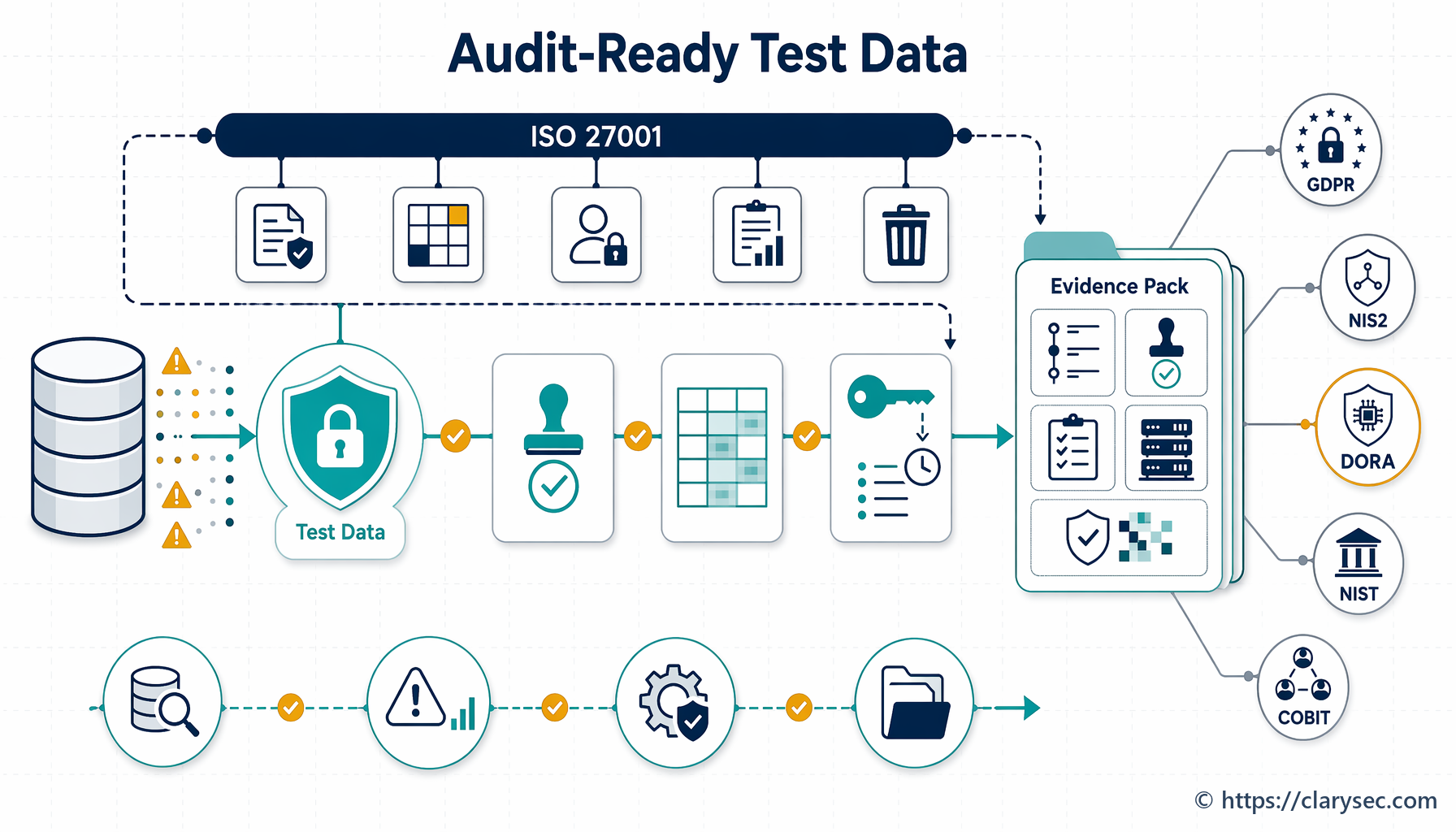
In 2026, test data protection is no longer a niche secure development issue. It is a board-level evidence problem across ISO/IEC 27001:2022, GDPR Article 32, NIS2 cyber hygiene, DORA ICT risk management, NIST Cybersecurity Framework 2.0 and COBIT 2019. Auditors, regulators and attackers have all recognized the same weakness: QA, UAT, staging, demo, training and vendor sandbox environments often contain sensitive data but operate with weaker controls than production.
If real customer data is copied into an environment with broad access, relaxed monitoring, shared credentials, outdated libraries, open debug interfaces and unclear retention, the organization has not reduced risk. It has moved regulated data into a softer target.
Why test data is now a regulated risk
A test dataset is not low risk simply because it is used for testing. Under GDPR, personal data includes information relating to an identified or identifiable natural person, and processing includes storage, use, disclosure, erasure and destruction. Restoring a customer database into staging is still processing. Exporting support tickets to a vendor sandbox is still processing. Keeping masked data with a reversible token map is still processing if re-identification remains possible.
GDPR Article 5 also brings principles that auditors apply before they even reach Article 32: purpose limitation, data minimization, storage limitation, integrity and confidentiality, and accountability. If personal data was collected to deliver a service, using it later in testing requires a clear purpose, documented safeguards and a defensible retention approach. GDPR Article 6 adds the lawful basis question, while Article 9 raises the bar where special categories of data are involved.
This can affect SaaS and fintech companies outside the EU. GDPR Article 3 may apply where organizations offer services to individuals in the EU or monitor their behaviour. A non-EU software company with EU users can still face GDPR test data questions if EU personal data is copied into QA.
NIS2 raises the issue from a cybersecurity governance angle. Article 21 requires essential and important entities to implement appropriate and proportionate technical, operational and organizational measures to manage risks to network and information systems. This includes risk analysis, incident handling, business continuity, supply chain security, secure acquisition, development and maintenance, cyber hygiene, training, cryptography, access control and asset management. Article 20 requires management bodies to approve and oversee cybersecurity risk-management measures and receive training. If staging systems or cloud test platforms support service delivery, incident response, release assurance or customer operations, they cannot be invisible.
DORA is even more direct for financial entities. Articles 5 and 6 require a documented ICT risk management framework. Articles 8 to 14 cover identification, protection, detection, response, recovery, backup, learning and communication. Articles 24 to 26 cover digital operational resilience testing, including risk-based testing and, for certain entities, advanced threat-led penetration testing. DORA applies from 17 January 2025, and for covered financial entities it acts as the sector-specific Union legal act for overlapping NIS2 obligations under NIS2 Article 4.
The practical message is simple: if test data can expose personal data, compromise ICT assets, affect service resilience or weaken secure development, it belongs inside the ISMS and the audit evidence set.
The ISO/IEC 27001:2022 control chain for test data protection
The strongest way to make non-production audit-ready is to treat test data protection as a control chain, not a single technical fix.
Three ISO/IEC 27002:2022 controls are central:
| ISO/IEC 27002:2022 control | What it means in practice | Typical failure in audits | Evidence Clarysec expects |
|---|---|---|---|
| 8.11 Data Masking | Replace or transform sensitive values so realistic testing can happen without unnecessary exposure | Masking exists as an ad hoc script with no approval, validation or retention rule | Masking policy, approved templates, sample masked dataset, tool logs, transformation rules |
| 8.31 Separation of Development, Test and Production Environments | Enforce logical, physical, procedural, credential and network boundaries | Developers have broad staging and production access, or staging connects to production services | Network diagrams, IAM review, CI/CD approvals, environment inventory, segmentation evidence |
| 8.33 Test Information | Protect information used in testing, especially production-derived or personal data | Production data is copied into QA without risk assessment or deletion record | Test data register, approval workflow, access logs, deletion evidence, supplier restrictions |
In Zenith Controls: The Cross-Compliance Guide, Clarysec summarizes ISO/IEC 27002:2022 control 8.33 as follows:
“Control 8.33 covers protection of test information, especially production-derived, personal, sensitive, or proprietary data used in testing. It is closely tied to environment separation, data masking, classification, privacy/PII protection, secure deletion, and secure SDLC practices.”
That is the audit thesis for 2026. Test information is not safe because it sits in a sandbox. It is safe only when the organization can prove that it is classified, minimized, masked, separated, access-controlled, logged, retained for a defined period and deleted.
The Zenith Blueprint: An Auditor’s 30-Step Roadmap treats data masking in the Controls in Action phase, Step 19: Technological Controls I. It explains why masking matters in development, testing, training and analytics:
“Data masking is not hiding information from attackers, it’s about preventing unnecessary exposure within your organization.”
The same step recommends defining use cases where masking or anonymization is mandatory, such as testing environments receiving live database copies, training datasets, data shared with vendors or offshore teams, and CI/CD testing pipelines. It also emphasizes that masked data should preserve format, length and logic so systems behave normally during testing.
In Step 21: Controls 8.27-8.34, Zenith Blueprint addresses separation directly:
“Modern software development moves fast, but security demands separation.”
It calls for logical, physical and procedural boundaries, credential separation, controlled deployments and data segregation. This is where many organizations fail. They can point to separate cloud accounts named dev, test and prod, but they cannot prove that credentials, network routes, logging coverage, secrets management and data flows are actually controlled differently.
Step 21 also warns:
“Information doesn’t lose its value just because it’s in a sandbox.”
Auditors now test whether that sentence is true in practice.
What ISO/IEC 27001:2022 adds beyond technical controls
ISO/IEC 27002:2022 gives the control language. ISO/IEC 27001:2022 gives the management system that makes the controls auditable.
Clauses 4.1 to 4.4 require the organization to define the ISMS context, interested parties, obligations, scope, interfaces and dependencies. For test data, this means non-production systems cannot be excluded by habit. If a cloud QA platform stores customer records, if an offshore testing vendor accesses masked extracts, or if UAT contains production-derived financial transactions, those interfaces belong in the scope analysis.
Clauses 5.1 to 5.3 make leadership responsible for policy, resources, integration into business processes and assigned responsibilities. This matters because test data failures often happen when business urgency overrides policy. The CISO should not be the only person saying no to a production database copy. Product, engineering, legal, privacy, procurement and operations need clear decision rights.
Clauses 6.1.1 to 6.1.3 require risk assessment, risk treatment, control selection, Statement of Applicability and risk owner approval. A mature organization identifies the confidentiality, integrity and availability risks of using production data in testing, selects treatment options, accepts residual risk where appropriate and documents why Annex A controls such as 8.11, 8.31 and 8.33 are included.
Clause 8.1 requires operational planning and control, including planned changes, unintended changes and externally provided processes, products or services relevant to the ISMS. Clauses 8.2 and 8.3 require risk assessments and treatment results at planned intervals or after significant changes. A new staging data pipeline, AI test platform, offshore QA supplier or UAT portal should trigger that machinery.
Related Annex A controls frequently appear in test data audits, including A.5.19 to A.5.22 for supplier and ICT supply chain risk, A.5.23 for cloud services, A.5.24 to A.5.28 for incident management, A.5.29 to A.5.30 for continuity and ICT readiness, A.5.31 for legal and contractual requirements, and A.5.34 for privacy and PII protection.
A mature answer is not, “We have a masking script.” A mature answer is, “Test data protection is in scope, risk assessed, policy controlled, mapped in the Statement of Applicability, embedded in change management, covered in supplier contracts, logged, reviewed and evidenced.”
Clarysec policy requirements that make the rule explicit
Policies convert intent into operating rules. Clarysec provides SME and enterprise versions so organizations can implement right-sized controls without losing audit strength.
The SME Test Data and Test Environment Policy starts with a clear purpose:
“It ensures that real customer data is never used inappropriately during software or system testing and that test environments are logically and technically segregated from production systems.”
From the same SME policy, clause 3.1 states:
“Prevent the use of real, identifiable customer data in testing unless it has been anonymized and explicitly approved.”
It also mandates environment segregation. Section 5.2.1 states:
“Test systems must be technically and logically segregated from production systems.”
The SME Data Masking and Pseudonymization Policy adds the masking obligation in clause 1.2:
“These techniques are mandatory where live data is not required, including in development, analytics, and third-party service scenarios, in order to reduce the risk of exposure, misuse, or breach.”
For enterprise environments, the Data Masking and Pseudonymization Policy is stricter. Clause 6.3 states:
“Real personal data must not be used in development, test, or staging environments. Masked or pseudonymized data must be used instead and must be generated from pre-approved transformation templates.”
The enterprise Test Data and Test Environment Policy extends the governance perimeter. Clause 5.2 requires segregation. Clause 5.3.3 requires access to be:
“Reviewed at least quarterly and revoked upon project completion or inactivity”
Clause 5.6 addresses external platforms:
“Any use of third-party test platforms must be subject to vendor risk assessment and approved by the CISO before deployment.”
And clause 6.6.1 closes a common evidence gap:
“All activity within test environments must be logged and retained in accordance with the Logging and Monitoring Policy (P22).”
These clauses solve Maria’s audit problem. When a team asks for production data in UAT, the answer is not improvised. The default is synthetic, anonymized or masked data. Exceptions require approval, risk assessment, environment segregation, access restriction, logging, retention limits, deletion evidence and supplier review.
The Clarysec test data approval workflow
A practical workflow lets engineering move quickly without turning staging into a compliance liability.
Imagine a fintech team needs to reproduce a reconciliation defect affecting a small number of EU customers. The issue appears only when accounts have multiple partial settlements, refunds and currency conversions. QA asks for a production subset.
Using the Clarysec approach, the security owner runs six steps.
Classify the request
Identify whether the dataset includes personal data, payment data, special category data, credentials, secrets, logs or proprietary business data. Customer names, account identifiers, transaction histories, IP addresses, emails, support notes and payment references may all be personal data.Challenge the need for real data
Ask whether the bug can be reproduced using synthetic data, anonymized data, generated transaction patterns or a masked subset. Zenith Blueprint, Step 19, expects masking to become default for testing, analytics, third-party integrations and CI/CD testing pipelines.Select a safe data method
Use synthetic data where no real customer record is used. Use anonymized data where re-identification is not reasonably possible. Use pseudonymized or masked data where format and referential logic must be preserved but identifiers should be replaced.Approve exceptions
If production data is technically necessary, document the business justification, technical necessity, risk assessment, compensating controls, access list, logging requirement, retention period and deletion date. The SME Test Data and Test Environment Policy requires anonymization and explicit approval where real identifiable customer data is involved.Secure the environment
Confirm that staging is technically and logically segregated from production, has no production credentials, has controlled network paths, uses MFA or strong authentication where appropriate, has audit logging and has no uncontrolled supplier access.Record and close
Create a test data record, attach masking evidence, approve access, retain logs, then verify deletion or refresh after testing. The SME Test Data and Test Environment Policy, clause 8.5.2, states:
“These records must be available for internal or external audits and retained in accordance with the organization’s retention schedule.”
A simple register can turn an informal request into audit-ready evidence.
| Field | Example entry |
|---|---|
| Request ID | TDATA-2026-014 |
| Business reason | Reproduce reconciliation defect before release |
| Dataset type | Production-derived transaction subset |
| Personal data present | Yes, customer IDs and transaction references |
| Method selected | Format-preserving masking for customer IDs, emails and account references |
| Approval | Product owner, DPO, CISO delegate |
| Environment | Segregated staging account, no production credentials |
| Access | QA lead and two developers, access expires in 10 days |
| Logging | Staging database audit logs and IAM logs retained |
| Supplier access | None |
| Deletion date | 2026-06-15 |
| Evidence | Masking job log, approval ticket, access review, deletion confirmation |
This is the kind of artifact auditors understand because it connects policy, risk, technical control and recordkeeping.
Cross-compliance mapping for GDPR, NIS2, DORA, NIST and COBIT
A strong test data protection program should not create separate evidence packs for every framework. It should create one control story that each framework recognizes.
| Requirement area | Test data implication | Evidence to keep |
|---|---|---|
| GDPR Article 5 and Article 32 | Personal data in testing must respect minimization, storage limitation, integrity, confidentiality and appropriate security of processing | Test data policy, masking evidence, approval records, deletion records, access logs |
| NIS2 Article 20 and Article 21 | Management oversight, secure development, access control, asset management, supplier security, encryption, training and effectiveness assessment apply to relevant systems | Environment inventory, risk assessment, access review, supplier assessment, control testing |
| DORA Articles 5, 6, 8-14 and 24-26 | ICT assets and dependencies must be identified, protected, monitored, tested and improved, including environments used for resilience and release testing | ICT asset classification, test environment controls, resilience test records, incident learning |
| NIST CSF 2.0 GOVERN, IDENTIFY, PROTECT, DETECT, RESPOND and RECOVER | Policy, roles, supply chain risk, asset inventories, identity management, data protection, monitoring and recovery outcomes apply to test data risks | Current Profile, Target Profile, POA&M, IAM evidence, monitoring logs, supplier records |
| COBIT 2019 BAI03, BAI07, DSS05 and DSS06 | Solution build, change acceptance, release transition, security services and business process controls require governed non-production environments | Change records, release approvals, segregation checks, test sign-offs, security monitoring |
NIST CSF 2.0 is especially useful when communicating with executives. Its Profiles help organizations define a Current Profile, Target Profile, gaps and a prioritized action plan. For test data, the Current Profile may show that staging is inventoried but not monitored, or that masking exists but is not mandatory. The Target Profile then defines outcomes for data protection, identity and access management, secure development, logging, supplier monitoring and incident response.
DORA adds stronger expectations for financial entities. Articles 28 to 30 require ICT third-party risk management, information registers, due diligence, concentration risk analysis, contract controls, audit rights, incident assistance, service levels, data location, data protection and exit rights. If a fintech uses a cloud-based test data platform or external QA provider for critical or important functions, the test environment is an ICT third-party risk dependency, not a procurement footnote.
NIS2 reinforces the same point through supply chain security and secure development. Article 21 includes security in acquisition, development and maintenance, cyber hygiene, policies on risk analysis, incident handling, business continuity, access control and asset management. A board should understand why copying production to staging is a risk decision, not a developer preference.
What auditors actually ask
Different auditors use different language, but they usually converge on the same evidence. Zenith Blueprint, Step 21, gives the direct question:
“Do you ever use production data in test environments? If so, how is it protected?”
It recommends showing a Test Data Policy or Development and QA Procedures stating that production data must be masked, anonymized or synthetically generated, real data in testing must be explicitly approved and tightly controlled, and sensitive test data must be encrypted, access-controlled and deleted after use.
| Auditor perspective | Likely question | Evidence that works |
|---|---|---|
| ISO/IEC 27001:2022 auditor | Is test data risk identified, treated and controlled through the ISMS? | ISMS scope, risk register, Statement of Applicability, policy, control evidence, internal audit results |
| GDPR privacy auditor | Why is personal data used in testing, and how is Article 32 security demonstrated? | RoPA linkage, DPIA where relevant, masking records, minimization rationale, retention and deletion evidence |
| NIS2 cybersecurity reviewer | Are non-production systems included in cyber hygiene, secure development, access control, supplier security and incident handling? | Asset inventory, access reviews, secure SDLC records, supplier due diligence, incident procedures |
| DORA ICT risk auditor | Are test environments, data flows and third-party QA tools part of ICT risk management and resilience testing evidence? | ICT asset register, testing programme, third-party register, contract clauses, continuity records |
| NIST CSF assessor | What is the Current Profile versus Target Profile for test data protection? | CSF profile, POA&M, risk register, identity controls, monitoring and response evidence |
| COBIT or ISACA auditor | Are development, testing, release and operations governed with segregation and change controls? | Change tickets, release approvals, environment segregation, test sign-offs, operational monitoring |
Zenith Controls links ISO/IEC 27002:2022 control 8.31 to logical, physical, procedural, credential and network separation between development, test, staging and production. It also ties the control to secure change management, secure coding, security testing, least privilege, credential segregation, monitoring, vulnerability management and network security.
That is why a cloud account name is not proof of separation. Auditors want diagrams, IAM exports, firewall or security group evidence, CI/CD approvals, secrets management rules and interviews that confirm how people actually work.
For control 8.11, Zenith Controls links data masking to classification, privacy and PII protection, field-level access restriction, data leakage prevention, cryptographic tokenization or format-preserving approaches, and safe testing under control 8.33. It highlights audit verification through policy review, sampling, configuration checks, role-based access testing, log review and third-party masking assurance.
Sampling is where weak programs fail. An auditor may ask for one recent test dataset, one masking job, one staging user list, one vendor access record and one deletion confirmation. If the organization cannot produce them quickly, the control may exist in theory but not in evidence.
Common findings in 2026 test data audits
Clarysec repeatedly sees the same non-production findings across SMEs and enterprises.
First, production data copies are treated as operational convenience. Teams create snapshots for debugging, performance testing or migrations, but nobody records what was copied, who approved it, who accessed it or when it was deleted.
Second, masking is partial. Names and emails may be replaced, but free-text notes, attachments, logs, payment references, IP addresses and account numbers remain identifiable. Masking must be based on data discovery and approved transformation templates, not guesswork.
Third, staging access is broader than production access. Developers, contractors, support engineers, product managers and vendors may all have standing access. Enterprise policy clause 5.3.3 directly addresses this by requiring quarterly review and revocation upon project completion or inactivity.
Fourth, test environments are excluded from logging. Production has SIEM coverage, but QA logs stay in local tools or disappear quickly. This conflicts with enterprise policy clause 6.6.1 and weakens incident investigation.
Fifth, suppliers are missed. A third-party testing platform, offshore QA contractor or cloud anonymization service may handle sensitive data, but procurement did not perform a vendor risk assessment. Enterprise policy clause 5.6 requires vendor risk assessment and CISO approval before third-party test platforms are deployed.
Sixth, retention is undefined. A dataset created for a two-week sprint remains in staging for 18 months. GDPR storage limitation, ISO/IEC 27001:2022 operational control and DORA ICT risk expectations all become harder to defend.
A practical 30-day remediation plan
If you suspect your test data controls are weak, do not wait for the audit. Start with a focused 30-day remediation sprint.
| Week | Objective | Actions | Outputs |
|---|---|---|---|
| Week 1 | Discover | Inventory development, QA, UAT, staging, performance, demo, training, analytics and vendor environments | Environment inventory, data flow list, production-derived dataset list |
| Week 2 | Decide | Approve a rule that real personal data is not used in development, test or staging unless masked, anonymized or explicitly approved | Adopted policy, exception criteria, decision owners |
| Week 3 | Control | Implement masking templates, segregation checks, access reviews, logging, deletion rules and supplier assessments | Masking evidence, IAM review, logging proof, vendor risk records |
| Week 4 | Evidence | Create the test data register, sample recent cases, update the risk register and Statement of Applicability | Audit pack, risk treatment updates, compliance mapping |
For financial entities, align the same sprint with DORA ICT risk documentation, testing programme records and ICT third-party registers. For NIS2 in-scope organizations, connect it to Article 21 cyber hygiene, secure development and supplier security. For GDPR, connect it to Article 5 accountability and Article 32 security of processing.
Build the evidence pack before the audit asks
Clarysec’s implementation approach is designed to make safe testing easier than unsafe testing.
Using Zenith Blueprint, test data protection usually appears in three implementation moments: Step 19 for data masking and anonymization, Step 21 for separation of development, test and production environments and test information, and audit preparation activities where policies, registers, access reviews, logs and deletion evidence are tested before external sampling.
A Clarysec evidence pack for test data typically includes:
- Test Data and Test Environment Policy, SME or enterprise version.
- Data Masking and Pseudonymization Policy, SME or enterprise version.
- Environment inventory covering development, QA, UAT, staging, performance, demo and training.
- Data classification for each non-production environment.
- Test data request and approval workflow.
- Masking transformation templates and validation records.
- Synthetic data generation procedure where applicable.
- Exception risk assessment for any real production data use.
- IAM review for test environments.
- Logging and monitoring evidence.
- Supplier risk assessment for test platforms or QA vendors.
- Retention and deletion records.
- Incident response linkage for test data exposure.
- Internal audit checklist mapped to ISO/IEC 27001:2022, GDPR, NIS2, DORA, NIST and COBIT.
The goal is not bureaucracy. The goal is to make the next audit question easy to answer.
When the auditor asks, “Do you ever use production data in test environments?”, the mature answer is:
“Only by exception. Our default is synthetic or masked data. Exceptions require approval, risk assessment, segregation, access restriction, logging and deletion. Here are three recent examples.”
That answer turns a common weakness into proof of governance.
Make non-production audit-ready with Clarysec
Test data protection is one of the highest-return compliance improvements available in 2026. It reduces privacy exposure, limits insider misuse, strengthens secure development, improves supplier governance and gives auditors evidence they can actually test.
Clarysec can help you implement it quickly with:
- Zenith Blueprint: An Auditor’s 30-Step Roadmap for phased ISO/IEC 27001:2022 implementation and audit preparation.
- Zenith Controls: The Cross-Compliance Guide for mapping ISO/IEC 27002:2022 controls 8.11, 8.31 and 8.33 to GDPR, NIS2, DORA, NIST and COBIT.
- Test Data and Test Environment Policy and Test Data and Test Environment Policy - SME for enforceable non-production rules.
- Data Masking and Pseudonymization Policy and Data Masking and Pseudonymization Policy - SME for masking, pseudonymization and safe dataset governance.
If your next audit could include the question, “What production data is sitting in QA right now?”, make sure your answer is evidence, not hope. Download the Clarysec policy set, map your controls with Zenith Controls, and use Zenith Blueprint to turn non-production from a hidden liability into an audit-ready part of your ISMS.
About the Author

Igor Petreski
Compliance Systems Architect, Clarysec LLC
Igor Petreski is a cybersecurity leader with over 30 years of experience in information technology and a dedicated decade specializing in global Governance, Risk, and Compliance (GRC).Core Credentials & Qualifications:• MSc in Cyber Security from Royal Holloway, University of London• PECB-Certified ISO/IEC 27001 Lead Auditor & Trainer• Certified Information Systems Auditor (CISA) from ISACA• Certified Information Security Manager (CISM) from ISACA • Certified Ethical Hacker from EC-Council